Sanchuniathon: Astarte, the deeds of Kronos and the symbols of Taautus (Eusebius, Praeparatio evangelica 1.10.31-41)
Introduction
Philo of Byblos, a Phoenician grammarian writing in Greek around 100 AD, claimed to have translated the Phoenician History of Sanchuniathon of Berytus, a priestly writer said to have lived before the Trojan War, who drew on the city records and the temple inscriptions of Phoenicia and on the writings of Taautus (Thoth). Philo's work survives only in the long quotations that Eusebius of Caesarea copied into book 1 of his Preparation for the Gospel (c. 313 AD), taken partly through the philosopher Porphyry. It is the fullest account of Phoenician myth in Greek, and since the discovery of the Ugaritic tablets (14th-13th c. BCE) several of its gods and stories, such as El, Dagon, the succession of divine kings and the castration of the sky god, are known to go back to Bronze Age Canaan.
The manuscript shown is Paris, Bibliothèque nationale de France, grec 451, written in 914 AD by the scribe Baanes for Arethas, archbishop of Caesarea in Cappadocia; it is the oldest manuscript of books 1-5 of the Preparation. The passage runs from fol. 204v to fol. 213v. Each section is one of Dindorf's numbered sections and points at the page(s) that carry it; the page breaks were read on the images and are recorded in each note.
This entry covers sections 1.10.31 to 1.10.41, on fols. 210r to 211v.
How was this verified? (Provenance)
Where on the image
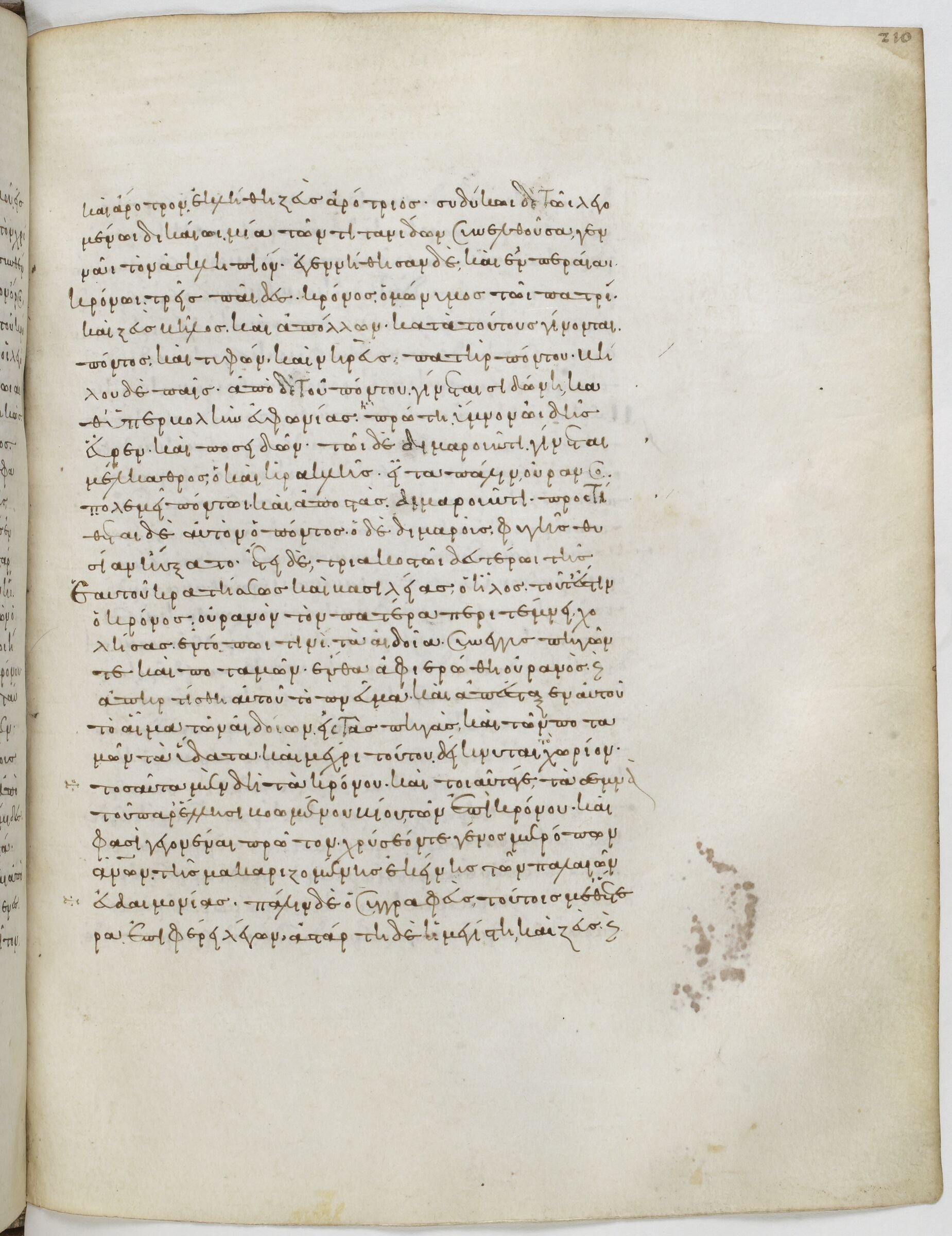
1.10.31 runs from fol. 210r to fol. 210v. Fol. 210r: begins 'καὶ ἄροτρον, ἐκλήθη Ζεὺς Ἀρότριος' (1.10.25) and ends at the start of 1.10.31 'Ἀστάρτη δὲ ἡ μεγίστη καὶ Ζεὺς'. Fol. 210v: begins 'Δημαροῦς καὶ Ἄδωδος βασιλεὺς θεῶν ἐβασίλευον τῆς χώρας' (1.10.31) and ends at the start of 1.10.37 'τὸ δὲ' after '...δύο δὲ ὡς ὑφειμένα'. Checked on the image. Viewer: https://gallica.bnf.fr/ark:/12148/btv1b84701396/f425.item
10.31“Ἀστάρτη δὲ ἡ μεγίστη καὶ Ζεὺς Δημαροῦς καὶ Ἄδωδος βασιλεὺς θεῶν ἐβασίλευον τῆς χώρας Κρόνου γνώμῃ. ἡ δὲ Ἀστάρτη ἐπέθηκε τῇ ἰδίᾳ κεφαλῇ βασιλείας παράσημον κεφαλὴν ταύρου· περινοστοῦσα δὲ τὴν οἰκουμένην εὗρεν ἀεροπετῆ ἀστέρα, ὃν καὶ ἀνελομένη ἐν Τύρῳ τῇ ἁγίᾳ νήσῳ ἀφιέρωσε.
10.31'But Astarte, the greatest goddess, and Zeus Demarus, and Adodus king of gods, reigned over the country with the consent of Kronos. And Astarte set the head of a bull upon her own head as a mark of royalty; and in travelling round the world she found a star that had fallen from the sky, which she took up and consecrated in the holy island Tyre.
Where on the image
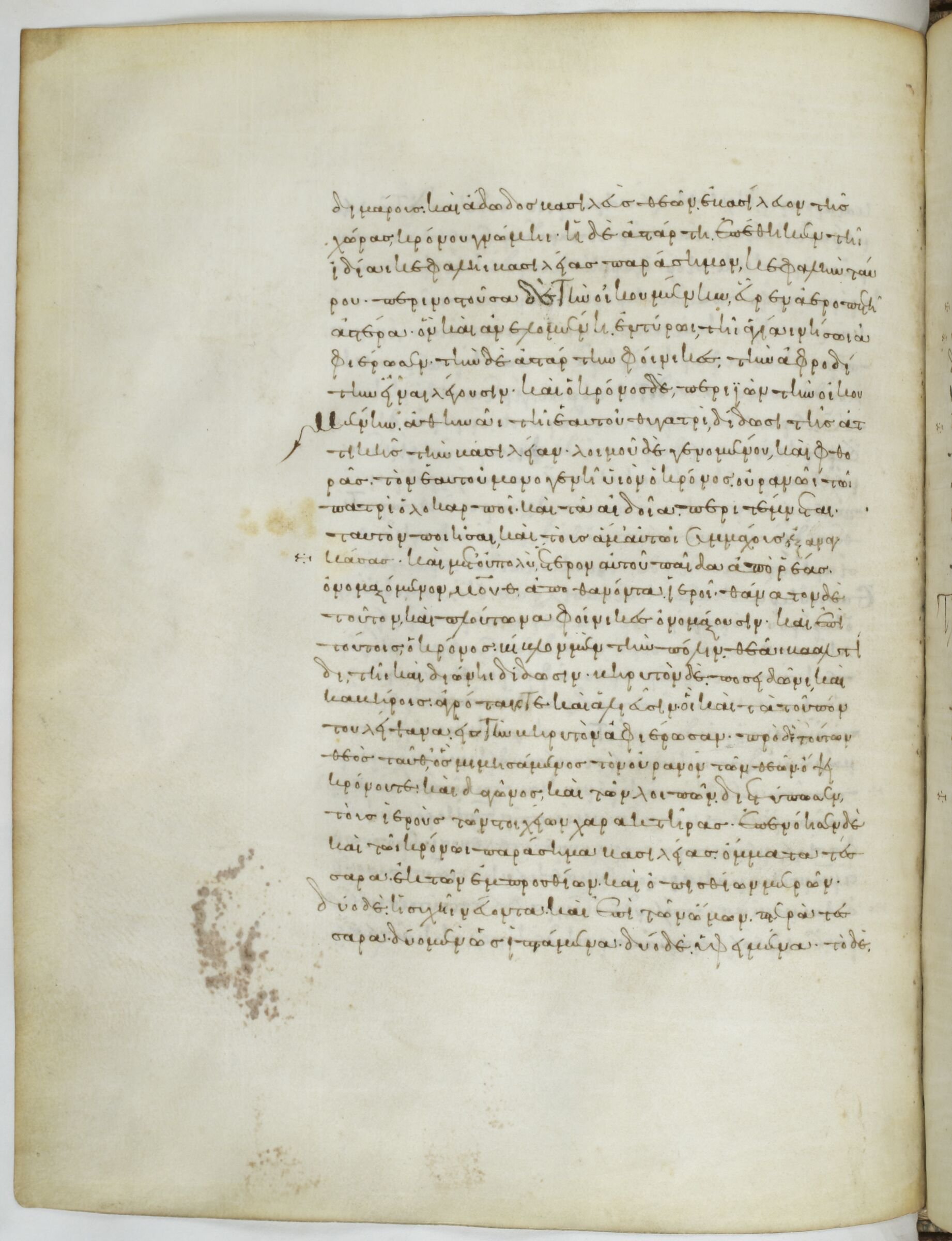
1.10.32 is on fol. 210v. Fol. 210v: begins 'Δημαροῦς καὶ Ἄδωδος βασιλεὺς θεῶν ἐβασίλευον τῆς χώρας' (1.10.31) and ends at the start of 1.10.37 'τὸ δὲ' after '...δύο δὲ ὡς ὑφειμένα'. Checked on the image. Viewer: https://gallica.bnf.fr/ark:/12148/btv1b84701396/f426.item
10.32τὴν δὲ Ἀστάρτην Φοίνικες τὴν Ἀφροδίτην εἶναι λέγουσι. καὶ ὁ Κρόνος δὲ περιιὼν τὴν οἰκουμένην Ἀθηνᾷ τῇ ἑαυτοῦ θυγατρὶ δίδωσι τῆς Ἀττικῆς τὴν βασιλείαν.
10.32And the Phoenicians say that Astarte is Aphrodite. 'Kronos also, in going round the world, gives the kingdom of Attica to his own daughter Athena.
Where on the image
1.10.33 is on fol. 210v. Fol. 210v: begins 'Δημαροῦς καὶ Ἄδωδος βασιλεὺς θεῶν ἐβασίλευον τῆς χώρας' (1.10.31) and ends at the start of 1.10.37 'τὸ δὲ' after '...δύο δὲ ὡς ὑφειμένα'. Checked on the image. Viewer: https://gallica.bnf.fr/ark:/12148/btv1b84701396/f426.item
10.33λοιμοῦ δὲ γενομένου καὶ φθορᾶς τὸν ἑαυτοῦ μονογενῆ υἱὸν Κρόνος Οὐρανῷ τῷ πατρὶ ὁλοκαρποῖ, καὶ τὰ αἰδοῖα περιτέμνεται, ταυτὸν ποιῆσαι καὶ τοὺς ἅμ’ αὐτῷ συμμάχους καταναγκάσας,
10.33But on the occurrence of a pestilence and mortality Kronos offers his only begotten son as a whole burnt-offering to his father Uranus, and circumcises himself, compelling his allies also to do the same.
Where on the image
1.10.34 is on fol. 210v. Fol. 210v: begins 'Δημαροῦς καὶ Ἄδωδος βασιλεὺς θεῶν ἐβασίλευον τῆς χώρας' (1.10.31) and ends at the start of 1.10.37 'τὸ δὲ' after '...δύο δὲ ὡς ὑφειμένα'. Checked on the image. Viewer: https://gallica.bnf.fr/ark:/12148/btv1b84701396/f426.item
10.34καὶ μετ’ οὐ πολὺ ἕτερον αὐτοῦ παῖδα ἀπὸ Ῥέας ὀνομαζόμενον Μοὺθ ἀποθανόντα ἀφιεροῖ. Θάνατον δὲ τοῦτον καὶ Πλούτωνα Φοίνικες ὀνομάζουσι.
10.34And not long after another of his sons by Rhea, named Muth, having died, he deifies him, and the Phoenicians call him Thanatos and Pluto.
Where on the image
1.10.35 is on fol. 210v. Fol. 210v: begins 'Δημαροῦς καὶ Ἄδωδος βασιλεὺς θεῶν ἐβασίλευον τῆς χώρας' (1.10.31) and ends at the start of 1.10.37 'τὸ δὲ' after '...δύο δὲ ὡς ὑφειμένα'. Checked on the image. Viewer: https://gallica.bnf.fr/ark:/12148/btv1b84701396/f426.item
10.35καὶ ἐπὶ τούτοις ὁ Κρόνος Βύβλον μὲν τὴν πόλιν θεᾷ Βααλτίδι, τῇ καὶ Διώνῃ, δίδωσι, Βηρυτὸν δὲ Ποσειδῶνι καὶ Καβείροις Ἀγρόταις τε καὶ Ἁλιεῦσιν, οἱ καὶ τὰ τοῦ Πόντου λείψανα εἰς τὴν Βηρυτὸν ἀφιέρωσαν.
10.35And after this Kronos gives the city Byblos to the goddess Baaltis, who is also called Dione, and Berytus to Poseidon and to the Cabeiri and Agrotae and Halieis, who also consecrated the remains of Pontus at Berytus.
Where on the image
1.10.36 is on fol. 210v. Fol. 210v: begins 'Δημαροῦς καὶ Ἄδωδος βασιλεὺς θεῶν ἐβασίλευον τῆς χώρας' (1.10.31) and ends at the start of 1.10.37 'τὸ δὲ' after '...δύο δὲ ὡς ὑφειμένα'. Checked on the image. Viewer: https://gallica.bnf.fr/ark:/12148/btv1b84701396/f426.item
10.36πρὸ δὲ τούτων θεὸς Ταυθὸς μιμησάμενος τῶν συνόντων θεῶν ὄψεις, Κρόνου τε καὶ Δαγῶνος καὶ τῶν λοιπῶν, διετύπωσεν τοὺς ἱεροὺς τῶν στοιχείων χαρακτῆρας. ἐπενόησε δὲ καὶ τῷ Κρόνῳ παράσημα βασιλείας ὄμματα τέσσαρα ἐκ τῶν ἐμπροσθίων καὶ ὀπισθίων μερῶν, * * * δύο δὲ ἡσυχῆ μύοντα, καὶ ἐπὶ τῶν ὤμων πτερὰ τέσσαρα, δύο μὲν ὡς ἱπτάμενα, δύο δὲ ὡς ὑφειμένα.
10.36'But before this the god Tauthus imitated the features of the gods who were his companions, Kronos, and Dagon, and the rest, and gave form to the sacred characters of the letters. He also devised for Kronos as insignia of royalty four eyes in front and behind . . . but two of them quietly closed, and upon his shoulders four wings, two as spread for flying, and two as folded.
Where on the image
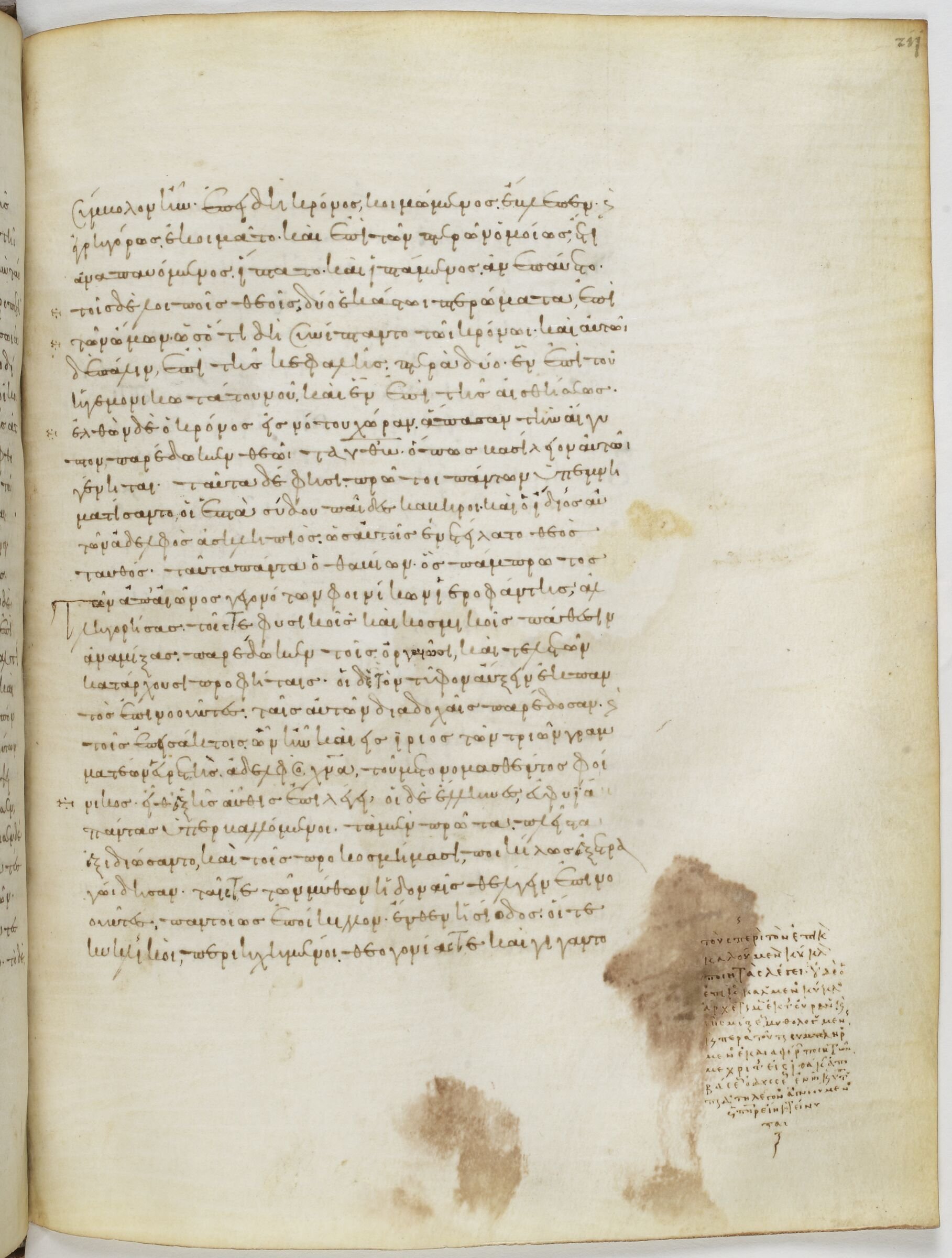
1.10.37 runs from fol. 210v to fol. 211r. Fol. 210v: begins 'Δημαροῦς καὶ Ἄδωδος βασιλεὺς θεῶν ἐβασίλευον τῆς χώρας' (1.10.31) and ends at the start of 1.10.37 'τὸ δὲ' after '...δύο δὲ ὡς ὑφειμένα'. Fol. 211r: begins 'σύμβολον ἦν, ἐπειδὴ Κρόνος κοιμώμενος ἔβλεπε' (1.10.37); the main text ends in 1.10.40 '...ἔνθεν Ἡσίοδος οἵ τε κυκλικοὶ περιηχημένοι θεογονίας καὶ γιγαντο-'. A marginal scholion stands in the lower right corner. Checked on the image. Viewer: https://gallica.bnf.fr/ark:/12148/btv1b84701396/f426.item
10.37τὸ δὲ σύμβολον ἦν, ἐπειδὴ Κρόνος κοιμώμενος ἔβλεπε, καὶ ἐγρηγορὼς ἐκοιμᾶτο· καὶ ἐπὶ τῶν πτερῶν ὁμοίως, ὅτι ἀναπαυόμενος ἵπτατο καὶ ἱπτάμενος ἀνεπαύετο. τοῖς δὲ λοιποῖς θεοῖς δύο ἑκάστῳ πτερώματα ἐπὶ τῶν ὤμων, ὡς ὅτι δὴ συνίπταντο τῷ Κρόνῳ. καὶ αὐτῷ δὲ πάλιν ἐπὶ τῆς κεφαλῆς πτερὰ δύο, ἓν ἐπὶ τοῦ ἡγεμονικωτάτου νοῦ καὶ ἓν ἐπὶ τῆς αἰσθήσεως.
10.37'And the symbol meant that Kronos could see when asleep, and sleep while waking: and similarly in the case of the wings, that he flew while at rest, and was at rest when flying. But to each of the other gods he gave two wings upon the shoulders, as meaning that they accompanied Kronos in his flight. And to Kronos himself again he gave two wings upon his head, one representing the all-ruling mind, and one sensation.
Where on the image
1.10.38 is on fol. 211r. Fol. 211r: begins 'σύμβολον ἦν, ἐπειδὴ Κρόνος κοιμώμενος ἔβλεπε' (1.10.37); the main text ends in 1.10.40 '...ἔνθεν Ἡσίοδος οἵ τε κυκλικοὶ περιηχημένοι θεογονίας καὶ γιγαντο-'. A marginal scholion stands in the lower right corner. Checked on the image. Viewer: https://gallica.bnf.fr/ark:/12148/btv1b84701396/f427.item
10.38ἐλθὼν δὲ ὁ Κρόνος εἰς νότου χώραν ἅπασαν τὴν Αἴγυπτον ἔδωκε θεῷ Ταυθῷ, ὅπως βασίλειον αὐτῷ γένηται. ταῦτα δὲ (φησὶ) πρῶτοι πάντων ὑπεμνηματίσαντο οἱ ἑπτὰ Συδὲκ παῖδες Κάβειροι, καὶ ὁ ἴδιος αὐτῶν ἀδελφὸς Ἀσκληπιὸς, ὡς αὐτοῖς ἐνετείλατο θεὸς Ταυθός.
10.38'And when Kronos came into the South country he gave all Egypt to the god Tauthus, that it might be his royal dwelling-place. And these things, he says, were recorded first by Suduc's seven sons the Cabeiri, and their eighth brother Asclepius, as the god Tauthus commanded them.
Where on the image
1.10.39 is on fol. 211r. Fol. 211r: begins 'σύμβολον ἦν, ἐπειδὴ Κρόνος κοιμώμενος ἔβλεπε' (1.10.37); the main text ends in 1.10.40 '...ἔνθεν Ἡσίοδος οἵ τε κυκλικοὶ περιηχημένοι θεογονίας καὶ γιγαντο-'. A marginal scholion stands in the lower right corner. Checked on the image. Viewer: https://gallica.bnf.fr/ark:/12148/btv1b84701396/f427.item
10.39ταῦτα πάντα ὁ Θαβίων, ὃς πάμπρωτος τῶν ἀπ’ αἰῶνος γεγονότων Φοινίκων ἱεροφάντης ἀλληγορήσας, τοῖς τε φυσικοῖς καὶ κοσμικοῖς πάθεσιν ἀναμίξας, παρέδωκε τοῖς ὀργεῶσι καὶ τελετῶν κατάρχουσι προφήταις· οἱ δὲ τὸν τῦφον αὔξειν ἐκ παντὸς ἐπινοοῦντες τοῖς αὐτῶν διαδόχοις παρέδοσαν καὶ τοῖς ἐπεισάκτοις· ὧν εἷς ἦν καὶ Εἰσίριος τῶν τριῶν γραμμάτων εὑρετὴς, ἀδελφὸς Χνᾶ τοῦ [πρώτου] μετονομασθέντος Φοίνικος.”
10.39'All these stories Thabion, who was the very first hierophant of all the Phoenicians from the beginning, allegorized and mixed up with the physical and cosmical phenomena, and delivered to the prophets who celebrated the orgies and inaugurated the mysteries: and they, purposing to increase their vain pretensions from every source, handed them on to their successors and to their foreign visitors: one of these was Eisirius the inventor of the three letters, brother of Chna the first who had his name changed to Phoenix.'
Where on the image
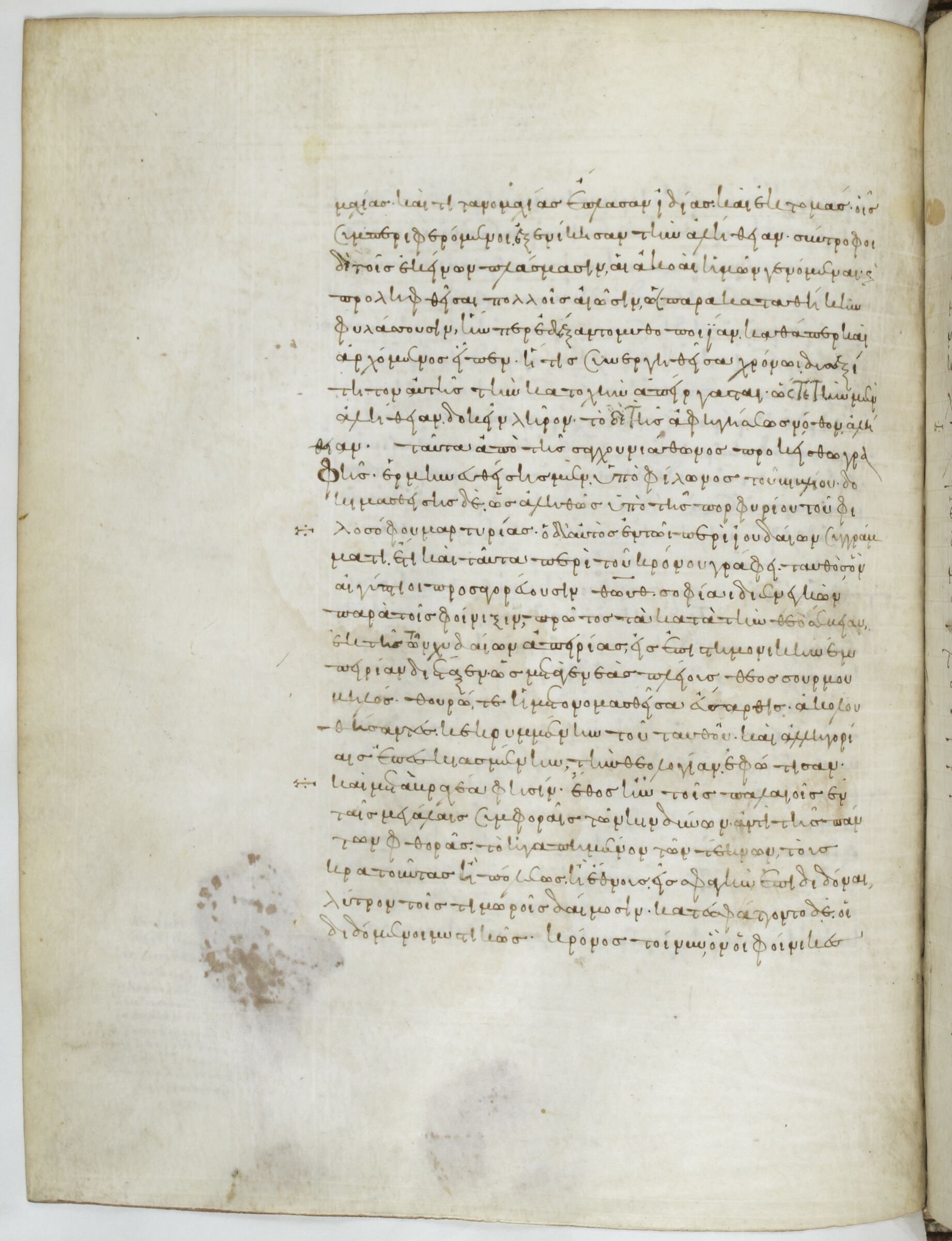
1.10.40 runs from fol. 211r to fol. 211v. Fol. 211r: begins 'σύμβολον ἦν, ἐπειδὴ Κρόνος κοιμώμενος ἔβλεπε' (1.10.37); the main text ends in 1.10.40 '...ἔνθεν Ἡσίοδος οἵ τε κυκλικοὶ περιηχημένοι θεογονίας καὶ γιγαντο-'. A marginal scholion stands in the lower right corner. Fol. 211v: begins '-μαχίας καὶ Τιτανομαχίας ἔπλασαν ἰδίας καὶ ἐκτομάς' (1.10.40) and ends in 1.10.44 '...κατεσφάττοντο δὲ οἱ διδόμενοι μυστικῶς. Κρόνος τοίνυν, ὃν οἱ Φοίνικες'. Checked on the image. Viewer: https://gallica.bnf.fr/ark:/12148/btv1b84701396/f427.item
10.40Εἶθ’ ἑξῆς αὖθις ἐπιλέγει “Οἱ δὲ Ἕλληνες εὐφυΐᾳ πάντας ὑπερβαλλόμενοι τὰ μὲν πρῶτα πλεῖστα ἐξιδιώσαντο, εἶτα καὶ τοῖς προκοσμήμασι ποικίλως ἐξετραγῴδησαν, ταῖς τε τῶν μύθων ἡδοναῖς θέλγειν ἐπινοοῦντες παντοίως ἐποίκιλλον. ἔνθεν Ἡσίοδος οἵ τε κυκλικοὶ περιηχημένοι θεογονίας καὶ γιγαντομαχίας καὶ Τιτανομαχίας ἔπλασαν ἰδίας καὶ ἐκτομὰς, οἷς συμπεριφερόμενοι ἐξενίκησαν τὴν ἀλήθειαν.
10.40Then again afterwards he adds: 'But the Greeks, surpassing all in genius, appropriated most of the earliest stories, and then variously decked them out with ornaments of tragic phrase, and adorned them in every way, with the purpose of charming by the pleasant fables. Hence Hesiod and the celebrated Cyclic poets framed theogonies of their own, and battles of the giants, and battles of Titans, and castrations; and with these fables, as they travelled about, they conquered and drove out the truth.
Where on the image
1.10.41 is on fol. 211v. Fol. 211v: begins '-μαχίας καὶ Τιτανομαχίας ἔπλασαν ἰδίας καὶ ἐκτομάς' (1.10.40) and ends in 1.10.44 '...κατεσφάττοντο δὲ οἱ διδόμενοι μυστικῶς. Κρόνος τοίνυν, ὃν οἱ Φοίνικες'. Checked on the image. Viewer: https://gallica.bnf.fr/ark:/12148/btv1b84701396/f428.item
10.41σύντροφοι δὲ τοῖς ἐκείνων πλάσμασιν αἱ ἀκοαὶ ἡμῶν γενόμεναι, καὶ προληφθεῖσαι πολλοῖς αἰῶσιν, ὡς παρακαταθήκην φυλάσσουσιν ἣν παρεδέξαντο μυθοποιίαν, καθάπερ καὶ ἀρχόμενος εἶπον, ἥτις συνεργηθεῖσα χρόνῳ δυσεξίτητον αὐτῆς τὴν κατοχὴν εἴργασται, ὥστε τὴν μὲν ἀλήθειαν δοκεῖν λῆρον, τὸ δὲ τῆς ἀφηγήσεως νόθον ἀλήθειαν.”
10.41'But our ears having grown up in familiarity with their fictions, and being for long ages pre-occupied, guard as a trust the mythology which they received, just as I said at the beginning; and this mythology, being aided by time, has made its hold difficult for us to escape from, so that the truth is thought to be nonsense, and the spurious narrative truth.'
Notes
- Greek: W. Dindorf's Teubner edition (1867), from the First1KGreek digital text, proofread against the printed pages. The manuscript's wording differs from the edition in small details; the Greek shown is the edition, not a transcription of the page.
- English: E. H. Gifford's translation (Oxford, 1903). Where a Greek section begins in the middle of an English sentence, the English is divided at the corresponding clause.
- Asterisks mark a gap that Dindorf indicates in the Greek of 1.10.36; Gifford marks it with dots.
Cite
Sources
- Source: Paris gr. 451 (Arethas codex, 914 AD) via Gallica + Dindorf Greek (First1KGreek, proofread) + Gifford English (1903) (holding institution)
- Critical edition: W. Dindorf, Eusebii Caesariensis opera I (Teubner 1867), First1KGreek, proofread
← previous · → next · v cycle view · l back to library