Book of Odes, Mao 105: Zai qu 載驅 (Keicho-era print)
Introduction
載驅 (Zai qu, Mao 105) is ode X of 齊風 Qi feng ("the Airs of Qi"), the eighth book of the Airs of the States (國風 Guofeng), the 160 songs of the regional states that open the Book of Odes (詩經 Shijing). The Airs are generally dated to the Western and early Eastern Zhou (about the 10th to 7th century BCE). It has 4 stanzas.
The photographs are of a copy of the Book of Odes in the National Diet Library, Tokyo (call no. WA7-183), printed with movable type in Japan in the Keicho era (1596-1615): main text only, seven columns of seventeen characters to the page, with Japanese reading marks added by hand. Each stanza begins a new column, and a line giving the count of stanzas and lines follows each ode. In this copy the ode runs from canvas 61, right-hand page to canvas 61, left-hand page of the first volume. Each section gathers the stanzas that begin on one page and links to that page and to any page the last stanza runs onto; the page boundaries were found by reading the first characters of every column on the photographs.
The Chinese is the Mao text from Wikisource. The English is James Legge's prose translation in The Chinese Classics, volume IV, part I (1871), Part I, Book 8, ode X (Tsae k'eu), page 160-161; his notes are not reproduced. Words in square brackets are Legge's own additions.
How was this verified? (Provenance)
Where on the image
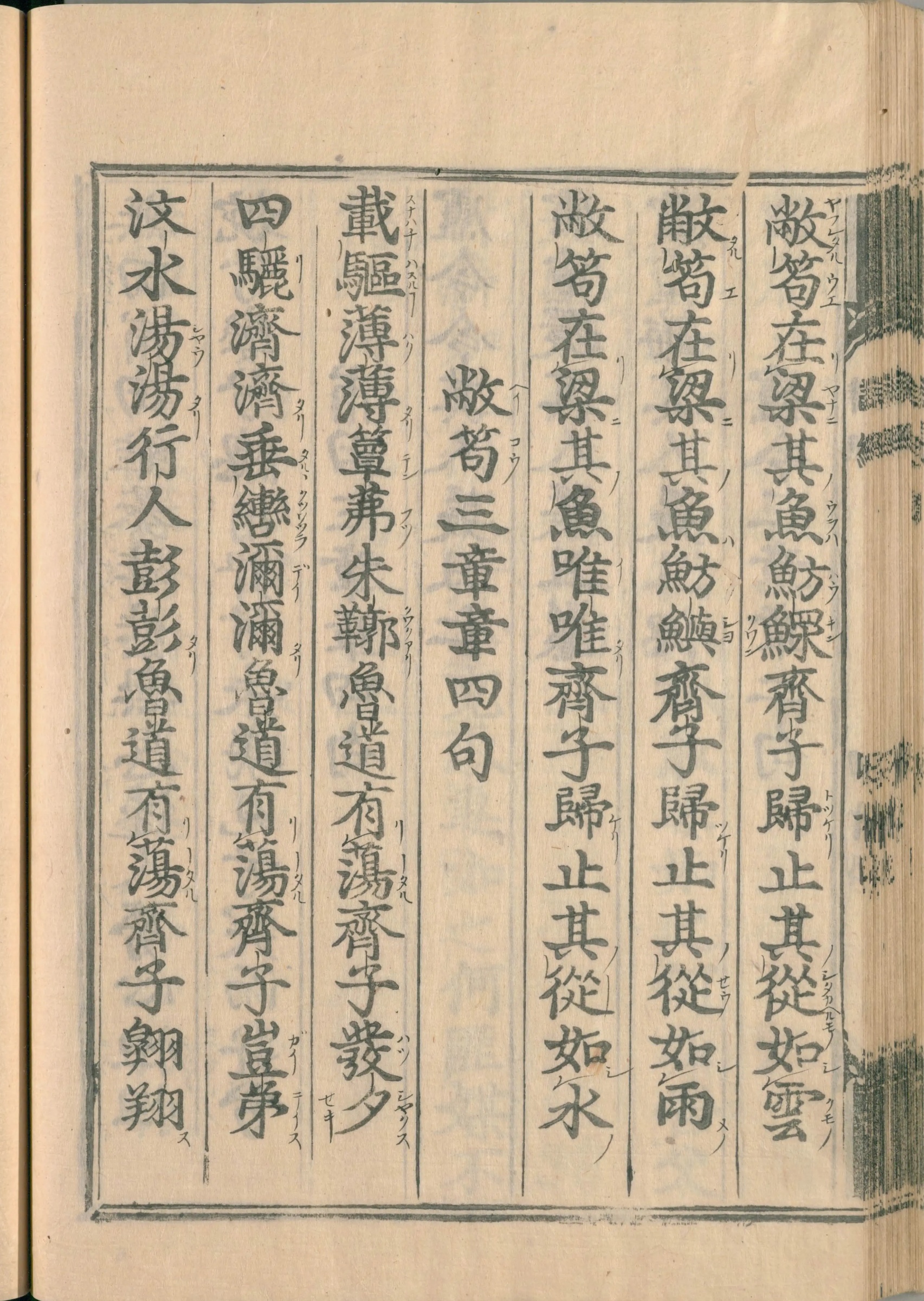
National Diet Library WA7-183, vol. [1], IIIF canvas 61, right-hand page: 7 columns of up to 17 characters, main text only, with Japanese reading marks. Checked on the image: stanza 1 opens column 5 ‹載驅薄薄›; stanza 2 opens column 6 ‹四驪濟濟›; stanza 3 opens column 7 ‹汶水湯湯›. Other columns on this page: column 4 is the count line of 敝笱 (stanzas and lines). The Chinese shown is the Wikisource Mao text, not a transcription of this print; Legge's English translates the same text.
1載驅薄薄,簟茀朱鞹。魯道有蕩,齊子發夕。
2四驪濟濟,垂轡濔濔。魯道有蕩,齊子豈弟。
3汶水湯湯,行人彭彭。魯道有蕩,齊子翱翔。
1She urges on her chariot rapidly,
With its screen of bamboos woven in squares, and its vermilion- coloured leather.
The way from Loo is easy and plain,
And the daughter of Ts'e started on it in the evening.
2Her four black horses are beautiful,
And soft look the reins as they hang.
The way from Loo is easy and plain,
And the daughter of Ts'e is delighted and complacent.
3The waters of the Wan flow broadly on;
The travellers are numerous.
The way from Loo is easy and plain,
And the daughter of Ts'e moves on with unconcern.
Where on the image
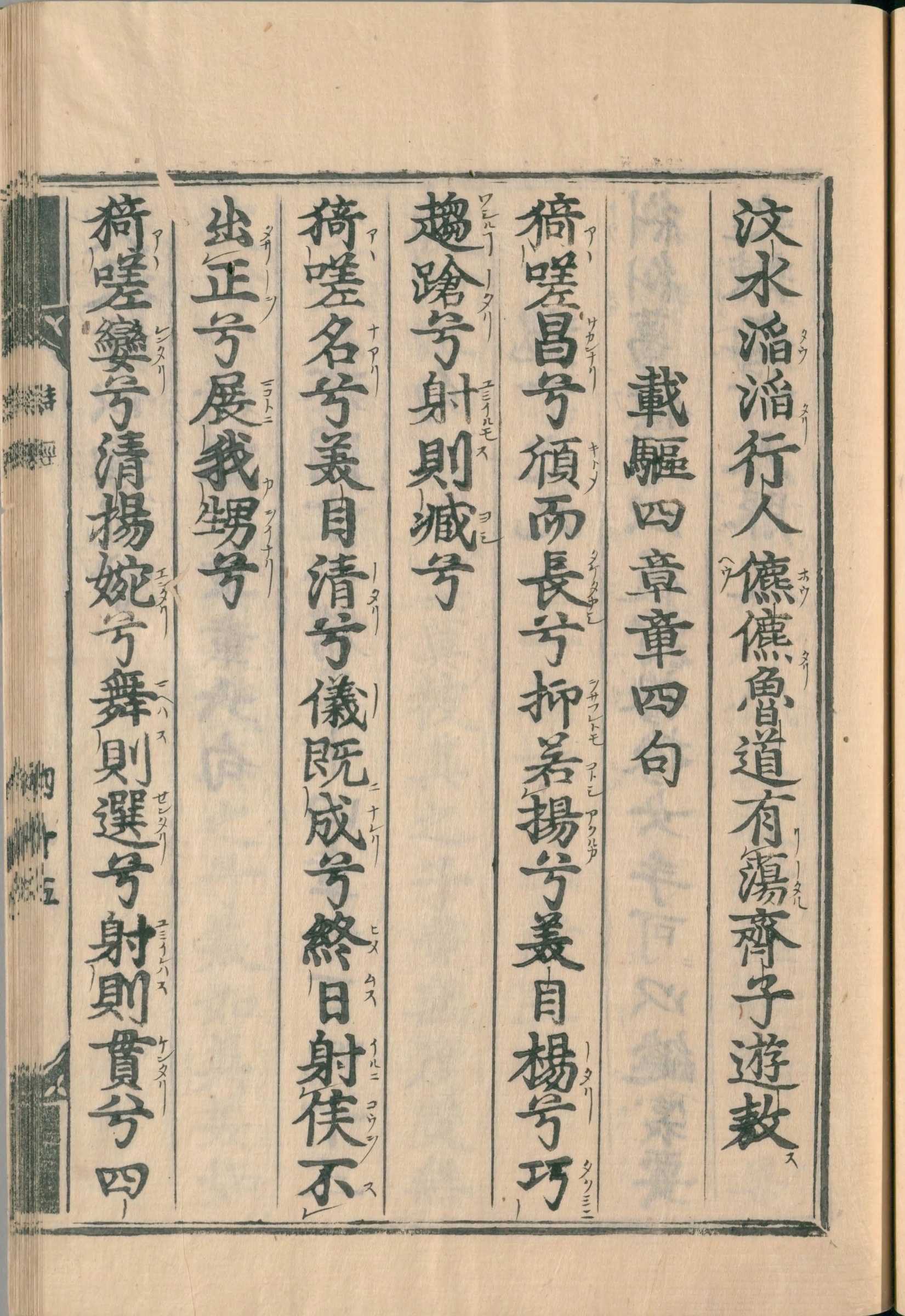
National Diet Library WA7-183, vol. [1], IIIF canvas 61, left-hand page: 7 columns of up to 17 characters, main text only, with Japanese reading marks. Checked on the image: stanza 4 opens column 1 ‹汶水滔滔›. Other columns on this page: column 2 is the count line of 載驅 (stanzas and lines). The Chinese shown is the Wikisource Mao text, not a transcription of this print; Legge's English translates the same text.
4汶水滔滔,行人儦儦。魯道有蕩,齊子遊敖。
4The waters of the Wan sweep on;
The travellers are in crowds.
The way from Loo is easy and plain,
And the daughter of Ts'e proceeds at her ease.
Notes
- English: James Legge, The She King, The Chinese Classics vol. IV part I (1871), Part I, Lessons from the States, Book 8, ode X (Tsae k'eu). Stanzas are numbered as in Legge and the Mao text.
- Transcribed for this library from the page images: lines read alike by two OCR programs were kept, and every other line was read on the image (data/sources/shijing/legge1871/). Legge's notes are left out.
Cite
Sources
- Source: National Diet Library WA7-183 (Keicho-era movable-type print of the Shijing, vol. 1) + Wikisource Mao text + James Legge, The She King (Chinese Classics IV, 1871) (holding institution)
- Critical edition: Mao text (Wikisource)
← previous · → next · v cycle view · l back to library