Book of Odes, Mao 106: Yi jie 猗嗟 (Keicho-era print)
Introduction
猗嗟 (Yi jie, Mao 106) is ode XI of 齊風 Qi feng ("the Airs of Qi"), the eighth book of the Airs of the States (國風 Guofeng), the 160 songs of the regional states that open the Book of Odes (詩經 Shijing). The Airs are generally dated to the Western and early Eastern Zhou (about the 10th to 7th century BCE). It has 3 stanzas.
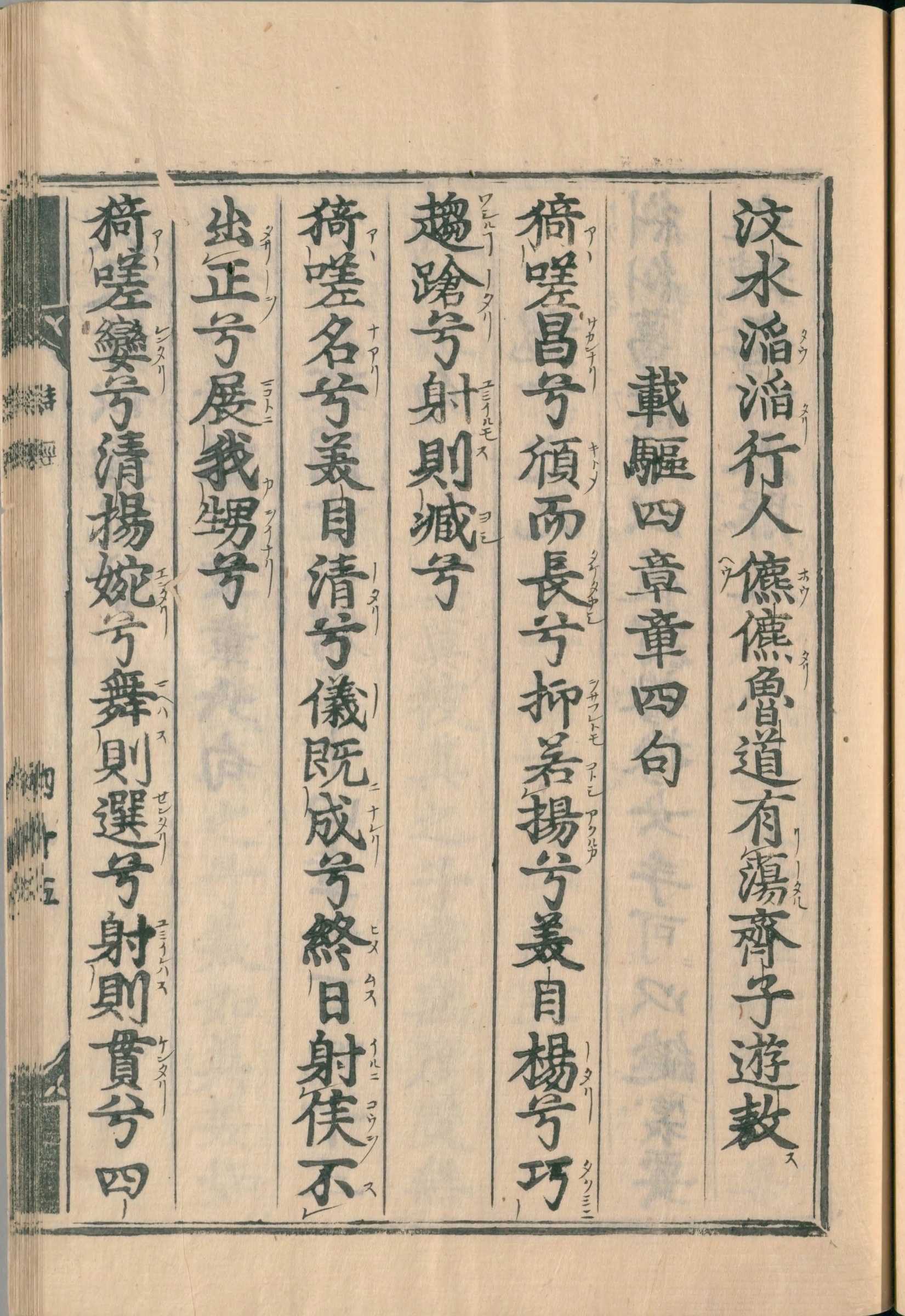
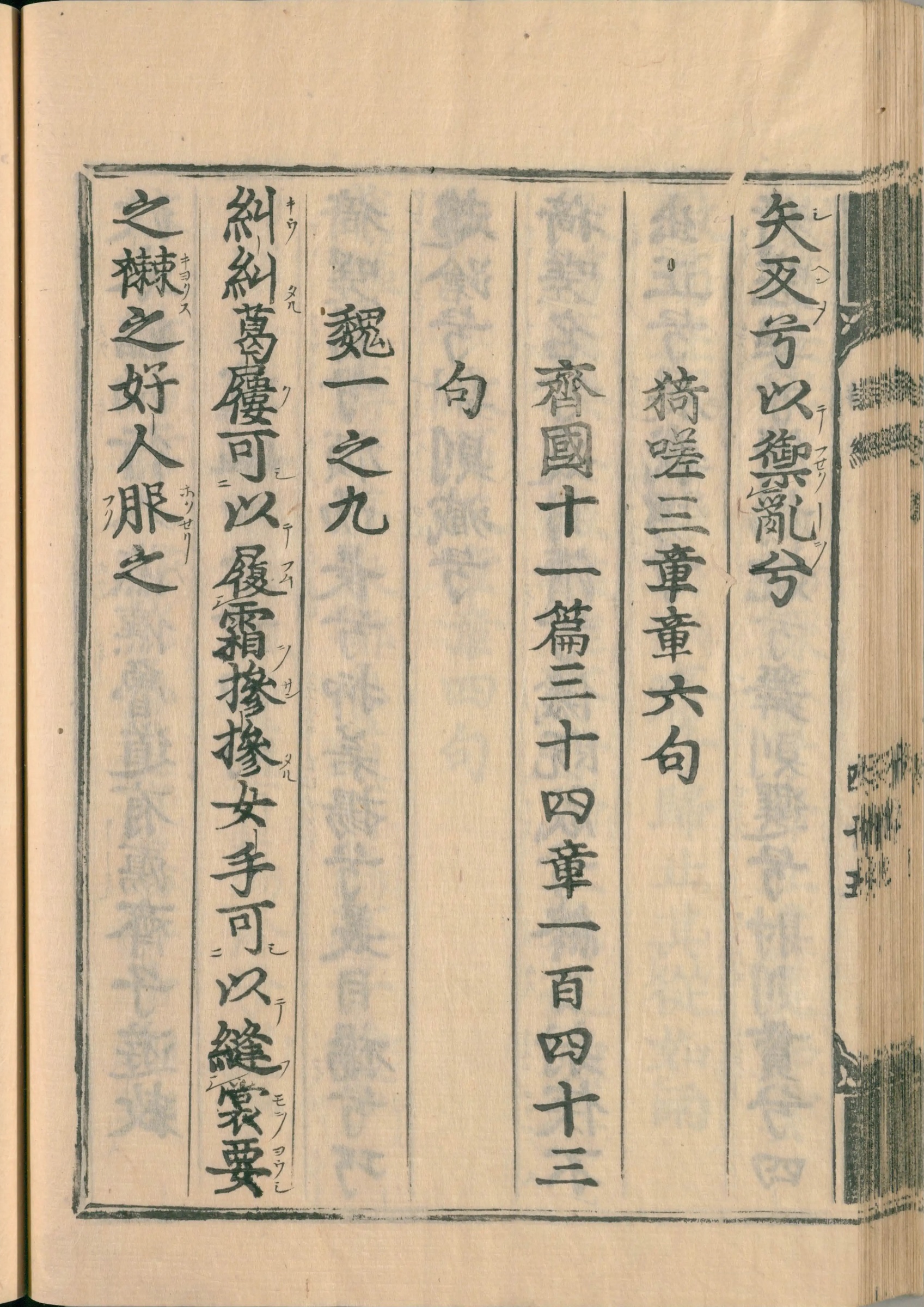
The photographs are of a copy of the Book of Odes in the National Diet Library, Tokyo (call no. WA7-183), printed with movable type in Japan in the Keicho era (1596-1615): main text only, seven columns of seventeen characters to the page, with Japanese reading marks added by hand. Each stanza begins a new column, and a line giving the count of stanzas and lines follows each ode. In this copy the ode runs from canvas 61, left-hand page to canvas 62, right-hand page of the first volume. Each section gathers the stanzas that begin on one page and links to that page and to any page the last stanza runs onto; the page boundaries were found by reading the first characters of every column on the photographs.
The Chinese is the Mao text from Wikisource. The English is James Legge's prose translation in The Chinese Classics, volume IV, part I (1871), Part I, Book 8, ode XI (E tseay), page 161-162; his notes are not reproduced. Words in square brackets are Legge's own additions.
How was this verified? (Provenance)
Where on the image
National Diet Library WA7-183, vol. [1], IIIF canvas 61, left-hand page: 7 columns of up to 17 characters, main text only, with Japanese reading marks. Checked on the image: stanza 1 opens column 3 ‹猗嗟昌兮›; stanza 2 opens column 5 ‹猗嗟名兮›; stanza 3 opens column 7 ‹猗嗟孌兮›. Other columns on this page: column 2 is the count line of 載驅 (stanzas and lines). Stanza 3 runs on to canvas 62, right-hand page (first column ‹矢反兮以›). The Chinese shown is the Wikisource Mao text, not a transcription of this print; Legge's English translates the same text.
1猗嗟昌兮!頎而長兮。抑若揚兮,美目揚兮。巧趨蹌兮。射則臧兮。
2猗嗟名兮!美目清兮。儀既成兮,終日射侯,不出正兮,展我甥兮。
3猗嗟孌兮!清揚婉兮。舞則選兮,射則貫兮,四矢反兮,以禦亂兮。
1Alas for him, so handsome and accomplished!
How grandly tall!
With what elegance in his high forehead!
With what motion of his beautiful eyes!
With what skill in the swift movements of his feet!
With what mastery of archery!
2Alas for him, so famous!
His beautiful eyes how clear!
His manners how complete!
Shooting all day at the target,
And never lodging outside the bird-square!
Indeed our [ruler's] nephew!
3Alas for him, so beautiful!
His bright eyes and high forehead how lovely!
His dancing so choice!
Sure to send his arrows right through!
The four all going to the same place!
One able to withstand rebellion!
Notes
- English: James Legge, The She King, The Chinese Classics vol. IV part I (1871), Part I, Lessons from the States, Book 8, ode XI (E tseay). Stanzas are numbered as in Legge and the Mao text.
- Transcribed for this library from the page images: lines read alike by two OCR programs were kept, and every other line was read on the image (data/sources/shijing/legge1871/). Legge's notes are left out.
Cite
Sources
- Source: National Diet Library WA7-183 (Keicho-era movable-type print of the Shijing, vol. 1) + Wikisource Mao text + James Legge, The She King (Chinese Classics IV, 1871) (holding institution)
- Critical edition: Mao text (Wikisource)
← previous · → next · v cycle view · l back to library