Book of Odes, Mao 107: Ge ju 葛屨 (Keicho-era print)
Introduction
葛屨 (Ge ju, Mao 107) is ode I of 魏風 Wei feng ("the Airs of Wei (the northern state)"), the ninth book of the Airs of the States (國風 Guofeng), the 160 songs of the regional states that open the Book of Odes (詩經 Shijing). The Airs are generally dated to the Western and early Eastern Zhou (about the 10th to 7th century BCE). It has 2 stanzas.
The photographs are of a copy of the Book of Odes in the National Diet Library, Tokyo (call no. WA7-183), printed with movable type in Japan in the Keicho era (1596-1615): main text only, seven columns of seventeen characters to the page, with Japanese reading marks added by hand. Each stanza begins a new column, and a line giving the count of stanzas and lines follows each ode. In this copy the ode runs from canvas 62, right-hand page to canvas 62, left-hand page of the first volume. Each section gathers the stanzas that begin on one page and links to that page and to any page the last stanza runs onto; the page boundaries were found by reading the first characters of every column on the photographs.
The Chinese is the Mao text from Wikisource. The English is James Legge's prose translation in The Chinese Classics, volume IV, part I (1871), Part I, Book 9, ode I (Koh keu), page 163-164; his notes are not reproduced. Words in square brackets are Legge's own additions.
How was this verified? (Provenance)
Where on the image
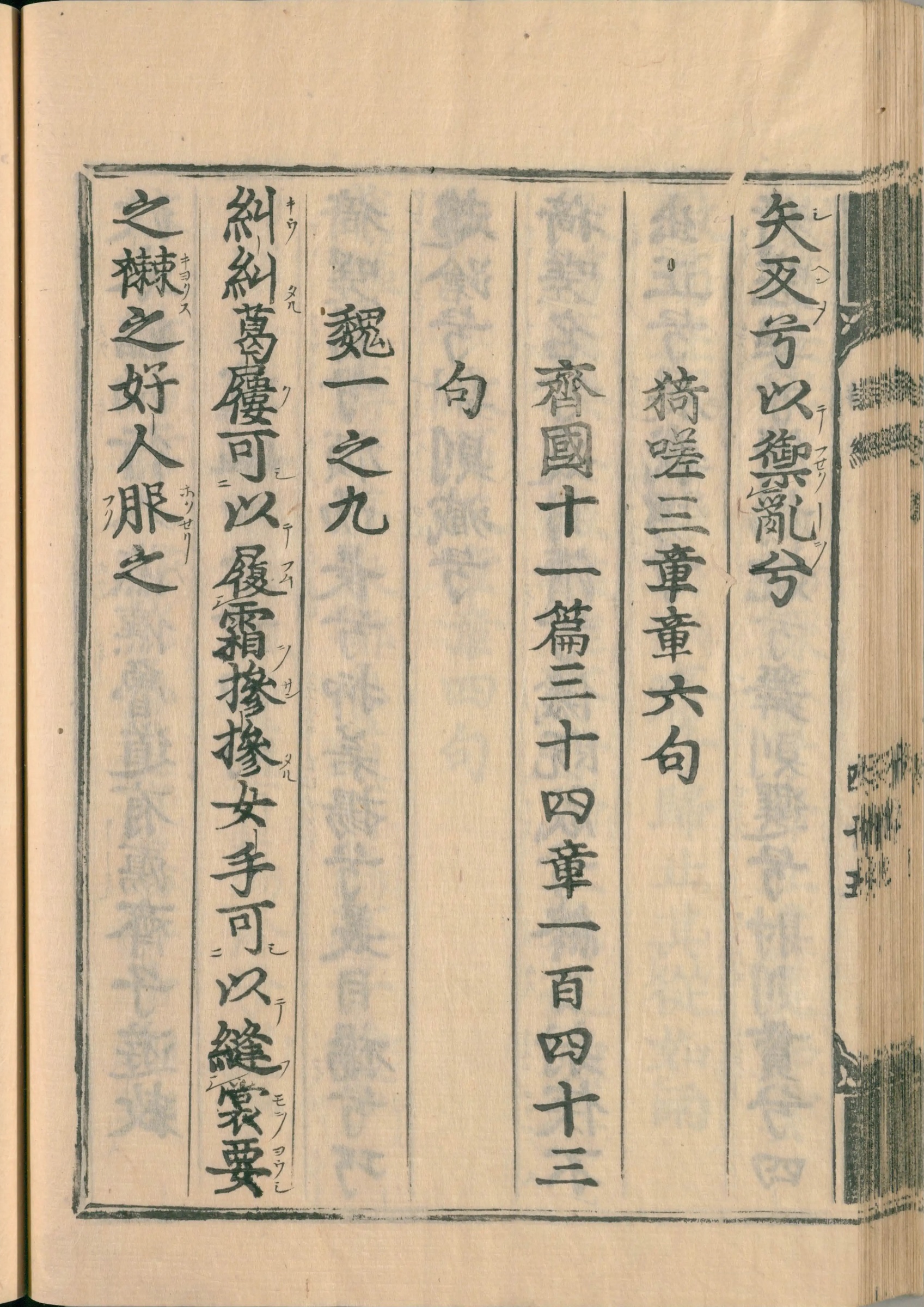
National Diet Library WA7-183, vol. [1], IIIF canvas 62, right-hand page: 7 columns of up to 17 characters, main text only, with Japanese reading marks. Checked on the image: stanza 1 opens column 6 ‹糾糾葛屨›. Other columns on this page: column 2 is the count line of 猗嗟 (stanzas and lines); column 3 is the count line of 齊國 (stanzas and lines); column 4 ‹句› ends the preceding count line; column 5 is the heading 魏一之九. The Chinese shown is the Wikisource Mao text, not a transcription of this print; Legge's English translates the same text.
1糾糾葛屨,可以履霜。摻摻女手,可以縫裳。要之襋之,好人服之。
1Shoes thinly woven of the dolichos fibre
May be used to walk on the hoarfrost.
The delicate fingers of a bride
May be used in making clothes.
[His bride] puts the waistband to his lower garment and the collar to his upper,
And he, a wealthy man, wears them.
Where on the image
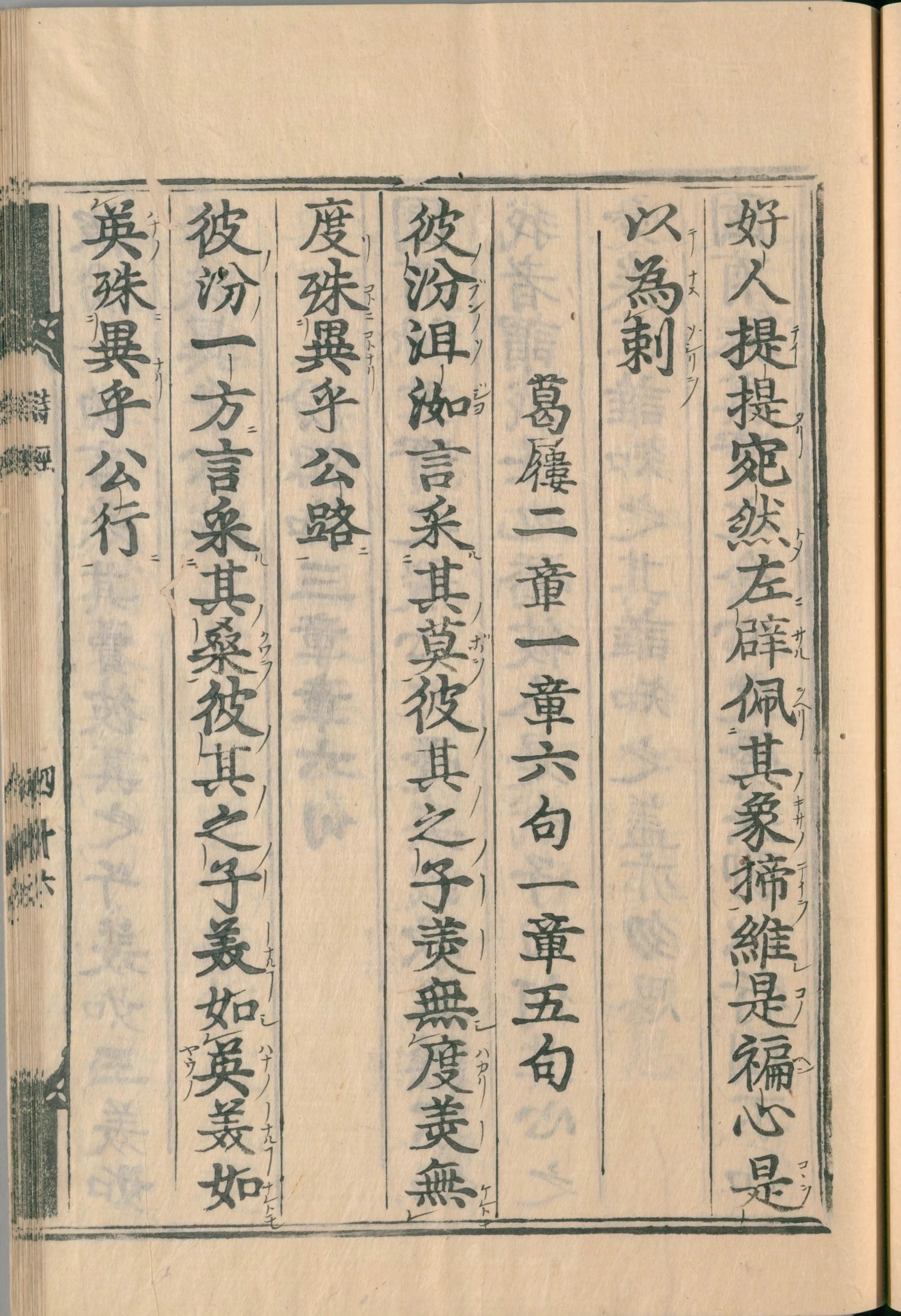
National Diet Library WA7-183, vol. [1], IIIF canvas 62, left-hand page: 7 columns of up to 17 characters, main text only, with Japanese reading marks. Checked on the image: stanza 2 opens column 1 ‹好人提提›. Other columns on this page: column 3 is the count line of 葛屨 (stanzas and lines). The Chinese shown is the Wikisource Mao text, not a transcription of this print; Legge's English translates the same text.
2好人提提,宛然左辟。佩其象揥。維是褊心,是以為刺。
2Wealthy, he moves about quite at ease,
And politely he stands aside to the left.
From his girdle hangs his ivory comb-pin.
It is the narrowness of his disposition,
Which makes him a subject for satire.
Notes
- English: James Legge, The She King, The Chinese Classics vol. IV part I (1871), Part I, Lessons from the States, Book 9, ode I (Koh keu). Stanzas are numbered as in Legge and the Mao text.
- Transcribed for this library from the page images: lines read alike by two OCR programs were kept, and every other line was read on the image (data/sources/shijing/legge1871/). Legge's notes are left out.
Cite
Sources
- Source: National Diet Library WA7-183 (Keicho-era movable-type print of the Shijing, vol. 1) + Wikisource Mao text + James Legge, The She King (Chinese Classics IV, 1871) (holding institution)
- Critical edition: Mao text (Wikisource)
← previous · → next · v cycle view · l back to library