Book of Odes, Mao 131: Huang niao 黃鳥 (Keicho-era print)
Introduction
黃鳥 (Huang niao, Mao 131) is ode VI of 秦風 Qin feng ("the Airs of Qin"), the eleventh book of the Airs of the States (國風 Guofeng), the 160 songs of the regional states that open the Book of Odes (詩經 Shijing). The Airs are generally dated to the Western and early Eastern Zhou (about the 10th to 7th century BCE). It has 3 stanzas.
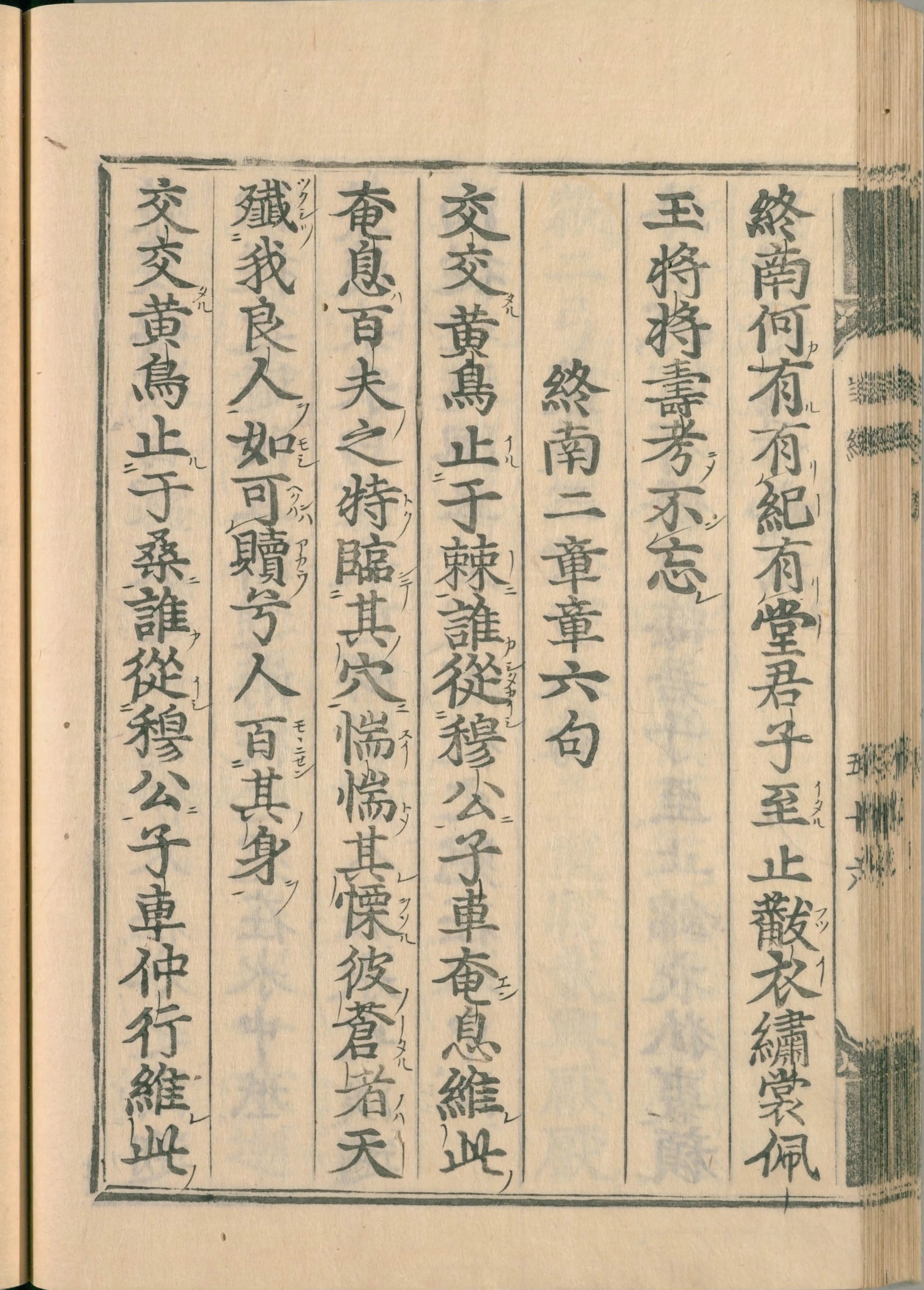
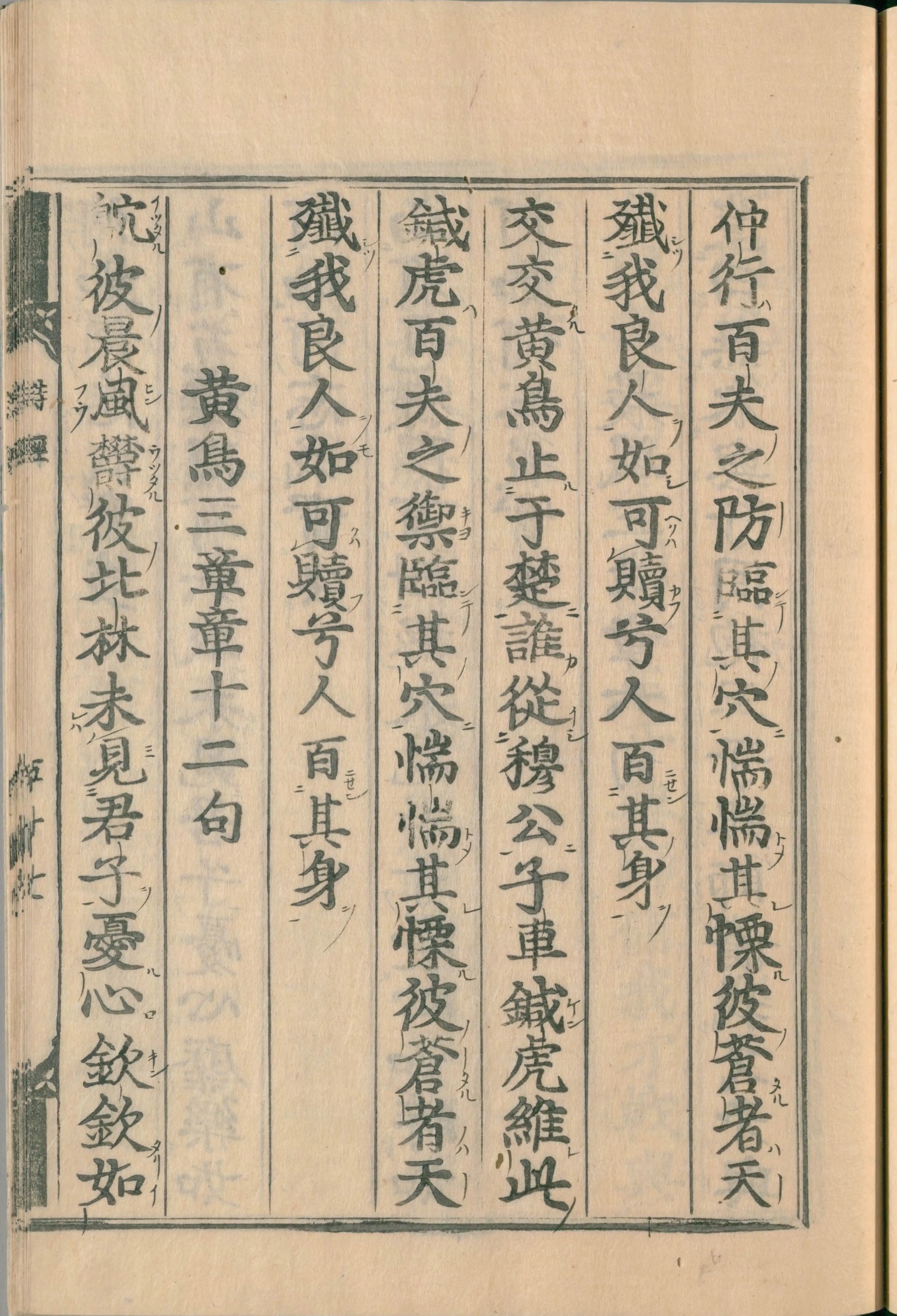
The photographs are of a copy of the Book of Odes in the National Diet Library, Tokyo (call no. WA7-183), printed with movable type in Japan in the Keicho era (1596-1615): main text only, seven columns of seventeen characters to the page, with Japanese reading marks added by hand. Each stanza begins a new column, and a line giving the count of stanzas and lines follows each ode. In this copy the ode runs from canvas 73, right-hand page to canvas 73, left-hand page of the first volume. Each section gathers the stanzas that begin on one page and links to that page and to any page the last stanza runs onto; the page boundaries were found by reading the first characters of every column on the photographs.
The Chinese is the Mao text from Wikisource. The English is James Legge's prose translation in The Chinese Classics, volume IV, part I (1871), Part I, Book 11, ode VI (Hwang nëaou), page 198-200; his notes are not reproduced. Words in square brackets are Legge's own additions.
How was this verified? (Provenance)
Where on the image
National Diet Library WA7-183, vol. [1], IIIF canvas 73, right-hand page: 7 columns of up to 17 characters, main text only, with Japanese reading marks. Checked on the image: stanza 1 opens column 4 ‹交交黃鳥›; stanza 2 opens column 7 ‹交交黃鳥›. Other columns on this page: column 3 is the count line of 終南 (stanzas and lines). Stanza 2 runs on to canvas 73, left-hand page (first column ‹仲行百夫›). The Chinese shown is the Wikisource Mao text, not a transcription of this print; Legge's English translates the same text.
1交交黃鳥,止于棘。
誰從穆公?子車奄息。維此奄息,百夫之特。
臨其穴,惴惴其慄。
彼蒼者天,殲我良人!如可贖兮,人百其身。
2交交黃鳥,止于桑。
誰從穆公?子車仲行。維此仲行,百夫之防。
臨其穴,惴惴其慄。
彼蒼者天,殲我良人!如可贖兮,人百其身。
1They flit about, the yellow birds,
And rest upon the jujube trees.
Who followed duke Muh [to the grave]?
Tsze-keu Yen-seih.
And this Yen-seih
Was a man above a hundred.
When he came to the grave,
He looked terrified and trembled.
Thou azure Heaven there!
Thou art destroying our good men.
Could he have been redeemed,
We should have given a hundred lives for him.
2They flit about, the yellow birds,
And rest upon the mulberry trees.
Who followed duke Muh [to the grave]?
Tsze-keu Chung-hang.
And this Chung-hang
Was a match for a hundred.
When he came to the grave,
He looked terrified and trembled,
Thou azure Heaven there!
Thou art destroying our good men.
Could he have been redeemed,
We should have given a hundred lives for him.
Where on the image
National Diet Library WA7-183, vol. [1], IIIF canvas 73, left-hand page: 7 columns of up to 17 characters, main text only, with Japanese reading marks. Checked on the image: stanza 3 opens column 3 ‹交交黃鳥›. Other columns on this page: column 6 is the count line of 黃鳥 (stanzas and lines). The Chinese shown is the Wikisource Mao text, not a transcription of this print; Legge's English translates the same text.
3交交黃鳥,止于楚。
誰從穆公?子車鍼虎。維此鍼虎,百夫之禦。
臨其穴,惴惴其慄。
彼蒼者天,殲我良人!如可贖兮,人百其身。
3They flit about, the yellow birds,
And rest upon the thorn trees.
Who followed duke Muh [to the grave]?
Tsze-keu K'ëen-hoo.
And this Tsze-keu K'ëen-hoo
Could withstand a hundred men.
When he came to the grave,
He looked terrified and trembled.
Thou azure Heaven there!
Thou art destroying our good men.
Could he have been redeemed,
We should have given a hundred lives for him.
Notes
- English: James Legge, The She King, The Chinese Classics vol. IV part I (1871), Part I, Lessons from the States, Book 11, ode VI (Hwang nëaou). Stanzas are numbered as in Legge and the Mao text.
- Transcribed for this library from the page images: lines read alike by two OCR programs were kept, and every other line was read on the image (data/sources/shijing/legge1871/). Legge's notes are left out.
Cite
Sources
- Source: National Diet Library WA7-183 (Keicho-era movable-type print of the Shijing, vol. 1) + Wikisource Mao text + James Legge, The She King (Chinese Classics IV, 1871) (holding institution)
- Critical edition: Mao text (Wikisource)
← previous · → next · v cycle view · l back to library