Book of Odes, Mao 132: Chen feng 晨風 (Keicho-era print)
Introduction
晨風 (Chen feng, Mao 132) is ode VII of 秦風 Qin feng ("the Airs of Qin"), the eleventh book of the Airs of the States (國風 Guofeng), the 160 songs of the regional states that open the Book of Odes (詩經 Shijing). The Airs are generally dated to the Western and early Eastern Zhou (about the 10th to 7th century BCE). It has 3 stanzas.
The photographs are of a copy of the Book of Odes in the National Diet Library, Tokyo (call no. WA7-183), printed with movable type in Japan in the Keicho era (1596-1615): main text only, seven columns of seventeen characters to the page, with Japanese reading marks added by hand. Each stanza begins a new column, and a line giving the count of stanzas and lines follows each ode. In this copy the ode runs from canvas 73, left-hand page to canvas 74, right-hand page of the first volume. Each section gathers the stanzas that begin on one page and links to that page and to any page the last stanza runs onto; the page boundaries were found by reading the first characters of every column on the photographs.
The Chinese is the Mao text from Wikisource. The English is James Legge's prose translation in The Chinese Classics, volume IV, part I (1871), Part I, Book 11, ode VII (Shin fung), page 200-201; his notes are not reproduced. Words in square brackets are Legge's own additions.
How was this verified? (Provenance)
Where on the image
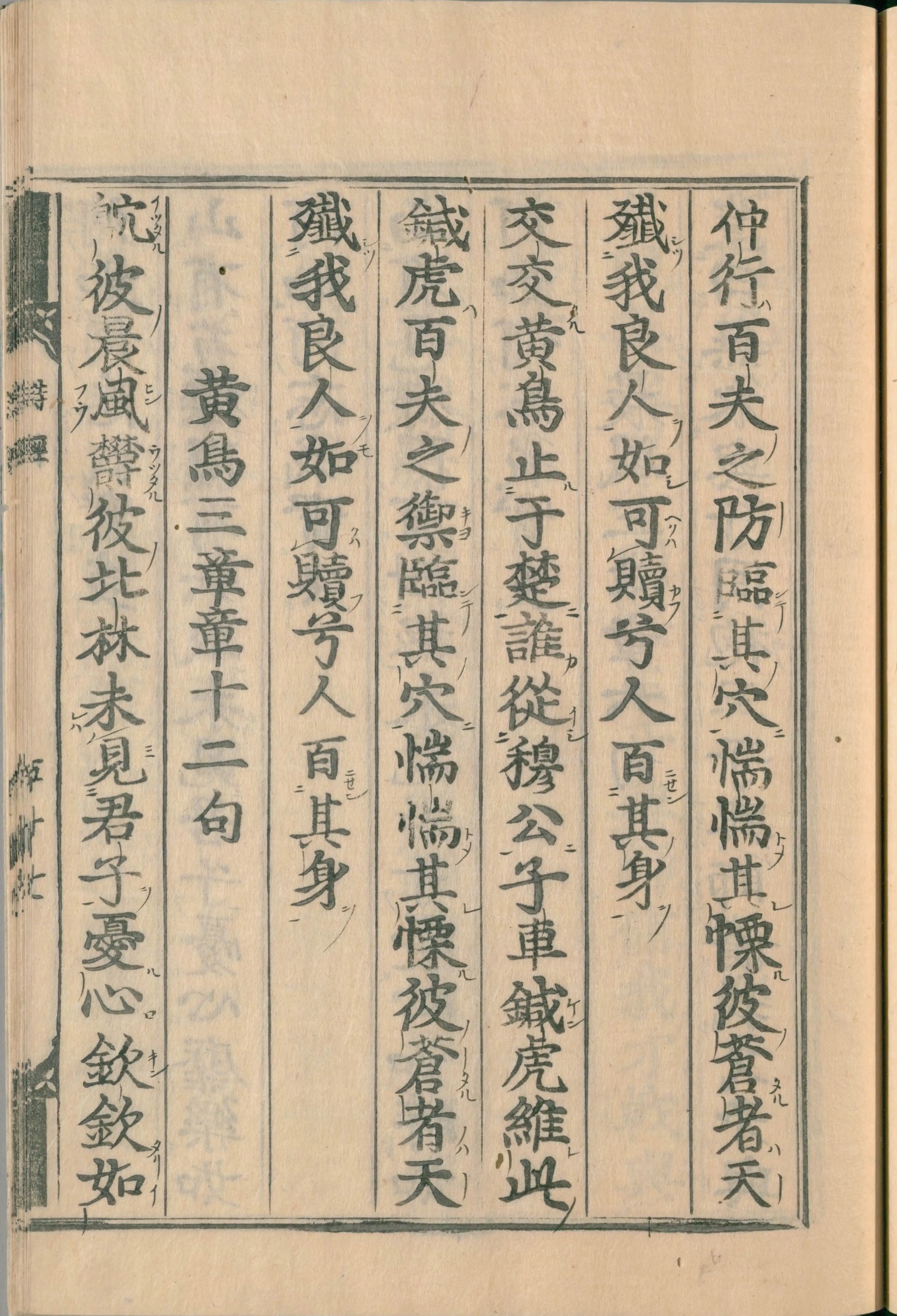
National Diet Library WA7-183, vol. [1], IIIF canvas 73, left-hand page: 7 columns of up to 17 characters, main text only, with Japanese reading marks. Checked on the image: stanza 1 opens column 7 ‹鴥彼晨風›. Other columns on this page: column 6 is the count line of 黃鳥 (stanzas and lines). Stanza 1 runs on to canvas 74, right-hand page (first column ‹何如何忘›). The Chinese shown is the Wikisource Mao text, not a transcription of this print; Legge's English translates the same text.
1鴥彼晨風,鬱彼北林,未見君子,憂心欽欽,如何如何,忘我實多。
1Swift flies the falcon
To the thick-wooded forest in the north.
While I do not see my husband,
My heart cannot forget its grief.
How is it, how is it,
That he forgets me so very much?
Where on the image
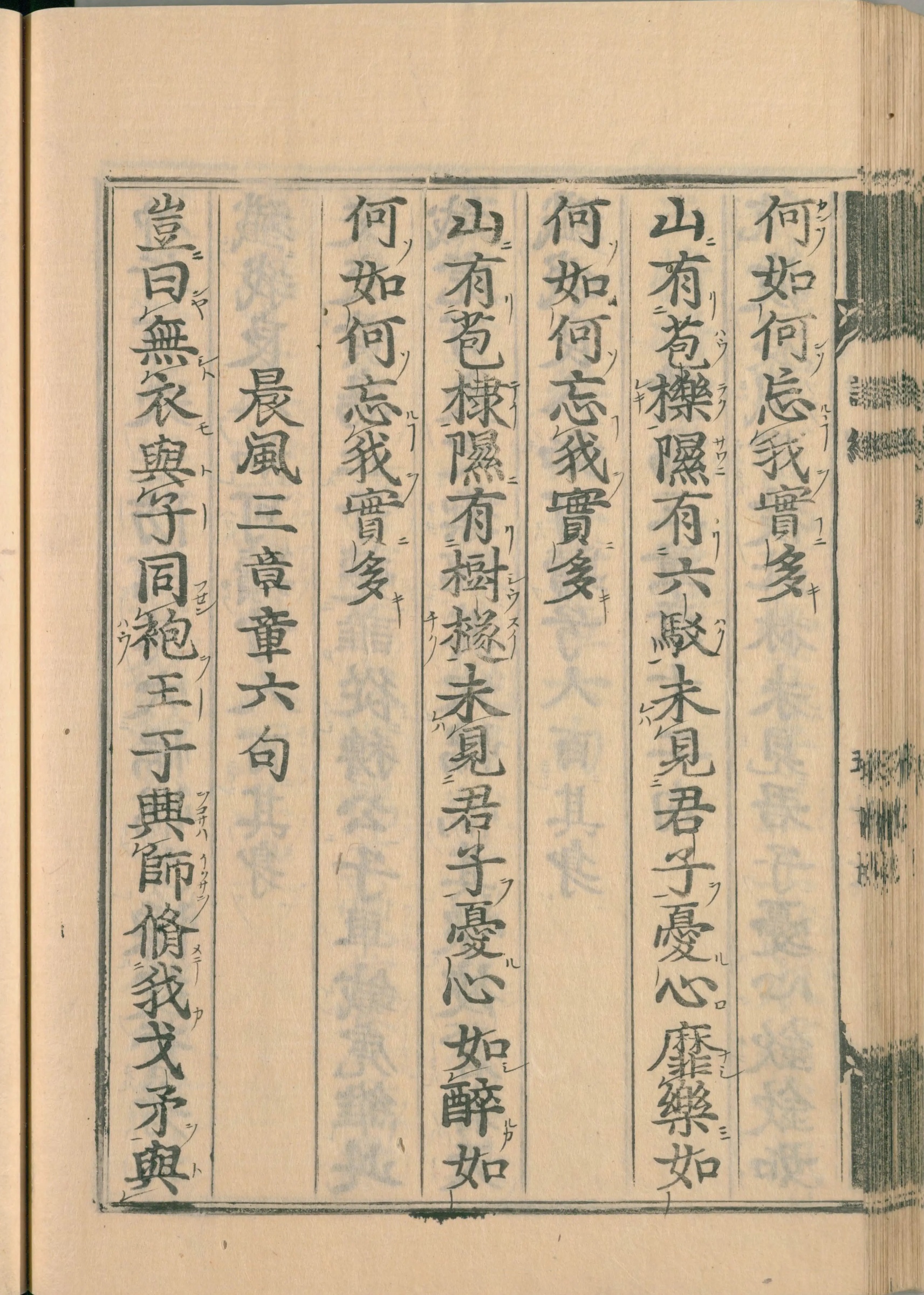
National Diet Library WA7-183, vol. [1], IIIF canvas 74, right-hand page: 7 columns of up to 17 characters, main text only, with Japanese reading marks. Checked on the image: stanza 2 opens column 2 ‹山有苞櫟›; stanza 3 opens column 4 ‹山有苞棣›. Other columns on this page: column 6 is the count line of 晨風 (stanzas and lines). The Chinese shown is the Wikisource Mao text, not a transcription of this print; Legge's English translates the same text.
2山有苞櫟,隰有六駮,未見君子,憂心靡樂,如何如何,忘我實多。
3山有苞棣,隰有樹檖,未見君子,憂心如醉,如何如何,忘我實多。
2On the mountain are the bushy oaks;
In the low wet grounds are six elms.
While I do not see my husband,
My sad heart has no joy.
How is it, how is it,
That he forgets me so very much?
3On the mountain are the bushy sparrow-plums;
In the low wet grounds are the high, wild pear trees.
While I do not see my husband,
My heart is as if intoxicated with grief.
How is it, how is it,
That he forgets me so very much?
Notes
- English: James Legge, The She King, The Chinese Classics vol. IV part I (1871), Part I, Lessons from the States, Book 11, ode VII (Shin fung). Stanzas are numbered as in Legge and the Mao text.
- Transcribed for this library from the page images: lines read alike by two OCR programs were kept, and every other line was read on the image (data/sources/shijing/legge1871/). Legge's notes are left out.
Cite
Sources
- Source: National Diet Library WA7-183 (Keicho-era movable-type print of the Shijing, vol. 1) + Wikisource Mao text + James Legge, The She King (Chinese Classics IV, 1871) (holding institution)
- Critical edition: Mao text (Wikisource)
← previous · → next · v cycle view · l back to library