Book of Odes, Mao 155: Chi xiao 鴟鴞 (Keicho-era print)
Introduction
鴟鴞 (Chi xiao, Mao 155) is ode II of 豳風 Bin feng ("the Airs of Bin"), the fifteenth book of the Airs of the States (國風 Guofeng), the 160 songs of the regional states that open the Book of Odes (詩經 Shijing). The Airs are generally dated to the Western and early Eastern Zhou (about the 10th to 7th century BCE). It has 4 stanzas.
The photographs are of a copy of the Book of Odes in the National Diet Library, Tokyo (call no. WA7-183), printed with movable type in Japan in the Keicho era (1596-1615): main text only, seven columns of seventeen characters to the page, with Japanese reading marks added by hand. Each stanza begins a new column, and a line giving the count of stanzas and lines follows each ode. In this copy the ode runs from canvas 83, left-hand page to canvas 84, right-hand page of the first volume. Each section gathers the stanzas that begin on one page and links to that page and to any page the last stanza runs onto; the page boundaries were found by reading the first characters of every column on the photographs.
The Chinese is the Mao text from Wikisource. The English is James Legge's prose translation in The Chinese Classics, volume IV, part I (1871), Part I, Book 15, ode II (Ch'e-hëaou), page 233-235; his notes are not reproduced. Words in square brackets are Legge's own additions.
How was this verified? (Provenance)
Where on the image
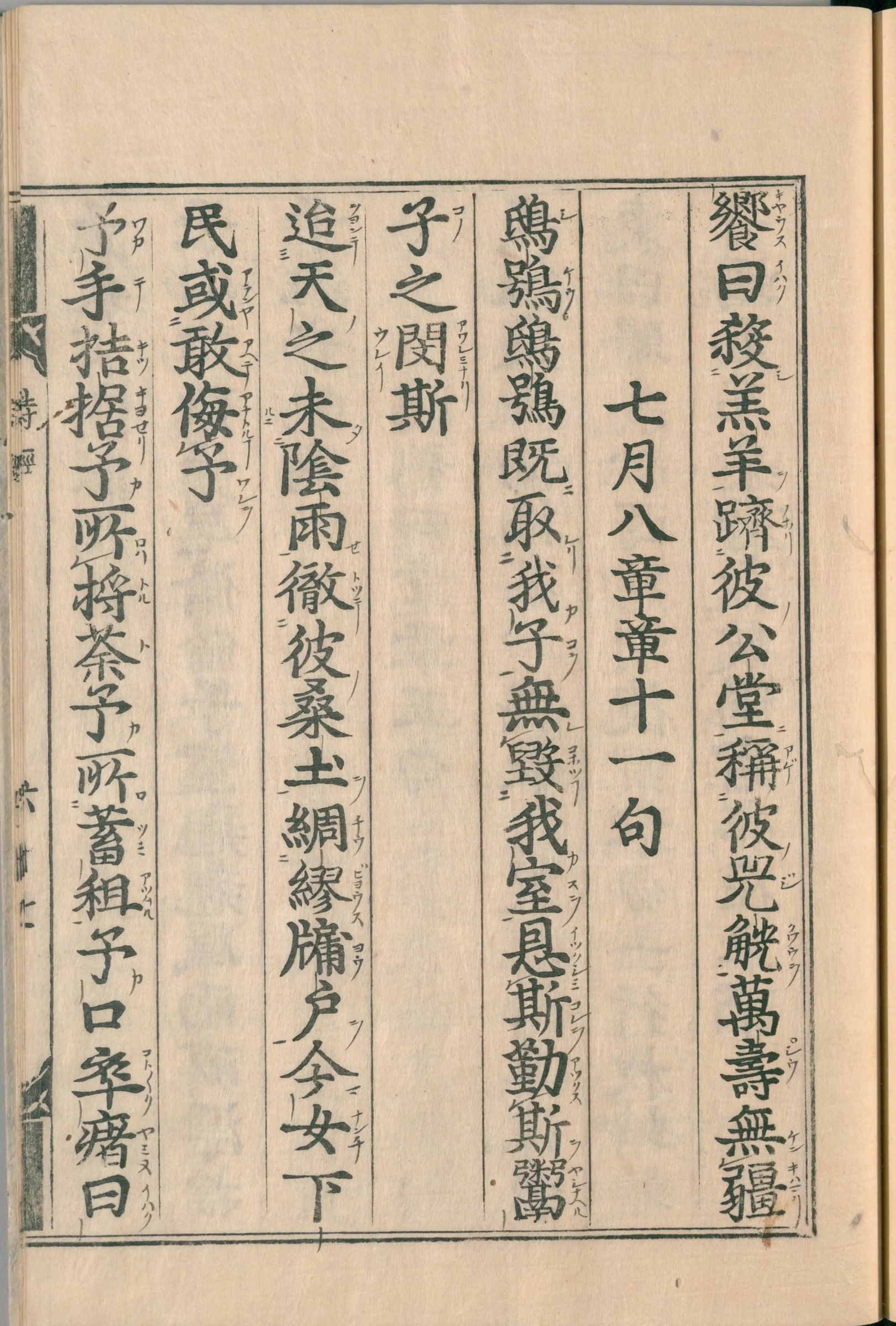
National Diet Library WA7-183, vol. [1], IIIF canvas 83, left-hand page: 7 columns of up to 17 characters, main text only, with Japanese reading marks. Checked on the image: stanza 1 opens column 3 ‹鴟鴞鴟鴞›; stanza 2 opens column 5 ‹迨天之未›; stanza 3 opens column 7 ‹予手拮据›. Other columns on this page: column 2 is the count line of 七月 (stanzas and lines). Stanza 3 runs on to canvas 84, right-hand page (first column ‹予未有室›). The Chinese shown is the Wikisource Mao text, not a transcription of this print; Legge's English translates the same text.
1鴟鴞鴟鴞,既取我子,無毀我室!恩斯勤斯,鬻子之閔斯。
2迨天之未陰雨,徹彼桑土。綢繆牖戶。今女下民,或敢侮予。
3予手拮据,予所捋荼。予所蓄租,予口卒瘏。曰予未有室家。
1O owl, O owl,
You have taken my young ones;—
Do not [also] destroy my nest.
With love and with toil
I nourished them.—I am to be pitied.
2Before the sky was dark with rain,
I gathered the roots of the mulberry tree,
And bound round and round my window and door.
Now ye people below,
Dare any of you despise my house?
3With my claws I tore and held.
Through the rushes which I gathered,
And all the materials I collected,
My mouth was all sore;—
I said to myself, 'I have not yet got my house complete.'
Where on the image
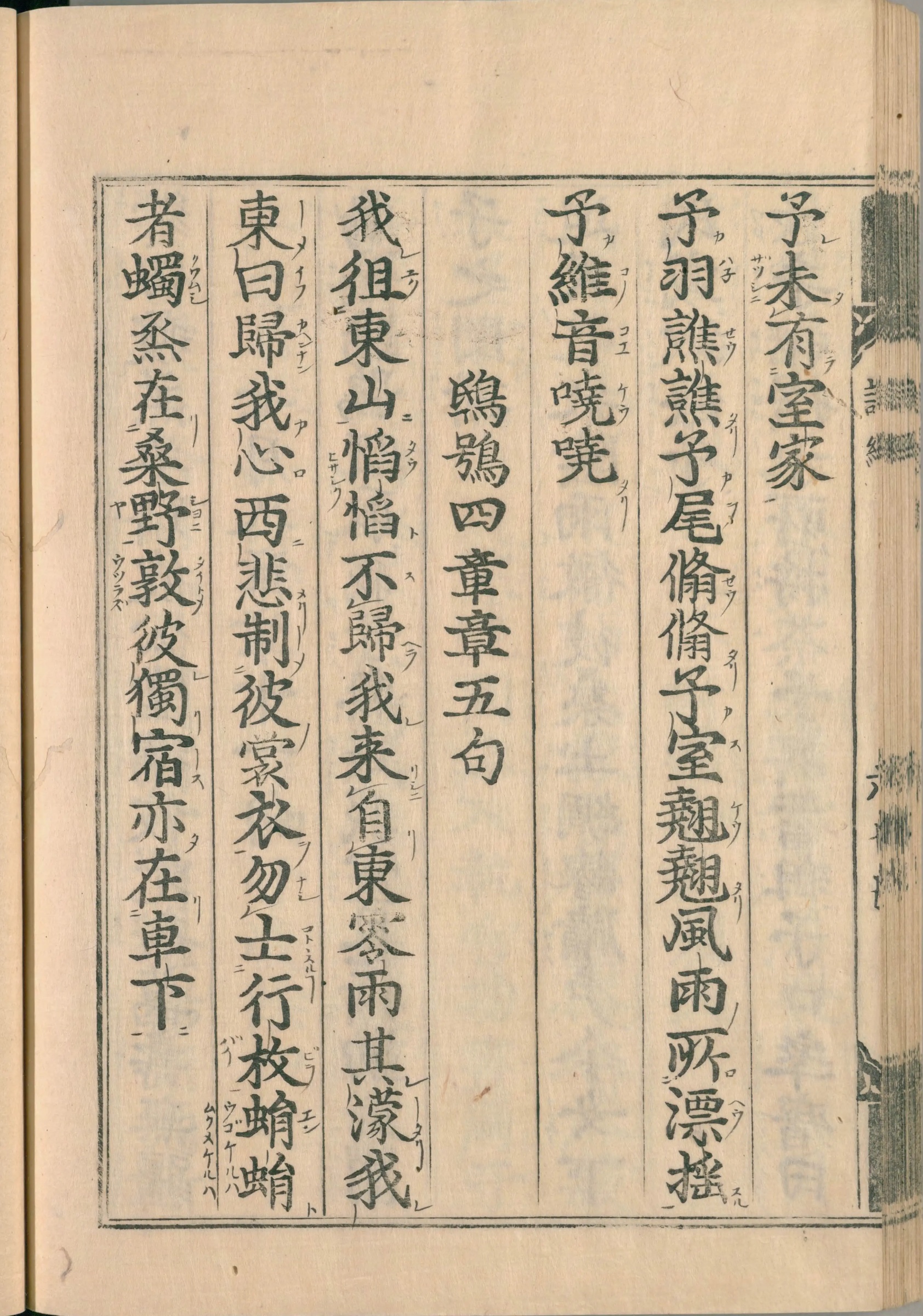
National Diet Library WA7-183, vol. [1], IIIF canvas 84, right-hand page: 7 columns of up to 17 characters, main text only, with Japanese reading marks. Checked on the image: stanza 4 opens column 2 ‹予羽譙譙›. Other columns on this page: column 4 is the count line of 鴟鴞 (stanzas and lines). The Chinese shown is the Wikisource Mao text, not a transcription of this print; Legge's English translates the same text.
4予羽譙譙,予尾翛翛。予室翹翹,風雨所漂搖。予維音嘵嘵。
4My wings are all-injured;
My tail is all-broken;
My house is in a perilous condition;
It is tossed about in the wind and rain:—
I can but cry out with this note of alarm.
Notes
- English: James Legge, The She King, The Chinese Classics vol. IV part I (1871), Part I, Lessons from the States, Book 15, ode II (Ch'e-hëaou). Stanzas are numbered as in Legge and the Mao text.
- Transcribed for this library from the page images: lines read alike by two OCR programs were kept, and every other line was read on the image (data/sources/shijing/legge1871/). Legge's notes are left out.
Cite
Sources
- Source: National Diet Library WA7-183 (Keicho-era movable-type print of the Shijing, vol. 1) + Wikisource Mao text + James Legge, The She King (Chinese Classics IV, 1871) (holding institution)
- Critical edition: Mao text (Wikisource)
← previous · → next · v cycle view · l back to library