Book of Odes, Mao 156: Dong shan 東山 (Keicho-era print)
Introduction
東山 (Dong shan, Mao 156) is ode III of 豳風 Bin feng ("the Airs of Bin"), the fifteenth book of the Airs of the States (國風 Guofeng), the 160 songs of the regional states that open the Book of Odes (詩經 Shijing). The Airs are generally dated to the Western and early Eastern Zhou (about the 10th to 7th century BCE). It has 4 stanzas.
The photographs are of a copy of the Book of Odes in the National Diet Library, Tokyo (call no. WA7-183), printed with movable type in Japan in the Keicho era (1596-1615): main text only, seven columns of seventeen characters to the page, with Japanese reading marks added by hand. Each stanza begins a new column, and a line giving the count of stanzas and lines follows each ode. In this copy the ode runs from canvas 84, right-hand page to canvas 85, right-hand page of the first volume. Each section gathers the stanzas that begin on one page and links to that page and to any page the last stanza runs onto; the page boundaries were found by reading the first characters of every column on the photographs.
The Chinese is the Mao text from Wikisource. The English is James Legge's prose translation in The Chinese Classics, volume IV, part I (1871), Part I, Book 15, ode III (Tung shan), page 235-238; his notes are not reproduced. Words in square brackets are Legge's own additions.
How was this verified? (Provenance)
Where on the image
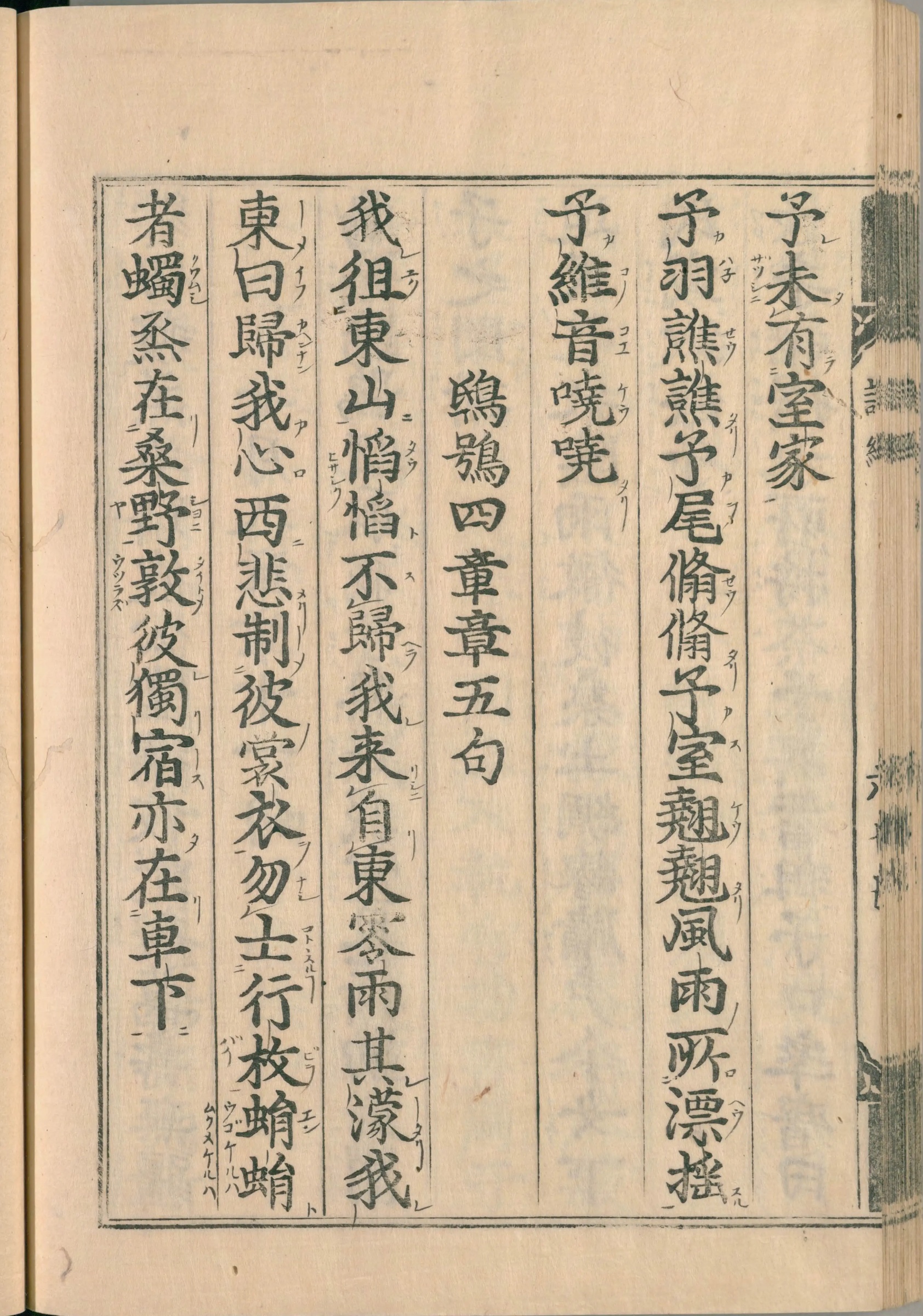
National Diet Library WA7-183, vol. [1], IIIF canvas 84, right-hand page: 7 columns of up to 17 characters, main text only, with Japanese reading marks. Checked on the image: stanza 1 opens column 5 ‹我徂東山›. Other columns on this page: column 4 is the count line of 鴟鴞 (stanzas and lines). The Chinese shown is the Wikisource Mao text, not a transcription of this print; Legge's English translates the same text.
1我徂東山,慆慆不歸。我來自東,零雨其濛。我東曰歸,我心西悲。
制彼裳衣,勿士行枚。蜎蜎者蠋,烝在桑野。敦彼獨宿,亦在車下。
1We went to the hills of the east,
And long were we there without returning,
When we came from the east,
Down came the rain drizzlingly.
When we were in the east, and it was said we should return,
Our hearts were in the west and sad;
But there were they preparing our clothes for us,
As to serve no more in the ranks with the gags.
Creeping about were the caterpillars,
All over the mulberry grounds;
And quietly and solitarily did we pass the night,
Under our carriages.
Where on the image
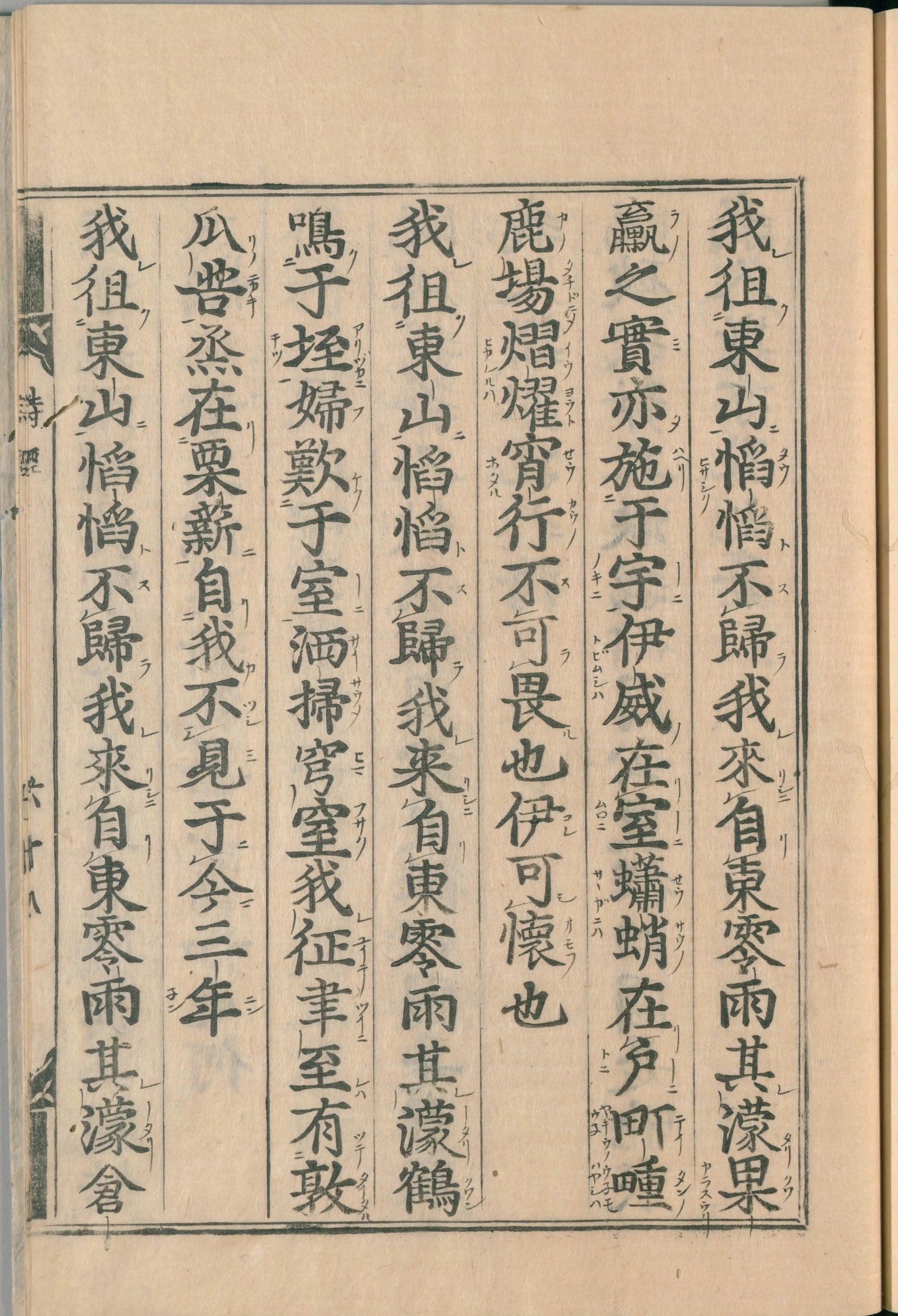
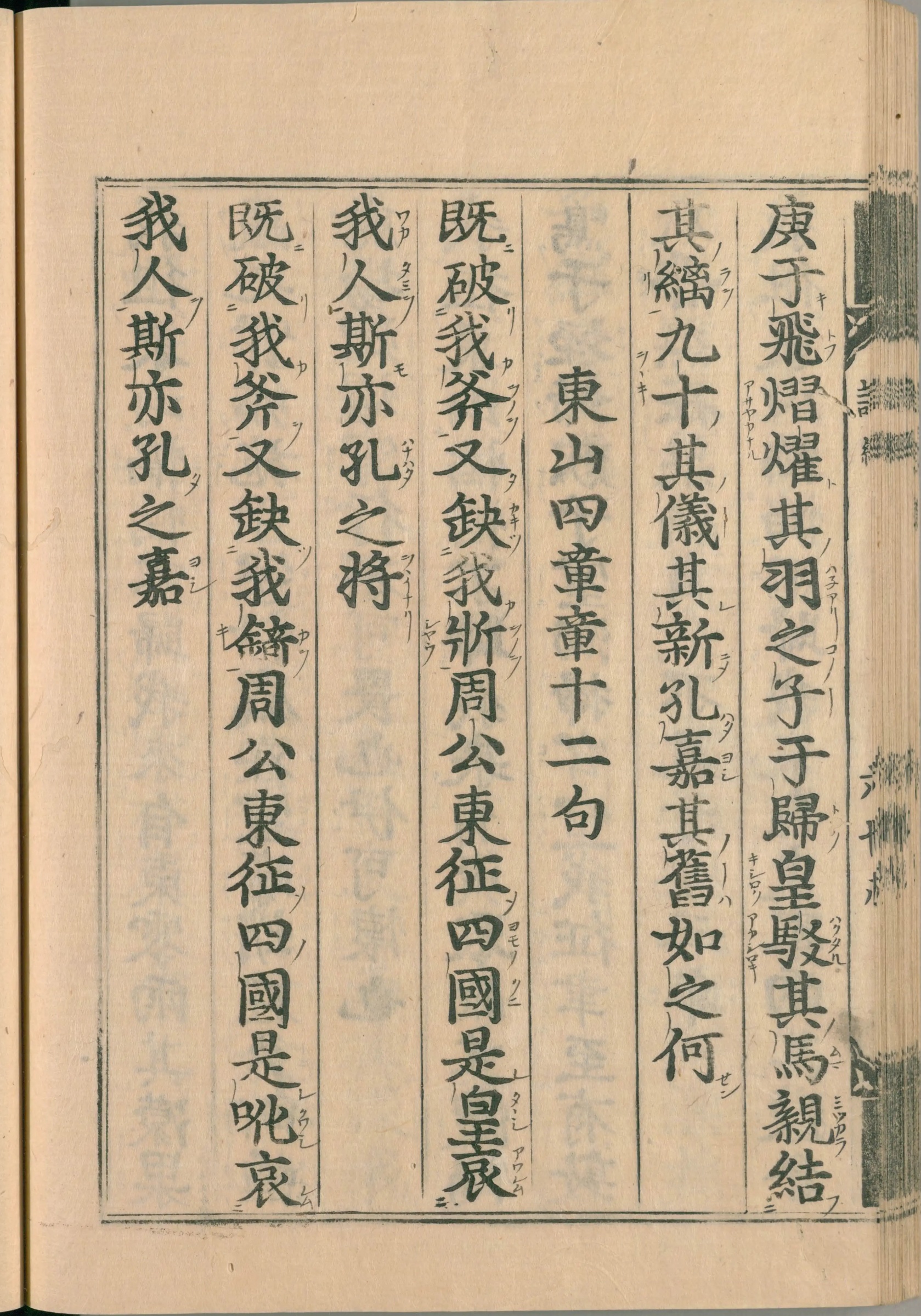
National Diet Library WA7-183, vol. [1], IIIF canvas 84, left-hand page: 7 columns of up to 17 characters, main text only, with Japanese reading marks. Checked on the image: stanza 2 opens column 1 ‹我徂東山›; stanza 3 opens column 4 ‹我徂東山›; stanza 4 opens column 7 ‹我徂東山›. Stanza 4 runs on to canvas 85, right-hand page (first column ‹庚于飛熠›). The Chinese shown is the Wikisource Mao text, not a transcription of this print; Legge's English translates the same text.
2我徂東山,慆慆不歸。我來自東,零雨其濛。果臝之實,亦施于宇。
伊威在室,蠨蛸在戶。町畽鹿場,熠燿宵行。不可畏也,伊可懷也。
3我徂東山,慆慆不歸。我來自東,零雨其濛。鸛鳴于垤,婦歎于室。
洒埽穹窒,我征聿至。有敦瓜苦,烝在栗薪。自我不見,于今三年。
4我徂東山,慆慆不歸。我來自東,零雨其濛。倉庚于飛,熠燿其羽。
之子于歸,皇駁其馬。親結其縭,九十其儀。其新孔嘉,其舊如之何?
2We went to the hills of the east,
And long were we there without returning.
When we came back from the east,
Down came the rain drizzlingly.
The fruit of the heavenly gourd
Would be hanging about our eaves;
The sowbug would be in our chambers;
The spiders' webs would be in our doors;
Our paddocks would be deer-fields;
The fitful light of the glow-worms would be all about.
These thoughts made us apprehensive,
And they occupied our breasts.
3We went to the hills of the east,
And long were we there without returning.
On our way back from the east,
Down came the rain drizzlingly.
The cranes were crying on the ant-hills;
Our wives were sighing in their rooms;
They had sprinkled and swept, and stuffed up all the crevices.
Suddenly we arrived from the expedition,
And there were the bitter gourds hanging
From the branches of the chestnut trees.
Since we had seen such a sight,
Three years were now elapsed.
4We went to the hills of the east,
And long were we there without returning.
On our way back from the east,
Down came the rain drizzlingly.
The oriole is flying about,
Now here, now there, are its wings.
Those young ladies are going to be married,
With their bay and red horses, flecked with white.
Their mothers have tied their sashes;
Complete are their equipments.
The new matches are admirable;—
How can the reunions of the old be expressed?
Notes
- English: James Legge, The She King, The Chinese Classics vol. IV part I (1871), Part I, Lessons from the States, Book 15, ode III (Tung shan). Stanzas are numbered as in Legge and the Mao text.
- Transcribed for this library from the page images: lines read alike by two OCR programs were kept, and every other line was read on the image (data/sources/shijing/legge1871/). Legge's notes are left out.
Cite
Sources
- Source: National Diet Library WA7-183 (Keicho-era movable-type print of the Shijing, vol. 1) + Wikisource Mao text + James Legge, The She King (Chinese Classics IV, 1871) (holding institution)
- Critical edition: Mao text (Wikisource)
← previous · → next · v cycle view · l back to library