Book of Odes, Mao 235: Wen wang 文王 (Keicho-era print)
Introduction
文王 (Wen wang, Mao 235) is one of the Major Odes of the Kingdom (大雅 Daya) in the Book of Odes (詩經 Shijing); its subject is King Wen in heaven and the transfer of Heaven's appointment from Shang to Zhou. With the other odes in this group it forms the Zhou court's account of how the house of Zhou rose to rule, and it was sung at the Zhou court; it is usually dated to the early Western Zhou (11th-10th century BCE).
The photographs are of a copy of the Book of Odes in the National Diet Library, Tokyo (call no. WA7-183), printed with movable type in Japan in the Keicho era (1596-1615): main text only, seven columns of seventeen characters to the page, with Japanese reading marks added by hand, and the count of stanzas and lines after each ode. In this copy the ode runs from canvas 59, left-hand page to canvas 60, left-hand page of the second volume. Each section gathers the stanzas that begin on one page and links to that page and to any page the last stanza runs onto; the page boundaries were found by reading the first characters of every column on the photographs. The Chinese is the Mao text from Wikisource. The English is James Legge's translation in Sacred Books of the East, volume 3 (1879), where this ode is The Major Odes of the Kingdom, Decade i, Ode 1; his footnotes are not reproduced.
How was this verified? (Provenance)
Where on the image
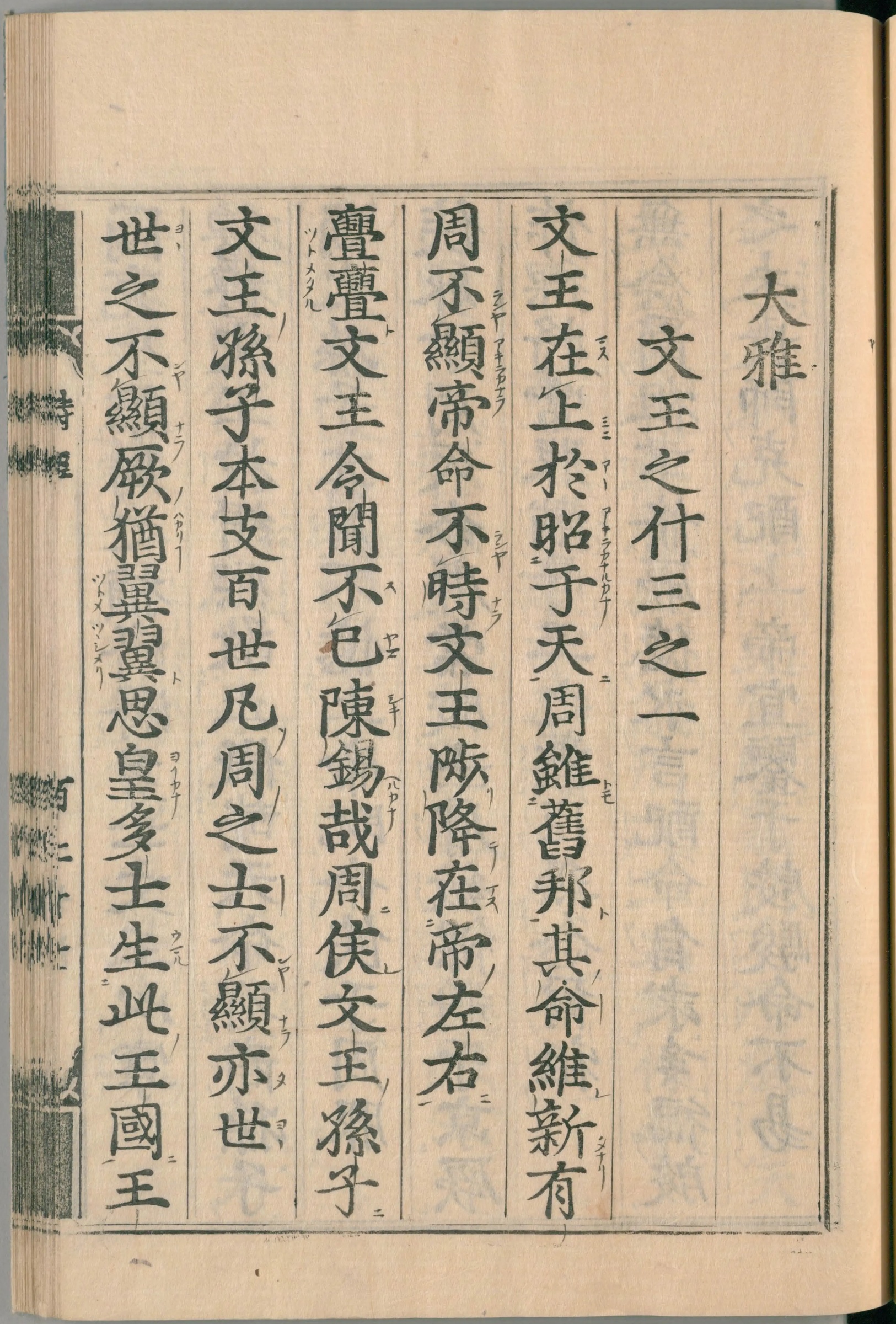
National Diet Library WA7-183, vol. [2], IIIF canvas 59, left-hand page: 7 columns of up to 17 characters, main text only, with Japanese reading marks. Checked on the image: the first column of this ode on this page begins ‹文王在上›, the last begins ‹世之不顯›. Stanza 1 opens column 3. Column 1 reads 大雅 (heading). Column 2 reads 文王之什三之一 (heading). Stanza 3 runs on to canvas 60, right-hand page (first column ‹國克生›), where the section ends. The Chinese shown is the Wikisource Mao text, not a transcription of this print; Legge's English translates the same text.
1文王在上,於昭于天。周雖舊邦,其命維新。
有周不顯,帝命不時。文王陟降,在帝左右。
2亹亹文王,令聞不已。陳錫哉周,侯文王孫子。
文王孫子,本支百世。凡周之士,不顯亦世。
3世之不顯,厥猶翼翼。思皇多士,生此王國。
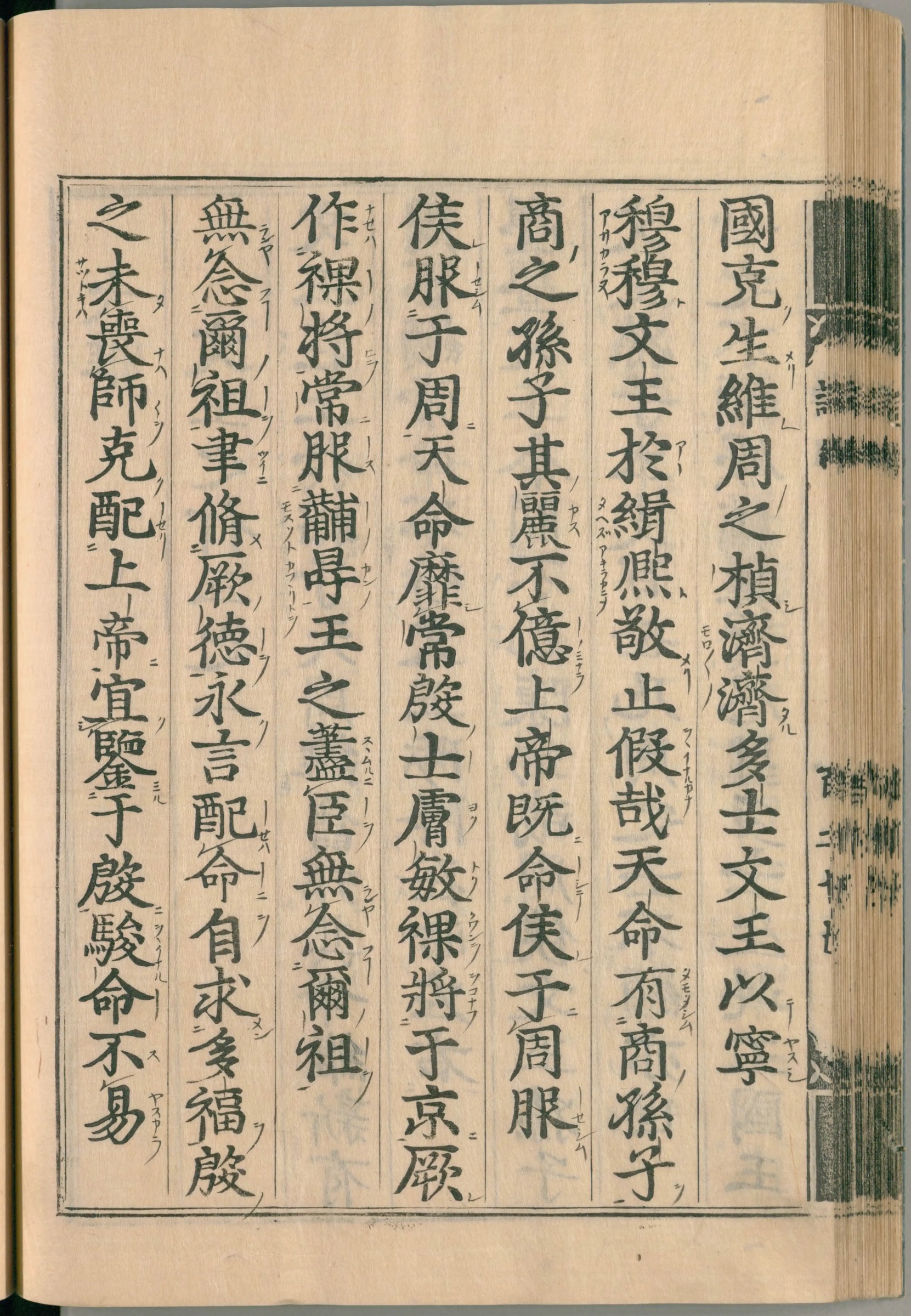
王國克生,維周之楨。濟濟多士,文王以寧。
1King Wăn is on high.
Oh! bright is he in heaven.
Although Kâu was an old country,
The (favouring) appointment lighted on it recently.
Illustrious was the House of Kâu,
And the appointment of God came at the proper season.
King Wăn ascends and descends
On the left and the right of God.
2Full of earnest activity was king Wăn,
And his fame is without end.
The gifts (of God) to Kâu
Extend to the descendants of king Wăn,
In the direct line and the collateral branches for a hundred generations.
All the officers of Kâu
Shall (also) be illustrious from age to age.
3They shall be illustrious from age to age,
Zealously and reverently pursuing their plans.
Admirable are the many officers,
Born in this royal kingdom.
The royal kingdom is able to produce them,
The supporters of (the House of) Kâu.
Numerous is the array of officers,
And by them king Wăn enjoys his repose.
Where on the image
National Diet Library WA7-183, vol. [2], IIIF canvas 60, right-hand page: 7 columns of up to 17 characters, main text only, with Japanese reading marks. Checked on the image: the first column of this ode on this page begins ‹國克生›, the last begins ‹之未喪師›. Stanza 4 opens column 2. Above it the page finishes stanza 3, shown in the previous section. The section ends on this page. The Chinese shown is the Wikisource Mao text, not a transcription of this print; Legge's English translates the same text.
4穆穆文王,於緝熙敬止。假哉天命,有商孫子。
商之孫子,其麗不億。上帝既命,侯于周服。
5侯服于周,天命靡常。殷士膚敏,祼將于京。
厥作祼將,常服黼冔。王之藎臣,無念爾祖。
6無念爾祖,聿脩厥德。永言配命,自求多福。
殷之未喪師,克配上帝。宜鑒于殷,駿命不易。
4Profound was king Wăn;
Oh! continuous and bright was his feeling of reverence.
Great is the appointment of Heaven!
There were the descendants of (the sovereigns of) Shang—
The descendants of the sovereigns of Shang
Were in number more than hundreds of thousands.
But when God gave the command,
They became subject to Kâu.
5They became subject to Kâu,
(For) the appointment of Heaven is not unchangeable.
The officers of Yin, admirable and alert,
Assist at the libations in our capital.
They assist at those libations,
Always wearing the hatchet-figures on their lower garments and their peculiar cap.
O ye loyal ministers of the king,
Ever think of your ancestor!
6Ever think of your ancestor,
Cultivating your virtue,
Always seeking to accord with the will (of Heaven):—
So shall you be seeking for much happiness,
Before Yin lost the multitudes,
(Its kings) were the correlates of God.
Look to Yin as a beacon;
The great appointment is not easily preserved.
Where on the image
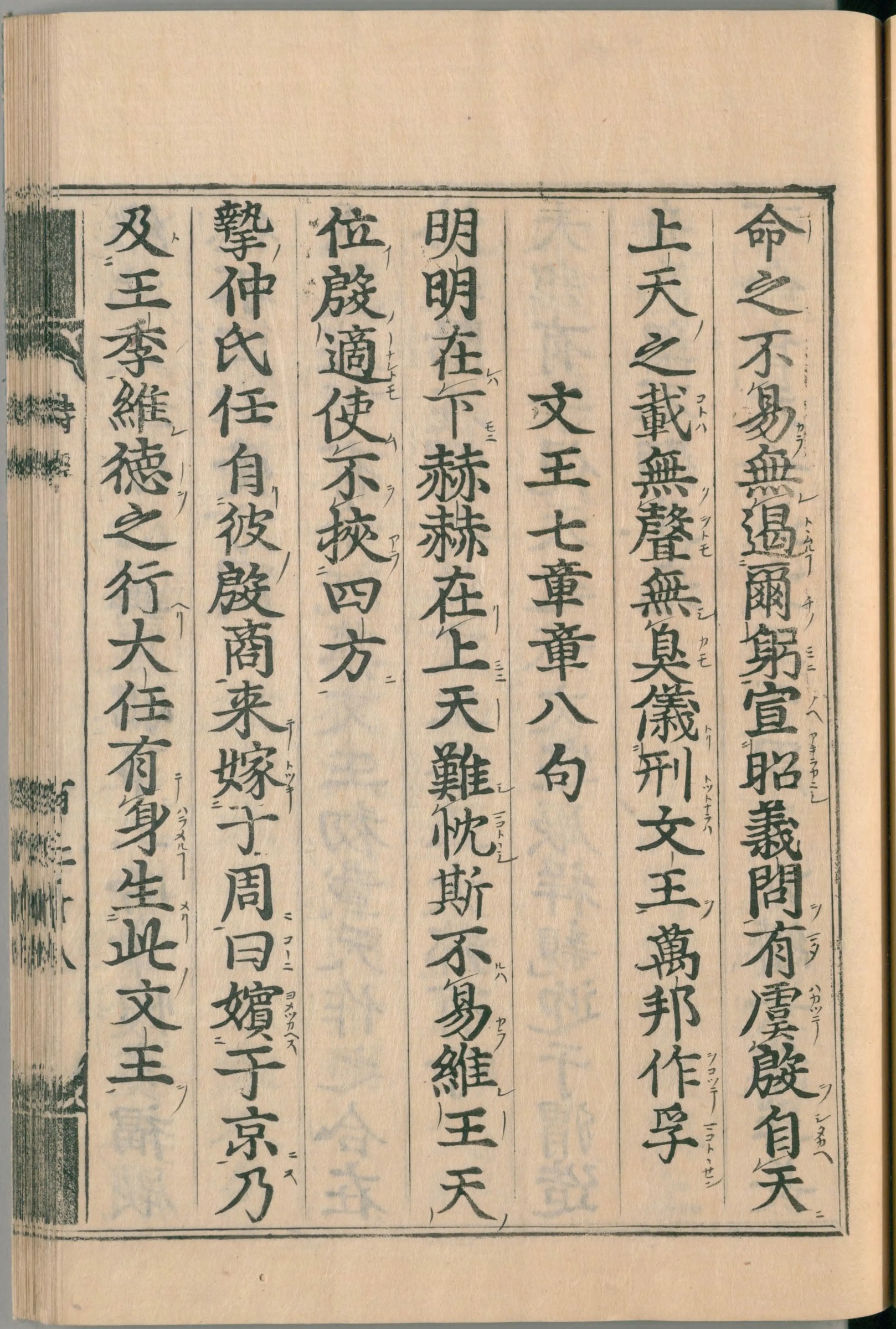
National Diet Library WA7-183, vol. [2], IIIF canvas 60, left-hand page: 7 columns of up to 17 characters, main text only, with Japanese reading marks. Checked on the image: the first column of this ode on this page begins ‹命之不易›, the last begins ‹上天之載›. Stanza 7 opens column 1. Column 3 reads 文王七章章八句 (the ode's stanza and line count). The section ends on this page. The Chinese shown is the Wikisource Mao text, not a transcription of this print; Legge's English translates the same text.
7命之不易,無遏爾躬。宣昭義問,有虞殷自天。
上天之載,無聲無臭。儀刑文王,萬邦作孚。
7The appointment is not easily (preserved):—
Do not cause your own extinction.
Display and make bright your righteousness and fame,
And look at (the fate of) Yin in the light of Heaven.
The doings of high Heaven
Have neither sound nor smell.
Take your pattern from king Wăn,
And the myriad regions will repose confidence in you.
Notes
- English: James Legge, The Shih King, Sacred Books of the East vol. 3 (1879), The Major Odes of the Kingdom, Decade i, Ode 1 (The Wan Wang). Stanzas are numbered as in the Chinese.
- Text is taken from the validated Wikisource transcription; footnotes and lines the Wikisource editors supplied from Legge's 1871 edition are left out.
Cite
Sources
- Source: National Diet Library WA7-183 (Keicho-era movable-type print of the Shijing, vol. 2) + Wikisource Mao text + James Legge, Sacred Books of the East 3 (1879), via Wikisource (holding institution)
- Critical edition: Mao text (Wikisource)
← previous · → next · v cycle view · l back to library