Book of Odes, Mao 236: Da ming 大明 (Keicho-era print)
Introduction
大明 (Da ming, Mao 236) is one of the Major Odes of the Kingdom (大雅 Daya) in the Book of Odes (詩經 Shijing); its subject is the mothers of King Wen and King Wu and the victory over Shang at Muye. With the other odes in this group it forms the Zhou court's account of how the house of Zhou rose to rule, and it was sung at the Zhou court; it is usually dated to the early Western Zhou (11th-10th century BCE).
The photographs are of a copy of the Book of Odes in the National Diet Library, Tokyo (call no. WA7-183), printed with movable type in Japan in the Keicho era (1596-1615): main text only, seven columns of seventeen characters to the page, with Japanese reading marks added by hand, and the count of stanzas and lines after each ode. In this copy the ode runs from canvas 60, left-hand page to canvas 61, left-hand page of the second volume. Each section gathers the stanzas that begin on one page and links to that page and to any page the last stanza runs onto; the page boundaries were found by reading the first characters of every column on the photographs. The Chinese is the Mao text from Wikisource. The English is James Legge's translation in Sacred Books of the East, volume 3 (1879), where this ode is The Major Odes of the Kingdom, Decade i, Ode 2; his footnotes are not reproduced.
How was this verified? (Provenance)
Where on the image
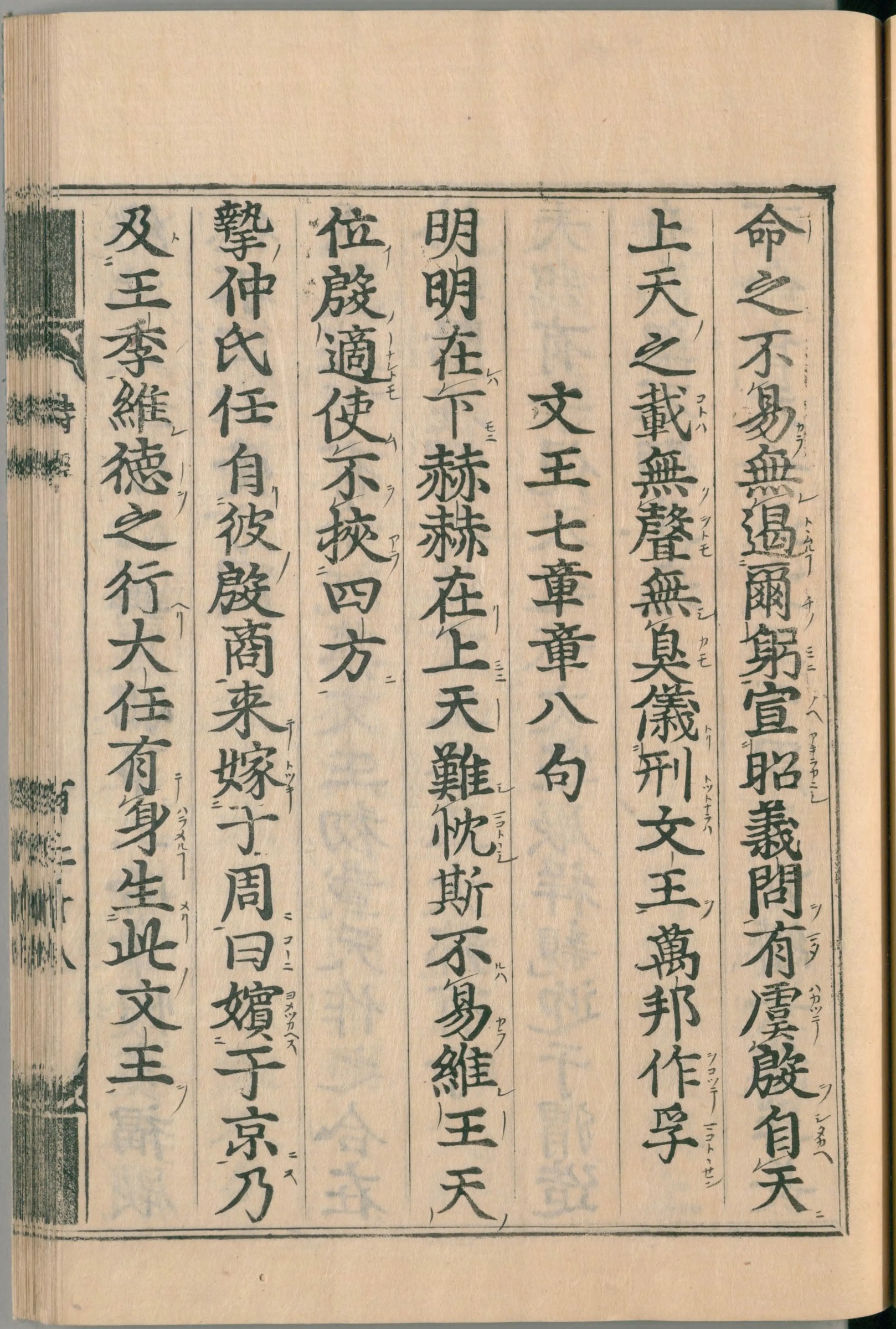
National Diet Library WA7-183, vol. [2], IIIF canvas 60, left-hand page: 7 columns of up to 17 characters, main text only, with Japanese reading marks. Checked on the image: the first column of this ode on this page begins ‹明明在下›, the last begins ‹及王季›. Stanza 1 opens column 4. Column 3 reads 文王七章章八句 (the ode's stanza and line count). The section ends on this page. The Chinese shown is the Wikisource Mao text, not a transcription of this print; Legge's English translates the same text.
1明明在下,赫赫在上。天難忱斯,不易維王。天位殷適,使不挾四方。
2摯仲氏任,自彼殷商,來嫁于周。曰嬪于京,乃及王季,維德之行。大任有身,生此文王。
1The illustration of illustrious (virtue) is required below,
And the dread majesty is on high.
Heaven is not readily to be relied on;
It is not easy to be king.
Yin's rightful heir to the heavenly seat
Was not permitted to possess the kingdom.
2Zăn, the second of the princesses of Kih,
From (the domain of) Yin-shang,
Came to be married to (the prince of) Kâu,
And became his wife in his capital.
Both she and king Kî
Were entirely virtuous.
(Then) Thâi-zăn became pregnant,
And gave birth to our king Wăn.
Where on the image
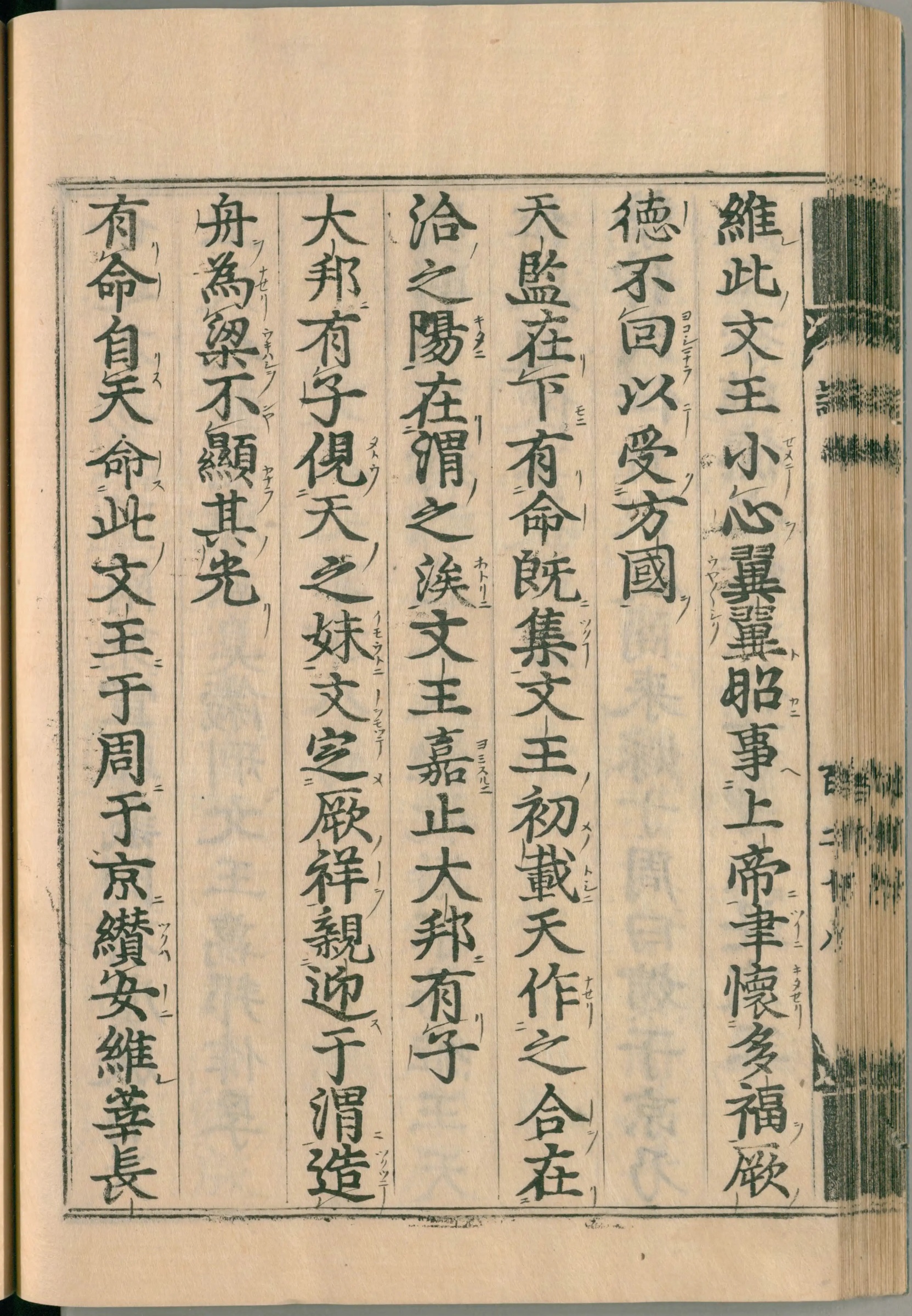
National Diet Library WA7-183, vol. [2], IIIF canvas 61, right-hand page: 7 columns of up to 17 characters, main text only, with Japanese reading marks. Checked on the image: the first column of this ode on this page begins ‹維此文王›, the last begins ‹有命自天›. Stanza 3 opens column 1. Stanza 6 runs on to canvas 61, left-hand page (first column ‹子維行›), where the section ends. The Chinese shown is the Wikisource Mao text, not a transcription of this print; Legge's English translates the same text.
3維此文王,小心翼翼。昭事上帝,聿懷多福。厥德不回,以受方國。
4天監在下,有命既集。文王初載,天作之合。在洽之陽,在渭之涘。文王嘉止,大邦有子。
5大邦有子,俔天之妹。文定厥祥,親迎于渭。造舟為梁,不顯其光。
6有命自天,命此文王。于周于京,纘女維莘。長子維行,篤生武王。保右命爾,燮伐大商。
3This king Wăn,
Watchfully and reverently,
With entire intelligence served God,
And so secured the great blessing.
His virtue was without deflection;
And in consequence he received (the allegiance of) the states from all quarters.
4Heaven surveyed this lower world;
And its appointment lighted (on king Wăn).
In his early years,
It made for him a mate;—
On the north of the Hsiâ,
On the banks of the Wei.
When king Wăn would marry,
There was the lady in a large state.
5In a large state was the lady,
Like a fair denizen of heaven.
The ceremonies determined the auspiciousness (of the union),
And in person he met her on the Wei.
Over it he made a bridge of boats;
The glory (of the occasion) was illustrious.
6The favouring appointment was from Heaven,
Giving the throne to our king Wăn,
In the capital of Kâu.
The lady-successor was from Hsin,
Its eldest daughter, who came to marry him.
She was blessed to give birth to king Wû,
Who was preserved, and helped, and received (also) the appoint- ment,
And in accordance with it smote the great Shang.
Where on the image
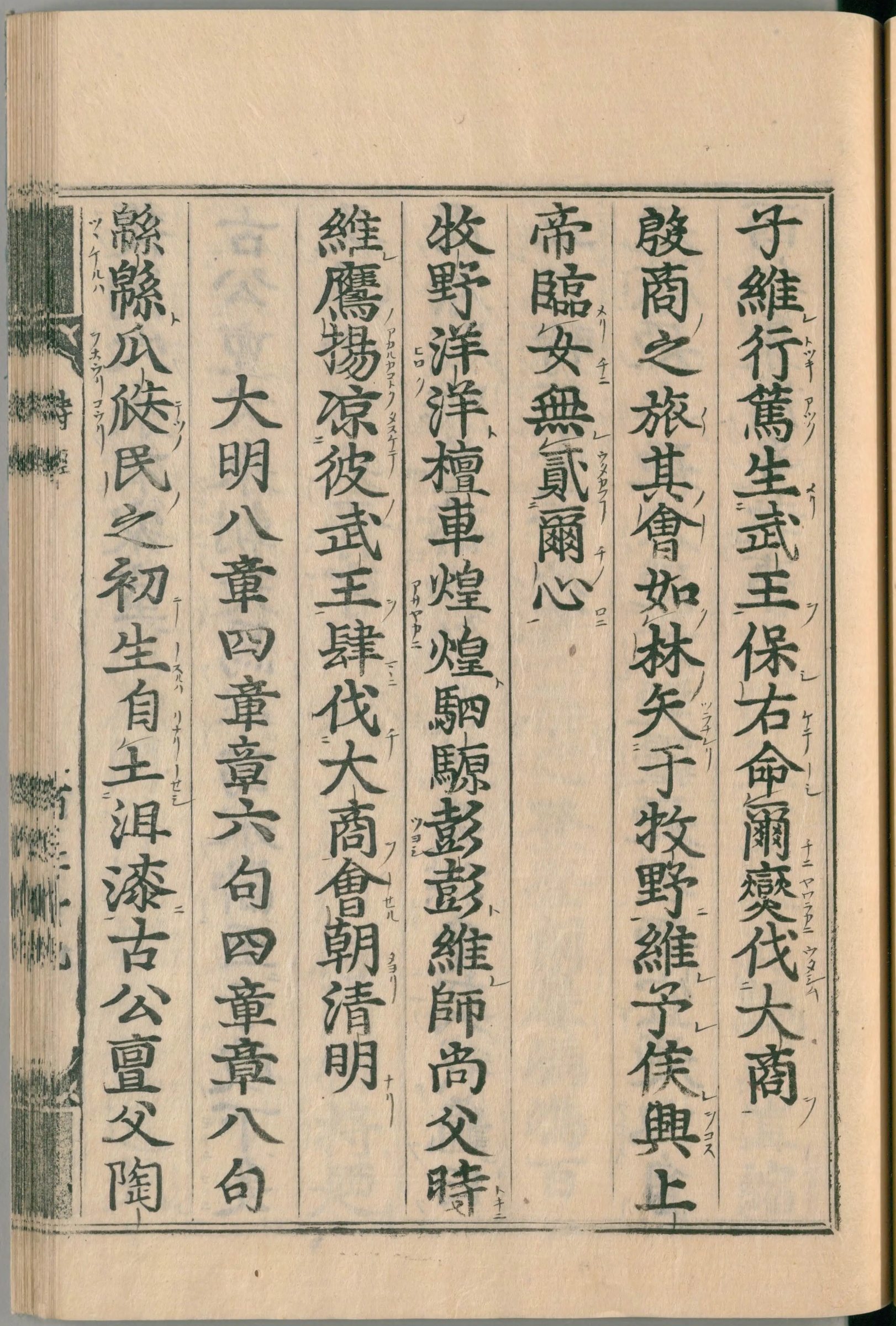
National Diet Library WA7-183, vol. [2], IIIF canvas 61, left-hand page: 7 columns of up to 17 characters, main text only, with Japanese reading marks. Checked on the image: the first column of this ode on this page begins ‹子維行›, the last begins ‹維鷹揚›. Stanza 7 opens column 2. Column 6 reads 大明八章四章章六句四章章八句 (the ode's stanza and line count). Above it the page finishes stanza 6, shown in the previous section. The section ends on this page. The Chinese shown is the Wikisource Mao text, not a transcription of this print; Legge's English translates the same text.
7殷商之旅,其會如林。矢于牧野,維予侯興。上帝臨女,無貳爾心。
8牧野洋洋,檀車煌煌,駟騵彭彭。維師尚父,時維鷹揚。涼彼武王,肆伐大商。會朝清明。
7The troops of Yin-shang
Were collected like a forest,
And marshalled in the wilderness of Mû.
We rose (to the crisis);
'God is with you,' (said Shang-fû to the king),
'Have no doubts in your heart.'
8The wilderness of Mû spread out extensive;
Bright shone the chariots of sandal;
The teams of bays, black-maned and white-bellied, galloped along;
The Grand-Master Shang-fû
Was like an eagle on the wing,
Assisting king Wû,
Who at one onset smote the great Shang.
That morning's encounter was followed by a clear, bright (day).
Notes
- English: James Legge, The Shih King, Sacred Books of the East vol. 3 (1879), The Major Odes of the Kingdom, Decade i, Ode 2 (The Ta Ming). Stanzas are numbered as in the Chinese.
- Text is taken from the validated Wikisource transcription; footnotes and lines the Wikisource editors supplied from Legge's 1871 edition are left out.
Cite
Sources
- Source: National Diet Library WA7-183 (Keicho-era movable-type print of the Shijing, vol. 2) + Wikisource Mao text + James Legge, Sacred Books of the East 3 (1879), via Wikisource (holding institution)
- Critical edition: Mao text (Wikisource)
← previous · → next · v cycle view · l back to library