Book of Odes, Mao 245: Sheng min 生民 (Keicho-era print)
Introduction
生民 (Sheng min, Mao 245) is one of the Major Odes of the Kingdom (大雅 Daya) in the Book of Odes (詩經 Shijing); its subject is the miraculous birth of Hou Ji, ancestor of the Zhou, and the origin of agriculture and sacrifice. With the other odes in this group it forms the Zhou court's account of how the house of Zhou rose to rule, and it was sung at the Zhou court; it is usually dated to the early Western Zhou (11th-10th century BCE).
The photographs are of a copy of the Book of Odes in the National Diet Library, Tokyo (call no. WA7-183), printed with movable type in Japan in the Keicho era (1596-1615): main text only, seven columns of seventeen characters to the page, with Japanese reading marks added by hand, and the count of stanzas and lines after each ode. In this copy the ode runs from canvas 69, right-hand page to canvas 70, right-hand page of the second volume. Each section gathers the stanzas that begin on one page and links to that page and to any page the last stanza runs onto; the page boundaries were found by reading the first characters of every column on the photographs. The Chinese is the Mao text from Wikisource. The English is James Legge's translation in Sacred Books of the East, volume 3 (1879), where this ode is The Major Odes of the Kingdom, Decade ii, Ode 1; his footnotes are not reproduced.
How was this verified? (Provenance)
Where on the image
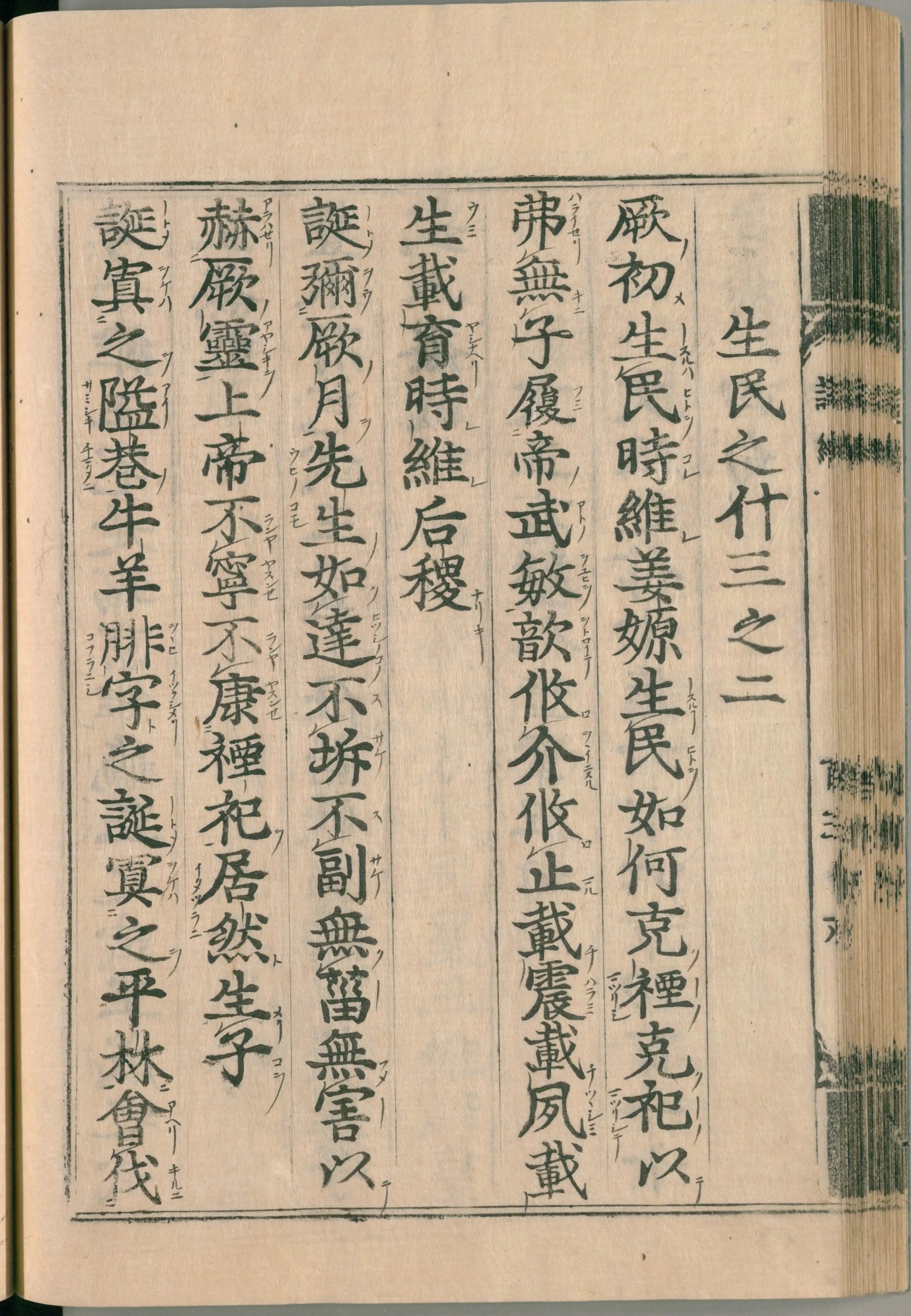
National Diet Library WA7-183, vol. [2], IIIF canvas 69, right-hand page: 7 columns of up to 17 characters, main text only, with Japanese reading marks. Checked on the image: the first column of this ode on this page begins ‹厥初生民›, the last begins ‹誕寘之隘巷›. Stanza 1 opens column 2. Column 1 reads 生民之什三之二 (heading). Stanza 3 runs on to canvas 69, left-hand page (first column ‹平林誕寘›), where the section ends. The Chinese shown is the Wikisource Mao text, not a transcription of this print; Legge's English translates the same text.
1厥初生民,時維姜嫄。生民如何?克禋克祀,以弗無子。
履帝武敏歆,攸介攸止。載震載夙,載生載育。時維后稷。
2誕彌厥月,先生如達。不坼不副,無菑無害。
以赫厥靈,上帝不寧。不康禋祀,居然生子。
3誕寘之隘巷,牛羊腓字之。誕寘之平林,會伐平林。
誕寘之寒冰,鳥覆翼之。鳥乃去矣,后稷呱矣。
1The first birth of (our) people
Was from Kiang Yüan.
How did she give birth to (our) people?
She had presented a pure offering and sacrificed,
That her childlessness might be taken away.
She then trod on a toe-print made by God, and was moved,
In the large place where she rested.
She became pregnant; she dwelt retired;
She gave birth to, and nourished (a son),
Who was Hâu-kî.
2When she had fulfilled her months,
Her firstborn son (came forth) like a lamb.
There was no bursting, nor rending,
No injury, no hurt;
Showing how wonderful he would be.
Did not God give her the comfort?
w Had he not accepted her pure offering and sacrifice,
So that thus easily she brought forth her son?
3He was placed in a narrow lane,
But the sheep and oxen protected him with loving care.
He was placed in a wide forest,
Where he was met with by the wood-cutters.
He was placed on the cold ice,
And a bird screened and supported him with its wings.
When the bird went away,
Hâu-kî began to wail.
His cry was long and loud,
So that his voice filled the whole way.
Where on the image
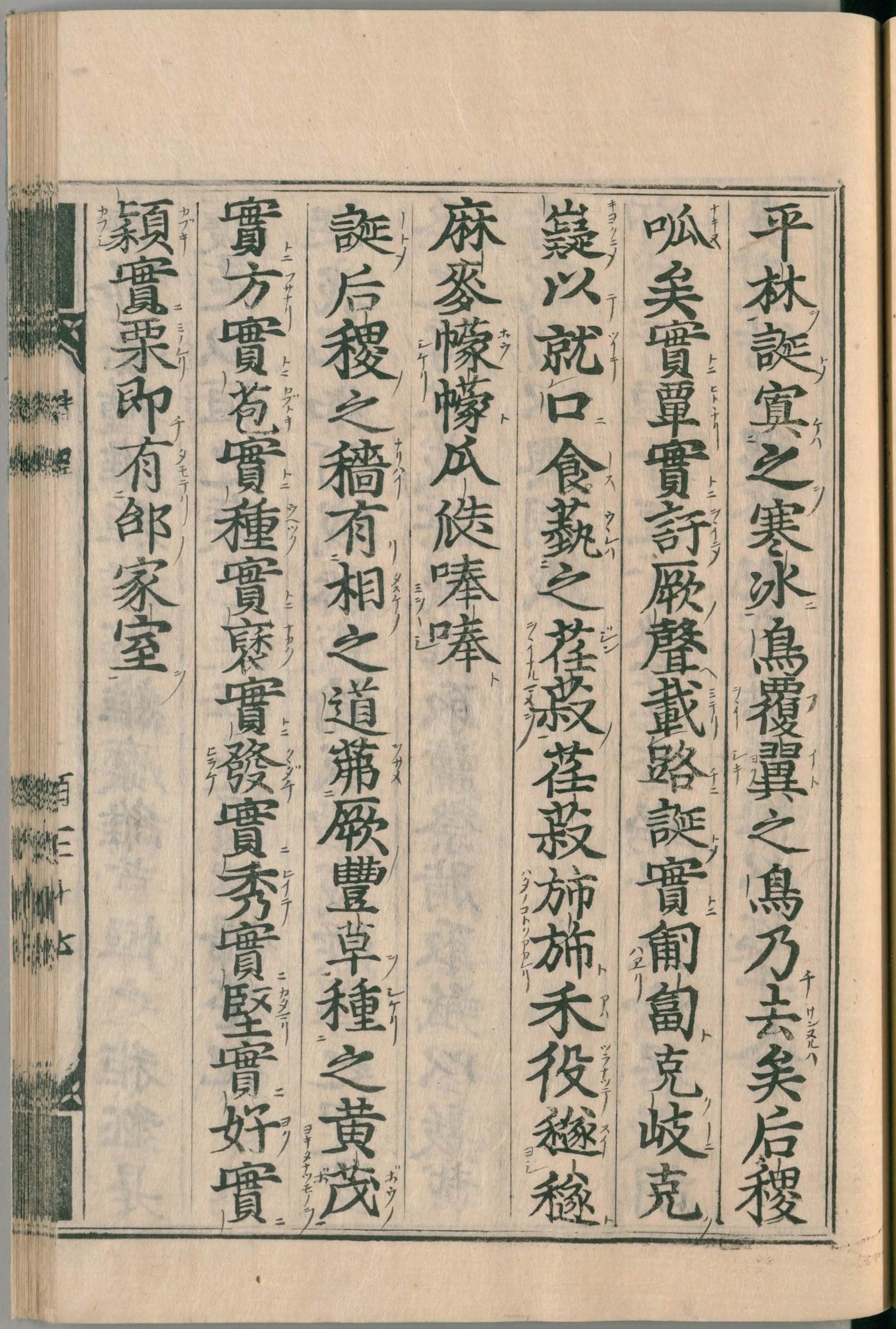
National Diet Library WA7-183, vol. [2], IIIF canvas 69, left-hand page: 7 columns of up to 17 characters, main text only, with Japanese reading marks. Checked on the image: the first column of this ode on this page begins ‹平林誕寘›, the last begins ‹穎實栗›. Stanza 4 begins inside column 2 (the column opens ‹呱矣實覃›), 2 characters down. Above it the page finishes stanza 3, shown in the previous section. The section ends on this page. The Chinese shown is the Wikisource Mao text, not a transcription of this print; Legge's English translates the same text.
4實覃實訏,厥聲載路。誕實匍匐,克岐克嶷,以就口食。
蓺之荏菽,荏菽斾斾,禾役穟穟。麻麥幪幪,瓜瓞唪唪。
5誕后稷之穡,有相之道。茀厥豐草,種之黃茂。
實方實苞,實種實褎,實發實秀,實堅實好,實穎實栗。即有邰家室。
4When he was able to crawl,
He looked majestic and intelligent.
When he was able to feed himself,
He fell to planting beans.
The beans grew luxuriantly;
His rows of paddy shot up beautifully;
His hemp and wheat grew strong and close;
His gourds yielded abundantly.
5The husbandry of Hâu-kî
Proceeded on the plan of helping (the growth).
Having cleared away the thick grass,
He sowed the ground with the yellow cereals.
He managed the living grain, till it was ready to burst;
Then he used it as seed, and it sprang up;
It grew and came into ear;
It became strong and good;
It hung down, every grain complete;
And thus he was appointed lord of Thâi.
Where on the image
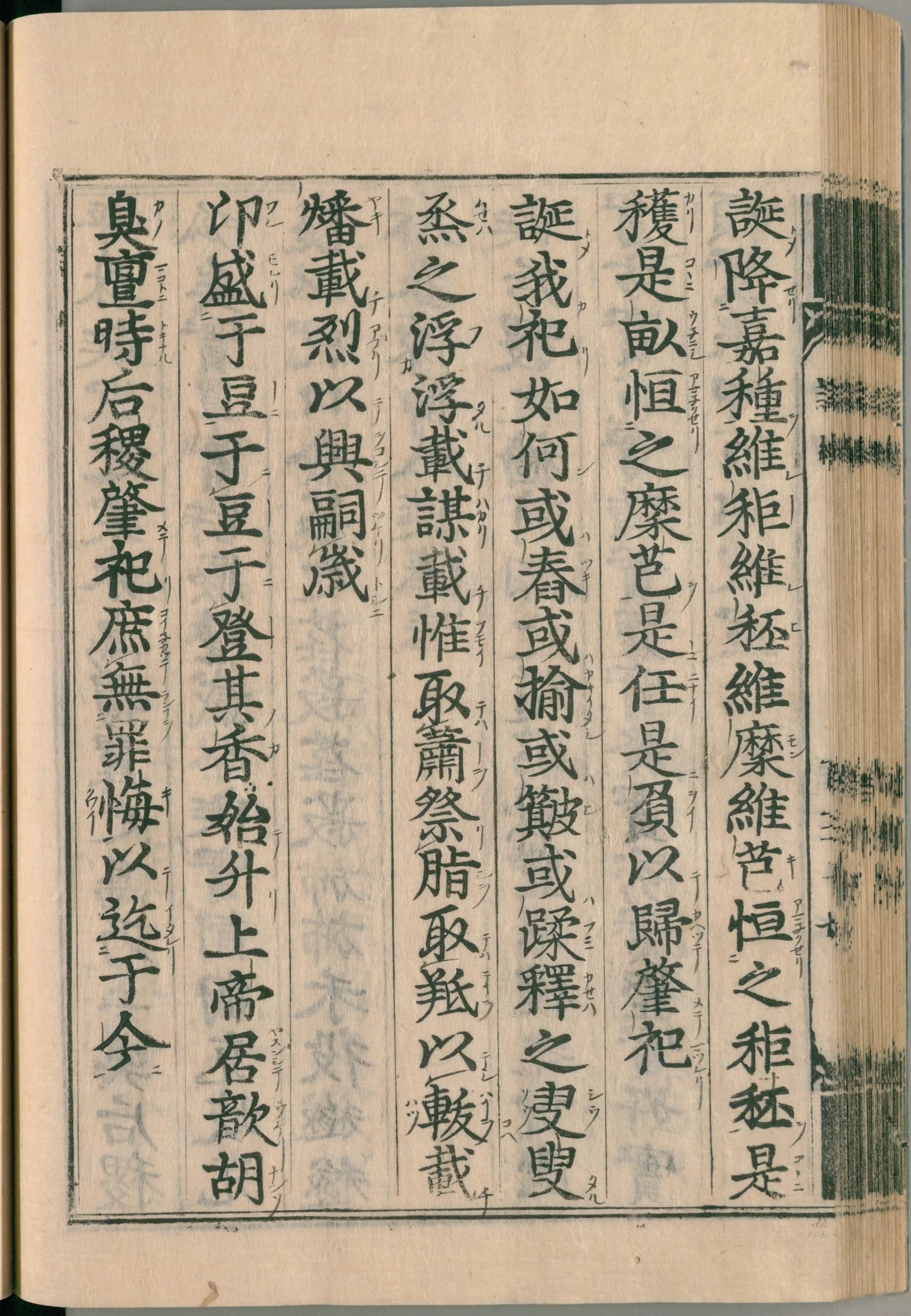
National Diet Library WA7-183, vol. [2], IIIF canvas 70, right-hand page: 7 columns of up to 17 characters, main text only, with Japanese reading marks. Checked on the image: the first column of this ode on this page begins ‹誕降嘉種›, the last begins ‹臭亶時›. Stanza 6 opens column 1. The section ends on this page. The Chinese shown is the Wikisource Mao text, not a transcription of this print; Legge's English translates the same text.
6誕降嘉種,維秬維秠,維穈維芑。
恒之秬秠,是穫是畝。恒之穈芑,是任是負。以歸肇祀。
7誕我祀如何?或舂或揄,或簸或蹂。釋之叟叟,烝之浮浮。
載謀載惟,取蕭祭脂,取羝以軷。載燔載烈,以興嗣歲。
8卬盛于豆,于豆于登。其香始升,上帝居歆。
胡臭亶時?后稷肇祀,庶無罪悔,以迄于今。
6He gave (his people) the beautiful grains;—
The black millet and the double-kernelled,
The tall red and the white.
They planted extensively the black and the double-kernelled,
Which were reaped and stacked on the ground.
They planted extensively the tall red and the white,
Which were carried on their shoulders and backs,
Home for the sacrifices which he founded.
7And how as to our sacrifices (continued from him)?
Some hull (the grain); some take it from the mortar;
Some sift it; some tread it.
It is rattling in the dishes;
It is distilled, and the steam floats about.
We consult; we observe the rites of purification;
We take southernwood and offer it with the fat;
We sacrifice a ram to the spirit of the path;
We offer roast flesh and broiled:—
And thus introduce the coming year.
8We load the stands with the offerings,
The stands both of wood and of earthenware.
As soon as the fragrance ascends,
God, well pleased, smells the sweet savour.
Fragrant it is, and in its due season.
Hâu-kî founded our sacrifices,
And no one, we presume, has given occasion for blame or regret in regard to them,
Down to the present day.
Notes
- English: James Legge, The Shih King, Sacred Books of the East vol. 3 (1879), The Major Odes of the Kingdom, Decade ii, Ode 1 (The Shang Min). Stanzas are numbered as in the Chinese.
- Text is taken from the validated Wikisource transcription; footnotes and lines the Wikisource editors supplied from Legge's 1871 edition are left out.
Cite
Sources
- Source: National Diet Library WA7-183 (Keicho-era movable-type print of the Shijing, vol. 2) + Wikisource Mao text + James Legge, Sacred Books of the East 3 (1879), via Wikisource (holding institution)
- Critical edition: Mao text (Wikisource)
← previous · → next · v cycle view · l back to library