Book of Odes, Mao 244: Wen wang you sheng 文王有聲 (Keicho-era print)
Introduction
文王有聲 (Wen wang you sheng, Mao 244) is one of the Major Odes of the Kingdom (大雅 Daya) in the Book of Odes (詩經 Shijing); its subject is King Wen's city at Feng and King Wu's capital at Hao. With the other odes in this group it forms the Zhou court's account of how the house of Zhou rose to rule, and it was sung at the Zhou court; it is usually dated to the early Western Zhou (11th-10th century BCE).
The photographs are of a copy of the Book of Odes in the National Diet Library, Tokyo (call no. WA7-183), printed with movable type in Japan in the Keicho era (1596-1615): main text only, seven columns of seventeen characters to the page, with Japanese reading marks added by hand, and the count of stanzas and lines after each ode. In this copy the ode runs from canvas 67, left-hand page to canvas 68, left-hand page of the second volume. Each section gathers the stanzas that begin on one page and links to that page and to any page the last stanza runs onto; the page boundaries were found by reading the first characters of every column on the photographs. The Chinese is the Mao text from Wikisource. The English is James Legge's translation in Sacred Books of the East, volume 3 (1879), where this ode is The Major Odes of the Kingdom, Decade i, Ode 10; his footnotes are not reproduced.
How was this verified? (Provenance)
Where on the image
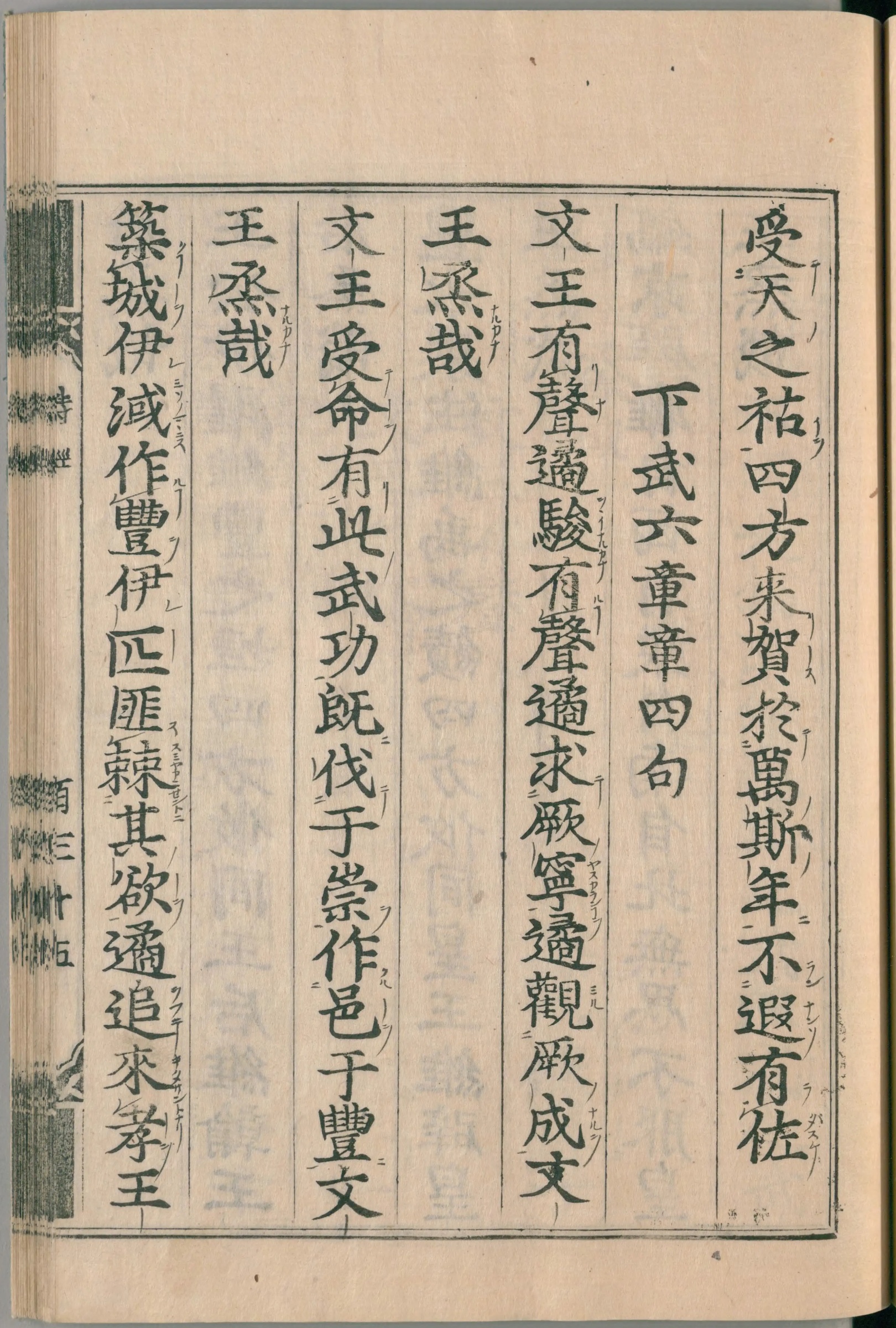
National Diet Library WA7-183, vol. [2], IIIF canvas 67, left-hand page: 7 columns of up to 17 characters, main text only, with Japanese reading marks. Checked on the image: the first column of this ode on this page begins ‹文王有聲›, the last begins ‹築城伊淢›. Stanza 1 opens column 3. Column 2 reads 下武六章章四句 (the ode's stanza and line count). Stanza 3 runs on to canvas 68, right-hand page (first column ‹后烝哉›), where the section ends. The Chinese shown is the Wikisource Mao text, not a transcription of this print; Legge's English translates the same text.
1文王有聲,遹駿有聲。遹求遹寧,遹觀厥成。文王烝哉。
2文王受命,有此武功。既伐于崇,作邑于豐。文王烝哉。
3築城伊淢,作豐伊匹。匪棘其欲,遹追來孝。王后烝哉。
1King Wăn is famous;
Yea, he is very famous.
What he sought was the repose (of the people);
What he saw was the completion (of his work).
A sovereign true was king Wăn!
2King Wăn received the appointment (from Heaven),
And achieved his martial success.
Having overthrown Khung
He fixed his (capital) city in Făng.
A sovereign true was king Wăn!
3He repaired the walls along the (old) moat.
His establishing himself in Făng was according to (the pattern of his forefathers),
It was not that he was in haste to gratify his wishes;—
It was to show the filial duty that had come down to him.
A sovereign true was the royal prince!
Where on the image
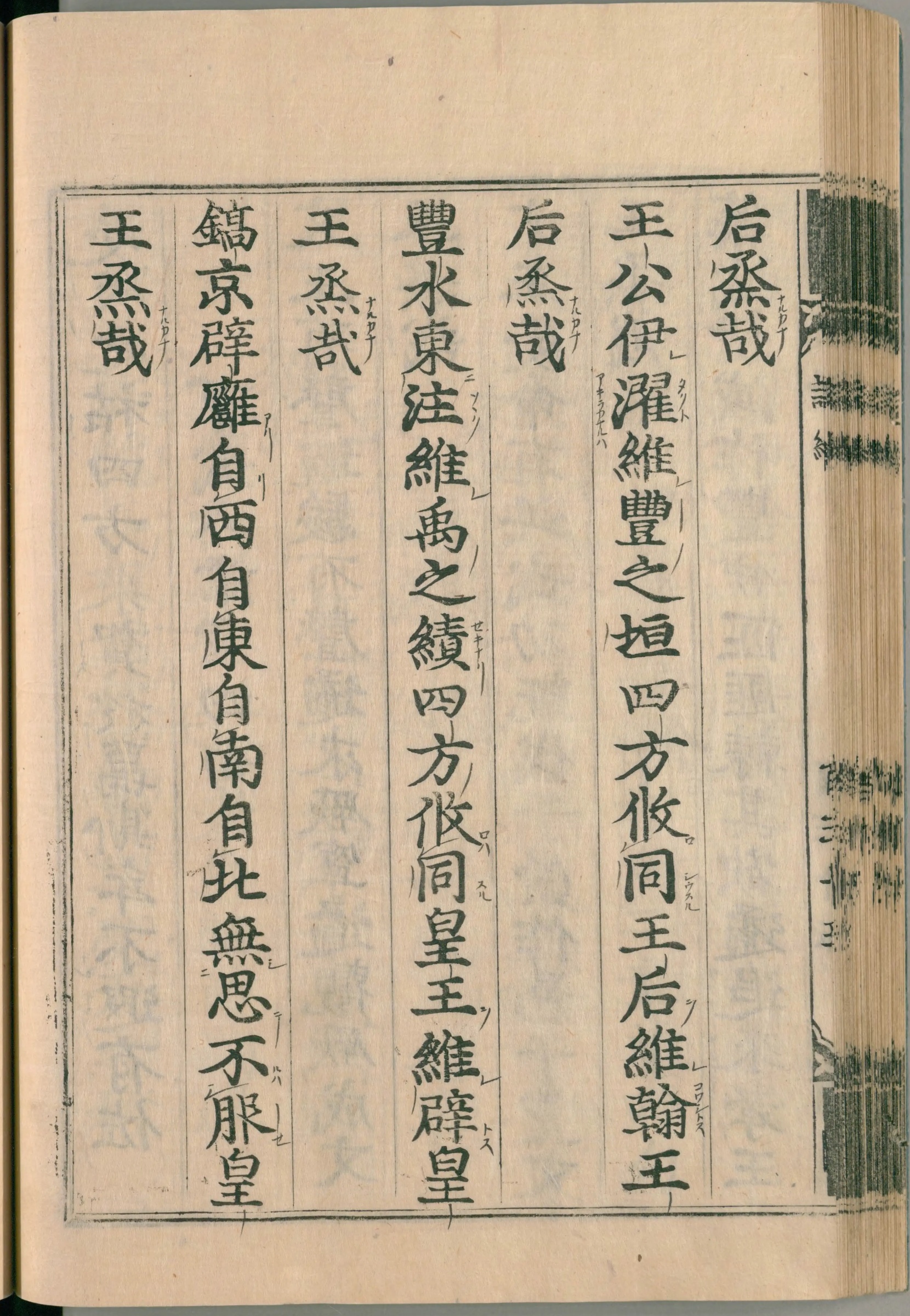
National Diet Library WA7-183, vol. [2], IIIF canvas 68, right-hand page: 7 columns of up to 17 characters, main text only, with Japanese reading marks. Checked on the image: the first column of this ode on this page begins ‹后烝哉›, the last begins ‹王烝哉›. Stanza 4 opens column 2. Above it the page finishes stanza 3, shown in the previous section. The section ends on this page. The Chinese shown is the Wikisource Mao text, not a transcription of this print; Legge's English translates the same text.
4王公伊濯,維豐之垣。四方攸同,王后維翰。王后烝哉。
5豐水東注,維禹之績。四方攸同,皇王維辟。皇王烝哉。
6鎬京辟廱,自西自東。自南自北,無思不服。皇王烝哉。
4His royal merit was brightly displayed
By those walls of Făng.
There were collected (the sympathies of the people of) the four quarters,
Who regarded the royal prince as their protector.
A sovereign true was the royal prince!
5The Făng-water flowed on to the east (of the city),
Through the meritorious labour of Yü.
There were collected (the sympathies of the people of) the four quarters,
Who would have the great king as their ruler.
A sovereign true was the great king!
6In the capital of Hâo he built his hall with its circlet of water.
From the west to the east,
From the south to the north,
There was not a thought but did him homage.
A sovereign true was the great king!
Where on the image
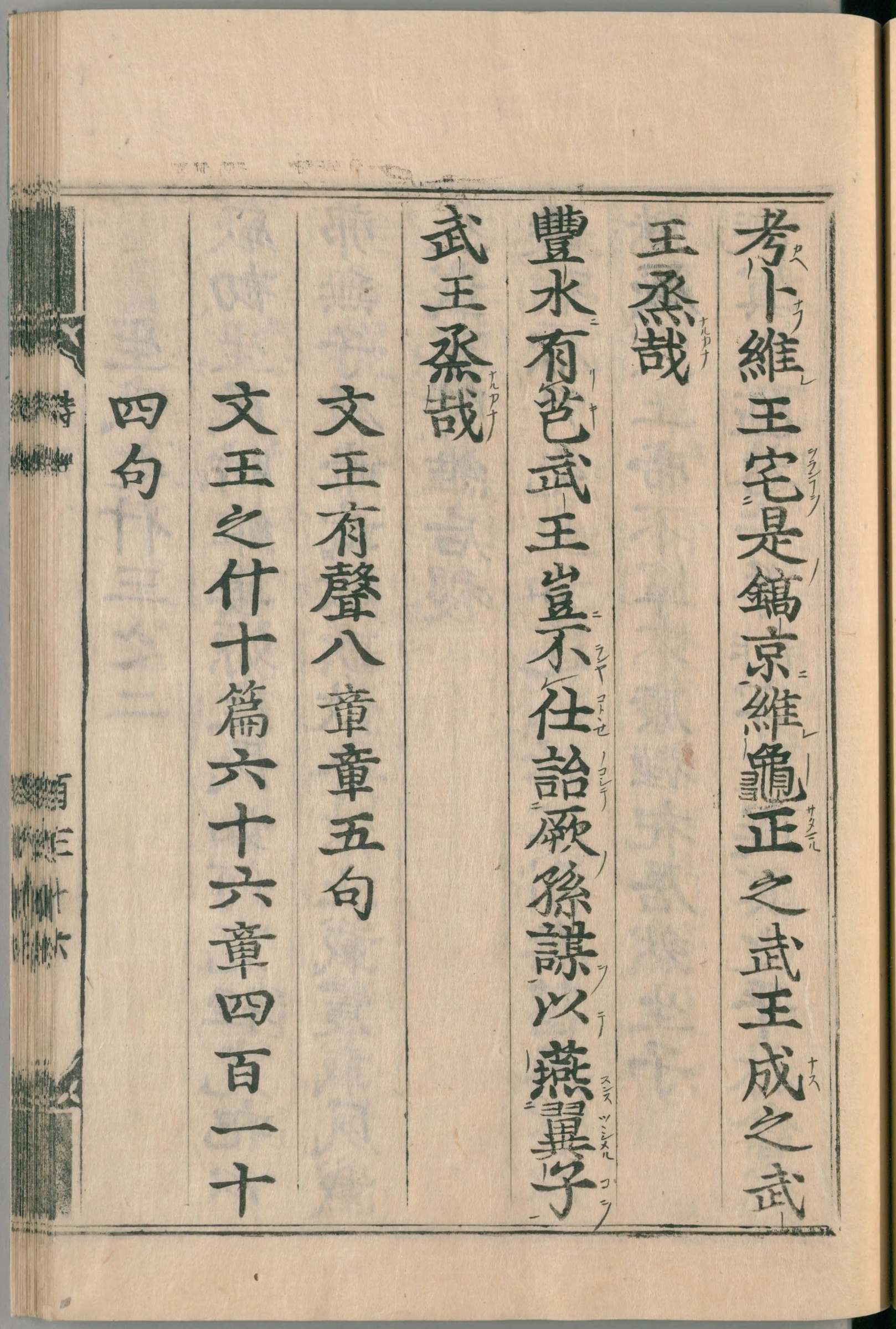
National Diet Library WA7-183, vol. [2], IIIF canvas 68, left-hand page: 7 columns of up to 17 characters, main text only, with Japanese reading marks. Checked on the image: the first column of this ode on this page begins ‹考卜維王›, the last begins ‹武王烝哉›. Stanza 7 opens column 1. Column 5 reads 文王有聲八章章五句 (the ode's stanza and line count). Column 6 reads 文王之什十篇六十六章四百一十 (heading). Column 7 reads 四句 (heading). The section ends on this page. The Chinese shown is the Wikisource Mao text, not a transcription of this print; Legge's English translates the same text.
7考卜維王,宅是鎬京。維龜正之,武王成之。武王烝哉。
8豐水有芑,武王豈不仕。詒厥孫謀,以燕翼子。武王烝哉。
7He examined and divined, did the king,
About settling in the capital of Hâo.
The tortoise-shell decided the site,
And king Wû completed the city.
A sovereign true was king Wû!
8By the Făng-water grows the white millet;—
Did not king Wû show wisdom in his employment of officers?
He would leave his plans to his descendants,
And secure comfort and support to his son.
A sovereign true was king Wû!
Notes
- English: James Legge, The Shih King, Sacred Books of the East vol. 3 (1879), The Major Odes of the Kingdom, Decade i, Ode 10 (The Wan Wang Yu Shang). Stanzas are numbered as in the Chinese.
- Text is taken from the validated Wikisource transcription; footnotes and lines the Wikisource editors supplied from Legge's 1871 edition are left out.
Cite
Sources
- Source: National Diet Library WA7-183 (Keicho-era movable-type print of the Shijing, vol. 2) + Wikisource Mao text + James Legge, Sacred Books of the East 3 (1879), via Wikisource (holding institution)
- Critical edition: Mao text (Wikisource)
← previous · → next · v cycle view · l back to library