Book of Odes, Mao 31: Ji gu 擊鼓 (Keicho-era print)
Introduction
擊鼓 (Ji gu, Mao 31) is ode VI of 邶風 Bei feng ("the Airs of Bei"), the third book of the Airs of the States (國風 Guofeng), the 160 songs of the regional states that open the Book of Odes (詩經 Shijing). The Airs are generally dated to the Western and early Eastern Zhou (about the 10th to 7th century BCE). It has 5 stanzas.
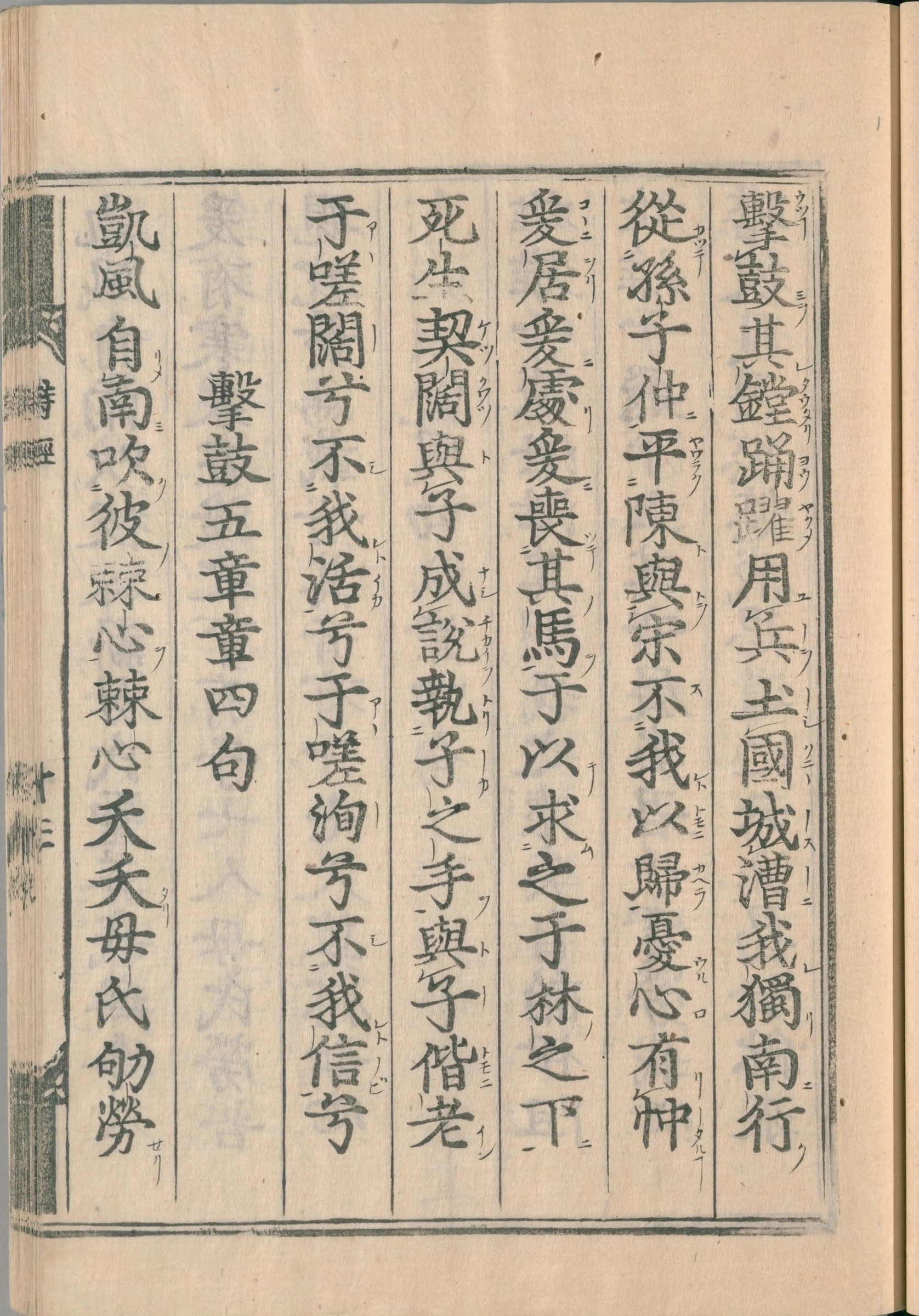
The photographs are of a copy of the Book of Odes in the National Diet Library, Tokyo (call no. WA7-183), printed with movable type in Japan in the Keicho era (1596-1615): main text only, seven columns of seventeen characters to the page, with Japanese reading marks added by hand. Each stanza begins a new column, and a line giving the count of stanzas and lines follows each ode. In this copy the ode runs from canvas 29, left-hand page to canvas 29, left-hand page of the first volume. Each section gathers the stanzas that begin on one page and links to that page and to any page the last stanza runs onto; the page boundaries were found by reading the first characters of every column on the photographs.
The Chinese is the Mao text from Wikisource. The English is James Legge's prose translation in The Chinese Classics, volume IV, part I (1871), Part I, Book 3, ode VI (Keih koo), page 48-49; his notes are not reproduced. Words in square brackets are Legge's own additions.
How was this verified? (Provenance)
Where on the image
National Diet Library WA7-183, vol. [1], IIIF canvas 29, left-hand page: 7 columns of up to 17 characters, main text only, with Japanese reading marks. Checked on the image: stanza 1 opens column 1 ‹擊鼓其鏜›; stanza 2 opens column 2 ‹從孫子仲›; stanza 3 opens column 3 ‹爰居爰處›; stanza 4 opens column 4 ‹死生契闊›; stanza 5 opens column 5 ‹于嗟闊兮›. Other columns on this page: column 6 is the count line of 擊鼓 (stanzas and lines). The Chinese shown is the Wikisource Mao text, not a transcription of this print; Legge's English translates the same text.
1擊鼓其鏜,踴躍用兵,土國城漕,我獨南行。
2從孫子仲,平陳與宋,不我以歸,憂心有忡。
3爰居爰處,爰喪其馬,于以求之,于林之下。
4死生契闊,與子成說,執子之手,與子偕老。
5于嗟闊兮,不我活兮,于嗟洵兮,不我信兮。
1Hear the roll of our drums!
See how we leap about, using our weapons!
Those do the fieldwork in the State, or fortify Ts'aou,
While we alone march to the south.
2We followed Sun Tsze-chung,
Peace having been made with Ch'in and Sung;
[But] he did not lead us back,
And our sorrowful hearts are very sad.
3Here we stay; here we stop;
Here we lose our horses;
And we seek for them,
Among the trees of the forest.
4For life or for death, however separated,
To our wives we pledged our word.
We held their hands;—
We were to grow old together with them.
5Alas for our separation!
We have no prospect of life.
Alas for our stipulation!
We cannot make it good.
Notes
- English: James Legge, The She King, The Chinese Classics vol. IV part I (1871), Part I, Lessons from the States, Book 3, ode VI (Keih koo). Stanzas are numbered as in Legge and the Mao text.
- Transcribed for this library from the page images: lines read alike by two OCR programs were kept, and every other line was read on the image (data/sources/shijing/legge1871/). Legge's notes are left out.
Cite
Sources
- Source: National Diet Library WA7-183 (Keicho-era movable-type print of the Shijing, vol. 1) + Wikisource Mao text + James Legge, The She King (Chinese Classics IV, 1871) (holding institution)
- Critical edition: Mao text (Wikisource)
← previous · → next · v cycle view · l back to library