Book of Odes, Mao 32: Kai feng 凱風 (Keicho-era print)
Introduction
凱風 (Kai feng, Mao 32) is ode VII of 邶風 Bei feng ("the Airs of Bei"), the third book of the Airs of the States (國風 Guofeng), the 160 songs of the regional states that open the Book of Odes (詩經 Shijing). The Airs are generally dated to the Western and early Eastern Zhou (about the 10th to 7th century BCE). It has 4 stanzas.
The photographs are of a copy of the Book of Odes in the National Diet Library, Tokyo (call no. WA7-183), printed with movable type in Japan in the Keicho era (1596-1615): main text only, seven columns of seventeen characters to the page, with Japanese reading marks added by hand. Each stanza begins a new column, and a line giving the count of stanzas and lines follows each ode. In this copy the ode runs from canvas 29, left-hand page to canvas 30, right-hand page of the first volume. Each section gathers the stanzas that begin on one page and links to that page and to any page the last stanza runs onto; the page boundaries were found by reading the first characters of every column on the photographs.
The Chinese is the Mao text from Wikisource. The English is James Legge's prose translation in The Chinese Classics, volume IV, part I (1871), Part I, Book 3, ode VII (K'ae fung), page 50-51; his notes are not reproduced. Words in square brackets are Legge's own additions.
How was this verified? (Provenance)
Where on the image
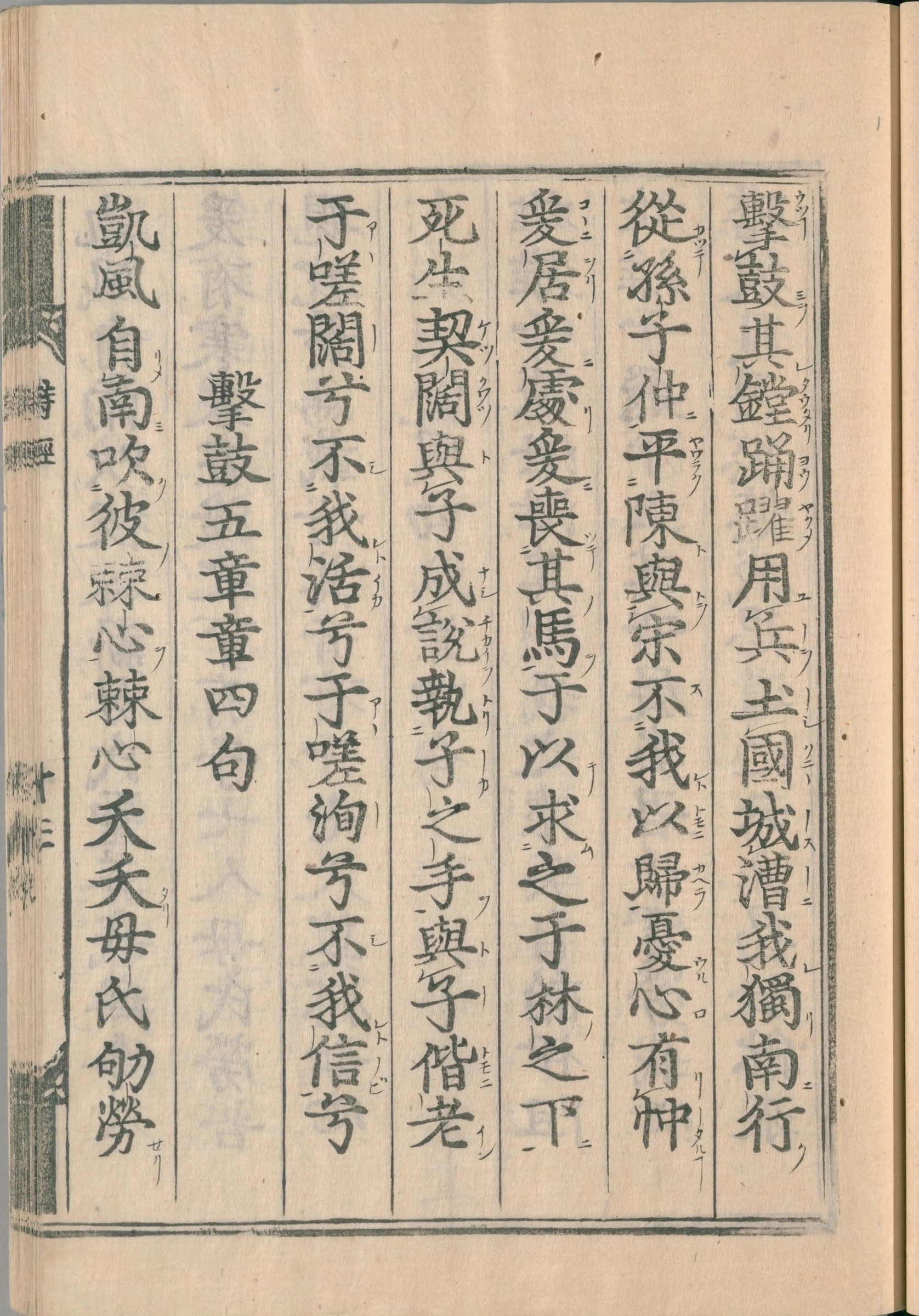
National Diet Library WA7-183, vol. [1], IIIF canvas 29, left-hand page: 7 columns of up to 17 characters, main text only, with Japanese reading marks. Checked on the image: stanza 1 opens column 7 ‹凱風自南›. Other columns on this page: column 6 is the count line of 擊鼓 (stanzas and lines). The Chinese shown is the Wikisource Mao text, not a transcription of this print; Legge's English translates the same text.
1凱風自南,吹彼棘心;
棘心夭夭,母氏劬勞。
1The genial wind from the south
Blows on the heart of that jujube tree,
Till that heart looks tender and beautiful.
What toil and pain did our mother endure!
Where on the image
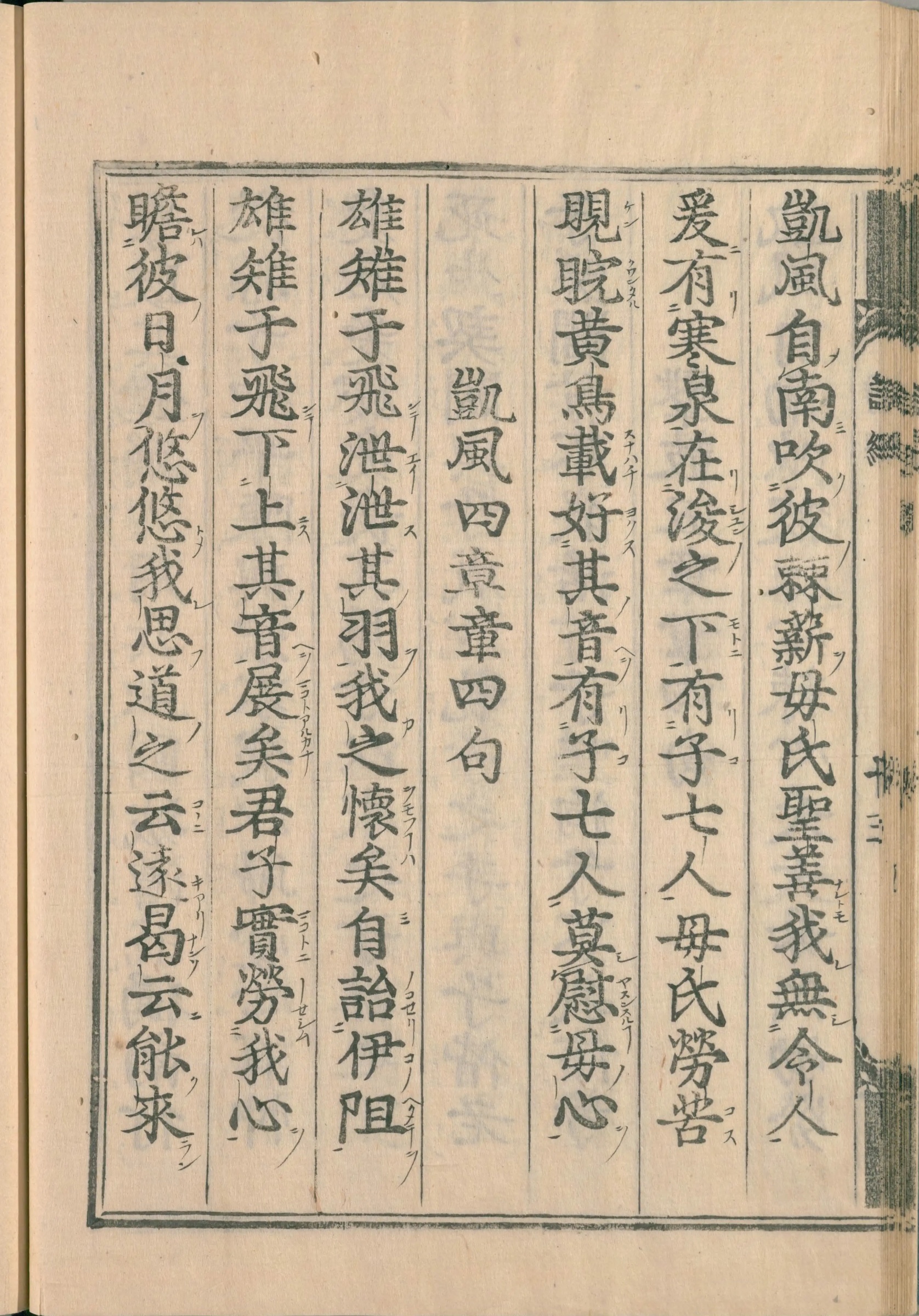
National Diet Library WA7-183, vol. [1], IIIF canvas 30, right-hand page: 7 columns of up to 17 characters, main text only, with Japanese reading marks. Checked on the image: stanza 2 opens column 1 ‹凱風自南›; stanza 3 opens column 2 ‹爰有寒泉›; stanza 4 opens column 3 ‹睍睆黃鳥›. Other columns on this page: column 4 is the count line of 凱風 (stanzas and lines). The Chinese shown is the Wikisource Mao text, not a transcription of this print; Legge's English translates the same text.
2凱風自南,吹彼棘薪;
母氏聖善,我無令人。
3爰有寒泉,在浚之下;
有子七人,母氏勞苦。
4睍睆黃鳥,載好其音;
有子七人,莫慰母心。
2The genial wind from the south
Blows on the branches of that jujube tree,
Our mother is wise and good;
But among us there is none good.
3There is the cool spring
Below [the city of] Tseun.
We are seven sons,
And our mother is full of pain and suffering.
4The beautiful yellow birds
Give forth their pleasant notes.
We are seven sons,
And cannot compose our mother's heart.
Notes
- English: James Legge, The She King, The Chinese Classics vol. IV part I (1871), Part I, Lessons from the States, Book 3, ode VII (K'ae fung). Stanzas are numbered as in Legge and the Mao text.
- Transcribed for this library from the page images: lines read alike by two OCR programs were kept, and every other line was read on the image (data/sources/shijing/legge1871/). Legge's notes are left out.
Cite
Sources
- Source: National Diet Library WA7-183 (Keicho-era movable-type print of the Shijing, vol. 1) + Wikisource Mao text + James Legge, The She King (Chinese Classics IV, 1871) (holding institution)
- Critical edition: Mao text (Wikisource)
← previous · → next · v cycle view · l back to library