Book of Odes, Mao 35: Gu feng 谷風 (Keicho-era print)
Introduction
谷風 (Gu feng, Mao 35) is ode X of 邶風 Bei feng ("the Airs of Bei"), the third book of the Airs of the States (國風 Guofeng), the 160 songs of the regional states that open the Book of Odes (詩經 Shijing). The Airs are generally dated to the Western and early Eastern Zhou (about the 10th to 7th century BCE). It has 6 stanzas.
The photographs are of a copy of the Book of Odes in the National Diet Library, Tokyo (call no. WA7-183), printed with movable type in Japan in the Keicho era (1596-1615): main text only, seven columns of seventeen characters to the page, with Japanese reading marks added by hand. Each stanza begins a new column, and a line giving the count of stanzas and lines follows each ode. In this copy the ode runs from canvas 31, right-hand page to canvas 31, left-hand page of the first volume. Each section gathers the stanzas that begin on one page and links to that page and to any page the last stanza runs onto; the page boundaries were found by reading the first characters of every column on the photographs.
The Chinese is the Mao text from Wikisource. The English is James Legge's prose translation in The Chinese Classics, volume IV, part I (1871), Part I, Book 3, ode X (Kuh fung), page 55-58; his notes are not reproduced. Words in square brackets are Legge's own additions.
How was this verified? (Provenance)
Where on the image
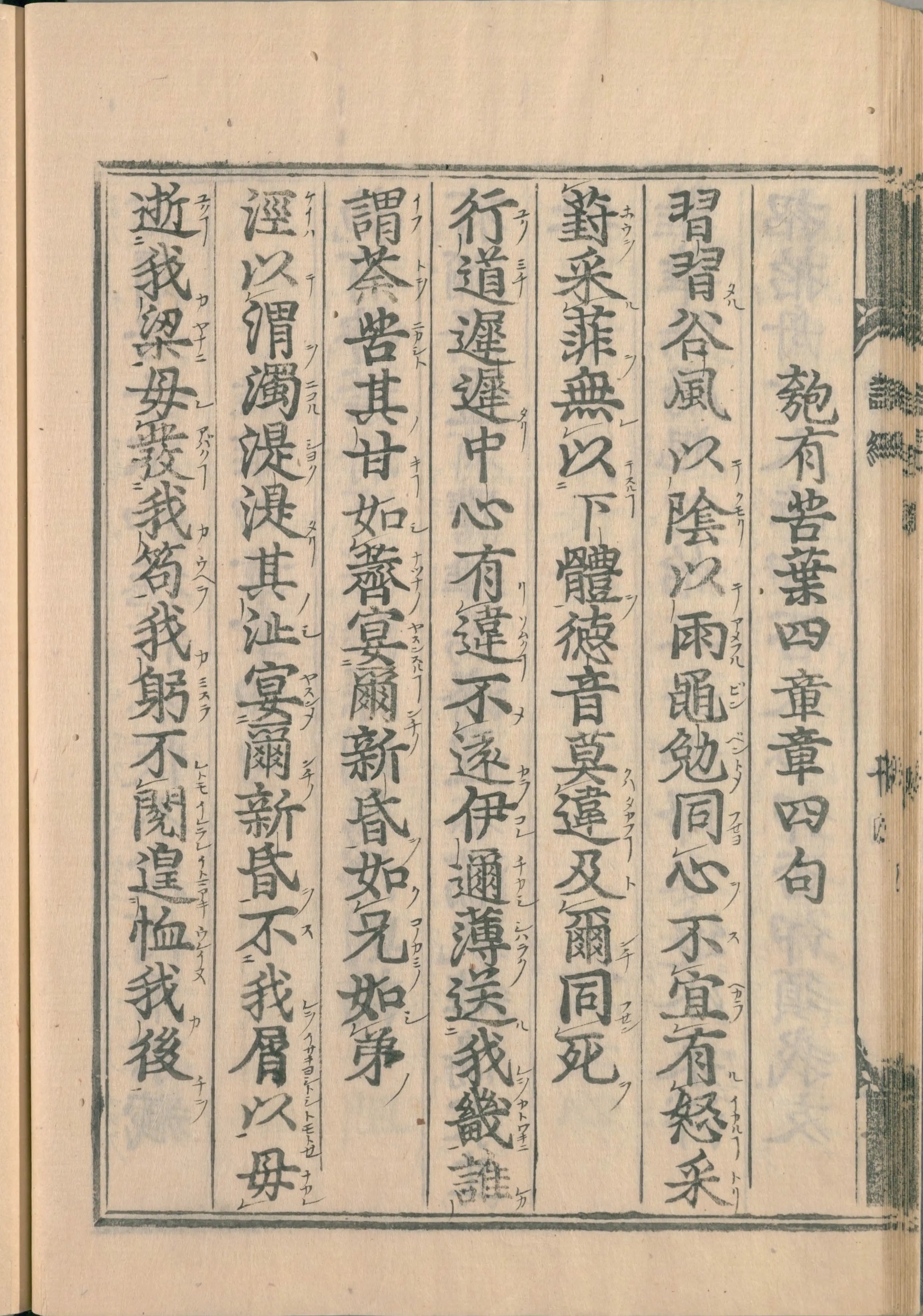
National Diet Library WA7-183, vol. [1], IIIF canvas 31, right-hand page: 7 columns of up to 17 characters, main text only, with Japanese reading marks. Checked on the image: stanza 1 opens column 2 ‹習習谷風›; stanza 2 opens column 4 ‹行道遲遲›; stanza 3 opens column 6 ‹涇以渭濁›. Other columns on this page: column 1 is the count line of 匏有苦葉 (stanzas and lines). The Chinese shown is the Wikisource Mao text, not a transcription of this print; Legge's English translates the same text.
1習習谷風,以陰以雨。黽勉同心,不宜有怒。
采葑采菲,無以下體?德音莫違,及爾同死。
2行道遲遲,中心有違。不遠伊邇,薄送我畿。
誰謂荼苦,其甘如薺。宴爾新昏,如兄如弟。
3涇以渭濁,湜湜其沚。宴爾新昏,不我屑以。
毋逝我梁,毋發我笱。我躬不閱,遑恤我後。
1Gently blows the east wind,
With cloudy skies and with rain.
[Husband and wife] should strive to be of the same mind,
And not let angry feelings arise.
When we gather the mustard plant and earth melons,
We do not reject them because of their roots.
While I do nothing contrary to my good name,
I should live with you till our death.
2I go along the road slowly, slowly,
In my inmost heart reluctant.
Not far, only a little way,
Did he accompany me to the threshold.
Who says that the sowthistle is bitter?
It is as sweet as the shepherd's purse.
You feast with your new wife,
[Loving] as brothers.
3The muddiness of the King appears from the Wei,
But its bottom may be seen about the islets.
You feast with your new wife,
And think me not worth being with.
Do not approach my dam,
Do not move my basket.
My person is rejected;—
What avails it to care for what may come after?
Where on the image
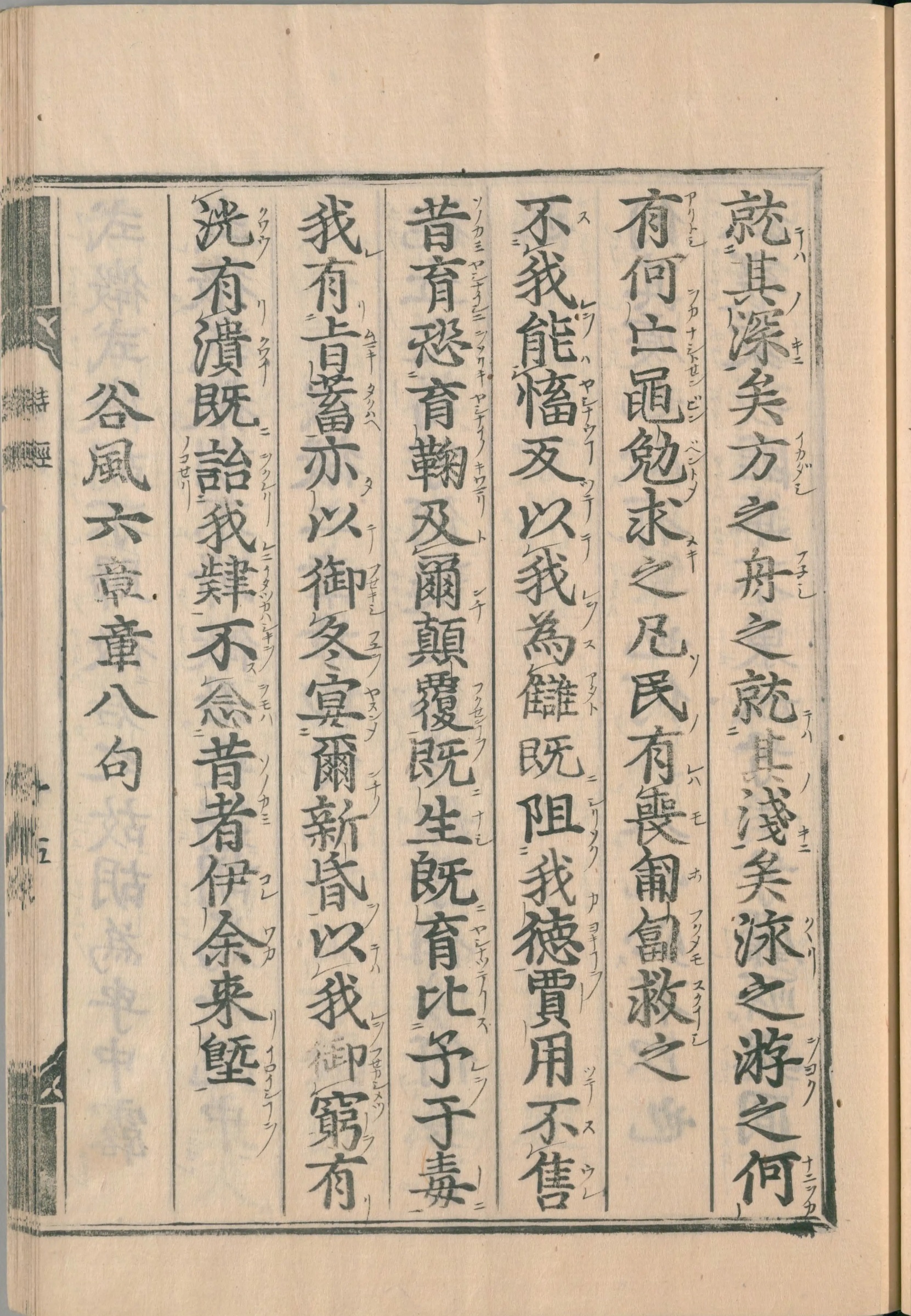
National Diet Library WA7-183, vol. [1], IIIF canvas 31, left-hand page: 7 columns of up to 17 characters, main text only, with Japanese reading marks. Checked on the image: stanza 4 opens column 1 ‹就其深矣›; stanza 5 opens column 3 ‹不我能慉›; stanza 6 opens column 5 ‹我有旨蓄›. Other columns on this page: column 7 is the count line of 谷風 (stanzas and lines). The Chinese shown is the Wikisource Mao text, not a transcription of this print; Legge's English translates the same text.
4就其深矣,方之舟之。就其淺矣,泳之游之。
何有何亡,黽勉求之。凡民有喪,匍匐救之。
5不我能慉,反以我為讎。既阻我德,賈用不售。
昔育恐育鞫,及爾顛覆。既生既育,比予于毒。
6我有旨蓄,亦以御冬。宴爾新昏,以我御窮。
有洸有潰,既詒我肄。不念昔者,伊余來塈。
4Where the water was deep,
I crossed it by a raft or a boat.
Where it was shallow,
I dived or swam across it.
Whether we had plenty or not,
I exerted myself to be getting.
When among others there was a death,
I crawled on my knees to help them.
5You cannot cherish me,
And you even count me as an enemy.
You disdain my virtues,—
A pedlar's wares which do not sell.
Formerly, I was afraid our means might be exhausted,
And I might come with you to destitution.
Now, when your means are abundant,
You compare me to poison.
6My fine collection of vegetables
Is but a provision against the winter.
Feasting with your new wife,
You think of me as a provision [only] against your poverty.
Cavalierly and angrily you treat me;
You give me only pain.
You do not think of the former days,
And are only angry with me.
Notes
- English: James Legge, The She King, The Chinese Classics vol. IV part I (1871), Part I, Lessons from the States, Book 3, ode X (Kuh fung). Stanzas are numbered as in Legge and the Mao text.
- Transcribed for this library from the page images: lines read alike by two OCR programs were kept, and every other line was read on the image (data/sources/shijing/legge1871/). Legge's notes are left out.
Cite
Sources
- Source: National Diet Library WA7-183 (Keicho-era movable-type print of the Shijing, vol. 1) + Wikisource Mao text + James Legge, The She King (Chinese Classics IV, 1871) (holding institution)
- Critical edition: Mao text (Wikisource)
← previous · → next · v cycle view · l back to library