Book of Odes, Mao 38: Jian xi 簡兮 (Keicho-era print)
Introduction
簡兮 (Jian xi, Mao 38) is ode XIII of 邶風 Bei feng ("the Airs of Bei"), the third book of the Airs of the States (國風 Guofeng), the 160 songs of the regional states that open the Book of Odes (詩經 Shijing). The Airs are generally dated to the Western and early Eastern Zhou (about the 10th to 7th century BCE). It has 4 stanzas, as Legge, Zhu Xi and this print divide it (the Wikisource text, following the Mao division, has 3; its verses are regrouped here to match).
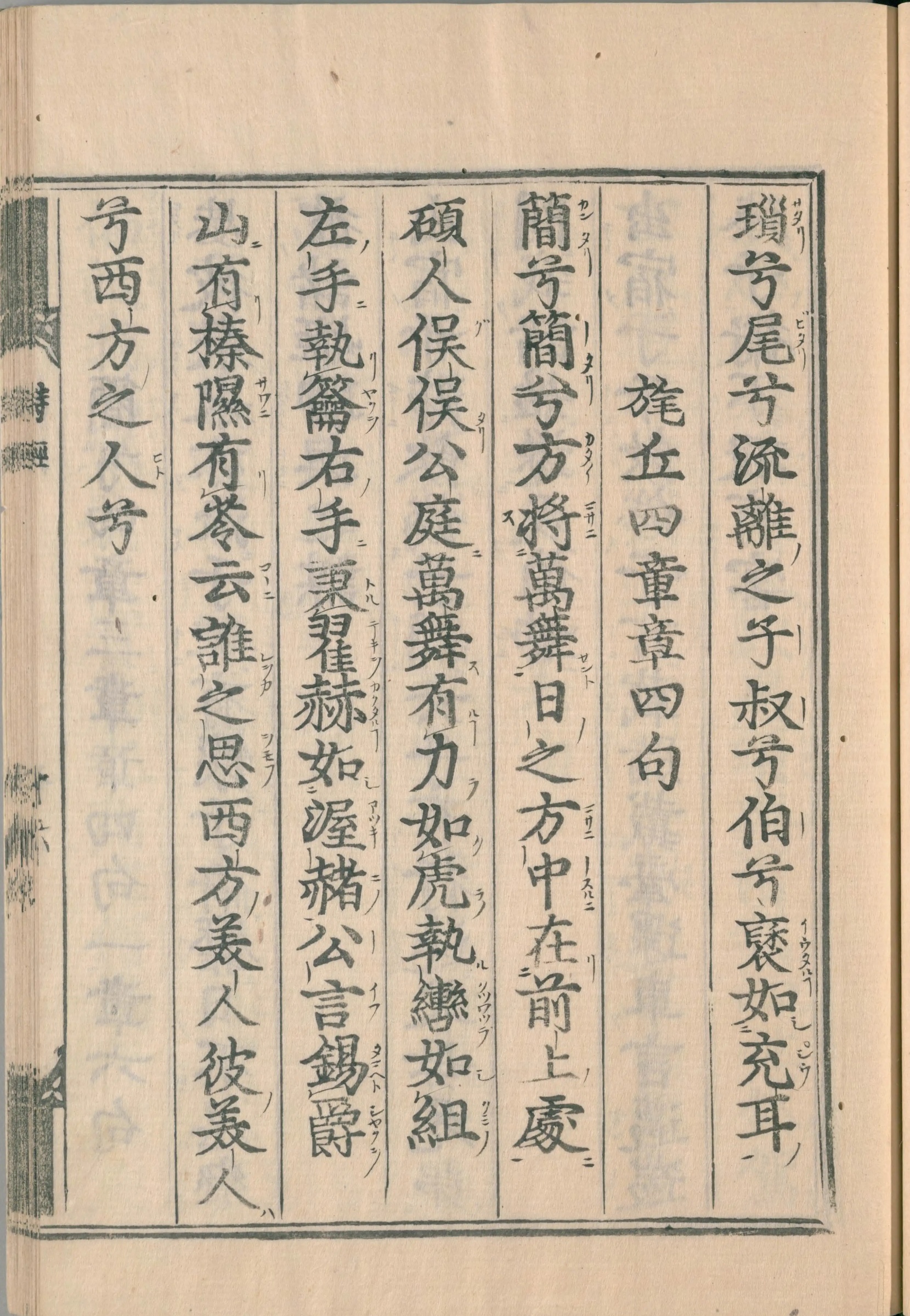
The photographs are of a copy of the Book of Odes in the National Diet Library, Tokyo (call no. WA7-183), printed with movable type in Japan in the Keicho era (1596-1615): main text only, seven columns of seventeen characters to the page, with Japanese reading marks added by hand. Each stanza begins a new column, and a line giving the count of stanzas and lines follows each ode. In this copy the ode runs from canvas 32, left-hand page to canvas 33, right-hand page of the first volume. Each section gathers the stanzas that begin on one page and links to that page and to any page the last stanza runs onto; the page boundaries were found by reading the first characters of every column on the photographs.
The Chinese is the Mao text from Wikisource. The English is James Legge's prose translation in The Chinese Classics, volume IV, part I (1871), Part I, Book 3, ode XIII (Këen he), page 61-62; his notes are not reproduced. Words in square brackets are Legge's own additions.
How was this verified? (Provenance)
Where on the image
National Diet Library WA7-183, vol. [1], IIIF canvas 32, left-hand page: 7 columns of up to 17 characters, main text only, with Japanese reading marks. Checked on the image: stanza 1 opens column 3 ‹簡兮簡兮›; stanza 2 opens column 4 ‹碩人俁俁›; stanza 3 opens column 5 ‹左手執籥›; stanza 4 opens column 6 ‹山有榛隰›. Other columns on this page: column 2 is the count line of 旄丘 (stanzas and lines). The Chinese shown is the Wikisource Mao text, not a transcription of this print; Legge's English translates the same text.
1簡兮簡兮,方將萬舞,日之方中,在前上處,
2碩人俁俁,公庭萬舞。有力如虎,執轡如組,
3左手執籥,右手秉翟,赫如渥赭,公言錫爵。
4山有榛,隰有苓,云誰之思,西方美人,彼美人兮,西方之人兮。
1Easy and indifferent! easy and indifferent!
I am ready to perform in all dances,
Then when the sun is in the meridian,
There in that conspicuous place.
2With my large figure,
I dance in the ducal courtyard.
I am strong [also] as a tiger;
The reins are in my grasp like ribbons.
3In my left hand I grasp a flute;
In my right I hold a pheasant's feather.
I am red as if I were rouged;
The duke gives me a cup [of spirits].
4The hazel grows on the hills,
And the liquorice in the marshes.
Of whom are my thoughts?
Of the fine men of the west.
O those fine men!
Those men of the west!
Notes
- English: James Legge, The She King, The Chinese Classics vol. IV part I (1871), Part I, Lessons from the States, Book 3, ode XIII (Këen he). Stanzas are numbered as in Legge and the Mao text.
- Transcribed for this library from the page images: lines read alike by two OCR programs were kept, and every other line was read on the image (data/sources/shijing/legge1871/). Legge's notes are left out.
Cite
Sources
- Source: National Diet Library WA7-183 (Keicho-era movable-type print of the Shijing, vol. 1) + Wikisource Mao text + James Legge, The She King (Chinese Classics IV, 1871) (holding institution)
- Critical edition: Mao text (Wikisource)
← previous · → next · v cycle view · l back to library