Book of Odes, Mao 39: Quan shui 泉水 (Keicho-era print)
Introduction
泉水 (Quan shui, Mao 39) is ode XIV of 邶風 Bei feng ("the Airs of Bei"), the third book of the Airs of the States (國風 Guofeng), the 160 songs of the regional states that open the Book of Odes (詩經 Shijing). The Airs are generally dated to the Western and early Eastern Zhou (about the 10th to 7th century BCE). It has 4 stanzas.
The photographs are of a copy of the Book of Odes in the National Diet Library, Tokyo (call no. WA7-183), printed with movable type in Japan in the Keicho era (1596-1615): main text only, seven columns of seventeen characters to the page, with Japanese reading marks added by hand. Each stanza begins a new column, and a line giving the count of stanzas and lines follows each ode. In this copy the ode runs from canvas 33, right-hand page to canvas 33, left-hand page of the first volume. Each section gathers the stanzas that begin on one page and links to that page and to any page the last stanza runs onto; the page boundaries were found by reading the first characters of every column on the photographs.
The Chinese is the Mao text from Wikisource. The English is James Legge's prose translation in The Chinese Classics, volume IV, part I (1871), Part I, Book 3, ode XIV (Ts'euen shwuy), page 63-64; his notes are not reproduced. Words in square brackets are Legge's own additions.
How was this verified? (Provenance)
Where on the image
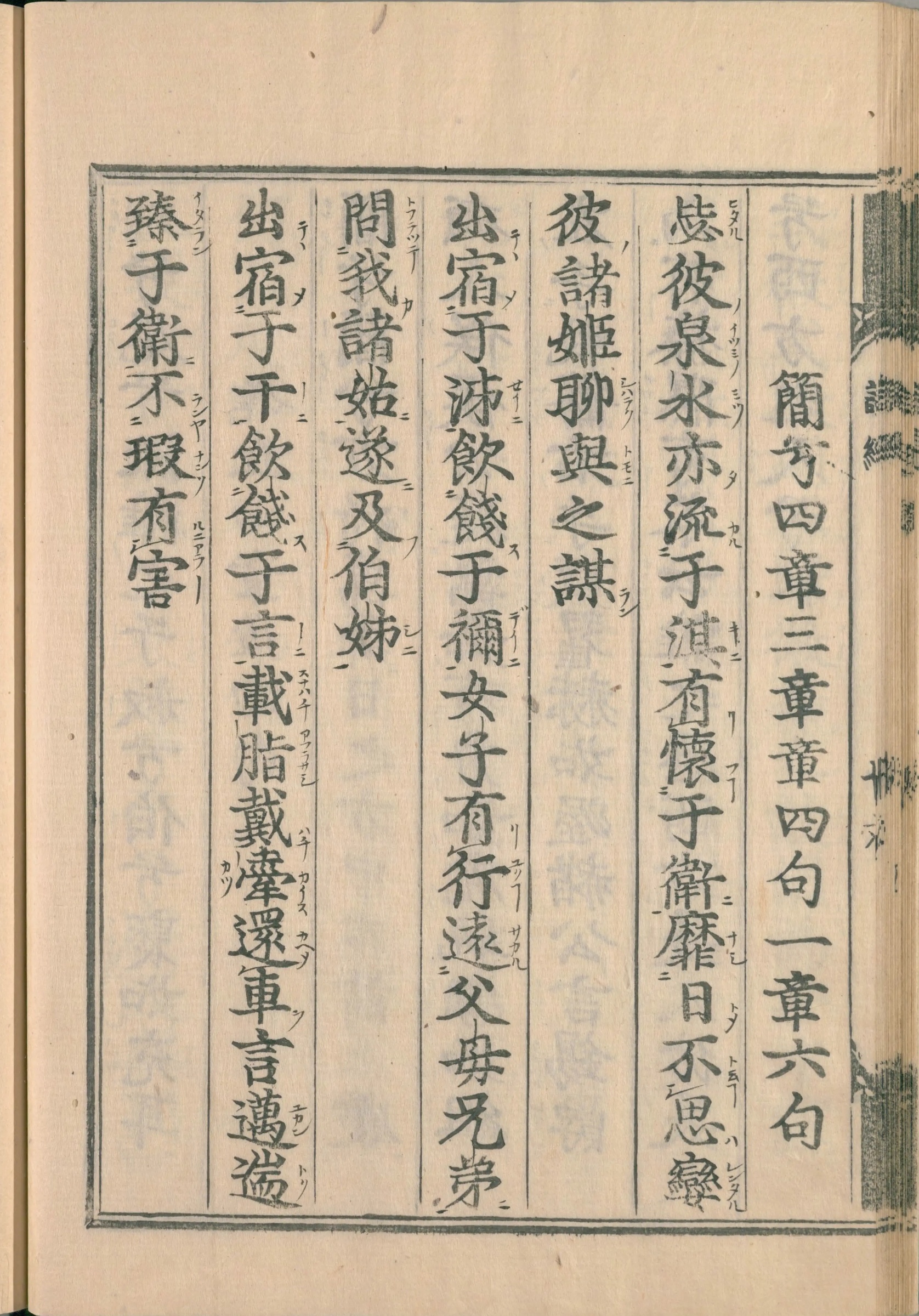
National Diet Library WA7-183, vol. [1], IIIF canvas 33, right-hand page: 7 columns of up to 17 characters, main text only, with Japanese reading marks. Checked on the image: stanza 1 opens column 2 ‹毖彼泉水›; stanza 2 opens column 4 ‹出宿于泲›; stanza 3 opens column 6 ‹出宿于干›. Other columns on this page: column 1 is the count line of 簡兮 (stanzas and lines). The Chinese shown is the Wikisource Mao text, not a transcription of this print; Legge's English translates the same text.
1毖彼泉水,亦流于淇,有懷于衞,靡日不思,孌彼諸姬,聊與之謀。
2出宿于泲,飲餞于禰,女子有行,遠父母兄弟,問我諸姑,遂及伯姊。
3出宿于干,飲餞于言,載脂載舝,還車言邁,遄臻于衞,不瑕有害。
1How the water bubbles up from that spring,
And flows away to the K'e!
My heart is in Wei;
There is not a day I do not think of it.
Admirable are those, my cousins;
I will take counsel with them.
2When I came forth, I lodged in Tse,
And we drank the cup of convoy at Ne.
When a young lady goes [to be married],
She leaves her parents and brothers;
[But] I would ask for my aunts,
And then for my elder sister.
3I will go forth and lodge in Kan,
And we will drink the cup of convoy at Yen.
I will grease the axle and fix the pin,
And the returning chariot will proceed.
Quickly shall we arrive in Wei;—
But would not this be wrong?
Where on the image
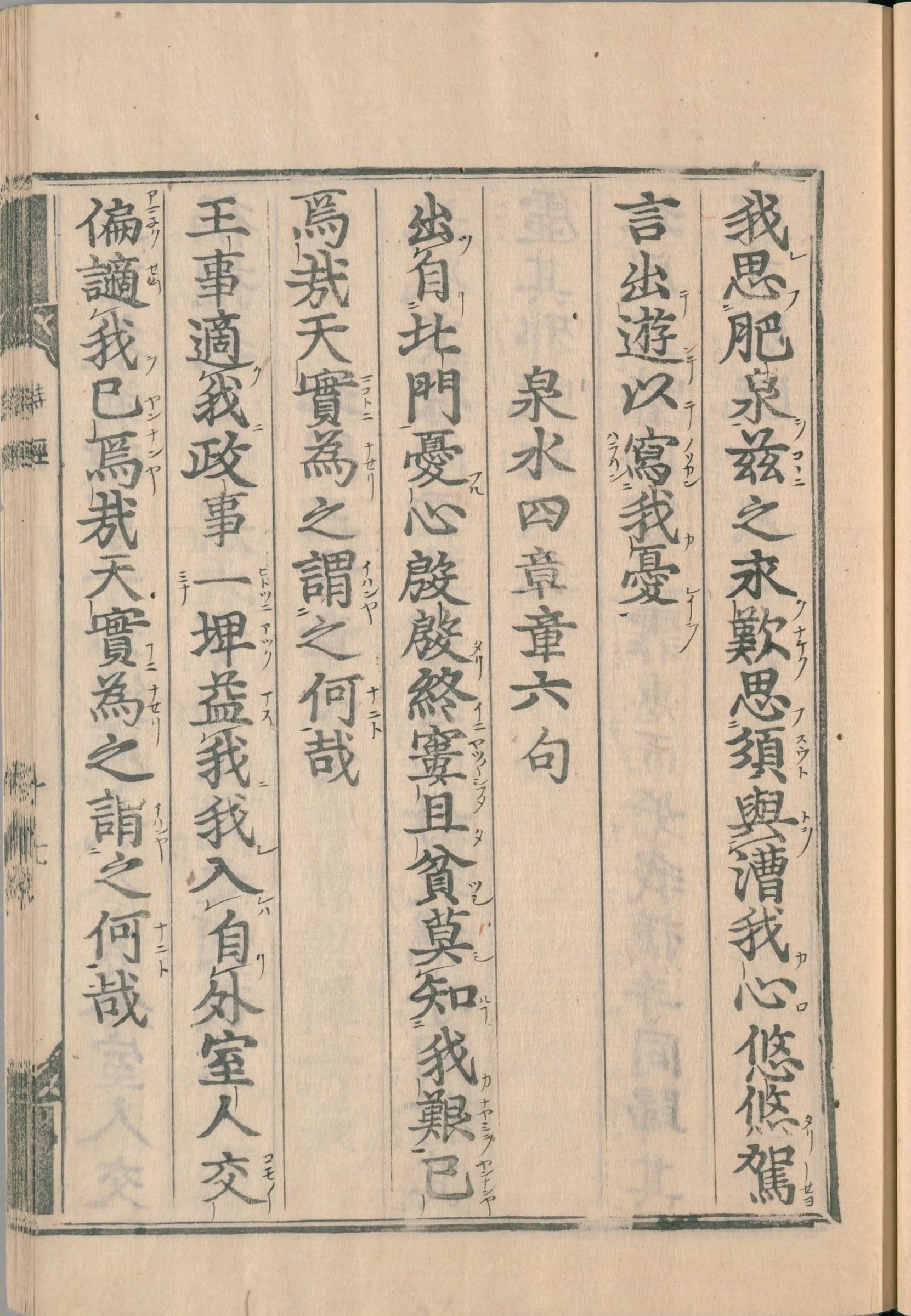
National Diet Library WA7-183, vol. [1], IIIF canvas 33, left-hand page: 7 columns of up to 17 characters, main text only, with Japanese reading marks. Checked on the image: stanza 4 opens column 1 ‹我思肥泉›. Other columns on this page: column 3 is the count line of 泉水 (stanzas and lines). The Chinese shown is the Wikisource Mao text, not a transcription of this print; Legge's English translates the same text.
4我思肥泉,茲之永歎,思須與漕,我心悠悠,駕言出遊,以寫我憂。
4I think of the Fei-ts'euen,
I am ever sighing about it.
I think of Seu and Ts'aou,
Long, long, my heart dwells with them.
Let me drive forth and travel there,
To dissipate my sorrow.
Notes
- English: James Legge, The She King, The Chinese Classics vol. IV part I (1871), Part I, Lessons from the States, Book 3, ode XIV (Ts'euen shwuy). Stanzas are numbered as in Legge and the Mao text.
- Transcribed for this library from the page images: lines read alike by two OCR programs were kept, and every other line was read on the image (data/sources/shijing/legge1871/). Legge's notes are left out.
Cite
Sources
- Source: National Diet Library WA7-183 (Keicho-era movable-type print of the Shijing, vol. 1) + Wikisource Mao text + James Legge, The She King (Chinese Classics IV, 1871) (holding institution)
- Critical edition: Mao text (Wikisource)
← previous · → next · v cycle view · l back to library