Book of Odes, Mao 40: Bei men 北門 (Keicho-era print)
Introduction
北門 (Bei men, Mao 40) is ode XV of 邶風 Bei feng ("the Airs of Bei"), the third book of the Airs of the States (國風 Guofeng), the 160 songs of the regional states that open the Book of Odes (詩經 Shijing). The Airs are generally dated to the Western and early Eastern Zhou (about the 10th to 7th century BCE). It has 3 stanzas.
The photographs are of a copy of the Book of Odes in the National Diet Library, Tokyo (call no. WA7-183), printed with movable type in Japan in the Keicho era (1596-1615): main text only, seven columns of seventeen characters to the page, with Japanese reading marks added by hand. Each stanza begins a new column, and a line giving the count of stanzas and lines follows each ode. In this copy the ode runs from canvas 33, left-hand page to canvas 34, right-hand page of the first volume. Each section gathers the stanzas that begin on one page and links to that page and to any page the last stanza runs onto; the page boundaries were found by reading the first characters of every column on the photographs.
The Chinese is the Mao text from Wikisource. The English is James Legge's prose translation in The Chinese Classics, volume IV, part I (1871), Part I, Book 3, ode XV (Pih mun), page 65-66; his notes are not reproduced. Words in square brackets are Legge's own additions.
How was this verified? (Provenance)
Where on the image
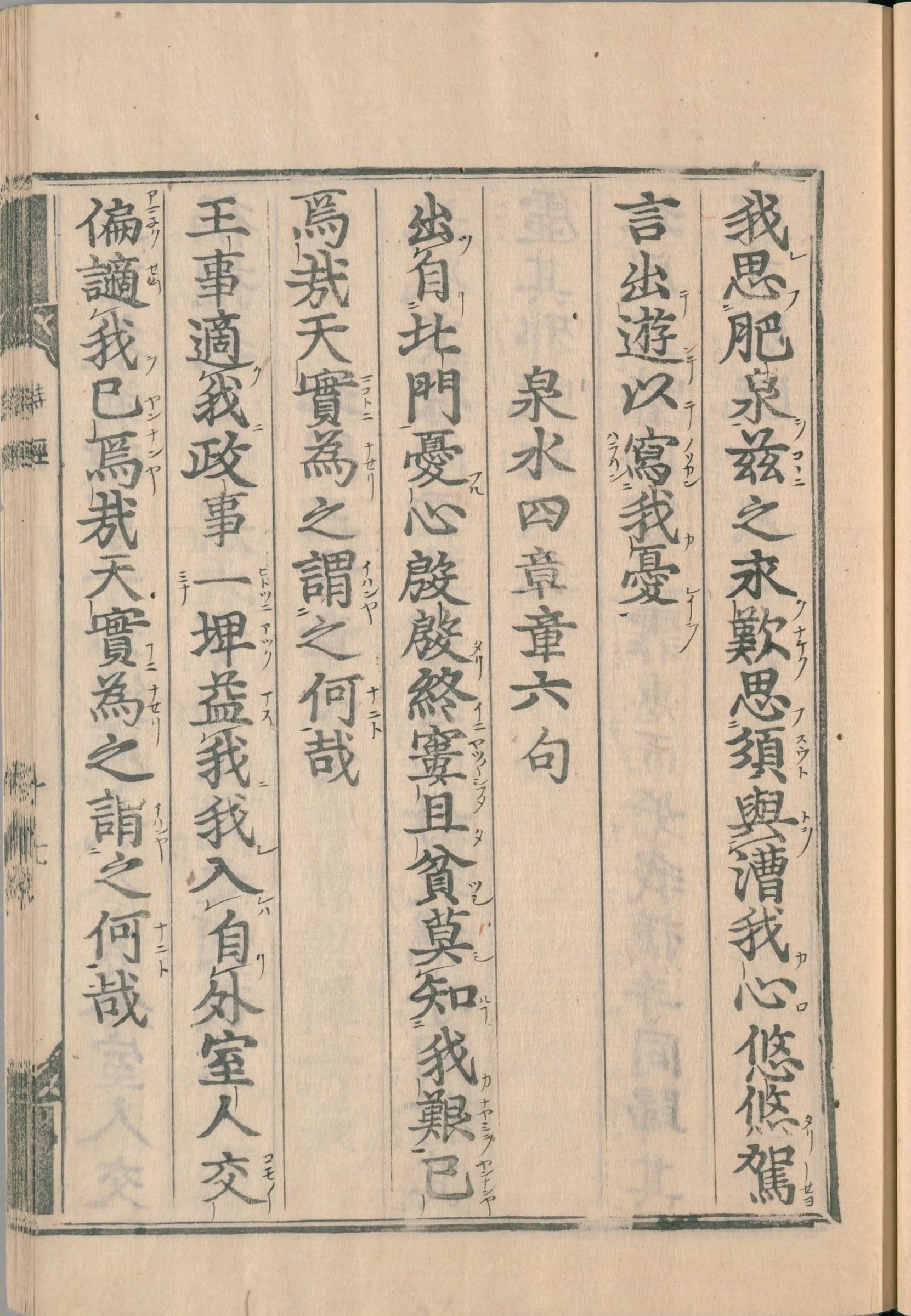
National Diet Library WA7-183, vol. [1], IIIF canvas 33, left-hand page: 7 columns of up to 17 characters, main text only, with Japanese reading marks. Checked on the image: stanza 1 opens column 4 ‹出自北門›; stanza 2 opens column 6 ‹王事適我›. Other columns on this page: column 3 is the count line of 泉水 (stanzas and lines). The Chinese shown is the Wikisource Mao text, not a transcription of this print; Legge's English translates the same text.
1出自北門,憂心殷殷,終窶且貧,莫知我艱,已焉哉,天實為之,謂之何哉。
2王事適我,政事一埤益我,我入自外,室人交徧讁我,已焉哉,天實為之,謂之何哉。
1I go out at the north gate,
With my heart full of sorrow.
Straitened am I and poor,
And no one takes knowledge of my distress.
So it is!
Heaven has done it;—
What then shall I say?
2The king's business comes on me,
And the affairs of our government in increasing measure.
When I come home from abroad,
The members of my family all emulously reproach me.
So it is!
Heaven has done it;—
What then shall I say?
Where on the image
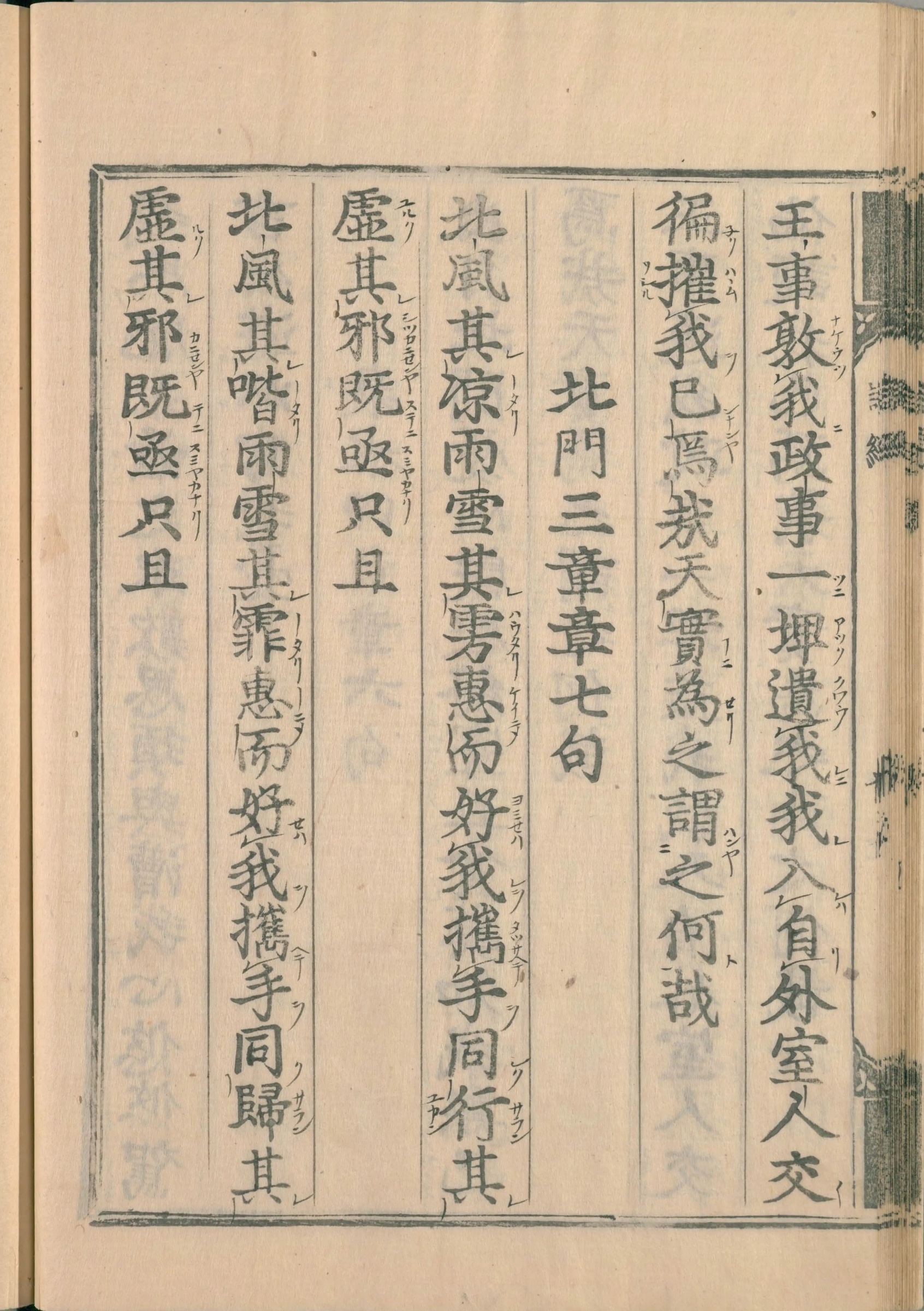
National Diet Library WA7-183, vol. [1], IIIF canvas 34, right-hand page: 7 columns of up to 17 characters, main text only, with Japanese reading marks. Checked on the image: stanza 3 opens column 1 ‹王事敦我›. Other columns on this page: column 3 is the count line of 北門 (stanzas and lines). The Chinese shown is the Wikisource Mao text, not a transcription of this print; Legge's English translates the same text.
3王事敦我,政事一埤遺我,我入自外,室人交徧摧我,已焉哉,天實為之,謂之何哉。
3The king's business is thrown on me,
And the affairs of our government are left to me more and more.
When I come home from abroad,
The members of my family all emulously thrust at me.
So it is!
Heaven has done it;—
What then shall I say?
Notes
- English: James Legge, The She King, The Chinese Classics vol. IV part I (1871), Part I, Lessons from the States, Book 3, ode XV (Pih mun). Stanzas are numbered as in Legge and the Mao text.
- Transcribed for this library from the page images: lines read alike by two OCR programs were kept, and every other line was read on the image (data/sources/shijing/legge1871/). Legge's notes are left out.
Cite
Sources
- Source: National Diet Library WA7-183 (Keicho-era movable-type print of the Shijing, vol. 1) + Wikisource Mao text + James Legge, The She King (Chinese Classics IV, 1871) (holding institution)
- Critical edition: Mao text (Wikisource)
← previous · → next · v cycle view · l back to library