Book of Odes, Mao 47: Junzi xie lao 君子偕老 (Keicho-era print)
Introduction
君子偕老 (Junzi xie lao, Mao 47) is ode III of 鄘風 Yong feng ("the Airs of Yong"), the fourth book of the Airs of the States (國風 Guofeng), the 160 songs of the regional states that open the Book of Odes (詩經 Shijing). The Airs are generally dated to the Western and early Eastern Zhou (about the 10th to 7th century BCE). It has 3 stanzas.
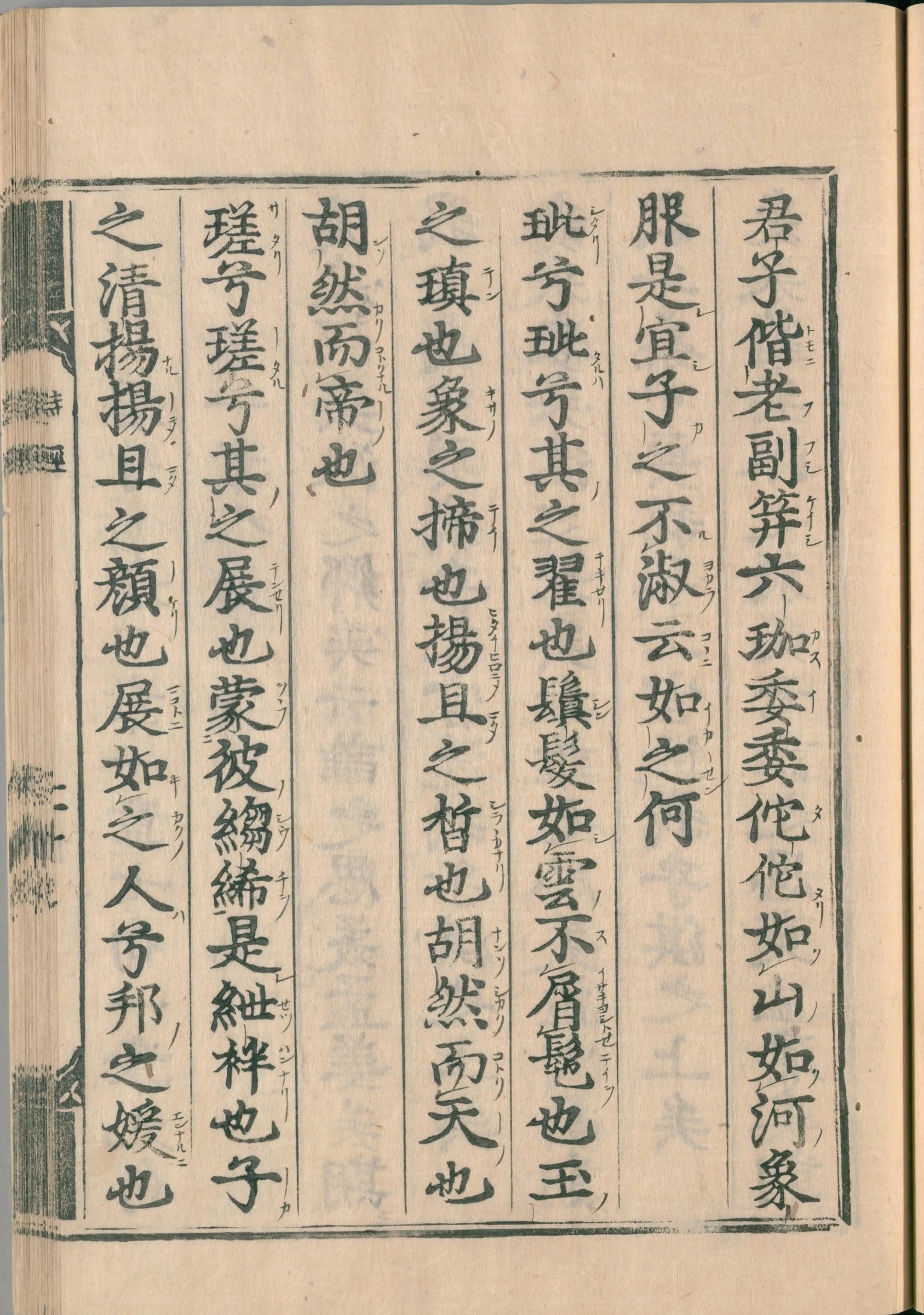
The photographs are of a copy of the Book of Odes in the National Diet Library, Tokyo (call no. WA7-183), printed with movable type in Japan in the Keicho era (1596-1615): main text only, seven columns of seventeen characters to the page, with Japanese reading marks added by hand. Each stanza begins a new column, and a line giving the count of stanzas and lines follows each ode. In this copy the ode runs from canvas 36, left-hand page to canvas 37, right-hand page of the first volume. Each section gathers the stanzas that begin on one page and links to that page and to any page the last stanza runs onto; the page boundaries were found by reading the first characters of every column on the photographs.
The Chinese is the Mao text from Wikisource. The English is James Legge's prose translation in The Chinese Classics, volume IV, part I (1871), Part I, Book 4, ode III (Keun-tsz' këae laou), page 76-78; his notes are not reproduced. Words in square brackets are Legge's own additions.
How was this verified? (Provenance)
Where on the image
National Diet Library WA7-183, vol. [1], IIIF canvas 36, left-hand page: 7 columns of up to 17 characters, main text only, with Japanese reading marks. Checked on the image: stanza 1 opens column 1 ‹君子偕老›; stanza 2 opens column 3 ‹玼兮玼兮›; stanza 3 opens column 6 ‹瑳兮瑳兮›. The Chinese shown is the Wikisource Mao text, not a transcription of this print; Legge's English translates the same text.
1君子偕老,副笄六珈。
委委佗佗,如山如河。
象服是宜。
子之不淑,云如之何。
2玼兮玼兮,其之翟也。
鬒髮如雲,不屑髢也。
玉之瑱也,象之揥也。
揚且之晳也,
胡然而天也,
胡然而帝也。
3瑳兮瑳兮,其之展也。
蒙彼縐絺,是紲袢也。
子之清揚,揚且之顏也。
展如之人兮,邦之媛也。
1The husband's to their old age;
In her headdress, and the cross-pins, with their six jewels;
Easy and elegant in her movements;
[Stately] as a mountain, [majestic] as a river,
Well beseeming her pictured robes:—
[But] with your want of virtue, O lady,
What have you to do with these things?
2How rich and splendid
Is her pheasant-figured robe!
Her black hair in masses like clouds,
No false locks does she descend to.
There are her ear-plugs of jade,
Her comb-pin of ivory,
And her high forehead, so white.
She appears like a visitant from heaven!
She appears like a goddess!
3How rich and splendid
Is her robe of state!
It is worn over the finest muslin of dolichos,
The more cumbrous and warm garment being removed.
Clear are her eyes; fine is her forehead;
Full are her temples.
Ah! such a woman as this!
The beauty of the country!
Notes
- English: James Legge, The She King, The Chinese Classics vol. IV part I (1871), Part I, Lessons from the States, Book 4, ode III (Keun-tsz' këae laou). Stanzas are numbered as in Legge and the Mao text.
- Transcribed for this library from the page images: lines read alike by two OCR programs were kept, and every other line was read on the image (data/sources/shijing/legge1871/). Legge's notes are left out.
Cite
Sources
- Source: National Diet Library WA7-183 (Keicho-era movable-type print of the Shijing, vol. 1) + Wikisource Mao text + James Legge, The She King (Chinese Classics IV, 1871) (holding institution)
- Critical edition: Mao text (Wikisource)
← previous · → next · v cycle view · l back to library