Book of Odes, Mao 50: Ding zhi fang zhong 定之方中 (Keicho-era print)
Introduction
定之方中 (Ding zhi fang zhong, Mao 50) is ode VI of 鄘風 Yong feng ("the Airs of Yong"), the fourth book of the Airs of the States (國風 Guofeng), the 160 songs of the regional states that open the Book of Odes (詩經 Shijing). The Airs are generally dated to the Western and early Eastern Zhou (about the 10th to 7th century BCE). It has 3 stanzas.
The photographs are of a copy of the Book of Odes in the National Diet Library, Tokyo (call no. WA7-183), printed with movable type in Japan in the Keicho era (1596-1615): main text only, seven columns of seventeen characters to the page, with Japanese reading marks added by hand. Each stanza begins a new column, and a line giving the count of stanzas and lines follows each ode. In this copy the ode runs from canvas 37, left-hand page to canvas 38, right-hand page of the first volume. Each section gathers the stanzas that begin on one page and links to that page and to any page the last stanza runs onto; the page boundaries were found by reading the first characters of every column on the photographs.
The Chinese is the Mao text from Wikisource. The English is James Legge's prose translation in The Chinese Classics, volume IV, part I (1871), Part I, Book 4, ode VI (Ting che fang chung), page 81-83; his notes are not reproduced. Words in square brackets are Legge's own additions.
How was this verified? (Provenance)
Where on the image
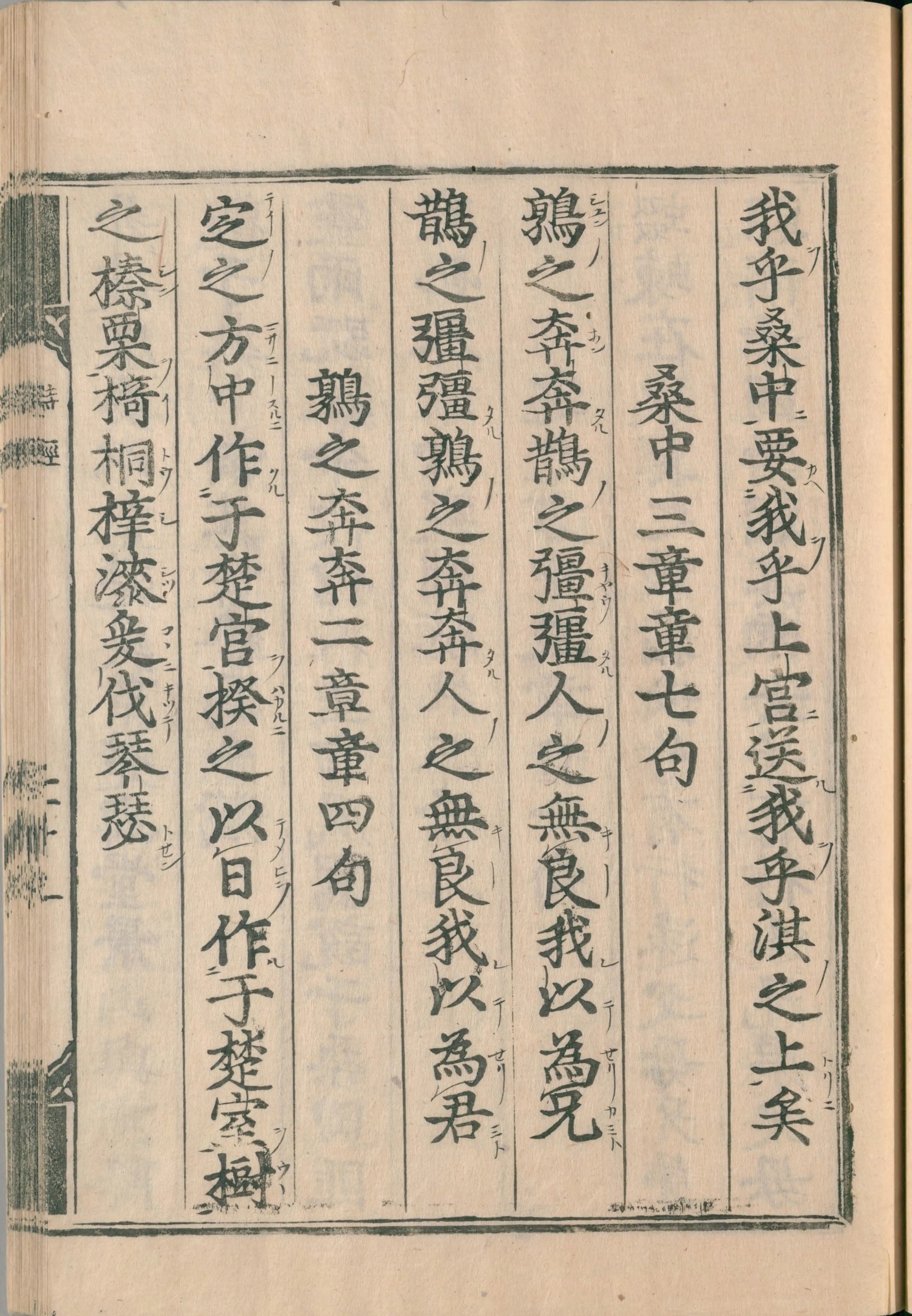
National Diet Library WA7-183, vol. [1], IIIF canvas 37, left-hand page: 7 columns of up to 17 characters, main text only, with Japanese reading marks. Checked on the image: stanza 1 opens column 6 ‹定之方中›. Other columns on this page: column 2 is the count line of 桑中 (stanzas and lines); column 5 is the count line of 鶉之奔奔 (stanzas and lines). The Chinese shown is the Wikisource Mao text, not a transcription of this print; Legge's English translates the same text.
1定之方中,作于楚宮,揆之以日,作于楚室,樹之榛栗,椅桐梓漆,爰伐琴瑟。
1When Ting culminated [at night-fall],
He began to build the palace at Ts'oo.
Determining its aspects by means of the sun,
He built the mansion at Ts'oo.
He planted about it hazel and chesnut trees,
The e, the t'ung, the tsze, and the varnish-tree,
Which, when cut down, might afford materials for lutes.
Where on the image
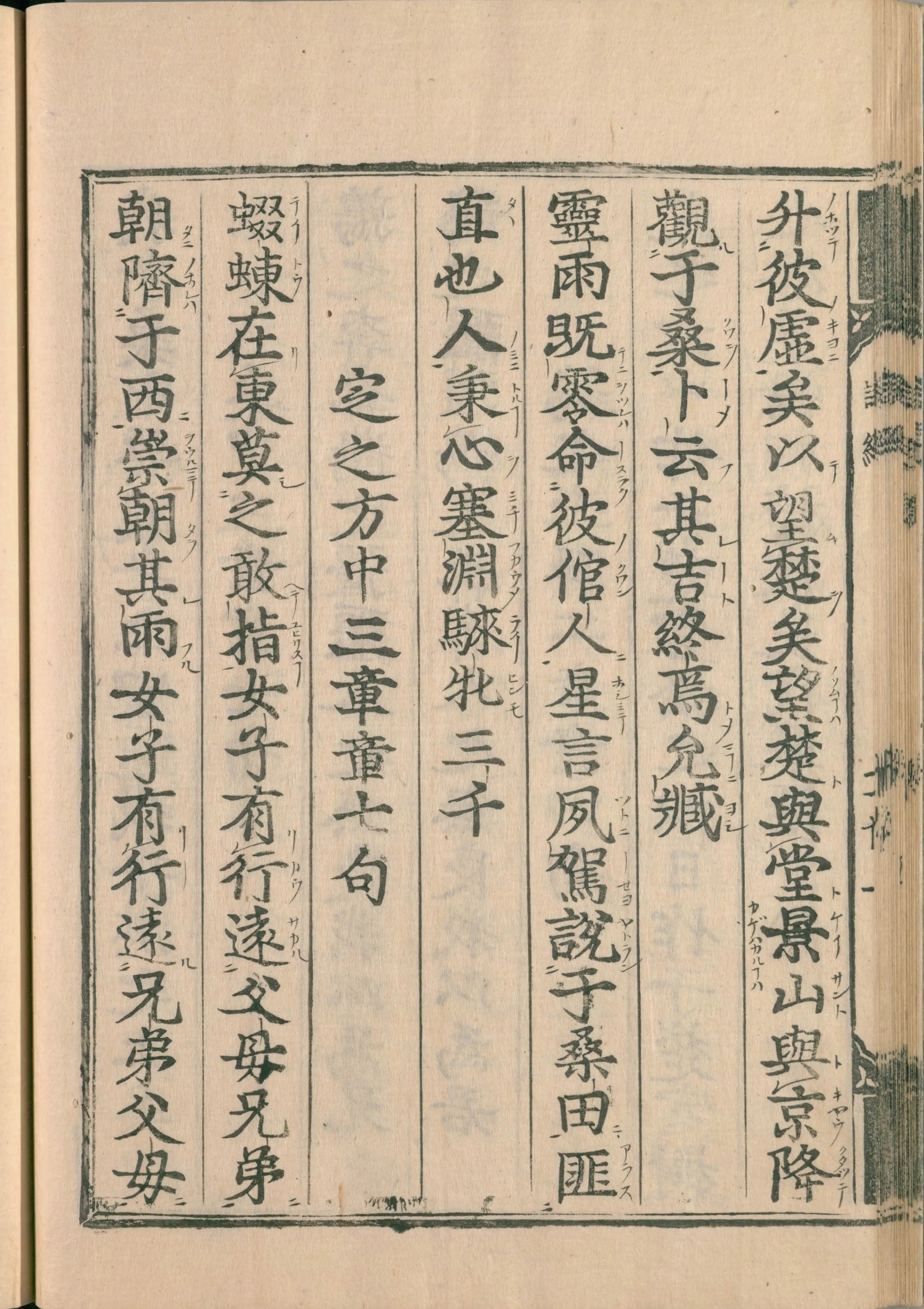
National Diet Library WA7-183, vol. [1], IIIF canvas 38, right-hand page: 7 columns of up to 17 characters, main text only, with Japanese reading marks. Checked on the image: stanza 2 opens column 1 ‹升彼虛矣›; stanza 3 opens column 3 ‹靈雨既零›. Other columns on this page: column 5 is the count line of 定之方中 (stanzas and lines). The Chinese shown is the Wikisource Mao text, not a transcription of this print; Legge's English translates the same text.
2升彼虛矣,以望楚矣,望楚與堂,景山與京,降觀于桑,卜云其吉,終然允臧。
3靈雨既零,命彼倌人,星言夙駕,說于桑田,匪直也人,秉心塞淵,騋牝三千。
2He ascended those old walls,
And thence surveyed [the site of] Ts'oo.
He surveyed Ts'oo and T'ang,
With the high hills and lofty elevations about:
He descended and examined the mulberry trees;
He then divined, and got a fortunate response;
And thus the issue has been truly good.
3When the good rains had fallen,
He would order his groom,
By starlight, in the morning, to yoke his carriage,
And would then stop among the mulberry trees and fields.
But not only thus did he show what he was;—
Maintaining in his heart a profound devotion to his duties,
His tall horses and mares amounted to three thousand.
Notes
- English: James Legge, The She King, The Chinese Classics vol. IV part I (1871), Part I, Lessons from the States, Book 4, ode VI (Ting che fang chung). Stanzas are numbered as in Legge and the Mao text.
- Transcribed for this library from the page images: lines read alike by two OCR programs were kept, and every other line was read on the image (data/sources/shijing/legge1871/). Legge's notes are left out.
Cite
Sources
- Source: National Diet Library WA7-183 (Keicho-era movable-type print of the Shijing, vol. 1) + Wikisource Mao text + James Legge, The She King (Chinese Classics IV, 1871) (holding institution)
- Critical edition: Mao text (Wikisource)
← previous · → next · v cycle view · l back to library