Book of Odes, Mao 51: Di dong 蝃蝀 (Keicho-era print)
Introduction
蝃蝀 (Di dong, Mao 51) is ode VII of 鄘風 Yong feng ("the Airs of Yong"), the fourth book of the Airs of the States (國風 Guofeng), the 160 songs of the regional states that open the Book of Odes (詩經 Shijing). The Airs are generally dated to the Western and early Eastern Zhou (about the 10th to 7th century BCE). It has 3 stanzas.
The photographs are of a copy of the Book of Odes in the National Diet Library, Tokyo (call no. WA7-183), printed with movable type in Japan in the Keicho era (1596-1615): main text only, seven columns of seventeen characters to the page, with Japanese reading marks added by hand. Each stanza begins a new column, and a line giving the count of stanzas and lines follows each ode. In this copy the ode runs from canvas 38, right-hand page to canvas 38, left-hand page of the first volume. Each section gathers the stanzas that begin on one page and links to that page and to any page the last stanza runs onto; the page boundaries were found by reading the first characters of every column on the photographs.
The Chinese is the Mao text from Wikisource. The English is James Legge's prose translation in The Chinese Classics, volume IV, part I (1871), Part I, Book 4, ode VII (Te tung), page 83-84; his notes are not reproduced. Words in square brackets are Legge's own additions.
How was this verified? (Provenance)
Where on the image
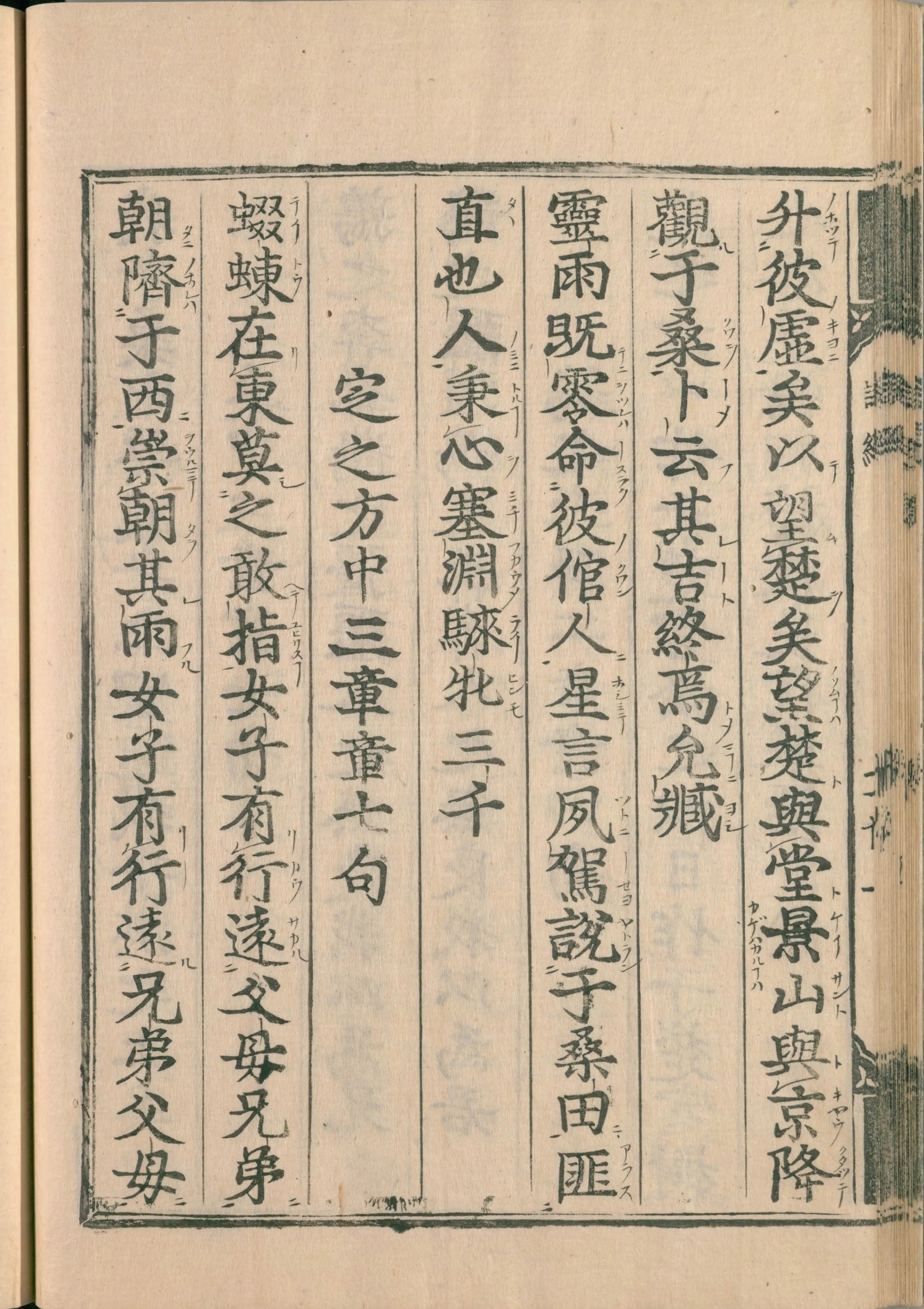
National Diet Library WA7-183, vol. [1], IIIF canvas 38, right-hand page: 7 columns of up to 17 characters, main text only, with Japanese reading marks. Checked on the image: stanza 1 opens column 6 ‹蝃蝀在東›; stanza 2 opens column 7 ‹朝隮于西›. Other columns on this page: column 5 is the count line of 定之方中 (stanzas and lines). The Chinese shown is the Wikisource Mao text, not a transcription of this print; Legge's English translates the same text.
1蝃蝀在東,莫之敢指,女子有行,遠父母兄弟。
2朝隮于西,崇朝其雨,女子有行,遠兄弟父母。
1There is a rainbow in the east,
And no one dares to point to it.
When a girl goes away [from her home],
She separates from her parents and brothers.
2In the morning [a rainbow] rises in the west,
And [only] during the morning is there rain.
When a girl goes away [from her home],
She separates from her brothers and parents.
Where on the image
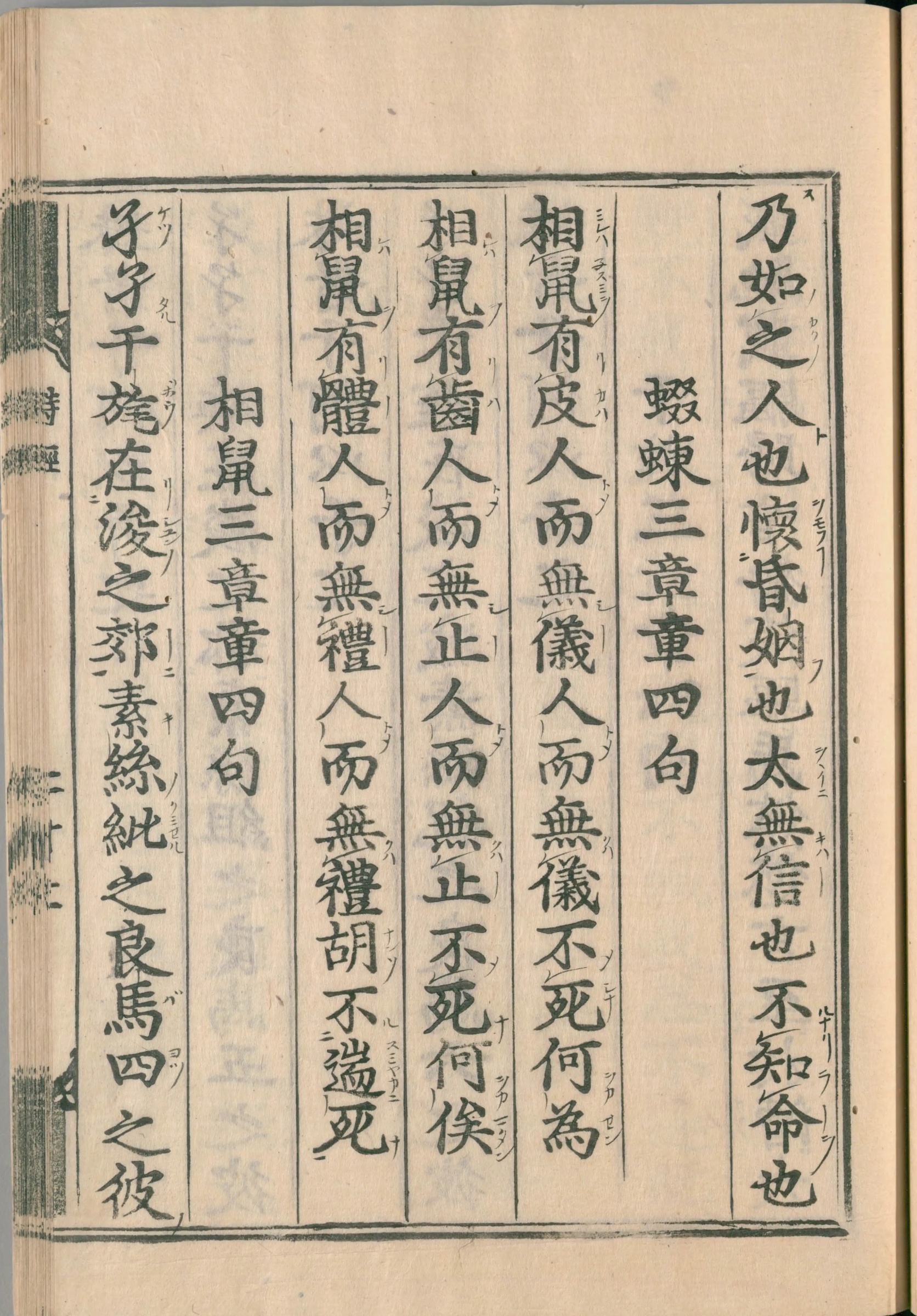
National Diet Library WA7-183, vol. [1], IIIF canvas 38, left-hand page: 7 columns of up to 17 characters, main text only, with Japanese reading marks. Checked on the image: stanza 3 opens column 1 ‹乃如之人›. Other columns on this page: column 2 is the count line of 蝃蝀 (stanzas and lines); column 6 is the count line of 相鼠 (stanzas and lines). The Chinese shown is the Wikisource Mao text, not a transcription of this print; Legge's English translates the same text.
3乃如之人也,懷昏姻也,大無信也,不知命也。
3This person
Has her heart only on being married.
Greatly is she untrue to herself,
And does not recognize [the law of] her lot.
Notes
- English: James Legge, The She King, The Chinese Classics vol. IV part I (1871), Part I, Lessons from the States, Book 4, ode VII (Te tung). Stanzas are numbered as in Legge and the Mao text.
- Transcribed for this library from the page images: lines read alike by two OCR programs were kept, and every other line was read on the image (data/sources/shijing/legge1871/). Legge's notes are left out.
Cite
Sources
- Source: National Diet Library WA7-183 (Keicho-era movable-type print of the Shijing, vol. 1) + Wikisource Mao text + James Legge, The She King (Chinese Classics IV, 1871) (holding institution)
- Critical edition: Mao text (Wikisource)
← previous · → next · v cycle view · l back to library