Book of Odes, Mao 54: Zai chi 載馳 (Keicho-era print)
Introduction
載馳 (Zai chi, Mao 54) is ode X of 鄘風 Yong feng ("the Airs of Yong"), the fourth book of the Airs of the States (國風 Guofeng), the 160 songs of the regional states that open the Book of Odes (詩經 Shijing). The Airs are generally dated to the Western and early Eastern Zhou (about the 10th to 7th century BCE). It has 4 stanzas, as Legge, Zhu Xi and this print divide it (the Wikisource text, following the Mao division, has 5; its verses are regrouped here to match).
The photographs are of a copy of the Book of Odes in the National Diet Library, Tokyo (call no. WA7-183), printed with movable type in Japan in the Keicho era (1596-1615): main text only, seven columns of seventeen characters to the page, with Japanese reading marks added by hand. Each stanza begins a new column, and a line giving the count of stanzas and lines follows each ode. In this copy the ode runs from canvas 39, right-hand page to canvas 40, right-hand page of the first volume. Each section gathers the stanzas that begin on one page and links to that page and to any page the last stanza runs onto; the page boundaries were found by reading the first characters of every column on the photographs.
The Chinese is the Mao text from Wikisource. The English is James Legge's prose translation in The Chinese Classics, volume IV, part I (1871), Part I, Book 4, ode X (Tsae ch'e), page 87-89; his notes are not reproduced. Words in square brackets are Legge's own additions.
How was this verified? (Provenance)
Where on the image
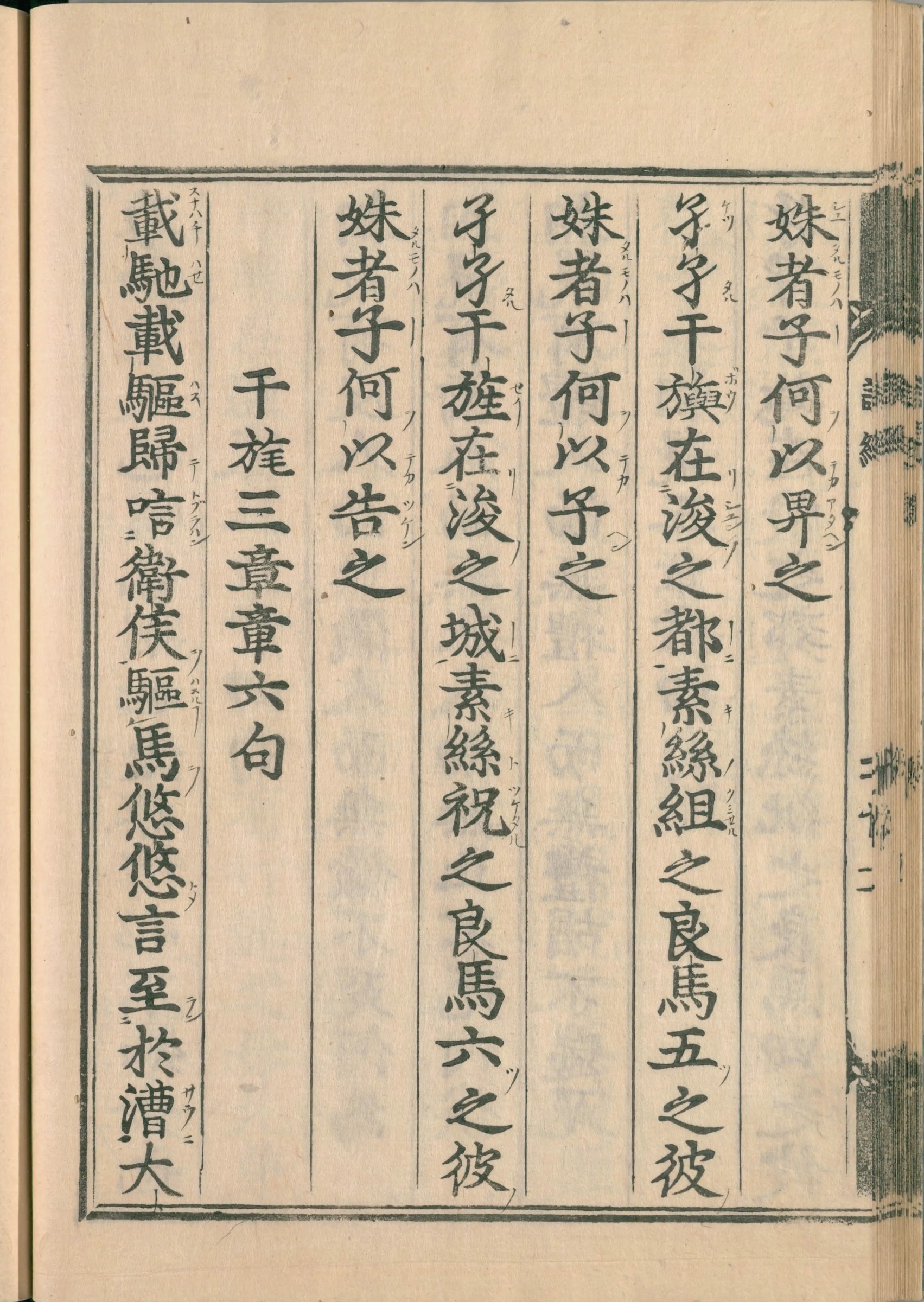
National Diet Library WA7-183, vol. [1], IIIF canvas 39, right-hand page: 7 columns of up to 17 characters, main text only, with Japanese reading marks. Checked on the image: stanza 1 opens column 7 ‹載馳載驅›. Other columns on this page: column 6 is the count line of 干旄 (stanzas and lines). Stanza 1 runs on to canvas 39, left-hand page (first column ‹夫跋涉我›). The Chinese shown is the Wikisource Mao text, not a transcription of this print; Legge's English translates the same text.
1載馳載驅,歸唁衞侯,驅馬悠悠,言至于漕,大夫跋涉,我心則憂。
1I would have galloped my horses and whipt them,
Returning to condole with the marquis of Wei.
I would have urged them all the long way,
Till I arrived at Ts'aou.
A great officer has gone, over the hills and through the rivers;
But my heart is full of sorrow.
Where on the image
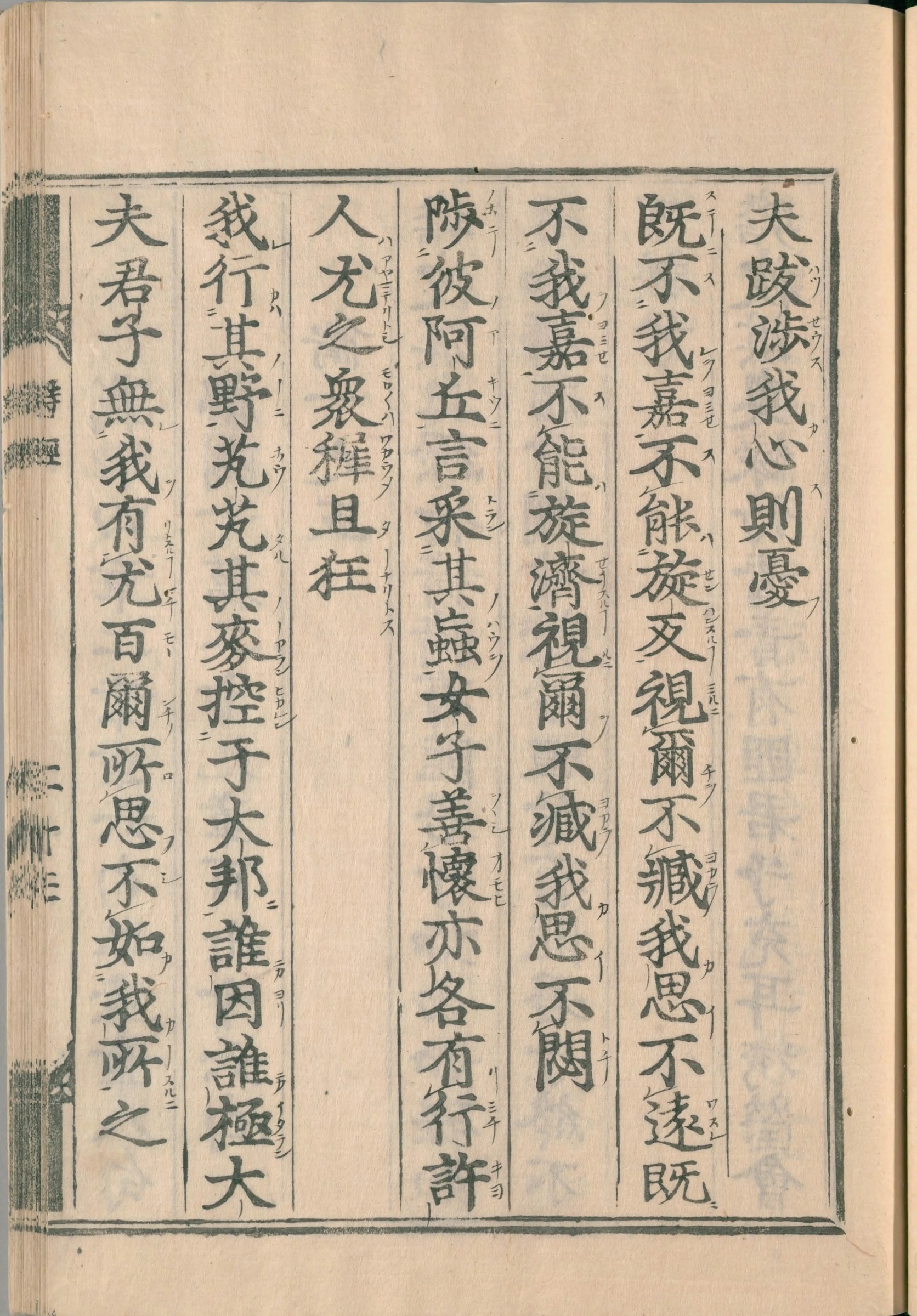
National Diet Library WA7-183, vol. [1], IIIF canvas 39, left-hand page: 7 columns of up to 17 characters, main text only, with Japanese reading marks. Checked on the image: stanza 2 opens column 2 ‹既不我嘉›; stanza 3 opens column 4 ‹陟彼阿丘›; stanza 4 opens column 6 ‹我行其野›. The Chinese shown is the Wikisource Mao text, not a transcription of this print; Legge's English translates the same text.
2既不我嘉,不能旋反,視爾不臧,我思不遠。既不我嘉,不能旋濟,視爾不臧,我思不閟。
3陟彼阿丘,言采其蝱,女子善懷,亦各有行,許人尤之,衆穉且狂。
4我行其野,芃芃其麥,控于大邦,誰因誰極,大夫君子,無我有尤,百爾所思,不如我所之。
2You disapproved of my [proposal],
And I cannot return [to Wei];
But I regard you as in the wrong,
And cannot forget my purpose.
You disapproved of my purpose,
And I cannot return across the streams;
But I regard you as in the wrong,
And cannot shut out my thoughts.
3I will ascend that mound with the steep side,
And gather the mother-of-pearl lilies.
I might, as a woman, have many thoughts,
But every one of them was practicable.
The people of Heu blame me,
But they are all childish and hasty [in their conclusions].
4I would have gone through the country,
Amidst the wheat so luxuriant.
I would have carried the case before the great State.
On whom should I have relied? Who would come [to the help of Wei]?
Ye great officers and gentlemen,
Do not condemn me.
The hundred plans you think of
Are not equal to the course I was going to take.
Notes
- English: James Legge, The She King, The Chinese Classics vol. IV part I (1871), Part I, Lessons from the States, Book 4, ode X (Tsae ch'e). Stanzas are numbered as in Legge and the Mao text.
- Transcribed for this library from the page images: lines read alike by two OCR programs were kept, and every other line was read on the image (data/sources/shijing/legge1871/). Legge's notes are left out.
Cite
Sources
- Source: National Diet Library WA7-183 (Keicho-era movable-type print of the Shijing, vol. 1) + Wikisource Mao text + James Legge, The She King (Chinese Classics IV, 1871) (holding institution)
- Critical edition: Mao text (Wikisource)
← previous · → next · v cycle view · l back to library