Book of Odes, Mao 55: Qi yu 淇奧 (Keicho-era print)
Introduction
淇奧 (Qi yu, Mao 55) is ode I of 衛風 Wei feng ("the Airs of Wei"), the fifth book of the Airs of the States (國風 Guofeng), the 160 songs of the regional states that open the Book of Odes (詩經 Shijing). The Airs are generally dated to the Western and early Eastern Zhou (about the 10th to 7th century BCE). It has 3 stanzas.
The photographs are of a copy of the Book of Odes in the National Diet Library, Tokyo (call no. WA7-183), printed with movable type in Japan in the Keicho era (1596-1615): main text only, seven columns of seventeen characters to the page, with Japanese reading marks added by hand. Each stanza begins a new column, and a line giving the count of stanzas and lines follows each ode. In this copy the ode runs from canvas 40, right-hand page to canvas 40, left-hand page of the first volume. Each section gathers the stanzas that begin on one page and links to that page and to any page the last stanza runs onto; the page boundaries were found by reading the first characters of every column on the photographs.
The Chinese is the Mao text from Wikisource. The English is James Legge's prose translation in The Chinese Classics, volume IV, part I (1871), Part I, Book 5, ode I (K'e yuh), page 91-93; his notes are not reproduced. Words in square brackets are Legge's own additions.
How was this verified? (Provenance)
Where on the image
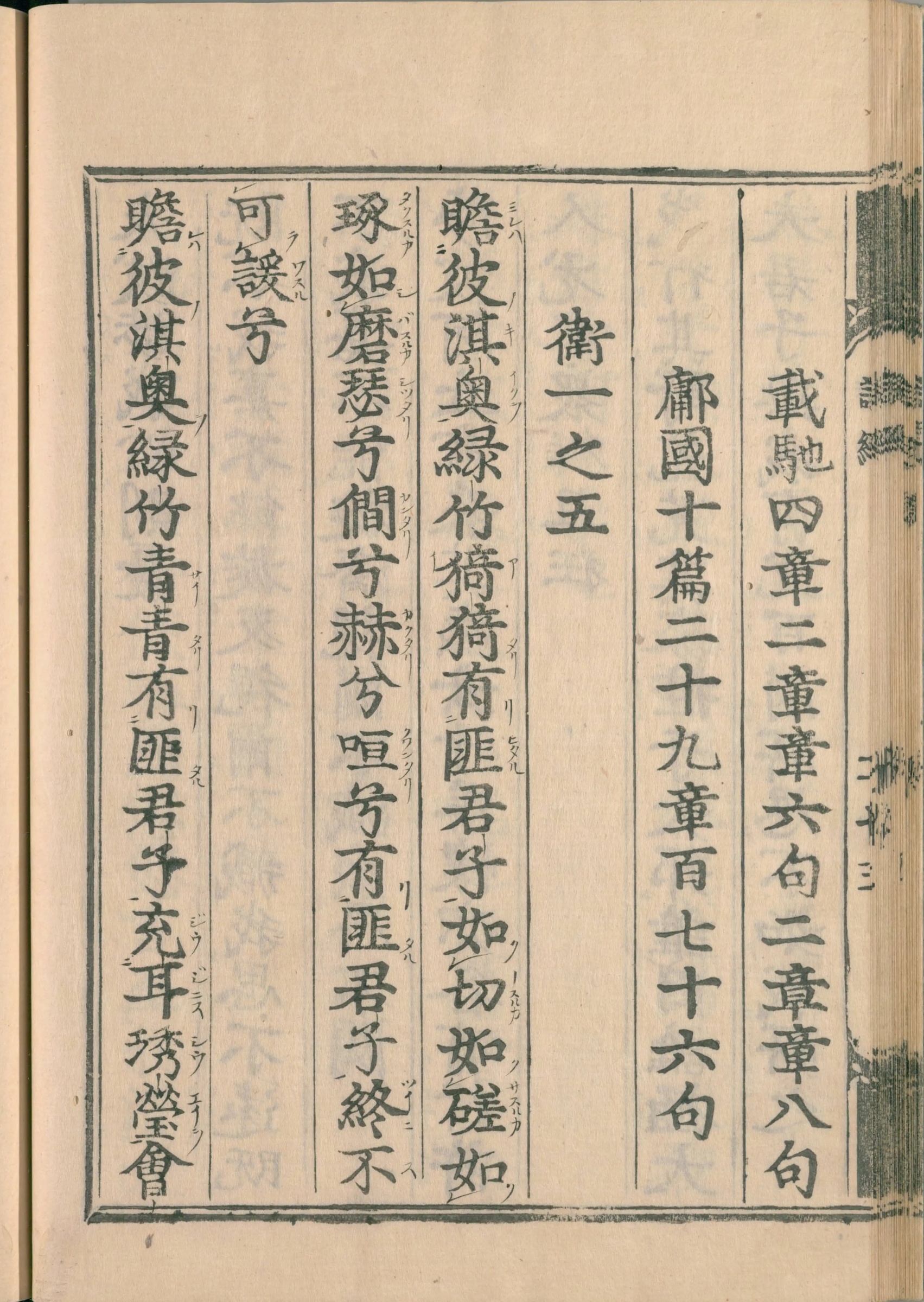
National Diet Library WA7-183, vol. [1], IIIF canvas 40, right-hand page: 7 columns of up to 17 characters, main text only, with Japanese reading marks. Checked on the image: stanza 1 opens column 4 ‹瞻彼淇奧›; stanza 2 opens column 7 ‹瞻彼淇奧›. Other columns on this page: column 1 is the count line of 載馳 (stanzas and lines); column 2 is the count line of 鄘國十篇二十九 (stanzas and lines); column 3 is the heading 衛一之五. Stanza 2 runs on to canvas 40, left-hand page (first column ‹弁如星瑟›). The Chinese shown is the Wikisource Mao text, not a transcription of this print; Legge's English translates the same text.
1瞻彼淇奧,綠竹猗猗,有匪君子,如切如瑳,如琢如磨,瑟兮僩兮,赫兮咺兮,有匪君子,終不可諼兮。
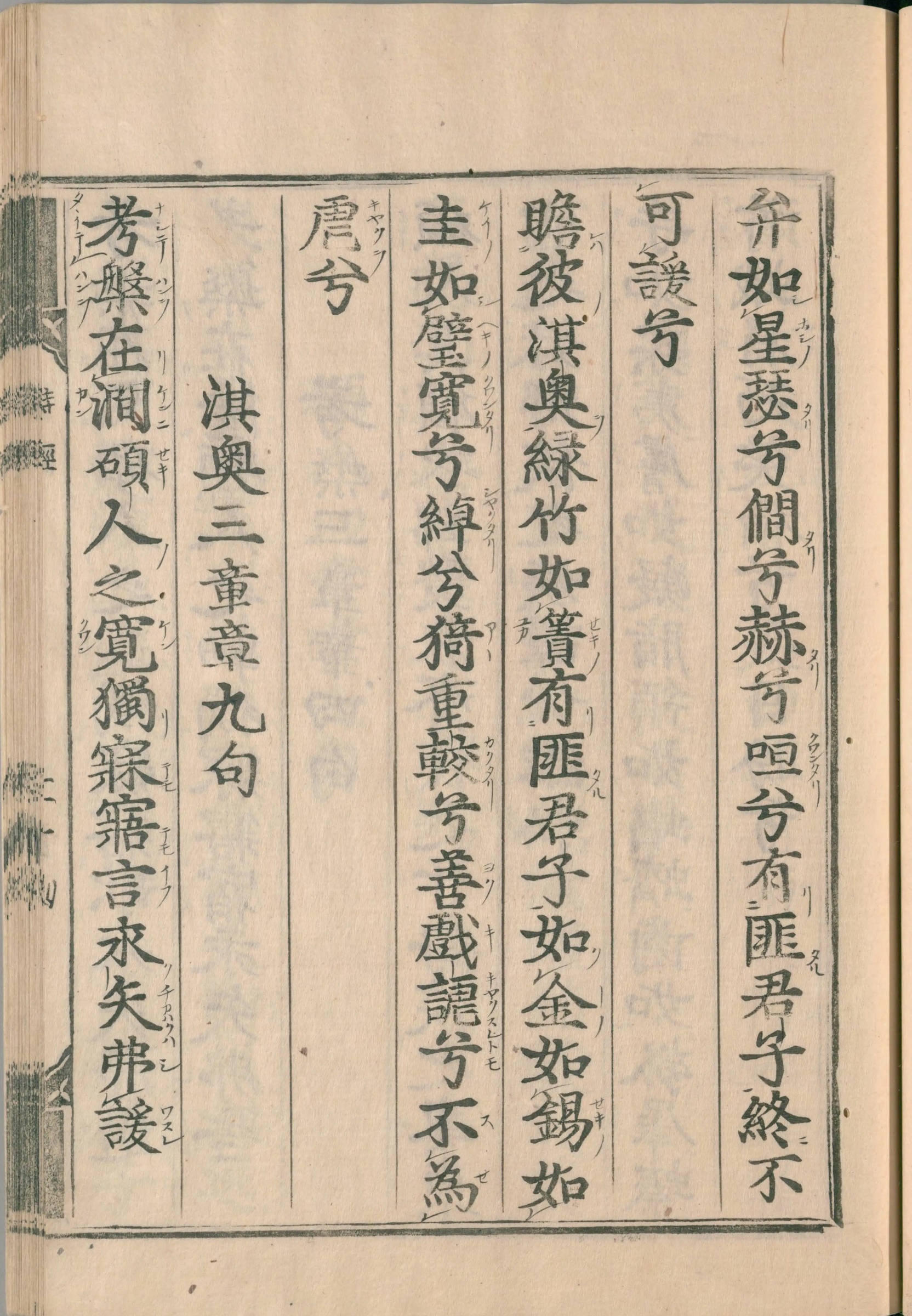
2瞻彼淇奧,綠竹青青,有匪君子,充耳琇瑩,會弁如星,瑟兮僩兮,赫兮咺兮,有匪君子,終不可諼兮。
1Look at those recesses in the banks of the K'e,
With their green bamboos, so fresh and luxuriant!
There is our elegant and accomplished prince,—
As from the knife and the file,
As from the chisel and the polisher!
How grave is he and dignified!
How commanding and distinguished!
Our elegant and accomplished prince,—
Never can he be forgotten!
2Look at those recesses in the banks of the K'e,
With their green bamboos, so strong and luxuriant!
There is our elegant and accomplished prince,—
With his ear-stoppers of beautiful pebbles,
And his cap, glittering as with stars between the seams!
How grave is he and dignified!
How commanding and distinguished!
Our elegant and accomplished prince,—
Never can he be forgotten!
Where on the image
National Diet Library WA7-183, vol. [1], IIIF canvas 40, left-hand page: 7 columns of up to 17 characters, main text only, with Japanese reading marks. Checked on the image: stanza 3 opens column 3 ‹瞻彼淇奧›. Other columns on this page: column 6 is the count line of 淇奧 (stanzas and lines). The Chinese shown is the Wikisource Mao text, not a transcription of this print; Legge's English translates the same text.
3瞻彼淇奧,綠竹如簀,有匪君子,如金如錫,如圭如璧,寬兮綽兮,猗重較兮,善戲謔兮,不為虐兮。
3Look at those recesses in the banks of the K'e,
With their green bamboos, so dense together!
There is our elegant and accomplished prince,—
[Pure] as gold or as tin,
[Soft and rich] as a sceptre of jade!
How magnanimous is he and gentle!
There he is in his chariot with its two high sides!
Skilful is he at quips and jokes,
But how does he keep from rudeness in them!
Notes
- English: James Legge, The She King, The Chinese Classics vol. IV part I (1871), Part I, Lessons from the States, Book 5, ode I (K'e yuh). Stanzas are numbered as in Legge and the Mao text.
- Transcribed for this library from the page images: lines read alike by two OCR programs were kept, and every other line was read on the image (data/sources/shijing/legge1871/). Legge's notes are left out.
Cite
Sources
- Source: National Diet Library WA7-183 (Keicho-era movable-type print of the Shijing, vol. 1) + Wikisource Mao text + James Legge, The She King (Chinese Classics IV, 1871) (holding institution)
- Critical edition: Mao text (Wikisource)
← previous · → next · v cycle view · l back to library