Book of Odes, Mao 57: Shuo ren 碩人 (Keicho-era print)
Introduction
碩人 (Shuo ren, Mao 57) is ode III of 衛風 Wei feng ("the Airs of Wei"), the fifth book of the Airs of the States (國風 Guofeng), the 160 songs of the regional states that open the Book of Odes (詩經 Shijing). The Airs are generally dated to the Western and early Eastern Zhou (about the 10th to 7th century BCE). It has 4 stanzas.
The photographs are of a copy of the Book of Odes in the National Diet Library, Tokyo (call no. WA7-183), printed with movable type in Japan in the Keicho era (1596-1615): main text only, seven columns of seventeen characters to the page, with Japanese reading marks added by hand. Each stanza begins a new column, and a line giving the count of stanzas and lines follows each ode. In this copy the ode runs from canvas 41, right-hand page to canvas 41, left-hand page of the first volume. Each section gathers the stanzas that begin on one page and links to that page and to any page the last stanza runs onto; the page boundaries were found by reading the first characters of every column on the photographs.
The Chinese is the Mao text from Wikisource. The English is James Legge's prose translation in The Chinese Classics, volume IV, part I (1871), Part I, Book 5, ode III (Shih jin), page 94-97; his notes are not reproduced. Words in square brackets are Legge's own additions.
How was this verified? (Provenance)
Where on the image
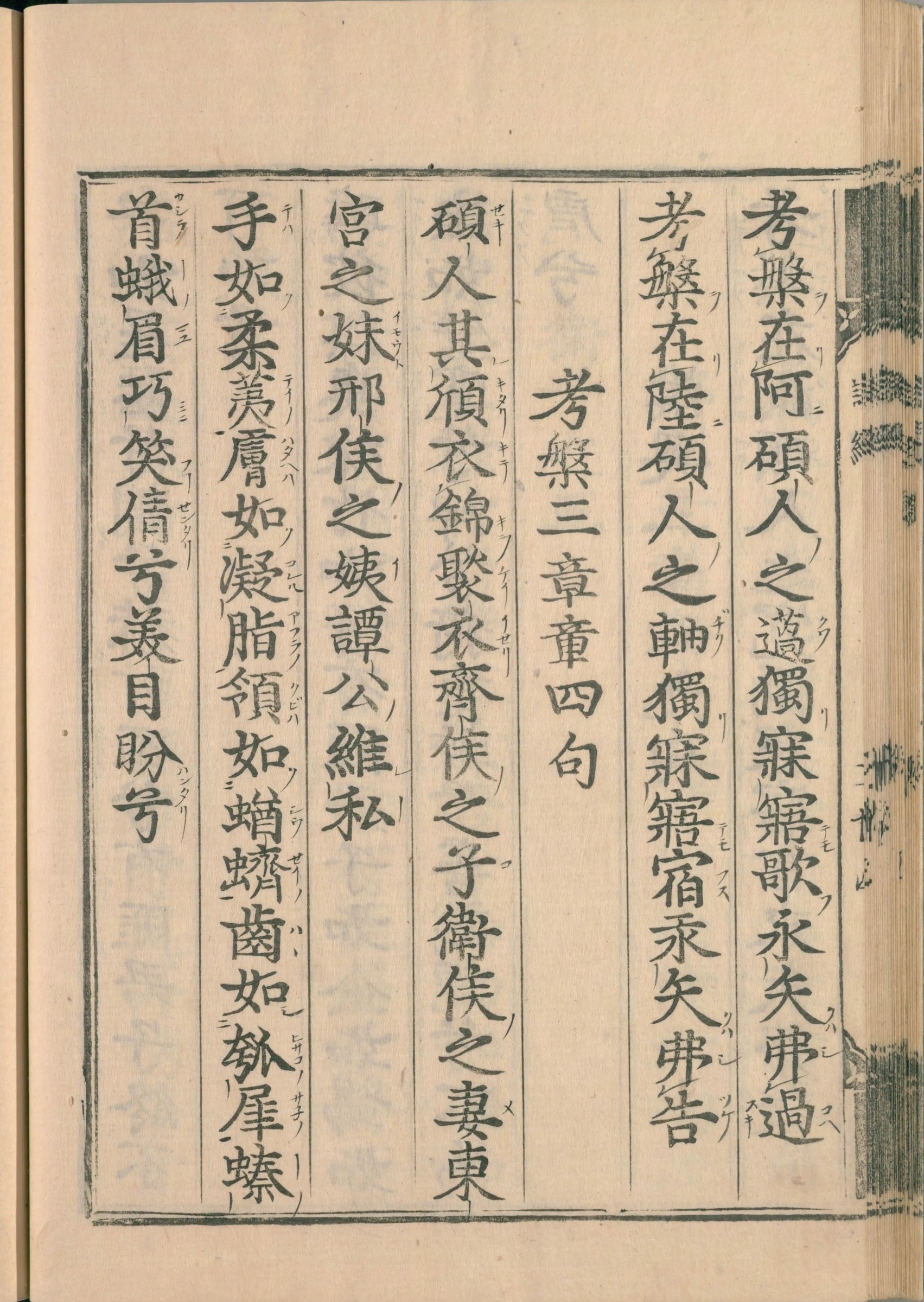
National Diet Library WA7-183, vol. [1], IIIF canvas 41, right-hand page: 7 columns of up to 17 characters, main text only, with Japanese reading marks. Checked on the image: stanza 1 opens column 4 ‹碩人其頎›; stanza 2 opens column 6 ‹手如柔荑›. Other columns on this page: column 3 is the count line of 考槃 (stanzas and lines). The Chinese shown is the Wikisource Mao text, not a transcription of this print; Legge's English translates the same text.
1碩人其頎,衣錦褧衣,齊侯之子,衛侯之妻,東宮之妹,邢侯之姨,譚公維私。
2手如柔荑,膚如凝脂,領如蝤蠐,齒如瓠犀,螓首蛾眉,巧笑倩兮,美目盼兮。
1Large was she and tall,
In her embroidered robe, with a [plain] single garment over it:—
The daughter of the marquis of Ts'e,
The wife of the marquis of Wei,
The sister of the heir-son of Ts'e,
The sister-in-law of the marquis of Hing,
The viscount of T'an also her brother-in-law.
2Her fingers were like the blades of the young white-grass;
Her skin was like congealed ointment;
Her neck was like the tree-grub;
Her teeth were like melon seeds;
Her forehead cicada-like; her eyebrows like [the antennæ of] the silkworm moth;
What dimples, as she artfully smiled!
How lovely her eyes, with the black and white so well defined!
Where on the image
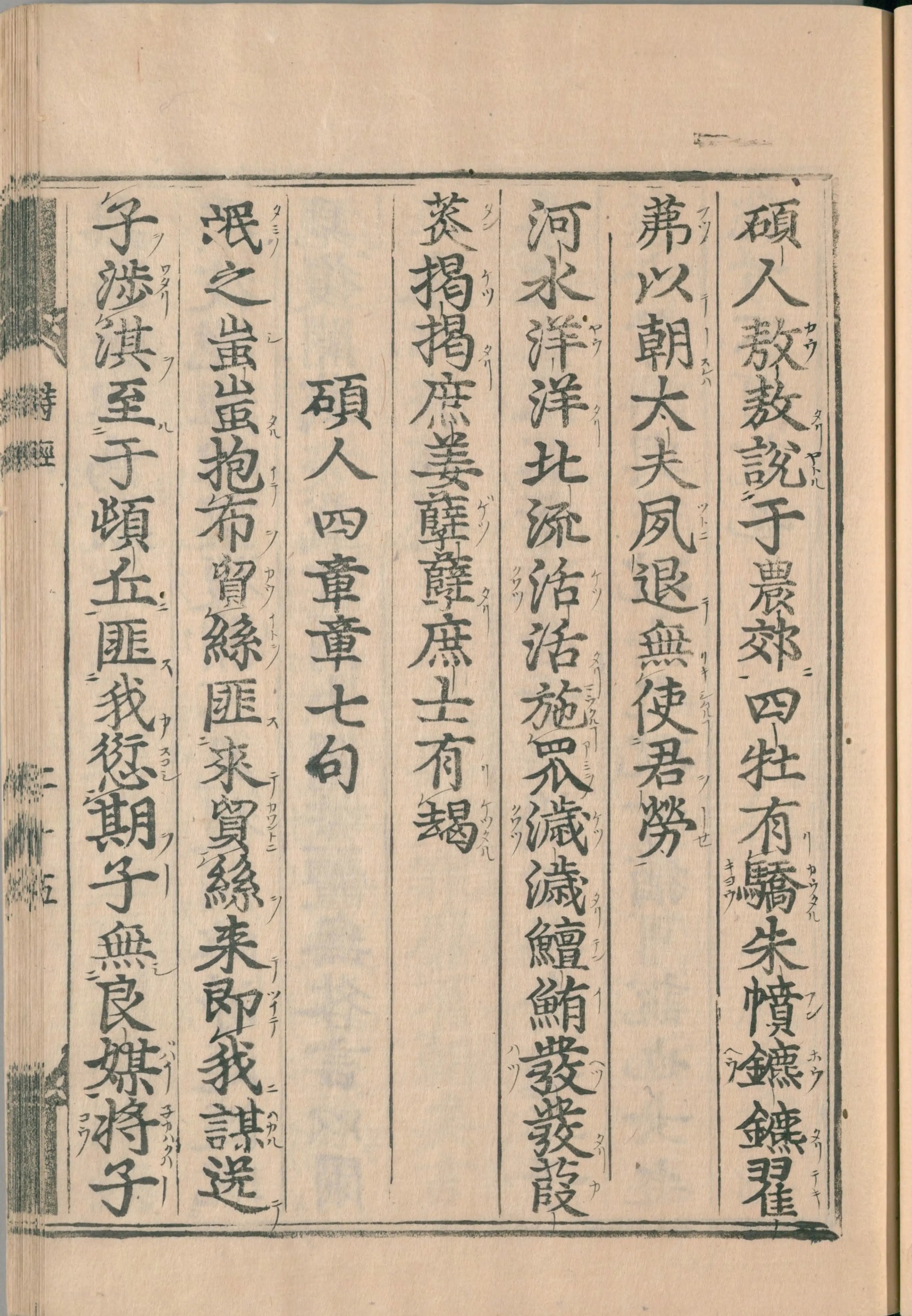
National Diet Library WA7-183, vol. [1], IIIF canvas 41, left-hand page: 7 columns of up to 17 characters, main text only, with Japanese reading marks. Checked on the image: stanza 3 opens column 1 ‹碩人敖敖›; stanza 4 opens column 3 ‹河水洋洋›. Other columns on this page: column 5 is the count line of 碩人 (stanzas and lines). The Chinese shown is the Wikisource Mao text, not a transcription of this print; Legge's English translates the same text.
3碩人敖敖,說于農郊,四牡有驕,朱幩鑣鑣,翟茀以朝,大夫夙退,無使君勞。
4河水洋洋,北流活活,施罛濊濊,鱣鮪發發,葭菼揭揭,庶姜孽孽,庶士有朅。
3Large was she and tall,
When she halted in the cultivated suburbs.
Strong looked her four horses,
With the red ornaments so rich about their bits.
Thus in her carriage, with its screens of pheasant feathers, she proceeded to our court.
Early retire, ye great officers,
And do not make the marquis fatigued!
4The waters of the Ho, wide and deep,
Flow northwards in majestic course.
The nets are dropt into them with a plashing sound,
Among shoals of sturgeon, large and small,
While the rushes and sedges are rank about.
Splendidly adorned were her sister ladies;
Martial looked the attendant officers.
Notes
- English: James Legge, The She King, The Chinese Classics vol. IV part I (1871), Part I, Lessons from the States, Book 5, ode III (Shih jin). Stanzas are numbered as in Legge and the Mao text.
- Transcribed for this library from the page images: lines read alike by two OCR programs were kept, and every other line was read on the image (data/sources/shijing/legge1871/). Legge's notes are left out.
Cite
Sources
- Source: National Diet Library WA7-183 (Keicho-era movable-type print of the Shijing, vol. 1) + Wikisource Mao text + James Legge, The She King (Chinese Classics IV, 1871) (holding institution)
- Critical edition: Mao text (Wikisource)
← previous · → next · v cycle view · l back to library