Book of Odes, Mao 58: Meng 氓 (Keicho-era print)
Introduction
氓 (Meng, Mao 58) is ode IV of 衛風 Wei feng ("the Airs of Wei"), the fifth book of the Airs of the States (國風 Guofeng), the 160 songs of the regional states that open the Book of Odes (詩經 Shijing). The Airs are generally dated to the Western and early Eastern Zhou (about the 10th to 7th century BCE). It has 6 stanzas.
The photographs are of a copy of the Book of Odes in the National Diet Library, Tokyo (call no. WA7-183), printed with movable type in Japan in the Keicho era (1596-1615): main text only, seven columns of seventeen characters to the page, with Japanese reading marks added by hand. Each stanza begins a new column, and a line giving the count of stanzas and lines follows each ode. In this copy the ode runs from canvas 41, left-hand page to canvas 43, right-hand page of the first volume. Each section gathers the stanzas that begin on one page and links to that page and to any page the last stanza runs onto; the page boundaries were found by reading the first characters of every column on the photographs.
The Chinese is the Mao text from Wikisource. The English is James Legge's prose translation in The Chinese Classics, volume IV, part I (1871), Part I, Book 5, ode IV (Măng), page 97-101; his notes are not reproduced. Words in square brackets are Legge's own additions.
How was this verified? (Provenance)
Where on the image
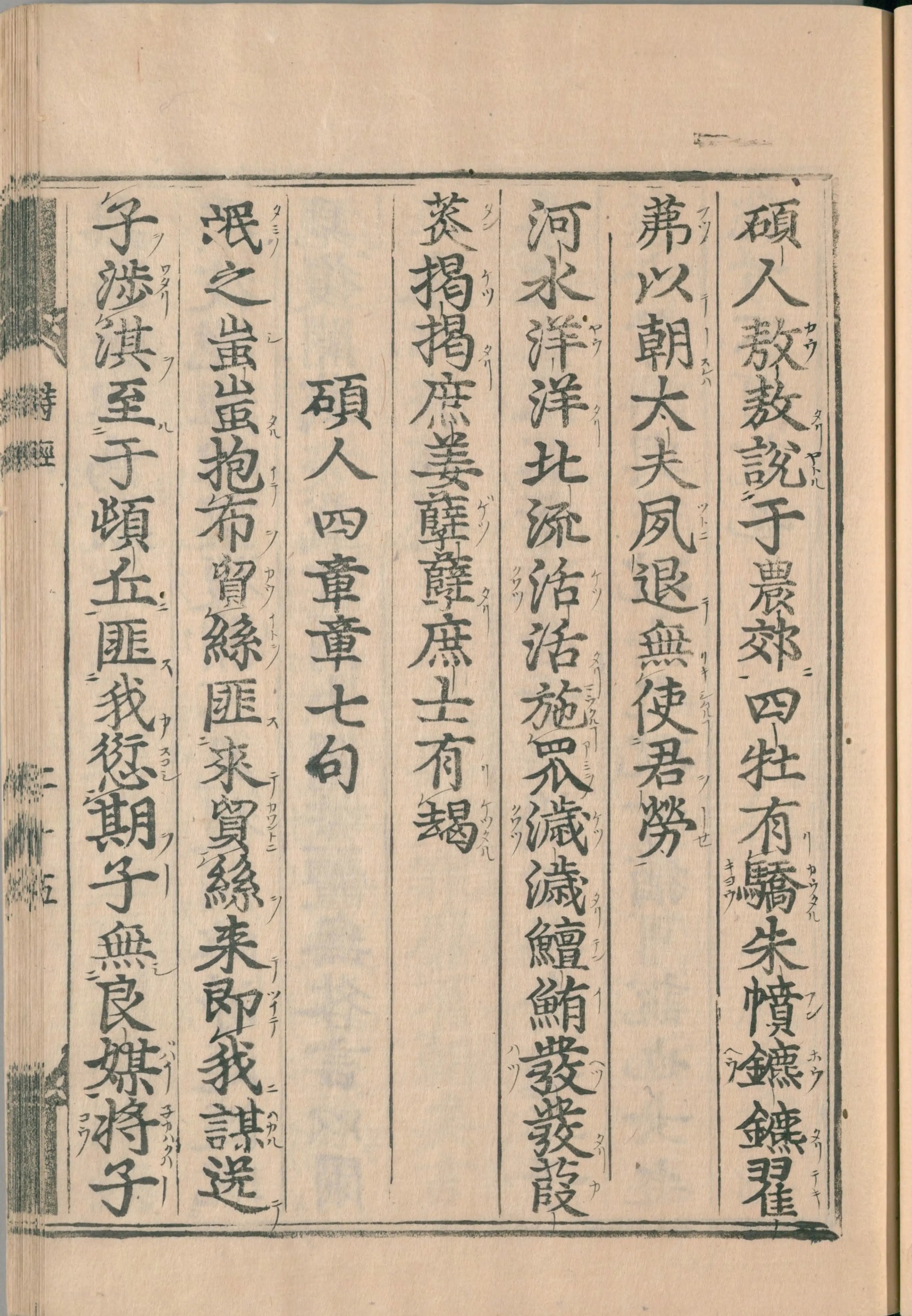
National Diet Library WA7-183, vol. [1], IIIF canvas 41, left-hand page: 7 columns of up to 17 characters, main text only, with Japanese reading marks. Checked on the image: stanza 1 opens column 6 ‹氓之蚩蚩›. Other columns on this page: column 5 is the count line of 碩人 (stanzas and lines). Stanza 1 runs on to canvas 42, right-hand page (first column ‹無怒秋以›). The Chinese shown is the Wikisource Mao text, not a transcription of this print; Legge's English translates the same text.
1氓之蚩蚩,抱布貿絲。匪來貿絲,來即我謀。送子涉淇,至于頓丘。匪我愆期,子無良媒。將子無怒,秋以為期。
1A simple-looking lad you were,
Carrying cloth to exchange it for silk.
[But] you came not so to purchase silk;—
You came to make proposals to me.
I convoyed you through the K'e,
As far as Tun-k'ew.
'It is not I,' [I said], 'who would protract the time;
But you have had no good go-between.
I pray you be not angry,
And let autumn be the time.'
Where on the image
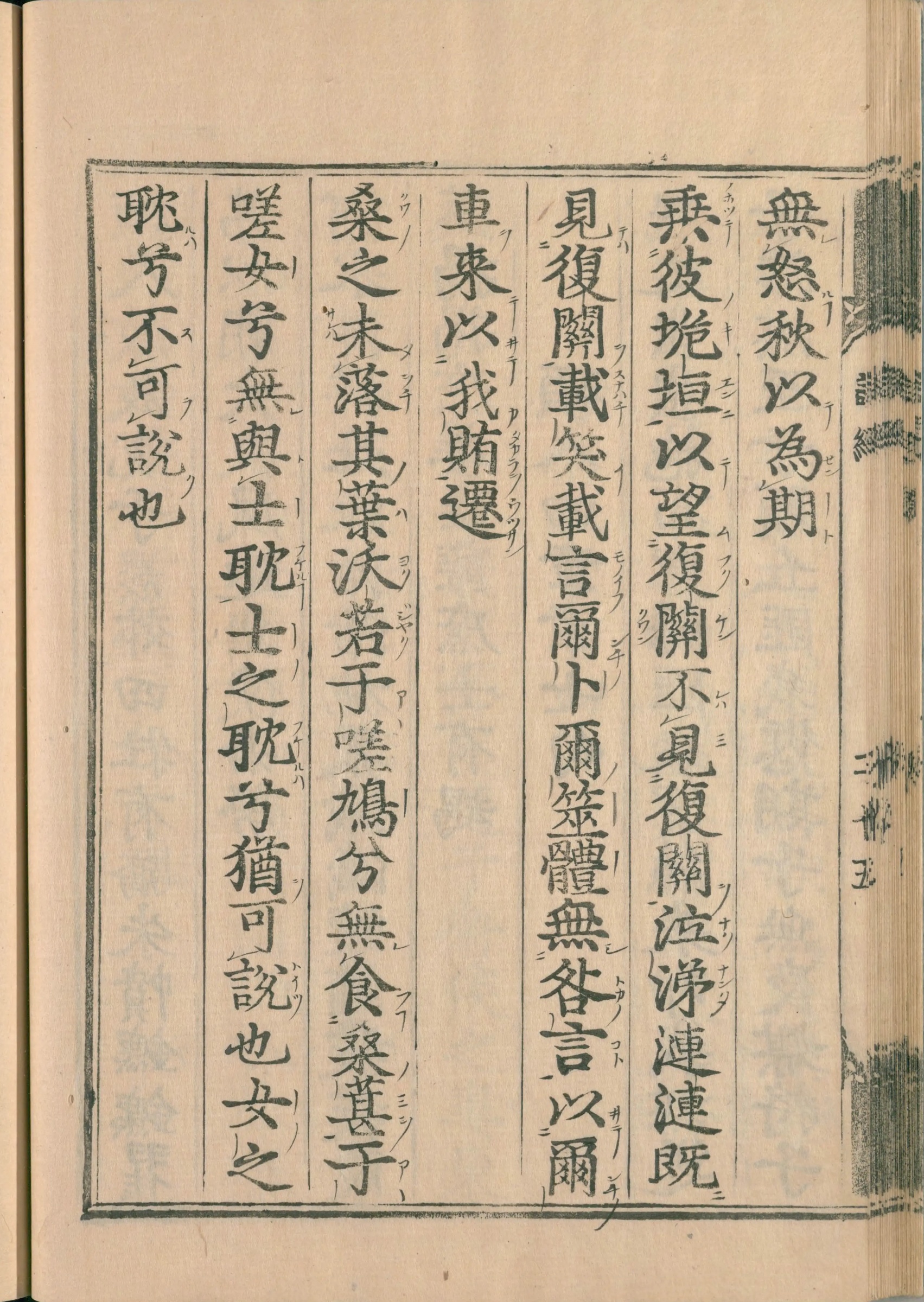
National Diet Library WA7-183, vol. [1], IIIF canvas 42, right-hand page: 7 columns of up to 17 characters, main text only, with Japanese reading marks. Checked on the image: stanza 2 opens column 2 ‹乘彼垝垣›; stanza 3 opens column 5 ‹桑之未落›. The Chinese shown is the Wikisource Mao text, not a transcription of this print; Legge's English translates the same text.
2乘彼垝垣,以望復關。不見復關,泣涕漣漣。既見復關,載笑載言。爾卜爾筮,體無咎言。以爾車來,以我賄遷。
3桑之未落,其葉沃若。于嗟鳩兮,無食桑葚。于嗟女兮,無與士耽。士之耽兮,猶可說也。女之耽兮,不可說也。
2I ascended that ruinous wall,
To look towards Fuh-kwan;
And when I saw [you] not [coming from] it;
My tears flowed in streams.
When I did see [you coming from] Fuh-kwan,
I laughed and I spoke.
You had consulted, [you said], the tortoise-shell and the reeds,
And there was nothing unfavourable in their response.
'Then come,' [I said],' with your carriage,
And I will remove with my goods.'
3Before the mulberry tree has shed its leaves,
How rich and glossy are they!
Ah! thou dove,
Eat not its fruit [to excess].
Ah! thou young lady,
Seek no licentious pleasure with a gentleman.
When a gentleman indulges in such pleasure,
Something may still be said for him;
When a lady does so,
Nothing can be said for her.
Where on the image
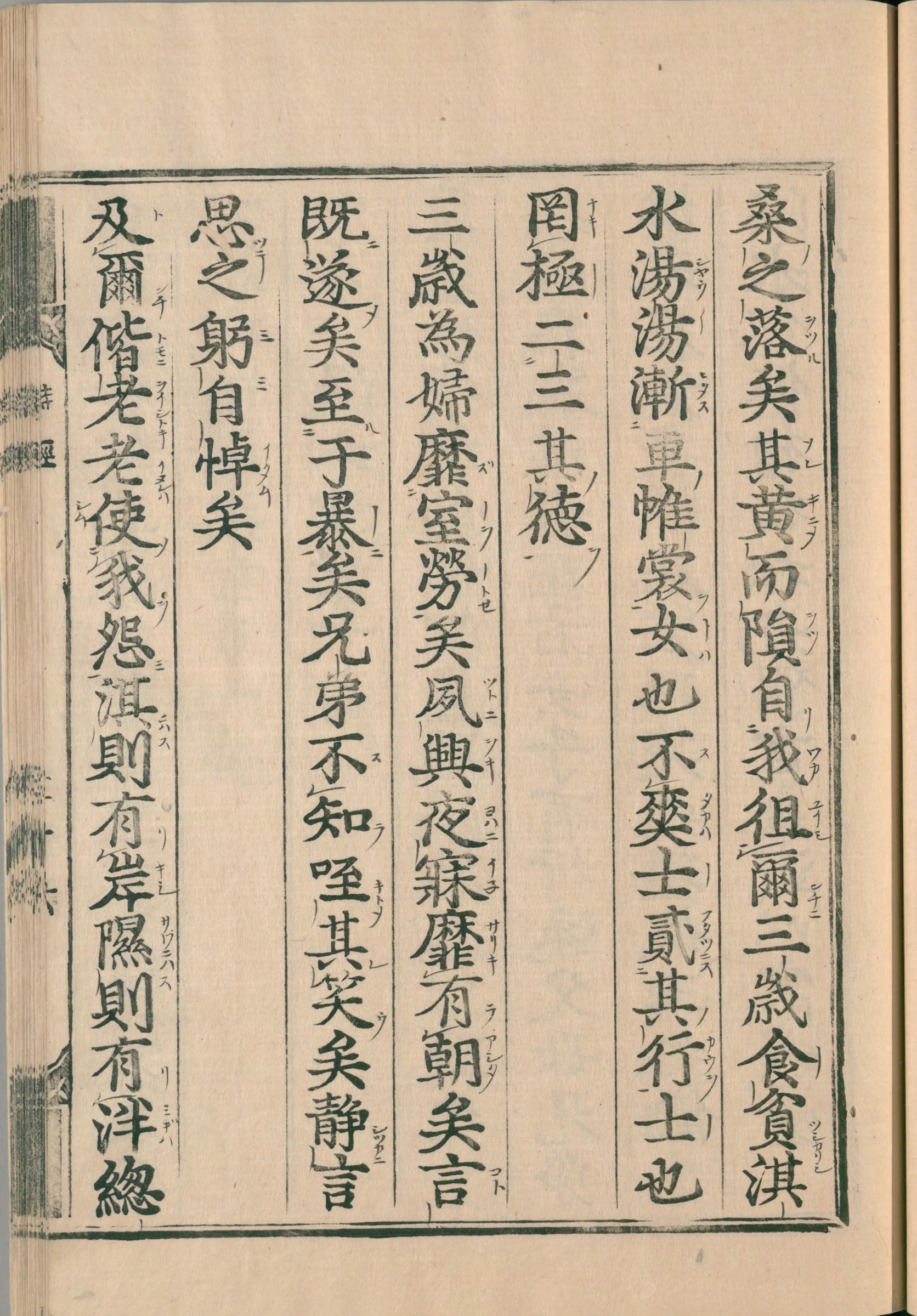
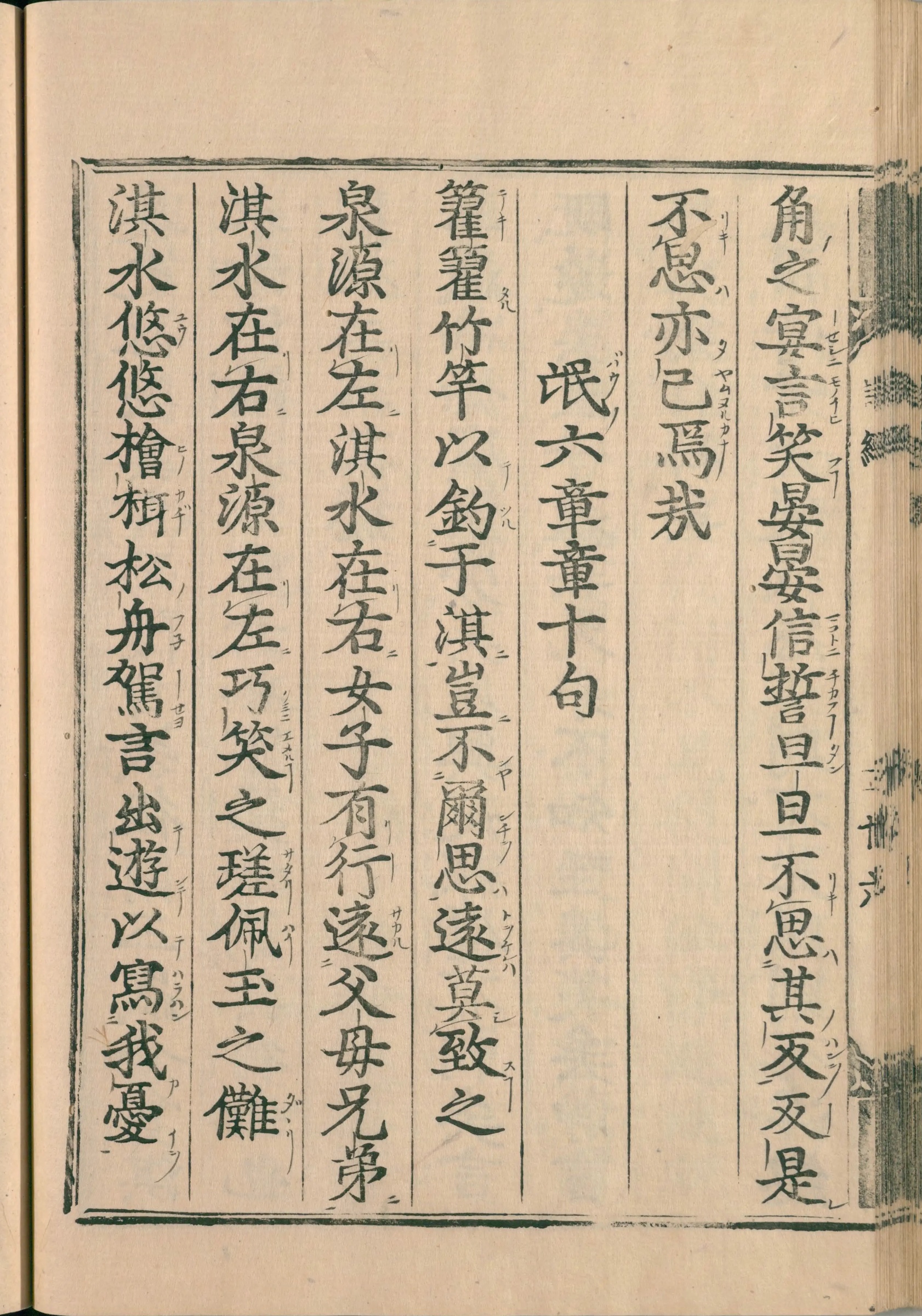
National Diet Library WA7-183, vol. [1], IIIF canvas 42, left-hand page: 7 columns of up to 17 characters, main text only, with Japanese reading marks. Checked on the image: stanza 4 opens column 1 ‹桑之落矣›; stanza 5 opens column 4 ‹三歲爲婦›; stanza 6 opens column 7 ‹及爾偕老›. Stanza 6 runs on to canvas 43, right-hand page (first column ‹角之宴言›). The Chinese shown is the Wikisource Mao text, not a transcription of this print; Legge's English translates the same text.
4桑之落矣,其黃而隕。自我徂爾,三歲食貧。淇水湯湯,漸車帷裳。女也不爽,士貳其行。士也罔極,二三其德。
5三歲為婦,靡室勞矣。夙興夜寐,靡有朝矣。言既遂矣,至于暴矣。兄弟不知,咥其笑矣。靜言思之,躬自悼矣。
6及爾偕老,老使我怨。淇則有岸,隰則有泮。總角之宴,言笑晏晏。信誓旦旦,不思其反。反是不思,亦已焉哉。
4When the mulberry tree sheds its leaves,
They fall yellow on the ground.
Since I went with you,
Three years have I eaten of your poverty;
And [now] the full waters of the K'e
Wet the curtains of my carriage.
There has been no difference in me,
But you have been double in your ways.
It is you, Sir, who transgress the right,
Thus changeable in your conduct.
5For three years I was your wife,
And thought nothing of my toil in your house.
I rose early and went to sleep late,
Not intermitting my labours for a morning.
Thus [on my part] our contract was fulfilled,
But you have behaved thus cruelly.
My brothers will not know [all this],
And will only laugh at me.
Silently I think of it,
And bemoan myself.
6I was to grow old with you;—
Old, you give me cause for sad repining.
The K'e has its banks,
And the marsh has its shores.
In the pleasant time of my girlhood, with my hair simply gathered in a knot,
Harmoniously we talked and laughed.
Clearly were we sworn to good faith,
And I did not think the engagement would be broken.
That it would be broken I did not think,
And now it must be all over!
Notes
- English: James Legge, The She King, The Chinese Classics vol. IV part I (1871), Part I, Lessons from the States, Book 5, ode IV (Măng). Stanzas are numbered as in Legge and the Mao text.
- Transcribed for this library from the page images: lines read alike by two OCR programs were kept, and every other line was read on the image (data/sources/shijing/legge1871/). Legge's notes are left out.
Cite
Sources
- Source: National Diet Library WA7-183 (Keicho-era movable-type print of the Shijing, vol. 1) + Wikisource Mao text + James Legge, The She King (Chinese Classics IV, 1871) (holding institution)
- Critical edition: Mao text (Wikisource)
← previous · → next · v cycle view · l back to library