Chandogya Upanishad, Prapathaka 8 (the space in the heart; Indra and Virocana)
Introduction
The Chandogya Upanishad belongs to the Samaveda and is one of the two longest and oldest Upanishads. It has eight chapters (prapathakas). This entry gives chapter 8. It teaches the small space within the heart, the 'city of Brahman' that holds heaven and earth (8.1-6), and tells how the god Indra and the demon Virocana lived as students with Prajapati to learn the self that is free from evil, age and death; Virocana leaves with the teaching that the body is the self, Indra returns three times (8.7-12). It closes with verses on the way to Brahman (8.13-15).
The page images come from University of Pennsylvania Libraries, Ms. Coll. 390 Item 945, a paper manuscript of 74 leaves (11 x 17 cm) holding the whole Chandogya Upanishad, written in Devanagari, 10 to 11 lines to a side, on blue machine-made paper with watermarks; it is undated (catalogued 18th or 19th century). The scribe numbers the khandas and closes each chapter with a colophon, but does not number paragraphs. Chapter 8 runs from fol. 65r to fol. 74v.
For every page, the first and last words were read on the image and found in the edited text; the page boundaries follow from them. Each section below holds the paragraphs that end on one page, with every page they occupy.
How was this verified? (Provenance)
Where on the image
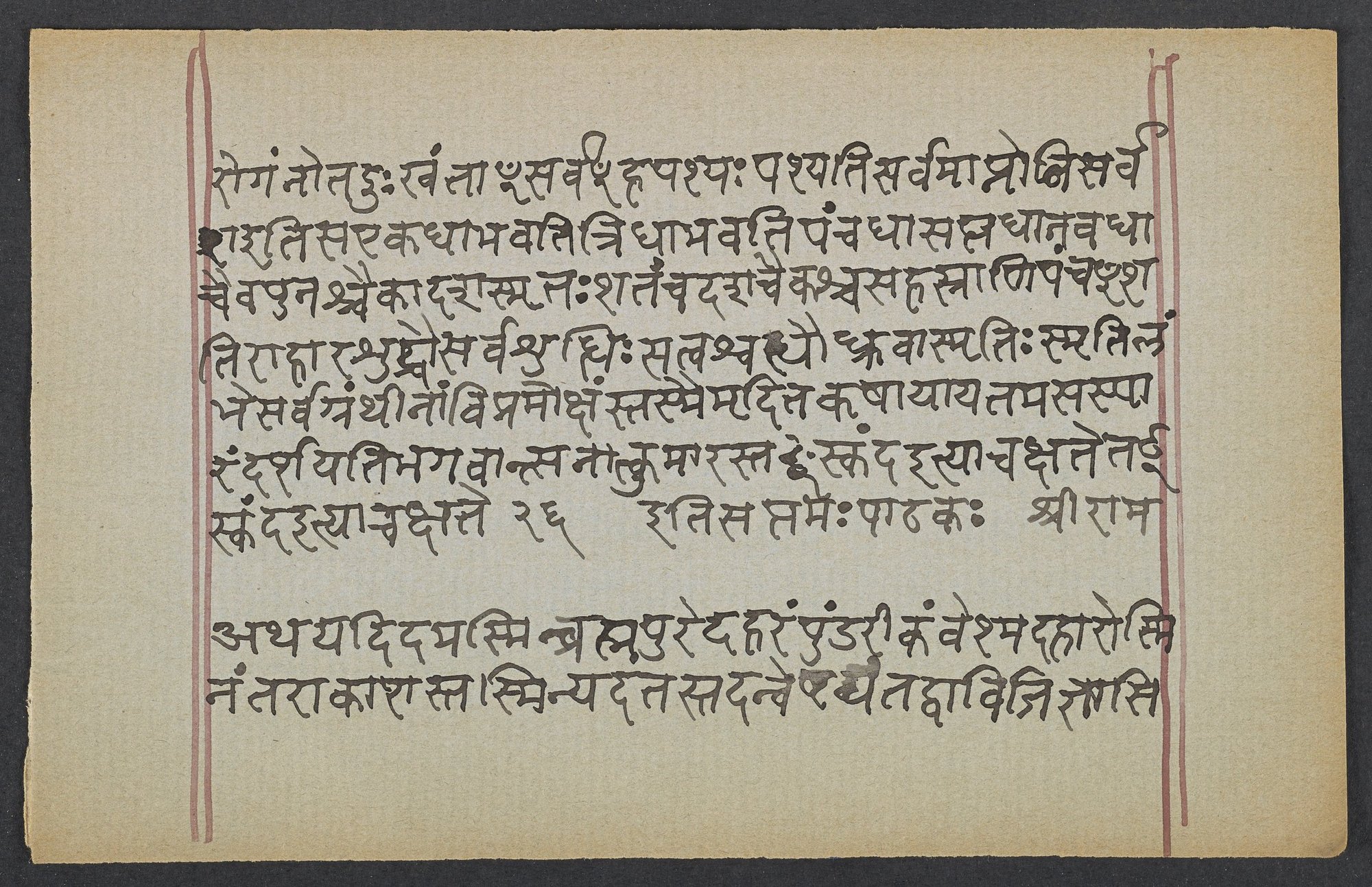
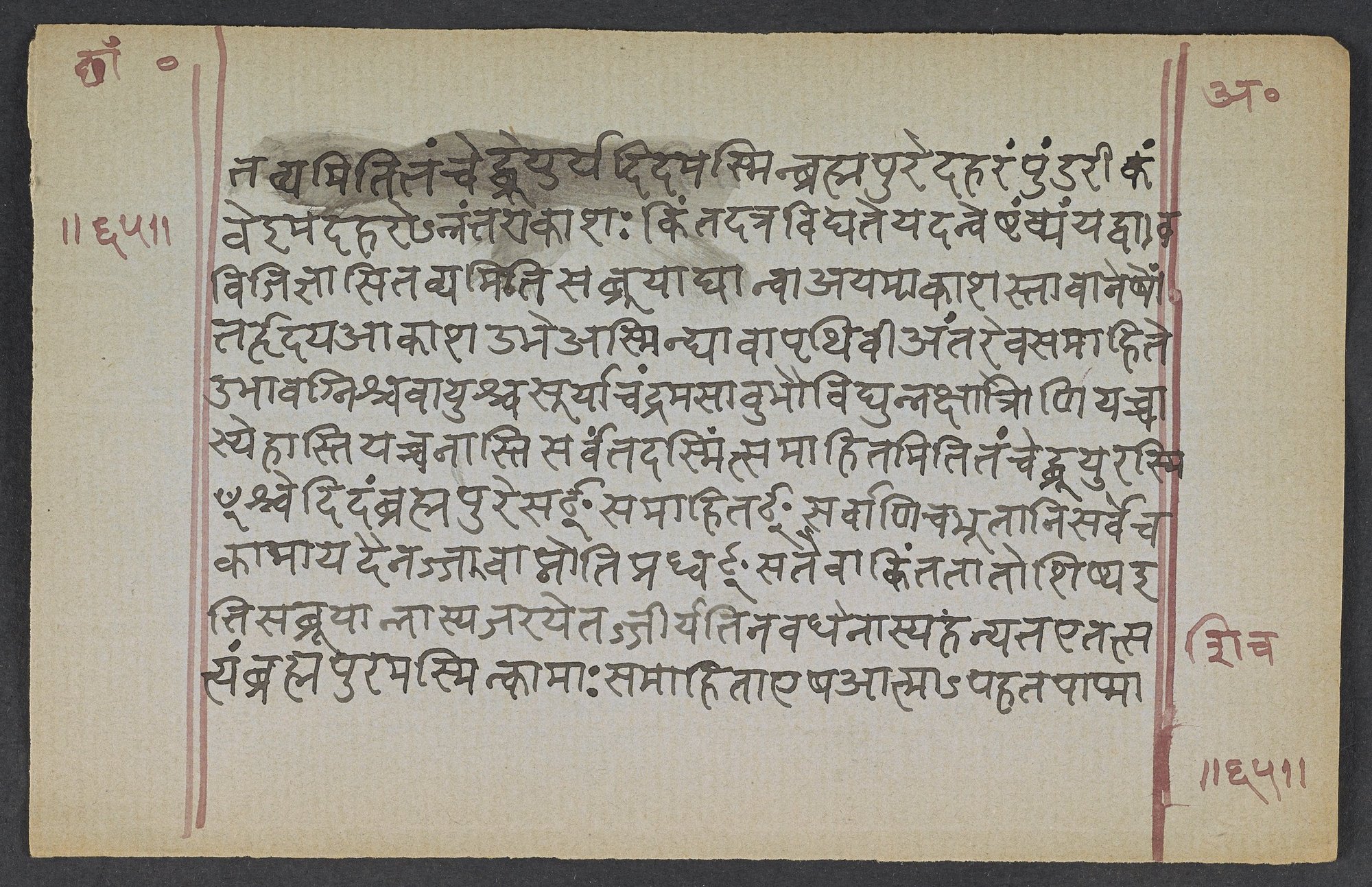
Penn Ms. Coll. 390 Item 945. fol. 65r begins ‹atha yad idam asmin brahmapure daharaṃ puṇḍarīkaṃ veśma daharo 'sminn antarākāśas› and ends ‹tasmin yad antas tad anveṣṭavyaṃ tad vāva vijijñāsi›; fol. 65v begins ‹tavyam iti taṃ ced brūyur yad idam asmin brahmapure daharaṃ puṇḍarīkaṃ› and ends ‹etat satyaṃ brahmapuram asmin kāmāḥ samāhitā eṣa ātmāpahatapāpmā› (first and last words read on the image, transliterated). The words were located in the GRETIL text by string matching and the page boundaries follow from them; readings and results are stored in data/sources/upanishads/mapping_945.json.
1.1atha yad idam asmin brahmapure daharaṃ puṇḍarīkaṃ veśma daharo 'sminn antarākāsaḥ |
tasmin yad antas tad anveṣṭavyaṃ tad vāva vijijñāsitavyam iti ||
1.2taṃ ced brūyur yad idam asmin brahmapure daharaṃ puṇḍarīkaṃ veśma daharo 'sminn antarākāśaḥ kiṃ tad atra vidyate yad anveṣṭavyaṃ yad vāva vijijñāsitavyam iti |
sa brūyāt ||
1.3yāvān vā ayam ākāśas tāvān eṣo 'ntarhṛdaya ākāśaḥ |
ubhe 'smin dyāvāpṛthivī antar eva samāhite |
ubhāv agniś ca vāyuś ca sūryācandramasāv ubhau vidyun nakṣatrāṇi |
yac cāsyehāsti yac ca nāsti sarvaṃ tad asmin samāhitam iti ||
1.4taṃ ced brūyur asmiṃś cedaṃ brahmapure sarvaṃ samāhitaṃ sarvāṇi ca bhūtāni sarve ca kāmā yad enaj jarā vāpnoti pradhvaṃsate vā kiṃ tato 'tiśiṣyata iti ||
1.1Harih, Om. There is this city of Brahman (the body), and in it the palace, the small lotus (of the heart), and in it that small ether. Now what exists within that small ether, that is to be sought for, that is to be understood.
1.2And if they should say to him: 'Now with regard to that city of Brahman, and the palace in it, i. e. the small lotus of the heart, and the small ether within the heart, what is there within it that deserves to be sought for, or that is to be understood?'
1.3Then he should say: 'As large as this ether (all space) is, so large is that ether within the heart. Both heaven and earth are contained within it, both fire and air, both sun and moon, both lightning and stars; and whatever there is of him (the Self) here in the world, and whatever is not (i. e. whatever has been or will be), all that is contained within it.
1.4And if they should say to him: 'If everything that exists is contained in that city of Brahman, all beings and all desires (whatever can be imagined or desired), then what is left of it, when old age reaches it and scatters it, or when it falls to pieces?'
Where on the image
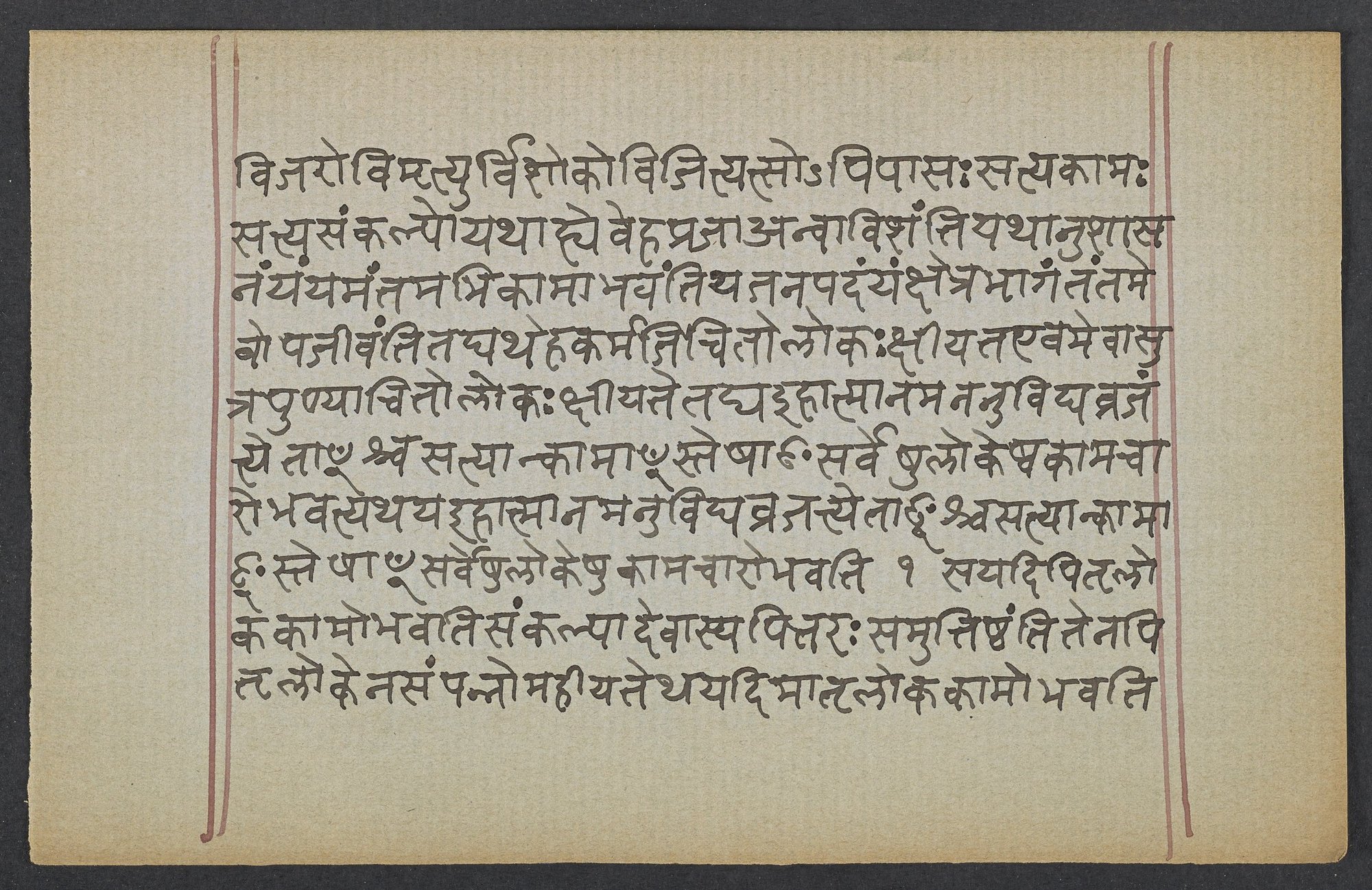
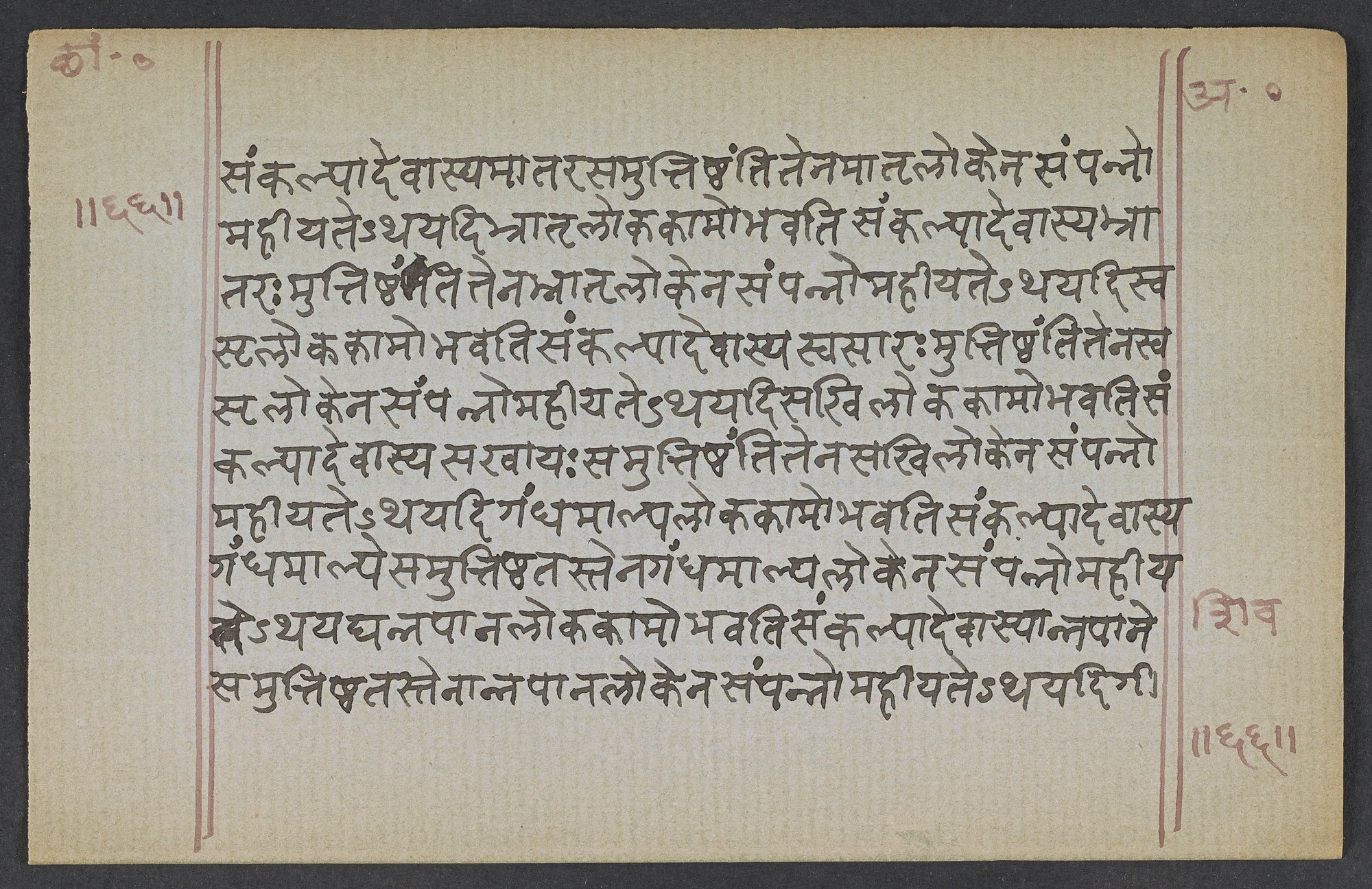
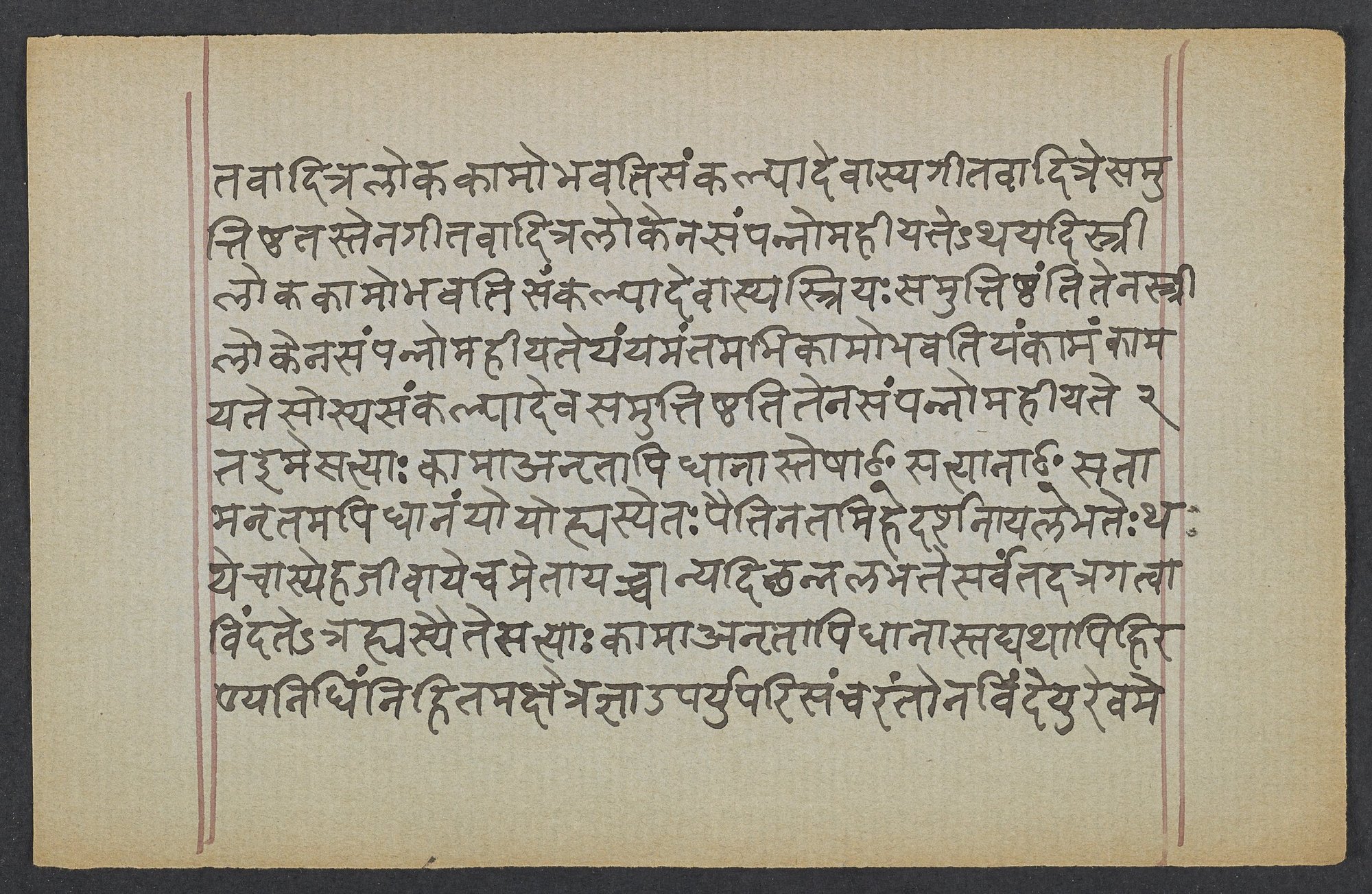
Penn Ms. Coll. 390 Item 945. fol. 65v begins ‹tavyam iti taṃ ced brūyur yad idam asmin brahmapure daharaṃ puṇḍarīkaṃ› and ends ‹etat satyaṃ brahmapuram asmin kāmāḥ samāhitā eṣa ātmāpahatapāpmā›; fol. 66r begins ‹vijaro vimṛtyur viśoko vijighatso 'pipāsaḥ satyakāmaḥ satyasaṃkalpo› and ends ‹atha yadi mātṛlokakāmo bhavati›; fol. 66v begins ‹saṃkalpād evāsya mātaraḥ samuttiṣṭhanti› and ends ‹samuttiṣṭhatas tenānnapānalokena saṃpanno mahīyate atha yadi gī›; fol. 67r begins ‹tavāditralokakāmo bhavati saṃkalpād evāsya gītavādite samuttiṣṭhatas› and ends ‹hiraṇyanidhiṃ nihitam akṣetrajñā upary upari saṃcaranto na vindeyur evam e› (first and last words read on the image, transliterated). Notes: Müller divides khanda 8.2 into paragraphs differently from the Sanskrit edition; the whole khanda is given here with his own numbers. The words were located in the GRETIL text by string matching and the page boundaries follow from them; readings and results are stored in data/sources/upanishads/mapping_945.json.
1.5sa brūyāt |
nāsya jarayaitaj jīryati na vadhenāsya hanyate |
etat satyaṃ brahmapuram asmin kāmāḥ samāhitāḥ |
eṣa ātmāpahatapāpmā vijaro vimṛtyur viśoko vijighatso 'pipāsaḥ satyakāmaḥ satyasaṃkalpaḥ |
yathā hy eveha prajā anvāviśanti yathānuśāsanam |
yaṃ yam antam abhikāmā bhavanti yaṃ janapadaṃ yaṃ kṣetrabhāgaṃ taṃ tam evopajīvanti ||
1.6tad yatheha karmajito lokaḥ kṣīyata evam evāmutra puṇyajito lokaḥ kṣīyate |
tad ya ihātmānam ananuvidya vrajanty etāṃś ca satyān kāmāṃs teṣāṃ sarveṣu lokeṣv akāmacāro bhavati |
atha ya ihātmānam anivudya vrajanty etaṃś ca satyān kāmāṃs teṣāṃ sarveṣu lokeṣu kāmacāro bhavati ||
2.1sa yadi pitṛlokakāmo bhavati |
saṃkalpād evāsya pitaraḥ samuttiṣṭhanti |
tena pitṛlokena saṃpanno mahīyate ||
2.2atha yadi mātṛlokakāmo bhavati |
saṃkalpād evāsya mātaraḥ samuttiṣṭhanti |
tena mātṛlokena saṃpanno mahīyate ||
2.3atha yadi bhrātṛlokakāmo bhavati |
saṃkalpād evāsya bhrātaraḥ samuttiṣṭhanti |
tena bhrātṛlokena saṃpanno mahīyate ||
2.4atha yadi svasṛlokakāmo bhavati |
saṃkalpād evāsya svasāraḥ samuttiṣṭhanti |
tena svasṛlokena saṃpanno mahīyate ||
2.5atha yadi sakhilokakāmo bhavati |
saṃkalpād evāsya sakhāyaḥ samuttiṣṭhanti |
tena sakhilokena saṃpanno mahīyate ||
2.6atha yadi gandhamālyalokakāmo bhavati |
saṃkalpād evāsya gandhamālye samuttiṣṭhataḥ |
tena gandhamālyalokena saṃpanno mahīyate ||
2.7atha yady annapānalokakāmo bhavati |
saṃkalpād evāsyānnapāne samuttiṣṭhataḥ |
tenānnapānalokena saṃpanno mahīyate ||
2.8atha yadi gītavāditalokakāmo bhavati |
saṃkalpād evāsya gītavādite samuttiṣṭhataḥ |
tena gītavāditalokena saṃpanno mahīyate ||
2.9atha yadi strīlokakāmo bhavati |
saṃkalpād evāsya striyaḥ samuttiṣṭhanti |
tena strīlokena saṃpanno mahīyate ||
2.10yaṃ yam antam abhikāmo bhavati |
yaṃ kāmaṃ kāmayate |
so 'sya saṃkalpād eva samuttiṣṭhati |
tena saṃpanno mahīyate ||
3.1ta ime satyāḥ kāmā anṛtāpidhānāḥ |
teṣāṃ satyānāṃ satām anṛtam apidhānam |
yo yo hy asyetaḥ praiti na tam iha darśanāya labhate ||
1.5Then he should say: 'By the old age of the body, that (the ether, or Brahman within it) does not age; by the death of the body, that (the ether, or Brahman within it) is not killed. That (the Brah- man) is the true Brahma-city (not the body). In it all desires are contained. It is the Self, free from sin, free from old age, from death and grief, from hunger and thirst, which desires nothing but what it ought to desire, and imagines nothing but what it ought to imagine. Now as here on earth people follow as they are commanded, and depend on the object which they are attached to, be it a country or a piece of land,
1.6'And as here on earth, whatever has been acquired by exertion, perishes, so perishes whatever is acquired for the next world by sacrifices and other good actions performed on earth. Those who depart from hence without having discovered the Self and those true desires, for them there is no freedom in all the worlds. But those who depart from hence, after having discovered the Self and those true desires, for them there is freedom in all the worlds.
2.1'Thus he who desires the world of the fathers, by his mere will the fathers come to receive him, and having obtained the world of the fathers, he is happy.
2.2'And he who desires the world of the mothers, by his mere will the mothers come to receive him, and having obtained the world of the mothers, he is happy.
2.3'And he who desires the world of the brothers, by his mere will the brothers come to receive him, and having obtained the world of the brothers, he is happy.
2.4'And he who desires the world of the sisters, by his mere will the sisters come to receive him, and having obtained the world of the sisters, he is happy.
2.5'And he who desires the world of the friends, by his mere will the friends come to receive him, and having obtained the world of the friends, he is happy.
2.6'And he who desires the world of perfumes and garlands (gandhamâlya), by his mere will perfumes and garlands come to him, and having obtained the world of perfumes and garlands, he is happy.
2.7'And he who desires the world of food and drink, by his mere will food and drink come to him, and having obtained the world of food and drink, he is happy.
2.8'And he who desires the world of song and music, by his mere will song and music come to him, and having obtained the world of song and music, he is happy.
2.9'And he who desires the world of women, by his mere will women come to receive him, and having obtained the world of women, he is happy. 'Whatever object he is attached to, whatever object he desires, by his mere will it comes to him, and having obtained it, he is happy.
3.1'These true desires, however, are hidden by what is false; though the desires be true, they have a covering which is false. Thus, whoever belonging to us has departed this life, him we cannot gain back, so that we should see him with our eyes.
Where on the image
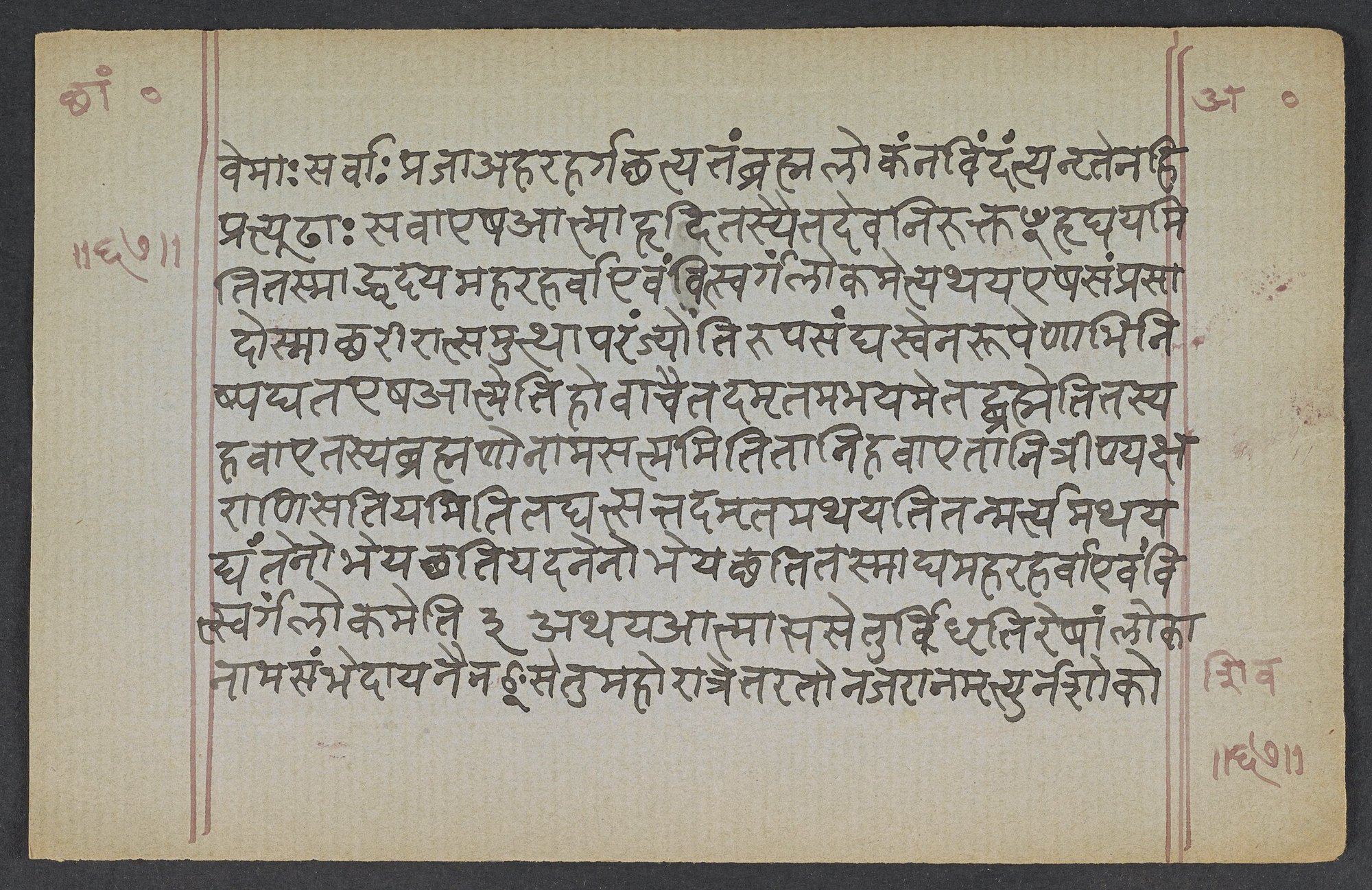
Penn Ms. Coll. 390 Item 945. fol. 67r begins ‹tavāditralokakāmo bhavati saṃkalpād evāsya gītavādite samuttiṣṭhatas› and ends ‹hiraṇyanidhiṃ nihitam akṣetrajñā upary upari saṃcaranto na vindeyur evam e›; fol. 67v begins ‹vemāḥ sarvāḥ prajā ahar ahar gacchantya etaṃ brahmalokaṃ na vindanty anṛtena hi pratyūḍhāḥ› and ends ‹atha ya ātmā sa setur vidhṛtir eṣāṃ lokānām asaṃbhedāya naitaṃ setum ahorātre tarato na jarā na mṛtyur na śoko› (first and last words read on the image, transliterated). The words were located in the GRETIL text by string matching and the page boundaries follow from them; readings and results are stored in data/sources/upanishads/mapping_945.json.
3.2atha ye cāsyeha jīvā ye ca pretā yac cānyad icchan na labhate sarvaṃ tad atra gatvā vindate |
atra hy asyaite satyāḥ kāmā anṛtāpidhānāḥ |
tad yathāpi hiraṇyanidhiṃ nihitam akṣetrajñā upary upari sañcaranto na vindeyuḥ |
evam evemāḥ sarvāḥ prajā ahar ahar gacchantya etaṃ brahmalokaṃ na vindanty anṛtena hi pratyūḍhāḥ ||
3.3sa vā eṣa ātmā hṛdi |
tasyaitad eva niruktaṃ hṛdy ayam iti tasmād dhṛd ayam |
ahar ahar vā evaṃvit svargaṃ lokam eti ||
3.4atha ya eṣa saṃprasādo 'smāc charīrāt samutthāya paraṃ jyotir upasaṃpadya svena rūpenābhiniṣpadyata eṣa ātmeti hovāca |
etad amṛtam abhayam etad brahmeti |
tasya ha vā etasya brahmaṇo nāma satyam iti ||
3.5tāni ha vā etāni trīṇyakṣarāṇi satīyamiti tadyatsattdamṛtamatha yatti tanmartyamatha
yadyaṃ tenobhe yacchati yadanenobhe yacchati tasmādyamaharaharvā evaṃvitsvargaṃ lokameti //
3.2'Those who belong to us, whether living or departed, and whatever else there is which we wish for and do not obtain, all that we find there (if we descend into our heart, where Brahman dwells, in the ether of the heart), There are all our true desires, but hidden by what is false. As people who do not know the country, walk again and again over a gold treasure that has been hidden somewhere in the earth and do not discover it, thus do all these creatures day after day go into the Brahma-world (they are merged in Brahman, while asleep), and yet do not discover it, because they are carried away by untruth (they do not come to themselves, i. e. they do not discover the true Self in Brahman, dwelling in the heart).
3.3'That Self abides in the heart. And this is the etymological explanation. The heart is called hridayam, instead of hrzdy-ayam, i. e. He who is in the heart. He who knows this, that He is in the heart, goes day by day (when in sushupti, deep sleep) into heaven (svarga), i.e. into the Brahman of the heart.
3.4'Now that serene being which, after having risen from out this earthly body, and having reached the highest light (self-knowledge), appears in its true form, that is the Self, thus he spoke (when asked by his pupils). This is the immortal, the fearless, this is Brahman. And of that Brahman the name is the True, Satyam,
3.5This name Sattyam consists of three syllables, sat-tî-yam. Sat signifies the immortal, t, the mortal, and with yam he binds both. Because he binds both, the immortal and the mortal, therefore it is yam. He who knows this goes day by day into heaven (svarga).
Where on the image
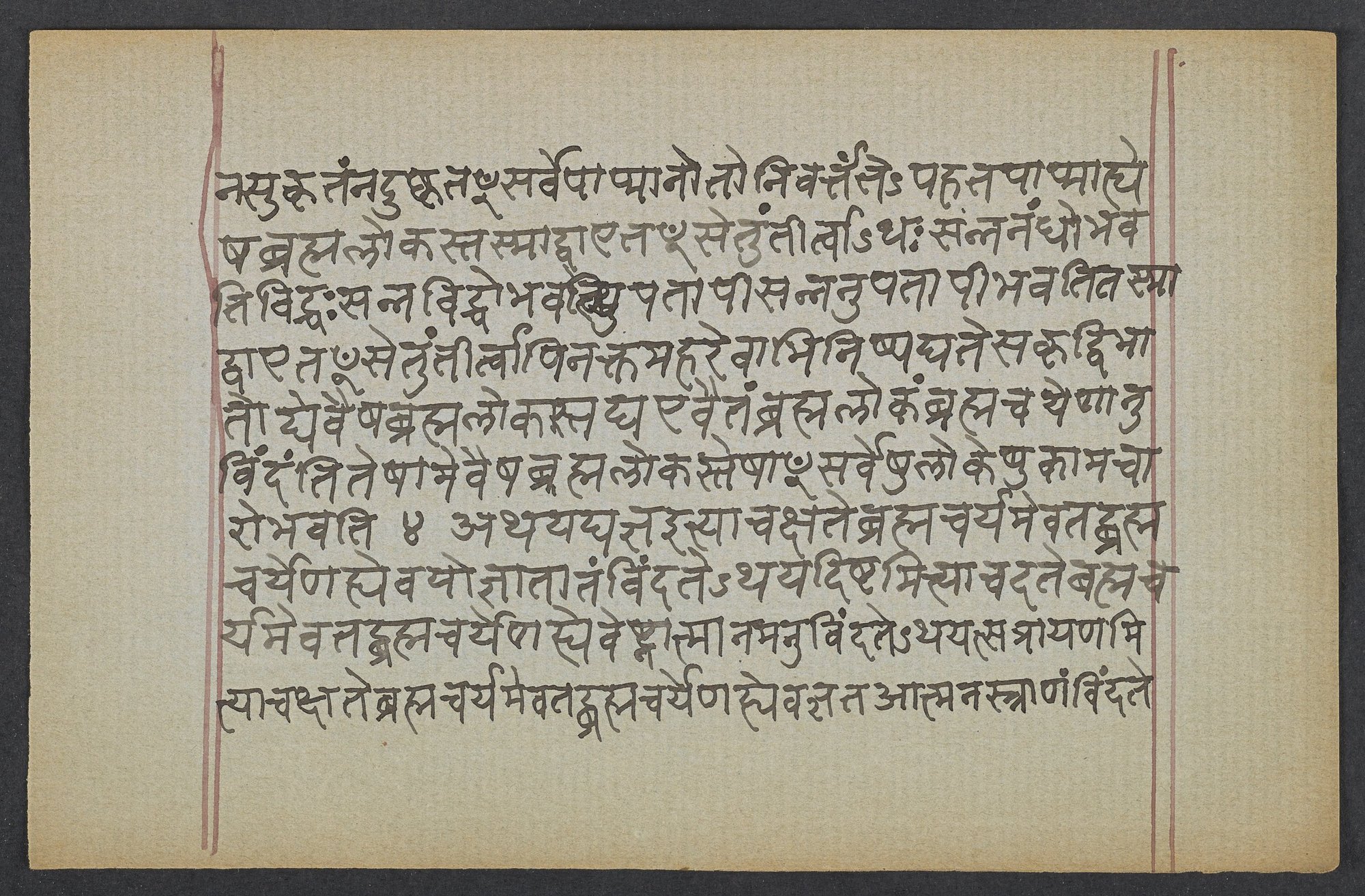
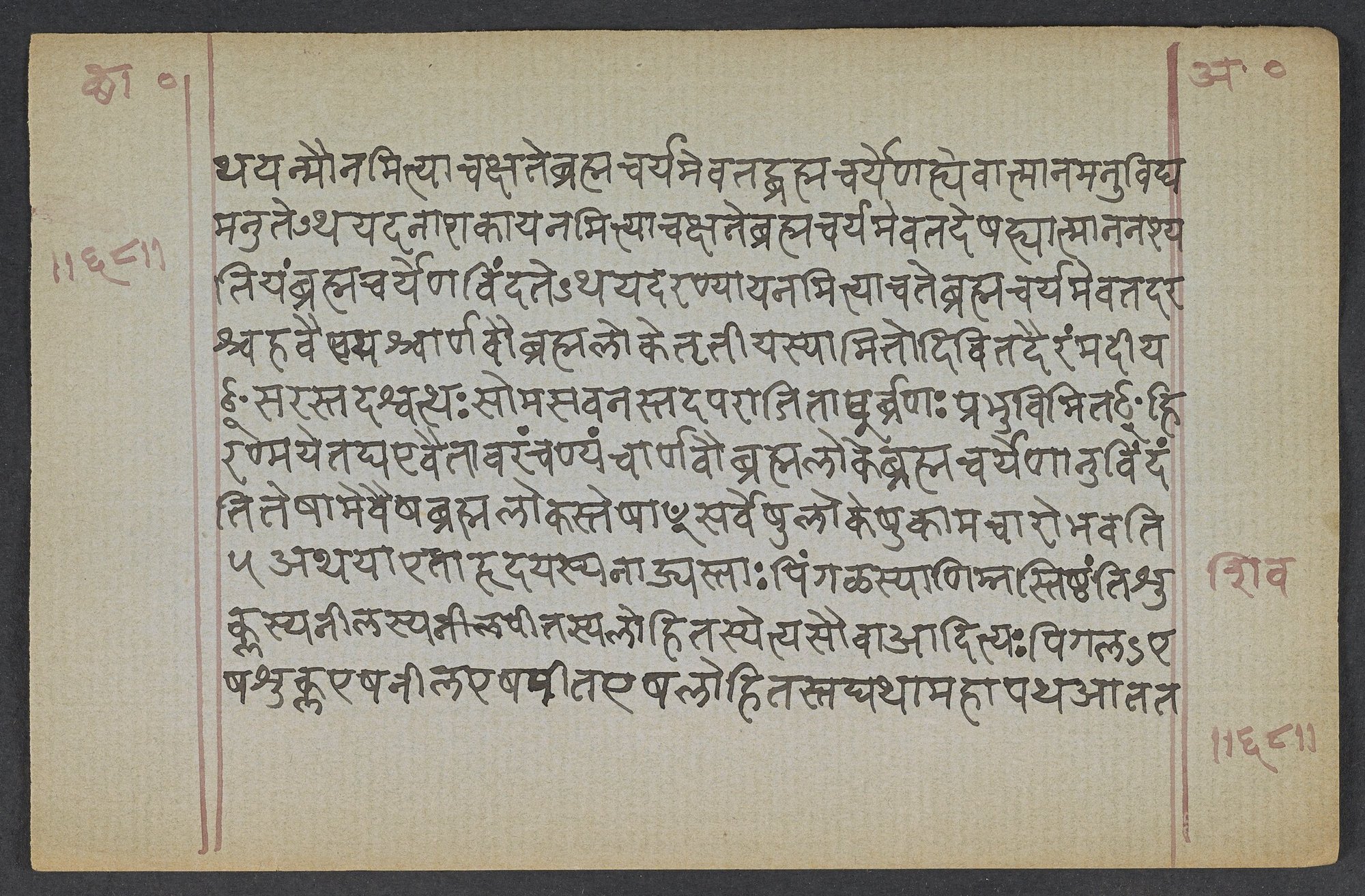
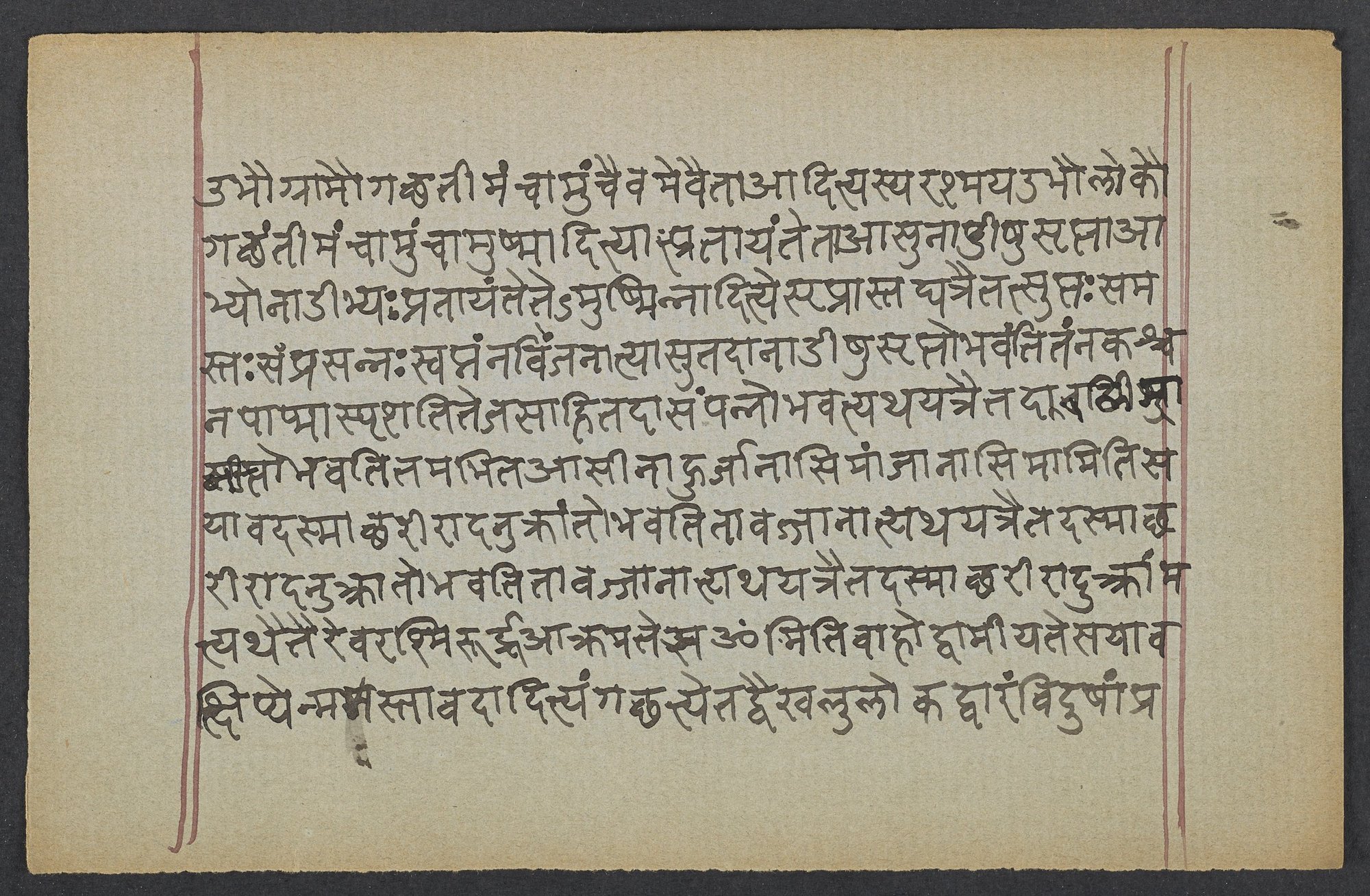
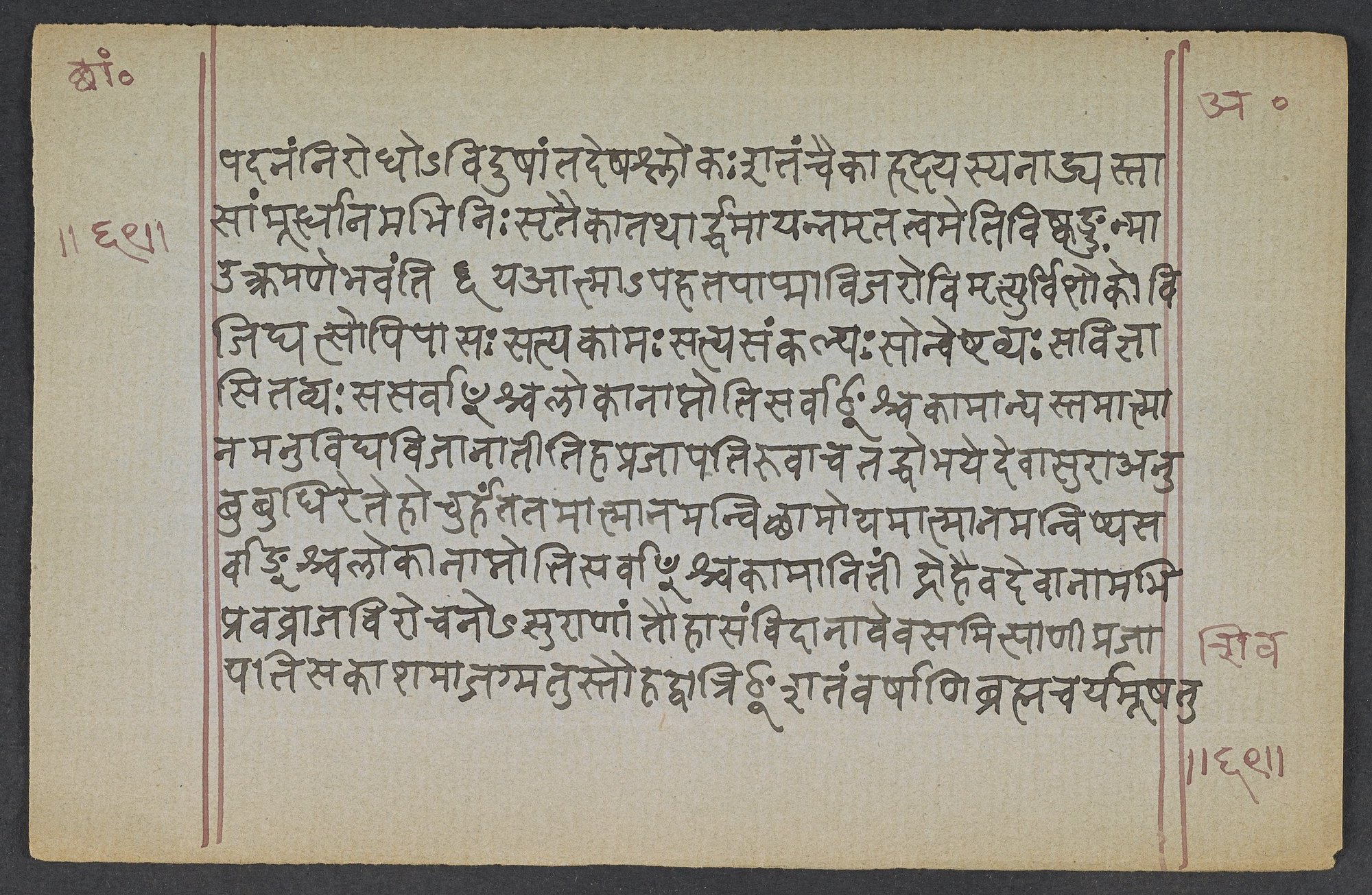
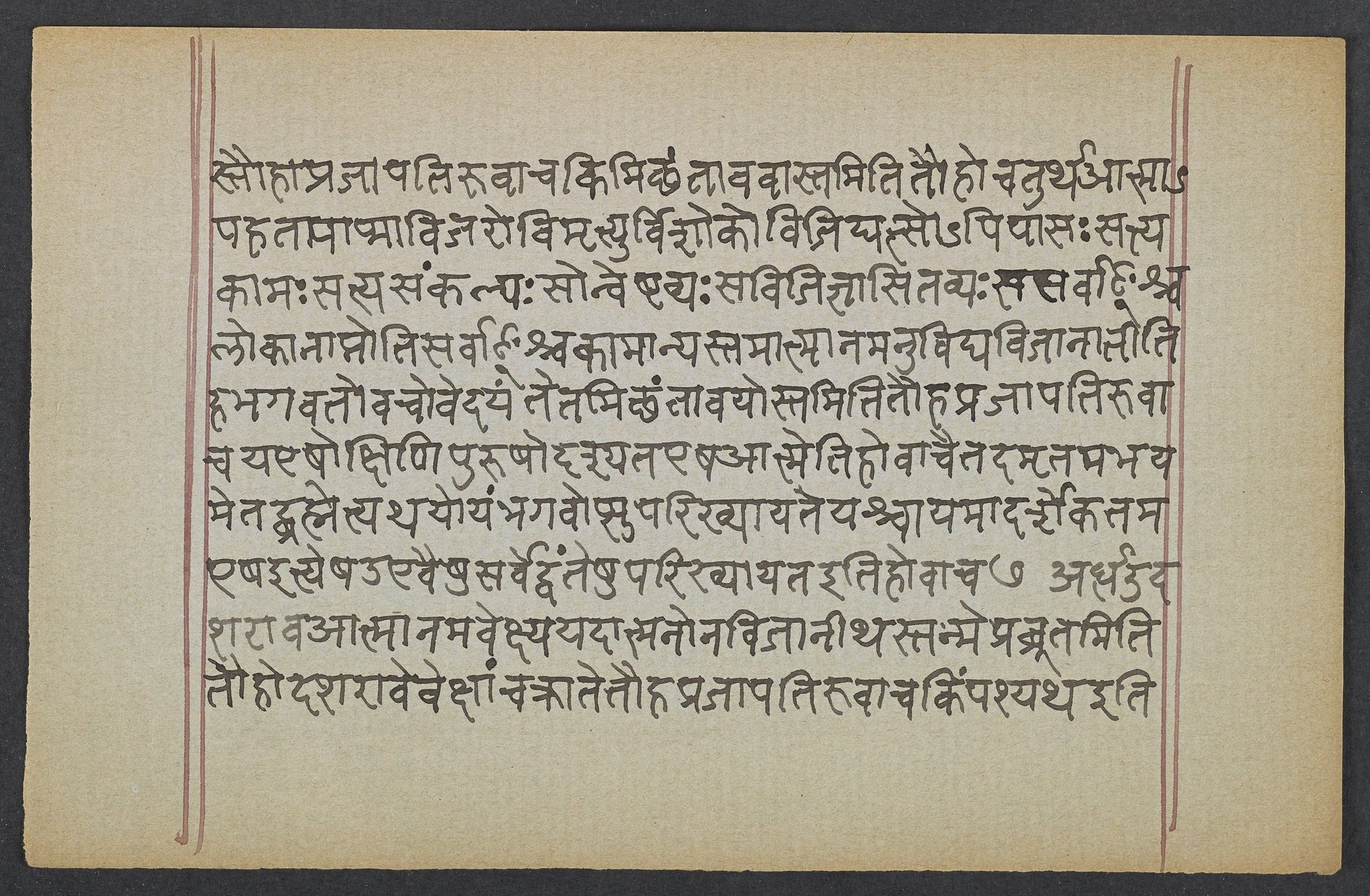
Penn Ms. Coll. 390 Item 945. fol. 67v begins ‹vemāḥ sarvāḥ prajā ahar ahar gacchantya etaṃ brahmalokaṃ na vindanty anṛtena hi pratyūḍhāḥ› and ends ‹atha ya ātmā sa setur vidhṛtir eṣāṃ lokānām asaṃbhedāya naitaṃ setum ahorātre tarato na jarā na mṛtyur na śoko›; fol. 68r begins ‹na sukṛtaṃ na duṣkṛtaṃ sarve pāpmāno 'to nivartante› and ends ‹atha yat sattrāyaṇam ity ācakṣate brahmacaryam eva tad brahmacaryeṇa hy eva sata ātmanas trāṇaṃ vindate›; fol. 68v begins ‹atha yan maunam ity ācakṣate brahmacaryam eva tad› and ends ‹eṣa śukla eṣa nīla eṣa pīta eṣa lohitas tad yathā mahāpatha ātata›; fol. 69r begins ‹ubhau grāmau gacchatīmaṃ cāmuṃ caivam evaitā ādityasya raśmaya ubhau lokau gacchantīmaṃ cāmuṃ ca› and ends ‹yāvat kṣipyen manas tāvad ādityaṃ gacchaty etad vai khalu lokadvāraṃ viduṣāṃ pra›; fol. 69v begins ‹padanaṃ nirodho 'viduṣāṃ tad eṣa ślokaḥ śataṃ caikā ca hṛdayasya nāḍyas› and ends ‹tau hādvātriṃśataṃ varṣāṇi brahmacaryam ūṣatu›; fol. 70r begins ‹tau ha prajāpatir uvāca kim icchantāv avāstam iti tau hocatur ya ātmāpahatapāpmā› and ends ‹tau ha daśaśarāva ivekṣāṃ cakrāte tau ha prajāpatir uvāca kiṃ paśyatha iti› (first and last words read on the image, transliterated). Notes: Müller divides khanda 8.5, 8.6, 8.7 into paragraphs differently from the Sanskrit edition; the whole khanda is given here with his own numbers. The words were located in the GRETIL text by string matching and the page boundaries follow from them; readings and results are stored in data/sources/upanishads/mapping_945.json.
4.1atha ya ātmā sa setur dhṛtir eṣāṃ lokānām asaṃbhedāya |
naitaṃ setum ahorātre tarato na jarā na mṛtyur na śoko na sukṛtam |
sarve pāpmāno 'to nivartante |
apahatapāpmā hy eṣa brahmalokaḥ ||
4.2tasmād vā etaṃ setuṃ tīrtvā andhaḥ sann anandho bhavati |
viddhaḥ sann aviddho bhavati |
upatāpī sann anupatāpī bhavati |
tasmād vā etaṃ setuṃ tīrtvā api naktam ahar evābhiniṣpadyate |
sakṛd vibhāto hy evaiṣa brahmalokaḥ ||
4.3tad ya evaitaṃ brahmalokaṃ brahmacaryeṇānuvindanti teṣām evaiṣa brahmalokaḥ |
teṣāṃ sarveṣu lokeṣu kāmacāro bhavati ||
5.1atha yad yajña ity ācakṣate brahmacaryam eva tat |
brahmacaryeṇa hy eva yo jñātā taṃ vindate |
atha yad iṣṭam ity ācakṣate brahmacaryam eva tat |
brahmacaryeṇa hy eveṣṭvātmānam anuvindate ||
5.2atha yat sattrāyaṇam ity ācakṣate brahmacaryam eva tat |
brahmacaryeṇa hy eva sata ātmanas trāṇaṃ vindate |
atha yan maunam ity ācakṣate brahmacaryam eva tat |
brahmacaryeṇa hy evātmānam anuvidya manute ||
5.3atha yad anāśakāyanam ity ācakṣate brahmacaryam eva tat |
eṣa hy ātmā na naśyati yaṃ brahmacaryeṇānuvindate |
atha yad araṇyāyanam ity ācakṣate brahmacaryam eva tat |
tat araś ca ha vai ṇyaś cārṇavau brahmaloke tṛtīyasyām ito divi |
tad airaṃmadīyaṃ saraḥ |
tad aśvatthaḥ somasavanaḥ |
tad aparājitā pūr brahmaṇaḥ prabhuvimitaṃ hiraṇmayam ||
5.4tad ya evaitāv araṃ ca ṇyaṃ cārṇavau brahmaloke brahmacaryeṇānuvindanti teṣām evaiṣa brahmalokaḥ |
teṣāṃ sarveṣu lokeṣu kāmacāro bhavati ||
6.1atha yā etā hṛdayasya nāḍyas tāḥ piṅgalasyāṇimnas tiṣṭhanti śuklasya nīlasya pītasya lohitasyeti |
asau vādityaḥ piṅgala eṣa śukla eṣa nīla eṣa pīta eṣa lohitaḥ ||
6.2tad yathā mahāpatha ātata ubhau grāmau gacchatīmaṃ cāmuṃ caivam evaitā ādityasya raśmaya ubhau lokau gacchantīmaṃ cāmuṃ ca |
amuṣmād ādityāt pratāyante tā āsu nāḍīṣu sṛptāḥ |
ābhyo nāḍībhyaḥ pratāyante te 'muṣminn āditye sṛptāḥ ||
6.3tad yatraitat suptaḥ samastaḥ saṃprasannaḥ svapnaṃ na vijānāti |
āsu tadā nāḍīṣu sṛpto bhavati |
taṃ na kaścana pāpmā spṛśati |
tejasā hi tadā saṃpanno bhavati ||
6.4atha yatraitad abalimānaṃ nīto bhavati |
tam abhita āsīnā āhur jānāsi māṃ jānāsi mām iti |
sa yāvad asmāc charīrād anutkrānto bhavati |
tāvaj jānāti ||
6.5atha yatraitad asmāc charīrād utkrāmati |
athaitair eva raśmibhir ūrdhvam ākramate |
sa om iti vā hod vā mīyate |
sa yāvat kṣipyen manas tāvad ādityaṃ gacchati |
etad vai khalu lokadvāraṃ viduṣāṃ prapadanaṃ nirodho 'viduṣām ||
6.6tad eṣa ślokaḥ |
śataṃ caikā ca hṛdayasya nāḍyas tāsāṃ mūrdhānam abhiniḥsṛtaikā |
tayordhvam āyann amṛtatvam eti viṣvaṅṅ anyā utkramaṇe bhavanty utkramaṇe bhavanti ||
7.1ya ātmā apahatapāpmā vijaro vimṛtyur viśoko vijighatso 'pipāsaḥ satyakāmaḥ satyasaṃkalpaḥ so 'nveṣṭavyaḥ sa vijijñāsitavyaḥ |
sa sarvāṃś ca lokān āpnoti sarvāṃś ca kāmān yas tam ātmānam anuvidya vijānātīti ha prajāpatir uvāca ||
7.2tad dhobhaye devāsurā anububudhire |
te hocur hanta tam ātmaānam anvecchāmo yam ātmānam anviṣya sarvāṃś ca lokān āpnoti sarvāṃś ca kāmān iti |
indro haiva devānām abhipravavrāja virocano 'surāṇām |
tau hāsaṃvidānāv eva samitpāṇī prajāpatisakāśam ājagmatuḥ ||
7.3tau ha dvātriṃśataṃ varṣāṇi brahmacaryam ūṣatuḥ |
tau ha prajāpatir uvāca |
kim icchantāv avāstam iti |
tau hocatur ya ātmā apahatapāpmā vijaro vimṛtyur viśoko vijighatso 'pipāsaḥ satyakāmaḥ satyasaṃkalpaḥ so 'nveṣṭavyaḥ sa vijijñāsitavyaḥ |
sa sarvāṃś ca lokān āpnoti sarvāṃś ca kāmān yas tam ātmānam anuvidya vijānātīti bhagavato vaco vedayante |
tam icchantāv avāstam iti ||
7.4tau ha prajāpatir uvāca ya eṣo 'kṣiṇi puruṣo dṛṣyata eṣa ātmeti hovāca |
etad amṛtam abhayam etad brahmeti |
atha yo 'yaṃ bhagavo 'psu parikhyāyate yaś cāyam ādarśe katama eṣa iti |
eṣa u evaiṣu sarveṣvannteṣu parikhyāyata iti hovāca ||
4.1That Self is a bank, a boundary, so that these worlds may not be confounded. Day and night do not pass that bank, nor old age, death, and grief; neither good nor evil deeds. All evil-doers turn back from it, for the world of Brahman is free from all evil.
4.2Therefore he who has crossed that bank, if blind, ceases to be blind; if wounded, ceases to be wounded; if afflicted, ceases to be afflicted. Therefore when that bank has been crossed, night becomes day indeed, for the world of Brahman is lighted up once for all.
4.3And that world of Brahman belongs to those only who find it by abstinence—for them there is freedom in all the worlds.
5.1What people call sacrifice (yagña), that is really abstinence (brahmakarya). For he who knows, obtains that (world of Brahman, which others obtain by sacrifice), by means of abstinence. What people call sacrifice (ishta), that is really abstinence, for by abstinence, having searched (ishtvâ), he obtains the Self.
5.2What people call sacrifice (sattrâyana), that is really abstinence, for by abstinence he obtains from the Sat (the true), the safety (trâna) of the Self. What people call the vow of silence (mauna), that is really abstinence, for he who by abstinence has found out the Self, meditates (manute).
5.3What people call fasting (aranyâyana), that is really abstinence, for that Self does not perish (na nasyati), which we find out by abstinence. What people call a hermit's life (aranyâyana), that is really abstinence. Ara and Nya are two lakes in the world of Brahman, in the third heaven from hence; and there is the lake Airammadîya, and the Asvattha tree, showering down Soma, and the city of Brahman (Hiranyagarbha) Aparâgitâ, and the golden Prabhuvimita (the hall built by Prabhu, Brahman). Now that world of Brahman belongs to those who find the lakes Ara and Nya in the world of Brahman by means of abstinence; for them there is freedom in all the worlds.
6.1Now those arteries of the heart consist of a brown substance, of a white, blue, yellow, and red substance, and so is the sun brown, white, blue, yellow, and red.
6.2As a very long highway goes to two places, to one at the beginning, and to another at the end, so do the rays of the sun go to both worlds, to this one and to the other. They start from the sun, and enter into those arteries; they start from those arteries, and enter into the sun.
6.3And when a man is asleep, reposing, and at perfect rest, so that he sees no dream, then he has entered into those arteries. Then no evil touches him, for he has obtained the light (of the sun).
6.4And when a man falls ill, then those who sit round him, say, 'Do you know me? Do you know me?' As long as he has not departed from this body, he knows them.
6.5But when he departs from this body, then he departs upwards by those very rays (towards the worlds which he has gained by merit, not by knowledge); or he goes out while meditating on Om (and thus securing an entrance into the Brahma- loka). And while his mind is failing, he is going to the sun. For the sun is the door of the world (of Brahman). Those who know, walk in; those who do not know, are shut out. There is this verse: 'There are a hundred and one arteries of the heart; one of them penetrates the crown of the head; moving upwards by it a man reaches the immortal; the others serve for departing in different directions, yea, in different directions.'
7.1Pragâpati said: 'The Self which is free from sin, free from old age, from death and grief, from hunger and thirst, which desires nothing but what it ought to desire, and imagines nothing but what it ought to imagine, that it is which we must search out, that it is which we must try to understand. He who has searched out that Self and understands it, obtains all worlds and all desires.'
7.2The Devas (gods) and Asuras (demons) both heard these words, and said: 'Well, let us search for that Self by which, if one has searched it out, all worlds and all desires are obtained.' Thus saying Indra went from the Devas, Virokana from the Asuras, and both, without having communicated with each other, approached Pragâpati, holding fuel in their hands, as is the custom for pupils approaching their master.
7.3They dwelt there as pupils for thirty-two years. Then Pragâpati asked them: 'For what purpose have you both dwelt here?' They replied: 'A saying of yours is being repeated, viz. "the Self which is free from sin, free from old age, from death and grief, from hunger and thirst, which desires nothing but what it ought to desire, and imagines nothing but what it ought to imagine, that it is which we must search out, that it is which we must try to understand. He who has searched out that Self and understands it, obtains all worlds and all desires." Now we both have dwelt here because we wish for that Self.' Pragâpati said to them: 'The person that is seen in the eye, that is the Self. This is what I have said. This is the immortal, the fearless, this is Brahman.' They asked: 'Sir, he who is perceived in the water, and he who is perceived in a mirror, who is he?' He replied: 'He himself indeed is seen in all these.'
Where on the image
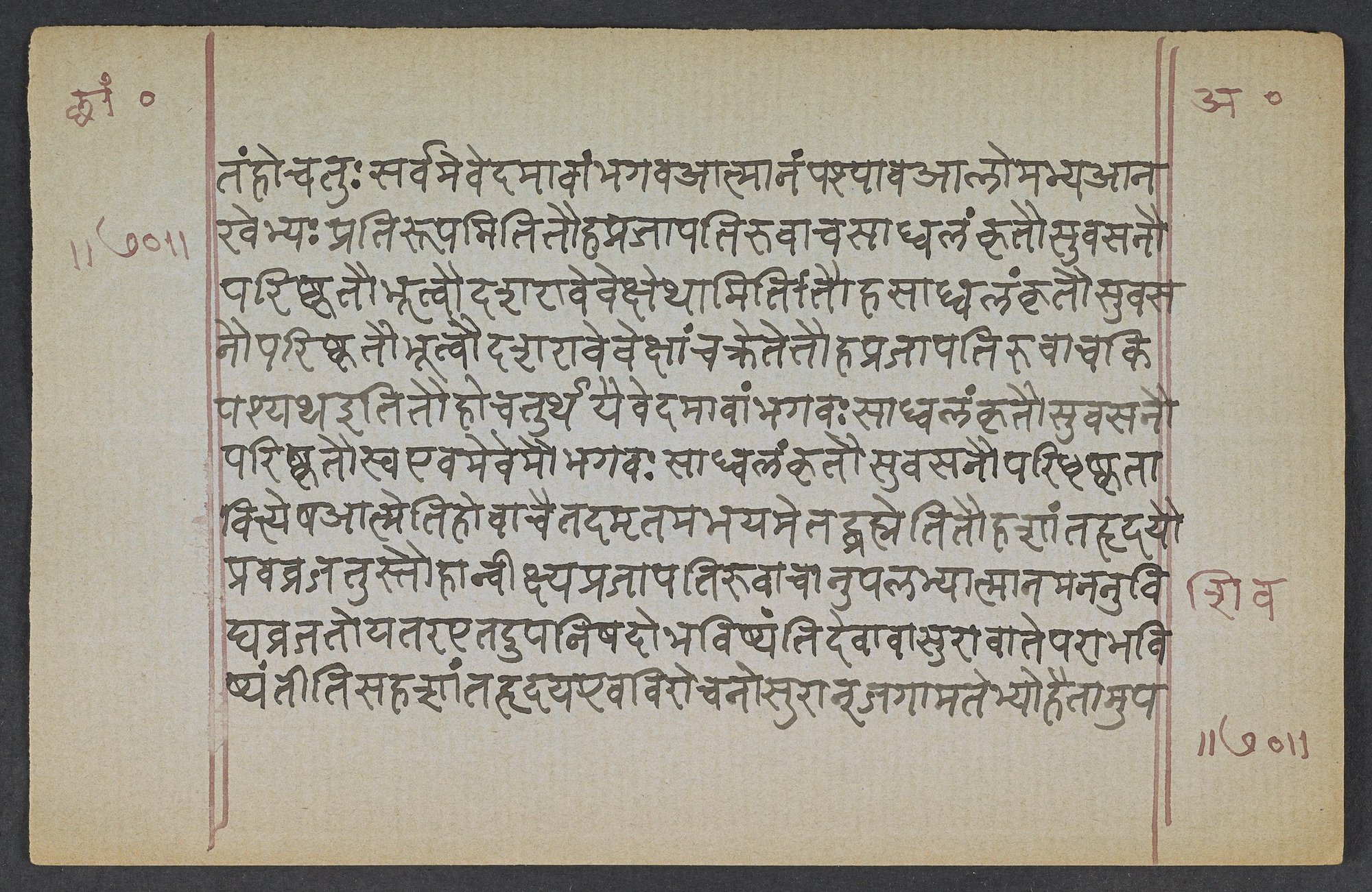
Penn Ms. Coll. 390 Item 945. fol. 70r begins ‹tau ha prajāpatir uvāca kim icchantāv avāstam iti tau hocatur ya ātmāpahatapāpmā› and ends ‹tau ha daśaśarāva ivekṣāṃ cakrāte tau ha prajāpatir uvāca kiṃ paśyatha iti›; fol. 70v begins ‹tau hocatuḥ sarvam evedam āvāṃ bhagava ātmānaṃ paśyāva ā lomabhya ā nakhebhyaḥ pratirūpam iti› and ends ‹sa ha śāntahṛdaya eva virocano 'surāñ jagāma tebhyo haitām upa› (first and last words read on the image, transliterated). The words were located in the GRETIL text by string matching and the page boundaries follow from them; readings and results are stored in data/sources/upanishads/mapping_945.json.
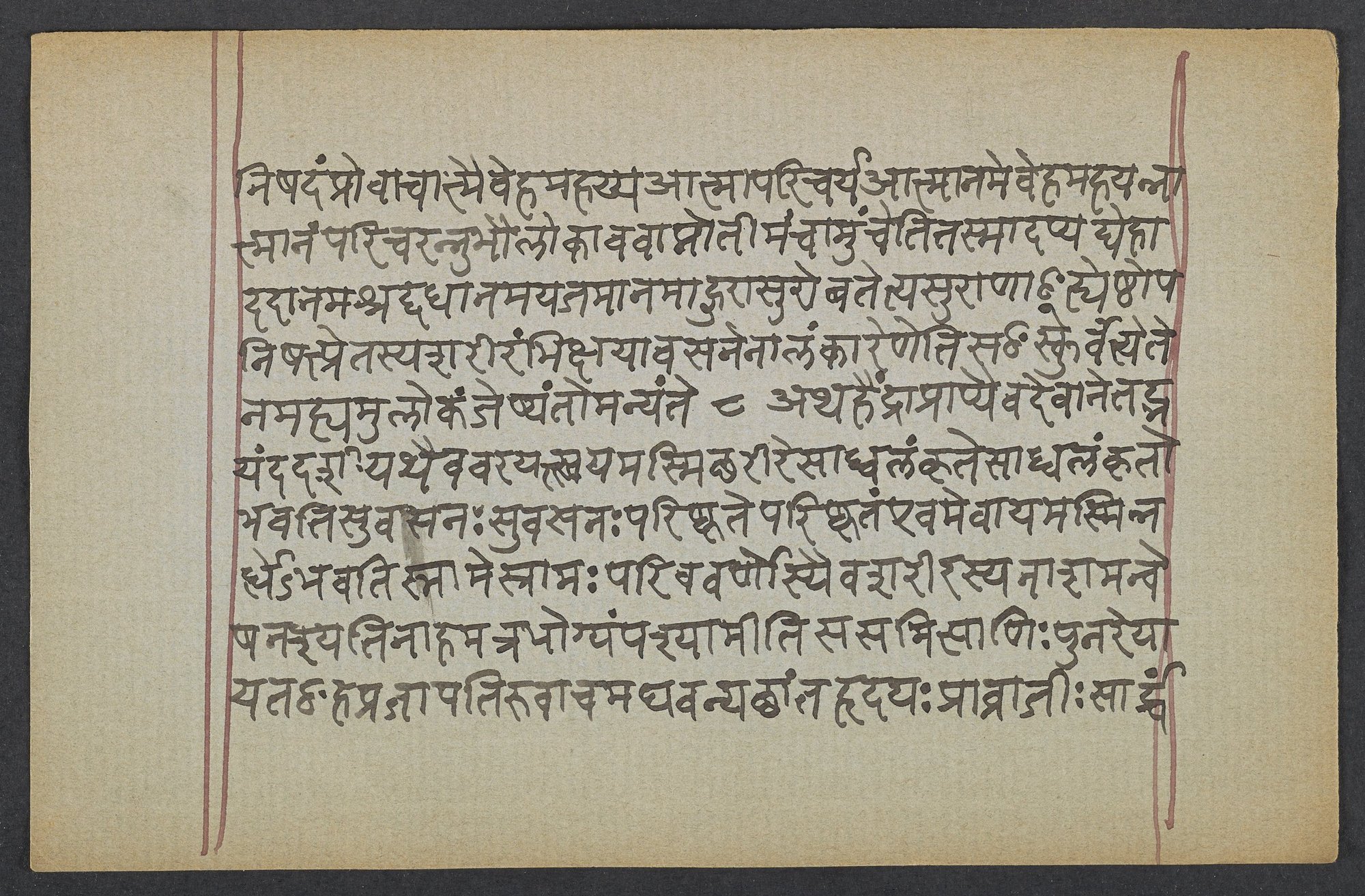
8.1udaśarāva ātmānam avekṣya yad ātmano na vijānīthas tan me prabrūtam iti |
tau hodaśarāve 'vekṣāṃ cakrāte |
tau ha prajāpatir uvāca kiṃ paśyatha iti |
tau hocatuḥ sarvam evedam āvāṃ bhagava ātmānaṃ paśyāva ā lomabhyaḥ ā nakhebhyaḥ pratirūpam iti ||
8.2tau ha prajāpatir uvāca sādhvalaṃkṛtau suvasanau pariṣkṛtau bhūtvodaśarāve 'vekṣethām iti |
tau ha sādhvalaṃkṛtau suvasanau pariṣkṛtau bhūtvodaśarāve 'vekṣāṃ cakrāte |
tau ha prajāpatir uvāca kiṃ paśyatha iti ||
8.3tau hocatur yathaivedam āvāṃ bhagavaḥ sādhvalaṃkṛtau suvasanau pariṣkṛtau sva evam evemau bhagavaḥ sādhvallaṃkṛtau suvasanau pariṣkṛtāv iti |
eṣa ātmeti hovāca |
etad amṛtam abhayam etad brahmeti |
tau ha śāntahṛdayau pravavrajatuḥ ||
8.1'Look at your Self in a pan of water, and whatever you do not understand of your Self, come and tell me.' They looked in the water-pan. Then Pragâpati said to them: 'What do you see?' They said: 'We both see the self thus altogether, a picture even to the very hairs and nails.'
8.2Pragâpati said to them: 'After you have adorned yourselves, have put on your best clothes and cleaned yourselves, look again into the water-pan.' They, after having adorned themselves, having put on their best clothes and cleaned themselves, looked into the water-pan. Pragâpati said: 'What do you see?'
8.3They said: 'Just as we are, well adorned, with our best clothes and clean, thus we are both there, Sir, well adorned, with our best clothes and clean.' Pragâpati said: 'That is the Self, this is the immortal, the fearless, this is Brahman.' Then both went away satisfied in their hearts.
Where on the image
Penn Ms. Coll. 390 Item 945. fol. 70v begins ‹tau hocatuḥ sarvam evedam āvāṃ bhagava ātmānaṃ paśyāva ā lomabhya ā nakhebhyaḥ pratirūpam iti› and ends ‹sa ha śāntahṛdaya eva virocano 'surāñ jagāma tebhyo haitām upa›; fol. 71r begins ‹niṣadaṃ provācātmaiveha mahayya ātmā paricarya› and ends ‹atha haindraḥ prajāpatir uvāca maghavan yac chāntahṛdayaḥ prāvrājīḥ sārdhaṃ› (first and last words read on the image, transliterated). The words were located in the GRETIL text by string matching and the page boundaries follow from them; readings and results are stored in data/sources/upanishads/mapping_945.json.
8.4tau hānvīkṣya prajāpatir uvāca |
anupalabhyātmānam ananuvidya vrajato yatara etadupaniṣado bhaviṣyanti devā vā asurā vā te parābhaviṣyantīti |
sa ha śāntahṛdaya eva virocano 'surāñ jagāma |
tebhyo haitām upaniṣadaṃ provāca ātmaiveha mahayya ātmā paricaryaḥ |
ātmānam eveha mahayann ātmānaṃ paricarann ubhau lokāv āpnotīmaṃ cāmuṃ ceti ||
8.5tasmād apyaddyehādadānam aśraddadhānam ayajamānam āhur āsuro bateti |
asurāṇāṃ hy eṣopaniṣat |
pretasya śarīraṃ bhikṣayā vasanenālaṃkāreṇeti saṃskurvanti |
etena hy ammuṃ lokaṃ jeṣyanto manyante ||
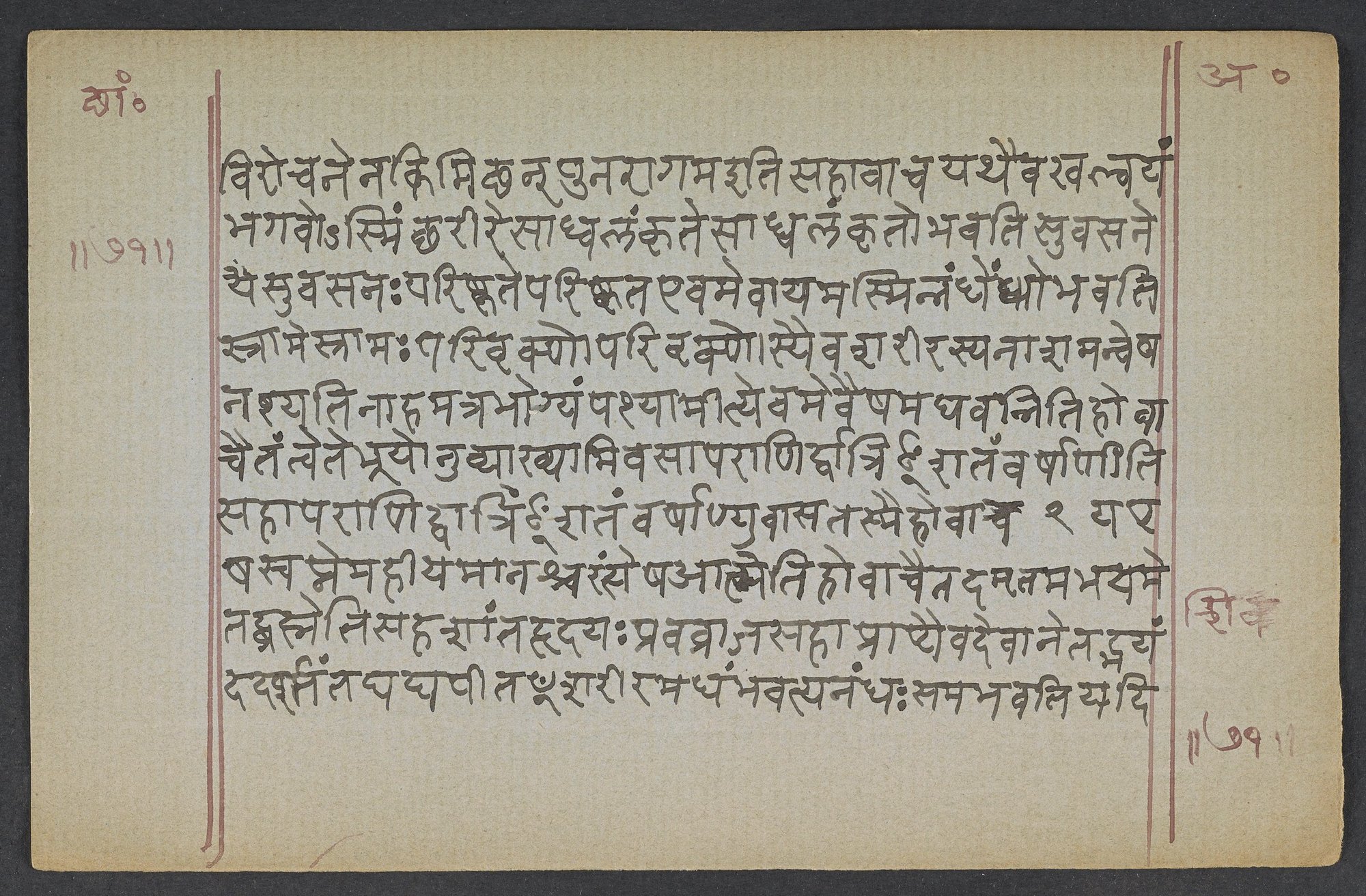
9.1atha hendro 'prāpyaiva devān etad bhayaṃ dadarśa |
yathaiva khalv ayam asmiñ charīre sādhvalaṃkṛte sādhvalaṃkṛto bhavati suvasane suvasanaḥ pariṣkṛte pariṣkṛta evam evāyam asminn andhe 'ndho bhavati srāme srāmaḥ parivṛkṇe parivṛkṇaḥ |
asyaiva śarīrasya nāśam anv eṣa naśyati |
nāham atra bhogyaṃ paśyāmīti ||
8.4And Pragâpati, looking after them, said: 'They both go away without having perceived and without having known the Self, and whoever of these two, whether Devas or Asuras, will follow this doctrine (upanishad), will perish.' Now Virokhana, satisfied in his heart, went to the Asuras and preached that doctrine to them, that the self (the body) alone is to be worshipped, that the self (the body) alone is to be served, and that he who worships the self and serves the self, gains both worlds, this and the next.
8.5Therefore they call even now a man who does not give alms here, who has no faith, and offers no sacrifices, an Âsura, for this is the doctrine (upanishad) of the Asuras. They deck out the body of the dead with perfumes, flowers, and fine raiment by way of ornament, and think they will thus conquer that world.
9.1But Indra, before he had returned to the Devas, saw this difficulty. As this self (the shadow in the water) is well adorned, when the body is well adorned, well dressed, when the body is well dressed, well cleaned, if the body is well cleaned, that self will also be blind, if the body is blind, lame, if the body is lame, crippled, if the body is crippled, and will perish in fact as soon as the body perishes. Therefore I see no good in this (doctrine).
Where on the image
Penn Ms. Coll. 390 Item 945. fol. 71r begins ‹niṣadaṃ provācātmaiveha mahayya ātmā paricarya› and ends ‹atha haindraḥ prajāpatir uvāca maghavan yac chāntahṛdayaḥ prāvrājīḥ sārdhaṃ›; fol. 71v begins ‹virocanena kim icchan punar āgama iti sa hovāca yathaiva khalv ayaṃ› and ends ‹sa ha śāntahṛdayaḥ pravavrāja sa hāprāpyaiva devān etad bhayaṃ dadarśa tad yady apīdaṃ śarīram andhaṃ bhavaty anandhaḥ sa bhavati yadi› (first and last words read on the image, transliterated). The words were located in the GRETIL text by string matching and the page boundaries follow from them; readings and results are stored in data/sources/upanishads/mapping_945.json.
9.2sa samitpāṇiḥ punar eyāya |
taṃ ha prajāpatir uvāca |
maghavan yac chāntahṛdayaḥ prāvrājīḥ sārdhaṃ virocanena kim icchan punar āgama iti |
sa hovāca yathā eva khalvayyaṃ bhagavo 'smiñ charīre sādhvalaṃkṛte sādhvalaṃkṛto bhavati suvasane suvasanaḥ pariṣkṛte pariṣkṛta evam evāyam asminn andhe 'ndho bhavati srāme srāmaḥ parivṛkṇe parivṛkṇaḥ |
asyaiva śarīrasya nāśam anv eṣa naśyati |
nāham atra bhogyaṃ paśyāmīti ||
9.3evam evaiṣa maghavann iti hovāca |
etaṃ tv eva te bhūyo 'nuvyākhyāsyāmi |
vasāparāṇi dvātriṃśataṃ varṣāṇīti |
sa hāparāṇi dvātriṃśataṃ varṣāṇyuvāsa |
tasmai hovāca ||
9.2Taking fuel in his hand he came again as a pupil to Pragâpati. Pragâpati said to him: 'Maghavat (Indra), as you went away with Virokana, satisfied in your heart, for what purpose did you come back?' He said: 'Sir, as this self (the shadow) is well adorned, when the body is well adorned, well dressed, when the body is well dressed, well cleaned, if the body is well cleaned, that self will also be blind, if the body is blind, lame, if the body is lame, crippled, if the body is crippled, and will perish in fact as soon as the body perishes. Therefore I see no good in this (doctrine).'
9.3'So it is indeed, Maghavat,' replied Pragâpati; 'but I shall explain him (the true Self) further to you. Live with me another thirty-two years.' He lived with him another thirty-two years, and then Pragâpati said:
Where on the image
Penn Ms. Coll. 390 Item 945. fol. 71v begins ‹virocanena kim icchan punar āgama iti sa hovāca yathaiva khalv ayaṃ› and ends ‹sa ha śāntahṛdayaḥ pravavrāja sa hāprāpyaiva devān etad bhayaṃ dadarśa tad yady apīdaṃ śarīram andhaṃ bhavaty anandhaḥ sa bhavati yadi›; fol. 72r begins ‹srāmam asrāmo naivaiṣo 'sya doṣeṇa duṣyati› and ends ‹sahāparāṇi dvātriṃśataṃ varṣāṇy uvāsa› (first and last words read on the image, transliterated). The words were located in the GRETIL text by string matching and the page boundaries follow from them; readings and results are stored in data/sources/upanishads/mapping_945.json.
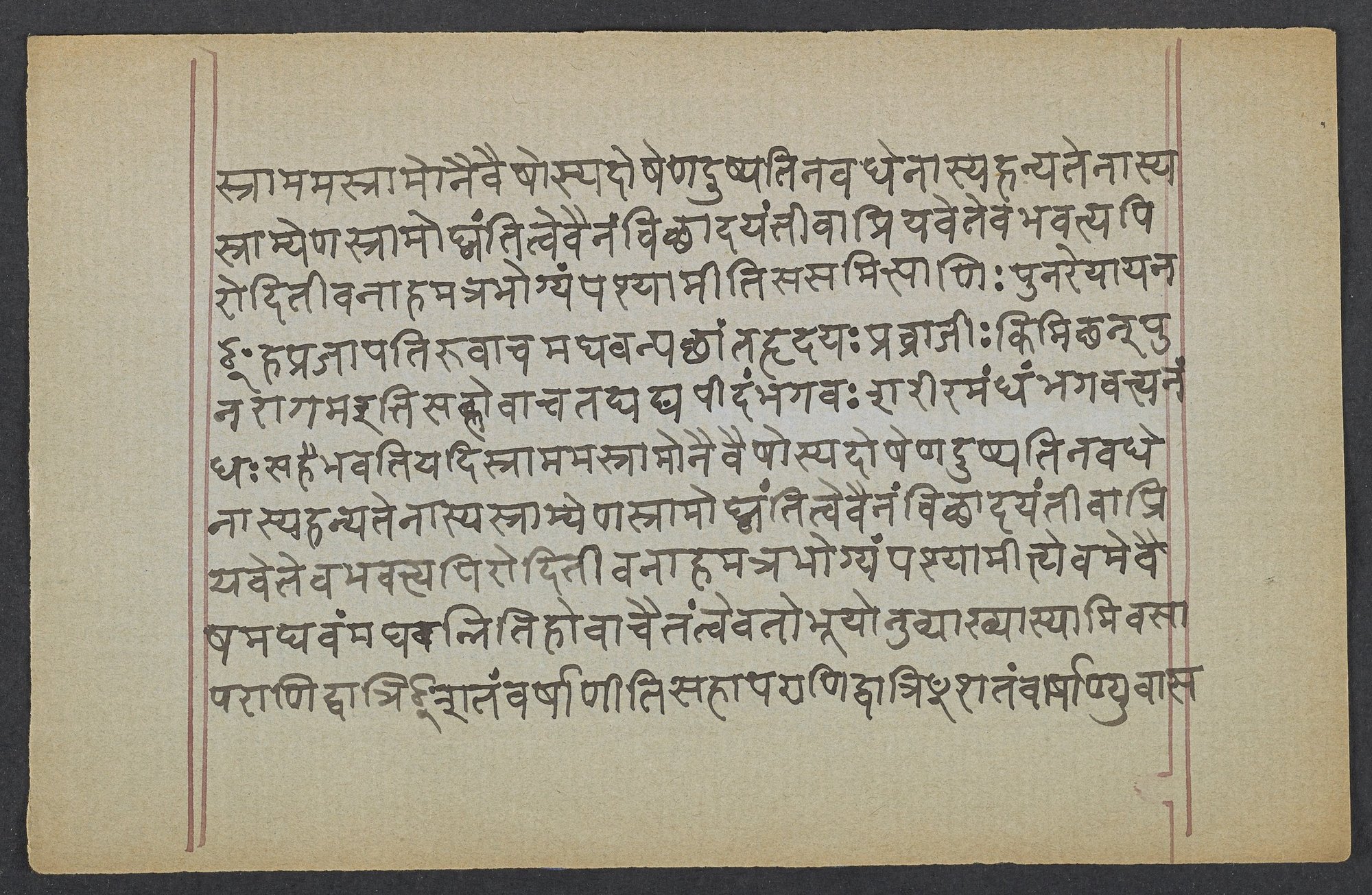
10.1ya eṣa svapne mahīyamānaś caraty eṣa ātmeti hovāca |
etad amṛtam abhayam etad brahmeti |
sa ha śāntahṛdayaḥ pravavrāja |
sa hāprāpyaiva devān etad bhayaṃ dadarśa |
tad yady apīdaṃ śarīram andhaṃ bhavaty anandhaḥ sa bhavati yadi srāmam asrāmaḥ |
naivaiṣo 'sya doṣeṇa duṣyati ||
10.2na vadhenāsya hanyate |
nāsya srāmyeṇa srāmaḥ |
ghnanti tv evainam |
vicchādayantīva |
apriyavetteva bhavati |
api roditīva nāham atra bhogyaṃ paśyāmīti ||
10.3sa samitpāṇiḥ punar eyāya |
taṃ ha prajāpatir uvāca |
maghavan yac chāntahṛdayaḥ prāvrājīḥ kim icchan punar āgama iti |
sa hovāca |
tad yady apīdaṃ bhagavaḥ śarīram andhaṃ bhavaty anandhaḥ sa bhavati yadi srāmam asrāmaḥ |
naivaiṣo 'sya doṣeṇa duṣyati ||
10.1'He who moves about happy in dreams, he is the Self, this is the immortal, the fearless, this is Brahman.' Then Indra went away satisfied in his heart. But before he had returned to the Devas, he saw this difficulty. Although it is true that that self is not blind, even if the body is blind, nor lame, if the body is lame, though it is true that that self is not rendered faulty by the faults of it (the body),
10.2Nor struck when it (the body) is struck, nor lamed when it is lamed, yet it is as if they struck him (the self) in dreams, as if they chased him. He becomes even conscious, as it were, of pain, and sheds tears. Therefore I see no good in this.
10.3Taking fuel in his hands, he went again as a pupil to Pragâpati. Pragâpati said to him: 'Maghavat, as you went away satisfied in your heart, for what purpose did you come back?' He said: 'Sir, although it is true that that self is not blind even if the body is blind, nor lame, if the body is lame, though it is true that that self is not rendered faulty by the faults of it (the body),
Where on the image
Penn Ms. Coll. 390 Item 945. fol. 72r begins ‹srāmam asrāmo naivaiṣo 'sya doṣeṇa duṣyati› and ends ‹sahāparāṇi dvātriṃśataṃ varṣāṇy uvāsa›; fol. 72v begins ‹tasmai hovāca tad yatraitat suptaḥ samastaḥ saṃprasannaḥ svapnaṃ na vijānāti› and ends ‹nāham atra bhogyaṃ paśyāmīty evam evaiṣa maghavann iti hovāca etaṃ tv eva te bhūyo 'nuvyākhyāsyāmi no evānyatraitasmād› (first and last words read on the image, transliterated). The words were located in the GRETIL text by string matching and the page boundaries follow from them; readings and results are stored in data/sources/upanishads/mapping_945.json.
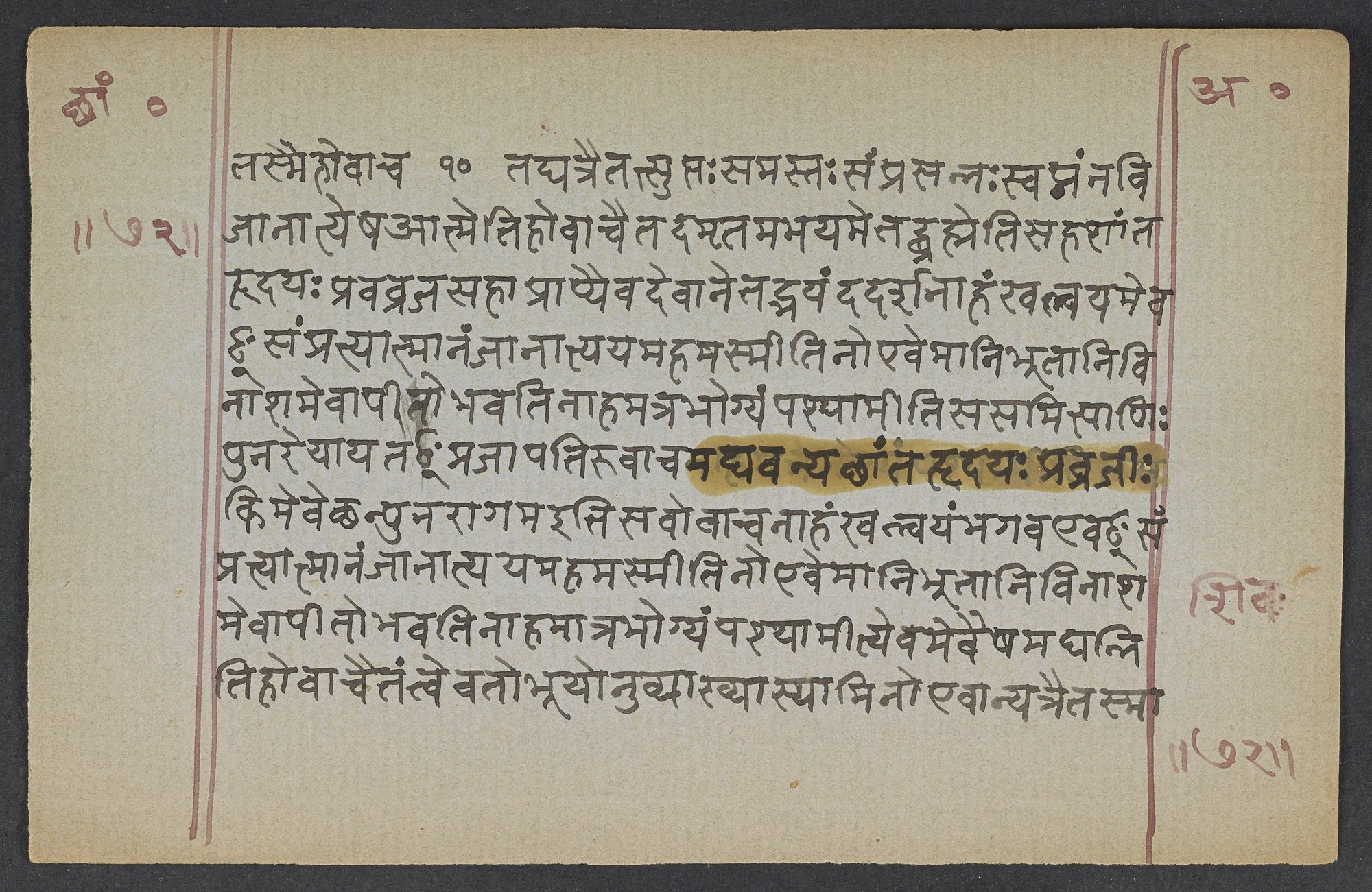
10.4na vadhenāsya hanyate |
nāsya srāmyeṇa srāmaḥ |
ghnanti tv ivainam |
vicchādayantīva |
apriyavetteva bhavati |
api roditīva |
nāham atra bhogyaṃ paśyāmīti |
evam evaiṣa maghavann iti hovāca |
etaṃ tv eva te bhūyo 'nuvyākhyāsyāmi |
vasāparāṇi dvātriṃśataṃ varṣāṇīti |
sa hāparāṇi dvātriṃśataṃ varṣāṇyuvāsa |
tasmai hovāca ||
11.1tad yatraitat suptaḥ samastaḥ saṃprasannaḥ svapnaṃ na vijānātyeṣa ātmeti hovāca |
etad amṛtam abhayam etad brahmeti |
sa ha śāntahṛdayaḥ pravavrāja |
sa hāprāpyaiva devān etad bhayaṃ dadarśa |
nāha khalv ayam evaṃ saṃpraty ātmānaṃ jānāty ayam aham asmīti |
no evemāni bhūtāni |
vināśam evāpīto bhavati |
nāham atra bhogyaṃ paśyāmīti ||
11.2sa samitpāṇiḥ punar eyāya |
taṃ ha prajāpatir uvāca - maghavan yac chāntahṛdayaḥ prāvrājīḥ kim icchan punar āgama iti |
sa hovāca nāha khalv ayaṃ bhagava evaṃ saṃpraty ātmānaṃ jānāty ayam aham asmīti |
no evemāni bhūtāni |
vināśam evāpīto bhavati |
nāham atra bhogyaṃ paśyāmīti ||
10.4Nor struck when it (the body) is struck, nor lamed when it is lamed, yet it is as if they struck him (the self) in dreams, as if they chased him. He becomes even conscious, as it were, of pain, and sheds tears. Therefore I see no good in this.' 'So it is indeed, Maghavat,' replied Pragâpati; 'but I shall explain him (the true Self) further to you. Live with me another thirty-two years.' He lived with him another thirty-two years. Then Pragâpati said:
11.1'When a man being asleep, reposing, and at perfect rest sees no dreams, that is the Self, this is the immortal, the fearless, this is Brahman.' Then Indra went away satisfied in his heart. But before he had returned to the Devas, he saw this difficulty. In truth he thus does not know himself (his self) that he is I, nor does he know anything that exists. He is gone to utter annihilation. I see no good in this.
11.2Taking fuel in his hand he went again as a pupil to Pragâpati. Pragâpati said to him: 'Maghavat, as you went away satisfied in your heart, for what purpose did you come back?' He said: 'Sir, in that way he does not know himself (his self) that he is I, nor does he know anything that exists. He is gone to utter annihilation. I see no good in this.'
Where on the image
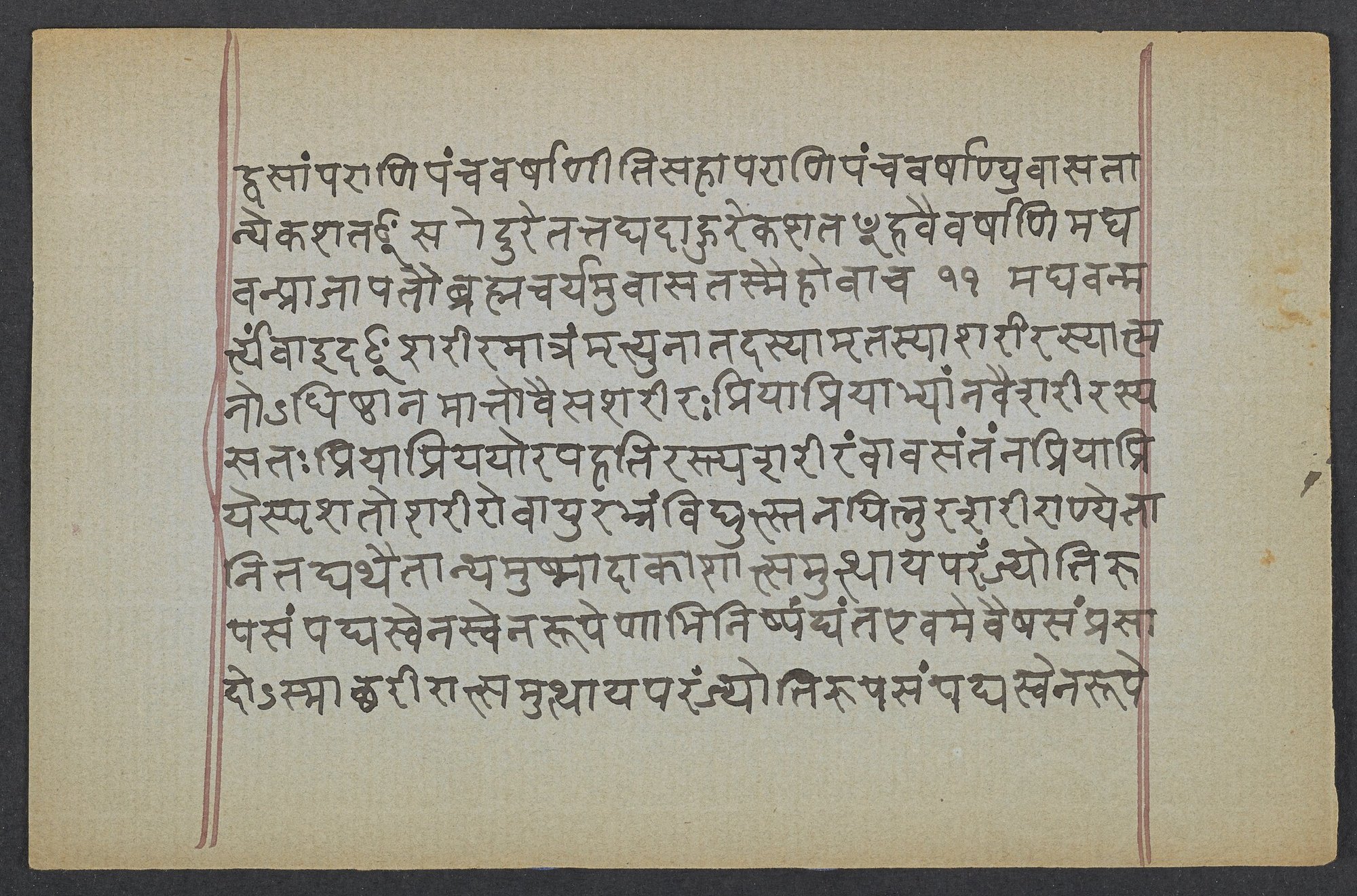
Penn Ms. Coll. 390 Item 945. fol. 72v begins ‹tasmai hovāca tad yatraitat suptaḥ samastaḥ saṃprasannaḥ svapnaṃ na vijānāti› and ends ‹nāham atra bhogyaṃ paśyāmīty evam evaiṣa maghavann iti hovāca etaṃ tv eva te bhūyo 'nuvyākhyāsyāmi no evānyatraitasmād›; fol. 73r begins ‹vasāparāṇi pañca varṣāṇīti sahāparāṇi pañca varṣāṇy uvāsa tāny ekaśataṃ saṃpeduḥ› and ends ‹evam evaiṣa saṃprasādo 'smāc charīrāt samutthāya paraṃ jyotir upasaṃpadya svena rūpe›; fol. 73v begins ‹ṇābhiniṣpadyate sa uttamaḥ puruṣaḥ sa tatra paryeti jakṣat krīḍan ramamāṇaḥ› and ends ‹sa sarvāṃś ca lokān āpnoti sarvāṃś ca kāmān ya›; fol. 74r begins ‹s tam ātmānam anuvidya vijānātīti ha prajāpatir uvāca prajāpatir uvāca› and ends ‹tad dhaitad brahmā prajāpataya uvāca prajāpatir manave manuḥ prajābhya ā› (first and last words read on the image, transliterated). Notes: Müller divides khanda 8.12 into paragraphs differently from the Sanskrit edition; the whole khanda is given here with his own numbers. The words were located in the GRETIL text by string matching and the page boundaries follow from them; readings and results are stored in data/sources/upanishads/mapping_945.json.
11.3evam evaiṣa maghavann iti hovāca |
etaṃ tv eva te bhūyo 'nuvyākhyāsyāmi |
no evānyatraitasmāt |
vasāparāṇi pañca varṣāṇīti |
sa hāparāṇi pañca varṣāṇyuvāsa |
tāny ekaśataṃ saṃpeduḥ |
etat tad yad āhuḥ |
ekaśataṃ ha vai varṣāṇi maghavān prajāpatau brahmacaryam uvāsa |
tasmai hovāca ||
12.1maghavan martyaṃ vā idaṃ śarīram āttaṃ mṛtyunā |
tad asyāmṛtasyāśarīrasyātmano 'dhiṣṭhānam |
ātto vai saśarīraḥ priyāpriyābhyām |
na vai saśarīrasya sataḥ priyāpriyayor apahatir asti |
aśarīraṃ vāva santaṃ na priyāpriye spṛśataḥ ||
12.2aśarīro vāyuḥ |
abhraṃ vidyut stanayitnur aśarīrāṇy etāni |
tad yathaitāny amuṣmād ākāśāt samutthāya paraṃ jyotir upasaṃpadya svena rūpeṇābhiniṣpadyante ||
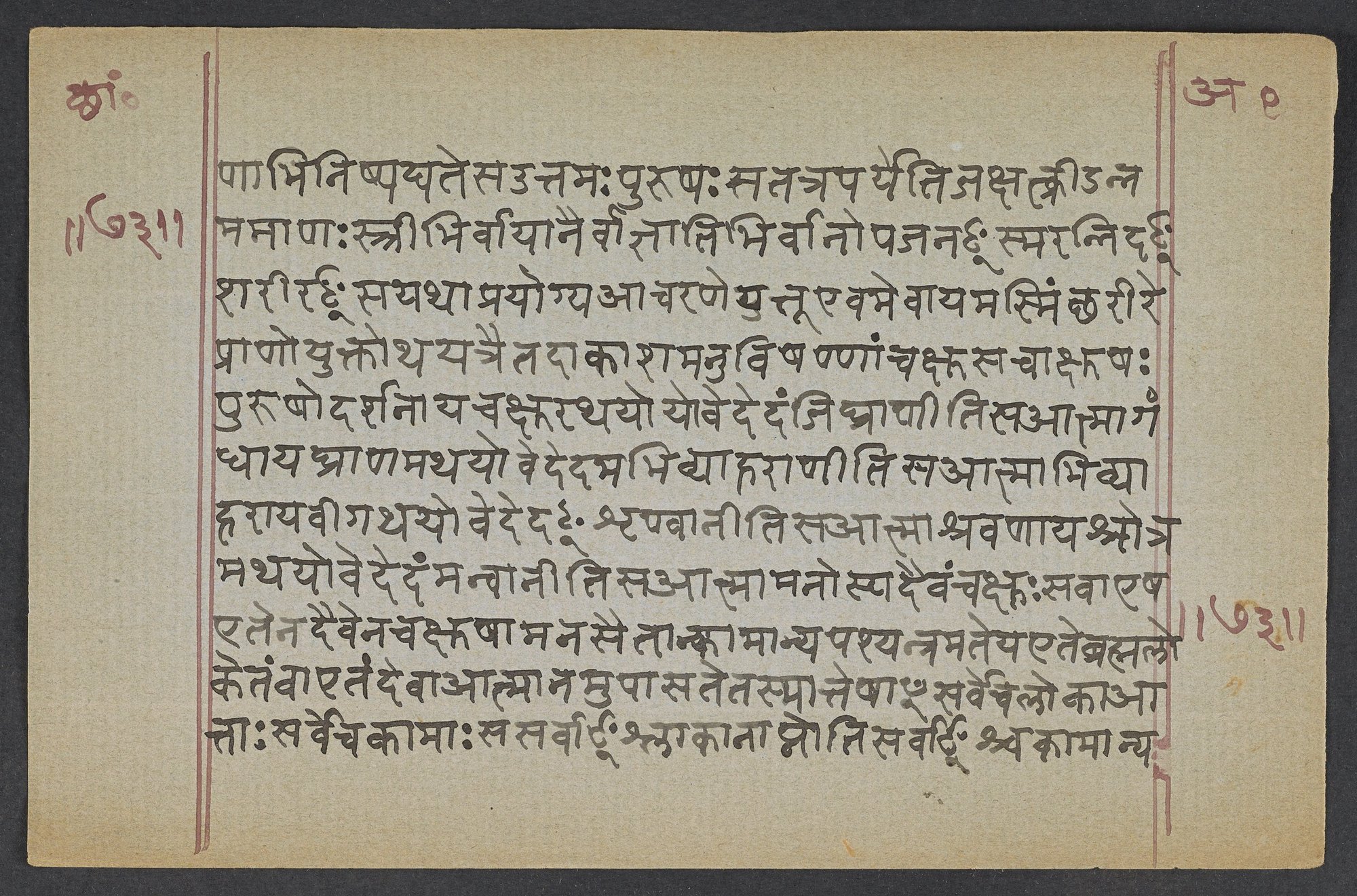
12.3evam evaiṣa saṃprasādo 'smāc charīrāt samutthāya paraṃ jyotir upasaṃpadya svena rūpeṇābhiniṣpadyate |
sa uttamapuruṣaḥ |
sa tatra paryeti jakṣat krīḍan ramamāṇaḥ strībhir vā yānair vā jñātibhir vā nopajanaṃ smarann idaṃ śarīram |
sa yathā prayogya ācaraṇe yukta evam evāyam asmiñ charīre prāṇo yuktaḥ ||
12.4atha yatraitad ākāśam anuviṣaṇṇaṃ cakṣuḥ sa cākṣuṣaḥ puruṣo darśanāya cakṣuḥ |
atha yo vededaṃ jighrāṇīti sa ātmā gandhāya ghrāṇam |
atha yo vededam abhivyāharāṇīti sa ātmā abhivyāhārāya vāk |
atha yo vededaṃ śṛṇvānīti sa ātmā śravaṇāya śrotram ||
12.5atha yo vededaṃ manvānīti sa ātmā |
mano 'sya daivaṃ cakṣuḥ |
sa vā eṣa etena daivena cakṣuṣā manasaitān kāmān paśyan ramate ya ete brahmaloke ||
12.6taṃ vā etaṃ devā ātmānam upāsate |
tasmāt teṣāṃ sarve ca lokā āttāḥ sarve ca kāmāḥ |
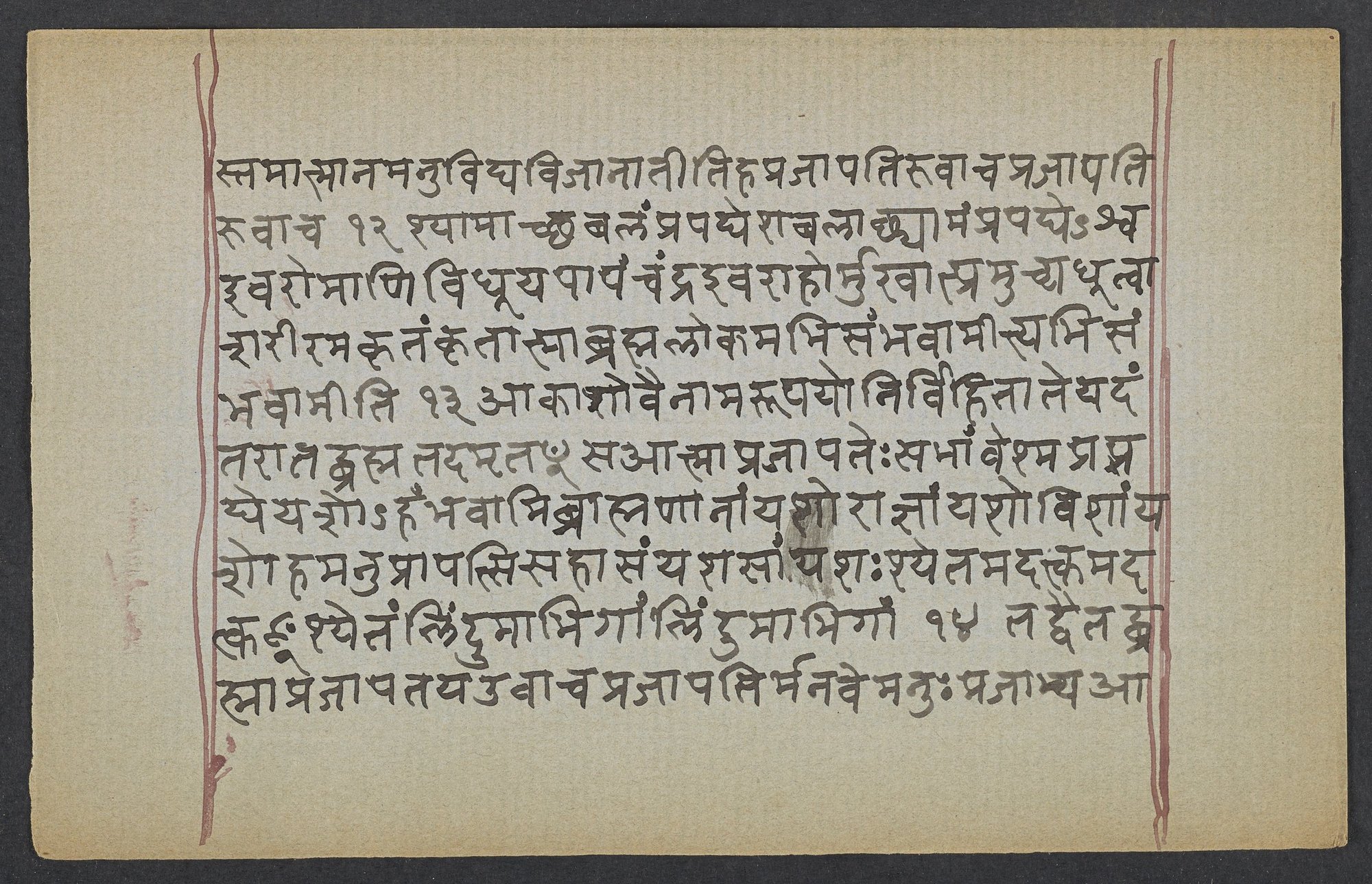
sa sarvāṃś ca lokān āpnoti sarvāṃś ca kāmān yas tam ātmānam anuvidya vijānāti |
iti ha prajāpatir uvāca prajāpatir uvāca ||
13.1śyāmāc chabalaṃ prapadye |
śabalāc chyāmaṃ prapadye |
aśva iva romāṇi vidhūya pāpaṃ candra iva rāhor mukhāt pramucya dhūtvā śarīram akṛtaṃ kṛtātmā brahmalokam abhisaṃbhavāmīty abhisaṃbhavāmīti ||
14.1ākāśo vai nāma nāmarūpayor nirvahitā |
te yadantarā tad brahma tad amṛtaṃ sa ātmā |
prajāpateḥ sabhāṃ veśma prapadye yaśo 'haṃ bhavāmi brāhmaṇānāṃ yaśo rājñām yaśo viśām |
yaśo 'ham anuprāpatsi |
sa hāhaṃ yaśasāṃ yaśaḥ |
śyetam adatkam adatkaṃ śyetaṃ lindu mābhigāṃ lindu mābhigām ||
11.3'So it is indeed, Maghavat,' replied Pragâpati; 'but I shall explain him (the true Self) further to you, and nothing more than this. Live here other five years.' He lived there other five years. This made in all one hundred and one years, and therefore it is said that Indra Maghavat lived one hundred and one years as a pupil with Pragâpati. Pragâpati said to him:
12.1'Maghavat, this body is mortal and always held by death. It is the abode of that Self which is immortal and without body. When in the body (by thinking this body is I and I am this body) the Self is held by pleasure and pain. So long as he is in the body, he cannot get free from pleasure and pain. But when he is free of the body (when he knows himself different from the body), then neither pleasure nor pain touches him.
12.2'The wind is without body, the cloud, lightning, and thunder are without body (without hands, feet, &c.) Now as these, arising from this heavenly ether (space), appear in their own form, as soon as they have approached the highest light,
12.3'Thus does that serene being, arising from this body, appear in its own form, as soon as it has approached the highest light (the knowledge of Self). He (in that state) is the highest person (uttama pfirusha). He moves about there laughing (or eating), playing, and rejoicing (in his mind), be it with women, carriages, or relatives, never minding that body into which he was born. 'Like as a horse attached to a cart, so is the spirit (prâna, pragñâtman) attached to this body.
12.4'Now where the sight has entered into the void (the open space, the black pupil of the eye), there is the person of the eye, the eye itself is the instrument of seeing. He who knows, let me smell this, he is the Self, the nose is the instrument of smelling. He who knows, let me say this, he is the Self, the tongue is the instrument of saying. He who knows, let me hear this, he is the Self, the ear is the instrument of hearing.
12.5'He who knows, let me think this, he is the Self, the mind is his divine eye. He, the Self, seeing these pleasures (which to others are hidden like a buried treasure of gold) through his divine eye, i. e. the mind, rejoices. 'The Devas who are in the world of Brahman meditate on that Self (as taught by Pragâpati to Indra, and by Indra to the Devas). Therefore all worlds belong to them, and all desires. He who knows that Self and understands it, obtains all worlds and all desires.' Thus said Pragâpati, yea, thus said Pragâpati.
13.1From the dark (the Brahman of the heart) I come to the nebulous (the world of Brahman), from the nebulous to the dark, shaking off all evil, as a horse shakes his hairs, and as the moon frees herself from the mouth of Râhu. Having shaken off the body, I obtain, self made and satisfied, the uncreated world of Brahman, yea, I obtain it.
14.1He who is called ether (âkâsa) is the revealer of all forms and names. That within which these forms and names are contained is the Brahman, the Immortal, the Self. I come to the hall of Pragâpati, to the house; I am the glorious among Brâhmans, glorious among princes, glorious among men. I obtained that glory, I am glorious among the glorious. May I never go to the white, toothless, yet devouring, white abode; may I never go to it.
Where on the image
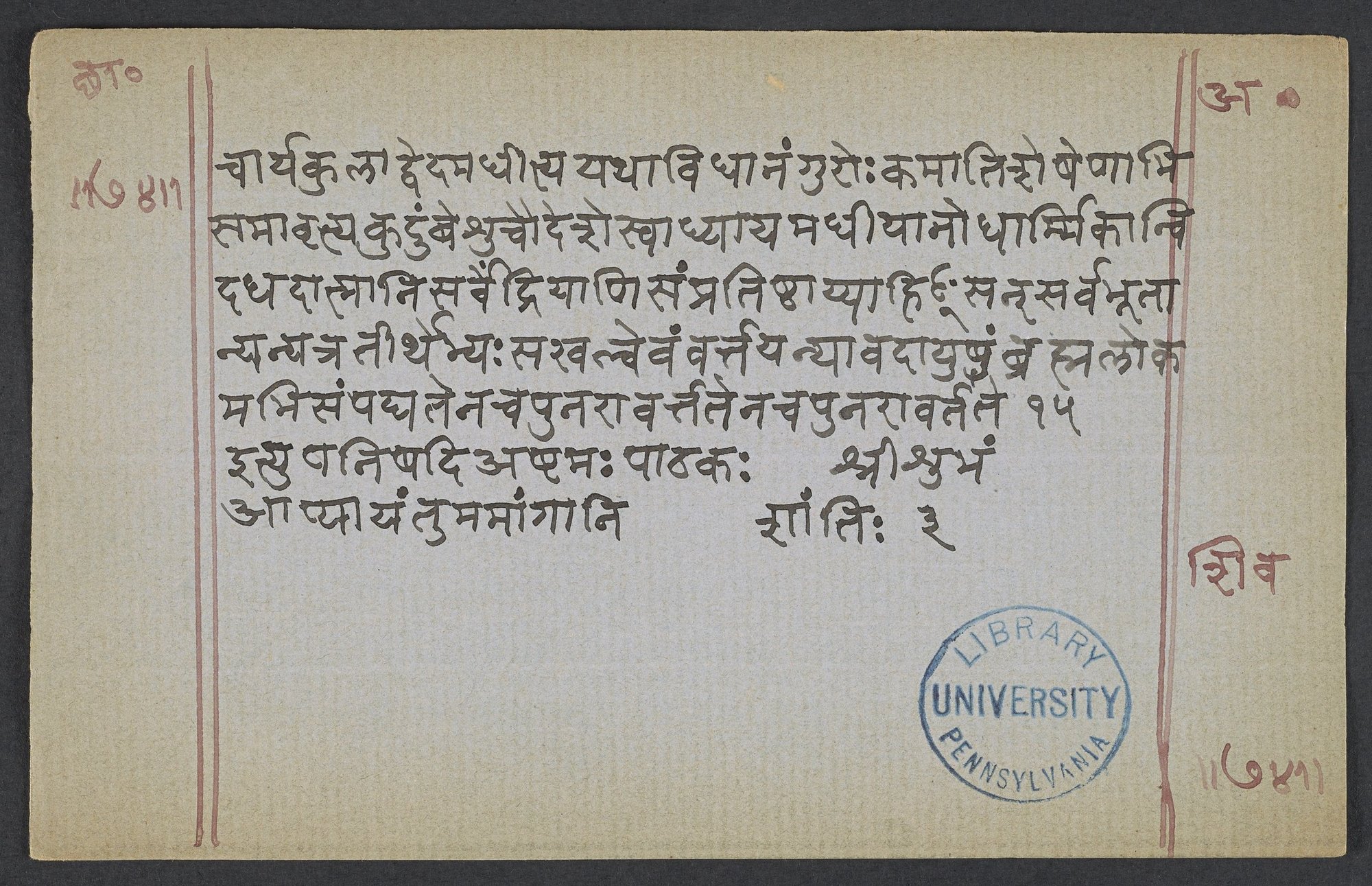
Penn Ms. Coll. 390 Item 945. fol. 74r begins ‹s tam ātmānam anuvidya vijānātīti ha prajāpatir uvāca prajāpatir uvāca› and ends ‹tad dhaitad brahmā prajāpataya uvāca prajāpatir manave manuḥ prajābhya ā›; fol. 74v begins ‹cāryakulād vedam adhītya yathāvidhānaṃ guroḥ karmātiśeṣeṇābhisamāvṛtya› and ends ‹na ca punar āvartate na ca punar āvartate› (first and last words read on the image, transliterated). The words were located in the GRETIL text by string matching and the page boundaries follow from them; readings and results are stored in data/sources/upanishads/mapping_945.json.
15.1tad dhaitad brahmā prajāpataya uvāca prajāpatir manave manuḥ prajābhyaḥ |
ācāryakulād vedam adhītya yathāvidhānaṃ guroḥ karmātiśeṣeṇābhisamāvṛtya kuṭumbe śucau deśe svādhyāyam adhīyāno dharmikān vidadhad ātmani sarvendriyāṇi saṃpratiṣṭhāpyāhiṃsan sarvabhūtāny anyatra tīrthebhyaḥ |
sa khalv evaṃ vartayan yāvad āyuṣaṃ brahmalokam abhisaṃpadyate |
na ca punar āvartate na ca punar āvartate ||
15.1Brahmâ (Hiranyagarbha or Paramesvara) told this to Pragâpati (Kasyapa), Pra'gâpati to Manu (his son), Manu to mankind. He who has learnt the Veda from a family of teachers, according to the sacred rule, in the leisure time left from the duties to be performed for the Guru, who, after receiving his discharge, has settled in his own house, keeping up the memory of what he has learnt by repeating it regularly in some sacred spot, who has begotten virtuous sons, and concentrated all his senses on the Self, never giving pain to any creature, except at the tîrthas (sacrifices, &c), he who behaves thus all his life, reaches the world of Brahman, and does not return, yea, he does not return.
Notes
- Sanskrit: GRETIL, Chandogyopanisad with the commentary ascribed to Samkara, mula text only (input by the Sansknet project). Paragraph numbers (khanda.paragraph) follow the edition. Three legacy encoding artifacts in GRETIL chapter 2 ('saptavidh.am', 'brahmavarcasy:', 'tejasvy:') are normalized.
- English: F. Max Müller, 'Khandogya-upanishad', The Upanishads part I, Sacred Books of the East 1 (1879), from the proofread English Wikisource transcription; footnotes are not reproduced. Where Müller divides a khanda into a different number of paragraphs than the Sanskrit edition, the whole khanda stands in one section and keeps his numbers. In other khandas his paragraph breaks sometimes fall a clause earlier or later than the Sanskrit ones.
- Transcription slips corrected to the printed page: 1.9.2 'udîttha' (printed udgîtha), 3.16.2 'sacrifices' (sacrificer,), 4.6.1 'toward' (towards), 7.25.1 'alt' (all); the stray heading 'Elventh Khanda' inside 2.10.6 is removed. 1.2.1 'Whent he' is a misprint in the book itself and is kept as printed.
- The manuscript readings differ from the edition in places; the Sanskrit shown is the edition text.
Cite
Sources
- Source: Penn Ms. Coll. 390 Item 945 (OPenn, public domain) + GRETIL Sanskrit + F. Max Müller (1879) English (holding institution)
- Critical edition: GRETIL Sanskrit e-texts (Isa, Katha, Prasna, Mandukya, Aitareya, Taittiriya, Svetasvatara, Chandogya); Nirnaya Sagar edition of 1925, transcribed (Kena, Mundaka)
← previous · → next · v cycle view · l back to library