Chandogya Upanishad, Prapathaka 7 (Narada and Sanatkumara: the infinite (bhuman))
Introduction
The Chandogya Upanishad belongs to the Samaveda and is one of the two longest and oldest Upanishads. It has eight chapters (prapathakas). This entry gives chapter 7. Narada, learned in all the Vedas and sciences, comes to Sanatkumara for help against sorrow. Sanatkumara leads him step by step from name, speech and mind up to breath and to the infinite (bhuman), which is happiness: 'where one sees nothing else, hears nothing else, knows nothing else, that is the infinite'.
The page images come from University of Pennsylvania Libraries, Ms. Coll. 390 Item 945, a paper manuscript of 74 leaves (11 x 17 cm) holding the whole Chandogya Upanishad, written in Devanagari, 10 to 11 lines to a side, on blue machine-made paper with watermarks; it is undated (catalogued 18th or 19th century). The scribe numbers the khandas and closes each chapter with a colophon, but does not number paragraphs. Chapter 7 runs from fol. 56r to fol. 65r.
For every page, the first and last words were read on the image and found in the edited text; the page boundaries follow from them. Each section below holds the paragraphs that end on one page, with every page they occupy.
How was this verified? (Provenance)
Where on the image
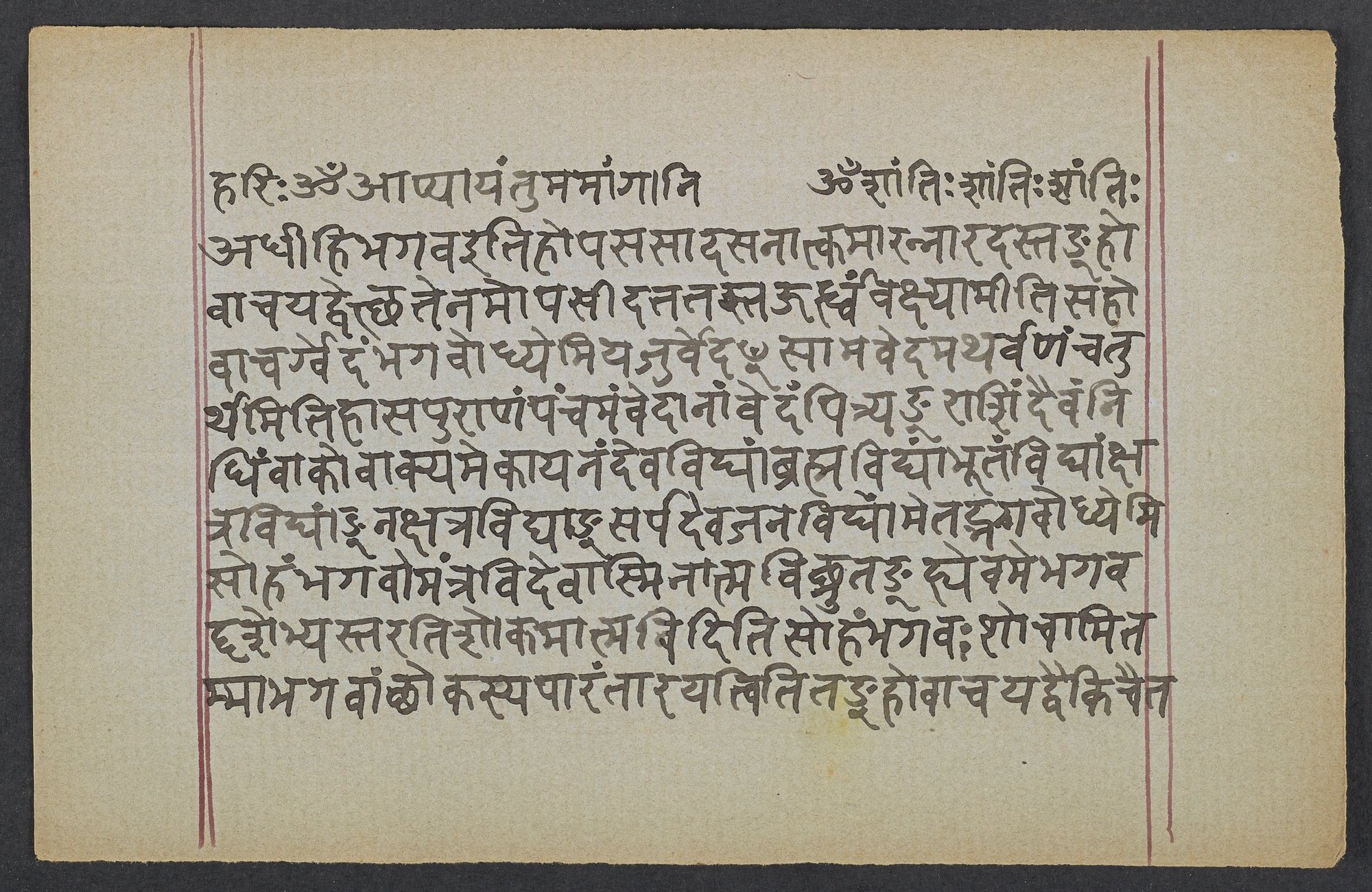
Penn Ms. Coll. 390 Item 945. fol. 56r begins ‹adhīhi bhagava iti hopasasāda sanatkumāraṃ nāradas taṃ hovāca› and ends ‹taṃ hovāca yad vai kiṃcaitad› (first and last words read on the image, transliterated). The words were located in the GRETIL text by string matching and the page boundaries follow from them; readings and results are stored in data/sources/upanishads/mapping_945.json.
1.1adhīhi bhagava iti hopasasāda sanatkumāraṃ nāradaḥ |
taṃ hovāca yad vettha tena mopasīda |
tatas ta ūrdhvaṃ vakṣyāmīti |
sa hovāca ||
1.2ṛgvedaṃ bhagavo 'dhyemi yajurvedaṃ sāmavedam ātharvaṇaṃ caturtham itihāsapurāṇaṃ pañcamaṃ vedānāṃ vedaṃ pitryaṃ rāśiṃ daivaṃ nidhiṃ vākovākyam ekāyanaṃ devavidyāṃ brahmavidyāṃ bhūtavidyāṃ kṣatravidyāṃ nakṣatravidyāṃ sarpadevajanavidyām etad bhagavo 'dhyemi ||
1.1Nârada approached Sanatkumâra and said, 'Teach me, Sir!' Sanatkumâra said to him: 'Please to tell me what you know; afterward I shall tell you what is beyond.'
1.2Nârada said: 'I know the Rig-veda, Sir, the Yagur-veda, the Sâma-veda, as the fourth the Âtharvana, as the fifth the Itihâsa-purâna (the Bhârata); the Veda of the Vedas (grammar); the Pitrya (the rules for the sacrifices for the ancestors); the Râsi (the science of numbers); the Daiva (the science of portents); the Nidhi (the science of time); the Vâkovâkya (logic); the Ekâyana (ethics); the Devavidyâ (etymology); the Brahma-vidyâ (pronunciation, sikshâ, ceremonial, kalpa, prosody, khandas); the Bhûta-vidyâ (the science of demons); the Kshatravidyâ (the science of weapons); the Nakshatra-vidyâ (astronomy); the Sarpa and Devagana-vidyâ (the science of serpents or poisons, and the sciences of the genii, such as the making of perfumes, dancing, singing, playing, and other fine arts). All this I know, Sir.
Where on the image
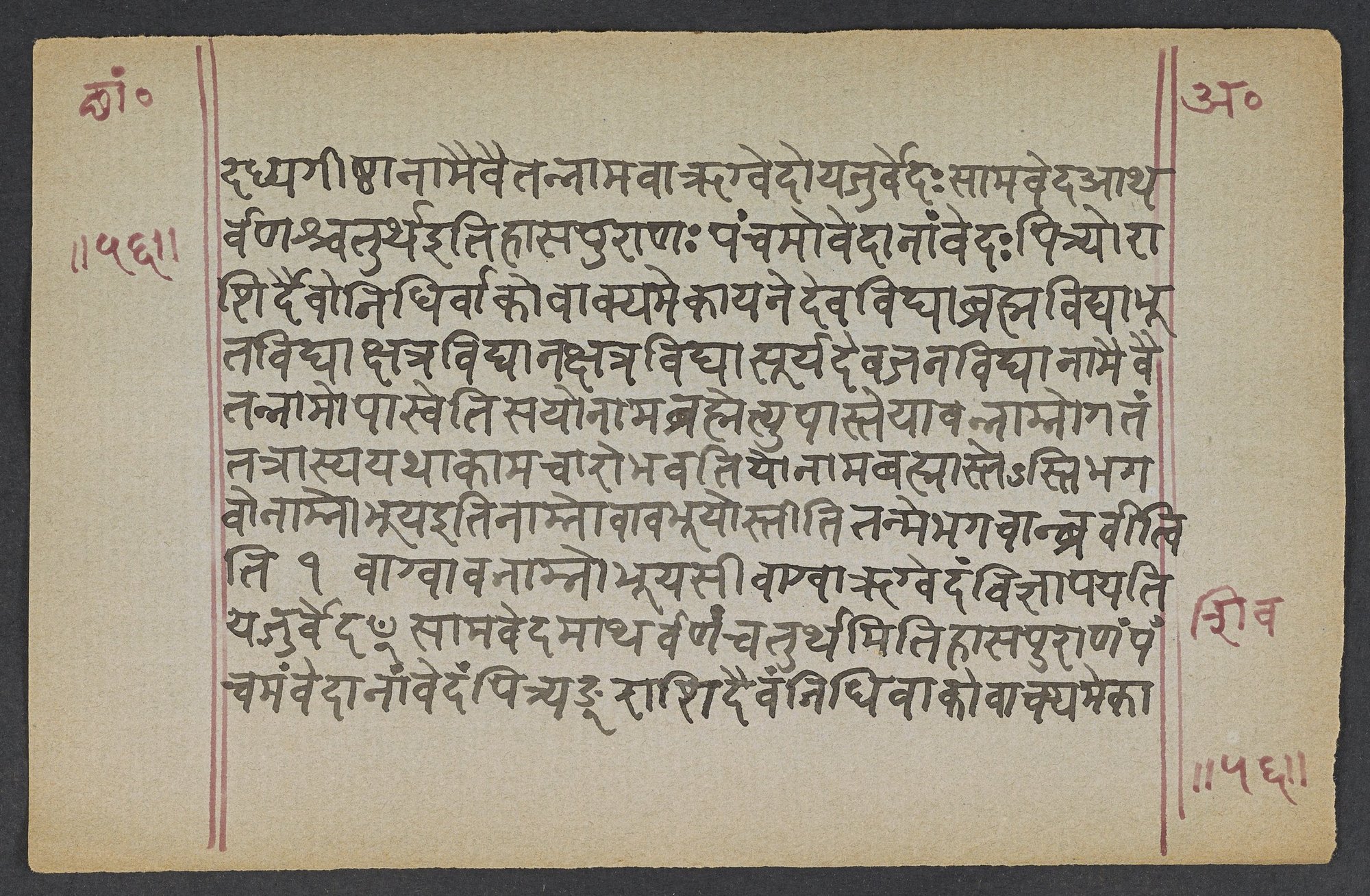
Penn Ms. Coll. 390 Item 945. fol. 56r begins ‹adhīhi bhagava iti hopasasāda sanatkumāraṃ nāradas taṃ hovāca› and ends ‹taṃ hovāca yad vai kiṃcaitad›; fol. 56v begins ‹adhyagīṣṭhā nāmaivaitat nāma vā ṛgvedo yajurvedaḥ sāmaveda ātharvaṇaś caturtha› and ends ‹itihāsapurāṇaṃ pañcamaṃ vedānāṃ vedaṃ pitryaṃ rāśiṃ daivaṃ nidhiṃ vākovākyam ekā› (first and last words read on the image, transliterated). The words were located in the GRETIL text by string matching and the page boundaries follow from them; readings and results are stored in data/sources/upanishads/mapping_945.json.
1.3so 'haṃ bhagavo mantravid evāsmi nātmavit |
śrutaṃ hy eva me bhagavaddṛśebhyas tarati śokam ātmavid iti |
so 'haṃ bhagavaḥ śocāmi |
taṃ mā bhagavāñ chokasya pāraṃ tārayatv iti |
taṃ hovāca yad vai kiṃcaitad adhyagīṣṭhā nāmaivaitat ||
1.4nāma vā ṛgvedo yajurvedaḥ sāmaveda ātharvaṇaś caturtha itihāsapurāṇaḥ pañcamo vedānāṃ vedaḥ pitryo rāśir daivo nidhir vākovākyam ekāyanaṃ devavidyā brahmavidyā bhūtavidyā kṣatravidyā nakṣatravidyā sarpadevajanavidyā |
nāmaivaitat |
nāmopāssveti ||
1.5sa yo nāma brahmety upāste |
yāvan nāmno gataṃ tatrāsya yathākāmacāro bhavati yo nāma brahmety upāste |
asti bhagavo nāmno bhūya iti |
nāmno vāva bhūyo 'stīti |
tan me bhagavān bravītv iti ||
1.3'But, Sir, with all this I know the Mantras only, the sacred books, I do not know the Self. I have heard from men like you, that he who knows the Self overcomes grief. I am in grief. Do, Sir, help me over this grief of mine.' Sanatkumâra said to him: 'Whatever you have read, is only a name.
1.4'A name is the Rig-veda, Yagur-veda, Sâma-veda, and as the fourth the Âtharvana, as the fifth the Itihâsa-purâna, the Veda of the Vedas, the Pitrya, the Râsi, the Daiva, the Nidhi, the Vâkovâkya, the Ekâyana, the Deva-vidyâ, the Brahma-vidyâ, the Bhûta-vidyâ, the Kshatra-vidyâ, the Nakshatra-vidyâ, the Sarpa and Devagana-vidyâ. All these are a name only. Meditate on the name.
1.5'He who meditates on the name as Brahman, is, as it were, lord and master as far as the name reaches—he who meditates on the name as Brahman.' 'Sir, is there something better than a name?' 'Yes, there is something better than a name.' 'Sir, tell it me.'
Where on the image
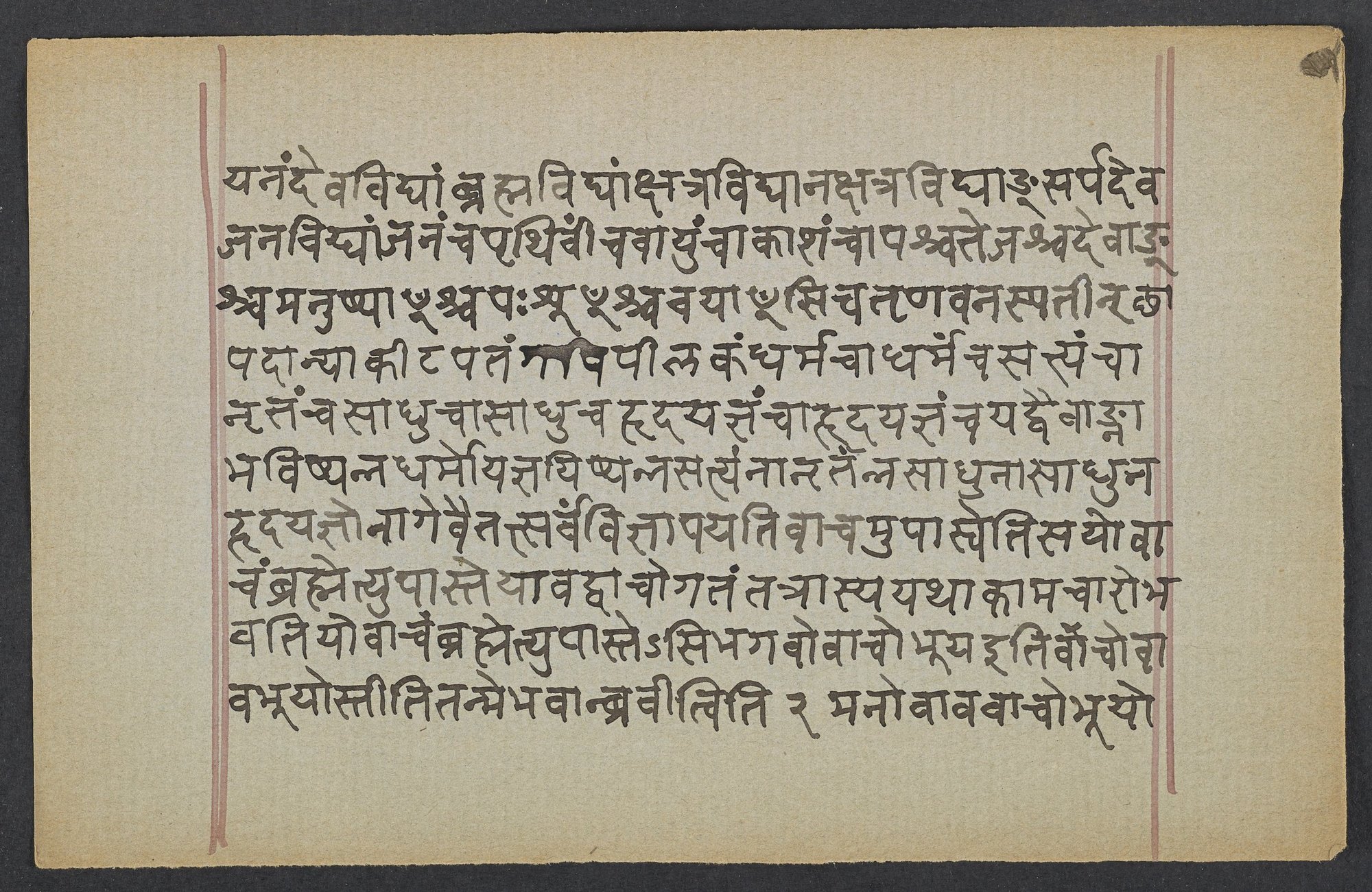
Penn Ms. Coll. 390 Item 945. fol. 56v begins ‹adhyagīṣṭhā nāmaivaitat nāma vā ṛgvedo yajurvedaḥ sāmaveda ātharvaṇaś caturtha› and ends ‹itihāsapurāṇaṃ pañcamaṃ vedānāṃ vedaṃ pitryaṃ rāśiṃ daivaṃ nidhiṃ vākovākyam ekā›; fol. 57r begins ‹yanaṃ devavidyāṃ brahmavidyāṃ bhūtavidyāṃ kṣatravidyāṃ nakṣatravidyāṃ sarpadevajanavidyāṃ› and ends ‹tan me bhagavān bravītv iti mano vāva vāco bhūyo› (first and last words read on the image, transliterated). The words were located in the GRETIL text by string matching and the page boundaries follow from them; readings and results are stored in data/sources/upanishads/mapping_945.json.
2.1vāg vāva nāmno bhūyasī |
vāg vā ṛgvedaṃ vijñāpayati yajurvedaṃ sāmavedam ātharvaṇaṃ caturtham itihāsapurāṇaṃ pañcamaṃ vedānāṃ vedaṃ pitryaṃ rāśiṃ daivaṃ nidhiṃ vākovākyam ekāyanaṃ devavidyāṃ brahmavidyāṃ bhūtavidyāṃ kṣatravidyāṃ nakṣatravidyāṃ sarpadevajanavidyāṃ divaṃ ca pṛthivīṃ ca vāyuṃ cākāśaṃ cāpaś ca tejaś ca devāṃś ca manuṣyāṃś ca paśūṃś ca vayāṃsi ca tṛṇavanaspatīñ śvāpadāny ākīṭapataṅgapipīlakaṃ dharmaṃ cādharmaṃ |
ca satyaṃ cānṛtaṃ ca sādhu cāsādhu ca hṛdayajñaṃ cāhṛdayajñaṃ ca |
yad vai vāṅ nābhaviṣyan na dharmo nādharmo vyajñāpayiṣyan na satyaṃ nānṛtaṃ na sādhu nāsādhu na hṛdayajño nāhṛdayajñaḥ |
vāg evaitad sarvaṃ vijñāpayati vācam upāssveti ||
2.2sa yo vācaṃ brahmety upāste |
yāvad vāco gataṃ tatrāsya yathākāmacāro bhavati yo vācaṃ brahmety upāste |
asti bhagavo vāco bhūya iti |
vāco vāva bhūyo 'stīti |
tan me bhagavān bravītv iti ||
2.1'Speech is better than a name. Speech makes us understand the Rig-veda, Yagur-veda, Sâma-veda, and as the fourth the Âtharvana, as the fifth the Itihâsa-purâna, the Veda of the Vedas, the Pitrya, the Râsi, the Daiva, the Nidhi, the Vâkovâkya, the Ekâyana, the Deva-vidyâ, the Brahma-vidyâ, the Kshatra-vidyâ, the Nakshatra-vidyâ, the Sarpa and Devagana-vidyâ; heaven, earth, air, ether, water, fire, gods, men, cattle, birds, herbs, trees, all beasts down to worms, midges, and ants; what is right and what is wrong; what is true and what is false; what is good and what is bad; what is pleasing and what is not pleasing. For if there were no speech, neither right nor wrong would be known, neither the true nor the false, neither the good nor the bad, neither the pleasant nor the unpleasant. Speech makes us understand all this. Meditate on speech.
2.2'He who meditates on speech as Brahman, is, as it were, lord and master as far as speech reaches—he who meditates on speech as Brahman.' 'Sir, is there something better than speech?' 'Yes, there is something better than speech.' 'Sir, tell it me."
Where on the image
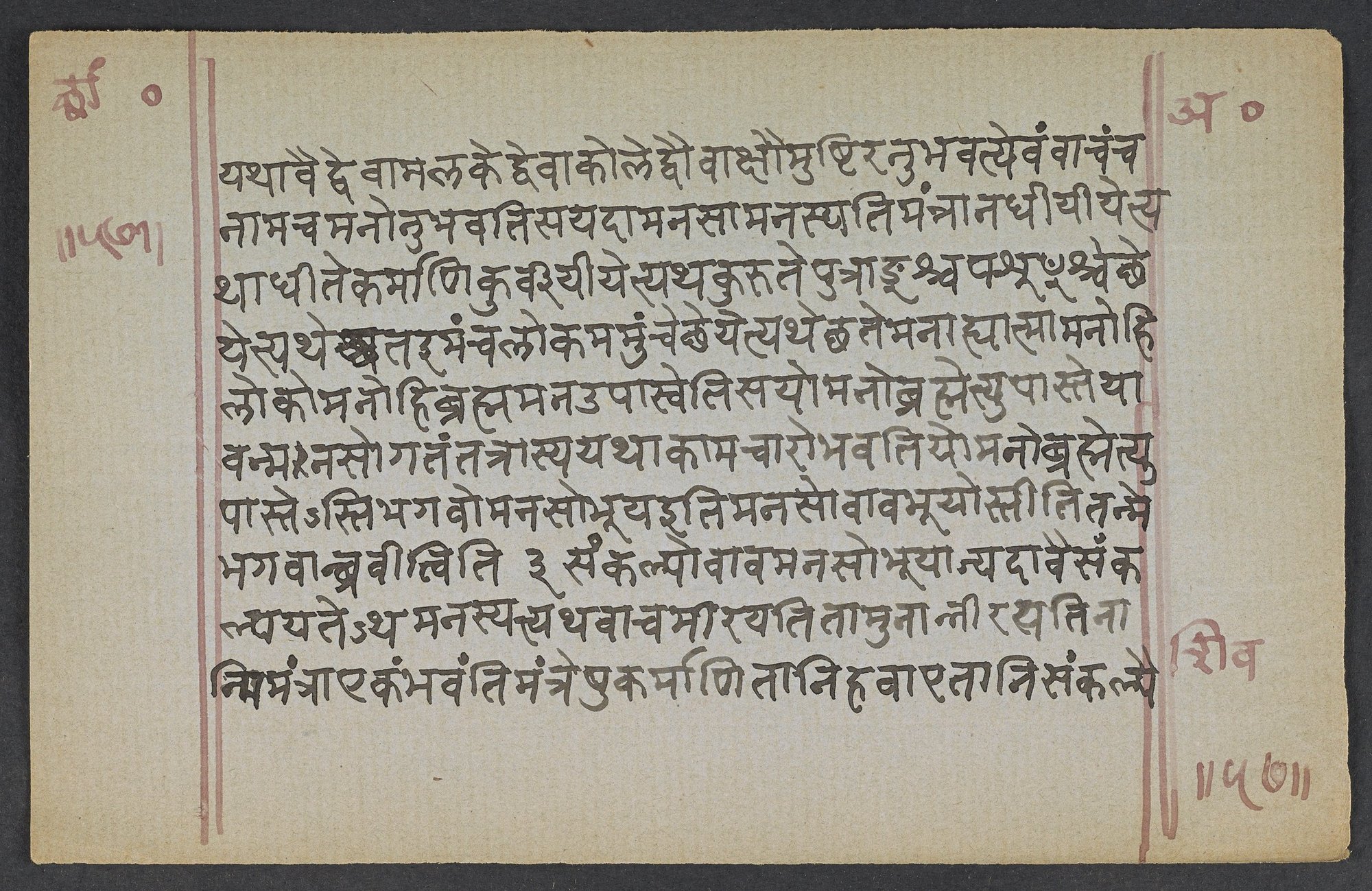
Penn Ms. Coll. 390 Item 945. fol. 57r begins ‹yanaṃ devavidyāṃ brahmavidyāṃ bhūtavidyāṃ kṣatravidyāṃ nakṣatravidyāṃ sarpadevajanavidyāṃ› and ends ‹tan me bhagavān bravītv iti mano vāva vāco bhūyo›; fol. 57v begins ‹yathā vai dve vāmalake dve vā kole dvau vākṣau muṣṭir anubhavaty evaṃ vācaṃ ca› and ends ‹nāmni mantrā ekaṃ bhavanti mantreṣu karmāṇi tāni ha vā etāni saṃkalpai› (first and last words read on the image, transliterated). The words were located in the GRETIL text by string matching and the page boundaries follow from them; readings and results are stored in data/sources/upanishads/mapping_945.json.
3.1mano vāva vāco bhūyaḥ |
yathā vai dve vāmalake dve vā kole dvau vākṣau muṣṭir anubhavaty evaṃ vācaṃ ca nāma ca mano 'nubhavati |
sa yadā manasā manasyati mantrān adhīyīyety athādhīte |
karmāṇi kurvīyety atha kurute |
putrāṃś ca paśūṃś ceccheyety athecchate |
imaṃ ca lokam amuṃ ceccheyety athecchate |
mano hy ātmā |
mano hi lokaḥ |
mano hi brahma |
mana upāssveti ||
3.2sa yo mano brahmety upāste |
yāvan manaso gataṃ tatrāsya yathākāmacāro bhavati yo mano brahmety upāste |
asti bhagavo manaso bhūya iti |
manaso vāva bhūyo 'stīti |
tan me bhagavān bravītv iti ||
4.1saṃkalpo vāva manaso bhūyān |
yadā vai saṃkalpayate 'tha manasyati |
atha vācam īrayati |
tām u nāmnīyūati |
nāmni mantrā ekaṃ bhavanti |
mantreṣu karmāṇi ||
3.1'Mind (manas) is better than speech. For as the closed fist holds two amalaka or two kola or two aksha fruits, thus does mind hold speech and name. For if a man is minded in his mind to read the sacred hymns, he reads them; if he is minded in his mind to perform any actions, he performs them; if he is minded to wish for sons and cattle, he wishes for them; if he is minded to wish for this world and the other, he wishes for them. For mind is indeed the self, mind is the world, mind is Brahman. Meditate on the mind.
3.2'He who meditates on the mind as Brahman, is, as it were, lord and master as far as the mind reaches—he who meditates on the mind as Brahman.' 'Sir, is there something better than mind?' 'Yes, there is something better than mind.' 'Sir, tell it me.'
4.1'Will (saṅkalpa) is better than mind. For when a man wills, then he thinks in his mind, then he sends forth speech, and he sends it forth in a name. In a name the sacred hymns are contained, in the sacred hymns all sacrifices.
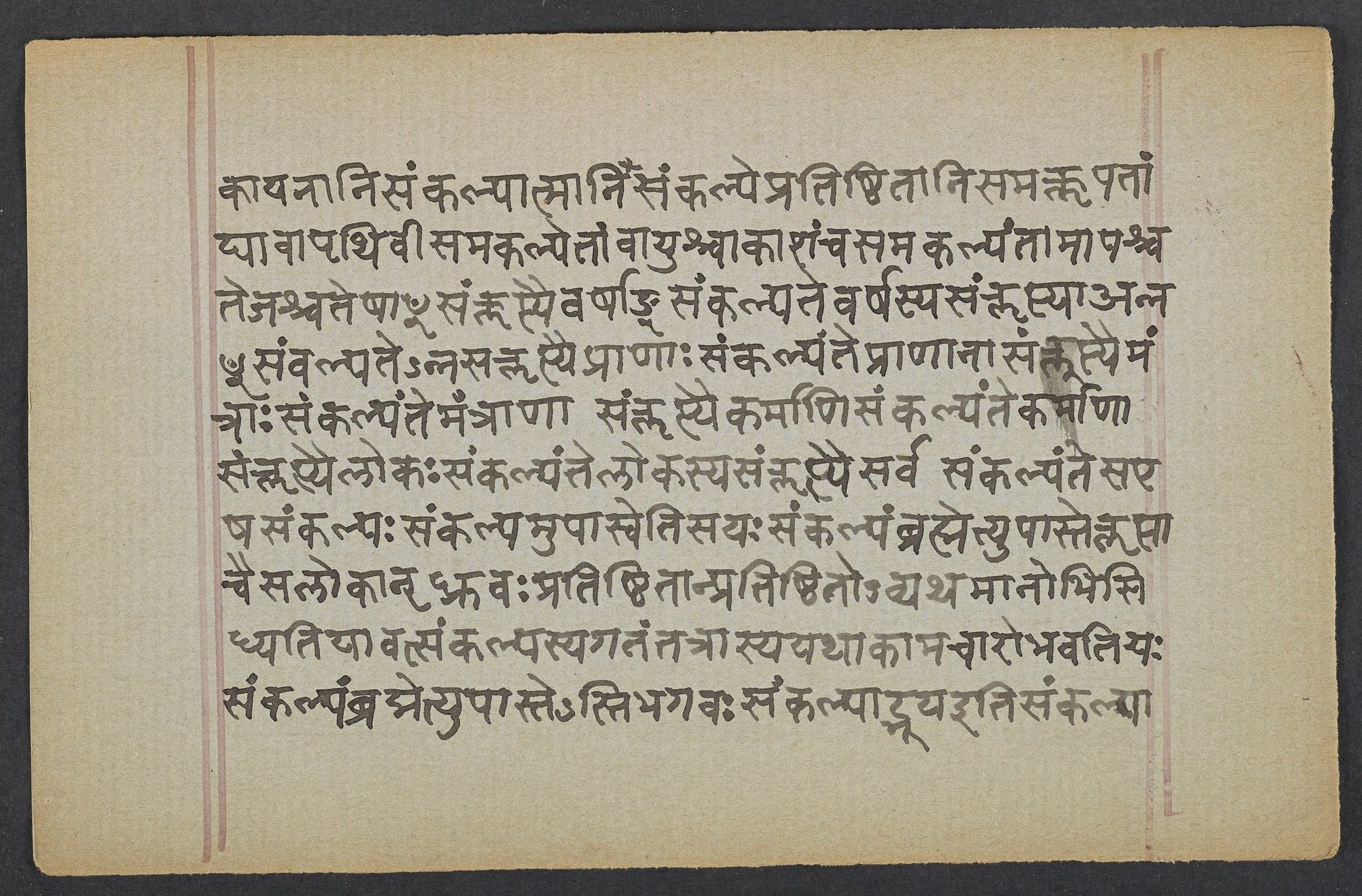
Where on the image
Penn Ms. Coll. 390 Item 945. fol. 57v begins ‹yathā vai dve vāmalake dve vā kole dvau vākṣau muṣṭir anubhavaty evaṃ vācaṃ ca› and ends ‹nāmni mantrā ekaṃ bhavanti mantreṣu karmāṇi tāni ha vā etāni saṃkalpai›; fol. 58r begins ‹kāyanāni saṃkalpātmāni saṃkalpe pratiṣṭhitāni samakḷpatāṃ dyāvāpṛthivī› and ends ‹yaḥ saṃkalpaṃ brahmety upāste 'sti bhagavaḥ saṃkalpād bhūya iti saṃkalpā› (first and last words read on the image, transliterated). The words were located in the GRETIL text by string matching and the page boundaries follow from them; readings and results are stored in data/sources/upanishads/mapping_945.json.
4.2tāni ha vā etāni saṃkalpaikāyanāni saṃkalpātmakāni saṃkalpe pratiṣṭhitāni |
samakḷpatāṃ dyāvāpṛthivī |
samakalpetāṃ vāyuś cākāśaṃ ca |
samakalpantāpaś ca tejaś ca |
teṣāṃ saṃkḷptyai varṣaṃ saṃkalpate |
varṣasya saṃkḷptyā annaṃ saṃkalpate |
annasya saṃkḷptyai prāṇāḥ saṃkalpante |
prāṇānāṃ saṃkḷptyai mantrāḥ saṃkalpante |
mantrāṇāṃ saṃkḷptyai karmāṇi saṃkalpante |
karmaṇāṃ saṃkḷptyai lokaḥ saṃkalpate |
lokasya saṃkḷptyai sarvaṃ saṃkalpate |
sa eṣa saṃkalpaḥ |
saṃkalpam upāssveti ||
4.2'All these therefore (beginning with mind and ending in sacrifice) centre in will, consist of will, abide in will. Heaven and earth willed, air and ether willed, water and fire willed. Through the will of heaven and earth &c. rain wills; through the will of rain food wills; through the will of food the vital airs will; through the will of the vital airs the sacred hymns will; through the will of the sacred hymns the sacrifices will; through the will of the sacrifices the world (as their reward) wills; through the will of the world everything wills. This is will. Meditate on will.
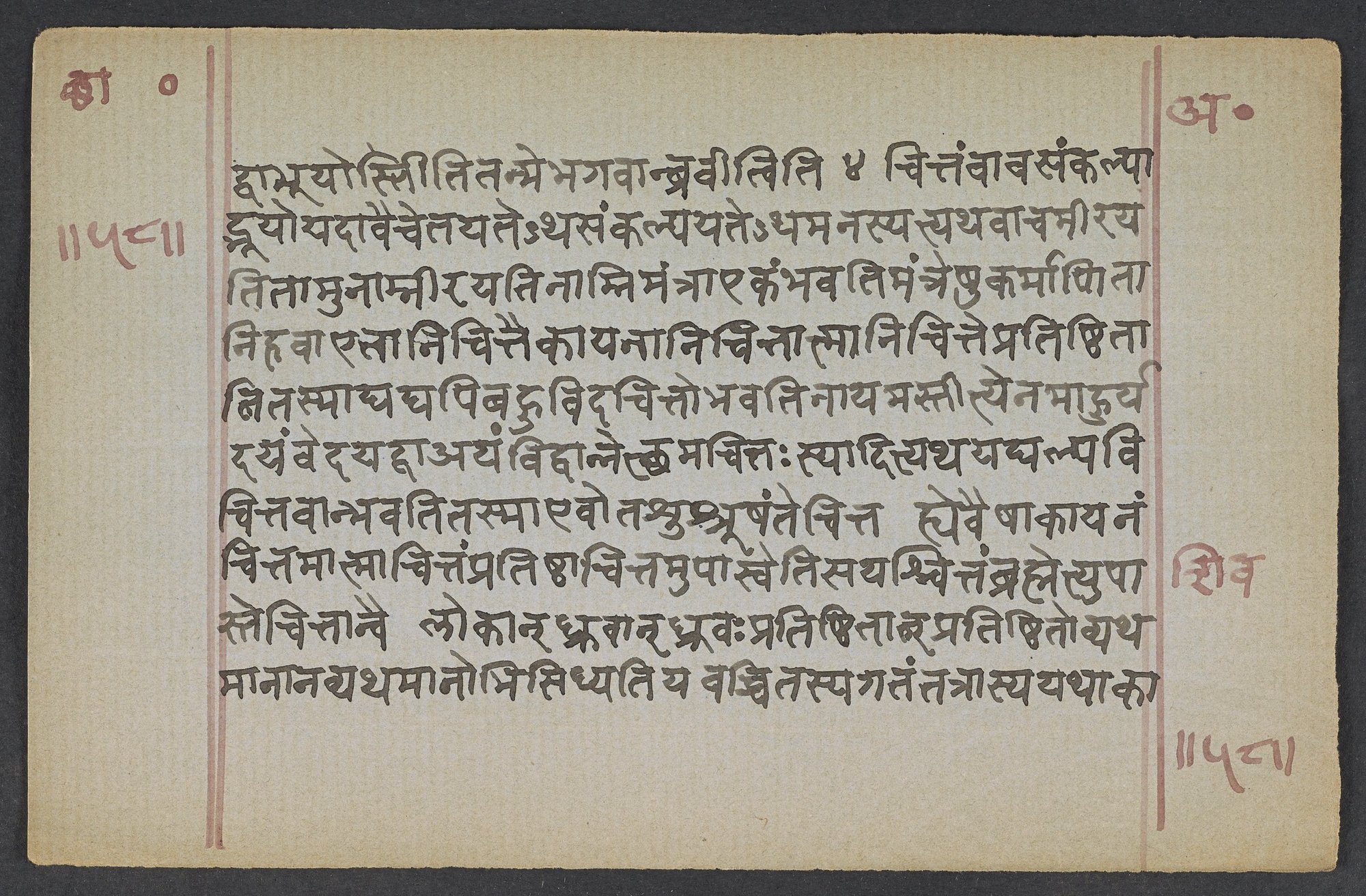
Where on the image
Penn Ms. Coll. 390 Item 945. fol. 58r begins ‹kāyanāni saṃkalpātmāni saṃkalpe pratiṣṭhitāni samakḷpatāṃ dyāvāpṛthivī› and ends ‹yaḥ saṃkalpaṃ brahmety upāste 'sti bhagavaḥ saṃkalpād bhūya iti saṃkalpā›; fol. 58v begins ‹d vāva bhūyo 'stīti tan me bhagavān bravītv iti cittaṃ vāva saṃkalpād bhūyo› and ends ‹abhisidhyati yāvac cittasya gataṃ tatrāsya yathākā› (first and last words read on the image, transliterated). The words were located in the GRETIL text by string matching and the page boundaries follow from them; readings and results are stored in data/sources/upanishads/mapping_945.json.
4.3sa yaḥ saṃkalpaṃ brahmety upāste |
kḷptān vai sa lokān dhruvān dhruvaḥ pratiṣṭhitān pratiṣṭhito 'vyathamānān avyathamāno 'bhisidhyati |
yāvat saṃkalpasya gataṃ tatrāsya yathākāmacāro bhavati yaḥ saṃkalpaṃ brahmety upāste |
asti bhagavaḥ saṃkalpād bhūya iti |
saṃkalpād vāva bhūyo 'stīti |
tan me bhagavān bravītv iti ||
5.1cittaṃ vāva saṃkalpād bhūyaḥ |
yadā vai cetayate 'tha saṃkalpayate |
atha manasyati |
atha vācam īrayati |
tām u nāmnīyūati |
nāmni mantrā ekaṃ bhavanti |
mantreṣu karmāṇi ||
5.2tāni ha vā etāni cittaikāyanāni cittātmāni citte pratiṣṭhitāni |
tasmād yady api bahuvid acitto bhavati nāyam astīty evainam āhuḥ |
yad ayaṃ veda yad vā ayaṃ vidvān nettham acittaḥ syād iti |
atha yady alpavic cittavān bhavati tasmā evota śuśrūṣante |
cittaṃ hy evaiṣām ekāyanam |
cittam ātmā |
cittaṃ pratiṣṭhā |
cittam upāssveti ||
4.3'He who meditates on will as Brahman, he, being himself safe, firm, and undistressed, obtains the safe, firm, and undistressed worlds which he has willed; he is, as it were, lord and master as far as will reaches—he who meditates on will as Brahman.' 'Sir, is there something better than will?' 'Yes, there is something better than will.' 'Sir, tell it me.'
5.1Consideration (kitta) is better than will. For when a man considers, then he wills, then he thinks in his mind, then he sends forth speech, and he sends it forth in a name. In a name the sacred hymns are contained, in the sacred hymns all sacrifices.
5.2'All these (beginning with mind and ending in sacrifice) centre in consideration, consist of consideration, abide in consideration. Therefore if a man is inconsiderate, even if he possesses much learning, people say of him, he is nothing, whatever he may know; for, if he were learned, he would not be so inconsiderate. But if a man is considerate, even though he knows but little, to him indeed do people listen gladly. Consideration is the centre, consideration is the self, consideration is the support of all these. Meditate on consideration.
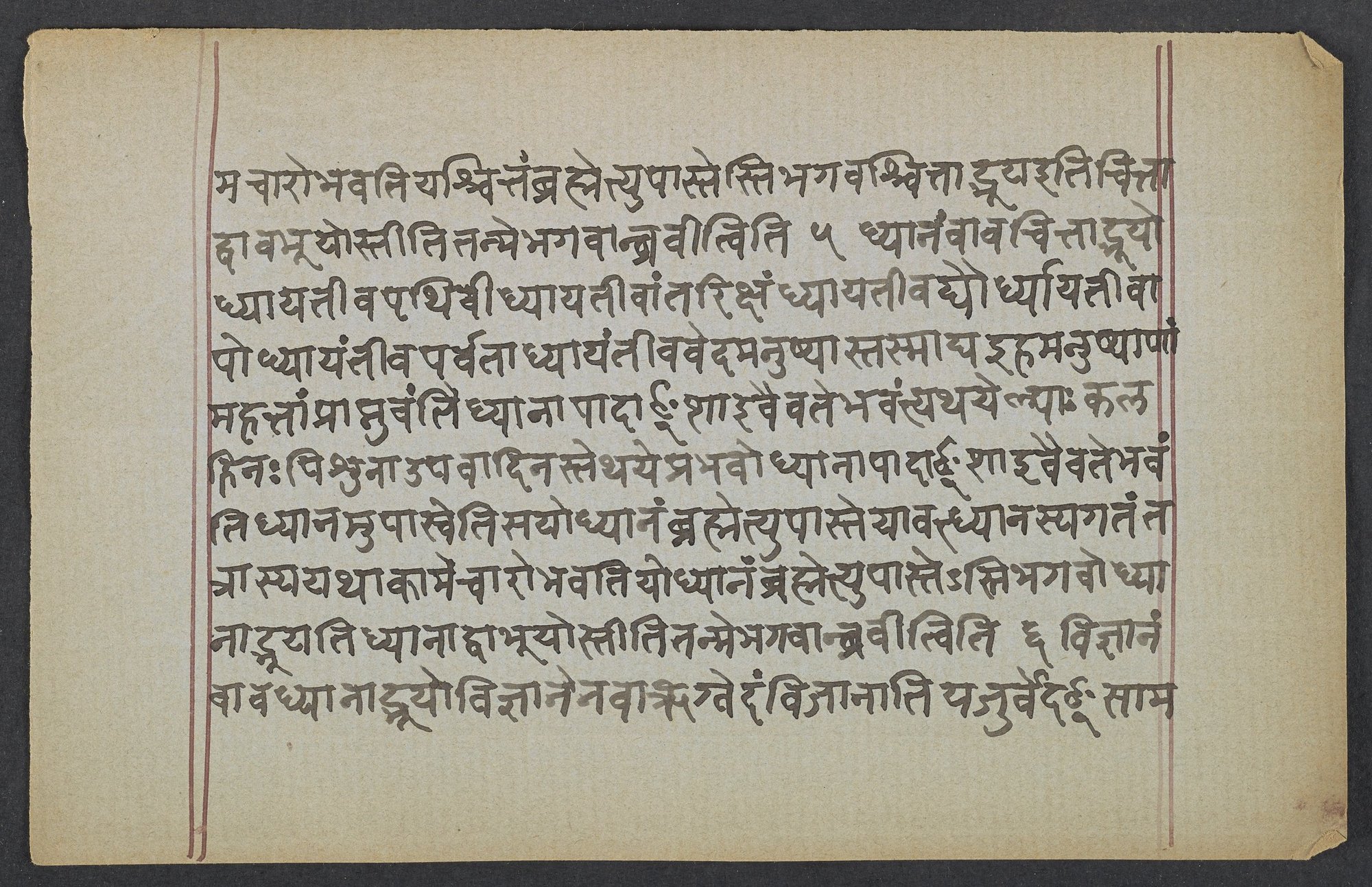
Where on the image
Penn Ms. Coll. 390 Item 945. fol. 58v begins ‹d vāva bhūyo 'stīti tan me bhagavān bravītv iti cittaṃ vāva saṃkalpād bhūyo› and ends ‹abhisidhyati yāvac cittasya gataṃ tatrāsya yathākā›; fol. 59r begins ‹macāro bhavati yaś cittaṃ brahmety upāste 'sti bhagavaś cittād bhūya iti› and ends ‹vijñānaṃ vāva dhyānād bhūyo vijñānena vā ṛgvedaṃ vijānāti yajurvedaṃ sāma› (first and last words read on the image, transliterated). The words were located in the GRETIL text by string matching and the page boundaries follow from them; readings and results are stored in data/sources/upanishads/mapping_945.json.
5.3sa yaś cittaṃ brahmety upāste |
cittān vai sa lokān dhruvān dhruvaḥ pratiṣṭhitān pratiṣṭhito 'vyathamānān avyathamāno 'bhisidhyati |
yāvac cittasya gataṃ tatrāsya yathākāmacāro bhavati yaś cittaṃ brahmety upāste |
asti bhagavaś cittād bhūya iti |
cittād vāva bhūyo 'stīti |
tan me bhagavān bravītv iti ||
6.1dhyānaṃ vāva cittād bhūyaḥ |
dhyāyatīva pṛthivī |
dhyāyatīvāntarikṣam |
dhyāyatīva dyauḥ |
dhyāyantīvāpaḥ |
dhyāyantīva parvatāḥ |
dhyāyantīva devamanuṣyāḥ |
tasmād ya iha manuṣyāṇāṃ mahattāṃ prāpnuvanti dhyānāpādāṃśā ivaiva te bhavanti |
atha ye 'lpāḥ kalahinaḥ piśunā upavādinas te |
atha ye prabhavo dhyānāpādāṃśā ivaiva te bhavanti |
dhyānam upāssveti ||
6.2sa yo dhyānaṃ brahmety upāste |
yāvad dhyānasya gataṃ tatrāsya yathākāmacāro bhavati yo dhyānaṃ brahmety upāste |
asti bhagavo dyānād bhūya iti |
dhyānād vāva bhūyo 'stīti |
tan me bhagavān bravītv iti ||
5.3'He who meditates on consideration as Brahman, he, being himself safe, firm, and undistressed, obtains the safe, firm, and undistressed worlds which he has considered; he is, as it were, lord and master as far as consideration reaches—he who meditates on consideration as Brahman.' 'Sir, is there something better than consideration?' 'Yes, there is something better than consideration.' 'Sir, tell it me.'
6.1'Reflection (dhyâna) is better than consideration. The earth reflects, as it were, and thus does the sky, the heaven, the water, the mountains, gods and men. Therefore those who among men obtain greatness here on earth, seem to have obtained a part of the object of reflection (because they show a certain repose of manner). Thus while small and vulgar people are always quarrelling, abusive, and slandering, great men seem to have obtained a part of the reward of reflection. Meditate on reflection.
6.2'He who meditates on reflection as Brahman, is lord and master, as it were, as far as reflection reaches—he who meditates on reflection as Brahman.' 'Sir, is there something better than reflection?' 'Yes, there is something better than reflection.' 'Sir, tell it me.'
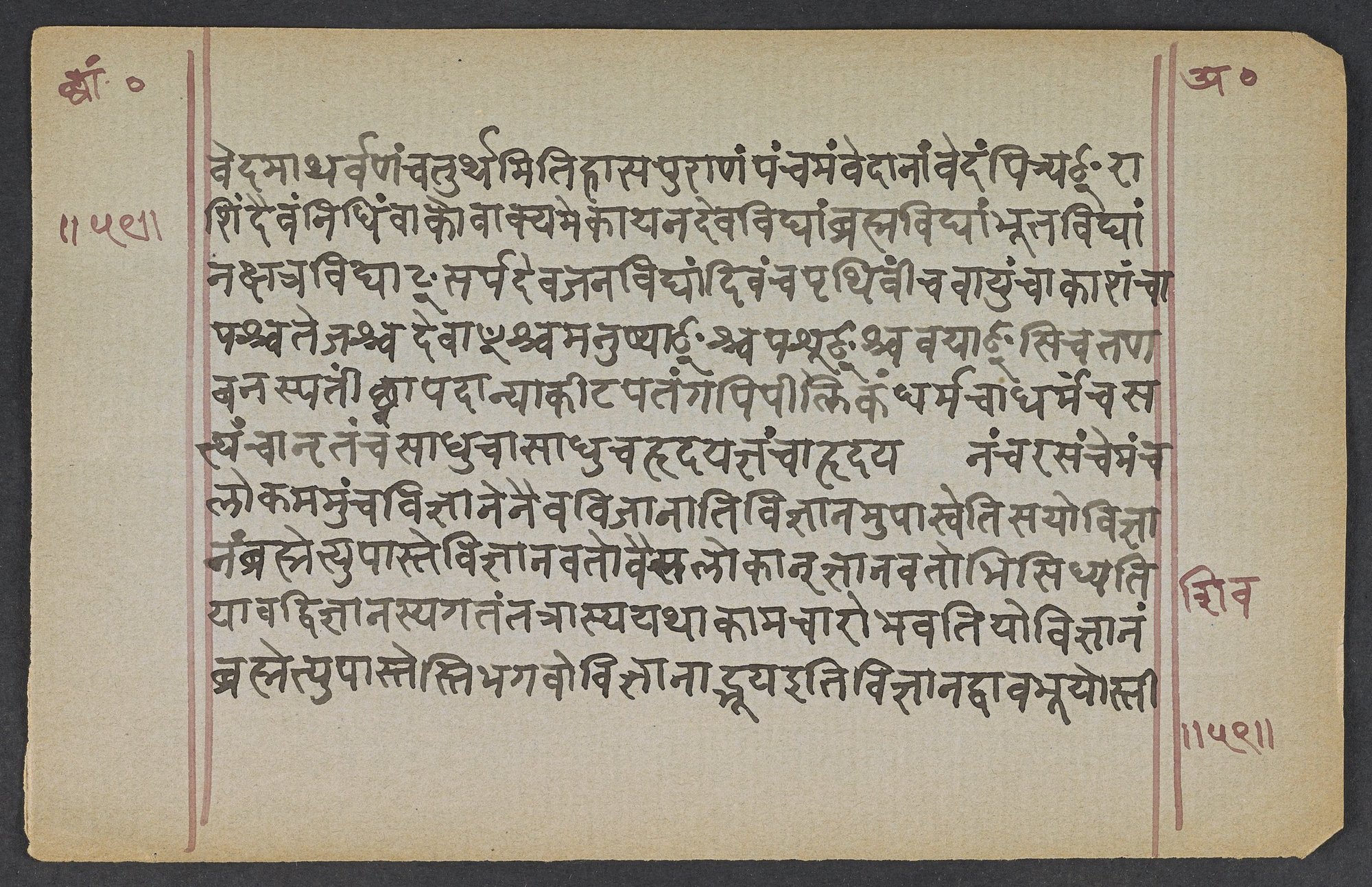
Where on the image
Penn Ms. Coll. 390 Item 945. fol. 59r begins ‹macāro bhavati yaś cittaṃ brahmety upāste 'sti bhagavaś cittād bhūya iti› and ends ‹vijñānaṃ vāva dhyānād bhūyo vijñānena vā ṛgvedaṃ vijānāti yajurvedaṃ sāma›; fol. 59v begins ‹vedam ātharvaṇaṃ caturtham itihāsapurāṇaṃ pañcamaṃ vedānāṃ vedaṃ pitryaṃ rāśiṃ› and ends ‹yo vijñānaṃ brahmety upāste 'sti bhagavo vijñānād bhūya iti vijñānād vāva bhūyo 'stī› (first and last words read on the image, transliterated). The words were located in the GRETIL text by string matching and the page boundaries follow from them; readings and results are stored in data/sources/upanishads/mapping_945.json.
7.1vijñānaṃ vāva dhyānād bhūyaḥ |
vijñānena vā ṛgvedaṃ vijānāti yajurvedaṃ sāmavedam ātharvaṇaṃ caturtham itihāsapurāṇaṃ pañcamaṃ vedānāṃ vedaṃ pitryaṃ rāśiṃ daivaṃ nidhiṃ vākovākyam ekāyanaṃ devavidyāṃ brahmavidyāṃ bhūtavidyāṃ kṣatravidyāṃ nakṣatravidyāṃ sarpadevajanavidyāṃ divaṃ ca pṛthivīṃ ca vāyuṃ cākāśaṃ cāpaś ca tejaś ca devāṃś ca manuṣyāṃś ca paśūṃś ca vayāṃsi ca tṛṇavanaspatīñ chvāpadāny ākīṭapataṅgapipīlakam |
dharmaṃ cādharmaṃ ca satyaṃ cānṛtaṃ ca sādhu cāsādhu ca hṛdayajñaṃ cāhṛdayajñaṃ cānnaṃ ca rasaṃ cemaṃ ca lokam amuṃ ca vijñānenaiva vijānāti |
vijñānam upāssveti ||
7.1'Understanding (vigñâna) is better than reflection. Through understanding we understand the Rig-veda, the Yagur-veda, the Sâma-veda, and as the fourth the Âtharvana, as the fifth the tihâsapurâna, the Veda of the Vedas, the Pitrya, the Râsi, the Daiva, the Nidhi, the Vâkovâkya, the Ekâyana, the Deva-vidyâ, the Brahma-vidyâ, the Bhûta-vidyâ, the Kshatra-vidyâ, the Nakshatra-vidyâ, the Sarpa and Devagana-vidyâ, heaven, earth, air, ether, water, fire, gods, men, cattle, birds, herbs, trees, all beasts down to worms, midges, and ants; what is right and what is wrong; what is true and what is false; what is good and what is bad; what is pleasing and what is not pleasing; food and savour, this world and that, all this we understand through understanding. Meditate on understanding.
Where on the image
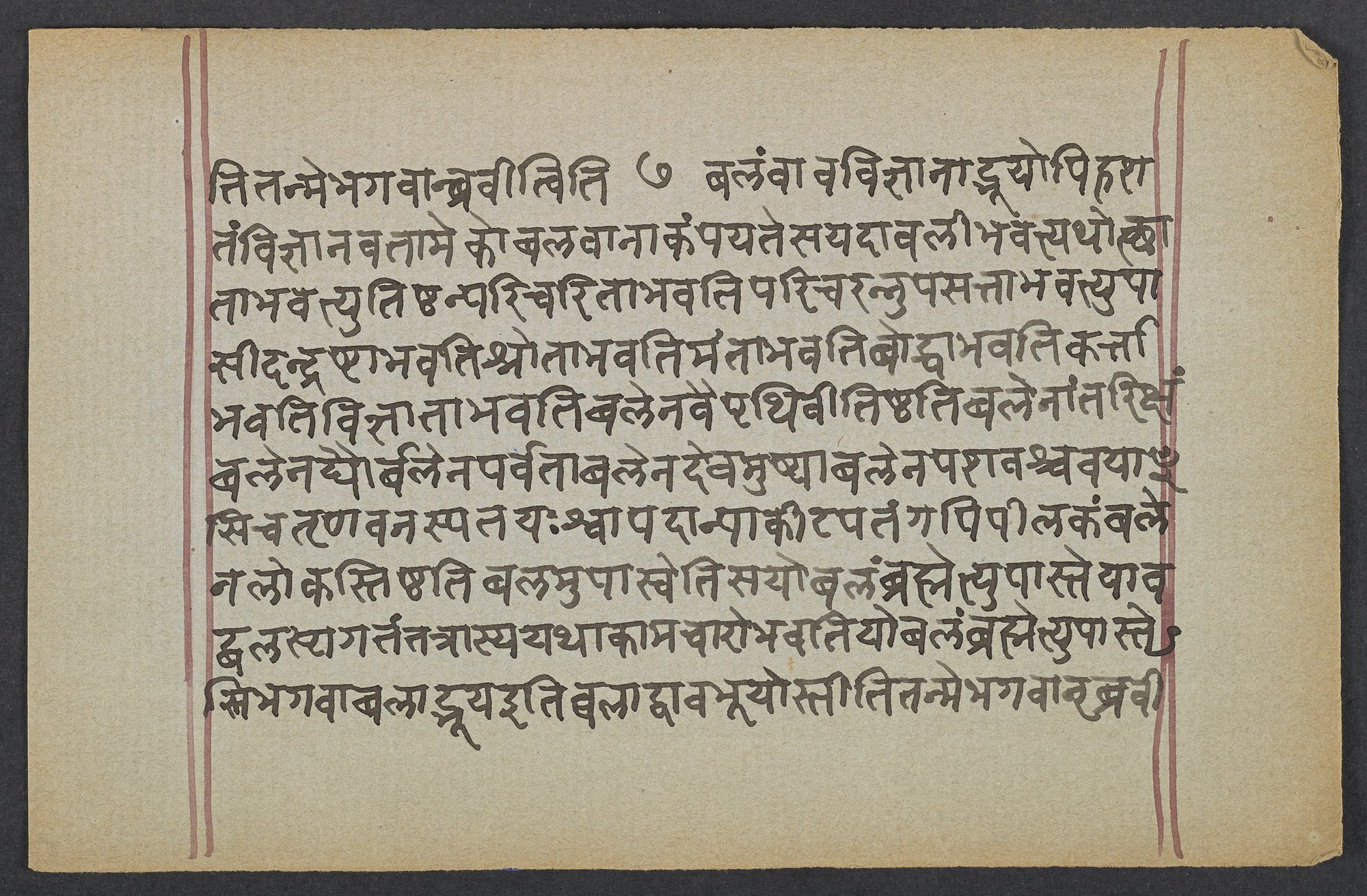
Penn Ms. Coll. 390 Item 945. fol. 59v begins ‹vedam ātharvaṇaṃ caturtham itihāsapurāṇaṃ pañcamaṃ vedānāṃ vedaṃ pitryaṃ rāśiṃ› and ends ‹yo vijñānaṃ brahmety upāste 'sti bhagavo vijñānād bhūya iti vijñānād vāva bhūyo 'stī›; fol. 60r begins ‹ti tan me bhagavān bravītv iti balaṃ vāva vijñānād bhūyo› and ends ‹asti bhagavo balād bhūya iti balād vāva bhūyo 'stīti tan me bhagavān bravī› (first and last words read on the image, transliterated). The words were located in the GRETIL text by string matching and the page boundaries follow from them; readings and results are stored in data/sources/upanishads/mapping_945.json.
7.2sa yo vijñānaṃ brahmety upāste |
vijñānavato vai sa lokāñ jñānavato 'bhisidhyati |
yāvad vijñānasya gataṃ tatrāsya yathākāmacāro bhavati yo vijñānaṃ brahmety upāste |
asti bhagavo vijñānād bhūya iti |
vijñānād vāva bhūyo 'stīti |
tan me bhagavān bravītv iti ||
8.1balaṃ vāva vijñānād bhūyaḥ |
api ha śataṃ vijñānavatām eko balavān ākampayate |
sa yadā balī bhavaty athotthātā bhavati |
uttiṣṭhan paricaritā bhavati |
paricarann upasattā bhavati |
upasīdan draṣṭā bhavati śrotā bhavati mantā bhavati boddhā bhavati kartā bhavati vijñātā bhavati |
balena vai pṛthivī tiṣṭhati balenāntarikṣaṃ balena dyaur balena parvatā balena devamanuṣyā balena paśavaś ca vayāṃsi ca tṛṇavanaspatayaḥ śvāpadāny ākīṭapataṅgapipīlakam |
balena lokas tiṣṭhati |
balam upāssveti ||
7.2'He who meditates on understanding as Brahman, reaches the worlds where there is understanding and knowledge; he is, as it were, lord and master as far as understanding reaches—he who meditates on understanding as Brahman.' 'Sir, is there something better than understanding?' 'Yes, there is something better than understanding.' 'Sir, tell it me.'
8.1'Power (bala) is better than understanding. One powerful man shakes a hundred men of understanding. If a man is powerful, he becomes a rising man. If he rises, he becomes a man who visits wise people. If he visits, he becomes a follower of wise people. If he follows them, he becomes a seeing, a hearing, a perceiving, a knowing, a doing, an understanding man. By power the earth stands firm, and the sky, and the heaven, and the mountains, gods and men, cattle, birds, herbs, trees, all beasts down to worms, midges, and ants; by power the world stands firm. Meditate on power.
Where on the image
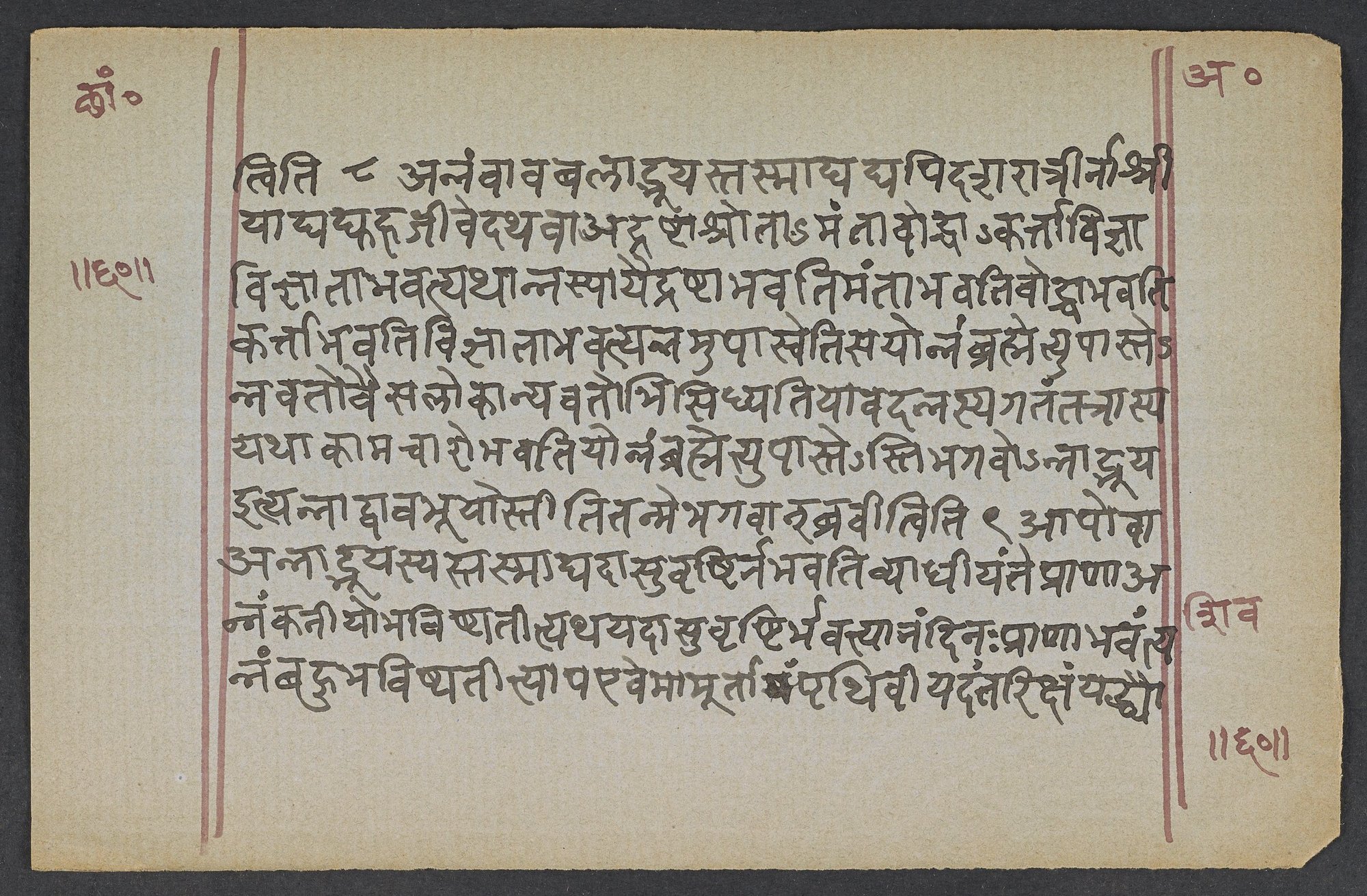
Penn Ms. Coll. 390 Item 945. fol. 60r begins ‹ti tan me bhagavān bravītv iti balaṃ vāva vijñānād bhūyo› and ends ‹asti bhagavo balād bhūya iti balād vāva bhūyo 'stīti tan me bhagavān bravī›; fol. 60v begins ‹tv iti annaṃ vāva balād bhūyas tasmād yady api daśa rātrīr nāśnīyāt› and ends ‹yad antarikṣaṃ yad dyaur› (first and last words read on the image, transliterated). The words were located in the GRETIL text by string matching and the page boundaries follow from them; readings and results are stored in data/sources/upanishads/mapping_945.json.
8.2sa yo balam upāste |
yāvad balasya gataṃ tatrāsya yathākāmacāro bhavati yo balaṃ brahmety upāste |
asti bhagavo balād bhūya iti |
balād vāva bhūyo 'stīti |
tan me bhagavān bravītv iti ||
9.1annaṃ vāva balād bhūyaḥ |
tasmād yady api daśa rātrīr nāśnīyāt |
yady u ha jīvet |
athavādraṣṭāśrotāmantāboddhākartāvijñātā bhavati |
athānnasyāye draṣṭā bhavati śrotā bhavati mantā bhavati boddhā bhavati kartā bhavati vijñātā bhavati |
annam upāssveti ||
9.2sa yo 'nnaṃ brahmety upāste |
annavato vai sa lokān pānavato 'bhisidhyati |
yāvad annasya gataṃ tatrāsya yathākāmacāro bhavati yo 'nnaṃ brahmety upāste |
asti bhagavo 'nnād bhūya iti |
annād vāva bhūyo 'stīti |
tan me bhagavān bravītv iti ||
8.2'He who meditates on power as Brahman, is, as it were, lord and master as far as power reaches—he who meditates on power as Brahman.' 'Sir, is there something better than power?' 'Yes, there is something better than power.' 'Sir, tell it me.'
9.1'Food (anna) is better than power. Therefore if a man abstain from food for ten days, though he live, he would be unable to see, hear, perceive, think, act, and understand. But when he obtains food, he is able to see, hear, perceive, think, act, and understand. Meditate on food.
9.2'He who meditates on food as Brahman, obtains the worlds rich in food and drink; he is, as it were, lord and master as far as food reaches—he who meditates on food as Brahman.' 'Sir, is there something better than food?' 'Yes, there is something better than food.' 'Sir, tell it me.'
Where on the image
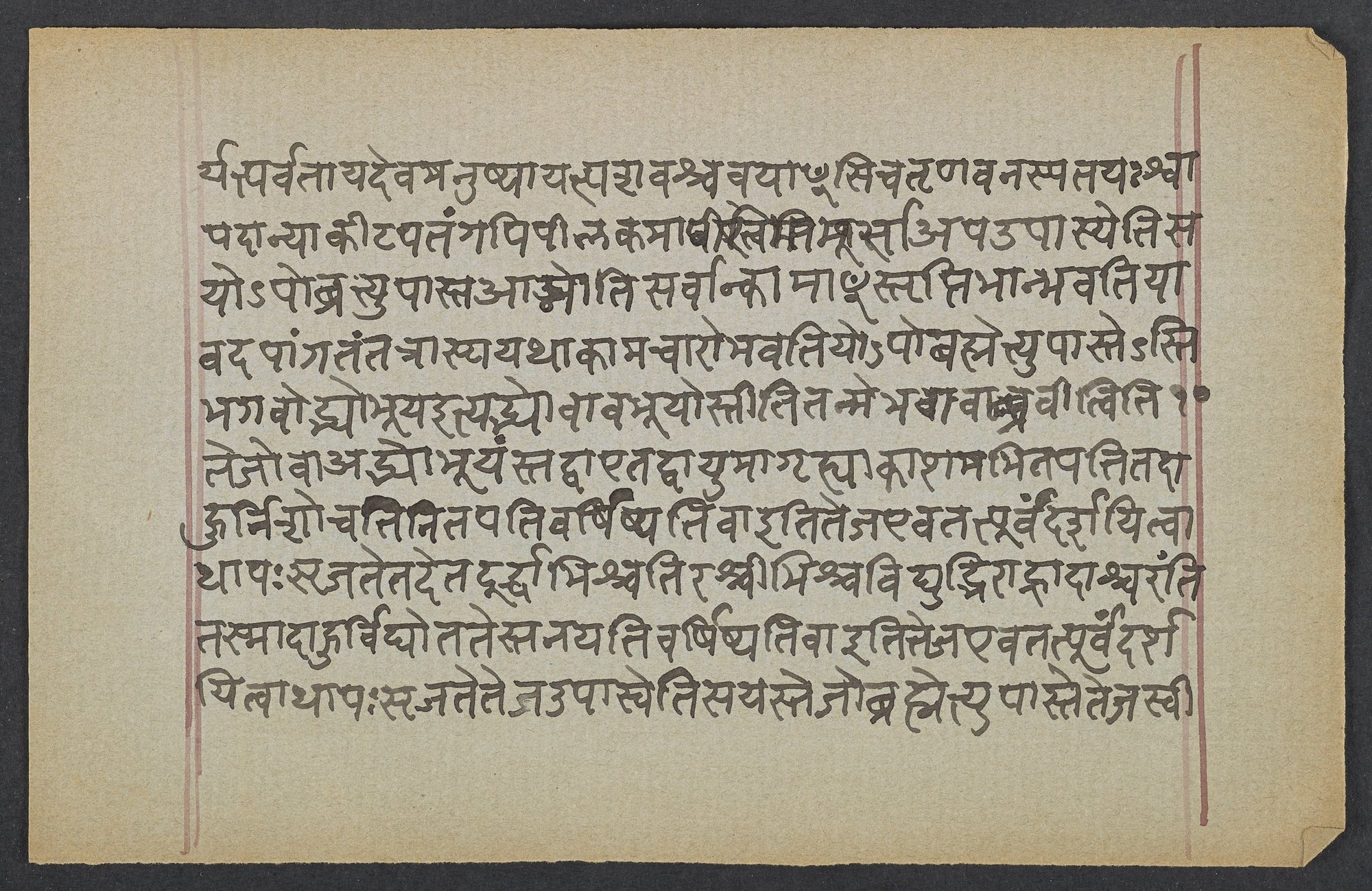
Penn Ms. Coll. 390 Item 945. fol. 60v begins ‹tv iti annaṃ vāva balād bhūyas tasmād yady api daśa rātrīr nāśnīyāt› and ends ‹yad antarikṣaṃ yad dyaur›; fol. 61r begins ‹parvatā yad devamanuṣyā yat paśavaś ca vayāṃsi ca tṛṇavanaspatayaḥ śvāpadāny ākīṭapataṅgapipīlakam› and ends ‹tad ādarśayitvāthāpaḥ sṛjate tad etat teja upāssveti sa yas tejo brahmety upāste tejasvī› (first and last words read on the image, transliterated). The words were located in the GRETIL text by string matching and the page boundaries follow from them; readings and results are stored in data/sources/upanishads/mapping_945.json.
10.1āpo vāvānnād bhūyasyaḥ |
tasmād yadā suvṛṣṭir na bhavati vyādhīyante prāṇā annaṃ kanīyo bhaviṣyatīti |
atha yadā suvṛṣṭir bhavaty ānandinaḥ prāṇā bhavanty annaṃ bahu bhaviṣyatīti |
āpa evemā mūrtā yeyaṃ pṛthivī yad antarikṣaṃ yad dyaur yat parvatā yad devamanuṣyā yat paśavaś ca vayāṃsi ca tṛṇavanaspatayaḥ śvāpadāny ākīṭapataṅgapipīlakam |
āpa evemā mūrtāḥ |
apa upāssveti ||
10.2sa yo 'po brahmety upāste |
āpnoti sarvān kāmāṃs tṛptimān bhavati |
yāvad apāṃ gataṃ tatrāsya yathākāmacāro bhavati yo 'po brahmety upāste |
asti bhagavo 'dbhyo bhūya iti |
adbhyo vāva bhūyo 'stīti |
tan me bhagavān bravītv iti ||
11.1tejo vāvādbhyo bhūyaḥ |
tad vā etad vāyum āgṛhyākāśam abhitapati tadāhur niśocati nitapati varṣiṣyati vā iti |
teja eva tatpūrvaṃ darśayitvāthāpaḥ sṛjate |
tad etad ūrdhvābhiś ca tiraścībhiś ca vidyudbhir āhrādāś caranti tasmād āhur vidyotate stanayati varṣiṣyati vā iti |
teja eva tatpūrvaṃ darśayitvāthāpaḥ sṛjate |
teja upāssveti ||
10.1'Water (ap) is better than food. Therefore if there is not sufficient rain, the vital spirits fail from fear that there will be less food. But if there is sufficient rain, the vital spirits rejoice, because there will be much food. This water, on assuming different forms, becomes this earth, this sky, this heaven, the mountains, gods and men, cattle, birds, herbs and trees, all beasts down to worms, midges, and ants. Water indeed assumes all these forms. Meditate on water.
10.2He who meditates on water as Brahman, obtains all wishes, he becomes satisfied; he is, as it were, lord and master as far as water reaches—he who meditates on water as Brahman. 'Sir, is there something better than water?' 'Yes, there is something better than water.' 'Sir, tell it me.'
11.1'Fire (tegas) is better than water. For fire united with air, warms the ether. Then people say, It is hot, it burns, it will rain. Thus does fire, after showing this sign (itself) first, create water. And thus again thunderclaps come with lightnings, flashing upwards and across the sky. Then people say, There is lightning and thunder, it will rain. Then also does fire, after showing this sign first, create water. Meditate on fire.
Where on the image
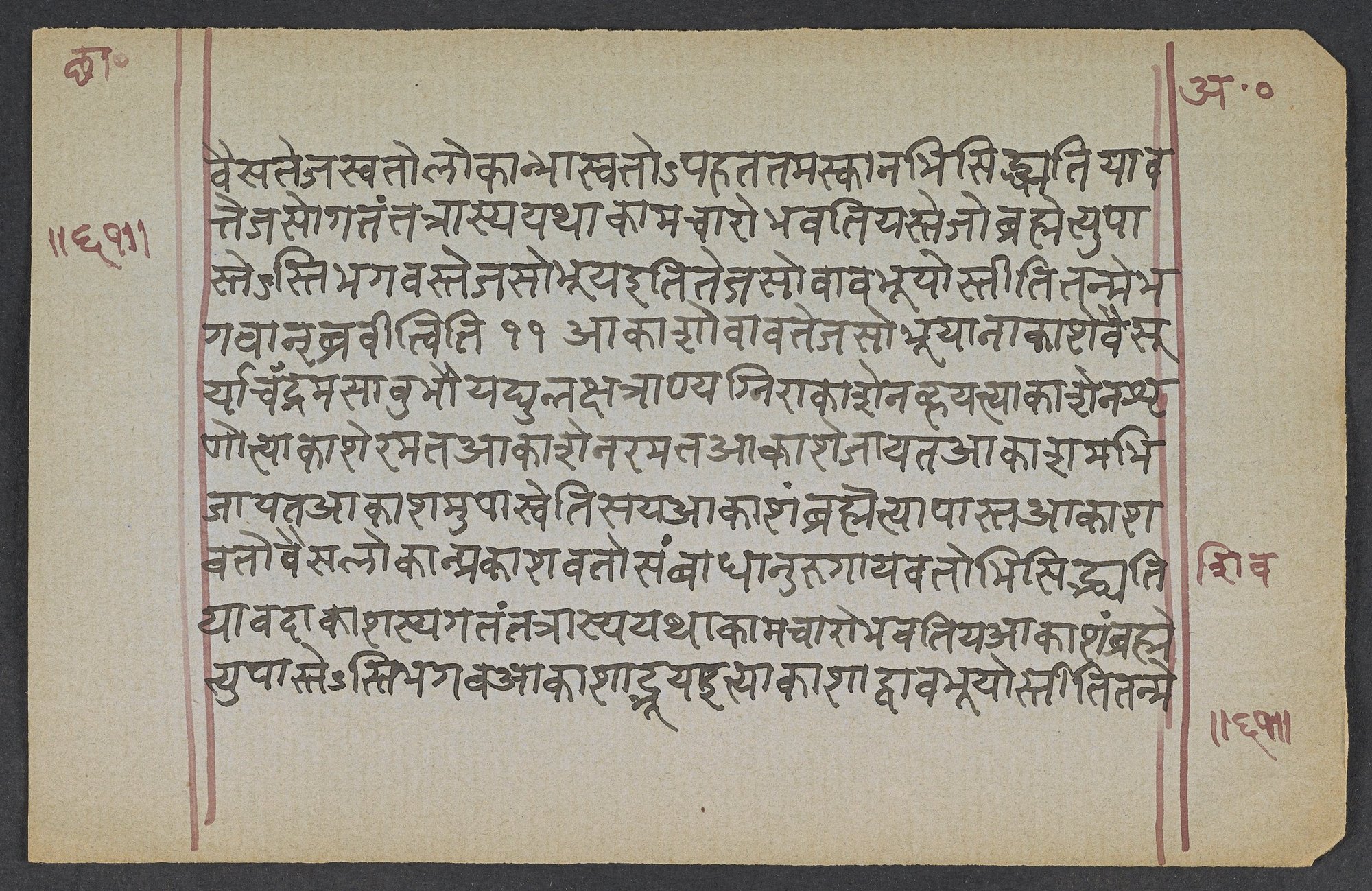
Penn Ms. Coll. 390 Item 945. fol. 61r begins ‹parvatā yad devamanuṣyā yat paśavaś ca vayāṃsi ca tṛṇavanaspatayaḥ śvāpadāny ākīṭapataṅgapipīlakam› and ends ‹tad ādarśayitvāthāpaḥ sṛjate tad etat teja upāssveti sa yas tejo brahmety upāste tejasvī›; fol. 61v begins ‹vai sa tejasvato lokān bhāsvato 'pahatatamaskān abhisidhyati› and ends ‹asti bhagava ākāśād bhūya iti smaro vāvākāśād bhūyo 'stīti tan me› (first and last words read on the image, transliterated). The words were located in the GRETIL text by string matching and the page boundaries follow from them; readings and results are stored in data/sources/upanishads/mapping_945.json.
11.2sa yas tejo brahmety upāste |
tejasvī vai sa tejasvato lokān bhāsvato 'pahatatamaskān abhisidhyati |
yāvat tejaso gataṃ tatrāsya yathākāmacāro bhavati yas tejo brahmety upāste |
asti bhagavas tejaso bhūya iti |
tejaso vāva bhūyo 'stīti |
tan me bhagavān bravītv iti ||
12.1ākāśo vāva tejaso bhūyān |
ākāśe vai sūryācandramasāv ubhau vidyun nakṣatrāṇy agniḥ |
ākāśenāhvāyati |
ākāśena sṛṇoti |
ākāśena pratisṛṇoti |
ākāśe ramate |
ākāśe na ramate |
ākāśe jāyate |
ākāśam abhijāyate |
ākāśam upāssveti ||
11.2'He who meditates on fire as Brahman, obtains, resplendent himself, resplendent worlds, full of light and free of darkness; he is, as it were, lord and master as far as fire reaches—he who meditates on fire as Brahman.' 'Sir, is there something better than fire?' 'Yes, there is something better than fire.' 'Sir, tell it me.'
12.1'Ether (or space) is better than fire. For in the ether exist both sun and moon, the lightning, stars, and fire (agni). Through the ether we call, through the ether we hear, through the ether we answer. In the ether or space we rejoice (when we are together), and rejoice not (when we are separated). In the ether everything is born, and towards the ether everything tends when it is born. Meditate on ether.
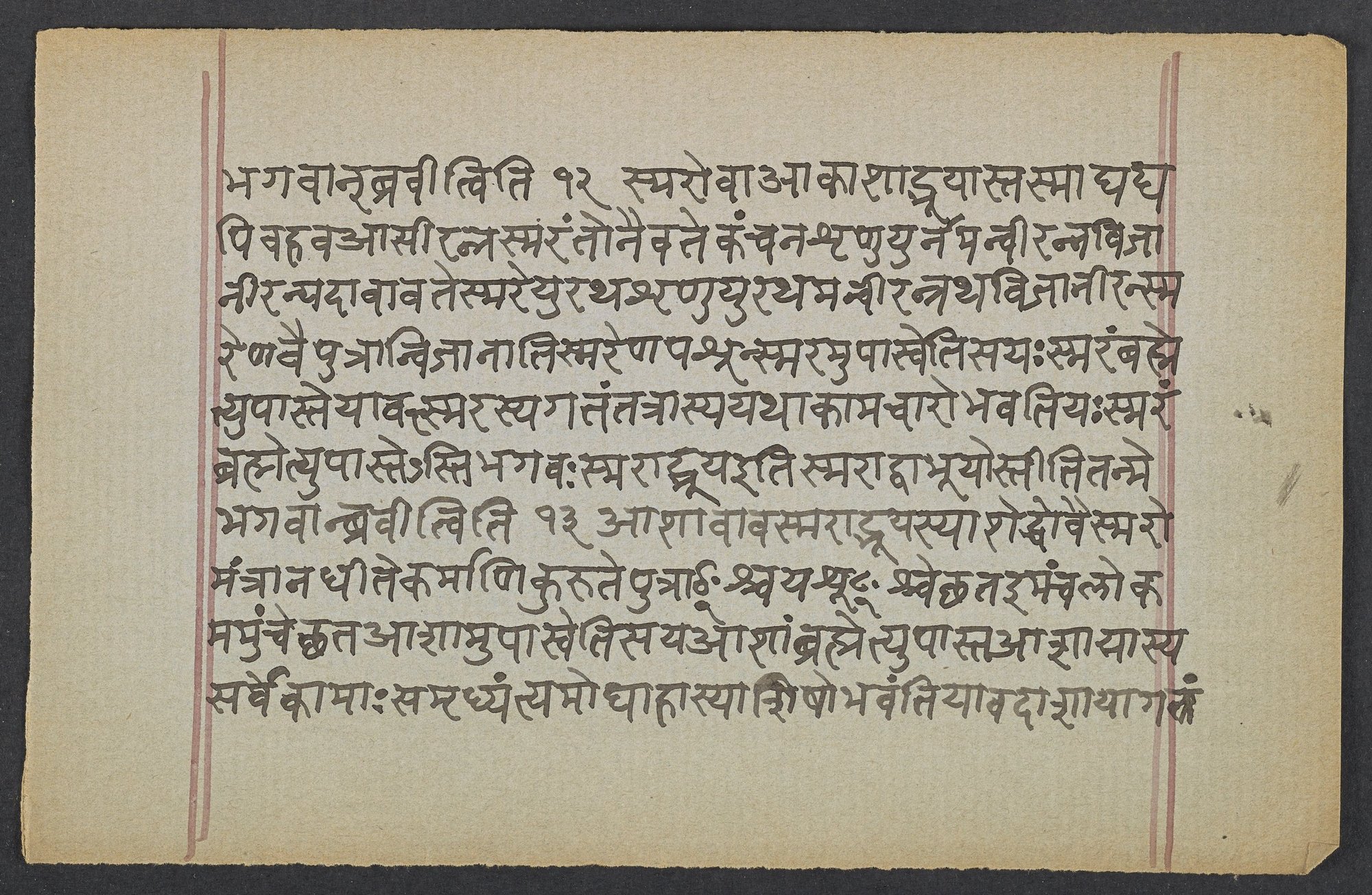
Where on the image
Penn Ms. Coll. 390 Item 945. fol. 61v begins ‹vai sa tejasvato lokān bhāsvato 'pahatatamaskān abhisidhyati› and ends ‹asti bhagava ākāśād bhūya iti smaro vāvākāśād bhūyo 'stīti tan me›; fol. 62r begins ‹bhagavān bravītv iti smaro vāvākāśād bhūyas tasmād yady api bahava āsīrann› and ends ‹āśayāsya sarve kāmāḥ samṛdhyanty amoghā hāsyāśiṣo bhavanti yāvad āśāyā gataṃ› (first and last words read on the image, transliterated). The words were located in the GRETIL text by string matching and the page boundaries follow from them; readings and results are stored in data/sources/upanishads/mapping_945.json.
12.2sa ya ākāśaṃ brahmety upāste |
ākāśavato vai sa lokān prakāśavato 'saṃbādhān urugāyavato 'bhisidhyati |
yāvad ākāśasya gataṃ tatrāsya yathākāmacāro bhavati ya ākāśaṃ brahmety upāste |
asti bhagava ākāśād bhūya iti |
ākāśad vāva bhūyo 'stīti |
tan me bhagavān bravītv iti ||
13.1smaro vāvākāśād bhūyaḥ |
tasmād yady api bahava āsīrann a smaranto naiva te kaṃcana śṛṇuyur na manvīran na vijānīran |
yadā vāva te smareyur atha śṛṇuyur atha manvīrann atha vijānīran |
smareṇa vai putrān vijānāti smareṇa paśūn |
smaram upāssveti ||
13.2sa yaḥ smaraṃ brahmety upāste |
yāvat smarasya gataṃ tatrāsya yathākāmacāro bhavati yaḥ smaraṃ brahmety upāste |
asti bhagavaḥ smarād bhūya iti |
smarād vāva bhūyo 'stīti |
tan me bhagavān bravītv iti ||
14.1āśā vāva smarād bhūyasī |
āśeddho vai smaro mantrān adhīte karmāṇi kurute putrāṃś ca paśūṃś cecchata imaṃ ca lokaṃ amuṃ cecchate |
āśām upāssveti ||
12.2He who meditates on ether as Brahman, obtains the worlds of ether and of light, which are free from pressure and pain, wide and spacious; he is, as it were, lord and master as far as ether reaches — he who meditates on ether as Brahman.' 'Sir, is there something better than ether?' 'Yes, there is something better than ether.' 'Sir, tell it me.'
13.1'Memory (smara) is better than ether. Therefore where many are assembled together, if they have no memory, they would hear no one, they would not perceive, they would not understand. Through memory we know our sons, through memory our cattle. Meditate on memory.
13.2'He who meditates on memory as Brahman, is, as it were, lord and master as far as memory reaches—he who meditates on memory as Brahman.' 'Sir, is there something better than memory?' 'Yes, there is something better than memory.' 'Sir, tell it me.'
14.1'Hope (âsâ) is better than memory. Fired by hope does memory read the sacred hymns, perform sacrifices, desire sons and cattle, desire this world and the other. Meditate on hope.
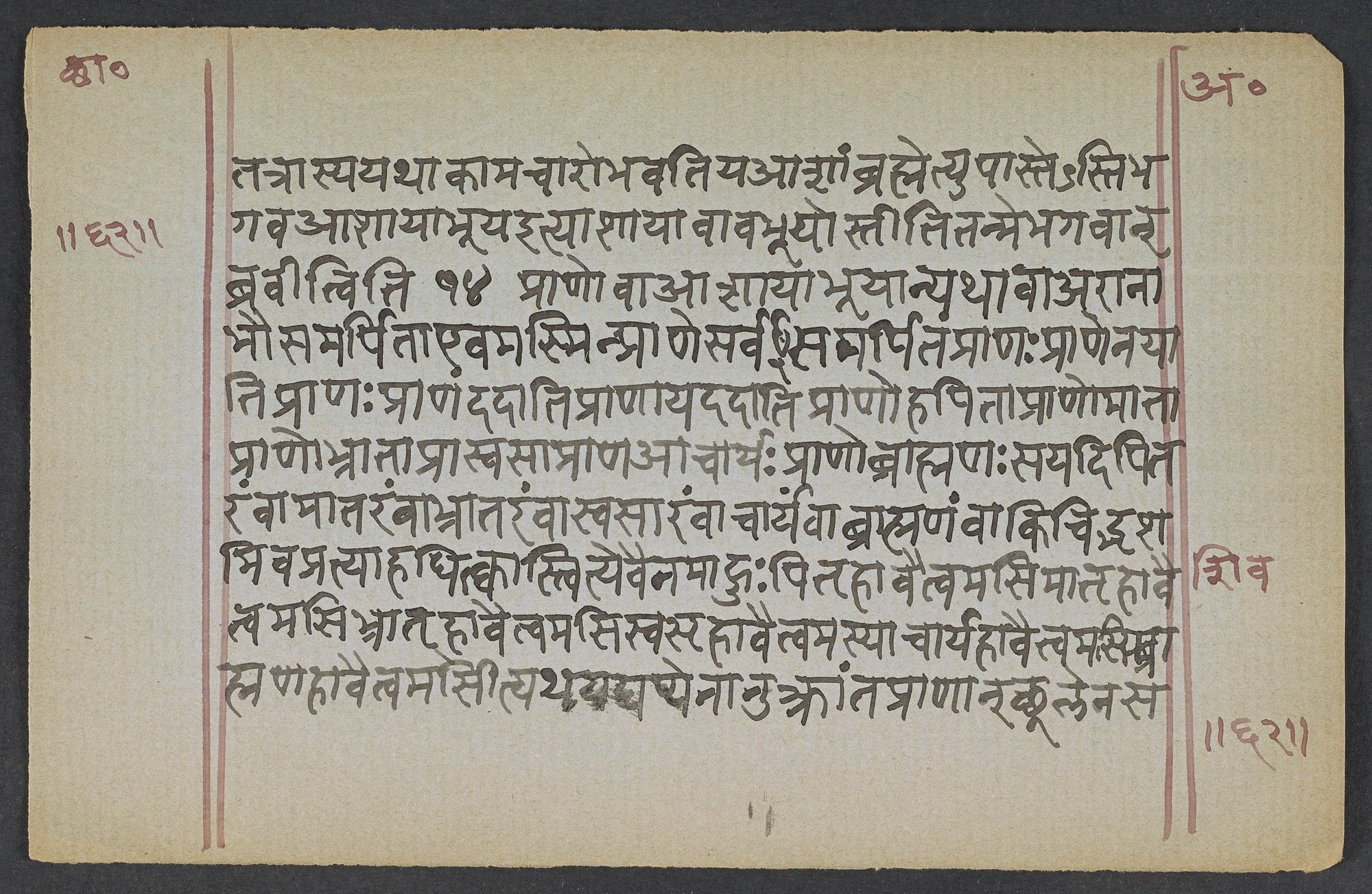
Where on the image
Penn Ms. Coll. 390 Item 945. fol. 62r begins ‹bhagavān bravītv iti smaro vāvākāśād bhūyas tasmād yady api bahava āsīrann› and ends ‹āśayāsya sarve kāmāḥ samṛdhyanty amoghā hāsyāśiṣo bhavanti yāvad āśāyā gataṃ›; fol. 62v begins ‹tatrāsya yathākāmacāro bhavati ya āśāṃ brahmety upāste 'sti bhagava āśāyā bhūya iti› and ends ‹atha yady apy enān utkrāntaprāṇāñ chūlena sa› (first and last words read on the image, transliterated). The words were located in the GRETIL text by string matching and the page boundaries follow from them; readings and results are stored in data/sources/upanishads/mapping_945.json.
14.2sa ya āśāṃ brahmety upāste |
āśayāsya sarve kāmāḥ samṛdhyanti |
amoghā hāsyāśiṣo bhavanti |
yāvad āśāyā gataṃ tatrāsya yathākāmacāro bhavati ya āśāṃ brahmety upāste |
asti bhagava āśāyā bhūya iti |
āśāyā bhūyo 'stīti |
tan me bhagavān bravītv iti ||
15.1prāṇo vāva āśāyā bhūyān |
yathā vā arā nābhau samarpitā evam asmin prāṇe sarvaṃ samarpitam |
prāṇaḥ prāṇena yāti |
prāṇaḥ prāṇaṃ dadāti |
prāṇāya dadāti |
prāṇo ha pitā |
prāṇo mātā |
prāṇo bhrātā |
prāṇaḥ svasā |
prāṇa ācāryaḥ |
prāṇo brāhmaṇaḥ ||
15.2sa yadi pitaraṃ vā mātaraṃ vā bhrātaraṃ vā svasāraṃ vācāryaṃ vā brāhmaṇaṃ vā kiṃcid bhṛśam iva pratyāha |
dhik tvāstv ity evainam āhuḥ |
pitṛhā vai tvam asi mātṛhā vai tvam asi bhrātṛhā vai tvam asi svasṛhā vai tvam asy ācāryahā vai tvam asi brāhmaṇahā vai tvam asīti ||
14.2'He who meditates on hope as Brahman, all his desires are fulfilled by hope, his prayers are not in vain; he is, as it were, lord and master as far as hope reaches—he who meditates on hope as Brahman.' 'Sir, is there something better than hope?' 'Yes, there is something better than hope.' 'Sir, tell it me.'
15.1'Spirit (prâna) is better than hope. As the spokes of a wheel hold to the nave, so does all this (beginning with names and ending in hope) hold to spirit. That spirit moves by the spirit, it gives spirit to the spirit. Father means spirit, mother is spirit, brother is spirit, sister is spirit, tutor is spirit, Brâhmana is spirit.
15.2'For if one says anything unbecoming to a father, mother, brother, sister, tutor or Brâhmana, then people say, Shame on thee! thou hast offended thy father, mother, brother, sister, tutor, or a Brâhmana.
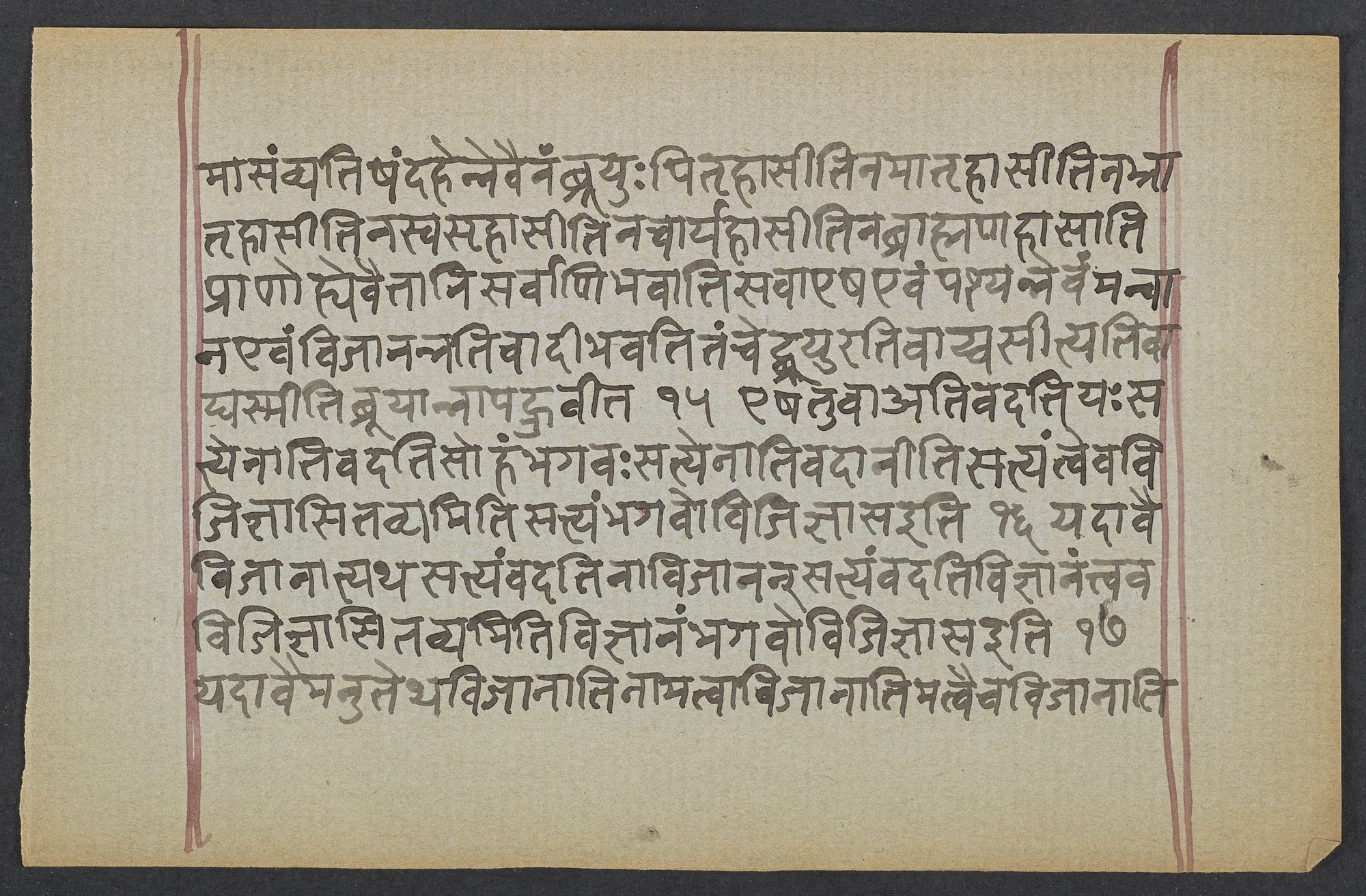
Where on the image
Penn Ms. Coll. 390 Item 945. fol. 62v begins ‹tatrāsya yathākāmacāro bhavati ya āśāṃ brahmety upāste 'sti bhagava āśāyā bhūya iti› and ends ‹atha yady apy enān utkrāntaprāṇāñ chūlena sa›; fol. 63r begins ‹māsaṃ vyatiṣaṃdahen naivainaṃ brūyuḥ pitṛhāsīti na mātṛhāsīti› and ends ‹yadā vai manute 'tha vijānāti nāmatvā vijānāti matvaiva vijānāti› (first and last words read on the image, transliterated). The words were located in the GRETIL text by string matching and the page boundaries follow from them; readings and results are stored in data/sources/upanishads/mapping_945.json.
15.3atha yady apy enān utkrāntaprāṇāñ chūlena samāsaṃ vyatiṣaṃdahet |
naivainaṃ brūyuḥ pitṛhāsīti na mātṛhāsīti na bhrātṛhāsīti na svasṛhāsīti nācāryahāsīti na brāhmaṇahāsīti ||
15.4prāṇo hy evaitāni sarvāṇi bhavati |
sa vā eṣa evaṃ paśyann evaṃ manvāna evaṃ vijānann ativādī bhavati |
taṃ ced brūyur ativādy asīti |
ativādy asmīti brūyāt |
nāpahnuvīta ||
16.1eṣa tu vā ativadati yaḥ satyenātivadati |
so 'haṃ bhagavaḥ satyenātivadānīti |
satyaṃ tveva vijijñāsitavyam iti |
satyaṃ bhagavo vijijñāsa iti ||
17.1yadā vai vijānāty atha satyaṃ vadati |
nāvijānan satyaṃ vadati |
vijānann eva satyaṃ vadati |
vijñānaṃ tv eva vijijñāsitavyam iti |
vijñānaṃ bhagavo vijijñāsa iti ||
15.3'But, if after the spirit has departed from them, one shoves them together with a poker, and burns them to pieces, no one would say, Thou offendest thy father, mother, brother, sister, tutor or a Brâhmana.
15.4'Spirit then is all this. He who sees this, perceives this, and understands this, becomes an ativâdin. If people say to such a man, Thou art an ativâdin, he may say, I am an ativâdin; he need not deny it.'
16.1'But in reality he is an ativâdin who declares the Highest Being to be the True (Satya).' 'Sir, may I become an ativâdin by the True.' 'But we must desire to know the True.' 'Sir, I desire to know the True.'
17.1'When one understands the True, then one declares the True. One who does not understand it, does not declare the True. Only he who understands it, declares the True. This understanding, however, we must desire to understand.' 'Sir, I desire to understand it.'
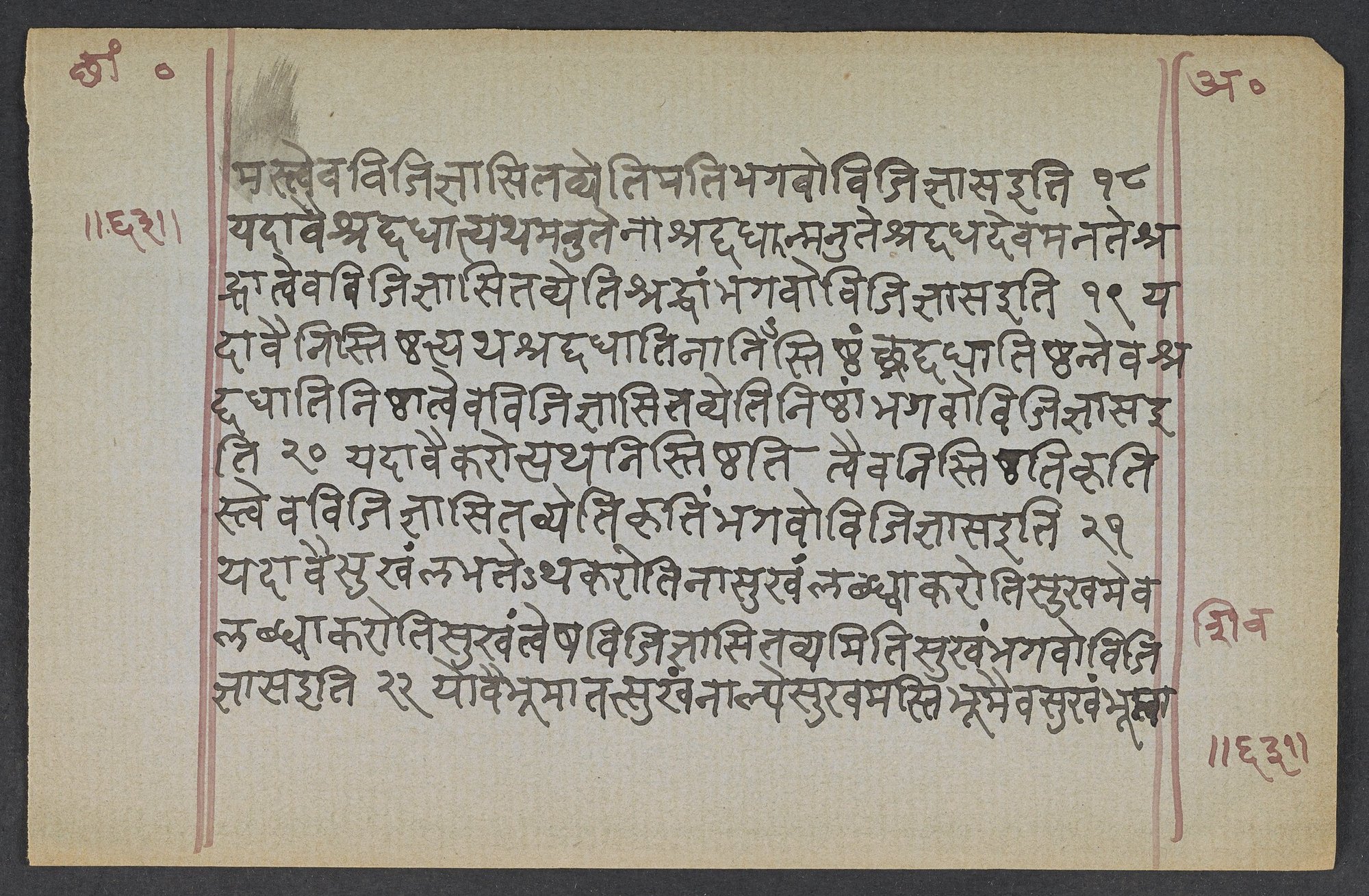
Where on the image
Penn Ms. Coll. 390 Item 945. fol. 63r begins ‹māsaṃ vyatiṣaṃdahen naivainaṃ brūyuḥ pitṛhāsīti na mātṛhāsīti› and ends ‹yadā vai manute 'tha vijānāti nāmatvā vijānāti matvaiva vijānāti›; fol. 63v begins ‹matis tv eva vijijñāsitavyeti matiṃ bhagavo vijijñāsa iti› and ends ‹yo vai bhūmā tat sukhaṃ nālpe sukham asti bhūmaiva sukhaṃ bhūmā› (first and last words read on the image, transliterated). The words were located in the GRETIL text by string matching and the page boundaries follow from them; readings and results are stored in data/sources/upanishads/mapping_945.json.
18.1yadā vai manute 'tha vijānāti |
nāmatvā vijānāti |
matvaiva vijānāti |
matis tv eva vijijñāsitavyeti |
matiṃ bhagavo vijijñāsa iti ||
19.1yadā vai śraddadhāty atha manute |
nāśraddadhan manute |
śraddadhad eva manute |
śraddhā tv eva vijijñāsitavyeti |
śraddhāṃ bhagavo vijijñāsa iti ||
20.1yadā vai nistiṣṭhaty atha śraddadhāti |
nānistiṣṭhañ chraddadhāti |
nistiṣṭhann eva śraddadhāti |
niṣṭhā tv eva vijijñāsitavyeti |
niṣṭhāṃ bhagavo vijijñāsa iti ||
21.1yadā vai karoty atha nistiṣṭhati |
nākṛtvā nistiṣṭhati |
kṛtvaiva nistiṣṭhati |
kṛtis tv eva vijijñāsitavyeti |
kṛtiṃ bhagavo vijijñāsa iti ||
22.1yadā vai sukhaṃ labhate 'tha karoti |
nāsukhaṃ labdhvā karoti |
sukham eva labdhvā karoti |
sukhaṃ tv eva vijijñāsitavyam iti |
sukhaṃ bhagavo vijijñāsa iti ||
18.1'When one perceives, then one understands. One who does not perceive, does not understand. Only he who perceives, understands. This perception, however, we must desire to understand.' 'Sir, I desire to understand it.'
19.1'When one believes, then one perceives. One who does not believe, does not perceive. Only he who believes, perceives. This belief, however, we must desire to understand.' 'Sir, I desire to understand it.'
20.1'When one attends on a tutor (spiritual guide), then one believes. One who does not attend on a tutor, does not believe. Only he who attends, believes. This attention on a tutor, however, we must desire to understand.' 'Sir, I desire to understand it.'
21.1'When one performs all sacred duties, then one attends really on a tutor. One who does not perform his duties, does not really attend on a tutor. Only he who performs his duties, attends on his tutor. This performance of duties, however, we must desire to understand.' 'Sir, I desire to understand it.'
22.1'When one obtains bliss (in oneself), then one performs duties. One who does not obtain bliss, does not perform duties. Only he who obtains bliss, performs duties. This bliss, however, we must desire to understand.' 'Sir, I desire to understand it.'
Where on the image
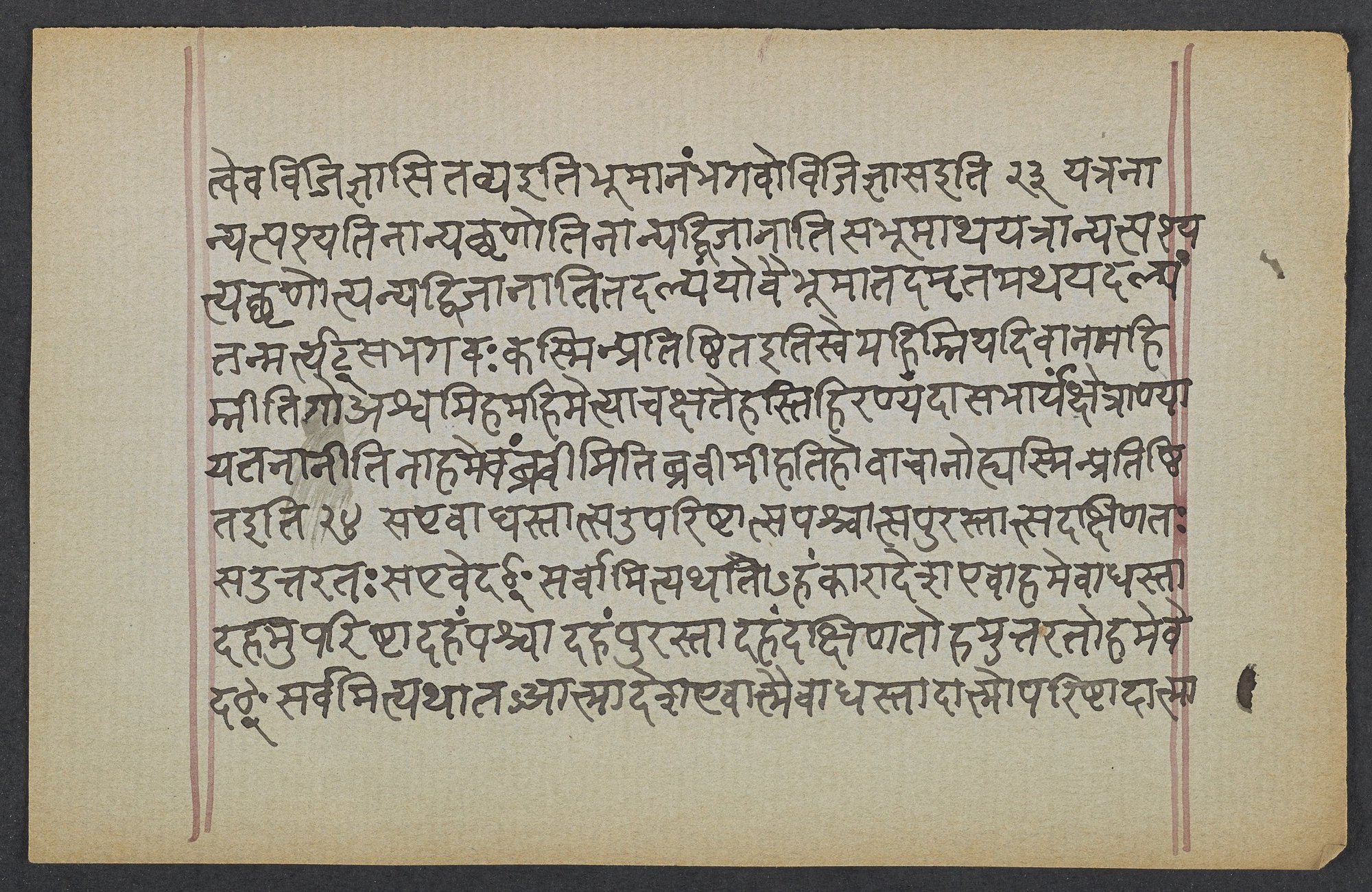
Penn Ms. Coll. 390 Item 945. fol. 63v begins ‹matis tv eva vijijñāsitavyeti matiṃ bhagavo vijijñāsa iti› and ends ‹yo vai bhūmā tat sukhaṃ nālpe sukham asti bhūmaiva sukhaṃ bhūmā›; fol. 64r begins ‹tv eva vijijñāsitavya iti bhūmānaṃ bhagavo vijijñāsa iti yatra nānyat paśyati› and ends ‹aham evādhastād aham upariṣṭād ahaṃ paścād ahaṃ purastād ahaṃ dakṣiṇato 'ham uttarato 'ham evedaṃ sarvam ity athāta ātmādeśa evātmaivādhastād ātmopariṣṭād ātmā› (first and last words read on the image, transliterated). The words were located in the GRETIL text by string matching and the page boundaries follow from them; readings and results are stored in data/sources/upanishads/mapping_945.json.
23.1yo vai bhūmā tat sukham |
nālpe sukham asti |
bhūmaiva sukham |
bhūmā tv eva vijijñāsitavya iti |
bhūmānaṃ bhagavo vijijñāsa iti ||
24.1yatra nānyat paśyati nānyac chṛṇoti nānyad vijānāti sa bhūmā |
atha yatrānyat paśyaty anyac chṛṇoty anyad vijānāti tad alpam |
yo vai bhūmā tad amṛtam |
atha yad alpaṃ tan martyam |
sa bhagavaḥ kasmin pratiṣṭhita iti |
sve mahimni yadi vā na mahimnīti ||
24.2go 'śvam iha mahimety ācakṣate hastihiraṇyaṃ dāsabhāryaṃ kṣetrāṇy āyatanānīti |
nāham evaṃ bravīmi |
bravīmīti hovāca |
anyo hy anyasmin pratiṣṭhita iti ||
25.1sa evādhastāt sa upariṣṭāt sa paścāt sa purastāt sa dakṣiṇataḥ sa uttarataḥ |
sa evedaṃ sarvam iti |
athāto 'haṃkārādeśa eva |
aham evādhastād aham upariṣṭād ahaṃ paścād ahaṃ purastād ahaṃ dakṣiṇato 'ham uttarato 'ham evedaṃ sarvam iti ||
23.1'The Infinite (bhûman) is bliss. There is no bliss in anything finite. Infinity only is bliss. This Infinity, however, we must desire to understand.' 'Sir, I desire to understand it.'
24.1'Where one sees nothing else, hears nothing else, understands nothing else, that is the Infinite. Where one sees something else, hears something else, understands something else, that is the finite. The Infinite is immortal, the finite is mortal.' 'Sir, in what does the Infinite rest?' 'In its own greatness—or not even in greatness.'
24.2'In the world they call cows and horses, elephants and gold, slaves, wives, fields and houses greatness. I do not mean this,' thus he spoke; 'for in that case one being (the possessor) rests in something else, (but the Infinite cannot rest in something different from itself.)
25.1'The Infinite indeed is below, above, behind, before, right and left—it is indeed all this. 'Now follows the explanation of the Infinite as the I: I am below, I am above, I am behind, before, right and left—I am all this.
Where on the image
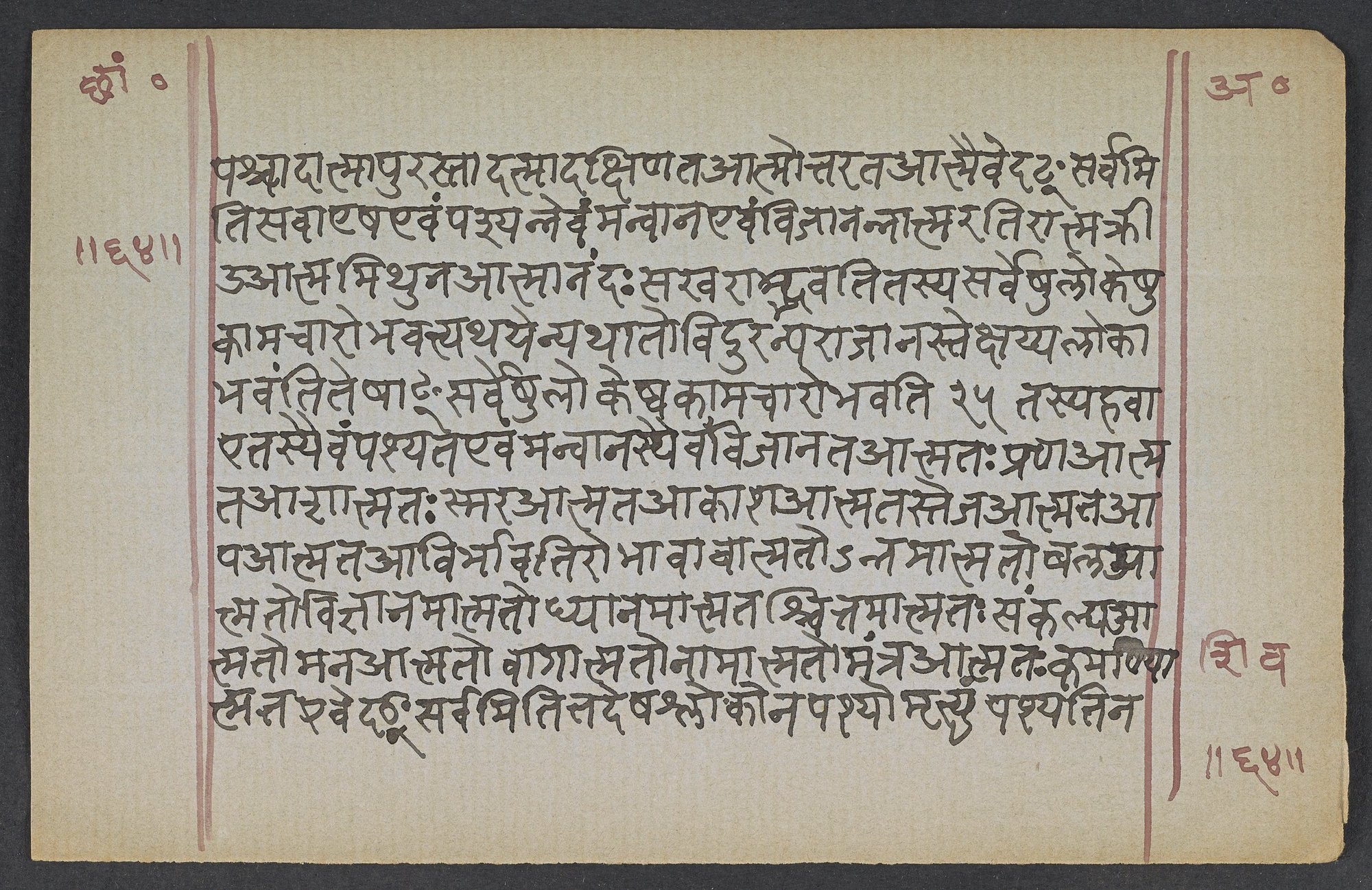
Penn Ms. Coll. 390 Item 945. fol. 64r begins ‹tv eva vijijñāsitavya iti bhūmānaṃ bhagavo vijijñāsa iti yatra nānyat paśyati› and ends ‹aham evādhastād aham upariṣṭād ahaṃ paścād ahaṃ purastād ahaṃ dakṣiṇato 'ham uttarato 'ham evedaṃ sarvam ity athāta ātmādeśa evātmaivādhastād ātmopariṣṭād ātmā›; fol. 64v begins ‹paścād ātmā purastād ātmā dakṣiṇata ātmottarata ātmaivedaṃ sarvam iti› and ends ‹ātmata evedaṃ sarvam iti tad eṣa śloko na paśyo mṛtyuṃ paśyati na› (first and last words read on the image, transliterated). The words were located in the GRETIL text by string matching and the page boundaries follow from them; readings and results are stored in data/sources/upanishads/mapping_945.json.
25.2athāta ātmādeśa eva |
ātmaivādhastād ātmopariṣṭād ātmā paścād ātmā purastād ātmā dakṣiṇata ātmottarata ātmaivedaṃ sarvam iti |
sa vā eṣa evaṃ paśyann evaṃ manvāna evaṃ vijānann ātmaratir ātmakrīḍa ātmamithuna ātmānandaḥ sa svarāḍ bhavati |
tasya sarveṣu lokeṣu kāmacāro bhavati |
atha ye 'nyathāto vidur anyarājānas te kṣayyalokā bhavanti |
teṣāṃ sarveṣu lokeṣv akāmacāro bhavati ||
26.1tasya ha vā etasyaivaṃ paśyata evaṃ manvānasyaivaṃ vijānata ātmataḥ prāṇa ātmata āśātmataḥ smara ātmata ākāśa ātmatas teja ātmata āpa ātmata āvirbhāvatirobhāvāv ātmato 'nnam ātmato balam ātmato vijñānam ātmato dhyānam ātmataś cittam ātmataḥ saṃkalpa ātmato mana ātmato vāg ātmato nāmātmato mantrā ātmataḥ karmāṇy ātmata evedaṃ sarvam iti ||
25.2'Next follows the explanation of the Infinite as the Self: Self is below, above, behind, before, right and left—Self is all this. 'He who sees, perceives, and understands this, loves the Self, delights in the Self, revels in the Self, rejoices in the Self—he becomes a Svarâg, (an autocrat or self-ruler); he is lord and master in all the worlds. 'But those who think differently from this, live in perishable worlds, and have other beings for their rulers.
26.1'To him who sees, perceives, and understands this the spirit (prâna) springs from the Self, hope springs from the Self, memory springs from the Self; so do ether, fire, water, appearance and disappearance, food, power, understanding, reflection, consideration, will, mind, speech, names, sacred hymns, and sacrifices—aye, all this springs from the Self.
Where on the image
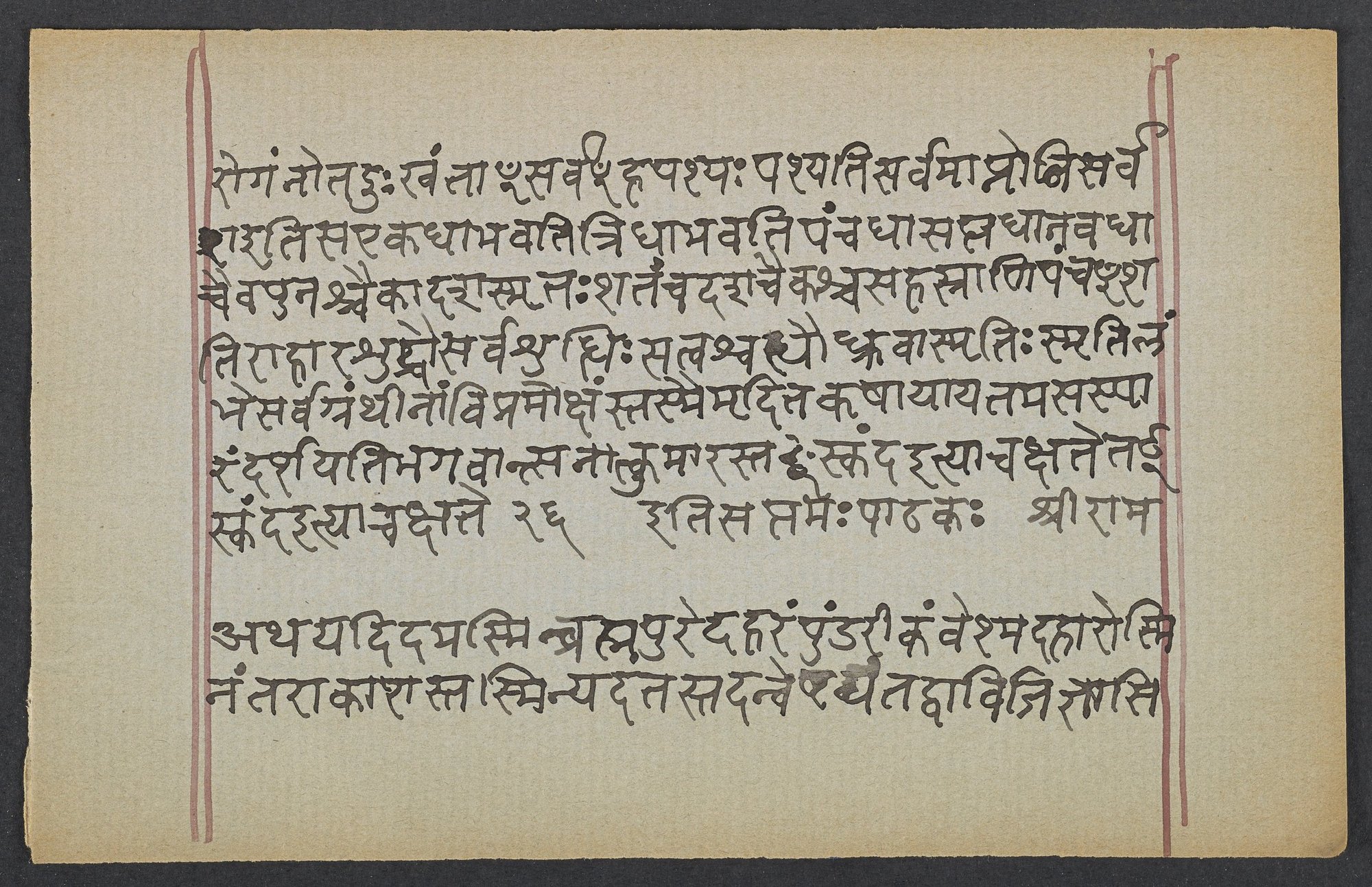
Penn Ms. Coll. 390 Item 945. fol. 64v begins ‹paścād ātmā purastād ātmā dakṣiṇata ātmottarata ātmaivedaṃ sarvam iti› and ends ‹ātmata evedaṃ sarvam iti tad eṣa śloko na paśyo mṛtyuṃ paśyati na›; fol. 65r begins ‹rogaṃ notaduḥkhatāṃ sarvaṃ ha paśyaḥ paśyati› and ends ‹tamasas pāraṃ darśayati bhagavān sanatkumāras taṃ skanda ity ācakṣate taṃ skanda ity ācakṣate› (first and last words read on the image, transliterated). The words were located in the GRETIL text by string matching and the page boundaries follow from them; readings and results are stored in data/sources/upanishads/mapping_945.json.
26.2tad eṣa ślokaḥ |
na paśyo mṛtyuṃ paśyati na rogaṃ nota duḥkhatām |
sarvaṃ ha paśyaḥ paśyati sarvam āpnoti sarvaśaḥ |
iti |
sa ekadhā bhavati tridhā bhavati pañcadhā |
saptadhā navadhā caiva punaś caikādaśa smṛtaḥ |
śataṃ ca daśa caikaś ca sahasrāṇi ca viṃśatiḥ |
āhāraśuddhau sattvaśuddhiḥ |
sattvaśuddhau dhruvā smṛtiḥ |
smṛtilambhe sarvagranthīnāṃ vipramokṣaḥ |
tasmai mṛditakaṣāyāya tamasas pāraṃ darśayati bhagavān sanatkumāraḥ |
taṃ skanda ity ācakṣate ||
26.2'There is this verse, "He who sees this, does not see death, nor illness, nor pain; he who sees this, sees everything, and obtains everything everywhere. '"He is one (before creation), he becomes three (fire, water, earth), he becomes five, he becomes seven, he becomes nine; then again he is called the eleventh, and hundred and ten and one thousand and twenty." 'When the intellectual aliment has been purified, the whole nature becomes purified. When the whole nature has been purified, the memory becomes firm. And when the memory (of the Highest Self) remains firm, then all the ties (which bind us to a belief in anything but the Self) are loosened. 'The venerable Sanatkumâra showed to Nârada, after his faults had been rubbed out, the other side of darkness. They call Sanatkumâra Skanda, yea, Skanda they call him.'
Notes
- Sanskrit: GRETIL, Chandogyopanisad with the commentary ascribed to Samkara, mula text only (input by the Sansknet project). Paragraph numbers (khanda.paragraph) follow the edition. Three legacy encoding artifacts in GRETIL chapter 2 ('saptavidh.am', 'brahmavarcasy:', 'tejasvy:') are normalized.
- English: F. Max Müller, 'Khandogya-upanishad', The Upanishads part I, Sacred Books of the East 1 (1879), from the proofread English Wikisource transcription; footnotes are not reproduced. Where Müller divides a khanda into a different number of paragraphs than the Sanskrit edition, the whole khanda stands in one section and keeps his numbers. In other khandas his paragraph breaks sometimes fall a clause earlier or later than the Sanskrit ones.
- Transcription slips corrected to the printed page: 1.9.2 'udîttha' (printed udgîtha), 3.16.2 'sacrifices' (sacrificer,), 4.6.1 'toward' (towards), 7.25.1 'alt' (all); the stray heading 'Elventh Khanda' inside 2.10.6 is removed. 1.2.1 'Whent he' is a misprint in the book itself and is kept as printed.
- The manuscript readings differ from the edition in places; the Sanskrit shown is the edition text.
Cite
Sources
- Source: Penn Ms. Coll. 390 Item 945 (OPenn, public domain) + GRETIL Sanskrit + F. Max Müller (1879) English (holding institution)
- Critical edition: GRETIL Sanskrit e-texts (Isa, Katha, Prasna, Mandukya, Aitareya, Taittiriya, Svetasvatara, Chandogya); Nirnaya Sagar edition of 1925, transcribed (Kena, Mundaka)
← previous · → next · v cycle view · l back to library