Isa Upanishad (Isavasya)
Introduction
The Isa or Isavasya Upanishad is the fortieth and last chapter of the Vajasaneyi Samhita of the White Yajurveda. Its eighteen verses open with the line that gives the text its name, 'All this is to be hidden in the Lord'. The Sanskrit here is the Kanva recension, the version commented on by Samkara, which matches the order of verses in the manuscript; the Madhyandina recension orders verses 9-14 differently.
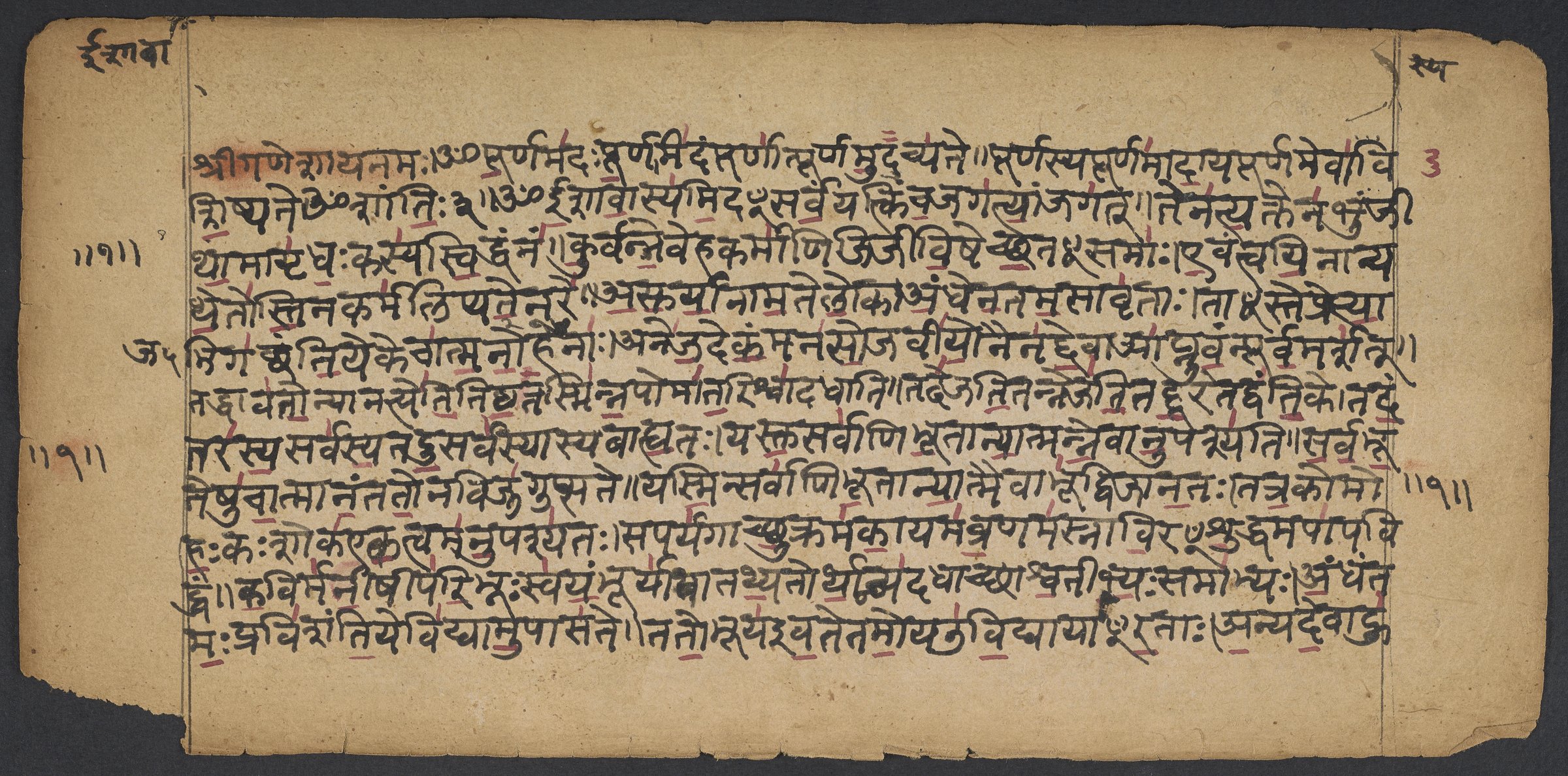
The page images come from a single paper manuscript in the University of Pennsylvania Libraries, Ms. Coll. 390 Item 869, catalogued as 'Six early upanisads'. It has 16 leaves (13 x 27 cm) written in Devanagari, 11 to 13 lines to a side, and is undated (the library assigns it to the 18th or 19th century). It contains the Isa, Kena, Katha, Prasna, Mundaka and Mandukya Upanisads in that order; its title page names a set of ten. Leaves are numbered in the right margin of each verso and carry abbreviated titles in the upper left margin.
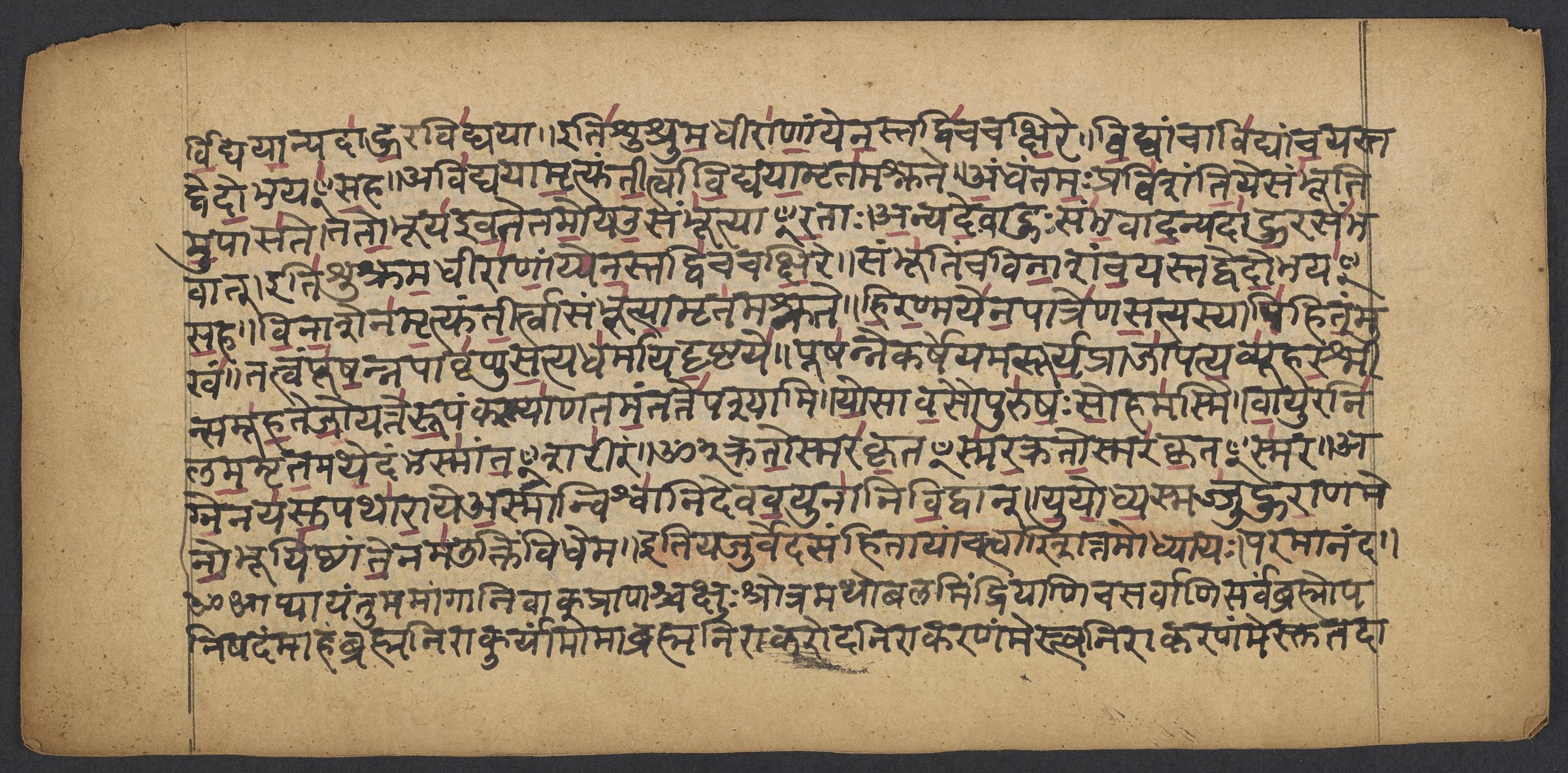
The Isa occupies fol. 1v and 2r. The manuscript ends it with a colophon that names it as a chapter of the Yajurveda Samhita. Verses 1-9 stand on fol. 1v and verses 10-18 on fol. 2r.
How was this verified? (Provenance)
Where on the image
Penn Ms. Coll. 390 Item 869, fol. 1v. fol. 1v (11 lines): after 'śrīgaṇeśāya namaḥ' and the invocation 'oṃ pūrṇam adaḥ ... oṃ śāntiḥ 3' (lines 1-2), verse 1 begins in line 2 ‹oṃ īśāvāsyam idaṃ sarvaṃ›; verse 9 ends in line 11 ‹ya u vidyāyāṃ ratāḥ›. The manuscript does not number the verses; each was found by reading its words on the image. Checked on the image; readings logged in data/sources/upanishads/mapping_notes_869.txt.
1īśā vāsyam idaṃ sarvaṃ yat kiñca jagatyāṃ jagat |
tena tyaktena bhuñjīthā mā gṛdhaḥ kasya sviddhanam ||
2kurvann eveha karmāṇi jijīviṣecchataṃ samāḥ |
evaṃ tvayi nānyatheto 'sti na karma lipyate nare ||
3asuryā nāma te lokā andhena tamasāvṛtāḥ |
tāṃste pretyābhigacchanti ye ke cātmahano janāḥ ||
4anejad ekaṃ manaso javīyo nainaddevā āpnuvanpūrvamarṣat |
taddhāvato 'nyānatyeti tiṣṭhat tasminn apo mātariśvā dadhāti ||
5tad ejati tan naijati tad dūre tad v antike |
tad antar asya sarvasya tad u sarvasyāsya bāhyataḥ ||
6yas tu sarvāṇi bhūtāny ātmany evānupaśyati |
sarvabhūteṣu cātmānaṃ tato na vijugupsate ||
7yasmin sarvāṇi bhūtāny ātmaivābhūd vijānataḥ |
tatra ko mohaḥ kaḥ śoka ekatvam anupaśyataḥ ||
8sa paryagāc chukram akāyam avraṇam asnāviraṃ śuddham apāpaviddham |
kavir manīṣī paribhūḥ svayambhūr yāthātathyator 'thān vyadadhāc chāśvatībhyaḥ samābhyaḥ ||
9andhaṃ tamaḥ praviśanti ye 'vidyām upāsate |
tato bhūya iva te tamo ya uvidyāyāṃ ratāḥ ||
1All this, whatsoever moves on earth, is to be hidden in the Lord (the Self). When thou hast surrendered all this, then thou mayest enjoy. Do not covet the wealth of any man!
2Though a man may wish to live a hundred years, performing works, it will be thus with him; but not in any other way: work will thus not cling to a man.
3There are the worlds of the Asuras covered with blind darkness. Those who have destroyed their self (who perform works, without having arrived at a knowledge of the true Self), go after death to those worlds.
4That one (the Self), though never stirring, is swifter than thought. The Devas (senses) never reached it, it walked before them. Though standing still, it overtakes the others who are running. Mâtarisvan (the wind, the moving spirit) bestows powers on it.
5It stirs and it stirs not; it is far, and likewise near. It is inside of all this, and it is outside of all this.
6And he who beholds all beings in the Self, and the Self in all beings, he never turns away from it.
7When to a man who understands, the Self has become all things, what sorrow, what trouble can there be to him who once beheld that unity?
8He (the Self) encircled all, bright, incorporeal, scatheless, without muscles, pure, untouched by evil; a seer, wise, omnipresent, self-existent, he disposed all things rightly for eternal years.
9All who worship what is not real knowledge (good works), enter into blind darkness: those who delight in real knowledge, enter, as it were, into greater darkness.
Where on the image
Penn Ms. Coll. 390 Item 869, fol. 1v, fol. 2r. Verse 10 begins at the end of fol. 1v line 11 ‹anyad evāhu-› and goes on at fol. 2r line 1 ‹-r vidyayā›; verses 11-18 fill fol. 2r lines 1-10 (verse 18 ends ‹bhūyiṣṭhāṃ te nama uktiṃ vidhema›), followed in line 10 by a colophon beginning ‹iti yajurvedasaṃhitāyāṃ› and ending ‹'dhyāyaḥ›. The order of verses 9-14 on the page is the Kāṇva order printed here. Checked on the image. Checked on the image; readings logged in data/sources/upanishads/mapping_notes_869.txt.
10anyad evāhur vidyayān yad āhur avidyayā |
iti śuśruma dhīrāṇāṃ ye nas tad vicacakṣire ||
11vidyāṃ cāvidyāṃ ca yas tad vedobhayaṃ saha |
avidyayā mṛtyuṃ tīrtvā vidyayāmṛtam aśnute ||
12andhaṃ tamaḥ praviśanti ye 'sambhūtim upāsate |
tato bhūya iva te tamo ya u sambhūtyāṃ ratāḥ ||
13anyad evāhuḥ saṃbhavād anyad āhur asaṃbhavāt |
iti śuśruma dhīrāṇāṃ ye nas tad vicacakṣire ||
14saṃbhūtiṃ ca vināśaṃ ca yas tad vedobhayaṃ saha |
vināśena mṛtyuṃ tīrtvā saṃbhūtyāmṛtam aśnute ||
15hiraṇmayena pātreṇa satyasyāpihitaṃ mukham /
tat tvaṃ pūṣann apāvṛṇu satyadharmāya dṛṣṭaye ||
16pūṣann ekarṣe yama sūrya prājāpatya vyūha raśmīn samūha tejaḥ |
yat te rūpaṃ kalyāṇatamaṃ tat te paśyāmi yo 'sāv asau puruṣaḥ so 'ham asmi ||
17vāyur anilam amṛtam athedaṃ bhasmāntaṃ śarīram |
oṃ krato smara kṛtaṃ smara krato smara kṛtaṃ smara ||
18agne naya supathā rāye asmān viśvāni deva vayunāni vidvān |
yuyodhy asmaj juhurāṇam eno bhūyiṣṭhāṃ te nama uktiṃ vidhema ||
10One thing, they say, is obtained from real knowledge; another, they say, from what is not knowledge. Thus we have heard from the wise who taught us this.
11He who knows at the same time both knowledge and not-knowledge, overcomes death through not-knowledge, and obtains immortality through knowledge.
12All who worship what is not the true cause, enter into blind darkness: those who delight in the true cause, enter, as it were, into greater darkness.
13One thing, they say, is obtained from (knowledge of) the cause; another, they say, from (knowledge of) what is not the cause. Thus we have heard from the wise who taught us this.
14He who knows at the same time both the cause and the destruction (the perishable body), overcomes death by destruction (the perishable body), and obtains immortality through (knowledge of) the true cause.
15The door of the True is covered with a golden disk. Open that, O Pûshan, that we may see the nature of the True.
16O Pûshan, only seer, Yama (judge), Sûrya (sun), son of Pragâpati, spread thy rays and gather them! The light which is thy fairest form, I see it. I am what He is (viz. the person in the sun).
17Breath to air, and to the immortal! Then this my body ends in ashes. Om! Mind, remember! Remember thy deeds! Mind, remember! Remember thy deeds
18Agni, lead us on to wealth (beatitude) by a good path, thou, O God, who knowest all things! Keep far from us crooked evil, and we shall offer thee the fullest praise! (Rv. I, 189, 1.)
Notes
- Sanskrit: GRETIL, Isopanisad (Kanva recension) with the commentary ascribed to Samkara, mula text only; input by the Sansknet project, checked by GRETIL against Limaye and Vadekar, Eighteen Principal Upanisads (1958).
- English: F. Max Müller, 'Vagasaneyi-samhita-upanishad', The Upanishads part I, Sacred Books of the East 1 (1879), from the proofread English Wikisource transcription; Müller's footnotes are not reproduced. Italic letters in Müller's spellings of Sanskrit names follow the printed book.
- The invocation 'oṃ pūrṇam adaḥ ...' written before verse 1 on fol. 1v is not translated by Müller and is not shown.
Cite
Sources
- Source: Penn Ms. Coll. 390 Item 869 (OPenn, public domain) + GRETIL Sanskrit + F. Max Müller (1879) English (holding institution)
- Critical edition: GRETIL Sanskrit e-texts (Isa, Katha, Prasna, Mandukya, Aitareya, Taittiriya, Svetasvatara, Chandogya); Nirnaya Sagar edition of 1925, transcribed (Kena, Mundaka)
← previous · → next · v cycle view · l back to library