Kena Upanishad (Talavakara)
Introduction
The Kena Upanishad takes its name from its first word, kena, 'by whom?'. It belongs to the Samaveda and is also called the Talavakara Upanishad, because it forms part of the Upanishad Brahmana of the Jaiminiya or Talavakara school. Its first two sections are in verse: a pupil asks by whose will the mind, the breath, speech, the eye and the ear do their work, and the teacher answers that it is Brahman, which is not the thing people worship as an object and which is known only by one who does not claim to know it. The last two sections are in prose. They tell how Brahman won a victory for the gods and appeared to them as a spirit (yaksha) that Agni could not burn and Vayu could not lift, and how Uma, daughter of Himavat, told Indra that it was Brahman.
The page images come from a single paper manuscript in the University of Pennsylvania Libraries, Ms. Coll. 390 Item 869, catalogued as 'Six early upanisads'. It has 16 leaves (13 x 27 cm) written in Devanagari, 11 to 13 lines to a side, and is undated (the library assigns it to the 18th or 19th century). It contains the Isa, Kena, Katha, Prasna, Mundaka and Mandukya Upanisads in that order; its title page names a set of ten. Leaves are numbered in the right margin of each verso and carry abbreviated titles in the upper left margin.
The Kena follows the Isa in the manuscript. Its opening invocation begins at the foot of fol. 2r; the text itself runs from fol. 2v line 1 to fol. 3v line 10, where the scribe closes it with the colophon 'iti kenopaniṣat samāptaḥ'. Each section below holds the verses of one khanda that end on one page; a verse that begins at the foot of the previous page is shown with both pages.
No openly licensed digital text of the Sanskrit Kena was found, so the Sanskrit here was typed from the page images of a printed edition of 1925 and transliterated. The manuscript's readings differ from it in a few places; the scan notes name those checked on the pages.
How was this verified? (Provenance)
Where on the image
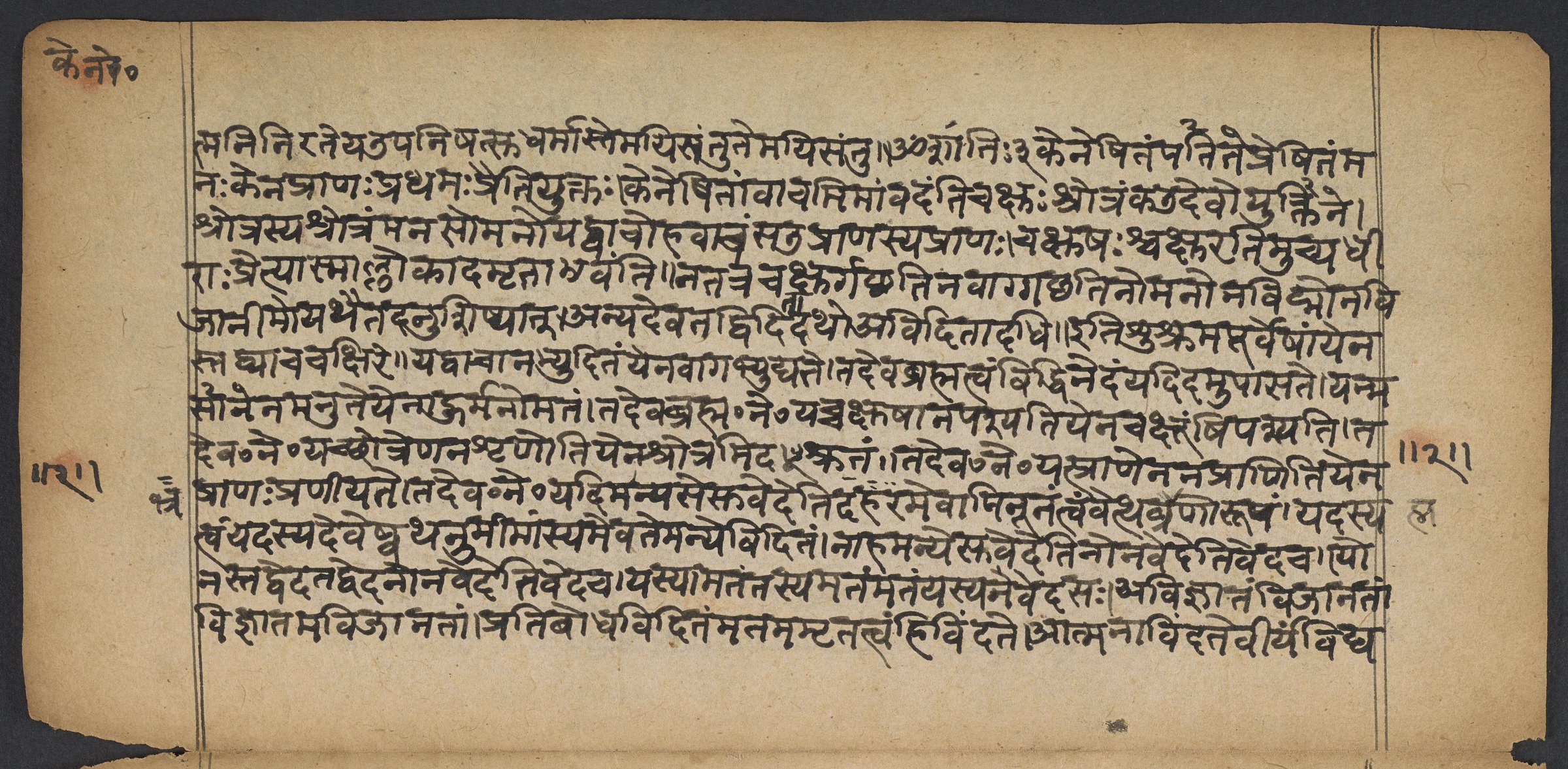
Penn Ms. Coll. 390 Item 869, fol. 2v. fol. 2v (12 lines): line 1 ends the invocation 'oṃ āpyāyantu ...' begun on fol. 2r line 11 (‹... te mayi santu›, ‹oṃ śāntiḥ 3›); 1.1 begins in the same line ‹keneṣitaṃ patati preṣitaṃ ma-›; 1.9 ends in line 9 ‹yena prāṇaḥ praṇīyate tad eva [brahma] ne[daṃ]›. From 1.6 on the scribe shortens the refrain to ‹tad eva bra. ne.›. In 1.9 the manuscript reads praṇīyate (line 9), as do most editions; the printed text shown has prāṇīyate. Checked on the image; readings logged in data/sources/upanishads/mapping_notes_869.txt.
1.1oṃ keneṣitaṃ patati preṣitaṃ manaḥ kena prāṇaḥ prathamaḥ praiti yuktaḥ ||
keneṣitāṃ vācamimāṃ vadanti cakṣuḥ śrotraṃ ka u devo yunakti ||
1.2śrotrasya śrotraṃ manaso mano yadvāco ha vācaṃ sa u prāṇasya prāṇaścakṣuṣaścakṣuratimucya dhīrāḥ pretyāsmāllokādamṛtā bhavanti ||
1.3-4na tatra cakṣurgacchati na vāggacchati no mano na vidmo na vijānīmo yathaitadanuśiṣyādanyadeva tadviditādatho aviditādadhi ||
iti śuśruma pūrveṣāṃ ye nastadvyācacakṣire ||
1.5yadvācānabhyuditaṃ yena vāgabhyudyate ||
tadeva brahma tvaṃ viddhi nedaṃ yadidamupāsate ||
1.6yanmanasā na manute yenāhurmano matam ||
tadeva brahma tvaṃ viddhi nedaṃ yadidamupāsate ||
1.7yaccakṣuṣā na paśyati yena cakṣūṃṣi paśyati ||
tadeva brahma tvaṃ viddhi nedaṃ yadidamupāsate ||
1.8yacchrotreṇa na śṛṇoti yena śrotramidaṃ śrutam ||
tadeva brahma tvaṃ viddhi nedaṃ yadidamupāsate ||
1.9yatprāṇena na prāṇiti yena prāṇaḥ prāṇīyate ||
tadeva brahma tvaṃ viddhi nedaṃ yadidamupāsate ||
1.1The Pupil asks: 'At whose wish does the mind sent forth proceed on its errand? At whose command does the first breath go forth? At whose wish do we utter this speech? What god directs the eye, or the ear?'
1.2The Teacher replies: It is the ear of the ear, the mind of the mind, the speech of speech, the breath of breath, and the eye of the eye. When freed (from the senses) the wise, on departing from this world, become immortal.
1.3'The eye does not go thither, nor speech, nor mind. We do not know, we do not understand, how any one can teach it.
1.4'It is different from the known, it is also above the unknown, thus we have heard from those of old, who taught us this.
1.5'That which is not expressed by speech and by which speech is expressed, that alone know as Brahman, not that which people here adore.
1.6'That which does not think by mind, and by which, they say, mind is thought, that alone know as Brahman, not that which people here adore.
1.7'That which does not see by the eye, and by which one sees (the work of) the eyes, that alone know as Brahman, not that which people here adore.
1.8'That which does not hear by the ear, and by which the ear is heard, that alone know as Brahman, not that which people here adore.
1.9'That which does not breathe by breath, and by which breath is drawn, that alone know as Brahman, not that which people here adore.'
Where on the image
Penn Ms. Coll. 390 Item 869, fol. 2v. fol. 2v line 9: 2.1 begins ‹yadi manyase suvedeti›; 2.3 ends in line 12 ‹vijñātam avijānatām›. In 2.1 the manuscript reads daharam where the printed text has dabhram. Checked on the image; readings logged in data/sources/upanishads/mapping_notes_869.txt.
2.1yadi manyase suvedeti dabhramevāpi nūnaṃ tvaṃ vettha brahmaṇo rūpaṃ ||
yadasya tvaṃ yadasya ca deveṣvatha nu mīmāṃsyameva te manye viditam ||
2.2nāhaṃ manye suvedeti no na vedeti veda ca ||
yo nastadveda tadveda no na vedeti veda ca ||
2.3yasyāmataṃ tasya mataṃ mataṃ yasya na veda saḥ ||
avijñātaṃ vijānatāṃ vijñātamavijānatām ||
2.1The Teacher says: 'If thou thinkest I know it well; then thou knowest surely but little, what is that form of Brahman known, it may be, to thee?'
2.2The Pupil says: 'I do not think I know it well, nor do I know that I do not know it. He among us who knows this, he knows it, nor does he know that he does not know it.
2.3'He by whom it (Brahman) is not thought, by him it is thought; he by whom it is thought, knows it not. It is not understood by those who understand it, it is understood by those who do not understand it.
Where on the image
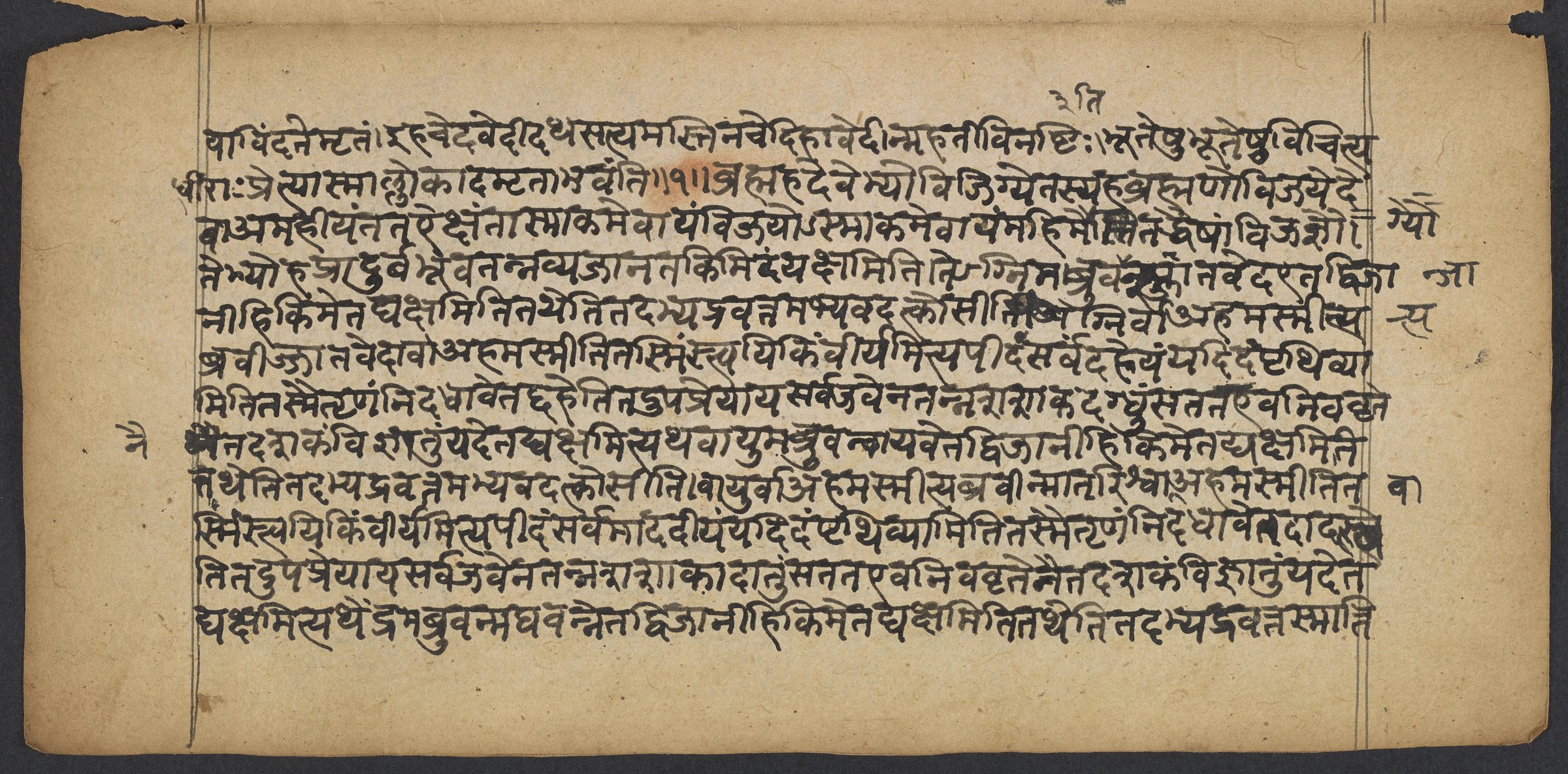
Penn Ms. Coll. 390 Item 869, fol. 2v, fol. 3r. 2.4 begins at the end of fol. 2v line 12 ‹pratibodhaviditaṃ› and ends at fol. 3r line 1 ‹vidyayā vindate 'mṛtam›; 2.5 follows in lines 1-2 and ends ‹amṛtā bhavanti›, marked ‹||1||›. Checked on the image; readings logged in data/sources/upanishads/mapping_notes_869.txt.
2.4pratibodhaviditaṃ matamamṛtatvaṃ hi vindate ||
ātmanā vindate vīryaṃ vidyayā vindate'mṛtam ||
2.5iha cedavedīdatha satyamasti na cedihāvedīnmahatī vinaṣṭiḥ ||
bhūteṣu bhūteṣu vicitya dhīrāḥ pretyāsmāllokādamṛtā bhavanti ||
2.4'It is thought to be known (as if) by awakening, and (then) we obtain immortality indeed. By the Self we obtain strength, by knowledge we obtain immortality.
2.5'If a man know this here, that is the true (end of life); if he does not know this here, then there is great destruction (new births). The wise who have thought on all things (and recognised the Self in them) become immortal, when they have departed from this world.'
Where on the image
Penn Ms. Coll. 390 Item 869, fol. 3r. fol. 3r line 2: 3.1 begins ‹brahma ha devebhyo vijigye›; 3.10 ends in line 12 ‹yad etad yakṣam iti›. In 3.5 the manuscript reads tasmiṃs tvayi (line 6), as in 3.9; the printed text shown has yasmiṃstvayi. Checked on the image; readings logged in data/sources/upanishads/mapping_notes_869.txt.
3.1brahma ha devebhyo vijigye tasya ha brahmaṇo vijaye devā amahīyanta ta aikṣantāsmākamevāyaṃ vijayo'smākamevāyaṃ mahimeti ||
3.2taddhaiṣāṃ vijajñau tebhyo ha prādurbabhūva tanna vyajānanta kimidaṃ yakṣamiti ||
3.3te'gnimabruvañjātaveda etadvijānīhi kimetadyakṣamiti tatheti ||
3.4tadabhyadravattamabhyavadatko'sītyagnirvā ahamasmītyabravījjātavedā vā ahamasmīti ||
3.5yasmiṃstvayi kiṃ vīryamityapīdaṃ sarvaṃ daheyaṃ yadidaṃ pṛthivyāmiti ||
3.6tasmai tṛṇaṃ nidadhāvetaddaheti tadupa preyāya sarvajavena tanna śaśāka dagdhuṃ sa tata eva nivavṛte naitadaśakaṃ vijñātuṃ yadetadyakṣamiti ||
3.7atha vāyumabruvanvāyavetadvijānīhi kimetadyakṣamiti tatheti ||
3.8tadabhyadravattamabhyavadatko'sīti vāyurvā ahamasmītyabravīnmātariśvā vā ahamasmīti ||
3.9tasmiṃstvayi kiṃ vīryamityapīdaṃ sarvamādadīya yadidaṃ pṛthivyāmiti ||
3.10tasmai tṛṇaṃ nidadhāvetadādatsveti tadupa preyāya sarvajavena tanna śaśākādātuṃ sa tata eva nivavṛte naitadaśakaṃ vijñātuṃ yadetadyakṣamiti ||
3.1Brahman obtained the victory for the Devas. The Devas became elated by the victory of Brahman, and they thought, this victory is ours only, this greatness is ours only.
3.2Brahman perceived this and appeared to them. But they did not know it, and said: 'What sprite (yaksha or yakshya) is this?'
3.3They said to Agni (fire): 'O Gâtavedas, find out what sprite this is.' 'Yes,' he said.
3.4He ran toward it, and Brahman said to him: 'Who are you?' He replied: 'I am Agni, I am Gâtavedas.'
3.5Brahman said: 'What power is in you?' Agni replied: 'I could burn all whatever there is on earth.'
3.6Brahman put a straw before him, saying: 'Burn this.' He went towards it with all his might, but he could not burn it. Then he returned thence and said: 'I could not find out what sprite this is.'
3.7Then they said to Vâyu (air): 'O Vâyu, find out what sprite this is.' 'Yes,' he said.
3.8He ran toward it, and Brahman said to him: 'Who are you?' He replied: 'I am Vâyu, I am Mâtarisvan.'
3.9Brahman said: 'What power is in you?' Vâyu replied: 'I could take up all whatever there is on earth.'
3.10Brahman put a straw before him, saying: 'Take it up.' He went towards it with all his might, but he could not take it up. Then he returned thence and said: 'I could not find out what sprite this is.'
Where on the image
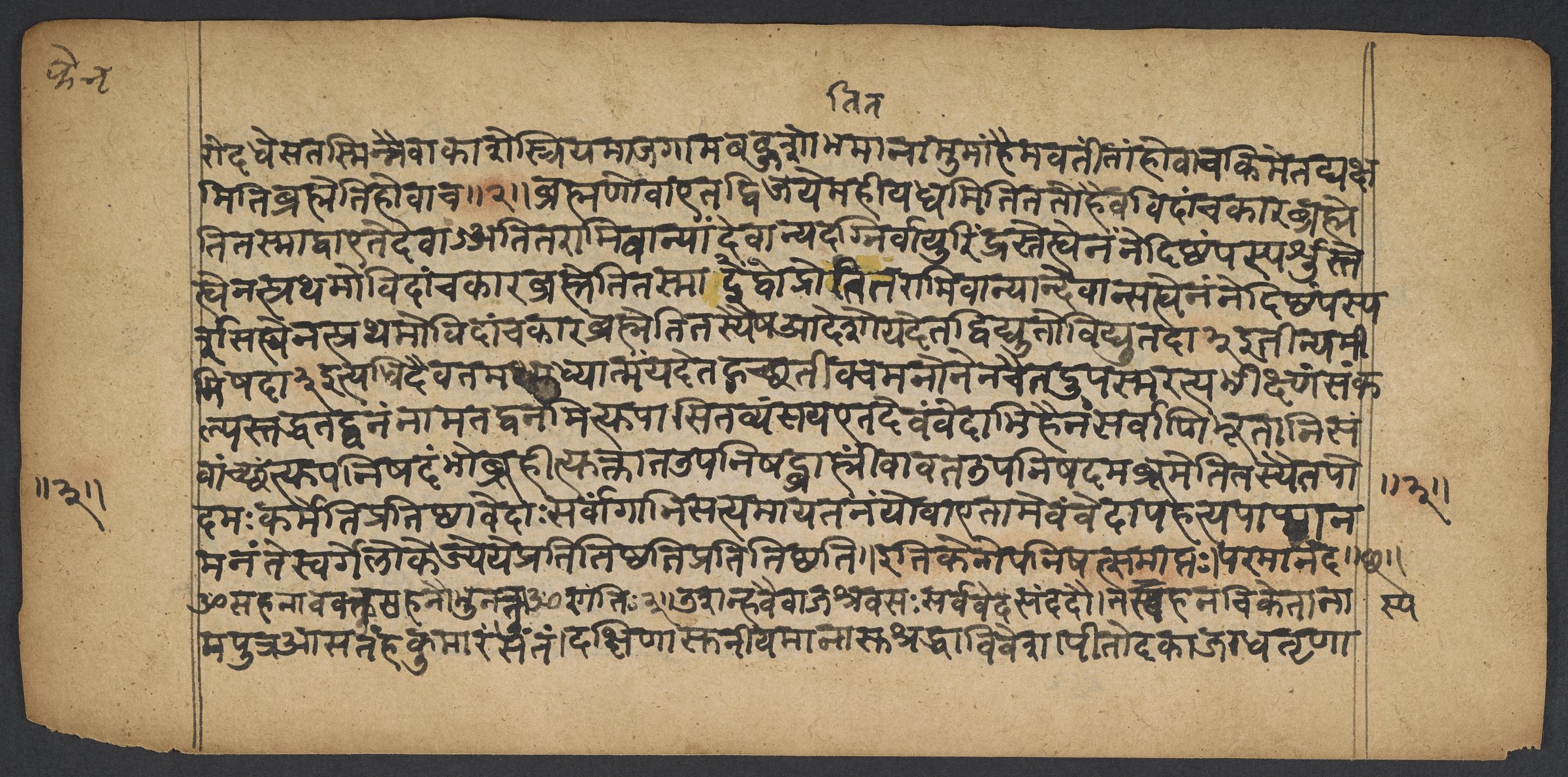
Penn Ms. Coll. 390 Item 869, fol. 3r, fol. 3v. 3.11 begins at fol. 3r line 12 ‹athendram abruvan maghavann› and ends at fol. 3v line 1 ‹-rodadhe›; 3.12 follows to line 2 ‹kim etad yakṣam iti›, after which the scribe writes ‹brahmeti hovāca ||3||›, closing the khanda with the first words of 4.1. Checked on the image; readings logged in data/sources/upanishads/mapping_notes_869.txt.
3.11athendramabruvanmaghavannetadvijānīhi kimetadyakṣamiti ||
tatheti tadabhyadravattasmāttirodadhe ||
3.12sa tasminnevākāśe striyamājagāma bahuśobhamānāmumāṃ haimavatīṃ tāṃ hovāca kimetadyakṣamiti ||
3.11Then they said to Indra: 'O Maghavan, find out what sprite this is.' He went towards it, but it disappeared from before him.
3.12Then in the same space (ether) he came towards a woman, highly adorned: it was Umâ, the daughter of Himavat. He said to her: 'Who is that sprite?'
Where on the image
Penn Ms. Coll. 390 Item 869, fol. 3v. fol. 3v line 2: 4.1 goes on ‹brahmaṇo vā etad vijaye mahīyadhvam›; 4.9 ends in line 10 ‹pratitiṣṭhati pratitiṣṭhati›, followed by the colophon ‹iti kenopaniṣat samāptaḥ paramānanda ||4||›. The manuscript reads ‹uktā ta upaniṣad› in 4.7 (line 8) and ‹pāpmānam anante› in 4.9 (lines 10-11), where the printed text shown has 'uktā ya' and 'pāpmānamante'. Checked on the image; readings logged in data/sources/upanishads/mapping_notes_869.txt.
4.1sā brahmeti hovāca brahmaṇo vā etadvijaye mahīyadhvamiti tato haiva vidāṃcakāra brahmeti ||
4.2tasmādvā ete devā atitarāmivānyāndevānyadagnirvāyurindraste hyenannediṣṭhaṃ pasparśuste hyenatprathamo vidāṃcakāra brahmeti ||
4.3tasmādvā indro'titarāmivānyāndevānsa hyenannediṣṭhaṃ pasparśa sa hyenatprathamo vidāṃcakāra brahmeti ||
4.4tasyaiṣa ādeśo yadetadvidyuto vyadyutadā3 itīti nyamīmiṣadā3 ityadhidaivatam ||
4.5athādhyātmaṃ yadetadgacchatīva ca mano'nena caitadupasmaratyabhīkṣṇaṃ saṃkalpaḥ ||
4.6taddha tadvanaṃ nāma tadvanamityupāsitavyaṃ sa ya etadevaṃ vedā'bhi hainaṃ sarvāṇi bhūtāni saṃvāñchanti ||
4.7upaniṣadaṃ bho brūhītyuktā ya upaniṣadbrāhmīṃ vāva ta upaniṣadamabrūmeti ||
4.8tasyai tapo damaḥ karmeti pratiṣṭhā vedāḥ sarvāṅgāni satyamāyatanam ||
4.9yo vā etāmevaṃ vedāpahatya pāpmānamante svarge loke jyeye pratitiṣṭhati pratitiṣṭhati ||
4.1She replied: 'It is Brahman. It is through the victory of Brahman that you have thus become great.' After that he knew that it was Brahman.
4.2Therefore these Devas, viz. Agni, Vâyu, and Indra, are, as it were, above the other gods, for they touched it (the Brahman) nearest.
4.3And therefore Indra is, as it were, above the other gods, for he touched it nearest, he first knew it.
4.4This is the teaching of Brahman, with regard to the gods (mythological): It is that which now flashes forth in the lightning, and now vanishes again.
4.5And this is the teaching of Brahman, with regard to the body (psychological): It is that which seems to move as mind, and by it imagination remembers again and again.
4.6That Brahman is called Tadvana, by the name of Tadvana it is to be meditated on. All beings have a desire for him who knows this.
4.7The Teacher: 'As you have asked me to tell you the Upanishad, the Upanishad has now been told you. We have told you the Brâhmî Upanishad.
4.8'The feet on which that Upanishad stands are penance, restraint, sacrifice; the Vedas are all its limbs, the True is its abode.
4.9'He who knows this Upanishad, and has shaken off all evil, stands in the endless, unconquerable world of heaven, yea, in the world of heaven.'
Notes
- Sanskrit: Isadyastottarasatopanisadah (108 Upanishads), ed. V. L. Sharma Panshikar (Bombay: Nirnaya Sagar Press, 1925), pp. 2-3, typed for this collection from the page images of the archive.org copy and transliterated from Devanagari into IAST letter by letter (data/sources/upanishads/ns1925/kena.txt). GRETIL has no Kena of its own and points to TITUS, whose files may not be republished. Words are divided as in the print, which writes Sanskrit with sandhi and joins words in the usual Devanagari way; its sign for anusvara before a sibilant or h is given as ṃ. The printed verse numbers and colophons are left out.
- The edition prints verses 1.3 and 1.4 as one verse (its no. 3), joined by sandhi (anuśiṣyād anyad eva); they are shown together as 1.3-4. Müller numbers them 3 and 4.
- Readings of this printing that differ from most editions are kept as printed: 1.9 prāṇīyate (praṇīyate), 3.5 yasmiṃstvayi (tasmiṃs tvayi, as in 3.9), 4.7 uktā ya upaniṣad (uktā ta upaniṣad), 4.9 pāpmānamante (pāpmānam anante). The manuscript has the usual readings in all four places (see the scan notes).
- English: F. Max Müller, 'Talavakara-upanishad', The Upanishads part I, Sacred Books of the East 1 (1879), pp. 147-152, from the proofread English Wikisource transcription, compared word by word with the archive.org OCR of the printed book (copy upanishads01mluoft); no differences other than OCR errors were found. Footnotes are not reproduced.
- The invocation 'oṃ āpyāyantu mamāṅgāni ...' that opens the Kena in the edition and in the manuscript (fol. 2r line 11 to fol. 2v line 1) is not translated by Müller and is not shown.
Cite
Sources
- Source: Penn Ms. Coll. 390 Item 869 (OPenn, public domain) + Nirnaya Sagar 1925 Sanskrit + F. Max Müller (1879) English (holding institution)
- Critical edition: GRETIL Sanskrit e-texts (Isa, Katha, Prasna, Mandukya, Aitareya, Taittiriya, Svetasvatara, Chandogya); Nirnaya Sagar edition of 1925, transcribed (Kena, Mundaka)
← previous · → next · v cycle view · l back to library