Hebrews, Chapter 9 (Codex Vaticanus)
Introduction
Hebrews 9 from Codex Vaticanus (4th c.).
How was this verified? (Provenance)
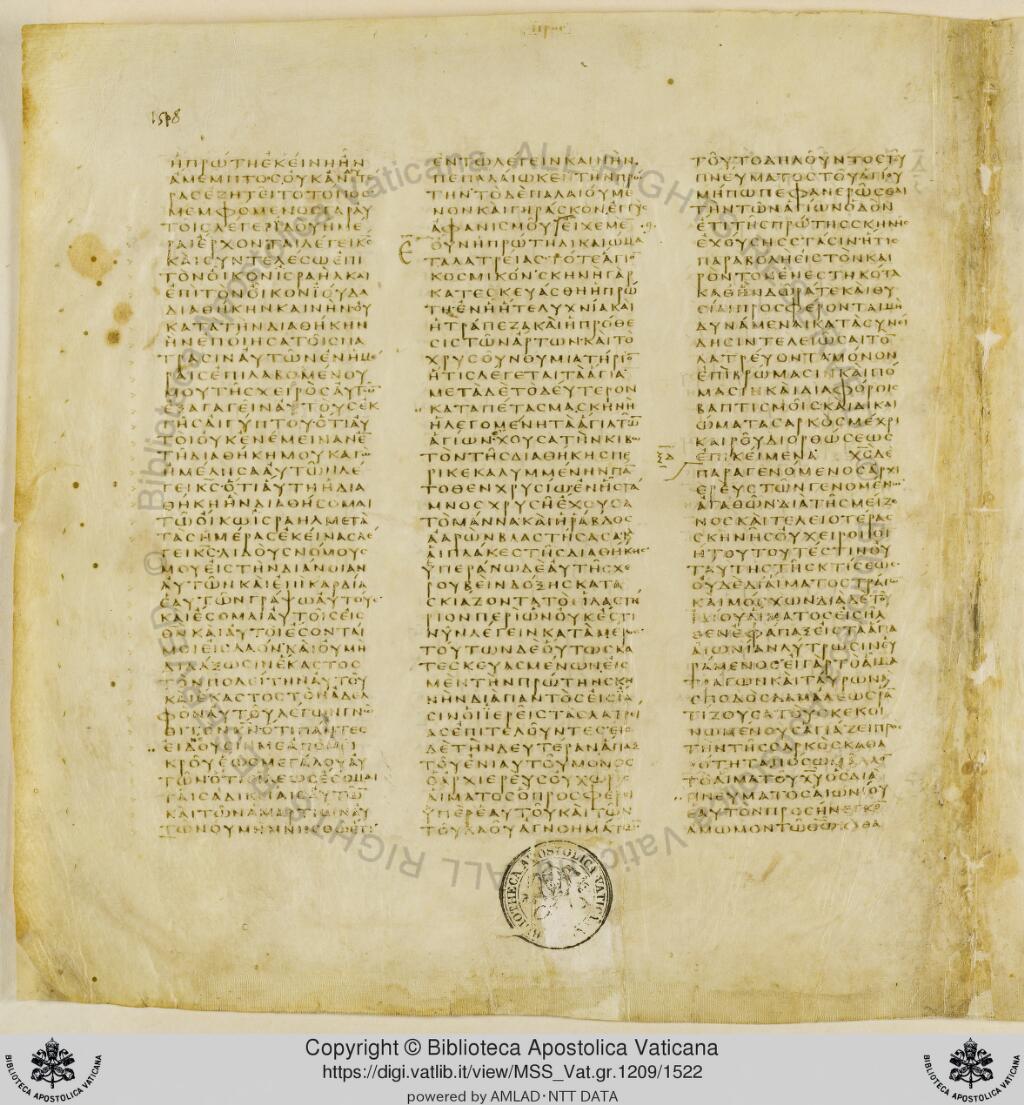
1Εἶχε μὲν οὖν καὶ ἡ πρώτη δικαιώματα λατρείας τό τε ἅγιον κοσμικόν. 2σκηνὴ γὰρ κατεσκευάσθη ἡ πρώτη ἐν ᾗ ἥ τε λυχνία καὶ ἡ τράπεζα καὶ ἡ πρόθεσις τῶν ἄρτων, ἥτις λέγεται ἅγια· 3μετὰ δὲ τὸ δεύτερον καταπέτασμα σκηνὴ ἡ λεγομένη ἅγια ἁγίων, 4χρυσοῦν ἔχουσα θυμιατήριον καὶ τὴν κιβωτὸν τῆς διαθήκης περικεκαλυμμένην πάντοθεν χρυσίῳ, ἐν ᾗ στάμνος χρυσῆ ἔχουσα τὸ μάννα καὶ ἡ ῥάβδος Ἀαρὼν ἡ βλαστήσασα καὶ αἱ πλάκες τῆς διαθήκης, 5ὑπεράνω δὲ αὐτῆς Χερουβεὶν δόξης κατασκιάζοντα τὸ ἱλαστήριον· περὶ ὧν οὐκ ἔστιν νῦν λέγειν κατὰ μέρος. 6Τούτων δὲ οὕτως κατεσκευασμένων, εἰς μὲν τὴν πρώτην σκηνὴν διαπαντὸς εἰσίασιν οἱ ἱερεῖς τὰς λατρείας ἐπιτελοῦντες, 7εἰς δὲ τὴν δευτέραν ἅπαξ τοῦ ἐνιαυτοῦ μόνος ὁ ἀρχιερεύς, οὐ χωρὶς αἵματος, ὃ προσφέρει ὑπὲρ ἑαυτοῦ καὶ τῶν τοῦ λαοῦ ἀγνοημάτων, 8τοῦτο δηλοῦντος τοῦ πνεύματος τοῦ ἁγίου, μήπω πεφανερῶσθαι τὴν τῶν ἁγίων ὁδὸν ἔτι τῆς πρώτης σκηνῆς ἐχούσης στάσιν, 9ἥτις παραβολὴ εἰς τὸν καιρὸν τὸν ἐνεστηκότα, καθ’ ἣν δῶρά τε καὶ θυσίαι προσφέρονται μὴ δυνάμεναι κατὰ συνείδησιν τελειῶσαι τὸν λατρεύοντα, 10μόνον ἐπὶ βρώμασιν καὶ πόμασιν καὶ διαφόροις βαπτισμοῖς, δικαιώματα σαρκὸς μέχρι καιροῦ διορθώσεως ἐπικείμενα. 11Χριστὸς δὲ παραγενόμενος ἀρχιερεὺς τῶν μελλόντων ἀγαθῶν διὰ τῆς μείζονος καὶ τελειοτέρας σκηνῆς οὐ χειροποιήτου, τοῦτ’ ἔστιν οὐ ταύτης τῆς κτίσεως, 12οὐδὲ δι’ αἵματος τράγων καὶ μόσχων διὰ δὲ τοῦ ἰδίου αἵματος, εἰσῆλθεν ἐφάπαξ εἰς τὰ ἅγια, αἰωνίαν λύτρωσιν εὑράμενος. 13εἰ γὰρ τὸ αἷμα τράγων καὶ ταύρων καὶ σποδὸς δαμάλεως ῥαντίζουσα τοὺς κεκοινωμένους ἁγιάζει πρὸς τὴν τῆς σαρκὸς καθαρότητα, 14πόσῳ μᾶλλον τὸ αἷμα τοῦ Χριστοῦ, ὃς διὰ πνεύματος αἰωνίου ἑαυτὸν προσήνεγκεν ἄμωμον τῷ θεῷ, καθαριεῖ τὴν συνείδησιν ὑμῶν ἀπὸ νεκρῶν ἔργων εἰς τὸ λατρεύειν θεῷ ζῶντι.
1Then verily the first covenant had also ordinances of divine service, and a worldly sanctuary. 2For there was a tabernacle made; the first, wherein was the candlestick, and the table, and the shewbread; which is called the sanctuary. 3And after the second veil, the tabernacle which is called the Holiest of all; 4Which had the golden censer, and the ark of the covenant overlaid round about with gold, wherein was the golden pot that had manna, and Aaron’s rod that budded, and the tables of the covenant; 5And over it the cherubims of glory shadowing the mercyseat; of which we cannot now speak particularly. 6Now when these things were thus ordained, the priests went always into the first tabernacle, accomplishing the service of God. 7But into the second went the high priest alone once every year, not without blood, which he offered for himself, and for the errors of the people: 8The Holy Ghost this signifying, that the way into the holiest of all was not yet made manifest, while as the first tabernacle was yet standing: 9Which was a figure for the time then present, in which were offered both gifts and sacrifices, that could not make him that did the service perfect, as pertaining to the conscience; 10Which stood only in meats and drinks, and divers washings, and carnal ordinances, imposed on them until the time of reformation. 11But Christ being come an high priest of good things to come, by a greater and more perfect tabernacle, not made with hands, that is to say, not of this building; 12Neither by the blood of goats and calves, but by his own blood he entered in once into the holy place, having obtained eternal redemption for us. 13For if the blood of bulls and of goats, and the ashes of an heifer sprinkling the unclean, sanctifieth to the purifying of the flesh: 14How much more shall the blood of Christ, who through the eternal Spirit offered himself without spot to God, purge your conscience from dead works to serve the living God?
Cite
Source & Cross-References
- Source text: Codex Vaticanus via Vatican IIIF + NTVMR verse mapping + Tischendorf + KJV — view original
- Critical edition: Tischendorf 8th edition (1869)
← previous · → next · v cycle view · l back to library