The Iliad, Book 15
Introduction
Book 15 of the Iliad (746 lines in Monro and Allen's edition) as written in Venetus A (Venice, Biblioteca Nazionale Marciana, Marc. gr. Z. 454 = 822), the oldest complete manuscript of the Iliad, copied in the 10th century with the text in the centre of each page and the scholia around it. This book is on fol. 191r-205v; each section below is one page of the manuscript and links that page.
The page of every line comes from the Homer Multitext Project's index of the manuscript (release 2024c), which records where each line stands on the page photographs.
Greek: the manuscript's own text, from the Homer Multitext diplomatic edition of Venetus A, with its accents, punctuation and signs as given there. The Oxford text of Monro and Allen (1920) is given for comparison.
English: A. T. Murray's translation (Loeb Classical Library, 1924). Murray numbers every fifth line and starts a new paragraph at many other lines; the English is divided only at those points, and a passage that runs across a page break goes with the page that holds most of its lines. The English of a section can therefore begin or end a few lines away from the Greek; each section gives its exact English line range.
Not in Venetus A: line 15.481 of the standard text is not in this manuscript. It is shown in the Monro and Allen text and in the English of the page where it would stand.
How was this verified? (Provenance)

Where on the image
Venetus A fol. 191r (photograph VA191RN_0362): Iliad 15.1-25, 25 lines of the manuscript, begins ‹αὐτὰρ ἐπεὶ διά τε σκόλοπας›, ends ‹ἀζηχὴς. ὀδύνη Ἡρακλῆος θείοιο:›. Page of each line from the Homer Multitext 2024c index of lines to pages. English (Murray): lines 15.1-24, in his blocks 1-4, 5-9, 10-14, 15-19, 20-24. Murray marks every fifth line and each paragraph; a block that crosses the page break goes with the page holding most of its lines, so the English here ends at line 24.
1αὐτὰρ ἐπεὶ διά τε σκόλοπας καὶ τάφρον ἔβησαν
2φεύγοντες. πολλοὶ δὲ δάμεν Δαναῶν ὑπο χερσὶν.
3οἱ μὲν δὴ παρ' όχεσφιν ἐρητύοντο μένοντες
4χλωροὶ ὑπαὶ δείους. πεφοβημένοι: ἔγρετο δὲ Ζεὺς
5Ἴ̈δης ἐν κορυφῇσι. παρα χρυσοθρόνου Ἥρης :
6στῆ δ' ὰρ ἀναΐξας: ἴ̈δε δὲ Τρῶας καὶ Ἀχαιοὺς .
7τοὺς μὲν ὀρινομένους. τοὺς δὲ κλονέοντας ὄπισθεν:
8Ἀργείους . μετὰ δέ σφι Ποσειδάωνα ἄνακτα:
9Ἕκτορα δ' ἐν πεδίῳ ἴ̈δε κείμενον ἀμφὶ δ' ἑταῖροι
10εἵαθ'. ὁ δ' ἀργαλέῳ ἔχετ' ἄσθματι. κῆρ, ἀπινύσσων:
11αἷμ' εμέων. ἐπεὶ οὔ μιν ἀφαυρότατος βάλ' Ἀχαιῶν :
12τὸν δὲ ἰ̈δὼν ἐλέησε πατὴρ ἀνδρῶν τε θεῶν τε:
13δεινὰ δ' ὑπόδρα ἰ̈δὼν Ἥρην πρὸς μῦθον ἔειπεν:
14ῆ μάλα δὴ κακότεχνος ἀμήχανε, σὸς δόλος. Ἥρη
15Ἕκτορα δῖον ἔπαυσε μάχης. ἐφόβησε δὲ λαούς:
16οὐ μὰν οῖδ': εἰ, αὖτε κακορραφίης ἀλεγεινῆς
17πρώτη ἐπαύρηαι. καί σε πληγῇσιν ϊμάσσω:
18ἠ οὐ μέμνῃ. ὅτε τ' ἐκρέμω ὑψόθεν. ἐκ δὲ ποδοῖϊν
19ἄκμονας ῆκα δύω: περι χερσὶ δὲ δεσμὸν ΐηλα
20χρύσεον. ἄρρηκτον, σὺ δ' ἐν αἰθέρι καὶ νεφέλῃσιν
21ἐκρέμω. ἠλάστεον δὲ θεοὶ κατα μακρὸν Ὄλυμπον :
22λῦσαι δ' οὐκ ἐδύναντο παρασταδὸν. ὃν δὲ λάβοιμι
23ῥίπτασκον τεταγὼν ἀπὸ βηλοῦ. ὄφρ' ἂν ΐκηται
24γῆν ὀλιγηπελέων: ἐμὲ δ' οὐδ' ὡς θυμὸν ἀν ἵει
25ἀζηχὴς. ὀδύνη Ἡρακλῆος θείοιο:
Compare: Monro & Allen, Oxford 1920 (Perseus)
1αὐτὰρ ἐπεὶ διά τε σκόλοπας καὶ τάφρον ἔβησαν
2φεύγοντες, πολλοὶ δὲ δάμεν Δαναῶν ὑπὸ χερσίν,
3οἳ μὲν δὴ παρʼ ὄχεσφιν ἐρητύοντο μένοντες
4χλωροὶ ὑπαὶ δείους πεφοβημένοι· ἔγρετο δὲ Ζεὺς
5Ἴδης ἐν κορυφῇσι παρὰ χρυσοθρόνου Ἥρης,
6στῆ δʼ ἄρʼ ἀναΐξας, ἴδε δὲ Τρῶας καὶ Ἀχαιοὺς
7τοὺς μὲν ὀρινομένους, τοὺς δὲ κλονέοντας ὄπισθεν
8Ἀργείους, μετὰ δέ σφι Ποσειδάωνα ἄνακτα·
9Ἕκτορα δʼ ἐν πεδίῳ ἴδε κείμενον, ἀμφὶ δʼ ἑταῖροι
10εἵαθʼ, ὃ δʼ ἀργαλέῳ ἔχετʼ ἄσθματι κῆρ ἀπινύσσων
11αἷμʼ ἐμέων, ἐπεὶ οὔ μιν ἀφαυρότατος βάλʼ Ἀχαιῶν.
12τὸν δὲ ἰδὼν ἐλέησε πατὴρ ἀνδρῶν τε θεῶν τε,
13δεινὰ δʼ ὑπόδρα ἰδὼν Ἥρην πρὸς μῦθον ἔειπεν·
14ἦ μάλα δὴ κακότεχνος ἀμήχανε σὸς δόλος Ἥρη
15Ἕκτορα δῖον ἔπαυσε μάχης, ἐφόβησε δὲ λαούς.
16οὐ μὰν οἶδʼ εἰ αὖτε κακορραφίης ἀλεγεινῆς
17πρώτη ἐπαύρηαι καί σε πληγῇσιν ἱμάσσω.
18ἦ οὐ μέμνῃ ὅτε τʼ ἐκρέμω ὑψόθεν, ἐκ δὲ ποδοῖιν
19ἄκμονας ἧκα δύω, περὶ χερσὶ δὲ δεσμὸν ἴηλα
20χρύσεον ἄρρηκτον; σὺ δʼ ἐν αἰθέρι καὶ νεφέλῃσιν
21ἐκρέμω· ἠλάστεον δὲ θεοὶ κατὰ μακρὸν Ὄλυμπον,
22λῦσαι δʼ οὐκ ἐδύναντο παρασταδόν· ὃν δὲ λάβοιμι
23ῥίπτασκον τεταγὼν ἀπὸ βηλοῦ ὄφρʼ ἂν ἵκηται
24γῆν ὀλιγηπελέων· ἐμὲ δʼ οὐδʼ ὧς θυμὸν ἀνίει
25ἀζηχὴς ὀδύνη Ἡρακλῆος θείοιο,
1But when the Trojans in their flight had passed over the palisade and the trench, and many had been vanquished beneath the hands of the Danaans, then beside their chariots they stayed, and were halted, pale with fear, terror-stricken; and Zeus awoke 5on the peaks of Ida beside Hera of the golden throne. Then he sprang up, and stood, and saw Trojans alike and Achaeans, these in rout, and the Argives driving them on from the rear, and amid them the lord Poseidon. And Hector he saw lying on the plain, while about him sat his comrades, 10and he was gasping with painful breath, distraught in mind, and vomiting blood; for not the weakest of the Achaeans was it that had smitten him. At sight of him the father of men and gods had pity, and with a dread glance from beneath his brows he spake to Hera, saying: “Hera, that art hard to deal with, it is the craft of thine evil wiles 15that hath stayed goodly Hector from the fight, and hath driven the host in rout. Verily I know not but thou shalt yet be the first to reap the fruits of thy wretched ill-contriving, and I shall scourge thee with stripes. Dost thou not remember when thou wast hung from on high, and from thy feet I suspended two anvils, and about thy wrists cast 20a band of gold that might not be broken? And in the air amid the clouds thou didst hang, and the gods had indignation throughout high Olympus; howbeit they availed not to draw nigh and loose thee. Nay, whomsoever I caught, I would seize and hurl from the threshold until he reached the earth, his strength all spent. Yet not even so was my heart

Where on the image
Venetus A fol. 191v (photograph VA191VN_0693): Iliad 15.26-50, 25 lines of the manuscript, begins ‹τὸν σὺ, ξὺν Βορέῃ ἀνέμῳ.›, ends ‹ἐμοὶ φρονέουσα. μετ' ἀθανάτοισι καθίζοις.›. Page of each line from the Homer Multitext 2024c index of lines to pages. English (Murray): lines 15.25-49, in his blocks 25-29, 30-33, 34, 35-39, 40-44, 45-49. Murray marks every fifth line and each paragraph; a block that crosses the page break goes with the page holding most of its lines, so the English here begins at line 25 and ends at line 49.
26τὸν σὺ, ξὺν Βορέῃ ἀνέμῳ. πεπιθοῦσα θυέλλας:
27πέμψας ἐπ' ἀτρύγετον πόντον κακὰ μητιόωσα:
28καί μιν ἔπειτα Κόων δ' εὖ ναιομένην ἀπένεικας:
29τὸν μὲν ἐγὼν. ἔνθεν ῥυσάμην. καὶ ἀνήγαγον αῦτις
30Ἄργος ἐς ἱ̈ππόβοτον. καὶ πολλά περ ἀθλήσαντα:
31τῶν σ' αῦτις μνήσω. ἵ̈ν' ἀπολλήξῃς ἀπατά̄ων:
32ὄφρα ἴ̈δῃς, ἤν τοι χραίσμῃ φιλότης τε καὶ εὐνὴ
33ἣν ἐμίγης ἐλθοῦσα θεῶν ἄπο. καί μ' ἀπάτησας:
34ὡς φάτο: ῥίγησεν δὲ βοῶπις πότνια Ἥρη :
35καί μιν φωνήσασ'. ἔπεα πτερόεντα προσηύδα:
36ἴ̈στω νῦν τόδε Γαῖα καὶ Οὐρανὸς εὐρυς ὕπερθε.
37καὶ τὸ κατειβόμενον Στυγὸς ὕδωρ. ὅς τε μέγιστος
38ὅρκος δεινότατός τε πέλει μακάρεσσι θεοῖσι:
39σή θ' ϊερὴ κεφαλὴ: καὶ νωΐτερον λέχος αὐτῶν
40κουρίδιον, τὸ μὲν οὐκ ἂν ἐγώ ποτε μὰψ, ὀμόσαιμι.
41μὴ δι' εμὴν ἰ̈ότητα Ποσειδάων ἐνοσίχθων
42πημαίνει Τρῶάς τε καὶ Ἕκτορα , τοῖσι δ' ἀρήγει;
43ἀλλά που αὐτὸν θυμὸς ἐποτρύνει καὶ ἀνώγει:
44τειρομένους δ' ἐπὶ νηυσὶν ἰ̈δὼν ἐλέησεν Ἀχαιούς .
45αὐτάρ τοι καὶ κείνῳ ἐγὼ παραμυθησαίμην
46τῇ ἴ̈μεν. ᾗ κεν, δὴ σὺ κελαινεφὲς ἡγεμονεύῃς:
47ὣς φάτο: μείδησεν δὲ πατὴρ ἀνδρῶν τε θεῶν τε.
48καί μιν ἀμειβόμενος. ἔπεα πτερόεντα προσηύδᾱ:
49εἰ μὲν δὴ σύ γ' ἔπειτα βοῶπι πότνια Ἥρη
50ἶ̈σον ἐμοὶ φρονέουσα. μετ' ἀθανάτοισι καθίζοις.
Compare: Monro & Allen, Oxford 1920 (Perseus)
26τὸν σὺ ξὺν Βορέῃ ἀνέμῳ πεπιθοῦσα θυέλλας
27πέμψας ἐπʼ ἀτρύγετον πόντον κακὰ μητιόωσα,
28καί μιν ἔπειτα Κόων δʼ εὖ ναιομένην ἀπένεικας.
29τὸν μὲν ἐγὼν ἔνθεν ῥυσάμην καὶ ἀνήγαγον αὖτις
30Ἄργος ἐς ἱππόβοτον καὶ πολλά περ ἀθλήσαντα.
31τῶν σʼ αὖτις μνήσω ἵνʼ ἀπολλήξῃς ἀπατάων,
32ὄφρα ἴδῃ ἤν τοι χραίσμῃ φιλότης τε καὶ εὐνή,
33ἣν ἐμίγης ἐλθοῦσα θεῶν ἄπο καί μʼ ἀπάτησας.
34ὣς φάτο, ῥίγησεν δὲ βοῶπις πότνια Ἥρη,
35καί μιν φωνήσασʼ ἔπεα πτερόεντα προσηύδα·
36ἴστω νῦν τόδε Γαῖα καὶ Οὐρανὸς εὐρὺς ὕπερθε
37καὶ τὸ κατειβόμενον Στυγὸς ὕδωρ, ὅς τε μέγιστος
38ὅρκος δεινότατός τε πέλει μακάρεσσι θεοῖσι,
39σή θʼ ἱερὴ κεφαλὴ καὶ νωΐτερον λέχος αὐτῶν
40κουρίδιον, τὸ μὲν οὐκ ἂν ἐγώ ποτε μὰψ ὀμόσαιμι·
41μὴ διʼ ἐμὴν ἰότητα Ποσειδάων ἐνοσίχθων
42πημαίνει Τρῶάς τε καὶ Ἕκτορα, τοῖσι δʼ ἀρήγει,
43ἀλλά που αὐτὸν θυμὸς ἐποτρύνει καὶ ἀνώγει,
44τειρομένους δʼ ἐπὶ νηυσὶν ἰδὼν ἐλέησεν Ἀχαιούς.
45αὐτάρ τοι καὶ κείνῳ ἐγὼ παραμυθησαίμην
46τῇ ἴμεν ᾗ κεν δὴ σὺ κελαινεφὲς ἡγεμονεύῃς.
47ὣς φάτο, μείδησεν δὲ πατὴρ ἀνδρῶν τε θεῶν τε,
48καί μιν ἀμειβόμενος ἔπεα πτερόεντα προσηύδα·
49εἰ μὲν δὴ σύ γʼ ἔπειτα βοῶπις πότνια Ἥρη
50ἶσον ἐμοὶ φρονέουσα μετʼ ἀθανάτοισι καθίζοις,
25eased of its ceaseless pain for godlike Heracles, whom thou when thou hadst leagued thee with the North Wind and suborned his blasts, didst send over the unresting sea, by thine evil devising, and thereafter didst bear him away unto well-peopled Cos. Him did I save from thence, and brought again 30to horse-pasturing Argos, albeit after he had laboured sore. Of these things will I mind thee yet again, that thou mayest cease from thy beguilings, to the end that thou mayest see whether they anywise avail thee, the dalliance and the couch, wherein thou didst lie with me when thou hadst come forth from among the gods, and didst beguile me.”
34So spake he, and the ox-eyed, queenly Hera shuddered; 35and she spake and addressed him with winged words: “Hereto now be Earth my witness and the broad Heaven above, and the down-flowing water of Styx, which is the greatest and most dread oath for the blessed gods, and thine own sacred head, and the couch of us twain, couch of our wedded love, 40whereby I verily would never forswear myself —not by my will doth Poseidon, the Shaker of Earth, work harm to the Trojans and Hector, and give succour to their foes. Nay, I ween, it is his own soul that urgeth and biddeth him on, and he hath seen the Achaeans sore-bested by their ships and taken pity upon them. 45But I tell thee, I would counsel even him to walk in that way, wherein thou, O lord of the dark cloud, mayest lead him.” So spake she, and the father of men and gods smiled, and made answer, and spake to her with winged words: “If in good sooth, O ox-eyed, queenly Hera,

Where on the image
Venetus A fol. 192r (photograph VA192RN_0363): Iliad 15.51-75, 25 lines of the manuscript, begins ‹τῶ κε Ποσειδάων γε: καὶ›, ends ‹πρῶτον. ἐμῷ δ' ἐπένευσα κάρητι.›. Page of each line from the Homer Multitext 2024c index of lines to pages. English (Murray): lines 15.50-74, in his blocks 50-54, 55-59, 60-64, 65-69, 70-74. Murray marks every fifth line and each paragraph; a block that crosses the page break goes with the page holding most of its lines, so the English here begins at line 50 and ends at line 74.
51τῶ κε Ποσειδάων γε: καὶ εἰ μάλα βούλεται ἄλλῃ.
52αῖψα μεταστρέψειε. νόον μετα σὸν καὶ ἐμὸν κῆρ:
53ἂλλ' εἰ δή ρ' ἐτεόν γε καὶ ἀτρεκέως ἀγορεύεις.
54ἔρχεο νῦν μετα φῦλα θεῶν. καὶ δεῦρο κάλεσσον
55Ϊ̂ρίν τ' ἐλθέμεναι καὶ Ἀπόλλωνα κλυτότοξον:
56ὄφρ' ἡ μὲν μετὰ λαὸν Ἀχαιῶν χαλκοχιτώνων
57ἔλθῃ, καὶ εἴπῃσι Ποσειδάωνι ἄνακτι.
58παυσάμενον πολέμοιο τὰ ἃ πρὸς δώμαθ' ἱ̈κέσθαι:
59Ἕκτορα δ' ὀτρύνῃσι μάχην ἒς Φοῖβος Ἀπόλλων :
60αῦτις δ' ἐμπνεύσῃσι μένος λελάθῃ δ' ὀδυνάων.
61αἳ νῦν μιν τείρουσι κατὰ φρένας. αὐτὰρ Ἀχαιοὺς
62αῦτις ἀποστρέψῃσιν. ἀνάλκιδα φύζαν ἐνόρσας:
63φεύγοντες δ' ἐν νηυσὶ πολυκλήϊσι πέσωσι
64Πηλείδεω Ἀχιλῆος : ὁ δ`' ἀνστήσει. ὃν, ἑταῖρον
65Πάτροκλον . τὸν δὲ κτενεῖ ἔγχεϊ φαίδιμος Ἕκτωρ
66Ἰ̈λίου προπάροιθε: πολεῖς ὀλέσαντ' αἰζηοὺς
67τοὺς ἄλλους. μετὰ δ' υἱὸν ἐμὸν Σαρπηδόνα δῖον:
68τοῦ δὲ χολωσάμενος κτενεῖ Ἕκτορα δῖος Ἀχιλλεύς :
69ἐκ τοῦ δ' άν τοι ἔπειτα παλίωξιν παρὰ νηῶν
70αἰὲν ἐγὼ τεύχοιμι διαμπερὲς. εἰσόκ' Ἀχαιοὶ
71Ί̈λιον αἰπὺ ἕλοιεν Ἀθηναίης διὰ βουλάς:
72τὸ πρὶν δ' οὔτ' ὰρ, ἐγὼ παύω χόλον οὔτέ τιν' ἄλλον
73ἀθανάτων Δαναοῖσιν ἀμυνέμεν ἐνθάδ' ἐάσω.
74πρίν γε τὸ Πηλείδαο τελευτηθῆναι ἐέλδωρ
75ὥς οἱ ὑπέστην πρῶτον. ἐμῷ δ' ἐπένευσα κάρητι.
Compare: Monro & Allen, Oxford 1920 (Perseus)
51τώ κε Ποσειδάων γε, καὶ εἰ μάλα βούλεται ἄλλῃ,
52αἶψα μεταστρέψειε νόον μετὰ σὸν καὶ ἐμὸν κῆρ.
53ἀλλʼ εἰ δή ῥʼ ἐτεόν γε καὶ ἀτρεκέως ἀγορεύεις,
54ἔρχεο νῦν μετὰ φῦλα θεῶν, καὶ δεῦρο κάλεσσον
55Ἶρίν τʼ ἐλθέμεναι καὶ Ἀπόλλωνα κλυτότοξον,
56ὄφρʼ ἣ μὲν μετὰ λαὸν Ἀχαιῶν χαλκοχιτώνων
57ἔλθῃ, καὶ εἴπῃσι Ποσειδάωνι ἄνακτι
58παυσάμενον πολέμοιο τὰ ἃ πρὸς δώμαθʼ ἱκέσθαι,
59Ἕκτορα δʼ ὀτρύνῃσι μάχην ἐς Φοῖβος Ἀπόλλων,
60αὖτις δʼ ἐμπνεύσῃσι μένος, λελάθῃ δʼ ὀδυνάων
61αἳ νῦν μιν τείρουσι κατὰ φρένας, αὐτὰρ Ἀχαιοὺς
62αὖτις ἀποστρέψῃσιν ἀνάλκιδα φύζαν ἐνόρσας,
63φεύγοντες δʼ ἐν νηυσὶ πολυκλήϊσι πέσωσι
64Πηλεΐδεω Ἀχιλῆος· ὃ δʼ ἀνστήσει ὃν ἑταῖρον
65Πάτροκλον· τὸν δὲ κτενεῖ ἔγχεϊ φαίδιμος Ἕκτωρ
66Ἰλίου προπάροιθε πολέας ὀλέσαντʼ αἰζηοὺς
67τοὺς ἄλλους, μετὰ δʼ υἱὸν ἐμὸν Σαρπηδόνα δῖον.
68τοῦ δὲ χολωσάμενος κτενεῖ Ἕκτορα δῖος Ἀχιλλεύς.
69ἐκ τοῦ δʼ ἄν τοι ἔπειτα παλίωξιν παρὰ νηῶν
70αἰὲν ἐγὼ τεύχοιμι διαμπερὲς εἰς ὅ κʼ Ἀχαιοὶ
71Ἴλιον αἰπὺ ἕλοιεν Ἀθηναίης διὰ βουλάς.
72τὸ πρὶν δʼ οὔτʼ ἄρʼ ἐγὼ παύω χόλον οὔτέ τινʼ ἄλλον
73ἀθανάτων Δαναοῖσιν ἀμυνέμεν ἐνθάδʼ ἐάσω
74πρίν γε τὸ Πηλεΐδαο τελευτηθῆναι ἐέλδωρ,
75ὥς οἱ ὑπέστην πρῶτον, ἐμῷ δʼ ἐπένευσα κάρητι,
50thy thought hereafter were to be one with my thought as thou sittest among the immortals, then would Poseidon, how contrary soever his wish might be, forthwith bend his mind to follow thy heart and mine. But if verily thou speakest in frankness and in truth, go thou now among the tribes of gods and call 55Iris to come hither, and Apollo, famed for his bow, that she may go amid the host of the brazen-coated Achaeans, and bid the lord Poseidon that he cease from war, and get him to his own house; but let Phoebus Apollo rouse Hector to the fight, 60and breathe strength into him again, and make him forget the pains that now distress his heart; and let him drive the Achaeans back once more, when he has roused in them craven panic; so shall they flee and fall among the many-benched ships of Achilles, son of Peleus, and he shall send forth his comrade 65Patroclus, howbeit him shall glorious Hector slay with the spear before the face of Ilios, after himself hath slain many other youths, and among them withal my son, goodly Sarpedon. And in wrath for Patroclus shall goodly Achilles slay Hector. Then from that time forth shall I cause a driving back of the Trojans from the ships 70evermore continually, until the Achaeans shall take steep Ilios through the counsels of Athene. But until that hour neither do I refrain my wrath, nor will I suffer any other of the immortals to bear aid to the Danaans here, until the desire of the son of Peleus be fulfilled,

Where on the image
Venetus A fol. 192v (photograph VA192VN_0694): Iliad 15.76-100, 25 lines of the manuscript, begins ‹ἤματι τῷ. ὅτ' ἐμεῖο θεὰ›, ends ‹εἰποῦσα καθέζετο πότνια Ἥρη :›. Page of each line from the Homer Multitext 2024c index of lines to pages. English (Murray): lines 15.75-99, in his blocks 75-77, 78-79, 80-84, 85-89, 90-94, 95-99. Murray marks every fifth line and each paragraph; a block that crosses the page break goes with the page holding most of its lines, so the English here begins at line 75 and ends at line 99.
76ἤματι τῷ. ὅτ' ἐμεῖο θεὰ Θέτις ἥψατο γούνων.
77λισσομένη τιμῆσαι Ἀχιλλῆα πτολίπορθον:
78ὣς ἔφατ'. οὐδ' ἀπίθησε θεὰ λευκώλενος Ἥρη .
79βῆ δὲ κατ' Ϊδαίων ὀρέων ἐς μακρὸν Ὄλυμπον :
80ὡς δ' ὅτ' ἂν ἀΐξῃ νόος ἀνέρος. ὅς τ' ἐπὶ πολλὴν
81γαῖαν ἐληλουθὼς. φρεσὶ πευκαλίμῃσι, νοήσῃ.
82ἔνθ' εἴην. ἢ, ἔνθα: μενοινήσειέ τε πολλά:
83ὣς κραιπνῶς μεμαυῖα διέπτατο πότνια Ἥρη :
84ΐκετο δ' αἰπὺν Ὄλυμπον . ὁμηγερέεσσι δ' ἐπῆλθεν
85ἀθανάτοισι θεοῖσι: Διὸς δόμῳ: οἱ δὲ ἰδόντες.
86πάντες ἀνήϊξαν καὶ δεικανόωντο δέπασσιν:
87ἣ δ' ἄλλους μὲν ἔασε. Θέμιστι δὲ καλλιπαρήῳ
88δέκτο δέπας. πρώτη γὰρ ἐναντίη ἦλθε θέουσα:
89καί μιν φωνήσασ' ἔπεα πτερόεντα προσηύδᾱ:
90Ἥρη . τίπτε βέβηκας. ἀτυζομένῃ δὲ ἔοικας:
91ῆ μάλα δή σε φόβησε Κρόνου παῖς. ὅς τοι ἀκοίτης:
92τὴν δ' ἠμείβετ' ἔπειτα θεὰ λευκώλενος Ἥρη :
93μή με θεὰ Θέμι ταῦτα διείρεο. οἶσθα καὶ αὐτὴ
94οἷος εκείνου θυμὸς ὑπερφίαλος καὶ ἀπηνής:
95ἀλλὰ σύ γ' ἄρχε θεοῖσι: δόμοις ἔνι δαιτὸς ἐΐσης:
96ταῦτα δὲ καὶ μετα πᾶσιν ἀκούσεαι ἀθανάτοισιν.
97οἷα Ζεὺς κακὰ ἔργα πιφαύσκεται: οὐδέ τί φημὶ
98πᾶσιν ὁμῶς θυμὸν κεχαρησέμεν. οὔτε βροτοῖσιν.
99οὔτε θεοῖς. εἴ πέρ τις ἔτι νῦν δαίνυται ἔϋφρων .
100ἡ μὲν ἂρ ὡς εἰποῦσα καθέζετο πότνια Ἥρη :
Compare: Monro & Allen, Oxford 1920 (Perseus)
76ἤματι τῷ ὅτʼ ἐμεῖο θεὰ Θέτις ἥψατο γούνων,
77λισσομένη τιμῆσαι Ἀχιλλῆα πτολίπορθον.
78ὣς ἔφατʼ, οὐδʼ ἀπίθησε θεὰ λευκώλενος Ἥρη,
79βῆ δʼ ἐξ Ἰδαίων ὀρέων ἐς μακρὸν Ὄλυμπον.
80ὡς δʼ ὅτʼ ἂν ἀΐξῃ νόος ἀνέρος, ὅς τʼ ἐπὶ πολλὴν
81γαῖαν ἐληλουθὼς φρεσὶ πευκαλίμῃσι νοήσῃ
82ἔνθʼ εἴην ἢ ἔνθα, μενοινήῃσί τε πολλά,
83ὣς κραιπνῶς μεμαυῖα διέπτατο πότνια Ἥρη·
84ἵκετο δʼ αἰπὺν Ὄλυμπον, ὁμηγερέεσσι δʼ ἐπῆλθεν
85ἀθανάτοισι θεοῖσι Διὸς δόμῳ· οἳ δὲ ἰδόντες
86πάντες ἀνήϊξαν καὶ δεικανόωντο δέπασσιν.
87ἣ δʼ ἄλλους μὲν ἔασε, Θέμιστι δὲ καλλιπαρῄῳ
88δέκτο δέπας· πρώτη γὰρ ἐναντίη ἦλθε θέουσα,
89καί μιν φωνήσασʼ ἔπεα πτερόεντα προσηύδα·
90Ἥρη τίπτε βέβηκας; ἀτυζομένῃ δὲ ἔοικας·
91ἦ μάλα δή σʼ ἐφόβησε Κρόνου πάϊς, ὅς τοι ἀκοίτης.
92τὴν δʼ ἠμείβετʼ ἔπειτα θεὰ λευκώλενος Ἥρη·
93μή με θεὰ Θέμι ταῦτα διείρεο· οἶσθα καὶ αὐτὴ
94οἷος κείνου θυμὸς ὑπερφίαλος καὶ ἀπηνής.
95ἀλλὰ σύ γʼ ἄρχε θεοῖσι δόμοις ἔνι δαιτὸς ἐΐσης·
96ταῦτα δὲ καὶ μετὰ πᾶσιν ἀκούσεαι ἀθανάτοισιν
97οἷα Ζεὺς κακὰ ἔργα πιφαύσκεται· οὐδέ τί φημι
98πᾶσιν ὁμῶς θυμὸν κεχαρησέμεν, οὔτε βροτοῖσιν
99οὔτε θεοῖς, εἴ πέρ τις ἔτι νῦν δαίνυται εὔφρων.
100ἣ μὲν ἄρʼ ὣς εἰποῦσα καθέζετο πότνια Ἥρη,
75even as I promised at the first and bowed my head thereto, on the day when the goddess Thetis clasped my knees, beseeching me to do honour to Achilles, sacker of cities.”
78So spake he, and the goddess, white-armed Hera, failed not to hearken, but went her way from the mountains of Ida unto high Olympus. 80And even as swiftly darteth the mind of a man who hath travelled over far lands and thinketh in the wisdom of his heart, “Would I were here, or there,” and many are the wishes he conceiveth: even so swiftly sped on in her eagerness the queenly Hera; and she came to steep Olympus, and found 85the immortal gods gathered together in the house of Zeus, and at sight of her they all sprang up, and greeted her with cups of welcome. She on her part let be the others, but took the cup from Themis, of the fair cheeks, for she ran first to meet her, and spake, and addressed her with winged words: 90“Hera, wherefore art thou come? Thou art as one distraught. In good sooth the son of Cronos hath affrighted thee, he thine own husband.” Then made answer to her, the goddess, white-armed Hera: “Ask me not at large concerning this, O goddess Themis; of thyself thou knowest what manner of mood is his, how over-haughty and unbending. 95Nay, do thou begin for the gods the equal feast in the halls, and this shalt thou hear amid all the immortals, even what manner of evil deeds Zeus declareth. In no wise, methinks, will it delight in like manner the hearts of all, whether mortals or gods, if so be any even now still feasteth with a joyful mind.”

Where on the image
Venetus A fol. 193r (photograph VA193RN_0364): Iliad 15.101-125, 25 lines of the manuscript, begins ‹ὄχθησαν δ' ἀνὰ δῶμα Διὸς›, ends ‹κόρυθ' εἵλετο: καὶ σάκος ὤμων.›. Page of each line from the Homer Multitext 2024c index of lines to pages. English (Murray): lines 15.100-124, in his blocks 100-104, 105-109, 110-112, 113-114, 115-119, 120-124. Murray marks every fifth line and each paragraph; a block that crosses the page break goes with the page holding most of its lines, so the English here begins at line 100 and ends at line 124.
101ὄχθησαν δ' ἀνὰ δῶμα Διὸς . θεοὶ: ἡ δ γέλασσε
102χείλεσιν. οὐδὲ μέτωπον ἐπ' ὀφρύσι κυανέῃσιν
103ἰ̈άνθη: πᾶσιν δὲ νεμεσσηθεῖσα μετηύδα:
104νήπιοι, οἳ Ζηνὶ μενεαίνομεν ἀφρονέοντες :
105ἦ ἔτι μιν μέμαμεν καταπαυσέμεν άσσον ϊόντες
106ἢ ἔπει. ἠὲ βίῃ. ὁ δ`' ἀφήμενος οὐκ ἀλεγίζει.
107οὐδ' ὄθεται. φησὶν γὰρ ἐν ἀθανάτοισι θεοῖσι.
108κάρτεΐ τε, σθένεΐ τε διακριδὸν εἶναι ἄριστος:
109τῶ, ἔχεθ', ὅττί κεν ὔμμι κακὸν πέμπῃσιν ἑκάστῳ:
110ἤδη γὰρ νῦν ἔλπομ' Ἄρηΐ γε πῆμα τετύχθαι:
111υἱὸς γάρ οἱ, όλωλε μάχῃ ἔνι φίλτατος ἀνδρῶν
112Ἀσκάλαφος , τόν φησὶν, ὃν, ἔμμεναι όβριμος Ἄρης :
113ὡς ἔφατ', αὐτὰρ Ἄρης θαλερὼ πεπλήγετο μηρὼ
114χερσὶ καταπρηνέεσσ' , ὀλοφυρόμενος δ' ἔπος ηύδα:
115μὴ νῦν μοι νεμεσήσετ' Ὀλύμπια δώματ' ἔχοντες
116τίσασθαι φόνον υἷος ἰ̈όντ' ἐπὶ νῆας Ἀχαιῶν :
117εἴ πέρ μοι καὶ μοῖρα Διὸς πληγέντι κεραυνῷ
118κεῖσθαι ὁμοῦ νεκύεσσι μεθ' αἵματι καὶ κονίῃσιν:
119ὡς φάτο. καί ῥ' ἵ̈ππους κέλετο. Δεῖμόν τε Φόβον τε
120ζευγνύμεν: αὐτὸς δ' έντε' ἐδύσατο παμφανόωντα:
121ἔνθά κ' τι μείζων τε καὶ ἀργαλεώτερος ἄλλος
122πὰρ Διὸς ἀθανάτοισι χόλος καὶ μῆνις ἐτύχθη.
123εἰ μὴ Ἀθήνη πᾶσι περιδείσασα θεοῖσιν
124ῶρτο δι' ἐκ προθύρου: λίπε δὲ θρόνον ἔνθα θάασσε:
125τοῦ δ' ἀπὸ μὲν κεφαλῆς κόρυθ' εἵλετο: καὶ σάκος ὤμων.
Compare: Monro & Allen, Oxford 1920 (Perseus)
101ὄχθησαν δʼ ἀνὰ δῶμα Διὸς θεοί· ἣ δʼ ἐγέλασσε
102χείλεσιν, οὐδὲ μέτωπον ἐπʼ ὀφρύσι κυανέῃσιν
103ἰάνθη· πᾶσιν δὲ νεμεσσηθεῖσα μετηύδα·
104νήπιοι οἳ Ζηνὶ μενεαίνομεν ἀφρονέοντες·
105ἦ ἔτι μιν μέμαμεν καταπαυσέμεν ἆσσον ἰόντες
106ἢ ἔπει ἠὲ βίῃ· ὃ δʼ ἀφήμενος οὐκ ἀλεγίζει
107οὐδʼ ὄθεται· φησὶν γὰρ ἐν ἀθανάτοισι θεοῖσι
108κάρτεΐ τε σθένεΐ τε διακριδὸν εἶναι ἄριστος.
109τὼ ἔχεθʼ ὅττί κεν ὔμμι κακὸν πέμπῃσιν ἑκάστῳ.
110ἤδη γὰρ νῦν ἔλπομʼ Ἄρηΐ γε πῆμα τετύχθαι·
111υἱὸς γάρ οἱ ὄλωλε μάχῃ ἔνι φίλτατος ἀνδρῶν
112Ἀσκάλαφος, τόν φησιν ὃν ἔμμεναι ὄβριμος Ἄρης.
113ὣς ἔφατʼ, αὐτὰρ Ἄρης θαλερὼ πεπλήγετο μηρὼ
114χερσὶ καταπρηνέσσʼ, ὀλοφυρόμενος δʼ ἔπος ηὔδα·
115μὴ νῦν μοι νεμεσήσετʼ Ὀλύμπια δώματʼ ἔχοντες
116τίσασθαι φόνον υἷος ἰόντʼ ἐπὶ νῆας Ἀχαιῶν,
117εἴ πέρ μοι καὶ μοῖρα Διὸς πληγέντι κεραυνῷ
118κεῖσθαι ὁμοῦ νεκύεσσι μεθʼ αἵματι καὶ κονίῃσιν.
119ὣς φάτο, καί ῥʼ ἵππους κέλετο Δεῖμόν τε Φόβον τε
120ζευγνύμεν, αὐτὸς δʼ ἔντεʼ ἐδύσετο παμφανόωντα.
121ἔνθά κʼ ἔτι μείζων τε καὶ ἀργαλεώτερος ἄλλος
122πὰρ Διὸς ἀθανάτοισι χόλος καὶ μῆνις ἐτύχθη,
123εἰ μὴ Ἀθήνη πᾶσι περιδείσασα θεοῖσιν
124ὦρτο διὲκ προθύρου, λίπε δὲ θρόνον ἔνθα θάασσε,
125τοῦ δʼ ἀπὸ μὲν κεφαλῆς κόρυθʼ εἵλετο καὶ σάκος ὤμων,
100When she had thus spoken, queenly Hera sate her down, and wroth waxed the gods throughout the hall of Zeus. And she laughed with her lips, but her forehead above her dark brows relaxed not, and, moved with indignation, she spake among them all: “Fools, that in our witlessness are wroth against Zeus! 105In sooth we are even yet fain to draw nigh unto him and thwart him of his will by word or by constraint, but he sitteth apart and recketh not, neither giveth heed thereto; for he deemeth that among the immortal gods he is manifestly supreme in might and strength. Wherefore content ye yourselves with whatsoever evil thing he sendeth upon each. 110Even now I deem that sorrow hath been wrought for Ares, seeing that his son, dearest of men to him, hath perished in battle, even Ascalaphus, whom mighty Ares declareth to be his own.”
113So spake she, but Ares smote his sturdy thighs with the flat of his hands, and with wailing spake, and said: 115“Count it not blame for me now, O ye that have dwellings on Olympus, if I go to the ships of the Achaeans and avenge the slaying of my son, even though it be my fate to be smitten with the bolt of Zeus, and to lie low in blood and dust amid the dead.” So spake he and bade Terror and Rout yoke his horses, 120and himself did on his gleaming armour. Then would yet greater and more grievous wrath and anger have been stirred between Zeus and the immortals, had not Athene, seized with fear for all the gods, sped forth through the doorway, and left the throne whereon she sat, and taken the helm from the head of Ares and the shield from his shoulders;

Where on the image
Venetus A fol. 193v (photograph VA193VN_0695): Iliad 15.126-150, 25 lines of the manuscript, begins ‹ἔγχος δ' ἔστησε στιβαρῆς ἀπο›, ends ‹θρόνῳ, τὼ δ' ἀΐξαντε πετέσθην.›. Page of each line from the Homer Multitext 2024c index of lines to pages. English (Murray): lines 15.125-149, in his blocks 125-129, 130-134, 135-139, 140-144, 145-148, 149. Murray marks every fifth line and each paragraph; a block that crosses the page break goes with the page holding most of its lines, so the English here begins at line 125 and ends at line 149.
126ἔγχος δ' ἔστησε στιβαρῆς ἀπο χειρὸς ἑλοῦσα
127χάλκεον. ἡ δ' ἐπέεσσι καθάπτετο θοῦρον Ἄρηα :
128μαινόμενε φρένας ἠλὲ, διέφθορας, ῆ νύ̆ τοι αύτως
129ούατ' ἀκουέμεν ἐστὶ, νόος δ' ἀπόλωλε καὶ αἰδώς:
130οὐκ ἀΐεις. ἅ, τε, φησὶ θεὰ λευκώλενος Ἥρη :
131ἣ. δὴ, νῦν παρ Ζηνὸς Ὀλυμπίου εἰλήλουθεν:
132ῆ ἐθέλεις, αὐτὸς μὲν ἀναπλήσας κακὰ πολλὰ
133ὰψ, ΐμεν Οὔλυμπον δὲ καὶ ἀχνύμενός περ ἀνάγκῃ.
134αὐτὰρ τοῖς ἄλλοισι κακὸν μέγα πᾶσι φυτεῦσαι:
135αὐτίκα γὰρ. Τρῶας μὲν ὑπερθύμους καὶ Ἀχαιοὺς
136λείψει: ὃ δ' ἡμέας εἶσι κυδοιμήσων ἐς Όλυμπον :
137μάρψει δ' εξείης ὅς τ' αἴτιος ὅς τε καὶ οὐκί:
138τῶ σ' αῦ νῦν κέλομαι μεθέμεν χόλον υἷος ἑῆος:
139ἤδη γάρ τις τοῦ γε βίην καὶ χεῖρας ἀμείνων
140ἢ πέφατ', ἢ καὶ ἔπειτα πεφήσεται. ἀργαλέον δὲ.
141πάντων ἀνων ῥῦσθαι γενεήν τε τόκον τε:
142ὣς εἰποῦσ': ΐδρυσε θρόνῳ ἔνι θοῦρον Ἄρηα :
143Ἥρη δ' Ἀπόλλωνα καλέσσατο δώματος ἐκτὸς
144Ϊ͂ρίν θ', ἥ τε θεοῖσι μετ' άγγελος ἀθανάτοισι:
145καί σφεας φωνήσασ' ἔπεα πτερόεντα προσηύδα:
146Ζεὺς , σφὼ, εἰς Ί̈δην κέλετ' ἐλθέμεν ὅττι τάχιστα:
147αὐτὰρ ἐπὴν ἔλθητε: Διός τ' εἰς ῶπα ἴ̈δησθε.
148ἔρδειν ὅττί κε κεῖνος ἐποτρύνῃ καὶ ἀνώγῃ:
149ἡ μὲν ἂρ ὣς εἰποῦσα, πάλιν κίε πότνια Ἥρη .
150ἕζετο δ' εἰνὶ θρόνῳ, τὼ δ' ἀΐξαντε πετέσθην.
Compare: Monro & Allen, Oxford 1920 (Perseus)
126ἔγχος δʼ ἔστησε στιβαρῆς ἀπὸ χειρὸς ἑλοῦσα
127χάλκεον· ἣ δʼ ἐπέεσσι καθάπτετο θοῦρον Ἄρηα·
128μαινόμενε φρένας ἠλὲ διέφθορας· ἦ νύ τοι αὔτως
129οὔατʼ ἀκουέμεν ἐστί, νόος δʼ ἀπόλωλε καὶ αἰδώς.
130οὐκ ἀΐεις ἅ τέ φησι θεὰ λευκώλενος Ἥρη
131ἣ δὴ νῦν πὰρ Ζηνὸς Ὀλυμπίου εἰλήλουθεν;
132ἦ ἐθέλεις αὐτὸς μὲν ἀναπλήσας κακὰ πολλὰ
133ἂψ ἴμεν Οὔλυμπον δὲ καὶ ἀχνύμενός περ ἀνάγκῃ,
134αὐτὰρ τοῖς ἄλλοισι κακὸν μέγα πᾶσι φυτεῦσαι;
135αὐτίκα γὰρ Τρῶας μὲν ὑπερθύμους καὶ Ἀχαιοὺς
136λείψει, ὃ δʼ ἡμέας εἶσι κυδοιμήσων ἐς Ὄλυμπον,
137μάρψει δʼ ἑξείης ὅς τʼ αἴτιος ὅς τε καὶ οὐκί.
138τώ σʼ αὖ νῦν κέλομαι μεθέμεν χόλον υἷος ἑῆος·
139ἤδη γάρ τις τοῦ γε βίην καὶ χεῖρας ἀμείνων
140ἢ πέφατʼ, ἢ καὶ ἔπειτα πεφήσεται· ἀργαλέον δὲ
141πάντων ἀνθρώπων ῥῦσθαι γενεήν τε τόκον τε.
142ὣς εἰποῦσʼ ἵδρυσε θρόνῳ ἔνι θοῦρον Ἄρηα.
143Ἥρη δʼ Ἀπόλλωνα καλέσσατο δώματος ἐκτὸς
144Ἶρίν θʼ, ἥ τε θεοῖσι μετάγγελος ἀθανάτοισι,
145καί σφεας φωνήσασʼ ἔπεα πτερόεντα προσηύδα·
146Ζεὺς σφὼ εἰς Ἴδην κέλετʼ ἐλθέμεν ὅττι τάχιστα·
147αὐτὰρ ἐπὴν ἔλθητε, Διός τʼ εἰς ὦπα ἴδησθε,
148ἕρδειν ὅττί κε κεῖνος ἐποτρύνῃ καὶ ἀνώγῃ.
149ἣ μὲν ἄρʼ ὣς εἰποῦσα πάλιν κίε πότνια Ἥρη,
150ἕζετο δʼ εἰνὶ θρόνῳ· τὼ δʼ ἀΐξαντε πετέσθην.
125and she took from his strong hand the spear of bronze, and set it down, and with words rebuked furious Ares: “Thou madman, distraught of wit, thou art beside thyself! Verily it is for naught that thou hast ears for hearing, and thine understanding and sense of right are gone from thee. 130Hearest thou not what the goddess, white-armed Hera, saith, she that is but now come from Olympian Zeus? Wouldest thou thyself fulfill the measure of manifold woes, and so return to Olympus despite thy grief, perforce, and for all the rest sow the seeds of grievous woe? 135For he will forthwith leave the Trojans, high of heart, and the Achaeans, and will hie him to Olympus to set us all in tumult, and will lay hands upon each in turn, the guilty alike and him in whom is no guilt. Wherefore now I bid thee put away thy wrath for thine own son. For ere now many a one more excellent than he in might and strength of hand hath been slain, 140or will yet be slain; and a hard thing it is to preserve the lineage and offspring of men.” She spake she, and made furious Ares to sit down upon his throne. But Hera called Apollo forth from out the hall, and Iris, that is the messenger of the immortal gods; 145and she spake and addressed them with winged words: “Zeus biddeth you twain go to Ida with all the speed ye may; and when ye have come, and looked upon the face of Zeus, then do ye whatsoever he may order and command.”
149When she had thus spoken queenly Hera returned again

Where on the image
Venetus A fol. 194r (photograph VA194RN_0365): Iliad 15.151-175, 25 lines of the manuscript, begins ‹Ἴδην δ' ΐκανον πολυπίδακα μητέρα›, ends ‹δεῦρο φέρουσα παραὶ Διὸς αἰγιόχοιο:›. Page of each line from the Homer Multitext 2024c index of lines to pages. English (Murray): lines 15.150-174, in his blocks 150-154, 155-159, 160-164, 165-169, 170-174. Murray marks every fifth line and each paragraph; a block that crosses the page break goes with the page holding most of its lines, so the English here begins at line 150 and ends at line 174.
151Ἴδην δ' ΐκανον πολυπίδακα μητέρα θηρῶν.
152εὗρον δ' εὐρύοπα Κρονίδην ἀνα Γαργάρῳ ἄκρῳ
153ἥμενον⁚ ἀμφὶ δέ μιν θυόεν νέφος ἐστεφάνωτο:
154τὼ δὲ πάροιθ' ἐλθόντε Διὸς νεφεληγερέταο.
155στήτην. οὐδέ σφωϊν ἰδὼν ἐχολώσατο θυμῷ.
156ὅττί̄ οἱ ὦκ' ἐπέεσσι φίλης ἀλόχοιο πιθέσθην:
157Ι̂̈ριν δὲ προτέρην ἔπεα πτερόεντα προσηύδᾱ⁚
158βάσκ' ἴ̈θι Ι̂̈ρι ταχεῖα. Ποσειδά̄ωνι ἄνακτι
159πάντα τάδ' ἀγγεῖλαι: μη δὲ ψευδάγγελος εἶναι:
160παυσάμενόν μιν ἄνωχθι μάχης ἠδὲ πτολέμοιο.
161ἔρχεσθαι μετὰ φῦλα θεῶν. ἢ εἰς ἅλα δῖαν:
162εἰ δέ μοι οὐκ ἐπέεσσ' ἐπιπείσεται. ἂλλ' ἀλογήσει.
163φραζέσθω δ' ήπειτα κατὰ φρένα καὶ κατα θυμὸν:
164μή μ' οὐδὲ καρτερός περ ἐὼν ἐπιόντα ταλάσσῃ
165μεῖναι. ἐπεὶ , εὑ φημὶ βίῃ πολὺ φέρτερος εἶναι:
166καὶ γενεῇ πρότερος. τοῦ δ' οὐκ ὄθεται φίλον ῆτορ
167ἶ̈σον ἐμοὶ φᾶσθαι. τόν τε, στυγέουσι καὶ ἄλλοι:
168ὣς ἔφατ'. οὐδ' ἀπίθησε ποδήνεμος ὠκέα Ι̂̈ρις .
169βῆ δὲ κατ' Ἰ̈δαίων ὀρέων εἰς Ἴ̈λιον ϊρήν:
170ὡς δ' ὅτ' ἂν ἐκ νεφέων πτῆται νιφὰς ἠὲ χάλαζα
171ψυχρὴ. ὑπαὶ ριπῆς αἰθρηγενέος Βορέαο .
172ὡς κραιπνῶς μεμαυῖα διέπτατο ὠκέα Ι̂̈ρις :
173ἀγχοῦ δ' ἱ̈σταμένη προσέφη κλυτὸν ἐννοσίγαιον:
174ἀγγελίην τινά τοι γαιήοχε κυανοχαῖτα
175ἦλθον δεῦρο φέρουσα παραὶ Διὸς αἰγιόχοιο:
Compare: Monro & Allen, Oxford 1920 (Perseus)
151Ἴδην δʼ ἵκανον πολυπίδακα μητέρα θηρῶν,
152εὗρον δʼ εὐρύοπα Κρονίδην ἀνὰ Γαργάρῳ ἄκρῳ
153ἥμενον· ἀμφὶ δέ μιν θυόεν νέφος ἐστεφάνωτο.
154τὼ δὲ πάροιθʼ ἐλθόντε Διὸς νεφεληγερέταο
155στήτην· οὐδέ σφωϊν ἰδὼν ἐχολώσατο θυμῷ,
156ὅττί οἱ ὦκʼ ἐπέεσσι φίλης ἀλόχοιο πιθέσθην.
157Ἶριν δὲ προτέρην ἔπεα πτερόεντα προσηύδα·
158βάσκʼ ἴθι Ἶρι ταχεῖα, Ποσειδάωνι ἄνακτι
159πάντα τάδʼ ἀγγεῖλαι, μὴ δὲ ψευδάγγελος εἶναι.
160παυσάμενόν μιν ἄνωχθι μάχης ἠδὲ πτολέμοιο
161ἔρχεσθαι μετὰ φῦλα θεῶν ἢ εἰς ἅλα δῖαν.
162εἰ δέ μοι οὐκ ἐπέεσσʼ ἐπιπείσεται, ἀλλʼ ἀλογήσει,
163φραζέσθω δὴ ἔπειτα κατὰ φρένα καὶ κατὰ θυμὸν
164μή μʼ οὐδὲ κρατερός περ ἐὼν ἐπιόντα ταλάσσῃ
165μεῖναι, ἐπεί εὑ φημὶ βίῃ πολὺ φέρτερος εἶναι
166καὶ γενεῇ πρότερος· τοῦ δʼ οὐκ ὄθεται φίλον ἦτορ
167ἶσον ἐμοὶ φάσθαι, τόν τε στυγέουσι καὶ ἄλλοι.
168ὣς ἔφατʼ, οὐδʼ ἀπίθησε ποδήνεμος ὠκέα Ἶρις,
169βῆ δὲ κατʼ Ἰδαίων ὀρέων εἰς Ἴλιον ἱρήν.
170ὡς δʼ ὅτʼ ἂν ἐκ νεφέων πτῆται νιφὰς ἠὲ χάλαζα
171ψυχρὴ ὑπὸ ῥιπῆς αἰθρηγενέος Βορέαο,
172ὣς κραιπνῶς μεμαυῖα διέπτατο ὠκέα Ἶρις,
173ἀγχοῦ δʼ ἱσταμένη προσέφη κλυτὸν ἐννοσίγαιον·
174ἀγγελίην τινά τοι γαιήοχε κυανοχαῖτα
175ἦλθον δεῦρο φέρουσα παραὶ Διὸς αἰγιόχοιο.
150and sate her down upon her throne; and the twain sprang up and sped forth upon their way. To many-fountained Ida they came, mother of wild beasts, and found Zeus, whose voice is borne afar, seated on topmost Gargarus; and about him a fragrant cloud was wreathed. The twain then came before the face of Zeus, the cloud-gatherer, 155and at sight of them his heart waxed nowise wroth, for that they had speedily obeyed the words of his dear wife. And to Iris first he spake winged words: “Up, go, swift Iris; unto the lord Poseidon bear thou all these tidings, and see thou tell him true. 160Bid him cease from war and battle, and go to join the tribes of gods, or into the bright sea. And if so be he will not obey my words, but shall set them at naught, let him bethink him then in mind and heart, lest, how strong soever he be, he have no hardihood to abide my on-coming; 165for I avow me to be better far than he in might, and the elder born. Yet his heart counteth it but a little thing to declare himself the peer of me of whom even the other gods are adread.” So spake he, and wind-footed, swift Iris failed not to hearken, but went down from the hills of Ida to sacred Ilios. 170And as when from the clouds there flieth snow or chill hail, driven by the blast of the North Wind that is born in the bright heaven, even so fleetly sped in her eagerness swift Iris; and she drew nigh, and spake to the glorious Shaker of Earth, saying: “A message for thee, O Earth-Enfolder, thou dark-haired god,

Where on the image
Venetus A fol. 194v (photograph VA194VN_0696): Iliad 15.176-200, 25 lines of the manuscript, begins ‹παυσάμενόν σε κέλεται μάχης ἠδὲ›, ends ‹ἔπειτα ποδήνεμος ὠκέα Ι̂̈ρις :›. Page of each line from the Homer Multitext 2024c index of lines to pages. English (Murray): lines 15.175-199, in his blocks 175-179, 180-183, 184, 185-189, 190-194, 195-199. Murray marks every fifth line and each paragraph; a block that crosses the page break goes with the page holding most of its lines, so the English here begins at line 175 and ends at line 199.
176παυσάμενόν σε κέλεται μάχης ἠδὲ πτολέμοιο.
177ἔρχεσθαι μετὰ φῦλα θεῶν. ἢ εἰς ἅλα δῖαν:
178εἰ δέ οἱ οὐκ ἐπέεσσ' ἐπι ἐπιπείσεαι. ἂλλ' ἀλογήσεις.
179ἠπείλει καὶ κεῖνος ἐναντίβιον πολεμίξων
180ἐνθάδ' ἐλεύσσεσθαι , σὲ δ' ὑπεξαλέασθαι ἀνώγει
181χεῖρας. ἐπεὶ σέο φησὶ βίῃ πολὺ φέρτερος εἶναι.
182καὶ γενεῇ πρότερος; σὸν δ' οὐκ όθεται φίλον ῆτορ
183ῗσόν οἱ φάσθαι. τόν τε στυγέουσι καὶ ἄλλοι:
184τὴν δὲ μέγ' ὀχθήσας προσέφη κλυτὸς ἐννοσίγαιος:
185ὦ πόποι: ῆ ρ' ἀγαθός περ ἐὼν. ὑπέροπλον ἔειπεν
186εἴ μ' ὁμότιμον ἐόντα. βίῃ ἀἕκοντα καθέξει:
187τρεῖς γάρ τ' ἐκ Κρόνου εἰμὲν ἀδελφεοὶ οὓς τέκετο Ῥέα :
188Ζεὺς , καὶ ἐγὼ. τρίτατος δ' Ἀΐδης : ἐνέροισιν ἀνάσσων:
189τριχθὰ δὲ πάντα δέδασται. ἕκαστος δ' ἔμμορε τιμῆς:
190ἤτοι ἐγὼν. ἔλαχον πολιὴν. ἅλα. ναιέμεν αἰεὶ.
191παλλομένων: Ἀΐδης δ' ἔλαχε, ζόφον ἠερόεντα:
192Ζεὺς δ' ἔλαχ' οὐρανὸν εὐρὺν ἐν αἰθέρι καὶ νεφέλῃσι:
193γαῖα δ' ἔτι ξυνὴ πάντων καὶ μακρὸς Ὄλυμπος :
194τῶ ῥα καὶ οὔ τι Διὸς βέομαι φρεσίν: ἀλλὰ, ἕκηλος
195καὶ κρατερός περ ἐὼν, μενέτω τριτάτῃ ἐνι μοίρῃ:
196χερσὶ δὲ μή τί με πάγχυ κακὸν ὡς δειδισσέσθω:
197θυγατέρεσσιν γάρ τε καὶ υἱάσι κέρδιον εἴη
198ἐκπάγλοις ἐπέεσσιν ἐνισσέμεν. οὓς τέκεν αὐτὸς :
199οἵ ἑθεν, ὀτρύνοντος ἀκούσονται καὶ ἀνάγκῃ.
200τὸν δ' ἠμείβετ' ἔπειτα ποδήνεμος ὠκέα Ι̂̈ρις :
Compare: Monro & Allen, Oxford 1920 (Perseus)
176παυσάμενόν σʼ ἐκέλευσε μάχης ἠδὲ πτολέμοιο
177ἔρχεσθαι μετὰ φῦλα θεῶν ἢ εἰς ἅλα δῖαν.
178εἰ δέ οἱ οὐκ ἐπέεσσʼ ἐπιπείσεαι, ἀλλʼ ἀλογήσεις,
179ἠπείλει καὶ κεῖνος ἐναντίβιον πολεμίξων
180ἐνθάδʼ ἐλεύσεσθαι· σὲ δʼ ὑπεξαλέασθαι ἄνωγε
181χεῖρας, ἐπεὶ σέο φησὶ βίῃ πολὺ φέρτερος εἶναι
182καὶ γενεῇ πρότερος· σὸν δʼ οὐκ ὄθεται φίλον ἦτορ
183ἶσόν οἱ φάσθαι, τόν τε στυγέουσι καὶ ἄλλοι.
184τὴν δὲ μέγʼ ὀχθήσας προσέφη κλυτὸς ἐννοσίγαιος·
185ὢ πόποι ἦ ῥʼ ἀγαθός περ ἐὼν ὑπέροπλον ἔειπεν
186εἴ μʼ ὁμότιμον ἐόντα βίῃ ἀέκοντα καθέξει.
187τρεῖς γάρ τʼ ἐκ Κρόνου εἰμὲν ἀδελφεοὶ οὓς τέκετο Ῥέα
188Ζεὺς καὶ ἐγώ, τρίτατος δʼ Ἀΐδης ἐνέροισιν ἀνάσσων.
189τριχθὰ δὲ πάντα δέδασται, ἕκαστος δʼ ἔμμορε τιμῆς·
190ἤτοι ἐγὼν ἔλαχον πολιὴν ἅλα ναιέμεν αἰεὶ
191παλλομένων, Ἀΐδης δʼ ἔλαχε ζόφον ἠερόεντα,
192Ζεὺς δʼ ἔλαχʼ οὐρανὸν εὐρὺν ἐν αἰθέρι καὶ νεφέλῃσι·
193γαῖα δʼ ἔτι ξυνὴ πάντων καὶ μακρὸς Ὄλυμπος.
194τώ ῥα καὶ οὔ τι Διὸς βέομαι φρεσίν, ἀλλὰ ἕκηλος
195καὶ κρατερός περ ἐὼν μενέτω τριτάτῃ ἐνὶ μοίρῃ.
196χερσὶ δὲ μή τί με πάγχυ κακὸν ὣς δειδισσέσθω·
197θυγατέρεσσιν γάρ τε καὶ υἱάσι βέλτερον εἴη
198ἐκπάγλοις ἐπέεσσιν ἐνισσέμεν οὓς τέκεν αὐτός,
199οἵ ἑθεν ὀτρύνοντος ἀκούσονται καὶ ἀνάγκῃ.
200τὸν δʼ ἠμείβετʼ ἔπειτα ποδήνεμος ὠκέα Ἶρις·
175have I come hither to bring from Zeus, that beareth the aegis. He biddeth thee cease from war and battle, and go to join the tribes of gods, or into the bright sea. And if so be thou wilt not obey his words, but shalt set them at naught, he threateneth that he will himself come hither to set his might against thine in battle; 180and he biddeth thee avoid thee out of his hands; for he avoweth him to be better far than thou in might, and the elder born. Yet thy heart counteth it but a little thing to declare thyself the peer of him, of whom even the other gods are adread.”
184Then, stirred to hot anger, the glorious Shaker of Earth spake unto her: 185“Out upon it, verily strong though he be he hath spoken overweeningly, if in sooth by force and in mine own despite he will restrain me that am of like honour with himself. For three brethren are we, begotten of Cronos, and born of Rhea,—Zeus, and myself, and the third is Hades, that is lord of the dead below. And in three-fold wise are all things divided, and unto each hath been apportioned his own domain. 190I verily, when the lots were shaken, won for my portion the grey sea to be my habitation for ever, and Hades won the murky darkness, while Zeus won the broad heaven amid the air and the clouds; but the earth and high Olympus remain yet common to us all. Wherefore will I not in any wise walk after the will of Zeus; nay in quiet 195let him abide in his third portion, how strong soever he be.And with might of hand let him not seek to affright me, as though I were some coward. His daughters and his sons were it better for him to threaten with blustering words, even them that himself begat, who perforce will hearken to whatsoever he may bid.”

Where on the image
Venetus A fol. 195r (photograph VA195RN_0366): Iliad 15.201-225, 25 lines of the manuscript, begins ‹οὕτω γὰρ δή τοι γαιήοχε›, ends ‹εἰσὶ. θεοὶ Κρόνον ἀμφὶς ἐόντες:›. Page of each line from the Homer Multitext 2024c index of lines to pages. English (Murray): lines 15.200-224, in his blocks 200-204, 205-209, 210-214, 215-219, 220-224. Murray marks every fifth line and each paragraph; a block that crosses the page break goes with the page holding most of its lines, so the English here begins at line 200 and ends at line 224.
201οὕτω γὰρ δή τοι γαιήοχε κυανοχαῖτα.
202τόνδε φέρω Διῒ μῦθον ἀπηνέα τε κρατερόν τε:
203ἦ τι μεταστρέψεις. στρεπταὶ μέν τε φρένες ἐσθλῶν:
204οἶσθ' ὡς πρεσβυτέροισιν Ἐρῑνύες αἰὲν ἕπονται:
205τὴν δ' αὖτε προσέειπε Ποσιδάων ἐνοσίχθων:
206ῖ̈ρι θεὰ. μάλα τοῦτο ἔπος κατα μοῖραν ἔειπες:
207ἐσθλὸν καὶ τὸ τέτυκται: ὅτ' ἄγγελος αἴσιμα εἰδῇ:
208ἀλλὰ τόδ' αἰνὸν ἄχος κραδίην καὶ θυμὸν ἱ̈κάνει:
209ὁππότ' ἂν ἰ̈σόμορον: καὶ ὁμῇ πεπρωμένον αἴσῃ.
210νεικείειν ἐθέλῃσι χολωτοῖσιν ἐπέεσσιν:
211ἂλλ' ἤτοι νῦν μέν κε, νεμεσσηθεὶς ὑποείξω:
212ἄλλο δέ τοι ἐρέω καὶ ἀπειλήσω τό γε θυμῷ:
213αἴ κεν ἄνευ ἐμέθεν. καὶ Ἀθηναίης ἀγελείης.
214Ἥρης Ἑρμείω τε. καὶ Ἡφαίστοιο ἄνακτος.
215Ἰ̈λίου αἰπεινῆς πεφιδήσεται. οὐδ' ἐθελήσει
216ἐκπέρσαι. δοῦναι δὲ μέγα κράτος Ἀργείοισιν :
217ἴ̈στω τοῦθ'. ὅτι νῶϊν ἀνήκεστος χόλος ἔσται:
218ὣς εἰπὼν. λίπε λαὸν Ἀχαιϊκὸν ἐννοσίγαιος.
219δῦνε δὲ πόντον ἰ̈ὼν. πόθεσαν δ' ἥρωες Ἀχαιοί :
220καὶ τότ' Ἀπόλλωνα προσέφη νεφεληγερέτα Ζεύς :
221ἔρχεο νῦν φίλε Φοῖβε μεθ' Ἕκτορα χαλκοκορυστήν:
222ἤδη μὲν γάρ τοι γαιήοχος ἐννοσίγαιος
223οἴχεται εἰς ἅλα δῖαν: ἀλευάμενος χόλον αἰπὺν
224ἡμέτερον, μάλα γάρ τε μάχης ἐπύθοντο καὶ ἄλλοι
225οἵ περ, νέρτεροί εἰσὶ. θεοὶ Κρόνον ἀμφὶς ἐόντες:
Compare: Monro & Allen, Oxford 1920 (Perseus)
201οὕτω γὰρ δή τοι γαιήοχε κυανοχαῖτα
202τόνδε φέρω Διὶ μῦθον ἀπηνέα τε κρατερόν τε,
203ἦ τι μεταστρέψεις; στρεπταὶ μέν τε φρένες ἐσθλῶν.
204οἶσθʼ ὡς πρεσβυτέροισιν Ἐρινύες αἰὲν ἕπονται.
205τὴν δʼ αὖτε προσέειπε Ποσειδάων ἐνοσίχθων·
206Ἶρι θεὰ μάλα τοῦτο ἔπος κατὰ μοῖραν ἔειπες·
207ἐσθλὸν καὶ τὸ τέτυκται ὅτʼ ἄγγελος αἴσιμα εἰδῇ.
208ἀλλὰ τόδʼ αἰνὸν ἄχος κραδίην καὶ θυμὸν ἱκάνει
209ὁππότʼ ἂν ἰσόμορον καὶ ὁμῇ πεπρωμένον αἴσῃ
210νεικείειν ἐθέλῃσι χολωτοῖσιν ἐπέεσσιν.
211ἀλλʼ ἤτοι νῦν μέν κε νεμεσσηθεὶς ὑποείξω·
212ἄλλο δέ τοι ἐρέω, καὶ ἀπειλήσω τό γε θυμῷ·
213αἴ κεν ἄνευ ἐμέθεν καὶ Ἀθηναίης ἀγελείης
214Ἥρης Ἑρμείω τε καὶ Ἡφαίστοιο ἄνακτος
215Ἰλίου αἰπεινῆς πεφιδήσεται, οὐδʼ ἐθελήσει
216ἐκπέρσαι, δοῦναι δὲ μέγα κράτος Ἀργείοισιν,
217ἴστω τοῦθʼ ὅτι νῶϊν ἀνήκεστος χόλος ἔσται.
218ὣς εἰπὼν λίπε λαὸν Ἀχαιϊκὸν ἐννοσίγαιος,
219δῦνε δὲ πόντον ἰών, πόθεσαν δʼ ἥρωες Ἀχαιοί.
220καὶ τότʼ Ἀπόλλωνα προσέφη νεφεληγερέτα Ζεύς·
221ἔρχεο νῦν φίλε Φοῖβε μεθʼ Ἕκτορα χαλκοκορυστήν·
222ἤδη μὲν γάρ τοι γαιήοχος ἐννοσίγαιος
223οἴχεται εἰς ἅλα δῖαν ἀλευάμενος χόλον αἰπὺν
224ἡμέτερον· μάλα γάρ κε μάχης ἐπύθοντο καὶ ἄλλοι,
225οἵ περ ἐνέρτεροί εἰσι θεοὶ Κρόνον ἀμφὶς ἐόντες.
200Then wind-footed swift Iris answered him: “Is it thus in good sooth, O Earth-Enfolder, thou dark-haired god, that I am to bear to Zeus this message, unyielding and harsh, or wilt thou anywise turn thee; for the hearts of the good may be turned? Thou knowest how the Erinyes ever follow to aid the elder-born.” 205Then answered her again Poseidon, the Shaker of Earth: “Goddess Iris, this word of thine is right fitly spoken; and a good thing verily is this, when a messenger hath an understanding heart. But herein dread grief cometh upon my heart and soul, whenso any is minded to upbraid with angry words 210one of like portion with himself, to whom fate hath decreed an equal share. Howbeit for this present will I yield, despite mine indignation; yet another thing will I tell thee, and make this threat in my wrath: if in despite of me, and of Athene, driver of the spoil, 215and of Hera, and Hermes, and lord Hephaestus, he shall spare steep Ilios, and shall be minded not to lay it waste, neither to give great might to the Argives, let him know this, that between us twain shall be wrath that naught can appease.” So saying, the Shaker of Earth left the host of the Achaeans, and fared to the sea and plunged therein; and the Achaean warriors missed him sore.
220Then unto Apollo spake Zeus, the cloud-gatherer: “Go now, dear Phoebus, unto Hector, harnessed in bronze, for now is the Enfolder and Shaker of Earth gone into the bright sea, avoiding our utter wrath; else verily had others too heard of our strife,

Where on the image
Venetus A fol. 195v (photograph VA195VN_0697): Iliad 15.226-250, 25 lines of the manuscript, begins ‹ἀλλὰ τόδ' ἠμὲν ἐμοὶ πολὺ›, ends ‹στῆθος, ἔπαυσε δὲ θούριδος ἀλκῆς:›. Page of each line from the Homer Multitext 2024c index of lines to pages. English (Murray): lines 15.225-249, in his blocks 225-229, 230-234, 235-239, 240-244, 245-249. Murray marks every fifth line and each paragraph; a block that crosses the page break goes with the page holding most of its lines, so the English here begins at line 225 and ends at line 249.
226ἀλλὰ τόδ' ἠμὲν ἐμοὶ πολὺ κέρδιον ἠδὲ, οἷ, αὐτῷ
227ἔπλετο. ὅττι πάροιθε, νεμεσσηθεὶς ὑπόειξε
228χεῖρας ἐμὰς, ἐπεὶ οὔ κεν ἀνιδρωτί̄ γ' ἐτελέσθη.
229ἀλλὰ σύ γ' ἐν χείρεσσι λάβ' αἰγίδα θυσσανόεσσαν
230τῇ μάλ' ἐπισσείων φοβέειν ἥρωας Ἀχαιούς .
231σοὶ δ' αὐτῷ μελέτω ἑκατηβόλε φαίδιμος Ἕκτωρ .
232τόφρα γὰρ, οὖν, οἱ. ἔγειρε μένος μέγα, ὄφρ' ἂν, Ἀχαιοὶ
233φεύγοντες. νῆάς τε καὶ Ἑλλήσποντον ΐκωνται:
234κεῖθεν δ' αὐτὸς ἐγὼ φράσομαι ἔργόν τε. ἔπος τε,
235ὥς κε , καὶ αὖτις Ἀχαιοὶ ἀναπνεύσωσι πόνοιο:
236ὡς ἔφατ', οὐδ' ἄρα πατρὸς ἀνηκούστησεν Ἀπόλλων :
237βῆ δὲ κατ' Ἰ̈δαίων ὀρέων, ΐρηκι ἐοικὼς
238ὠκέϊ, φασσοφόνῳ: ὅς τ' ὤκιστος πετεηνῶν:
239εὗρ' υἱὸν Πριάμοιο δαΐφρονος Ἕκτορα δῖον
240ἥμενον, οὐδ' έτι κεῖτο:, νέον δ' ἐσαγείρετο θυμὸν.
241ἀμφὶ ἓ, γιγνώσκων ἑτάρους. ἀτὰρ, ἄσθμα καὶ ἱ̈δρὼς
242παύετ'. ἐπεί μιν ἔγειρε Διὸς νόος αἰγιόχοιο:
243ἀγχοῦ δ' ἱ̈στάμενος προσέφη ἑκάεργος Ἀπόλλων :
244Ἕκτορ . υἱὲ Πριάμοιο : τίὴ δὲ σὺ, νόσφιν ἀπ' ἄλλων
245ἧσ' ὀλίγηπελέων. ῆ πού τι σε κῆδος ϊκάνει:
246τὸν δ' ὀλιγοδρανέων, προσέφη κορυθαίολος Ἕκτωρ
247τίς δὲ σύ ἐσσι φέριστε θεῶν. ὅς μ' εἴρεαι άντην:
248οὐκ ἀΐεις, ὅ με, νηυσὶν ἐπὶ πρύμνῃσιν Ἀχαιῶν .
249οὓς ἑτάρους ὀλέκοντα βοὴν ἀγαθὸς βάλεν Αἴας
250χερμαδίῳ πρὸ στῆθος, ἔπαυσε δὲ θούριδος ἀλκῆς:
Compare: Monro & Allen, Oxford 1920 (Perseus)
226ἀλλὰ τόδʼ ἠμὲν ἐμοὶ πολὺ κέρδιον ἠδέ οἱ αὐτῷ
227ἔπλετο, ὅττι πάροιθε νεμεσσηθεὶς ὑπόειξε
228χεῖρας ἐμάς, ἐπεὶ οὔ κεν ἀνιδρωτί γʼ ἐτελέσθη.
229ἀλλὰ σύ γʼ ἐν χείρεσσι λάβʼ αἰγίδα θυσσανόεσσαν,
230τῇ μάλʼ ἐπισσείων φοβέειν ἥρωας Ἀχαιούς·
231σοὶ δʼ αὐτῷ μελέτω ἑκατηβόλε φαίδιμος Ἕκτωρ·
232τόφρα γὰρ οὖν οἱ ἔγειρε μένος μέγα, ὄφρʼ ἂν Ἀχαιοὶ
233φεύγοντες νῆάς τε καὶ Ἑλλήσποντον ἵκωνται.
234κεῖθεν δʼ αὐτὸς ἐγὼ φράσομαι ἔργον τε ἔπος τε,
235ὥς κε καὶ αὖτις Ἀχαιοὶ ἀναπνεύσωσι πόνοιο.
236ὣς ἔφατʼ, οὐδʼ ἄρα πατρὸς ἀνηκούστησεν Ἀπόλλων,
237βῆ δὲ κατʼ Ἰδαίων ὀρέων ἴρηκι ἐοικὼς
238ὠκέϊ φασσοφόνῳ, ὅς τʼ ὤκιστος πετεηνῶν.
239εὗρʼ υἱὸν Πριάμοιο δαΐφρονος Ἕκτορα δῖον
240ἥμενον, οὐδʼ ἔτι κεῖτο, νέον δʼ ἐσαγείρετο θυμόν,
241ἀμφὶ ἓ γιγνώσκων ἑτάρους· ἀτὰρ ἆσθμα καὶ ἱδρὼς
242παύετʼ, ἐπεί μιν ἔγειρε Διὸς νόος αἰγιόχοιο.
243ἀγχοῦ δʼ ἱστάμενος προσέφη ἑκάεργος Ἀπόλλων·
244Ἕκτορ υἱὲ Πριάμοιο, τί ἢ δὲ σὺ νόσφιν ἀπʼ ἄλλων
245ἧσʼ ὀλιγηπελέων; ἦ πού τί σε κῆδος ἱκάνει;
246τὸν δʼ ὀλιγοδρανέων προσέφη κορυθαίολος Ἕκτωρ·
247τίς δὲ σύ ἐσσι φέριστε θεῶν ὅς μʼ εἴρεαι ἄντην;
248οὐκ ἀΐεις ὅ με νηυσὶν ἔπι πρυμνῇσιν Ἀχαιῶν
249οὓς ἑτάρους ὀλέκοντα βοὴν ἀγαθὸς βάλεν Αἴας
250χερμαδίῳ πρὸς στῆθος, ἔπαυσε δὲ θούριδος ἀλκῆς;
225even the gods that are in the world below with Cronos. But this was better for both, for me and for his own self, that ere then he yielded to my hands despite his wrath, for not without sweat would the issue have been wrought. But do thou take in thine hands the tasselled aegis, 230and shake it fiercely over the Achaean warriors to affright them withal. And for thine own self, thou god that smitest afar, let glorious Hector be thy care, and for this time's space rouse in him great might, even until the Achaeans shall come in flight unto their ships and the Hellespont. From that moment will I myself contrive word and deed, 235to the end that yet again the Achaeans may have respite from their toil.” So spake he, nor was Apollo disobedient to his father s bidding, but went down from the hills of Ida, like a fleet falcon, the slayer of doves, that is the swiftest of winged things. He found the son of wise-hearted Priam, even goodly Hector, 240sitting up, for he lay no longer, and he was but newly gathering back his spirit, and knew his comrades round about him, and his gasping and his sweat had ceased, for the will of Zeus, that beareth the aegis, revived him. And Apollo, that worketh afar, drew nigh unto him, and said: “Hector, son of Priam, why is it that thou apart from the rest 245abidest here fainting? Is it haply that some trouble is come upon thee?” Then, his strength all spent, spake to him Hector of the flashing helm: “Who of the gods art thou, mightiest one, that dost make question of me face to face? Knowest thou not that at the sterns of the Achaeans' ships as I made havoc of his comrades, Aias, good at the war-cry, smote me

Where on the image
Venetus A fol. 196r (photograph VA196RN_0367): Iliad 15.251-275, 25 lines of the manuscript, begins ‹καὶ δὴ ἔγωγ' ἐφάμην νέκυας›, ends ‹ὑπὸ ἰ̈αχῆς ἐφάνη λὶς ἠϋγένειος›. Page of each line from the Homer Multitext 2024c index of lines to pages. English (Murray): lines 15.250-274, in his blocks 250-252, 253-254, 255-259, 260-264, 265-269, 270-274. Murray marks every fifth line and each paragraph; a block that crosses the page break goes with the page holding most of its lines, so the English here begins at line 250 and ends at line 274.
251καὶ δὴ ἔγωγ' ἐφάμην νέκυας καὶ δῶμ' Ἀΐδαο
252ἤματι τῷδ' ὄψεσθαι. ἐπεὶ φίλον ἄϊον ῆτορ:
253τὸν δ' αῦτε προσέειπεν ἄναξ ἑκάεργος Ἀπόλλων .
254θάρσει νῦν, τοῖόν τοι ἀο̆σσητῆρα Κρονίων
255ἐξ ί̈δης προέηκε. παρεστάμεναι καὶ ἀμύνειν.
256Φοῖβον Ἀπόλλωνα χρυσάορον. ὅς σε πάρος περ
257ῥύομ'. ὁμῶς αὐτόν τε καὶ αἰπεινὸν πτολίεθρον:
258ἂλλ' άγε νῦν ἱ̈ππεῦσιν ἐπότρυνον πολέεσσι.
259νηυσὶν ἐπι γλαφυρῇσιν ἐλαυνέμεν ὠκέας ἵ̈ππους:
260αὐτὰρ ἐγὼ προπάροιθε κιὼν, ἵ̈πποισι κέλευθον
261πᾶσαν λειανέω. τρέψω δ' ἥρωας Ἀχαιούς :
262ὣς εἰπὼν. ἔμπνευσε μένος μέγα ποιμένι λαῶν:
263ὡς δ' ὅτε τις στατὸς ἵ̈ππος ἀκοστήσας ἐπι φάτνῃ:
264δεσμὸν ἀπορρήξας. θείη πεδίοιο κροαίνων.
265εἰωθὼς λούεσθαι ἐϋρρεῖος ποταμοῖο,
266κυδιόων. ὑψοῦ δὲ κάρη ἔχει. ἀμφι δὲ χαῖται
267ὤμοισ' ἀΐσσονται. ὁ δ̀' ἀγλαΐηφι πεποιθὼς.
268ῥίμφά ἑ γοῦνα φέρει μετά τ' ἤθεα καὶ νομὸν ἵ̈ππων:
269ὣς Ἕκτωρ λαιψηρὰ πόδας καὶ γούνατ' ἐνώμα
270ὀτρύνων ἱππῆας. ἐπεὶ θεοῦ ἔκλυεν αὐδήν:
271οἱ δ' ὥς τ'. ἢ, ἔλαφον κεραὸν. ἢ ἄγριον αἶγα
272ἐσσεύαντο κύνες τε καὶ ἀνέρες ἀγροιῶται.
273τὸν μέν τ' ἠλίβατος πέτρη καὶ δάσκιος ὕλη
274εἰρύσατ', οὐδ' ἄρα τέ σφι κιχήμεναι αἴσιμον ῆεν:
275τῶν δέ θ' ὑπὸ ἰ̈αχῆς ἐφάνη λὶς ἠϋγένειος
Compare: Monro & Allen, Oxford 1920 (Perseus)
251καὶ δὴ ἔγωγʼ ἐφάμην νέκυας καὶ δῶμʼ Ἀΐδαο
252ἤματι τῷδʼ ἵξεσθαι, ἐπεὶ φίλον ἄϊον ἦτορ.
253τὸν δʼ αὖτε προσέειπεν ἄναξ ἑκάεργος Ἀπόλλων·
254θάρσει νῦν· τοῖόν τοι ἀοσσητῆρα Κρονίων
255ἐξ Ἴδης προέηκε παρεστάμεναι καὶ ἀμύνειν
256Φοῖβον Ἀπόλλωνα χρυσάορον, ὅς σε πάρος περ
257ῥύομʼ, ὁμῶς αὐτόν τε καὶ αἰπεινὸν πτολίεθρον.
258ἀλλʼ ἄγε νῦν ἱππεῦσιν ἐπότρυνον πολέεσσι
259νηυσὶν ἔπι γλαφυρῇσιν ἐλαυνέμεν ὠκέας ἵππους·
260αὐτὰρ ἐγὼ προπάροιθε κιὼν ἵπποισι κέλευθον
261πᾶσαν λειανέω, τρέψω δʼ ἥρωας Ἀχαιούς.
262ὣς εἰπὼν ἔμπνευσε μένος μέγα ποιμένι λαῶν.
263ὡς δʼ ὅτε τις στατὸς ἵππος ἀκοστήσας ἐπὶ φάτνῃ
264δεσμὸν ἀπορρήξας θείῃ πεδίοιο κροαίνων
265εἰωθὼς λούεσθαι ἐϋρρεῖος ποταμοῖο
266κυδιόων· ὑψοῦ δὲ κάρη ἔχει, ἀμφὶ δὲ χαῖται
267ὤμοις ἀΐσσονται· ὃ δʼ ἀγλαΐηφι πεποιθὼς
268ῥίμφά ἑ γοῦνα φέρει μετά τʼ ἤθεα καὶ νομὸν ἵππων·
269ὣς Ἕκτωρ λαιψηρὰ πόδας καὶ γούνατʼ ἐνώμα
270ὀτρύνων ἱππῆας, ἐπεὶ θεοῦ ἔκλυεν αὐδήν.
271οἳ δʼ ὥς τʼ ἢ ἔλαφον κεραὸν ἢ ἄγριον αἶγα
272ἐσσεύαντο κύνες τε καὶ ἀνέρες ἀγροιῶται·
273τὸν μέν τʼ ἠλίβατος πέτρη καὶ δάσκιος ὕλη
274εἰρύσατʼ, οὐδʼ ἄρα τέ σφι κιχήμεναι αἴσιμον ἦεν·
275τῶν δέ θʼ ὑπὸ ἰαχῆς ἐφάνη λὶς ἠϋγένειος
250on the breast with a stone, and made me cease from my furious might? Aye, and I deemed that on this day I should behold the dead and the house of Hades, when I had gasped forth my life.”
253Then spake to him again the lord Apollo, that worketh afar: “Be now of good cheer, so mighty a helper hath the son of Cronos 255sent forth from Ida to stand by thy side and succour thee, even me, Phoebus Apollo of the golden sword, that of old ever protect thee, thyself and the steep citadel withal. But come now, bid thy many charioteers drive against the hollow ships their swift horses, 260and I will go before and make smooth all the way for the chariots, and will turn in flight the Achaean warriors.” So saying, he breathed great might into the shepherd of the host. And even as when a stalled horse that has fed his fill at the manger, breaketh his halter, and runneth stamping over the plain— 265being wont to bathe him in the fair-flowing river—and exulteth; on high doth he hold his head and about his shoulders his mane floateth streaming, and as he glorieth in his splendour his knees nimbly bear him to the haunts and pastures of mares; even so swiftly plied Hector his feet and knees, 270urging on his charioteers, when he had heard the voice of the god. But as when dogs and country-folk pursue a horned stag or a wild goat, but a sheer rock or a shadowy thicket saveth him from them, nor is it their lot to find him;

Where on the image
Venetus A fol. 196v (photograph VA196VN_0698): Iliad 15.276-300, 25 lines of the manuscript, begins ‹εἰς ὁδόν. αἶψα δὲ πάντας›, ends ‹μάλα μὲν κλύον ἠδ' ἐπίθοντο:›. Page of each line from the Homer Multitext 2024c index of lines to pages. English (Murray): lines 15.275-299, in his blocks 275-279, 280, 281-284, 285-289, 290-294, 295-299. Murray marks every fifth line and each paragraph; a block that crosses the page break goes with the page holding most of its lines, so the English here begins at line 275 and ends at line 299.
276εἰς ὁδόν. αἶψα δὲ πάντας ἀπέτραπε καὶ μεμαῶτας.
277ὡς Δαναοὶ , είως μὲν ὁμιλαδὸν αἰὲν ἕποντο
278νύσσοντες ξίφεσίν τε καὶ ἔγχεσιν ἀμφιγύοισιν:
279αὐτὰρ ἐπεὶ ἴ̈δον Ἕκτορ' ἐποιχόμενον στίχας ἀνδρῶν.
280τάρβησαν. πᾶσιν δὲ παραὶ ποσὶ κάππεσε θυμός:
281τοῖσι δ' ἔπειτ' ἀγόρευε Θόας Ἀνδραίμονος υἱὸς
282Αἰτωλῶν όχ' ἄριστος. ἐπιστάμενος μὲν ἄκοντι:
283ἐσθλὸς δ' ἐν σταδίῃ. ἀγορῇ δέ ἑ, παῦροι Ἀχαιῶν
284νίκων. ὁππότε κοῦροι ἐρίσσειαν περι μύθων:
285ὅ σφιν ἔϋ φρονέων ἀγορήσατο καὶ μετέειπεν:
286ὦ πόποι. ῆ μέγα θαῦμα τόδ' ὀφθαλμοῖσιν ὁρῶμαι:
287οἷον δ' αὒτ' ἐξαῦτις ἀνέστη κῆρας ἀλύξας
288Ἕκτωρ , ῆ θήν μιν μάλα ἔλπετο θυμὸς ἑκάστου
289χερσὶν ὑπ' Αἴαντος θανέειν Τελαμωνιάδαο :
290ἀλλά τις αὖτε θεῶν ἐρρύσατο καὶ ἐσάωσεν
291Ἕκτορ' . ὃ δὴ πολλῶν Δαναῶν ὑπο γούνατ' ἔλυσεν:
292ὡς καὶ νῦν ἔσσεσθαι ὀΐομαι: οὐ γὰρ ἄτερ γε
293Ζηνὸς ἐριγδούπου πρόμος ἵ̈σταται. ὧδε μενοινῶν:
294ἂλλ' άγεθ' ὡς ἂν ἐγὼ εἴπω πειθώμεθα πάντες:
295πληθὺν μὲν ποτὶ νῆας ἀνώξομεν ἀπονέεσθαι:
296αὐτοὶ δ'. ὅσσοι ἄριστοι ἐνι στρατῷ εὐχόμεθ' εἶναι
297στείομεν, ὥς κεν πρῶτον ἐρύξομεν ἀντιάσαντες:
298δούρατ' ἀνασχόμενοι: τὸν δ' οἴω καὶ μεμαῶτα
299θυμῷ δείσεσθαι Δαναῶν καταδῦναι ὅμιλον:
300ὣς ἔφαθ', οἱ δ' ἄρα τοῦ μάλα μὲν κλύον ἠδ' ἐπίθοντο:
Compare: Monro & Allen, Oxford 1920 (Perseus)
276εἰς ὁδόν, αἶψα δὲ πάντας ἀπέτραπε καὶ μεμαῶτας·
277ὣς Δαναοὶ εἷος μὲν ὁμιλαδὸν αἰὲν ἕποντο
278νύσσοντες ξίφεσίν τε καὶ ἔγχεσιν ἀμφιγύοισιν·
279αὐτὰρ ἐπεὶ ἴδον Ἕκτορʼ ἐποιχόμενον στίχας ἀνδρῶν
280τάρβησαν, πᾶσιν δὲ παραὶ ποσὶ κάππεσε θυμός.
281τοῖσι δʼ ἔπειτʼ ἀγόρευε Θόας Ἀνδραίμονος υἱός,
282Αἰτωλῶν ὄχʼ ἄριστος ἐπιστάμενος μὲν ἄκοντι
283ἐσθλὸς δʼ ἐν σταδίῃ· ἀγορῇ δέ ἑ παῦροι Ἀχαιῶν
284νίκων, ὁππότε κοῦροι ἐρίσσειαν περὶ μύθων·
285ὅ σφιν ἐϋφρονέων ἀγορήσατο καὶ μετέειπεν·
286ὢ πόποι ἦ μέγα θαῦμα τόδʼ ὀφθαλμοῖσιν ὁρῶμαι,
287οἷον δʼ αὖτʼ ἐξαῦτις ἀνέστη κῆρας ἀλύξας
288Ἕκτωρ· ἦ θήν μιν μάλα ἔλπετο θυμὸς ἑκάστου
289χερσὶν ὑπʼ Αἴαντος θανέειν Τελαμωνιάδαο.
290ἀλλά τις αὖτε θεῶν ἐρρύσατο καὶ ἐσάωσεν
291Ἕκτορʼ, ὃ δὴ πολλῶν Δαναῶν ὑπὸ γούνατʼ ἔλυσεν,
292ὡς καὶ νῦν ἔσσεσθαι ὀΐομαι· οὐ γὰρ ἄτερ γε
293Ζηνὸς ἐριγδούπου πρόμος ἵσταται ὧδε μενοινῶν.
294ἀλλʼ ἄγεθʼ ὡς ἂν ἐγὼν εἴπω πειθώμεθα πάντες.
295πληθὺν μὲν ποτὶ νῆας ἀνώξομεν ἀπονέεσθαι·
296αὐτοὶ δʼ, ὅσσοι ἄριστοι ἐνὶ στρατῷ εὐχόμεθʼ εἶναι,
297στήομεν, εἴ κεν πρῶτον ἐρύξομεν ἀντιάσαντες
298δούρατʼ ἀνασχόμενοι· τὸν δʼ οἴω καὶ μεμαῶτα
299θυμῷ δείσεσθαι Δαναῶν καταδῦναι ὅμιλον.
300ὣς ἔφαθʼ, οἳ δʼ ἄρα τοῦ μάλα μὲν κλύον ἠδὲ πίθοντο·
275and then at their clamour a bearded lion showeth himself in the way, and forthwith turneth them all back despite their eagerness: even so the Danaans for a time ever followed on in throngs, thrusting with swords and two-edged spears, but when they saw Hector going up and down the ranks of men, 280then were they seized with fear, and the spirits of all men sank down to their feet.
281Then among them spake Thoas, son of Andraemon, far the best of the Aetolians, well-skilled in throwing the javelin, but a good man too in close fight, and in the place of assembly could but few of the Achaeans surpass him, when the young men were striving in debate. 285He with good intent addressed their gathering, and spake among them: “Now look you, verily a great marvel is this that mine eyes behold, how that now he is risen again and hath avoided the fates, even Hector. In sooth the heart of each man of us hoped that he had died beneath the hands of Aias, son of Telamon. 290But lo, some one of the gods hath again delivered and saved Hector, who verily hath loosed the knees of many Danaans, as, I deem, will befall even now, since not without the will of loud-thundering Zeus doth he stand forth thus eagerly as a champion. Nay come, even as I shall bid, let us all obey. 295The multitude let us bid return to the ships, but ourselves, all we that declare us to be the the best in the host, let us take our stand, if so be we first may face him, and thrust him back with our outstretched spears; methinks, for all his eagerness he will fear at heart to enter into the throng of the Danaans.”

Where on the image
Venetus A fol. 197r (photograph VA197RN_0368): Iliad 15.301-325, 25 lines of the manuscript, begins ‹οἱ μὲν ἂρ ἀμφ' Αἴαντα›, ends ‹ἐλθόντ' ἐξαπίνης, σημάντορος οὐ παρεόντος.›. Page of each line from the Homer Multitext 2024c index of lines to pages. English (Murray): lines 15.300-324, in his blocks 300-304, 305-309, 310-311, 312-314, 315-319, 320-324. Murray marks every fifth line and each paragraph; a block that crosses the page break goes with the page holding most of its lines, so the English here begins at line 300 and ends at line 324.
301οἱ μὲν ἂρ ἀμφ' Αἴαντα : καὶ Ἰ̈δομενῆα ἄνακτα:
302Τεῦκρον : Μηριόνην τε. Μέγην τ' ἀτάλαντον Ἄρηϊ
303ὑσμίνην ἤρτυνον, ἀριστῆας καλέσαντες.
304Ἕκτορι καὶ Τρώεσσιν ἐναντίον: αὐτὰρ ὀπίσσω
305ἡ πληθὺς ἐπὶ νῆας Ἀχαιῶν ἀπονέοντο:
306Τρῶες δὲ προύτυψαν ἀολλέες, ἦρχε δ' ὰρ Ἕκτωρ
307μακρὰ βιβὰς. πρόσθεν δ' έκι' αὐτοῦ Φοῖβος Ἀπόλλων
308ειμένος ὤμοιιν νεφέλην. ἔχε δ' αἰγίδα θοῦριν.
309δεινὴν. ἀμφιδάσειαν, ἀριπρεπέ' ἣν, ἄρα χαλκεὺς
310Ἥφαιστος Διὶ̈ δῶκε φορήμεναι ἐς φόβον ἀνδρῶν:
311τὴν ἂρ ὅ γ' ἐν χείρεσσιν ἔχων ἡγήσατο λαῶν:
312Ἀργεῖοι δ' ὑπέμειναν ἀολλέες. ῶρτο δ' ἀϋτὴ
313ὀξεῖ' ἀμφοτέρωθεν, ἀπὸ νευρῆφι δ' ὀϊστοὶ
314θρῷσκον. πολλὰ δὲ δοῦρα θρασειάων ἀπὸ χειρῶν:
315ἄλλα μὲν, ἐν χροῒ πήγνυτ' ἀρηϊθόων αἰζηῶν.
316πολλὰ δὲ καὶ μεσσηγὺ, πάρος χρόα λευκὸν ἐπαυρεῖν
317ἐν γαίῃ ἵ̈σταντο: λιλαιόμενα χροὸς ᾶσαι:
318ὄφρα μὲν αἰγίδα χερσὶν ἔχ' ἀτρέμα Φοῖβος Ἀπόλλων :
319τόφρα μάλ' ἀμφοτέρων βέλε' ήπτετο: πῖπτε δὲ λαὸς :
320αὐτὰρ ἐπεὶ κατένῶπα ἰ̈δὼν Δαναῶν ταχυπώλων:
321σεῖσ'. ἐπι δ' αὐτὸς ἄϋσε μάλα μέγα. τοῖσι δὲ θυμὸν
322ἐν στήθεσσιν, ἔθελξε. λάθοντο δὲ θούριδος ἀλκῆς:
323οἳ δ̀' ὥς τ' ἠὲ βοῶν ἀγέλην. ἢ πῶϋ μέγ' οἰῶν
324θῆρε δύω κλονέωσι μελαίνης νυκτὸς ἀμολγῷ:
325ἐλθόντ' ἐξαπίνης, σημάντορος οὐ παρεόντος.
Compare: Monro & Allen, Oxford 1920 (Perseus)
301οἳ μὲν ἄρʼ ἀμφʼ Αἴαντα καὶ Ἰδομενῆα ἄνακτα
302Τεῦκρον Μηριόνην τε Μέγην τʼ ἀτάλαντον Ἄρηϊ
303ὑσμίνην ἤρτυνον ἀριστῆας καλέσαντες
304Ἕκτορι καὶ Τρώεσσιν ἐναντίον· αὐτὰρ ὀπίσσω
305ἣ πληθὺς ἐπὶ νῆας Ἀχαιῶν ἀπονέοντο.
306Τρῶες δὲ προὔτυψαν ἀολλέες, ἦρχε δʼ ἄρʼ Ἕκτωρ
307μακρὰ βιβάς· πρόσθεν δὲ κίʼ αὐτοῦ Φοῖβος Ἀπόλλων
308εἱμένος ὤμοιιν νεφέλην, ἔχε δʼ αἰγίδα θοῦριν
309δεινὴν ἀμφιδάσειαν ἀριπρεπέʼ, ἣν ἄρα χαλκεὺς
310Ἥφαιστος Διὶ δῶκε φορήμεναι ἐς φόβον ἀνδρῶν·
311τὴν ἄρʼ ὅ γʼ ἐν χείρεσσιν ἔχων ἡγήσατο λαῶν.
312Ἀργεῖοι δʼ ὑπέμειναν ἀολλέες, ὦρτο δʼ ἀϋτὴ
313ὀξεῖʼ ἀμφοτέρωθεν, ἀπὸ νευρῆφι δʼ ὀϊστοὶ
314θρῷσκον· πολλὰ δὲ δοῦρα θρασειάων ἀπὸ χειρῶν
315ἄλλα μὲν ἐν χροῒ πήγνυτʼ ἀρηϊθόων αἰζηῶν,
316πολλὰ δὲ καὶ μεσσηγὺ πάρος χρόα λευκὸν ἐπαυρεῖν
317ἐν γαίῃ ἵσταντο λιλαιόμενα χροὸς ἆσαι.
318ὄφρα μὲν αἰγίδα χερσὶν ἔχʼ ἀτρέμα Φοῖβος Ἀπόλλων,
319τόφρα μάλʼ ἀμφοτέρων βέλεʼ ἥπτετο, πῖπτε δὲ λαός.
320αὐτὰρ ἐπεὶ κατʼ ἐνῶπα ἰδὼν Δαναῶν ταχυπώλων
321σεῖσʼ, ἐπὶ δʼ αὐτὸς ἄϋσε μάλα μέγα, τοῖσι δὲ θυμὸν
322ἐν στήθεσσιν ἔθελξε, λάθοντο δὲ θούριδος ἀλκῆς.
323οἳ δʼ ὥς τʼ ἠὲ βοῶν ἀγέλην ἢ πῶϋ μέγʼ οἰῶν
324θῆρε δύω κλονέωσι μελαίνης νυκτὸς ἀμολγῷ
325ἐλθόντʼ ἐξαπίνης σημάντορος οὐ παρεόντος,
300So spake he, and they readily hearkened and obeyed. They that were in the company of Aias and prince Idomeneus, and Teucer, and Meriones, and Meges, the peer of Ares, called to the chieftains, and marshalled the fight, fronting Hector and the Trojans, 305but behind them the multitude fared back to the ships of the Achaeans. Then the Trojans drave forward in close throng, and Hector led them, advancing with long strides, while before him went Phoebus Apollo, his shoulders wrapped in cloud, bearing the fell aegis, girt with shaggy fringe, awful, gleaming bright, that the smith 310Hephaestus gave to Zeus to bear for the putting to rout of warriors; this Apollo bare in his hands as he led on the host.
312And the Argives in close throng abode their coming, and the war-cry rose shrill from either side, and the arrows leapt from the bow-string, and many spears, hurled by bold hands, 315were some of them lodged in the flesh of youths swift in battle, and many of them, or ever they reached the white flesh, stood fixed midway in the earth, fain to glut themselves with flesh. Now so long as Phoebus Apollo held the aegis moveless in his hands, even so long the missiles of either side reached their mark and the folk kept falling; 320but when he looked full in the faces of the Danaans of swift horses, and shook the aegis, and himself shouted mightily withal, then made he their hearts to faint within their breasts, and they forgat their furious might. And as when two wild beasts drive in confusion a herd of kine or a great flock of sheep in the darkness of black night,

Where on the image
Venetus A fol. 197v (photograph VA197VN_0699): Iliad 15.326-350, 25 lines of the manuscript, begins ‹ὡς ἐφόβηθεν Ἀχαιοὶ ἀνάλκιδες, ἐν›, ends ‹γνωταί τε. πυρὸς λελάχωσι θανόντα:›. Page of each line from the Homer Multitext 2024c index of lines to pages. English (Murray): lines 15.325-349, in his blocks 325-329, 330-334, 335-339, 340-342, 343-344, 345-349. Murray marks every fifth line and each paragraph; a block that crosses the page break goes with the page holding most of its lines, so the English here begins at line 325 and ends at line 349.
326ὡς ἐφόβηθεν Ἀχαιοὶ ἀνάλκιδες, ἐν γὰρ Ἀπόλλων
327ῆκε φόβον, Τρωσὶν δὲ καὶ Ἕκτορι κῦδος ὄπαζεν:
328ἔνθα δ' ἀνὴρ ἕλεν ἄνδρα κεδασθείσης ὑσμίνης:
329Ἕκτωρ μὲν Στιχίον τε καὶ Ἀρκεσίλαον ἔπεφνε:
330τὸν μὲν Βοιωτῶν ἡγήτορα χαλκοχιτώνων:
331τὸν δὲ Μενεσθῆος μεγαθύμου πιστὸν ἑταῖρον:
332Αἰνείας δὲ Μέδοντα καὶ Ἴ̈̄ασον ἐξενάριξεν:
333ἤτοι ὁ μὲν νόθος υἱὸς Ὀϊλῆος θείοιο
334ἔσκε Μέδων : Αἴαντος ἀδελφεὸς. αὐτὰρ ἔναιεν
335ἐν Φυλάκῃ . γαίης ἀπο πατρίδος, ἄνδρα κατακτὰς
336γνωτὸν μητρυϊῆς Ἐριώπιδος , ἣν ἔχ' Ὀϊλεύς :
337Ἴ̈ασος αὖτ', ἀρχὸς μὲν Ἀθηναίων ἐτέτυκτο:
338υἱὸς δὲ Σφήλοιο καλέσκετο Βουκολίδαο :
339Μηκιστῆ δ' ἕλε Πουλυδάμας , Ἐχίον δὲ Πολίτης
340πρώτῃ ἐν ὑσμίνῃ, Κλονίον δ' ἕλε δῖος Ἀγήνωρ :
341Δηΐοχον δὲ Πάρις βάλε, νείατον. ὦμον ὄπισθε,
342φεύγόντ' ἐν προμάχοισι: δια πρὸ δὲ χαλκὸν ἔλασσεν:
343ὄφρ' οἳ, τοὺς, ἐνάριζον ἀπ' έντεα. τόφρα δ' Ἀχαιοὶ
344τάφρῳ καὶ σκολόπεσσιν ἐνιπλήξαντες ὀρυκτῇ:
345ἔνθα καὶ ἔνθα φέβοντο: δύοντο δὲ τεῖχος ἀνάγκῃ:
346Ἕκτωρ δὲ Τρώεσσιν ἐκέκλετο μακρὸν ἀΰσας
347νηυσὶν ἐπισσεύεσθαι: ἐᾶν δ' ἔναρα βροτόεντα:
348ὃν δ' ἂν, ἐγὼν ἀπάνευθε, νεῶν ἑτέρωθι νοήσω,
349αὐτοῦ οἱ θάνατον μητί̄σομαι. οὐδέ νῠ τόν γε
350γνωτοί τε γνωταί τε. πυρὸς λελάχωσι θανόντα:
Compare: Monro & Allen, Oxford 1920 (Perseus)
326ὣς ἐφόβηθεν Ἀχαιοὶ ἀνάλκιδες· ἐν γὰρ Ἀπόλλων
327ἧκε φόβον, Τρωσὶν δὲ καὶ Ἕκτορι κῦδος ὄπαζεν.
328ἔνθα δʼ ἀνὴρ ἕλεν ἄνδρα κεδασθείσης ὑσμίνης.
329Ἕκτωρ μὲν Στιχίον τε καὶ Ἀρκεσίλαον ἔπεφνε,
330τὸν μὲν Βοιωτῶν ἡγήτορα χαλκοχιτώνων,
331τὸν δὲ Μενεσθῆος μεγαθύμου πιστὸν ἑταῖρον·
332Αἰνείας δὲ Μέδοντα καὶ Ἴασον ἐξενάριξεν.
333ἤτοι ὃ μὲν νόθος υἱὸς Ὀϊλῆος θείοιο
334ἔσκε Μέδων Αἴαντος ἀδελφεός· αὐτὰρ ἔναιεν
335ἐν Φυλάκῃ γαίης ἄπο πατρίδος ἄνδρα κατακτὰς
336γνωτὸν μητρυιῆς Ἐριώπιδος, ἣν ἔχʼ Ὀϊλεύς·
337Ἴασος αὖτʼ ἀρχὸς μὲν Ἀθηναίων ἐτέτυκτο,
338υἱὸς δὲ Σφήλοιο καλέσκετο Βουκολίδαο.
339Μηκιστῆ δʼ ἕλε Πουλυδάμας, Ἐχίον δὲ Πολίτης
340πρώτῃ ἐν ὑσμίνῃ, Κλονίον δʼ ἕλε δῖος Ἀγήνωρ.
341Δηΐοχον δὲ Πάρις βάλε νείατον ὦμον ὄπισθε
342φεύγοντʼ ἐν προμάχοισι, διὰ πρὸ δὲ χαλκὸν ἔλασσεν.
343ὄφρʼ οἳ τοὺς ἐνάριζον ἀπʼ ἔντεα, τόφρα δʼ Ἀχαιοὶ
344τάφρῳ καὶ σκολόπεσσιν ἐνιπλήξαντες ὀρυκτῇ
345ἔνθα καὶ ἔνθα φέβοντο, δύοντο δὲ τεῖχος ἀνάγκῃ.
346Ἕκτωρ δὲ Τρώεσσιν ἐκέκλετο μακρὸν ἀΰσας
347νηυσὶν ἐπισσεύεσθαι, ἐᾶν δʼ ἔναρα βροτόεντα·
348ὃν δʼ ἂν ἐγὼν ἀπάνευθε νεῶν ἑτέρωθι νοήσω,
349αὐτοῦ οἱ θάνατον μητίσομαι, οὐδέ νυ τόν γε
350γνωτοί τε γνωταί τε πυρὸς λελάχωσι θανόντα,
325when they have come upon them suddenly, and a herdsman is not by, even so were the Achaeans driven in rout with no might in them; for upon them Apollo had sent panic, and unto the Trojans and Hector was he giving glory. Then man slew man as the fight was scattered. Hector laid low Stichius and Arcesilaus, 330the one a leader of the brazen-coated Boeotians, and the other a trusty comrade of great-souled Menestheus; and Aeneas slew Medon and Iasus. The one verily, Medon, was a bastard son of godlike Oïleus, and brother of Aias, 335but he dwelt in Phylace far from his native land, for that he had slain a man of the kin of his stepmother, Eriopis that Oïleus had to wife; and Iasus was a captain of the Athenians, and was called the son of Sphelus, son of Bucolus. And Mecisteus did Polydamas slay, and Polites slew Echius 340in the forefront of the fight, and Clonius was slain of goodly Agenor. And Deïochus did Paris smite from behind, as he fled amid the foremost fighters, upon the base of the shoulder, and drave the bronze clean through.
343While they were stripping the armour from these, meanwhile the Achaeans were flinging themselves into the digged trench and against the palisade, 345fleeing this way and that, and were getting them within their wall perforce. And Hector shouted aloud, and called to the Trojans: “Speed ye against the ships, and let be the blood-stained spoils. Whomsoever I shall mark holding aloof from the ships on the further side, on the very spot shall I devise his death, nor shall his

Where on the image
Venetus A fol. 198r (photograph VA198RN_0369): Iliad 15.351-375, 25 lines of the manuscript, begins ‹ἀλλὰ καὶ ες ἐρύουσι πρὸ›, ends ‹καὶ ἄμυνον Ὀλύμπιε νηλεὲς ἦμαρ:›. Page of each line from the Homer Multitext 2024c index of lines to pages. English (Murray): lines 15.350-374, in his blocks 350-354, 355-359, 360-364, 365-369, 370-374. Murray marks every fifth line and each paragraph; a block that crosses the page break goes with the page holding most of its lines, so the English here begins at line 350 and ends at line 374.
351ἀλλὰ καὶ ες ἐρύουσι πρὸ ἄστεος ἡμετέροιο:
352ὡς εἰπὼν. μάστιγι κατωμαδὸν ήλασεν ἵ̈ππους:
353κεκλόμενος Τρώεσσιν ἐπι στίχας. οἱ δὲ συν αυτῷ
354πάντες ὁμοκλήσαντες έχον ἐρυσάρματας ἵ̈ππους
355ἠχῇ θεσπεσίῃ: προπάροιθε δὲ Φοῖβος Ἀπόλλων
356ῥεῖ' ὄχθας καπέτοιο βαθείης ποσσὶν ἐρίπων
357ἐς μέσσον κατέβαλλε, γεφύρωσεν δὲ κέλευθον
358μακρὴν ἠ δ̀' εὐρεῖαν. ὅσον τ' ἐπὶ δουρὸς ἐρωῆ
359γίνεται. ὁππότ' ἀνὴρ σθένεος πειρώμενος ᾗσι:
360τῇ ῥ' οἵ γε προχέοντο φαλαγγηδὸν. πρὸ δ' Ἀπόλλων
361αἰγίδ' ἔχων ἐρίτιμον: ἔρειπε δὲ τεῖχος Ἀχαιῶν
362ῥεῖα μάλ'. ὡς ὅτε τις ψάμαθον παῖς ἄγχι θαλάσσης:
363ὅς τ' ἐπεὶ οὖν ποιήσῃ ἀθύρματα νηπιέῃσιν.
364ὰψ αὖτις συνέχευε ποσὶν καὶ χερσὶν ἀθύρων.
365ὥς ῥα σὺ ἤϊε Φοῖβε πολὺν κάματον καὶ ὀϊζὺν
366σύγχεας Ἀργείων . αὐτοῖσι δὲ φῦζαν φύζαν ἐνῶρσας:
367ὡς οἱ μὲν, παρὰ νηυσὶν ἐρητύοντο μένοντες:
368ἀλλήλοισί τε κεκλόμενοι, καὶ πᾶσι θεοῖσι
369χεῖρας ἀνίσχοντες, μεγάλ' εὐχετόωντο ἕκαστος:
370Νέστωρ αὖτε μάλιστα Γερήνιος . οὖρος Ἀχαιῶν
371εὔχετο χεῖρ' ὀρέγων εἰς οὐρανὸν ἀστερόεντα:
372Ζεῦ πάτερ. εἴ ποτέ τις τοι ἐν Ἄργεΐ περ πολυπύρῳ
373ἠ βοὸς ἢ ὄϊος καταπίονα μηρία καίων
374εὔχετο νοστῆσαι. σὺ δ' ὑπέσχεο καὶ κατένευσας.
375τῶν μνῆσαι. καὶ ἄμυνον Ὀλύμπιε νηλεὲς ἦμαρ:
Compare: Monro & Allen, Oxford 1920 (Perseus)
351ἀλλὰ κύνες ἐρύουσι πρὸ ἄστεος ἡμετέροιο.
352ὣς εἰπὼν μάστιγι κατωμαδὸν ἤλασεν ἵππους
353κεκλόμενος Τρώεσσι κατὰ στίχας· οἳ δὲ σὺν αὐτῷ
354πάντες ὁμοκλήσαντες ἔχον ἐρυσάρματας ἵππους
355ἠχῇ θεσπεσίῃ· προπάροιθε δὲ Φοῖβος Ἀπόλλων
356ῥεῖʼ ὄχθας καπέτοιο βαθείης ποσσὶν ἐρείπων
357ἐς μέσσον κατέβαλλε, γεφύρωσεν δὲ κέλευθον
358μακρὴν ἠδʼ εὐρεῖαν, ὅσον τʼ ἐπὶ δουρὸς ἐρωὴ
359γίγνεται, ὁππότʼ ἀνὴρ σθένεος πειρώμενος ᾗσι.
360τῇ ῥʼ οἵ γε προχέοντο φαλαγγηδόν, πρὸ δʼ Ἀπόλλων
361αἰγίδʼ ἔχων ἐρίτιμον· ἔρειπε δὲ τεῖχος Ἀχαιῶν
362ῥεῖα μάλʼ, ὡς ὅτε τις ψάμαθον πάϊς ἄγχι θαλάσσης,
363ὅς τʼ ἐπεὶ οὖν ποιήσῃ ἀθύρματα νηπιέῃσιν
364ἂψ αὖτις συνέχευε ποσὶν καὶ χερσὶν ἀθύρων.
365ὥς ῥα σὺ ἤϊε Φοῖβε πολὺν κάματον καὶ ὀϊζὺν
366σύγχεας Ἀργείων, αὐτοῖσι δὲ φύζαν ἐνῶρσας.
367ὣς οἳ μὲν παρὰ νηυσὶν ἐρητύοντο μένοντες,
368ἀλλήλοισί τε κεκλόμενοι καὶ πᾶσι θεοῖσι
369χεῖρας ἀνίσχοντες μεγάλʼ εὐχετόωντο ἕκαστος·
370Νέστωρ αὖτε μάλιστα Γερήνιος οὖρος Ἀχαιῶν
371εὔχετο χεῖρʼ ὀρέγων εἰς οὐρανὸν ἀστερόεντα·
372Ζεῦ πάτερ εἴ ποτέ τίς τοι ἐν Ἄργεΐ περ πολυπύρῳ
373ἢ βοὸς ἢ οἰὸς κατὰ πίονα μηρία καίων
374εὔχετο νοστῆσαι, σὺ δʼ ὑπέσχεο καὶ κατένευσας,
375τῶν μνῆσαι καὶ ἄμυνον Ὀλύμπιε νηλεὲς ἦμαρ,
350kinsmen and kinswomen give him his due meed of fire in death, but the dogs shall rend him in front of our city.” So saying, with a downward sweep of his arm he smote his horses with the lash, and called aloud to the Trojans along the ranks; and they all raised a shout, and even with him drave the steeds that drew their chariots, with a wondrous din; 355and before them Phoebus Apollo lightly dashed down with his feet the banks of the deep trench, and cast them into the midst thereof, bridging for the men a pathway long and broad, even as far as a spear-cast, when a man hurleth, making trial of his strength. 360Therethrough they poured forward rank on rank, and before them went Apollo, bearing the priceless aegis. And full easily did he cast down the wall of the Achaeans, even as when a boy scattereth the sand by the sea, one that makes of it a plaything in his childishness, and then again confounds it with hands and feet as he maketh sport: 365so lightly didst thou, O archer Phoebus, confound the long toil and labour of the Achaeans, and on themselves send rout. So then beside their ships the Danaans halted, and were stayed, calling one upon the other, and lifting up their hands to all the gods they made fervent prayer, each man of them; 370and most of all prayed Nestor of Gerenia, the warder of the Achaeans, stretching forth his two hands to the starry heaven: “O father Zeus, if ever any man of us in wheat-bearing Argos burned to thee fat thigh-pieces of bull or of ram with the prayer that he might return, and thou didst promise and nod thy head thereto,

Where on the image
Venetus A fol. 198v (photograph VA198VN_0700): Iliad 15.376-400, 25 lines of the manuscript, begins ‹μὴ δ' οὕτω Τρώεσσιν ἔα›, ends ‹δὴ γὰρ μέγα νεῖκος όρωρεν:›. Page of each line from the Homer Multitext 2024c index of lines to pages. English (Murray): lines 15.375-399, in his blocks 375-378, 379, 380-384, 385-389, 390-394, 395-399. Murray marks every fifth line and each paragraph; a block that crosses the page break goes with the page holding most of its lines, so the English here begins at line 375 and ends at line 399. Checked on the image: first line 15.376 (‹μὴ δ' οὕτω Τρώεσσιν ἔα›) and last line 15.400 (‹μέγα νεῖκος ὄρωρεν›) read on the photograph; no Iliad line above the first or below the last.
376μὴ δ' οὕτω Τρώεσσιν ἔα δάμνασθαι Ἀχαιούς :
377ὡς ἔφατ' εὐχόμενος. μ́έγα δ' ἔκτυπε μητίετα Ζεύς
378ἀ̄ρά̄ων ἀΐων Νηληϊάδαο γέροντος:
379Τρῶες δ' ὡς ἐπύθοντο Διὸς κτύπον αἰγιόχοιο:
380μᾶλλον ἐπ' Ἀργείοισι θόρον. μνήσαντο δὲ χάρμης:
381οἱ δ' ὥς τε μέγα κῦμα θαλάσσης εὐρυπόροιο.
382νηὸς ὑπὲρ τοίχων καταβήσεται. ὁππότ' ἐπείγῃ
383ἲ̈ς, ἀνέμου. ἣ γάρ τε μάλιστά γε κύματ' οφέλλει:
384ὡς Τρῶες μεγάλῃ ἰ̈αχῇ κατὰ τεῖχος ἔβαινον
385ἵ̈ππους δ' εἰσελάσαντες. ἐπὶ πρύμνησι μάχοντο
386ἔγχεσιν ἀμφιγύοις αὐτοσχεδὸν, οἱ μὲν ἀφ ἵππων.
387οἱ δ' ἀπο νηῶν ὕψι μελαινάων ἐπιβάντες
388μακροῖσι ξυστοῖσι. τά, ῥά, σφ' ἐπι νηυσὶν ἔκειτο
389ναύμαχα κολλήεντα. κατὰ στόμα, ειμένα χαλκῷ:
390Πάτροκλος δ' είως μὲν Ἀχαιοί τε Τρῶές τε
391τείχεος ἀμφ' ἐμάχοντο θοάων ἔκτοθι νηῶν.
392τόφρ' ὅ γ' ἐνι κλισίῃ ἀγαπήνορος Εὐρυπύλοιο
393ἧστό τε. καὶ τὸν, ἔτερπε λόγοις. ἐπὶ δ' ἔλκεϊ λυγρῷ
394φάρμακ' ἀκήματ' έπασσε μελαινάων ὀδυνάων.
395αὐτὰρ ἐπειδὴ τεῖχος ἐπεσσυμένους ἐνόησε
396Τρῶας . ἀτὰρ Δαναῶν γένετο ἰ̈αχή τε φόβος τε.
397ᾤμωξεν τ' ἄρ ἔπειτα καὶ ὣ πεπλήγετο μηρὼ
398χερσὶ καταπρηνέσσ', ὀλοφυρόμενος δ' ἔπος ηύδαν:
399Εὐρύπυλ' , οὐκέτι τοι δύναμαι χατέοντί περ ἔμπης
400ἔνθαδε παρμενέμεν: δὴ γὰρ μέγα νεῖκος όρωρεν:
Compare: Monro & Allen, Oxford 1920 (Perseus)
376μηδʼ οὕτω Τρώεσσιν ἔα δάμνασθαι Ἀχαιούς.
377ὣς ἔφατʼ εὐχόμενος, μέγα δʼ ἔκτυπε μητίετα Ζεύς,
378ἀράων ἀΐων Νηληϊάδαο γέροντος.
379Τρῶες δʼ ὡς ἐπύθοντο Διὸς κτύπον αἰγιόχοιο,
380μᾶλλον ἐπʼ Ἀργείοισι θόρον, μνήσαντο δὲ χάρμης.
381οἳ δʼ ὥς τε μέγα κῦμα θαλάσσης εὐρυπόροιο
382νηὸς ὑπὲρ τοίχων καταβήσεται, ὁππότʼ ἐπείγῃ
383ἲς ἀνέμου· ἣ γάρ τε μάλιστά γε κύματʼ ὀφέλλει·
384ὣς Τρῶες μεγάλῃ ἰαχῇ κατὰ τεῖχος ἔβαινον,
385ἵππους δʼ εἰσελάσαντες ἐπὶ πρύμνῃσι μάχοντο
386ἔγχεσιν ἀμφιγύοις αὐτοσχεδόν, οἳ μὲν ἀφʼ ἵππων,
387οἳ δʼ ἀπὸ νηῶν ὕψι μελαινάων ἐπιβάντες
388μακροῖσι ξυστοῖσι, τά ῥά σφʼ ἐπὶ νηυσὶν ἔκειτο
389ναύμαχα κολλήεντα, κατὰ στόμα εἱμένα χαλκῷ.
390Πάτροκλος δʼ εἷος μὲν Ἀχαιοί τε Τρῶές τε
391τείχεος ἀμφεμάχοντο θοάων ἔκτοθι νηῶν,
392τόφρʼ ὅ γʼ ἐνὶ κλισίῃ ἀγαπήνορος Εὐρυπύλοιο
393ἧστό τε καὶ τὸν ἔτερπε λόγοις, ἐπὶ δʼ ἕλκεϊ λυγρῷ
394φάρμακʼ ἀκέσματʼ ἔπασσε μελαινάων ὀδυνάων.
395αὐτὰρ ἐπεὶ δὴ τεῖχος ἐπεσσυμένους ἐνόησε
396Τρῶας, ἀτὰρ Δαναῶν γένετο ἰαχή τε φόβος τε,
397ᾤμωξέν τʼ ἄρʼ ἔπειτα καὶ ὣ πεπλήγετο μηρὼ
398χερσὶ καταπρηνέσσʼ, ὀλοφυρόμενος δʼ ἔπος ηὔδα·
399Εὐρύπυλʼ οὐκ ἔτι τοι δύναμαι χατέοντί περʼ ἔμπης
400ἐνθάδε παρμενέμεν· δὴ γὰρ μέγα νεῖκος ὄρωρεν·
375be thou now mindful of these things, and ward from us, O Olympian god, the pitiless day of doom, nor suffer the Achaeans thus to be vanquished by the Trojans.” So he spake in prayer, and Zeus the counsellor thundered aloud, hearing the prayer of the aged son of Neleus.
379But the Trojans, when they heard the thunder of Zeus that beareth the aegis, 380leapt yet the more upon the Argives and bethought them of battle. And as when a great billow of the broad-wayed sea sweepeth down over the bulwarks of a ship, whenso it is driven on by the might of the wind, which above all maketh the waves to swell; even so did the Trojans with a great cry rush down over the wall, — 385they in their cars, but the Achaeans high up on the decks of their black ships to which they had climbed, fought therefrom with long pikes that lay at hand for them upon the ships for sea-fighting,— jointed pikes, shod at the tip with bronze. 390And Patroclus, so long as the Achaeans and Trojans were fighting about the wall aloof from the swift ships, even so long sat in the hut of kindly Eurypylus, and was making him glad with talk, and on his grievous wound was spreading simples to assuage his dark pangs. 395But when he saw the Trojans rushing upon the wall, while the Danaans with loud cries turned in flight, then he uttered a groan, and smote his two thighs with the flat of his hands, and with wailing spake, saying: “Eurypylus, in no wise may I abide longer with thee here,

Where on the image
Venetus A fol. 199r (photograph VA199RN_0370): Iliad 15.401-425, 25 lines of the manuscript, begins ‹ἀλλὰ σὲ μὲν θεράπων ποτιτερπέτω:›, ends ‹Λύκιοι . καὶ Δάρδανοι ἀγχιμαχηταὶ.›. Page of each line from the Homer Multitext 2024c index of lines to pages. English (Murray): lines 15.400-424, in his blocks 400-404, 405-409, 410-414, 415-419, 420-424. Murray marks every fifth line and each paragraph; a block that crosses the page break goes with the page holding most of its lines, so the English here begins at line 400 and ends at line 424.
401ἀλλὰ σὲ μὲν θεράπων ποτιτερπέτω: αὐτὰρ ἔγωγε
402σπεύσομαι εἰς Ἀχιλῆα : ἵ̈ν' ὀτρύνω πολεμίζειν:
403τίς δ' οἶδ' εἴ κέν οἱ σὺν δαίμονι θυμὸν ὀρίνω
404παρειπών. ἀγαθὴ δὲ παραίφασίς. ἐστιν ἑταίρου:
405τὸν μὲν ἂρ ὣς εἰπόντα πόδες φέρον. αὐτὰρ Ἀχαιοὶ
406Τρῶας ἐπερχομένους μένον ἔμπεδον. οὐδ' ἐδύναντο
407παυροτέρους περ ἐόντας ἀπώσασθαι παρὰ νηῶν:
408οὐδέ ποτε Τρῶες : Δαναῶν ἐδύναντο φάλαγγας
409ῥηξάμενοι. κλισίῃσι μιγήμεναι οὐδὲ νέεσσιν:
410ἂλλ' ὥς τε στάθμη δόρυ νήϊον ἐξῑθύνει
411τέκτονος ἐν παλάμῃσι δαί̈μονος. ὁς ῥά τε πάσης
412εὖ εἰδῇ σοφίης ὑποθημοσύνῃσιν Ἀθήνης :
413ὡς μὲν τῶν ἐπὶ ῖ̈σα μάχη τέτατο πτόλεμός τε:
414ἄλλοι δ' ἀμφ' ἄλλησι μάχην ἐμάχοντο νέεσσιν:
415Ἕκτωρ δ' ἄντ' Αἴαντος εείσατο κυδαλίμοιο:
416τὼ δὲ μιῆς περὶ νηὸς ἔχον πόνον: οὐδὲ δύναντο:
417οὔθ' ὃ, τὸν. ἐξελάσαι: καὶ ἐνιπρῆσαι πυρὶ νῆας.
418οὔθ' ὃ, τὸν, ὰψ, ὤσασθαι. ἐπεί ῥ' ἐπέλασσέ γε δαίμων:
419ἔνθ' υἷα Κλυτίοιο Καλήτορα φαίδιμος Αἴας
420πῦρ ἐς νῆα φέροντα. κατὰ στῆθος βάλε δουρί:
421δούπησεν δὲ πεσὼν. δαλὸς δέ οἱ ἔκπεσε χειρός:
422Ἕκτωρ δ' ὡς ἐνόησεν ἀνεψῐὸν ὀφθαλμοῖσιν.
423ἐν κονίῃσι πεσόντα. νεὸς προπάροιθε μελαίνης:
424Τρωσί τε καὶ Λυκίοισιν ἐκέκλετο, μακρὸν ἀΰσᾱς:
425Τρῶες . καὶ Λύκιοι . καὶ Δάρδανοι ἀγχιμαχηταὶ.
Compare: Monro & Allen, Oxford 1920 (Perseus)
401ἀλλὰ σὲ μὲν θεράπων ποτιτερπέτω, αὐτὰρ ἔγωγε
402σπεύσομαι εἰς Ἀχιλῆα, ἵνʼ ὀτρύνω πολεμίζειν.
403τίς δʼ οἶδʼ εἴ κέν οἱ σὺν δαίμονι θυμὸν ὀρίνω
404παρειπών; ἀγαθὴ δὲ παραίφασίς ἐστιν ἑταίρου.
405τὸν μὲν ἄρʼ ὣς εἰπόντα πόδες φέρον· αὐτὰρ Ἀχαιοὶ
406Τρῶας ἐπερχομένους μένον ἔμπεδον, οὐδʼ ἐδύναντο
407παυροτέρους περ ἐόντας ἀπώσασθαι παρὰ νηῶν·
408οὐδέ ποτε Τρῶες Δαναῶν ἐδύναντο φάλαγγας
409ῥηξάμενοι κλισίῃσι μιγήμεναι ἠδὲ νέεσσιν.
410ἀλλʼ ὥς τε στάθμη δόρυ νήϊον ἐξιθύνει
411τέκτονος ἐν παλάμῃσι δαήμονος, ὅς ῥά τε πάσης
412εὖ εἰδῇ σοφίης ὑποθημοσύνῃσιν Ἀθήνης,
413ὣς μὲν τῶν ἐπὶ ἶσα μάχη τέτατο πτόλεμός τε·
414ἄλλοι δʼ ἀμφʼ ἄλλῃσι μάχην ἐμάχοντο νέεσσιν,
415Ἕκτωρ δʼ ἄντʼ Αἴαντος ἐείσατο κυδαλίμοιο.
416τὼ δὲ μιῆς περὶ νηὸς ἔχον πόνον, οὐδὲ δύναντο
417οὔθʼ ὃ τὸν ἐξελάσαι καὶ ἐνιπρῆσαι πυρὶ νῆα
418οὔθʼ ὃ τὸν ἂψ ὤσασθαι, ἐπεί ῥʼ ἐπέλασσέ γε δαίμων.
419ἔνθʼ υἷα Κλυτίοιο Καλήτορα φαίδιμος Αἴας
420πῦρ ἐς νῆα φέροντα κατὰ στῆθος βάλε δουρί.
421δούπησεν δὲ πεσών, δαλὸς δέ οἱ ἔκπεσε χειρός.
422Ἕκτωρ δʼ ὡς ἐνόησεν ἀνεψιὸν ὀφθαλμοῖσιν
423ἐν κονίῃσι πεσόντα νεὸς προπάροιθε μελαίνης,
424Τρωσί τε καὶ Λυκίοισιν ἐκέκλετο μακρὸν ἀΰσας·
425Τρῶες καὶ Λύκιοι καὶ Δάρδανοι ἀγχιμαχηταὶ
400albeit thy need is sore; for lo, a mighty struggle hath arisen. Nay, as for thee, let thy squire bring thee comfort, but I will hasten to Achilles, that I may urge him on to do battle. Who knows but that, heaven helping, I may rouse his spirit with my persuading? A good thing is the persuasion of a comrade.”
405When he had thus spoken his feet bare him on; but the Achaeans firmly abode the oncoming of the Trojans, yet availed not to thrust them back from the ships, albeit they were fewer, nor ever could the Trojans break the battalions of the Danaans and make way into the midst of the huts and the ships. 410But as the carpenter's line maketh straight a ship's timber in the hands of a cunning workman, that is well skilled in all manner of craft by the promptings of Athene, so evenly was strained their war and battle. So fought they on, divers of them about divers ships, 415but Hector made straight for glorious Aias. They twain were labouring in the toil of war about the same ship, nor might the one drive back the other and burn the ship with fire, nor the other thrust him in back, now that a god had brought him nigh. Then did glorious Aias cast his spear and smite upon the breast Caletor, son of Clytius, 420as he was bearing fire against the ship; and he fell with a thud, and the torch dropped from out his hand. But Hector, when his eyes beheld his cousin fallen in the dust in front of the black ship, called to the Trojans and Lycians with a loud shout:

Where on the image
Venetus A fol. 199v (photograph VA199VN_0701): Iliad 15.426-450, 25 lines of the manuscript, begins ‹μὴ δή πω χάζεσθε μάχης›, ends ‹οὔ τις ἐρύκακεν, ϊεμένων περ.›. Page of each line from the Homer Multitext 2024c index of lines to pages. English (Murray): lines 15.425-449, in his blocks 425-429, 430-434, 435-439, 440-441, 442-444, 445-449. Murray marks every fifth line and each paragraph; a block that crosses the page break goes with the page holding most of its lines, so the English here begins at line 425 and ends at line 449.
426μὴ δή πω χάζεσθε μάχης ἐν στείνεϊ τῷδε,
427ἂλλ' υἷα Κλυτίοιο σαώσατε: μή μιν Ἀχαιοὶ
428τεύχεα συλήσωσι. νεῶν ἐν ἀγῶνι πεσόντα:
429ὡς εἰπὼν Αἴαντος ἀκόντισε δουρὶ φαεινῷ:
430τοῦ μὲν ἅμαρθ'. ὁ δ' ἔπειτα Λυκόφρονα : Μάστορος υἱὸν,
431Αἴαντος θεράποντα: Κυθήριον : ὅς ῥα παρ' αὐτῷ
432ναῖ' ἐπεὶ ἄνδρα κατέκτα Κυθήροισι ζαθέοισι:
433τόν ῥ' ἔβαλεν κεφαλὴν. ὑπὲρ ούατος: ὀξέϊ χαλκῷ
434ἑσταότ' ἄγχ' Αἴαντος . ὁ δ' ὕπτιος ἐν κονίῃσι
435νηὸς ἀπο πρυμνῆς χαμάδις πέσε. λύντο δὲ γυῖα:
436Αἴας δ' ἐρρίγησε. κασίγνητον δὲ προσηύδα:
437Τεῦκρε πέπον: δὴ νῶϊν ἀπέκτατο πιστὸς ἑταῖρος
438Μαστορίδης : ὃν νῶϊ Κυθηρόθεν ἔνδον, ἐόντα:
439ἶ̈σα φίλοισι τοκεῦσιν ἐτίομεν ἐν μεγάροισι:
440τόν δ' Ἕκτωρ μεγάθυμος ἀπέκτανε. ποῦ νύ̆ τοι ἰ̈οὶ
441ὠκύμοροι: καὶ τόξον. ὅ τοι πόρε Φοῖβος Ἀπόλλων :
442ὡς φάθ'. ὁ δὲ ξυνέηκε, θέων δέ οἱ ἄγχι παρέστη
443τόξον ἔχων ἐν χειρὶ παλίντονον. ἠδὲ φαρέτρην
444ἰ̈οδόκον. μάλα δ' ῶκα βέλεα Τρώεσσιν ἐφίει:
445καί ῥ' ἔβαλε Κλεῖτον Πεισήνορος ἀγλαὸν υἱὸν:
446Πουλυδάμαντος ἑταῖρον ἀγαυοῦ Πανθοίδαο .
447ἡνία χερσὶν ἔχοντα: ὁ μὲν πεπόνητο καθ' ἵππους.
448τῇ γὰρ έχ': ῇ ῥα πολὺ πλεῖσται κλονέοντο φάλαγγες:
449Ἕκτορι καὶ Τρώεσσι χαριζόμενος: τάχα δ' αὐτῷ
450ἦλθε κακόν. τό οἱ οὔ τις ἐρύκακεν, ϊεμένων περ.
Compare: Monro & Allen, Oxford 1920 (Perseus)
426μὴ δή πω χάζεσθε μάχης ἐν στείνεϊ τῷδε,
427ἀλλʼ υἷα Κλυτίοιο σαώσατε, μή μιν Ἀχαιοὶ
428τεύχεα συλήσωσι νεῶν ἐν ἀγῶνι πεσόντα.
429ὣς εἰπὼν Αἴαντος ἀκόντισε δουρὶ φαεινῷ.
430τοῦ μὲν ἅμαρθʼ, ὃ δʼ ἔπειτα Λυκόφρονα Μάστορος υἱὸν
431Αἴαντος θεράποντα Κυθήριον, ὅς ῥα παρʼ αὐτῷ
432ναῖʼ, ἐπεὶ ἄνδρα κατέκτα Κυθήροισι ζαθέοισι,
433τόν ῥʼ ἔβαλεν κεφαλὴν ὑπὲρ οὔατος ὀξέϊ χαλκῷ
434ἑσταότʼ ἄγχʼ Αἴαντος· ὃ δʼ ὕπτιος ἐν κονίῃσι
435νηὸς ἄπο πρυμνῆς χαμάδις πέσε, λύντο δὲ γυῖα.
436Αἴας δʼ ἐρρίγησε, κασίγνητον δὲ προσηύδα·
437Τεῦκρε πέπον δὴ νῶϊν ἀπέκτατο πιστὸς ἑταῖρος
438Μαστορίδης, ὃν νῶϊ Κυθηρόθεν ἔνδον ἐόντα
439ἶσα φίλοισι τοκεῦσιν ἐτίομεν ἐν μεγάροισι·
440τὸν δʼ Ἕκτωρ μεγάθυμος ἀπέκτανε. ποῦ νύ τοι ἰοὶ
441ὠκύμοροι καὶ τόξον ὅ τοι πόρε Φοῖβος Ἀπόλλων;
442ὣς φάθʼ, ὃ δὲ ξυνέηκε, θέων δέ οἱ ἄγχι παρέστη,
443τόξον ἔχων ἐν χειρὶ παλίντονον ἠδὲ φαρέτρην
444ἰοδόκον· μάλα δʼ ὦκα βέλεα Τρώεσσιν ἐφίει.
445καί ῥʼ ἔβαλε Κλεῖτον Πεισήνορος ἀγλαὸν υἱὸν
446Πουλυδάμαντος ἑταῖρον ἀγαυοῦ Πανθοΐδαο
447ἡνία χερσὶν ἔχοντα· ὃ μὲν πεπόνητο καθʼ ἵππους·
448τῇ γὰρ ἔχʼ ᾗ ῥα πολὺ πλεῖσται κλονέοντο φάλαγγες
449Ἕκτορι καὶ Τρώεσσι χαριζόμενος· τάχα δʼ αὐτῷ
450ἦλθε κακόν, τό οἱ οὔ τις ἐρύκακεν ἱεμένων περ.
425“Ye Trojans and Lycians and Dardanians that fight in close combat, in no wise give ye ground from battle in this strait: nay, save ye the son of Clytius, lest so be the Achaeans strip him of his armour, now that he is fallen amid the gathering of the ships.” So saying, he hurled at Aias with his bright spear; 430him he missed, but Lycophron, Mastor's son, a squire of Aias from Cythera, who dwelt with him, for that he had slain a man in sacred Cythera—him Hector smote upon the head above the ear with the sharp bronze, even as he stood near Aias, and backward in the dust 435he fell to the ground from off the stern of the ship and his limbs were loosed. And Aias shuddered, and spake unto his brother: “Good Teucer, verily a true comrade of us twain hath been laid low, even the son of Mastor, whom while he abode with us, being come from Cythera, we honoured in our halls even as our own parents. 440Him hath great-souled Hector slain. Where now are thy arrows that bring swift death, and the bow that Phoebus Apollos gave thee?”
442So spake he, and the other hearkened, and ran, and took his stand close beside him, bearing in his hand his bent-back bow and the quiver that held his arrows; and full swiftly did he let fly his shafts upon the Trojans. 445And he smote Cleitus, the glorious son of Peisenor, comrade of Polydamas, the lordly son of Panthous, even as he was holding the reins in his hand, and was busied with his horses; for thither was he driving them, where the most battalions were being driven in rout, thus doing pleasure unto Hector and the Trojans. But full swiftly

Where on the image
Venetus A fol. 200r (photograph VA200RN_0371): Iliad 15.451-475, 25 lines of the manuscript, begins ‹αὐχένι γάρ οἱ ὄπισθε πολύστονος›, ends ‹. καὶ ἄλλους ὄρνυθι λαούς.›. Page of each line from the Homer Multitext 2024c index of lines to pages. English (Murray): lines 15.450-474, in his blocks 450-454, 455-459, 460-464, 465-469, 470-474. Murray marks every fifth line and each paragraph; a block that crosses the page break goes with the page holding most of its lines, so the English here begins at line 450 and ends at line 474.
451αὐχένι γάρ οἱ ὄπισθε πολύστονος ἔμπεσεν ἰ̈ός:
452ήριπε δ' ἐξ οχέων, ὑπερώησαν δέ οἱ, ἵ̈πποι
453κεὶν' ὄχεα κροτέοντες. ἄναξ δ' ἐνόησε τάχιστα
454Πουλυδάμας . καὶ πρῶτος ἐναντίος ἤλυθεν ἵππων:
455τοὺς μὲν ὅ γ' Ἀστυνόῳ . Προτιάονος υἱέϊ δῶκε.
456πολλὰ δ' ἐπότρυνε σχεδὸν ἴ̈σχειν εἰσορόωντα:
457ἵππους. αὐτὸς δ' αὖτις ἰ̈ὼν, προμάχοισιν ἐμίχθη:
458Τεῦκρος δ' ἄλλον ὀϊστὸν ἐφ' Ἕκτορι χαλκοκορυστῇ
459αἴνυτο. καί κεν ἔπαυσε μάχης ἐπὶ νηυσὶν Ἀχαιῶν .
460εἴ μιν ἀριστεύοντα βαλὼν, ἐξείλετο θυμόν:
461ἀλλ' οὐ λῆθε Διὸς πυκινὸν νόον: ὅς ῥ' ἐφύλασσεν
462Ἕκτορ ': ἀτὰρ Τεῦκρον Τελαμώνιον εὖχος ἀπηύρα:
463ὅς, οἱ, ἐϋστρεφέᾰ νευρὴν ἐν ἀμύμονι τόξῳ
464ῥῆξ' ἐπὶ τῷ ἐρύοντι. παρεπλάγχθη δέ οἱ ἄλλῃ
465ἰ̈ὸς χαλκοβαρὴς. τόξον δέ οἱ ἔκπεσε χειρός:
466Τεῦκρος δ' ἐρρίγησε. κασίγνητον δὲ προσηύδα:
467ὢ πόποι: ῆ, δὴ πάγχυ μάχης ἐπι μήδεα κείρει
468δαίμων ἡμετέρης. ὅ τέ μοι βιὸν ἔκβαλε χειρὸς.
469νευρὴν δ' ἐξέρρηξε, νεόστροφον. ἣν ἐνέδησα
470πρώϊον. ὄφρ' ἀνέχοιτο, θαμὰ θρῴσκοντας ὀϊστούς:
471τὸν δ' ἠμείβετ'. ἔπειτα μέγας Τελαμώνιος Αἴας :
472ὦ πέπον. ἀλλὰ βιὸν μὲν, ἔα καὶ ταρφέας ἰ̈οὺς
473κεῖσθαι. ἐπεὶ συνέχευε θεὸς. Δαναοῖσι μεγήρας:
474αὐτὰρ χερσὶν ἑλὼν δολιχὸν δόρυ. καὶ σάκος ὤμῳ:
475μάρναό τε Τρώεσσι . καὶ ἄλλους ὄρνυθι λαούς.
Compare: Monro & Allen, Oxford 1920 (Perseus)
451αὐχένι γάρ οἱ ὄπισθε πολύστονος ἔμπεσεν ἰός·
452ἤριπε δʼ ἐξ ὀχέων, ὑπερώησαν δέ οἱ ἵπποι
453κείνʼ ὄχεα κροτέοντες. ἄναξ δʼ ἐνόησε τάχιστα
454Πουλυδάμας, καὶ πρῶτος ἐναντίος ἤλυθεν ἵππων.
455τοὺς μὲν ὅ γʼ Ἀστυνόῳ Προτιάονος υἱέϊ δῶκε,
456πολλὰ δʼ ἐπότρυνε σχεδὸν ἴσχειν εἰσορόωντα
457ἵππους· αὐτὸς δʼ αὖτις ἰὼν προμάχοισιν ἐμίχθη.
458Τεῦκρος δʼ ἄλλον ὀϊστὸν ἐφʼ Ἕκτορι χαλκοκορυστῇ
459αἴνυτο, καί κεν ἔπαυσε μάχης ἐπὶ νηυσὶν Ἀχαιῶν,
460εἴ μιν ἀριστεύοντα βαλὼν ἐξείλετο θυμόν.
461ἀλλʼ οὐ λῆθε Διὸς πυκινὸν νόον, ὅς ῥʼ ἐφύλασσεν
462Ἕκτορʼ, ἀτὰρ Τεῦκρον Τελαμώνιον εὖχος ἀπηύρα,
463ὅς οἱ ἐϋστρεφέα νευρὴν ἐν ἀμύμονι τόξῳ
464ῥῆξʼ ἐπὶ τῷ ἐρύοντι· παρεπλάγχθη δέ οἱ ἄλλῃ
465ἰὸς χαλκοβαρής, τόξον δέ οἱ ἔκπεσε χειρός.
466Τεῦκρος δʼ ἐρρίγησε, κασίγνητον δὲ προσηύδα·
467ὢ πόποι ἦ δὴ πάγχυ μάχης ἐπὶ μήδεα κείρει
468δαίμων ἡμετέρης, ὅ τέ μοι βιὸν ἔκβαλε χειρός,
469νευρὴν δʼ ἐξέρρηξε νεόστροφον, ἣν ἐνέδησα
470πρώϊον, ὄφρʼ ἀνέχοιτο θαμὰ θρῴσκοντας ὀϊστούς.
471τὸν δʼ ἠμείβετʼ ἔπειτα μέγας Τελαμώνιος Αἴας·
472ὦ πέπον ἀλλὰ βιὸν μὲν ἔα καὶ ταρφέας ἰοὺς
473κεῖσθαι, ἐπεὶ συνέχευε θεὸς Δαναοῖσι μεγήρας·
474αὐτὰρ χερσὶν ἑλὼν δολιχὸν δόρυ καὶ σάκος ὤμῳ
475μάρναό τε Τρώεσσι καὶ ἄλλους ὄρνυθι λαούς.
450upon himself came evil that not one of them could ward off, how fain soever they were. For upon the back of his neck lighted the arrow fraught with groanings, and he fell from the chariot, and thereat the horses swerved aside, rattling the empty car. And the prince Polydamas swiftly marked it, and was first to stride toward the horses. 455These he gave to Astynous, son of Protiaon, and straitly enjoined him to hold them near at hand, watching him the while; and he himself went back and mingled with the foremost fighters. Then Teucer drew forth another arrow for Hector, harnessed in bronze, and would have made him cease from battle by the ships of the Achaeans, 460had he but smitten him while he was showing his prowess and taken away his life. But he was not unmarked of the wise mind of Zeus, who guarded Hector, and took the glory from Teucer, son of Telamon. For Zeus brake the well-twisted string upon the goodly bow, even as he was drawing it against Hector, and his arrow 465heavy with bronze was turned aside, and the bow fell from his hand. Then Teucer shuddered, and spake to his brother: “Now look you, in good sooth a god is utterly bringing to naught the counsels of our battle, in that he hath cast the bow from my hand, and hath broken the newly-twisted string that I bound fast 470this morning that it might avail to bear the arrows that should leap thick and fast therefrom.” Then great Telamonian Aias answered him: “Aye, friend, but leave thou thy bow and thy many arrows to lie where they are, seeing that a god has confounded them, in malice toward the Danaans; but take thou in thy hand a long spear and a shield upon thy shoulder,

Where on the image
Venetus A fol. 200v (photograph VA200VN_0702): Iliad 15.476-501, 25 lines of the manuscript, begins ‹μη μὰν, ἀσπουδί γε. δαμασσάμενοί›, ends ‹αῦθ' ἑτέρωθεν ἐκέκλετο, οἷς ἑτάροισιν:›. Page of each line from the Homer Multitext 2024c index of lines to pages. Line 15.481 of the standard text is not in Venetus A; it is in the edition text (Monro & Allen) and the English. English (Murray): lines 15.475-499, in his blocks 475-477, 478-479, 480-484, 485-489, 490-494, 495-499. Murray marks every fifth line and each paragraph; a block that crosses the page break goes with the page holding most of its lines, so the English here begins at line 475 and ends at line 499.
476μη μὰν, ἀσπουδί γε. δαμασσάμενοί περ ἕλοιεν
477νῆας ἐϋσσέλμους. ἀλλὰ μνησώμεθα χάρμης:
478ὣς φάθ'. ὃ δὲ τόξον μὲν ἐνι κλισίῃσιν ἔθηκεν:
479αὐτὰρ ὅ γ' ἀμφ' ὤμοισι σάκος θέτο τετραθέλυμνον:
480κρᾱτὶ δ' ἐπ' ἰ̈φθίμῳ κυνέην εὔτυκτον ἔθηκεν.
482εἵλετο δ' ἄλκιμον ἔγχος. ἀκαχμένον ὀξέϊ χαλκῷ:
483βῆ δ' ϊέναι. μάλα δ' ῶκα θέων Αἴαντι παρέστη:
484Ἕκτορ δ' ὡς εἶδεν Τεύκρου βλαφθέντα βέλεμνα.
485Τρωσί τε καὶ Λυκίοισιν ἐκέκλετο μακρὸν ἀΰσας:
486Τρῶες . καὶ Λύκιοι . καὶ Δάρδανοι ἀγχιμαχηταὶ.
487ἀνέρες ἔστε φίλοι. μνήσασθε δὲ θούριδος ἀλκῆς
488νῆας ἀνα γλαφυρὰς . δὴ γὰρ ἴ̈δον ὀφθαλμοῖσιν.
489ἀνδρὸς ἀριστῆος Διόθεν βλαφθέντα βέλεμνα:
490ῥεῖα δ' ἀρίγνωτος Διὸς ἀνδράσι γίγνεται ἀλκὴ.
491ἠμὲν, ὁτέοισιν κῦδος ὑπέρτερον ἐγγυαλίξῃ.
492ἠδ' ὅτινας μινύθῃ τε καὶ οὐκ εθέλῃσιν ἀμύνειν:
493ὡς νῦν Ἀργείων μινύθει μένος. ἄμμι δ' ἀρήγει:
494ἀλλὰ μάχεσθ' ἐπὶ νηυσὶν ἀολλέες: ὃς δέ κεν ὕμέων:
495βλήμενος ἠὲ τυπεὶς θάνατον καὶ πότμον ἐπίσπῃ.
496τεθνάτω: οὔ οι ἀεικὲς ἀμυνομένῳ περι πάτρης
497τεθνάμεν: ἂλλ' ἄλοχός τε σόη καὶ παῖδες ὀπίσσω.
498καὶ οἶκος καὶ κλῆρος ἀκήρατος εἴ κεν Ἀχαιοὶ
499οἴχωνται σὺν νηυσὶ φίλην ἐς πατρίδα γαῖαν:
500ὣς εἰπὼν. ὄτρυνε μένος καὶ θυμὸν ἑκάστου:
501Αἴας δ' αῦθ' ἑτέρωθεν ἐκέκλετο, οἷς ἑτάροισιν:
Compare: Monro & Allen, Oxford 1920 (Perseus)
476μὴ μὰν ἀσπουδί γε δαμασσάμενοί περ ἕλοιεν
477νῆας ἐϋσσέλμους, ἀλλὰ μνησώμεθα χάρμης.
478ὣς φάθʼ, ὃ δὲ τόξον μὲν ἐνὶ κλισίῃσιν ἔθηκεν,
479αὐτὰρ ὅ γʼ ἀμφʼ ὤμοισι σάκος θέτο τετραθέλυμνον,
480κρατὶ δʼ ἐπʼ ἰφθίμῳ κυνέην εὔτυκτον ἔθηκεν
481ἵππουριν, δεινὸν δὲ λόφος καθύπερθεν ἔνευεν·
482εἵλετο δʼ ἄλκιμον ἔγχος ἀκαχμένον ὀξέϊ χαλκῷ,
483βῆ δʼ ἰέναι, μάλα δʼ ὦκα θέων Αἴαντι παρέστη.
484Ἕκτωρ δʼ ὡς εἶδεν Τεύκρου βλαφθέντα βέλεμνα,
485Τρωσί τε καὶ Λυκίοισιν ἐκέκλετο μακρὸν ἀΰσας·
486Τρῶες καὶ Λύκιοι καὶ Δάρδανοι ἀγχιμαχηταὶ
487ἀνέρες ἔστε φίλοι, μνήσασθε δὲ θούριδος ἀλκῆς
488νῆας ἀνὰ γλαφυράς· δὴ γὰρ ἴδον ὀφθαλμοῖσιν
489ἀνδρὸς ἀριστῆος Διόθεν βλαφθέντα βέλεμνα.
490ῥεῖα δʼ ἀρίγνωτος Διὸς ἀνδράσι γίγνεται ἀλκή,
491ἠμὲν ὁτέοισιν κῦδος ὑπέρτερον ἐγγυαλίξῃ,
492ἠδʼ ὅτινας μινύθῃ τε καὶ οὐκ ἐθέλῃσιν ἀμύνειν,
493ὡς νῦν Ἀργείων μινύθει μένος, ἄμμι δʼ ἀρήγει.
494ἀλλὰ μάχεσθʼ ἐπὶ νηυσὶν ἀολλέες· ὃς δέ κεν ὑμέων
495βλήμενος ἠὲ τυπεὶς θάνατον καὶ πότμον ἐπίσπῃ
496τεθνάτω· οὔ οἱ ἀεικὲς ἀμυνομένῳ περὶ πάτρης
497τεθνάμεν· ἀλλʼ ἄλοχός τε σόη καὶ παῖδες ὀπίσσω,
498καὶ οἶκος καὶ κλῆρος ἀκήρατος, εἴ κεν Ἀχαιοὶ
499οἴχωνται σὺν νηυσὶ φίλην ἐς πατρίδα γαῖαν.
500ὣς εἰπὼν ὄτρυνε μένος καὶ θυμὸν ἑκάστου.
501Αἴας δʼ αὖθʼ ἑτέρωθεν ἐκέκλετο οἷς ἑτάροισιν·
475and do battle with the Trojans, and urge on the rest of the folk. Verily not without a struggle, for all they have overpowered us, shall they take our well-benched ships; nay, let us bethink us of battle.”
478So spake he, and Teucer laid the bow again within the hut, but about his shoulders put a fourfold shield, 480and upon his mighty head set a well-wrought helmet with horse-hair crest; and terribly did the plume nod from above; and he took a valorous spear, tipped with sharp bronze, and went his way, and swiftly ran and took his stand by the side of Aias. But when Hector saw that Teucer's shafts had been brought to naught, 485to Trojans and Lycians he called with a loud shout, “Ye Trojans and Lycians and Dardanians that fight in close combat, be men, my friends, and bethink you of furious valour amid the hollow ships; for verily mine eyes have seen how Zeus hath brought to naught the shafts of a man that is a chieftain. 490Full easy to discern is the aid Zeus giveth to men, both to whomso he vouchsafeth the glory of victory, and whomso again he minisheth, and hath no mind to aid, even as now he minisheth the might of the Argives, and beareth aid to us. Nay, fight ye at the ships in close throngs, and if so be any of you, 495smitten by dart or thrust, shall meet death and fate, let him lie in death. No unseemly thing is it for him to die while fighting for his country. Nay, but his wife is safe and his children after him, and his house and his portion of land are unharmed, if but the Achaeans be gone with their ships to their dear native land.”

Where on the image
Venetus A fol. 201r (photograph VA201RN_0372): Iliad 15.502-526, 25 lines of the manuscript, begins ‹αἰδὼς Ἀργεῖοι : νῦν ἄρκιον›, ends ‹ὃν, Λάμπος ἐγείνατο φέρτατον υἱὸν›. Page of each line from the Homer Multitext 2024c index of lines to pages. English (Murray): lines 15.500-524, in his blocks 500-504, 505-509, 510-513, 514, 515-519, 520-524. Murray marks every fifth line and each paragraph; a block that crosses the page break goes with the page holding most of its lines, so the English here begins at line 500 and ends at line 524.
502αἰδὼς Ἀργεῖοι : νῦν ἄρκιον ἠ ἀπολέσθαι
503ἠὲ σαωθῆναι καὶ ἀπώσασθαι κακὰ νηῶν:
504ῆ ἔλπεσθ'. ἢν νῆας ἕλῃ κορυθαίολος Ἕκτωρ .
505ἐμβαδὸν ί̈ξεσθαι ἣν πατρίδα γαῖαν ἕκαστος:
506ἦ οὐκ ὀτρύνοντος ἀκούετε λαὸν ἅπαντα
507Ἕκτορος , ὃς δὴ νῆας ἐνιπρῆσαι μενεαίνει:
508οὐ μὰν ἔς γε, χορὸν κέλετ' ἐλθέμεν. ἀλλὰ μάχεσθαι:
509ἡμῖν δ' οὔ τις τοῦδε νόος. καὶ μῆτις ἀμείνων.
510ἢ αὐτοσχεδίῃ μῖξαι χεῖράς τε μένος τε:
511βέλτερον ἢ ἀπολέσθαι ἕνα χρόνον ἠὲ βιῶναι.
512ἢ δηθὰ στρεύγεσθαι ἐν αἰνῇ δηϊοτῆτι
513ὧδ' αύτως παρὰ νηυσὶν, ὑπ' ἀνδράσι χειροτέροισιν:
514ὡς εἰπὼν. ὤτρυνε μένος καὶ θυμὸν ἑκάστου:
515ἔνθ' Ἕκτωρ μὲν ἕλε. Σχεδίον Περιμήδεος υἱὸν.
516ἀρχὸν Φωκήων . Αἴας δ' ἕλε Λαοδάμαντα
517ἡγεμόνα πρυλέων. Ἀντήνορος ἀγλαὸν υἱόν:
518Πουλυδάμας δ' Ω̂τον Κυλλήνιον ἐξενάριξε
519Φῡλείδεω ἕταρον, μεγαθύμων ἀρχὸν Ἐπειῶν :
520τῷ δὲ Μέγης ἐπόρουσεν ἰ̈δών. ὁ δ' ὕπαιθα λιάσθη
521Πουλυδάμας , καὶ τοῦ μὲν ἀπήμβροτεν, οὐ γὰρ Ἀπόλλων
522εἴᾱ Πάνθου υἱὸν ἐνὶ προμάχοισι δαμῆναι:
523αὐτὰρ ὅ γε Κροίσμου στῆθος μέσον ούτασε δουρί:
524δούπησεν δὲ πεσὼν, ὃ δ' ἀπ' ὤμων τεύχε' ἐσύλα.
525τόφρα δὲ τῷ ἐπόρουσε Δόλοψ αἰχμῆς εὖ εἰδὼς.
526Λαμπετίδης . ὃν, Λάμπος ἐγείνατο φέρτατον υἱὸν
Compare: Monro & Allen, Oxford 1920 (Perseus)
502αἰδὼς Ἀργεῖοι· νῦν ἄρκιον ἢ ἀπολέσθαι
503ἠὲ σαωθῆναι καὶ ἀπώσασθαι κακὰ νηῶν.
504ἦ ἔλπεσθʼ ἢν νῆας ἕλῃ κορυθαίολος Ἕκτωρ
505ἐμβαδὸν ἵξεσθαι ἣν πατρίδα γαῖαν ἕκαστος;
506ἦ οὐκ ὀτρύνοντος ἀκούετε λαὸν ἅπαντα
507Ἕκτορος, ὃς δὴ νῆας ἐνιπρῆσαι μενεαίνει;
508οὐ μὰν ἔς γε χορὸν κέλετʼ ἐλθέμεν, ἀλλὰ μάχεσθαι.
509ἡμῖν δʼ οὔ τις τοῦδε νόος καὶ μῆτις ἀμείνων
510ἢ αὐτοσχεδίῃ μῖξαι χεῖράς τε μένος τε.
511βέλτερον ἢ ἀπολέσθαι ἕνα χρόνον ἠὲ βιῶναι
512ἢ δηθὰ στρεύγεσθαι ἐν αἰνῇ δηϊοτῆτι
513ὧδʼ αὔτως παρὰ νηυσὶν ὑπʼ ἀνδράσι χειροτέροισιν.
514ὣς εἰπὼν ὄτρυνε μένος καὶ θυμὸν ἑκάστου.
515ἔνθʼ Ἕκτωρ μὲν ἕλε Σχεδίον Περιμήδεος υἱὸν
516ἀρχὸν Φωκήων, Αἴας δʼ ἕλε Λαοδάμαντα
517ἡγεμόνα πρυλέων Ἀντήνορος ἀγλαὸν υἱόν·
518Πουλυδάμας δʼ Ὦτον Κυλλήνιον ἐξενάριξε
519Φυλεΐδεω ἕταρον, μεγαθύμων ἀρχὸν Ἐπειῶν.
520τῷ δὲ Μέγης ἐπόρουσεν ἰδών· ὃ δʼ ὕπαιθα λιάσθη
521Πουλυδάμας· καὶ τοῦ μὲν ἀπήμβροτεν· οὐ γὰρ Ἀπόλλων
522εἴα Πάνθου υἱὸν ἐνὶ προμάχοισι δαμῆναι·
523αὐτὰρ ὅ γε Κροίσμου στῆθος μέσον οὔτασε δουρί.
524δούπησεν δὲ πεσών· ὃ δʼ ἀπʼ ὤμων τεύχεʼ ἐσύλα.
525τόφρα δὲ τῷ ἐπόρουσε Δόλοψ αἰχμῆς ἐῢ εἰδὼς
526Λαμπετίδης, ὃν Λάμπος ἐγείνατο φέρτατον υἱὸν
500So saying, he aroused the strength and spirit of every man. And Aias again, over against him called to his comrades: “Shame on you, Argives, now is it sure that we must either perish utterly or find deliverance by thrusting back the peril from the ships. Think ye haply that if Hector of the flashing helm take the ships, 505ye shall come afoot each man of you to his own native land? Hear ye not Hector urging on all his host in his fury to burn the ships? Verily it is not to the dance that he biddeth them come, but to battle. And for us there is no counsel or device better than this, 510that in close combat we bring our hands and our might against theirs. Better is it once for all either to die or live, than long to be straitened in dread conflict thus bootlessly beside the ships at the hands of men that be meaner.”
514So saying, he aroused the strength and spirit of every man. 515Then Hector slew Schedius, son of Perimedes, a leader of the Phocians, and Aias slew Laodamas, the leader of the footmen, the glorious son of Antenor; and Polydamas laid low Otus of Cyllene, comrade of Phyleus' son, captain of the great-souled Epeians. 520And Meges saw, and leapt upon him, but Polydamas swerved from beneath him and him Meges missed; for Apollo would not suffer the son of Panthous to be vanquished amid the foremost fighters; but with a spear-thrust he smote Croesmus full upon the breast. And he fell with a thud, and the other set him to strip the armour from his shoulders.

Where on the image
Venetus A fol. 201v (photograph VA201VN_0703): Iliad 15.527-551, 25 lines of the manuscript, begins ‹Λαομεδοντιάδης . εὖ, εἰδότα θούριδος›, ends ‹δέ μιν τίεν ῖ̈σα τέκεσσι:›. Page of each line from the Homer Multitext 2024c index of lines to pages. English (Murray): lines 15.525-549, in his blocks 525-529, 530-534, 535-539, 540-544, 545-549. Murray marks every fifth line and each paragraph; a block that crosses the page break goes with the page holding most of its lines, so the English here begins at line 525 and ends at line 549.
527Λαομεδοντιάδης . εὖ, εἰδότα θούριδος ἀλκῆς:
528ὁς τότε Φυλείδᾱο μέσον σάκος ούτασε δουρὶ
529ἐγγύθεν ὁρμηθείς. πυκινὸς δέ οι ήρκεσε θώρηξ.
530τόν ῥ' ἐφόρει γυάλοισιν ἀρηρότα. τόν ποτε Φυλεὺς
531ἤγαγεν ἐξ Εφύρης . ποταμοῦ ἄπο Σελλήεντος :
532ξεῖνος γάρ οἱ ἔδωκεν ἄναξ ἀνδρῶν Εὐφήτης
533ἐς πόλεμον φορέειν: δηΐων ἀνδρῶν ἀλεωρήν:
534ὅς οἱ καὶ τότε παιδὸς ἀπο χροὸς ήρκεσ' ὄλεθρον:
535τοῦ δὲ Μέγης κόρυθος χαλκήρεος ἱπποδασείης:
536κύμβαχον ἀκρότατον νύξ' ἔγχεϊ ὀξυόεντι:
537ῥῆξε δ' ἀφ' ί̈ππειον λόφον αὐτοῦ. πᾶς δὲ χαμᾶζε
538κάππεσεν ἐν κονίῃσι, νέον φοίνῑκι φαεινός:
539ἕως, ὃ, τῷ, πολέμιζε μένων. ἔτι δ' έλπετο νίκην.
540τόφρα δέ οἱ Μενέλαος ἀρήϊος ἦλθεν ἀμύντωρ.
541στῆ δ' εὐρὰξ συν δουρὶ λαθὼν. βάλε δ' ῶμον ὄπισθεν:
542αἰχμὴ δὲ στέρνοιο διέσσυτο μαιμώωσα:
543πρόσσω ϊεμένη: ὁ δ' ἄρα πρηνὴς ἐλιάσθη:
544τὼ μὲν ἐεισάσθην χαλκήρεα τεύχε' ἀπ' ὤμων
545συλήσειν, Ἕκτωρ δὲ κασιγνήτοισι κέλευσε
546πᾶσι μάλα. πρῶτον δ' Ϊκεταονίδην ἐνένῑπεν
547ἴ̈φθῑμον Μελάνιππον . ὅ δ' ὄφρα μεν εἰλίποδας βοῦς
548βόσκ' ἐν Περκώτῃ . δηΐων ἀπο νόσφιν ἐόντων:
549αὐτὰρ ἐπεὶ Δαναῶν νέες ἤλυθον ἀμφιέλισσαι.
550ὰψ, εἰς Ἴ̈λιον ἦλθε. μετέπρεπε δὲ Τρώεσσιν .
551ναῖε δὲ παρ Πριάμῳ . ὁ δέ μιν τίεν ῖ̈σα τέκεσσι:
Compare: Monro & Allen, Oxford 1920 (Perseus)
527Λαομεδοντιάδης εὖ εἰδότα θούριδος ἀλκῆς,
528ὃς τότε Φυλεΐδαο μέσον σάκος οὔτασε δουρὶ
529ἐγγύθεν ὁρμηθείς· πυκινὸς δέ οἱ ἤρκεσε θώρηξ,
530τόν ῥʼ ἐφόρει γυάλοισιν ἀρηρότα· τόν ποτε Φυλεὺς
531ἤγαγεν ἐξ Ἐφύρης, ποταμοῦ ἄπο Σελλήεντος.
532ξεῖνος γάρ οἱ ἔδωκεν ἄναξ ἀνδρῶν Εὐφήτης
533ἐς πόλεμον φορέειν δηΐων ἀνδρῶν ἀλεωρήν·
534ὅς οἱ καὶ τότε παιδὸς ἀπὸ χροὸς ἤρκεσʼ ὄλεθρον.
535τοῦ δὲ Μέγης κόρυθος χαλκήρεος ἱπποδασείης
536κύμβαχον ἀκρότατον νύξʼ ἔγχεϊ ὀξυόεντι,
537ῥῆξε δʼ ἀφʼ ἵππειον λόφον αὐτοῦ· πᾶς δὲ χαμᾶζε
538κάππεσεν ἐν κονίῃσι νέον φοίνικι φαεινός.
539εἷος ὃ τῷ πολέμιζε μένων, ἔτι δʼ ἔλπετο νίκην,
540τόφρα δέ οἱ Μενέλαος ἀρήϊος ἦλθεν ἀμύντωρ,
541στῆ δʼ εὐρὰξ σὺν δουρὶ λαθών, βάλε δʼ ὦμον ὄπισθεν·
542αἰχμὴ δὲ στέρνοιο διέσσυτο μαιμώωσα
543πρόσσω ἱεμένη· ὃ δʼ ἄρα πρηνὴς ἐλιάσθη.
544τὼ μὲν ἐεισάσθην χαλκήρεα τεύχεʼ ἀπʼ ὤμων
545συλήσειν· Ἕκτωρ δὲ κασιγνήτοισι κέλευσε
546πᾶσι μάλα, πρῶτον δʼ Ἱκεταονίδην ἐνένιπεν
547ἴφθιμον Μελάνιππον. ὃ δʼ ὄφρα μὲν εἰλίποδας βοῦς
548βόσκʼ ἐν Περκώτῃ δηΐων ἀπὸ νόσφιν ἐόντων·
549αὐτὰρ ἐπεὶ Δαναῶν νέες ἤλυθον ἀμφιέλισσαι,
550ἂψ εἰς Ἴλιον ἦλθε, μετέπρεπε δὲ Τρώεσσι,
551ναῖε δὲ πὰρ Πριάμῳ, ὃ δέ μιν τίεν ἶσα τέκεσσι·
525Meanwhile upon him leapt Dolops, well skilled with the spear, the son of Lampus, whom Lampus, son of Laomedon, begat, even his bravest son, well skilled in furious might; he it was that then thrust with his spear full upon the shield of Phyleus' son, setting upon him from nigh at hand. But his cunningly-wrought corselet saved him, 530the corselet that he was wont to wear, fitted with plates of mail. This Phyleus had brought from out of Ephyre, from the river Seleïs. For a guest-friend of his, the king of men Euphetes, had given it him that he might wear it in war, a defence against foe-men; and this now warded death from the body of his son. 535Then Meges thrust with his sharp spear upon the topmost socket of the helm of bronze with horse-hair plume which Dolops wore, and shore therefrom the plume of horse-hair, and all the plume, bright with its new scarlet dye, fell in the dust. Now while Meges abode and fought with Dolops, and yet hoped for victory, 540meanwhile warlike Menelaus came to bear him aid, and he took his stand on one side with his spear, unmarked of Dolops, and cast and smote him on the shoulder from behind; and the spear in its fury sped through his breast, darting eagerly onward, and he fell upon his face; and the twain made for him to strip from his shoulders his armour wrought of bronze. 545But Hector called to his kinsmen, one and all, and first did he chide Hicetaon's son, strong Melanippus. He until this time had been wont to feed his kine of shambling gait in Percote, while the foemen were yet afar, but when the curved ships of the Danaans came,

Where on the image
Venetus A fol. 202r (photograph VA202RN_0373): Iliad 15.552-576, 25 lines of the manuscript, begins ‹τόν ῥ' Ἕκτωρ ἐνένιπεν. ἔπος›, ends ‹ἂλλ' Ἰ̈κετάονος υἱὸν ὑπέρθυμον Μελάνιππον›. Page of each line from the Homer Multitext 2024c index of lines to pages. English (Murray): lines 15.550-574, in his blocks 550-554, 555-558, 559, 560-564, 565-569, 570-574. Murray marks every fifth line and each paragraph; a block that crosses the page break goes with the page holding most of its lines, so the English here begins at line 550 and ends at line 574.
552τόν ῥ' Ἕκτωρ ἐνένιπεν. ἔπος τ' ἔφατ'. ἔκ τ' ὀνόμαζε
553οὕτω δὴ Μελάνιππε μεθήσομεν. οὐδέ νυ σοί περ
554ἐντρέπεται φίλον ῆτορ ἀνεψιοῦ κταμένοιο:
555οὐχ ὁράᾳς οῖον Δόλοπος περὶ τεύχε' έπουσιν:
556ἂλλ' ἕπευ, οὐ γὰρ ἔτ' ἐστιν ἀποσταδὸν Ἀργείοισι
557μάρνασθαι. πρίν γ' ἠὲ κατακτάμεν. ἠὲ κατ' ἄκρης
558Ἴ̈λιον αἰπεινὴν ἑλέειν κτάσθαί τε πολίτας:
559ὡς εἰπὼν. ὁ μὲν ἦρχ'. ὁ δ' ἅμ' ἕσπετο ἰ̈σόθεος φῶς :
560Ἀργείους δ' ὤτρυνε μέγας Τελαμώνιος Αἴας :
561ὦ φίλοι ἀνέρες έστε: καὶ αἰδῶ θέσθ' ἐνι θυμῷ:
562ἀλλήλους τ' αἰδεῖσθε κατα κρατερὰς ὑσμίνας:
563αἰδομένων δ' ἀνδρῶν πλέονες σόοι ἠὲ πέφανται:
564φευγόντων δ' οὔτ' ὰρ κλέος ὄρνυται. οὔτέ τις ἀλκή:
565ὡς ἔφαθ', οἱ δὲ καὶ αὐτοὶ ἀλέξασθαι μενέαινον:
566ἐν θυμῷ δ' ἐβάλοντο ἔπος. φράξαντο δὲ νῆας
567ἔγκεϊ χαλκείῳ: ἐπὶ δὲ Ζεὺς Τρῶας ἔγειρεν:
568Ἀντίλοχον δ' ὤτρυνε βοὴν ἀγαθὸς Μενέλαος :
569Ἀντίλοχ' . οὔ τις σεῖο νεώτερος ἄλλος Ἀχαιῶν .
570οὔτε ποσὶν θάσσων οὔτ' ἄλκιμος ὡς σὺ μάχεσθαι:
571εἴ τινά που Τρώων ἐξάλμενος ἄνδρα βάλοισθα:
572ὡς εἰπὼν, ὁ μὲν αῦτις ἀπέσσυτο. τὸν δ' ὀρόθυνεν:
573ἐκ δ' ἔθορε προμάχων: καὶ ἀκόντισε δουρὶ φαεινῷ
574ἀμφὶ ἓ. παπτήνας: ὑπο δὲ Τρῶες κεκάδοντο
575ἀνδρὸς ἀκοντίσσαντος. ὁ δ' οὐχ ἅλιον βέλος ἧκεν:
576ἂλλ' Ἰ̈κετάονος υἱὸν ὑπέρθυμον Μελάνιππον
Compare: Monro & Allen, Oxford 1920 (Perseus)
552τόν ῥʼ Ἕκτωρ ἐνένιπεν ἔπος τʼ ἔφατʼ ἔκ τʼ ὀνόμαζεν·
553οὕτω δὴ Μελάνιππε μεθήσομεν; οὐδέ νυ σοί περ
554ἐντρέπεται φίλον ἦτορ ἀνεψιοῦ κταμένοιο;
555οὐχ ὁράᾳς οἷον Δόλοπος περὶ τεύχεʼ ἕπουσιν;
556ἀλλʼ ἕπευ· οὐ γὰρ ἔτʼ ἔστιν ἀποσταδὸν Ἀργείοισι
557μάρνασθαι, πρίν γʼ ἠὲ κατακτάμεν ἠὲ κατʼ ἄκρης
558Ἴλιον αἰπεινὴν ἑλέειν κτάσθαι τε πολίτας.
559ὣς εἰπὼν ὃ μὲν ἦρχʼ, ὃ δʼ ἅμʼ ἕσπετο ἰσόθεος φώς·
560Ἀργείους δʼ ὄτρυνε μέγας Τελαμώνιος Αἴας·
561ὦ φίλοι ἀνέρες ἔστε, καὶ αἰδῶ θέσθʼ ἐνὶ θυμῷ,
562ἀλλήλους τʼ αἰδεῖσθε κατὰ κρατερὰς ὑσμίνας.
563αἰδομένων δʼ ἀνδρῶν πλέονες σόοι ἠὲ πέφανται·
564φευγόντων δʼ οὔτʼ ἂρ κλέος ὄρνυται οὔτέ τις ἀλκή.
565ὣς ἔφαθʼ, οἳ δὲ καὶ αὐτοὶ ἀλέξασθαι μενέαινον,
566ἐν θυμῷ δʼ ἐβάλοντο ἔπος, φράξαντο δὲ νῆας
567ἕρκεϊ χαλκείῳ· ἐπὶ δὲ Ζεὺς Τρῶας ἔγειρεν.
568Ἀντίλοχον δʼ ὄτρυνε βοὴν ἀγαθὸς Μενέλαος·
569Ἀντίλοχʼ οὔ τις σεῖο νεώτερος ἄλλος Ἀχαιῶν,
570οὔτε ποσὶν θάσσων οὔτʼ ἄλκιμος ὡς σὺ μάχεσθαι·
571εἴ τινά που Τρώων ἐξάλμενος ἄνδρα βάλοισθα.
572ὣς εἰπὼν ὃ μὲν αὖτις ἀπέσσυτο, τὸν δʼ ὀρόθυνεν·
573ἐκ δʼ ἔθορε προμάχων, καὶ ἀκόντισε δουρὶ φαεινῷ
574ἀμφὶ ἓ παπτήνας· ὑπὸ δὲ Τρῶες κεκάδοντο
575ἀνδρὸς ἀκοντίσσαντος· ὃ δʼ οὐχ ἅλιον βέλος ἧκεν,
576ἀλλʼ Ἱκετάονος υἱὸν ὑπέρθυμον Μελάνιππον
550he returned back to Ilios, and was pre-eminent among the Trojans; and he dwelt in the house of Priam, who held him in like honour with his own children. Him did Hector chide, and spake and addressed him, saying: “In good sooth, Melanippus, are we to be thus slack? Hath thine own heart no regard for thy kinsman that is slain? 555Seest thou not in what wise they are busied about the armour of Dolops? Nay, come thou on; for no longer may we fight with the Argives from afar, till either we slay them, or they utterly take steep Ilios, and slay her people.”
559So saying, he led the way, and the other followed with him, a godlike man. 560And the Argives did great Telamonian Aias urge on, saying: “My friends, be men, and take ye shame in your hearts, and have shame each of the other in the fierce conflict. Of men that have shame more are saved than are slain; but from them that flee springeth neither glory nor any avail.” 565So spake he, and they even of themselves were eager to ward off the foe, but they laid up his word in their hearts, and fenced in the ships with a hedge of bronze; and against them Zeus urged on the Trojans. Then Menelaus, good at the war-cry, exhorted Antilochus: “Antilochus, none other of the Achaeans is younger than thou, 570nor swifter of foot, nor valiant as thou art in fight; I would thou mightest leap forth, and smite some man of the Trojans.” He spake, and hasted back again himself, but aroused the other, and Antilochus leapt forth from amid the foremost fighters and, glancing warily about him, hurled with his bright spear, and back did the Trojans shrink

Where on the image
Venetus A fol. 202v (photograph VA202VN_0704): Iliad 15.577-601, 25 lines of the manuscript, begins ‹νῑσόμενον πόλεμον δὲ. βάλε στῆθος›, ends ‹τοῦ ἔμελλε παλίωξιν παρὰ νηῶν›. Page of each line from the Homer Multitext 2024c index of lines to pages. English (Murray): lines 15.575-599, in his blocks 575-579, 580-584, 585-589, 590-591, 592-594, 595-599. Murray marks every fifth line and each paragraph; a block that crosses the page break goes with the page holding most of its lines, so the English here begins at line 575 and ends at line 599.
577νῑσόμενον πόλεμον δὲ. βάλε στῆθος παρὰ μαζόν:
578δούπησεν δὲ πεσὼν. τὸν δὲ σκότος ὄσσε κάλυψεν:
579Ἀντίλοχος δ' ἐπόρουσε. κύων ὥς: ὅς τ' ἐπι νεβρῷ
580βλημένῳ ἀΐξῃ, τόν τ' ἐξ εὐνῆφι θορόντα
581θηρητὴρ ἐτύχησε βαλὼν. ὑπέλυσε δὲ γυῖα:
582ὡς ἐπι σοὶ Μελάνιππε . θόρ' Ἀντίλοχος μενεχάρμης
583τεύχεα συλήσων: ἂλλ' οὐ λάθεν Ἕκτορα δῖον.
584ὅς ῥά οἱ ἀντίος ἦλθε θέων ἀνὰ δηϊοτῆτα:
585Ἀντίλοχος δ' οὐ μεῖνε. θοὸς περ ἐὼν πολεμιστής:
586ἀλλ' ὃ γ' ἄρ' ἔτρεσε, θηρὶ κακὸν ῥέξαντι ἐοικὼς.
587ὅς τε κύνας κτείνας ἡ βουκόλον ἀμφι βόεσσι:
588φεύγει, πρίν περ ὅμιλον ἀολλισθήμεναι ἀνδρῶν:
589ὡς τρέσε, Νεστορίδης : ἐπὶ δὲ Τρῶές τε καὶ Ἕκτωρ
590ηχῇ θεσπεσίῃ βέλεα στονόεντα χέοντο:
591στῆ δὲ μεταστρεφθεὶς. ἐπεὶ ί̈κετο ἔθνος ἑταίρων:
592Τρῶες δὲ λείουσιν ἐοικότες ὠμοφάγοισι.
593νηυσὶν ἐπεσσεύοντο. Διὸς δ' ἐτέλειον ἐφετμὰς.
594ὅ, σφισιν αἰὲν ἔγειρε μένος μέγα. θέλγε δὲ θυμὸν
595Ἀργείων , καὶ κῦδος ἀπαίνυτο, τοὺς δ' ορόθυνεν:
596Ἕκτορι γάρ οἱ θυμὸς ἐβούλετο κῦδος ὀρέξαι
597Πριαμίδῃ : ἵνα νηυσὶ κορωνίσι θεσπιδαὲς πῦρ
598ἐμβάλῃ ἀκάματον, Θέτιδος δ' ἐξαίσιον ἀρὴν
599πᾶσαν ἐπικρήνειε, τὸ γὰρ μένε μητίετα Ζεὺς .
600νηὸς καιομένης σέλας ὀφθαλμοῖσιν ἰ̈δέσθαι.
601ἐκ γὰρ δὴ τοῦ ἔμελλε παλίωξιν παρὰ νηῶν
Compare: Monro & Allen, Oxford 1920 (Perseus)
577νισόμενον πόλεμον δὲ βάλε στῆθος παρὰ μαζόν.
578δούπησεν δὲ πεσών, τὸν δὲ σκότος ὄσσε κάλυψεν.
579Ἀντίλοχος δʼ ἐπόρουσε κύων ὥς, ὅς τʼ ἐπὶ νεβρῷ
580βλημένῳ ἀΐξῃ, τόν τʼ ἐξ εὐνῆφι θορόντα
581θηρητὴρ ἐτύχησε βαλών, ὑπέλυσε δὲ γυῖα·
582ὣς ἐπὶ σοὶ Μελάνιππε θόρʼ Ἀντίλοχος μενεχάρμης
583τεύχεα συλήσων· ἀλλʼ οὐ λάθεν Ἕκτορα δῖον,
584ὅς ῥά οἱ ἀντίος ἦλθε θέων ἀνὰ δηϊοτῆτα.
585Ἀντίλοχος δʼ οὐ μεῖνε θοός περ ἐὼν πολεμιστής,
586ἀλλʼ ὅ γʼ ἄρʼ ἔτρεσε θηρὶ κακὸν ῥέξαντι ἐοικώς,
587ὅς τε κύνα κτείνας ἢ βουκόλον ἀμφὶ βόεσσι
588φεύγει πρίν περ ὅμιλον ἀολλισθήμεναι ἀνδρῶν·
589ὣς τρέσε Νεστορίδης, ἐπὶ δὲ Τρῶές τε καὶ Ἕκτωρ
590ἠχῇ θεσπεσίῃ βέλεα στονόεντα χέοντο·
591στῆ δὲ μεταστρεφθείς, ἐπεὶ ἵκετο ἔθνος ἑταίρων.
592Τρῶες δὲ λείουσιν ἐοικότες ὠμοφάγοισι
593νηυσὶν ἐπεσσεύοντο, Διὸς δʼ ἐτέλειον ἐφετμάς,
594ὅ σφισιν αἰὲν ἔγειρε μένος μέγα, θέλγε δὲ θυμὸν
595Ἀργείων καὶ κῦδος ἀπαίνυτο, τοὺς δʼ ὀρόθυνεν.
596Ἕκτορι γάρ οἱ θυμὸς ἐβούλετο κῦδος ὀρέξαι
597Πριαμίδῃ, ἵνα νηυσὶ κορωνίσι θεσπιδαὲς πῦρ
598ἐμβάλοι ἀκάματον, Θέτιδος δʼ ἐξαίσιον ἀρὴν
599πᾶσαν ἐπικρήνειε· τὸ γὰρ μένε μητίετα Ζεὺς
600νηὸς καιομένης σέλας ὀφθαλμοῖσιν ἰδέσθαι.
601ἐκ γὰρ δὴ τοῦ μέλλε παλίωξιν παρὰ νηῶν
575from the warrior as he cast. Not in vain did he let fly his spear, but smote Hicetaon's son, Melanippus, high of heart, as he was coming to the battle, upon the breast beside the nipple; and he fell with a thud, and darkness enfolded his eyes. And Antilochus sprang upon him, as a hound that darteth upon a wounded fawn, 580that a hunter with sure aim hath smitten as it leapt from its lair, and hath loosed its limbs; even in such wise upon thee, O Melanippus, leapt Antilochus staunch in fight, to strip from thee thine armour. Howbeit he was not unseen of goodly Hector, who came running to meet him amid the battle; 585and Antilochus abode not, swift warrior though he was, but fled like a wild beast that hath wrought some mischief—one that hath slain a hound or a herdsman beside his kine, and fleeth before the throng of men be gathered together; even so fled the son of Nestor; and the Trojans and Hector 590with wondrous shouting poured forth upon him their darts fraught with groanings; but he turned and stood, when he had reached the host of his comrades.
592But the Trojans, like ravening lions, rushed upon the ships and were fulfilling the behests of Zeus, who ever roused great might in them, but made the hearts 595of the Argives to melt, and took away their glory, while he spurred on the others. For his heart was set on giving glory to Hector, son of Priam, to the end that he might cast upon the beaked ships unwearied, wondrous-blazing fire, and so fulfill to the uttermost the presumptuous prayer of Thetis. Even for this was Zeus the counsellor waiting,

Where on the image
Venetus A fol. 203r (photograph VA203RN_0374): Iliad 15.602-626, 25 lines of the manuscript, begins ‹θησέμεναι Τρώων . Δαναοῖσι δὲ›, ends ‹ὑπεκρύφθη: ἀνὲμοιο δὲ δεινὸς ἀήτη›. Page of each line from the Homer Multitext 2024c index of lines to pages. English (Murray): lines 15.600-624, in his blocks 600-604, 605-609, 610-614, 615-619, 620-624. Murray marks every fifth line and each paragraph; a block that crosses the page break goes with the page holding most of its lines, so the English here begins at line 600 and ends at line 624.
602θησέμεναι Τρώων . Δαναοῖσι δὲ κῦδος ὀρέξεαι:
603τὰ, φρονέων. νήεσσιν ἐπι γλαφυρῇσιν ἔγειρεν
604Ἕκτορα Πριαμίδην . μάλα περ μεμαῶτα καὶ αὐτόν:
605μαίνετο δ' ὡς ὅτ' Ἄρης ἐγχέσπαλος ἠ ὀλοὸν πῦρ
606ούρεσι μαίνηται, βαθέης ἐν τάρφεσιν ὕλης:
607ἀφλοισμὸς δὲ περὶ στόμα γίγνετο, τὼ δέ οἱ, ὄσσε
608λαμπέσθην βλοσυρῇσιν ὑπ' ὀφρυσιν, ἀμφὶ δὲ πήληξ
609σμερδαλέον κροτάφοισι τινάσσετο. μαρναμένοιο
610Ἕκτορος , αὐτὸς γὰρ οἱ, ἀπ' αἰθέρος ῆεν ἀμύντωρ
611Ζεὺς . ὅς μιν πλεόνεσσι μετ' ἀνδράσι μοῦνον ἐόντα
612τίμα καὶ κύδαινε, μινυνθάδιος γὰρ ἔμελλεν:
613ἔσσεσθ', ήδη γάρ οἱ ἐπώρνυε μόρσιμον ἦμαρ
614Παλλὰς Ἀθηναίη ὑπο Πηλείδαο βίηφι
615καί ῥ' ἔθελε ῥῆξαι στίχας ἀνδρῶν πειρητίζων.
616ᾗ δὴ, πλεῖστον ὅμιλον ὅρα καὶ τεύχε' ἄριστα.
617ἂλλ' οὐδ' ὡς δύνατο ῥῆξαι μάλα περ μενεαίνων:
618ἴσχον γὰρ πυργηδὸν ἀρηρότες ἠΰτε πέτρη
619ἠλίβατος μεγάλη. πολιῆς ἁλὸς ἐγγὺς ἐοῦσα:
620ἥ τε, μένει λιγέων ἀνέμων λαιψηρὰ κέλευθα:
621κύματά τε τροφέοντα τά τε προσερεύγεται αὐτὴν:
622ὡς Δαναοὶ Τρῶας μένον ἔμπεδον. οὐδεφέβοντο:
623αὐτὰρ ὃ λαμπόμενος πυρὶ πάντοθεν ἔνθορ' ὁμίλῳ:
624ἐν δ' έπεσ', ὡς ὅτε κῦμα θοῇ ἐν νηῒ πέσῃσι
625λάβρον. ὑπαὶ νεφέων ἀνεμοτρεφὲς, ἣ δέ τε πᾶσα
626ἄχνῃ ὑπεκρύφθη: ἀνὲμοιο δὲ δεινὸς ἀήτη
Compare: Monro & Allen, Oxford 1920 (Perseus)
602θησέμεναι Τρώων, Δαναοῖσι δὲ κῦδος ὀρέξειν.
603τὰ φρονέων νήεσσιν ἔπι γλαφυρῇσιν ἔγειρεν
604Ἕκτορα Πριαμίδην μάλα περ μεμαῶτα καὶ αὐτόν.
605μαίνετο δʼ ὡς ὅτʼ Ἄρης ἐγχέσπαλος ἢ ὀλοὸν πῦρ
606οὔρεσι μαίνηται βαθέης ἐν τάρφεσιν ὕλης·
607ἀφλοισμὸς δὲ περὶ στόμα γίγνετο, τὼ δέ οἱ ὄσσε
608λαμπέσθην βλοσυρῇσιν ὑπʼ ὀφρύσιν, ἀμφὶ δὲ πήληξ
609σμερδαλέον κροτάφοισι τινάσσετο μαρναμένοιο
610Ἕκτορος· αὐτὸς γάρ οἱ ἀπʼ αἰθέρος ἦεν ἀμύντωρ
611Ζεύς, ὅς μιν πλεόνεσσι μετʼ ἀνδράσι μοῦνον ἐόντα
612τίμα καὶ κύδαινε. μινυνθάδιος γὰρ ἔμελλεν
613ἔσσεσθʼ· ἤδη γάρ οἱ ἐπόρνυε μόρσιμον ἦμαρ
614Παλλὰς Ἀθηναίη ὑπὸ Πηλεΐδαο βίηφιν.
615καί ῥʼ ἔθελεν ῥῆξαι στίχας ἀνδρῶν πειρητίζων,
616ᾗ δὴ πλεῖστον ὅμιλον ὅρα καὶ τεύχεʼ ἄριστα·
617ἀλλʼ οὐδʼ ὧς δύνατο ῥῆξαι μάλα περ μενεαίνων·
618ἴσχον γὰρ πυργηδὸν ἀρηρότες, ἠΰτε πέτρη
619ἠλίβατος μεγάλη πολιῆς ἁλὸς ἐγγὺς ἐοῦσα,
620ἥ τε μένει λιγέων ἀνέμων λαιψηρὰ κέλευθα
621κύματά τε τροφόεντα, τά τε προσερεύγεται αὐτήν·
622ὣς Δαναοὶ Τρῶας μένον ἔμπεδον οὐδὲ φέβοντο.
623αὐτὰρ ὃ λαμπόμενος πυρὶ πάντοθεν ἔνθορʼ ὁμίλῳ,
624ἐν δʼ ἔπεσʼ ὡς ὅτε κῦμα θοῇ ἐν νηῒ πέσῃσι
625λάβρον ὑπαὶ νεφέων ἀνεμοτρεφές· ἣ δέ τε πᾶσα
626ἄχνῃ ὑπεκρύφθη, ἀνέμοιο δὲ δεινὸς ἀήτη
600that his eyes might behold the glare of a burning ship; for from that time forth was he to ordain a driving-back of the Trojans from the ships, and to grant glory to the Danaans. With this intent he was rousing against the hollow ships Hector son of Priam, that was himself full eager. 605And he was raging like Ares, wielder of the spear, or as when consuming fire rageth among the mountains in the thickets of a deep wood; and foam came forth about his mouth, and his two eyes blazed beneath his dreadful brows, and round about his temples terribly shook the helm of Hector as he fought; 610for Zeus out of heaven was himself his defender, and vouchsafed him honour and glory, alone as he was amid so many warriors. For brief was his span of life to be, since even now Pallas Athene was hastening on the day of his doom beneath the might of the son of Peleus. 615But fain was he to break the ranks of men, making trial of them wheresoever he saw the greatest throng and the goodliest arms. Yet not even so did he avail to break them, for all he was so eager; for they abode firm-fixed as it were a wall, like a crag, sheer and great, hard by the grey sea, 620that abideth the swift paths of the shrill winds, and the swelling waves that belch forth against it; even so the Danaans withstood the Trojans steadfastly, and fled not. But Hector shining all about as with fire leapt among the throng, and fell upon them; even as when beneath the clouds a fierce-rushing wave,

Where on the image
Venetus A fol. 203v (photograph VA203VN_0705): Iliad 15.627-651, 25 lines of the manuscript, begins ‹ἱστίῳ ἐμβρέμεται: τρομέουσι δέ τε›, ends ‹ἐδύναντο καὶ ἀχνύμενοί περ ἑταίρου›. Page of each line from the Homer Multitext 2024c index of lines to pages. English (Murray): lines 15.625-652, in his blocks 625-629, 630-634, 635-639, 640-644, 645-649, 650-652. Murray marks every fifth line and each paragraph; a block that crosses the page break goes with the page holding most of its lines, so the English here begins at line 625 and ends at line 652.
627ἱστίῳ ἐμβρέμεται: τρομέουσι δέ τε φρένα, ναῦται
628δειδιότες, τυτθὸν γὰρ ὑπεκ θανάτοιο φέρονται:
629ὡς ἐδαΐζετο θυμὸς ἐνι στήθεσσιν Ἀχαιῶν :
630αὐτὰρ ὅ γ' ὥς τε λέων ὀλοόφρων βουσὶν ἐπελθῶν :
631αἵ ῥά τ' ἐν εἱαμενῇ ἕλεος μεγάλοιο νέμονται
632μυρίαι: ἐν δέ τε τῇσι, νομεὺς. οὔ πω σάφα εἰδὼς
633θηρὶ μαχέσσασθαι ἕλικος βοὸς ἀμφι φονῇσιν:
634ἤτοι ὁ μὲν πρώτῃσι καὶ ὑστατίῃσι βόεσσιν
635αἰὲν ομοστιχάει: ὃ δέ τ' ἐν μέσσῃσιν ὀρούσας
636βοῦν έδει: αἱ δέ τε πᾶσαι ὑπέτρεσαν. ὡς τότ' Ἀχαιοὶ
637θεσπεσίως ἐφόβηθεν ὑφ' Ἕκτορι . καὶ Διὶ̈ πατρὶ
638πάντες: ὁ δ' οἶον ἔπεφνε Μυκηναῖον Περιφήτην :
639Κοπρῆος φίλον υἱὸν, ὃς Εὐρυσθῆος ἄνακτος
640ἀγγελίης οίχνεσκε βίῃ Ἡρακληείῃ :
641τοῦ γένετ' ἐκ πατρὸς πολὺ χείρονος υἱὸς ἀμείνων
642παντοίας ἀρετὰς, ἠμὲν πόδας ἠδὲ μάχεσθαι.
643καὶ νόον ἐν πρώτοισι Μυκηναίων ἐτέτυκτο:
644ὅς ρα τόθ' Ἕκτορι κῦδος ὑπέρτερον ἐγγυάλιξε:
645στρεφθεὶς γὰρ. μετ' όπισθεν. ἐν ἀσπίδος ἄντυγι πᾶλτο :
646τὴν αὐτὸς φορέεσκε ποδηνεκὲς ἔρκος ἀκόντων:
647τῇ ὅ γ' ἐνὶ βλαφθεὶς πέσεν ὕπτιος. ἀμφὶ δὲ πήληξ
648σμερδαλέον κονάβησε περι κροτάφοισι πεσόντος:
649Ἕκτωρ δ' ὀξὺ νόησε, θέων δέ οἱ ἄγχι παρέστη:
650στήθεϊ δ' ἐν δόρυ πῆξε. φίλων δέ μιν ἐγγὺς ἑταίρων
651κτεῖν'. οἱ δ̀' οὐκ ἐδύναντο καὶ ἀχνύμενοί περ ἑταίρου
Compare: Monro & Allen, Oxford 1920 (Perseus)
627ἱστίῳ ἐμβρέμεται, τρομέουσι δέ τε φρένα ναῦται
628δειδιότες· τυτθὸν γὰρ ὑπʼ ἐκ θανάτοιο φέρονται·
629ὣς ἐδαΐζετο θυμὸς ἐνὶ στήθεσσιν Ἀχαιῶν.
630αὐτὰρ ὅ γʼ ὥς τε λέων ὀλοόφρων βουσὶν ἐπελθών,
631αἵ ῥά τʼ ἐν εἱαμενῇ ἕλεος μεγάλοιο νέμονται
632μυρίαι, ἐν δέ τε τῇσι νομεὺς οὔ πω σάφα εἰδὼς
633θηρὶ μαχέσσασθαι ἕλικος βοὸς ἀμφὶ φονῇσιν·
634ἤτοι ὃ μὲν πρώτῃσι καὶ ὑστατίῃσι βόεσσιν
635αἰὲν ὁμοστιχάει, ὃ δέ τʼ ἐν μέσσῃσιν ὀρούσας
636βοῦν ἔδει, αἳ δέ τε πᾶσαι ὑπέτρεσαν· ὣς τότʼ Ἀχαιοὶ
637θεσπεσίως ἐφόβηθεν ὑφʼ Ἕκτορι καὶ Διὶ πατρὶ
638πάντες, ὃ δʼ οἶον ἔπεφνε Μυκηναῖον Περιφήτην,
639Κοπρῆος φίλον υἱόν, ὃς Εὐρυσθῆος ἄνακτος
640ἀγγελίης οἴχνεσκε βίῃ Ἡρακληείῃ.
641τοῦ γένετʼ ἐκ πατρὸς πολὺ χείρονος υἱὸς ἀμείνων
642παντοίας ἀρετάς, ἠμὲν πόδας ἠδὲ μάχεσθαι,
643καὶ νόον ἐν πρώτοισι Μυκηναίων ἐτέτυκτο·
644ὅς ῥα τόθʼ Ἕκτορι κῦδος ὑπέρτερον ἐγγυάλιξε.
645στρεφθεὶς γὰρ μετόπισθεν ἐν ἀσπίδος ἄντυγι πάλτο,
646τὴν αὐτὸς φορέεσκε ποδηνεκέʼ ἕρκος ἀκόντων·
647τῇ ὅ γʼ ἐνὶ βλαφθεὶς πέσεν ὕπτιος, ἀμφὶ δὲ πήληξ
648σμερδαλέον κονάβησε περὶ κροτάφοισι πεσόντος.
649Ἕκτωρ δʼ ὀξὺ νόησε, θέων δέ οἱ ἄγχι παρέστη,
650στήθεϊ δʼ ἐν δόρυ πῆξε, φίλων δέ μιν ἐγγὺς ἑταίρων
651κτεῖνʼ· οἳ δʼ οὐκ ἐδύναντο καὶ ἀχνύμενοί περ ἑταίρου
625swollen by the winds, falleth upon a swift ship, and she is all hidden by the foam thereof, and the dread blast of the wind roareth against the sail, and the hearts of the sailors shudder in their fear, for that by little are they borne forth from death; even so were the hearts of the Achaeans rent within their breasts. 630But he fell upon them like a lion of baneful mind coming against kine, that are grazing in the bottom-land of a great marsh, and there is no counting them, and among them is a herdsman that is as yet unskilled to fight with a wild beast over the carcase of a sleek heifer that hath been slain: he verily walketh ever by their side, now abreast of the foremost of the kine, and now of the hindmost, 635but the lion leapeth upon the midmost, and devoureth a heifer, and thereat they all flee in terror; even so in wondrous wise were the Achaeans one and all then driven in wondrous rout by Hector and father Zeus, albeit Hector slew one only man, Periphetes of Mycenae, the dear son of Copreus, that had been wont to go on messages from king Eurystheus 640to the mighty Heracles. Of him, a father baser by far, was begotten a son goodlier in all manner of excellence, both in fleetness of foot and in fight, and in mind he was among the first of the men of Mycenae; he it was who then yielded to Hector the glory of victory. 645For, as he turned back, he tripped upon the rim of the shield that himself bare, a shield that reached to the feet, a defence against javelins: thereon he stumbled and fell backward, and about his temples his helm rang wondrously as he fell. And Hector was quick to mark it, and ran, and stood close beside him, 650and fixed his spear in his breast, and slew him hard by his dear comrades; and they availed not to aid him, albeit they sorrowed for their comrade; for themselves were sore adread of goodly Hector.

Where on the image
Venetus A fol. 204r (photograph VA204RN_0375): Iliad 15.652-676, 25 lines of the manuscript, begins ‹χραισμεῖν: αὐτοὶ γὰρ μάλα δείδισαν›, ends ‹νηῶν ΐκρι' ἐπῴχετο, μακρὰ βιβάσθων:›. Page of each line from the Homer Multitext 2024c index of lines to pages. English (Murray): lines 15.653-674, in his blocks 653-654, 655-659, 660-664, 665-669, 670-674. Murray marks every fifth line and each paragraph; a block that crosses the page break goes with the page holding most of its lines, so the English here begins at line 653 and ends at line 674.
652χραισμεῖν: αὐτοὶ γὰρ μάλα δείδισαν Ἕκτορα δῖον:
653εἰσωποὶ δ' ἐγένοντο, νεῶν. περὶ δ' έσχεθον ἄκραι
654νῆες ὅσαι πρῶται εἰρύατο: τοὶ δ' ἐπέχυντο:
655Ἀργεῖοι δὲ, νεῶν μὲν ἐχώρησαν καὶ ἀνάγκῃ
656τῶν πρωτέων. αὐτοὶ δὲ παρὰ κλισίῃσιν ἔμειναν
657αθρόοι: οὐδὲ κέδασθεν ἀναστρατὸν: ἴ̈σχε γὰρ αἰδὼς
658καὶ δέος: ἀζηχὲς γὰρ ὁμόκλεον ἀλλήλοισι:
659Νέστωρ αὖτε μάλιστα Γερήνιος οῦρος Ἀχαιῶν
660λίσσεθ' ὑπὲρ τοκέων γουνούμενος ἄνδρα ἕκαστον:
661ὦ φίλοι. ἀνέρες ἔστε, καὶ αἰδῶ θέσθ' ἐνι θυμῷ
662ἄλλων ἀνθρώπων. ἐπὶ δὲ μνήσασθε ἕκαστος
663παίδων, ἠδ' ἀλόχων. καὶ κτήσιος. ἠδὲ τοκήων:
664ἠμὲν ὅτεῳ ζώουσι. καὶ ᾧ κατατεθνήκασι:
665τῶν ὕπερ ἐνθάδ' ἐγὼ γουνάζομαι οὐ παρεόντων
666ἐστάμεναι κρατερῶς, μὴ δὲ τρωπᾶσθαι φόβον δὲ:
667ὡς εἰπὼν, ὄτρυνε μένος καὶ θυμὸν ἑκάστου:
668τοῖσι δ' ἀπ' ὀφθαλμῶν νέφος ἀχλύος ὦσεν Ἀθήνη
669θεσπέσιον. μάλα δέ σφι φόως γένετ' ἀμφοτέρωθεν:
670ἠμὲν προς νηῶν. καὶ ὁμοιΐου πτολέμοιο:
671Ἕκτορα δὲ ἐφράσσαντο βοὴν ἀγαθὸν καὶ ἑταίρους
672ἠμὲν ὅσοι μετ' όπισθεν ἀφέστασαν οὐδ' ἐμάχοντο:
673ἠδ' ὅσσοι παρὰ νηυσὶ μάχην ἐμάχοντο θοῇσιν:
674οὐδ ἂρ ἔτ' Αἴαντι μεγαλήτορι ἥνδανε θυμῷ
675ἑστάμεν ἔνθά περ ἄλλοι ἀφέστασαν υἷες Ἀχαιῶν :
676ἂλλ' ὅ γε νηῶν ΐκρι' ἐπῴχετο, μακρὰ βιβάσθων:
Compare: Monro & Allen, Oxford 1920 (Perseus)
652χραισμεῖν· αὐτοὶ γὰρ μάλα δείδισαν Ἕκτορα δῖον.
653εἰσωποὶ δʼ ἐγένοντο νεῶν, περὶ δʼ ἔσχεθον ἄκραι
654νῆες ὅσαι πρῶται εἰρύατο· τοὶ δʼ ἐπέχυντο.
655Ἀργεῖοι δὲ νεῶν μὲν ἐχώρησαν καὶ ἀνάγκῃ
656τῶν πρωτέων, αὐτοῦ δὲ παρὰ κλισίῃσιν ἔμειναν
657ἁθρόοι, οὐδὲ κέδασθεν ἀνὰ στρατόν· ἴσχε γὰρ αἰδὼς
658καὶ δέος· ἀζηχὲς γὰρ ὁμόκλεον ἀλλήλοισι.
659Νέστωρ αὖτε μάλιστα Γερήνιος οὖρος Ἀχαιῶν
660λίσσεθʼ ὑπὲρ τοκέων γουνούμενος ἄνδρα ἕκαστον·
661ὦ φίλοι ἀνέρες ἔστε καὶ αἰδῶ θέσθʼ ἐνὶ θυμῷ
662ἄλλων ἀνθρώπων, ἐπὶ δὲ μνήσασθε ἕκαστος
663παίδων ἠδʼ ἀλόχων καὶ κτήσιος ἠδὲ τοκήων,
664ἠμὲν ὅτεῳ ζώουσι καὶ ᾧ κατατεθνήκασι·
665τῶν ὕπερ ἐνθάδʼ ἐγὼ γουνάζομαι οὐ παρεόντων
666ἑστάμεναι κρατερῶς, μὴ δὲ τρωπᾶσθε φόβον δέ.
667ὣς εἰπὼν ὄτρυνε μένος καὶ θυμὸν ἑκάστου.
668τοῖσι δʼ ἀπʼ ὀφθαλμῶν νέφος ἀχλύος ὦσεν Ἀθήνη
669θεσπέσιον· μάλα δέ σφι φόως γένετʼ ἀμφοτέρωθεν
670ἠμὲν πρὸς νηῶν καὶ ὁμοιΐου πολέμοιο.
671Ἕκτορα δὲ φράσσαντο βοὴν ἀγαθὸν καὶ ἑταίρους,
672ἠμὲν ὅσοι μετόπισθεν ἀφέστασαν οὐδὲ μάχοντο,
673ἠδʼ ὅσσοι παρὰ νηυσὶ μάχην ἐμάχοντο θοῇσιν.
674οὐδʼ ἄρʼ ἔτʼ Αἴαντι μεγαλήτορι ἥνδανε θυμῷ
675ἑστάμεν ἔνθά περ ἄλλοι ἀφέστασαν υἷες Ἀχαιῶν·
676ἀλλʼ ὅ γε νηῶν ἴκριʼ ἐπῴχετο μακρὰ βιβάσθων,
653Now were they got among the ships, and the outermost ships encircled them, even they that had been drawn up in the first line; but their foes rushed on. 655And the Argives gave way perforce from the outermost ships, but abode there beside their huts, all in one body, and scattered not throughout the camp; for shame withheld them and fear; and unceasingly they called aloud one to the other. And above all others Nestor of Gerenia, the warder of the Achaeans, 660besought each man, adjuring him by them that begat him, saying: “My friends, play the man, and take in your hearts shame of other men, and be ye mindful, each man of you, of children and wife, of possessions and of his parents, whether in the case of any they be living or be dead. 665For the sake of them that are not here with us do I now beseech you to stand firm, and turn not back in flight.” So saying, he aroused the strength and spirit of every man, and from their eyes Athene thrust away the wondrous cloud of mist, and mightily did light come to them from either hand, 670both from the side of the ships and from that of evil war. And all beheld Hector, good at the war-cry, and his comrades, alike they that stood in the rear and fought not, and all they that did battle by the swift ships. Now was it no more pleasing to the soul of great-hearted Aias

Where on the image
Venetus A fol. 204v (photograph VA204VN_0706): Iliad 15.677-701, 25 lines of the manuscript, begins ‹νώμα δὲ ξυστὸν μέγα, ναύμαχον›, ends ‹ήλπετο θυμὸς ἐνι στήθεσσιν ἑκάστου.›. Page of each line from the Homer Multitext 2024c index of lines to pages. English (Murray): lines 15.675-699, in his blocks 675-679, 680-684, 685-689, 690-694, 695, 696-699. Murray marks every fifth line and each paragraph; a block that crosses the page break goes with the page holding most of its lines, so the English here begins at line 675 and ends at line 699.
677νώμα δὲ ξυστὸν μέγα, ναύμαχον ἐν παλάμῃσι
678κολλητὸν βλήτροισι. δύω καὶ εἰκοσίπηχυ:
679ὡς δ' ὅτ' ἀνὴρ ἵπποισι κελητίζειν εὖ εἰδὼς.
680ὅς τ' ἐπεὶ ἐκ πολέων πίσυρας συναείρεται ἵππους.
681σεύας ἐκ πεδίοιο μέγα προτὶ ἄστυ δίηται
682λαοφόρον καθ' ὁδόν. πολέες τέ. ἑ. θηήσαντο
683ἀνέρες ἠδὲ γυναῖκες. ὁ δ' ἔμπεδον ἀσφαλὲς αἰεὶ
684θρῴσκων ἄλλοτ' ἐπ' ἄλλον ἀμείβεται, οἱ δὲ πέτονται.
685ὡς Αἴας ἐπὶ πολλὰ θοάων ΐκρια νηῶν
686φοίτᾱ μακρὰ βιβάς. φωνὴ δέ οἱ αἰθέρ' ΐκανεν:
687αἰεὶ δὲ σμερδνὸν βοόων, Δαναοῖσι κέλευε
688νηυσί τε καὶ κλισίῃσιν ἀμυνέμεν: οὐδέ μεν Ἕκτωρ
689μίμνεν ἐνὶ Τρώων ὁμάδῳ πύκα θωρηκτάων:
690ἂλλ' ὥς τ' ὀρνίθων πετεηνῶν αἰετὸς αἴθων
691ἔθνος ἐφορμᾶται ποταμὸν πάρα βοσκομενάων:
692χηνῶν. ἢ γεράνων. ἢ κύκνων δουλιχοδείρων:
693ὡς Ἕκτωρ ΐθυσε; νεὸς κυανοπρῴροιο
694ἀντίος ἀΐσσων, τὸν δὲ Ζεὺς ὦρσεν ὄπισθε
695χειρὶ μάλα μεγάλῃ. ὄτρυνε δὲ λαὸν ἅμ' αὐτῷ:
696αὖτις δὲ δριμεῖᾰ μάχη παρὰ νηυσὶν ἐτύχθη:
697φαίης κ' ἀκμῆτας καὶ ἀτειρέας ἀλλήλοισιν
698ἄντεσθ' ἐν πολέμῳ: ὡς ἐσσυμένως ἐμάχοντο:
699τοῖσι δὲ μαρναμένοισιν ὅδ' ἦν, νόος: ἤτοι Ἀχαιοὶ
700οὐκ ἔφασαν φεύξεσθαι ὑπεκ κακοῦ: ἂλλ' ὀλέεσθαι.
701Τρωσὶν δ' ήλπετο θυμὸς ἐνι στήθεσσιν ἑκάστου.
Compare: Monro & Allen, Oxford 1920 (Perseus)
677νώμα δὲ ξυστὸν μέγα ναύμαχον ἐν παλάμῃσι
678κολλητὸν βλήτροισι δυωκαιεικοσίπηχυ.
679ὡς δʼ ὅτʼ ἀνὴρ ἵπποισι κελητίζειν ἐῢ εἰδώς,
680ὅς τʼ ἐπεὶ ἐκ πολέων πίσυρας συναείρεται ἵππους,
681σεύας ἐκ πεδίοιο μέγα προτὶ ἄστυ δίηται
682λαοφόρον καθʼ ὁδόν· πολέες τέ ἑ θηήσαντο
683ἀνέρες ἠδὲ γυναῖκες· ὃ δʼ ἔμπεδον ἀσφαλὲς αἰεὶ
684θρῴσκων ἄλλοτʼ ἐπʼ ἄλλον ἀμείβεται, οἳ δὲ πέτονται·
685ὣς Αἴας ἐπὶ πολλὰ θοάων ἴκρια νηῶν
686φοίτα μακρὰ βιβάς, φωνὴ δέ οἱ αἰθέρʼ ἵκανεν,
687αἰεὶ δὲ σμερδνὸν βοόων Δαναοῖσι κέλευε
688νηυσί τε καὶ κλισίῃσιν ἀμυνέμεν. οὐδὲ μὲν Ἕκτωρ
689μίμνεν ἐνὶ Τρώων ὁμάδῳ πύκα θωρηκτάων·
690ἀλλʼ ὥς τʼ ὀρνίθων πετεηνῶν αἰετὸς αἴθων
691ἔθνος ἐφορμᾶται ποταμὸν πάρα βοσκομενάων
692χηνῶν ἢ γεράνων ἢ κύκνων δουλιχοδείρων,
693ὣς Ἕκτωρ ἴθυσε νεὸς κυανοπρῴροιο
694ἀντίος ἀΐξας· τὸν δὲ Ζεὺς ὦσεν ὄπισθε
695χειρὶ μάλα μεγάλῃ, ὄτρυνε δὲ λαὸν ἅμʼ αὐτῷ.
696αὖτις δὲ δριμεῖα μάχη παρὰ νηυσὶν ἐτύχθη·
697φαίης κʼ ἀκμῆτας καὶ ἀτειρέας ἀλλήλοισιν
698ἄντεσθʼ ἐν πολέμῳ, ὡς ἐσσυμένως ἐμάχοντο.
699τοῖσι δὲ μαρναμένοισιν ὅδʼ ἦν νόος· ἤτοι Ἀχαιοὶ
700οὐκ ἔφασαν φεύξεσθαι ὑπʼ ἐκ κακοῦ, ἀλλʼ ὀλέεσθαι,
701Τρωσὶν δʼ ἔλπετο θυμὸς ἐνὶ στήθεσσιν ἑκάστου
675to stand in the place where the rest of the sons of the Achaeans stood aloof, but he kept faring with long strides up and down the decks of the ships, and he wielded in his hands a long pike for sea-fighting, a pike jointed with rings, of a length two and twenty cubits. And as a man well-skilled in horsemanship 680harnesseth together four horses chosen out of many, and driveth them in swift course from the plain toward a great city along a highway, while many marvel at him, both men-folk and women, and ever with sure step he leapeth, and passeth from horse to horse, while they speed on; 685even so Aias kept ranging with long strides over the many decks of the swift ships, and his voice went up to heaven, as ever with terrible cries he called to the Danaans to defend their ships and huts. Nor did Hector abide amid the throng of the mail-clad Trojans, 690but as a tawny eagle darteth upon a flock of winged fowl that are feeding by a river's bank—a flock of wild geese, or cranes, or long-necked swans, even so Hector made for a dark-prowed ship, rushing straight thereon; and from behind Zeus thrust him on 695with exceeding mighty hand, and aroused the host together with him.
696Then again keen battle was set afoot beside the ships. Thou wouldst have deemed that all unwearied and unworn they faced one another in war, so furiously did they fight. And in their fighting they were minded thus: The Achaeans

Where on the image
Venetus A fol. 205r (photograph VA205RN_0376): Iliad 15.702-726, 25 lines of the manuscript, begins ‹νῆας ἐνιπρήσειν. κτενέειν δ' ἥρωας›, ends ‹ἄρα μᾶλλον ἐπ' Ἀργείοισιν ὄρουσαν:›. Page of each line from the Homer Multitext 2024c index of lines to pages. English (Murray): lines 15.700-724, in his blocks 700-704, 705-709, 710-714, 715-719, 720-724. Murray marks every fifth line and each paragraph; a block that crosses the page break goes with the page holding most of its lines, so the English here begins at line 700 and ends at line 724.
702νῆας ἐνιπρήσειν. κτενέειν δ' ἥρωας Ἀχαιούς :
703οἱ μὲν, τὰ, φρονέοντες ἐφέστασαν ἀλλήλοισιν:
704Ἕκτωρ δὲ πρύμνης νεὸς ἥψατο ποντοπόροιο
705καλῆς. ὠκυάλου. ἣ Πρωτεσίλαον ἔνεικεν
706ἐς Τροίην . οὐδ' αῦτις ἀπήγαγε πατρίδα γαῖαν:
707τοῦ περ δὴ περὶ νηὸς Ἀχαιοί τε Τρῶές τε
708δῄουν ἀλλήλους αὐτοσχεδὸν. οὐδ' άρα τοί γε
709τόξων ἀϊκὰς ἀμφὶς, μένον. οὐδ έτ' ἀκόντων.
710ἂλλ' οἵ γ' ἐγγύθεν ἱ̈στάμενοι. ἕνα θυμὸν ἔχοντες:
711ὀξέσι δὴ πελέκεσσι καὶ ἀξί̄νῃσι μάχοντο.
712καὶ ξίφεσιν μεγάλοισι. καὶ ἔγχεσιν ἀμφιγύοισι:
713πολλὰ δὲ φάσγανα καλὰ. μελάνδετα: κωπήεντα:
714ἄλλα μὲν ἐκ χειρῶν χαμάδις πέσον: ἄλλα δ' ἀπ' ὤμων
715ἀνδρῶν μαρναμένων. ῥέε δ' αἵματι γαῖα μέλαινα:
716Ἕκτωρ δὲ πρύμνηθεν ἐπεὶ λάβεν. οὐχι μεθΐει:
717ἄφλαστον μετα χερσὶν ἔχων. Τρωσὶν δὲ κέλευεν:
718οἴσετε πῦρ. ἅμα δ' αὐτοὶ ἀολλέες ώρνυτ' ἀϋτήν:
719νῦν ἥμιν πάντων Ζεὺς ἄξιον ἦμαρ ἔδωκε
720νῆας ἑλεῖν. αἳ δεῦρο θεῶν ἀἕκητι μολοῦσαι.
721ἡμῖν πήματα πολλὰ θέσαν κακότητι γερόντων:
722οἵ μ' ἐθέλοντα μάχεσθαι ἐπὶ πρύμνῃσι. νέεσσιν.
723αὐτόν τ' ἰ̈σχανάασκον. ἐρητύοντό τε λαόν:
724ἂλλ' εἰ δή ῥα, τότε βλάπτε φρένας εὐρύοπα Ζεὺς
725ἡμετέρας. νῦν αὐτὸς ἐποτρύνει καὶ ἀνώγει:
726ὡς ἔφαθ'. οἱ δ' ἄρα μᾶλλον ἐπ' Ἀργείοισιν ὄρουσαν:
Compare: Monro & Allen, Oxford 1920 (Perseus)
702νῆας ἐνιπρήσειν κτενέειν θʼ ἥρωας Ἀχαιούς.
703οἳ μὲν τὰ φρονέοντες ἐφέστασαν ἀλλήλοισιν·
704Ἕκτωρ δὲ πρυμνῆς νεὸς ἥψατο ποντοπόροιο
705καλῆς ὠκυάλου, ἣ Πρωτεσίλαον ἔνεικεν
706ἐς Τροίην, οὐδʼ αὖτις ἀπήγαγε πατρίδα γαῖαν.
707τοῦ περ δὴ περὶ νηὸς Ἀχαιοί τε Τρῶές τε
708δῄουν ἀλλήλους αὐτοσχεδόν· οὐδʼ ἄρα τοί γε
709τόξων ἀϊκὰς ἀμφὶς μένον οὐδʼ ἔτʼ ἀκόντων,
710ἀλλʼ οἵ γʼ ἐγγύθεν ἱστάμενοι ἕνα θυμὸν ἔχοντες
711ὀξέσι δὴ πελέκεσσι καὶ ἀξίνῃσι μάχοντο
712καὶ ξίφεσιν μεγάλοισι καὶ ἔγχεσιν ἀμφιγύοισι.
713πολλὰ δὲ φάσγανα καλὰ μελάνδετα κωπήεντα
714ἄλλα μὲν ἐκ χειρῶν χαμάδις πέσον, ἄλλα δʼ ἀπʼ ὤμων
715ἀνδρῶν μαρναμένων· ῥέε δʼ αἵματι γαῖα μέλαινα.
716Ἕκτωρ δὲ πρύμνηθεν ἐπεὶ λάβεν οὐχὶ μεθίει
717ἄφλαστον μετὰ χερσὶν ἔχων, Τρωσὶν δὲ κέλευεν·
718οἴσετε πῦρ, ἅμα δʼ αὐτοὶ ἀολλέες ὄρνυτʼ ἀϋτήν·
719νῦν ἡμῖν πάντων Ζεὺς ἄξιον ἦμαρ ἔδωκε
720νῆας ἑλεῖν, αἳ δεῦρο θεῶν ἀέκητι μολοῦσαι
721ἡμῖν πήματα πολλὰ θέσαν, κακότητι γερόντων,
722οἵ μʼ ἐθέλοντα μάχεσθαι ἐπὶ πρυμνῇσι νέεσσιν
723αὐτόν τʼ ἰσχανάασκον ἐρητύοντό τε λαόν·
724ἀλλʼ εἰ δή ῥα τότε βλάπτε φρένας εὐρύοπα Ζεὺς
725ἡμετέρας, νῦν αὐτὸς ἐποτρύνει καὶ ἀνώγει.
726ὣς ἔφαθʼ, οἳ δʼ ἄρα μᾶλλον ἐπʼ Ἀργείοισιν ὄρουσαν.
700verily deemed that they should never escape from out the peril, but should perish, while for the Trojans, the heart in each man's breast hoped that they should fire the ships and slay the Achaean warriors. Such were their thoughts as they stood, each host against the other. But Hector laid hold of the stern of a seafaring ship, 705a fair ship, swift upon the brine, that had borne Protesilaus to Troy, but brought him not back again to his native land. About his ship Achaeans and Trojans were slaying one another in close combat, nor did they longer hold aloof and thus endure the flight of arrows and darts, 710but standing man against man in oneness of heart, they fought with sharp battle-axes and hatchets, and with great swords and two-edged spears. And many goodly blades, bound with dark thongs at the hilt, fell to the ground, some from the hands and some from the shoulders 715of the warriors as they fought; and the black earth flowed with blood. But Hector, when he had grasped the ship by the stern, would not loose his hold, but kept the ensign in his hands, and called to the Trojans: “Bring fire, and therewithal raise ye the war-cry all with one voice; now hath Zeus vouchsafed us a day that is recompense for all— 720to take the ships that came hither in despite of the gods, and brought us many woes, by reason of the cowardice of the elders, who, when I was eager to fight at the sterns of the ships, kept me back, and withheld the host. But if Zeus, whose voice is borne afar, then dulled our wits,
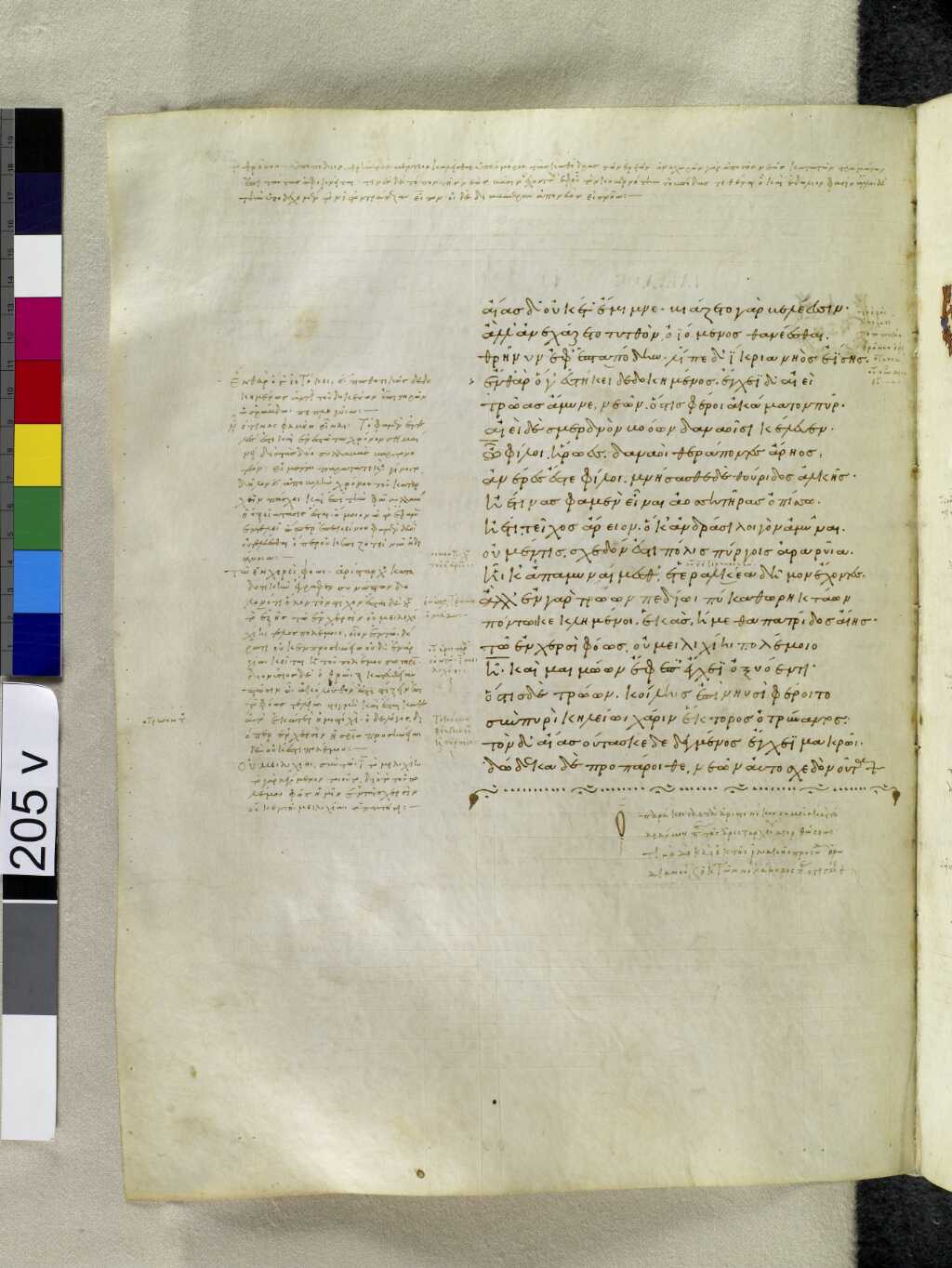
Where on the image
Venetus A fol. 205v (photograph VA205VN_0707): Iliad 15.727-746, 20 lines of the manuscript, begins ‹Αἴας δ' οὐκέτ' ἔμιμνε: βιάζετο›, ends ‹προπάροιθε, νεῶν αὐτοσχεδὸν οῦτα ⁑›. Page of each line from the Homer Multitext 2024c index of lines to pages. English (Murray): lines 15.725-746, in his blocks 725-729, 730-734, 735-739, 740-744, 745-746. Murray marks every fifth line and each paragraph; a block that crosses the page break goes with the page holding most of its lines, so the English here begins at line 725.
727Αἴας δ' οὐκέτ' ἔμιμνε: βιάζετο γὰρ βελέεσσιν:
728ἂλλ' ἀνεχάζετο τυτθὸν, ὀϊόμενος θανέεσθαι.
729θρῆνυν ἐφ' ἑπταπόδην: λί̆πε δ' ΐκρια νηὸς ἐΐσης.
730ἔνθ' ὰρ' ὅ γ' ἑστήκει δεδοκημένος. ἔγχεϊ δ' αἰεὶ
731Τρῶας ἄμυνε, νεῶν. ὅς τις φέροι ἀκάματον πῦρ:
732αἰεὶ δὲ σμερδνὸν βοόων Δαναοῖσι κέλευεν:
733ὦ φίλοι. ἥρωες. Δαναοὶ θεράποντες Ἄρηος .
734ἀνέρες ἔστε φίλοι. μνήσασθε δὲ θούριδος ἀλκῆς:
735ἠέ τινας φαμὲν εἶναι ἀοσσητῆρας ὀπίσσω.
736ἠέτι. τεῖχος ἄρειον. ὅ κ' ἀνδράσι λοιγὸν ἀμῦναι.
737οὐ μέν τις. σχεδόν ἐστι πόλις πύργοις ἀραρυῖα.
738ᾗ κ' ἀπαμυναίμεσθ' , ἑτεραλκέα δῆμον ἔχοντες:
739ἂλλ' ἐν γὰρ Τρώων πεδίῳ πύκα θωρηκτάων
740πόντῳ κεκλιμένοι. ἑκὰς, ήμεθα πατρίδος αἴης:
741τῶ ἐν χερσὶ φόως, οὐ μειλιχίῃ πολέμοιο.
742ῇ καὶ μαιμώων ἔφεπ' ἔγχεϊ ὀξυόεντι:
743ὅς τις δὲ Τρώων , κοίλῃς ἐπὶ νηυσὶ φέροιτο
744σὺν πυρὶ κηλείῳ χάριν Ἕκτορος ὀτρύναντος.
745τὸν δ' Αἴας ούτασκε δεδεγμένος ἔγχεϊ μακρῷ:
746δώδεκα δὲ προπάροιθε, νεῶν αὐτοσχεδὸν οῦτα ⁑
Compare: Monro & Allen, Oxford 1920 (Perseus)
727Αἴας δʼ οὐκέτʼ ἔμιμνε· βιάζετο γὰρ βελέεσσιν·
728ἀλλʼ ἀνεχάζετο τυτθόν, ὀϊόμενος θανέεσθαι
729θρῆνυν ἐφʼ ἑπταπόδην, λίπε δʼ ἴκρια νηὸς ἐΐσης.
730ἔνθʼ ἄρʼ ὅ γʼ ἑστήκει δεδοκημένος, ἔγχεϊ δʼ αἰεὶ
731Τρῶας ἄμυνε νεῶν, ὅς τις φέροι ἀκάματον πῦρ·
732αἰεὶ δὲ σμερδνὸν βοόων Δαναοῖσι κέλευε·
733ὦ φίλοι ἥρωες Δαναοὶ θεράποντες Ἄρηος
734ἀνέρες ἔστε φίλοι, μνήσασθε δὲ θούριδος ἀλκῆς.
735ἠέ τινάς φαμεν εἶναι ἀοσσητῆρας ὀπίσσω,
736ἦέ τι τεῖχος ἄρειον, ὅ κʼ ἀνδράσι λοιγὸν ἀμύναι;
737οὐ μέν τι σχεδόν ἐστι πόλις πύργοις ἀραρυῖα,
738ᾗ κʼ ἀπαμυναίμεσθʼ ἑτεραλκέα δῆμον ἔχοντες·
739ἀλλʼ ἐν γὰρ Τρώων πεδίῳ πύκα θωρηκτάων
740πόντῳ κεκλιμένοι ἑκὰς ἥμεθα πατρίδος αἴης·
741τὼ ἐν χερσὶ φόως, οὐ μειλιχίῃ πολέμοιο.
742ἦ, καὶ μαιμώων ἔφεπʼ ἔγχεϊ ὀξυόεντι.
743ὅς τις δὲ Τρώων κοίλῃς ἐπὶ νηυσὶ φέροιτο
744σὺν πυρὶ κηλείῳ, χάριν Ἕκτορος ὀτρύναντος,
745τὸν δʼ Αἴας οὔτασκε δεδεγμένος ἔγχεϊ μακρῷ·
746δώδεκα δὲ προπάροιθε νεῶν αὐτοσχεδὸν οὖτα.
725now of himself he urgeth and giveth command.” So spake he, and they leapt the more upon the Argives. But Aias no longer abode, for he was sore beset with darts, but, ever foreboding death, gave ground a little along the bridge of seven feet in height, and left the deck of the shapely ship. 730There stood he on the watch, and with his spear he ever warded from the ship whosoever of the Trojans sought to bring unwearied fire; and ever with terrible cries he called to the Danaans: “Friends, Danaan warriors, squires of Ares, be men, my friends, and bethink you of furious might. 735Do we haply deem that there are other helpers at our backs, or some stronger wall to ward off ruin from men? In no wise is there hard at hand a city fenced with walls, whereby we might defend ourselves, having a host to turn the tide of battle; nay, it is in the plain of the mail-clad Trojans 740that we are set, with naught to support us but the sea, and far from our native land. Therefore in the might of our hands is the light of deliverance, and not in slackness in fight.” He spake, and kept driving furiously at the foe with his sharp spear. And whoso of the Trojans would rush upon the hollow ships with blazing fire, doing pleasure to Hector at his bidding, 745for him would Aias wait, and wound him with a thrust of his long spear; and twelve men did he wound in close fight in front of the ships.
Notes
- Greek: Homer Multitext Project, diplomatic edition of the Venetus A text (release 2024c); edition text: D. B. Monro and T. W. Allen, Homeri Opera (Oxford, 1908-1920), via Perseus.
- English: A. T. Murray, Homer: The Iliad (Loeb Classical Library, 1924-1925), via Perseus; his footnotes are omitted, and speeches, marked as quotations in the Perseus text, are shown in quotation marks.
Cite
Sources
- Source: Venetus A (Marc. gr. Z. 454) page photographs and diplomatic text, Homer Multitext Project (release 2024c) + Monro & Allen (Oxford 1920, Perseus) + A. T. Murray, Loeb (1924, Perseus) (holding institution)
- Critical edition: Venetus A diplomatic edition, Homer Multitext Project (CC BY-NC 4.0); Monro & Allen for comparison
← previous · → next · v cycle view · l back to library