Virgil, Aeneid 6.724-751: Anchises on the world-soul and the return of souls
Introduction
In book 6 of the Aeneid Aeneas goes down to the underworld with the Sibyl of Cumae and finds his father Anchises in Elysium, beside the river Lethe, where crowds of souls wait. Asked why souls would ever wish to return to bodies, Anchises explains: 'a spirit within nourishes' heaven, earth, sea, moon and stars, and 'mind, poured through the limbs, moves the whole mass and mingles with the great body' (spiritus intus alit ... mens agitat molem, 726-727). Men and animals have in their seeds 'a fiery force and a heavenly origin', dulled by the earthly body; hence fear and desire, grief and joy. Even after death the stains of the body remain, so souls are purified by wind, water or fire; a few remain in Elysium until the long cycle of time has removed every stain and left 'the pure ethereal sense and the fire of simple air'. The rest, after a thousand years, are called to Lethe, forget, and begin to wish to return to bodies.
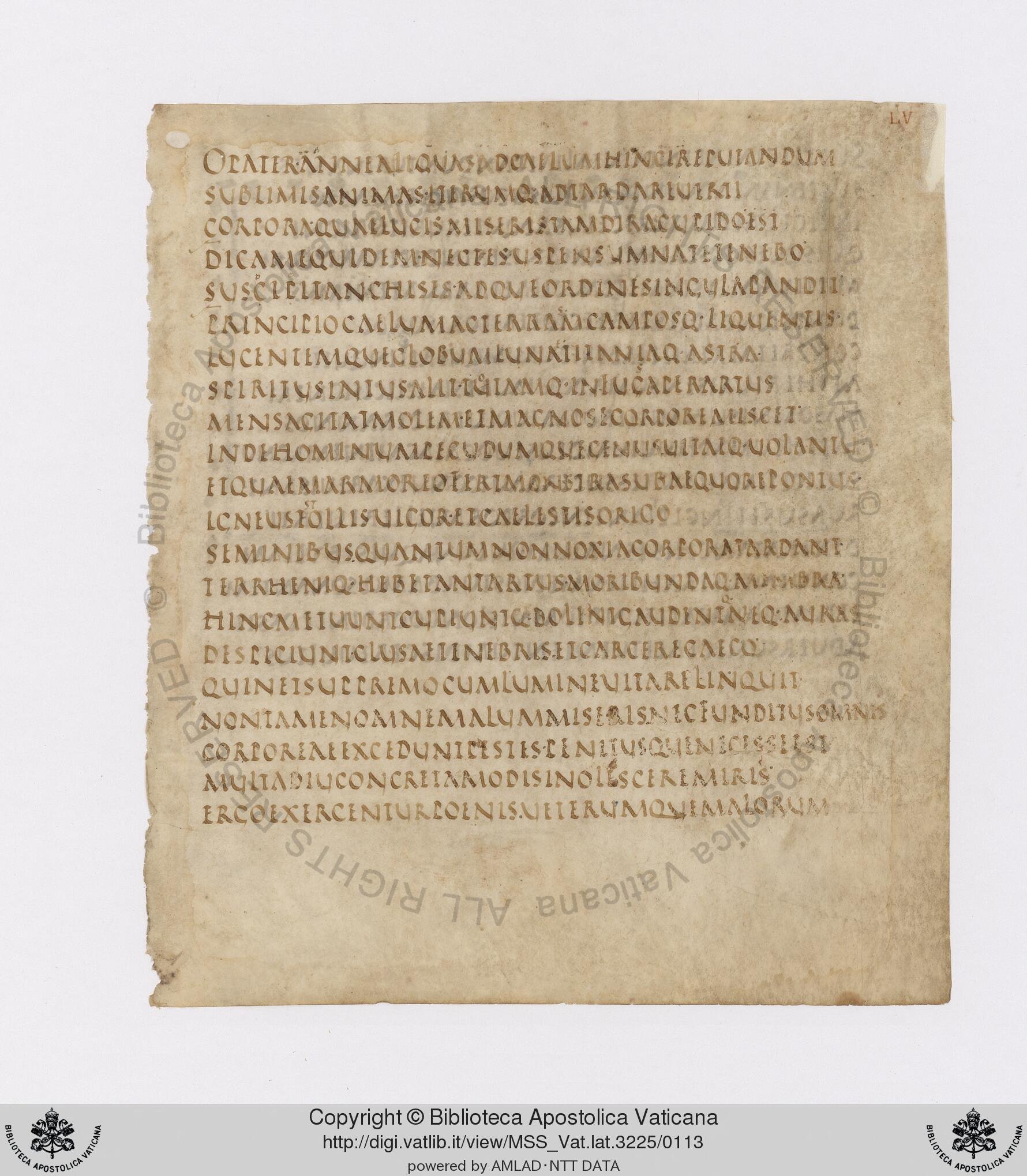
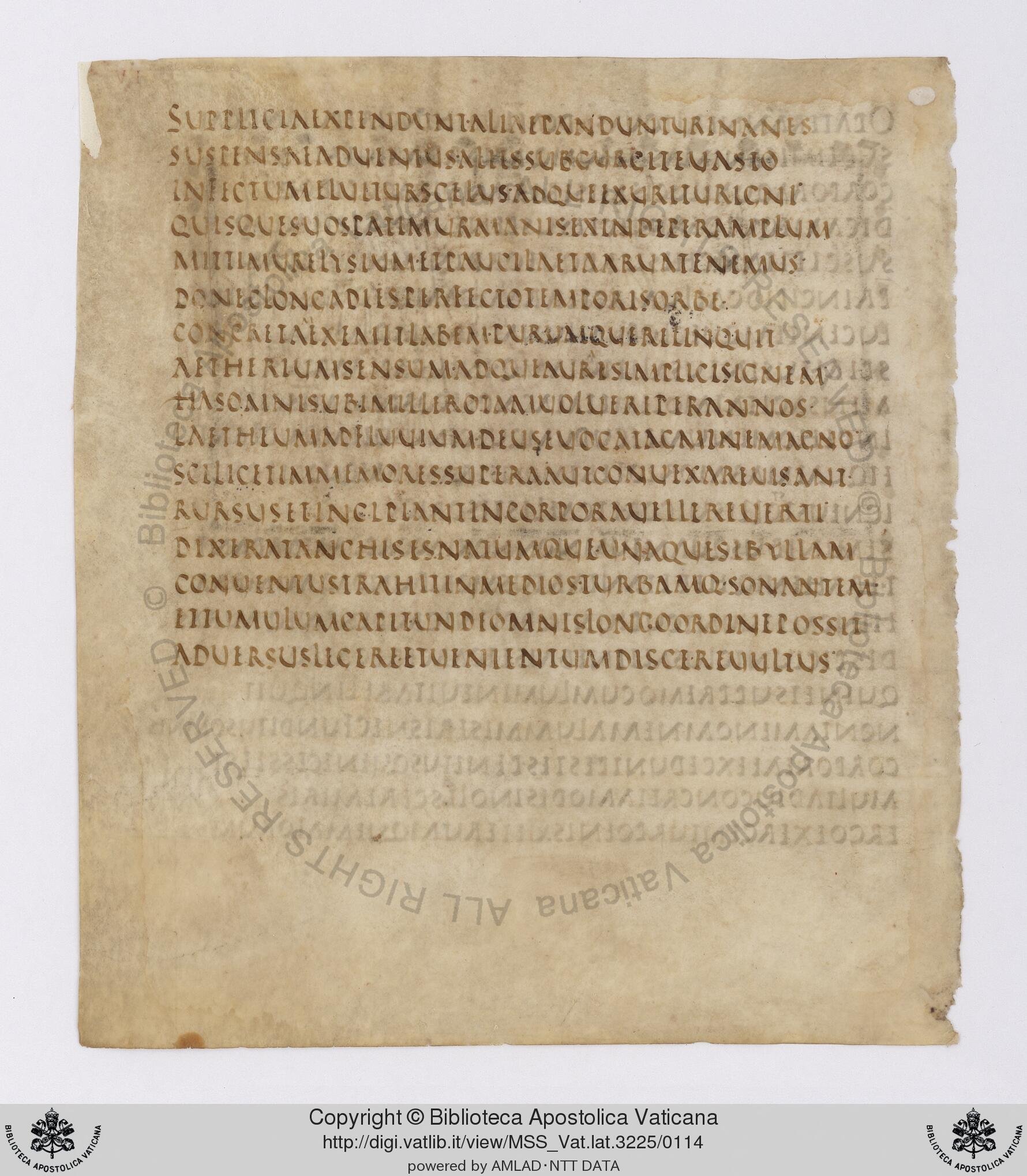
The pages shown are from Vatican City, Biblioteca Apostolica Vaticana, Vat. lat. 3225, the Vergilius Vaticanus, the oldest illustrated manuscript of Virgil, written in rustic capitals around 400 (the library dates it to the 4th century). Only 76 leaves survive; this passage is among them. Lines 724-739 stand on fol. 55r (line 724 is its sixth line) and 740-751 on fol. 55v. The Latin is Greenough's edition (Perseus), not a transcription of the manuscript. The English is Theodore C. Williams' verse translation (1910).
How was this verified? (Provenance)
Where on the image
Lines 724-732 are on Vergilius Vaticanus (Vat. lat. 3225) fol. 55r. Checked on the images: Vat. lat. 3225 fol. 55r runs from 'O pater, anne aliquas ad caelum hinc ire putandum (est)' on its first line (719) to 'ergo exercentur poenis, veterumque malorum' on its last (739). 6.724 'Principio caelum ac terras camposque liquentis' is the sixth line of the page. Viewer: https://digi.vatlib.it/view/MSS_Vat.lat.3225/0113 The Latin shown is Greenough's edited text; the manuscript's spelling differs from it in places. English: Williams' lines 942-956, which render Latin 724-734. His sentence for 728-734 (Thence man and beast ... on the radiant world.) runs across the break after 732 and is given whole here, so the English of 733-734 (whence also spring / Terrors and passions ... the radiant world.) stands in this section and the next section's English begins with 735.
724Principio caelum ac terras camposque liquentis
725lucentemque globum Lunae Titaniaque astra
726spiritus intus alit, totamque infusa per artus
727mens agitat molem et magno se corpore miscet.
728Inde hominum pecudumque genus, vitaeque volantum,
729et quae marmoreo fert monstra sub aequore pontus.
730Igneus est ollis vigor et caelestis origo
731seminibus, quantum non noxia corpora tardant,
732terrenique hebetant artus moribundaque membra.
724“Know first that heaven and earth and ocean's plain,
The moon's bright orb, and stars of Titan birth
Are nourished by one Life; one primal Mind,
Immingled with the vast and general frame,
Fills every part and stirs the mighty whole.
Thence man and beast, thence creatures of the air,
And all the swarming monsters that be found
Beneath the level of the marbled sea;
A fiery virtue, a celestial power,
Their native seeds retain; but bodies vile,
With limbs of clay and members born to die,
Encumber and o'ercloud; whence also spring
Terrors and passions, suffering and joy;
For from deep darkness and captivity
All gaze but blindly on the radiant world.
Where on the image
Lines 733-742 start on Vat. lat. 3225 fol. 55r and continue on fol. 55v (page break inside this section). Checked on the images: Vat. lat. 3225 fol. 55r runs from 'O pater, anne aliquas ad caelum hinc ire putandum (est)' on its first line (719) to 'ergo exercentur poenis, veterumque malorum' on its last (739). 6.724 'Principio caelum ac terras camposque liquentis' is the sixth line of the page. Viewer: https://digi.vatlib.it/view/MSS_Vat.lat.3225/0113 Vat. lat. 3225 fol. 55v runs from 'supplicia expendunt: aliae panduntur inanes' on its first line (740) to 'adversos legere et venientum discere vultus' on its last (755). 6.751 'rursus et incipiant in corpora velle reverti' is the twelfth line; the page ends with 6.755, followed by a gap in the manuscript. Viewer: https://digi.vatlib.it/view/MSS_Vat.lat.3225/0114 The Latin shown is Greenough's edited text; the manuscript's spelling differs from it in places. English: Williams' lines 957-966 (to the full stop in 966), which render Latin 735-742; the English of 733-734 ends the sentence given with the previous section (see there). His line 966 ends this section at Or burned away in fire. (aut exuritur igni, 742).
733Hinc metuunt cupiuntque, dolent gaudentque, neque auras
734dispiciunt clausae tenebris et carcere caeco.
735Quin et supremo cum lumine vita reliquit,
736non tamen omne malum miseris nec funditus omnes
737corporeae excedunt pestes, penitusque necesse est
738multa diu concreta modis inolescere miris.
739Ergo exercentur poenis, veterumque malorum
740supplicia expendunt: aliae panduntur inanes
741suspensae ad ventos; aliis sub gurgite vasto
742infectum eluitur scelus, aut exuritur igni;
735Nor when to life's last beam they bid farewell
May sufferers cease from pain, nor quite be freed
From all their fleshly plagues; but by fixed law,
The strange, inveterate taint works deeply in.
For this, the chastisement of evils past
Is suffered here, and full requital paid.
Some hang on high, outstretched to viewless winds;
For some their sin's contagion must be purged
In vast ablution of deep-rolling seas,
Or burned away in fire.
Where on the image
Lines 743-751 are on Vergilius Vaticanus (Vat. lat. 3225) fol. 55v. Checked on the images: Vat. lat. 3225 fol. 55v runs from 'supplicia expendunt: aliae panduntur inanes' on its first line (740) to 'adversos legere et venientum discere vultus' on its last (755). 6.751 'rursus et incipiant in corpora velle reverti' is the twelfth line; the page ends with 6.755, followed by a gap in the manuscript. Viewer: https://digi.vatlib.it/view/MSS_Vat.lat.3225/0114 The Latin shown is Greenough's edited text; the manuscript's spelling differs from it in places. English: Williams' lines 966 (from Each man receives) to 977, which render Latin 743-751, the same lines as the Latin.
743quisque suos patimur Manes; exinde per amplum
744mittimur Elysium, et pauci laeta arva tenemus;
745donec longa dies, perfecto temporis orbe,
746concretam exemit labem, purumque relinquit
747aetherium sensum atque auraï simplicis ignem.
748Has omnes, ubi mille rotam volvere per annos,
749Lethaeum ad fluvium deus evocat agmine magno,
750scilicet immemores supera ut convexa revisant,
751rursus et incipiant in corpora velle reverti.
743Each man receives
His ghostly portion in the world of dark;
But thence to realms Elysian we go free,
Where for a few these seats of bliss abide,
Till time's long lapse a perfect orb fulfils,
And takes all taint away, restoring so
The pure, ethereal soul's first virgin fire.
At last, when the millennial aeon strikes,
God calls them forth to yon Lethaean stream,
In numerous host, that thence, oblivious all,
They may behold once more the vaulted sky,
And willingly to shapes of flesh return.”
Notes
- Latin: J. B. Greenough, The Bucolics, Aeneid, and Georgics of Virgil (Boston: Ginn), Perseus digital text.
- English: Theodore C. Williams, The Aeneid of Virgil (Boston: Houghton Mifflin, 1910), Perseus canonical-latinLit phi0690.phi003.perseus-eng2. The translation is in verse with more lines than the Latin; each English section is cut at the end of one of Williams' sentences; where his sentence runs across a section break it is given whole to one side, and each section's note says which Latin lines its English renders.
Cite
Sources
- Source: Vat. lat. 3225 (Vergilius Vaticanus) fol. 55r-55v (DigiVatLib) + Greenough Latin (Perseus) + Theodore C. Williams (1910) English (Perseus) (holding institution)
- Critical edition: Greenough, Virgil (Ginn), via Perseus
← previous · → next · v cycle view · l back to library