Virgil, Eclogue 4: the return of the golden age
Introduction
The fourth of Virgil's ten Eclogues (pastoral poems) is addressed to Asinius Pollio, consul in 40 BCE. It announces that 'the last age of the Cumaean song' has come: the great order of the centuries is born anew, the Virgin (Justice) returns, Saturn's reign returns, and 'a new race is sent down from high heaven'. A boy is about to be born under whom 'the iron race shall cease and a golden race arise throughout the world'; he will receive the life of the gods and see heroes mingled with gods. As he grows, the earth will give its fruits untilled, though some traces of the old wrong will remain for a time (a second Argo, a second Trojan war), until all lands bear all things. From late antiquity Christian readers, among them Constantine and Augustine, read the poem as a prophecy of Christ.
The pages shown are from Vatican City, Biblioteca Apostolica Vaticana, Vat. lat. 3867, the Vergilius Romanus, one of the oldest surviving books of Virgil, written in rustic capitals in the 5th century. Here the poem carries the red title SAECULI NOVI INTERPRETATIO ('interpretation of the new age') and fills four pages: fol. 9v (lines 1-17), 10r (18-35), 10v (36-53) and 11r (54-63), where a miniature follows. Each section below is a group of lines; the pages were identified by reading the first and last line of each page on the images. The Latin is Greenough's edition (Perseus), not a transcription of the manuscript; at line 53 the manuscript has tum where Greenough prints tam. The English is James Rhoades' verse translation. The poem is complete.
How was this verified? (Provenance)
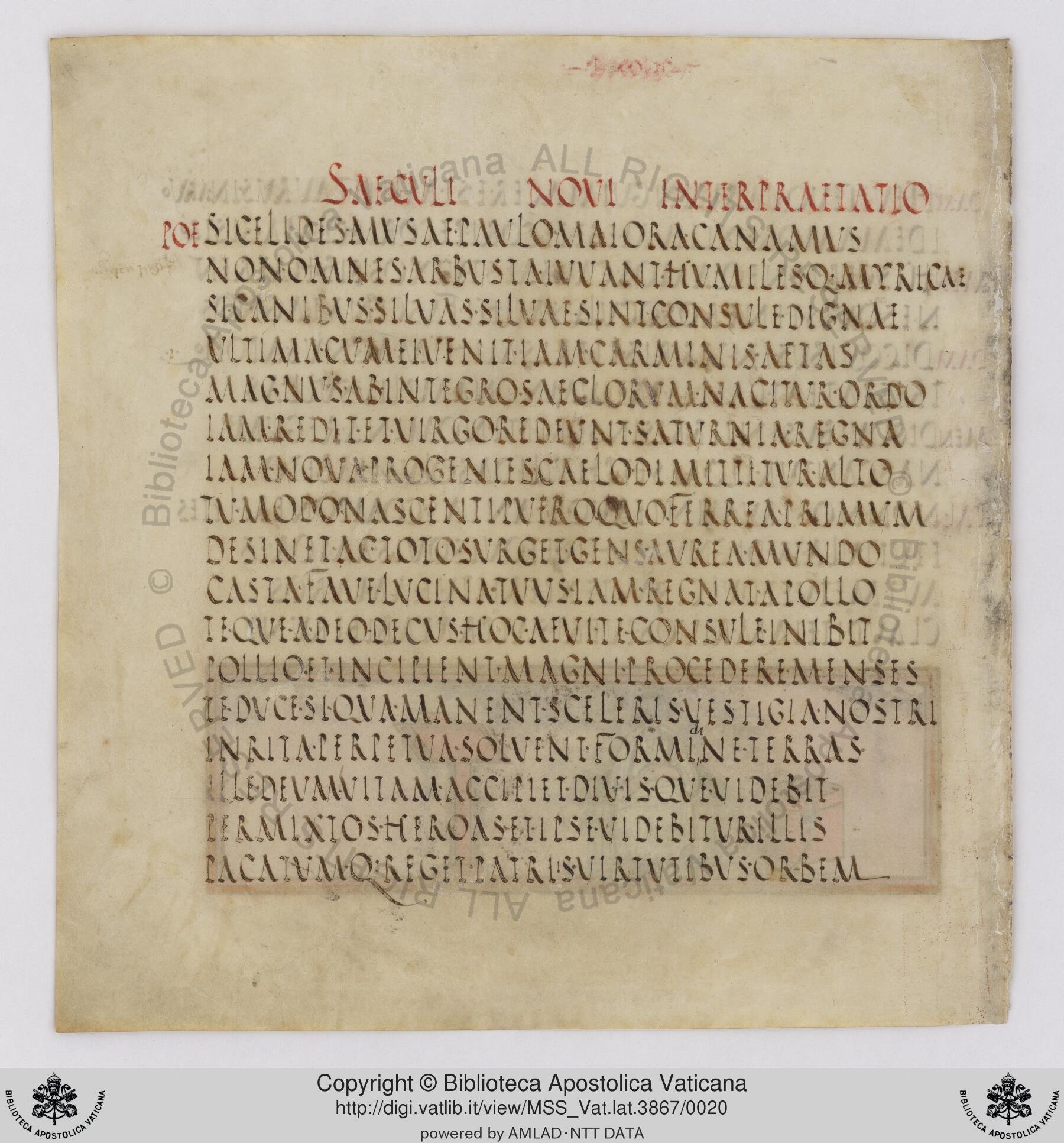
Where on the image
Lines 1-3 are on Vergilius Romanus (Vat. lat. 3867) fol. 9v. Checked on the images: Vat. lat. 3867 fol. 9v runs from 'Sicelides Musae, paulo maiora canamus (under the red title SAECULI NOVI INTERPRETATIO)' on its first line (1) to 'pacatumque reget patriis virtutibus orbem' on its last (17). The speaker mark POE stands in red in the left margin of the first line. Viewer: https://digi.vatlib.it/view/MSS_Vat.lat.3867/0020 The Latin shown is Greenough's edited text; the manuscript's spelling differs from it in places.
1Sicelides Musae, paulo maiora canamus!
2Non omnis arbusta iuvant humilesque myricae;
3si canimus silvas, silvae sint consule dignae.
1Muses of Sicily, essay we now
a somewhat loftier task! Not all men love
coppice or lowly tamarisk: sing we woods,
woods worthy of a Consul let them be.
Where on the image
Lines 4-10 are on Vergilius Romanus (Vat. lat. 3867) fol. 9v. Checked on the images: Vat. lat. 3867 fol. 9v runs from 'Sicelides Musae, paulo maiora canamus (under the red title SAECULI NOVI INTERPRETATIO)' on its first line (1) to 'pacatumque reget patriis virtutibus orbem' on its last (17). The speaker mark POE stands in red in the left margin of the first line. Viewer: https://digi.vatlib.it/view/MSS_Vat.lat.3867/0020 The Latin shown is Greenough's edited text; the manuscript's spelling differs from it in places.
4Ultima Cumaei venit iam carminis aetas;
5magnus ab integro saeclorum nascitur ordo:
6iam redit et Virgo, redeunt Saturnia regna;
7iam nova progenies caelo demittitur alto.
8Tu modo nascenti puero, quo ferrea primum
9desinet ac toto surget gens aurea mundo,
10casta fave Lucina: tuus iam regnat Apollo.
4Now the last age by Cumae's Sibyl sung
has come and gone, and the majestic roll
of circling centuries begins anew:
justice returns, returns old Saturn's reign,
with a new breed of men sent down from heaven.
Only do thou, at the boy's birth in whom
the iron shall cease, the golden race arise,
befriend him, chaste Lucina; 'tis thine own
Where on the image
Lines 11-17 are on Vergilius Romanus (Vat. lat. 3867) fol. 9v. Checked on the images: Vat. lat. 3867 fol. 9v runs from 'Sicelides Musae, paulo maiora canamus (under the red title SAECULI NOVI INTERPRETATIO)' on its first line (1) to 'pacatumque reget patriis virtutibus orbem' on its last (17). The speaker mark POE stands in red in the left margin of the first line. Viewer: https://digi.vatlib.it/view/MSS_Vat.lat.3867/0020 The Latin shown is Greenough's edited text; the manuscript's spelling differs from it in places.
11Teque adeo decus hoc aevi te consule inibit,
12Pollio, et incipient magni procedere menses.
13te duce, si qua manent sceleris vestigia nostri,
14inrita perpetua solvent formidine terras.
15ille deum vitam accipiet, divisque videbit
16permixtos heroas, et ipse videbitur illis,
17pacatumque reget patriis virtutibus orbem.
11Apollo reigns. And in thy consulate,
this glorious age, O Pollio, shall begin,
and the months enter on their mighty march.
Under thy guidance, whatso tracks remain
of our old wickedness, once done away,
shall free the earth from never-ceasing fear.
He shall receive the life of gods, and see
heroes with gods commingling, and himself
be seen of them, and with his father's worth
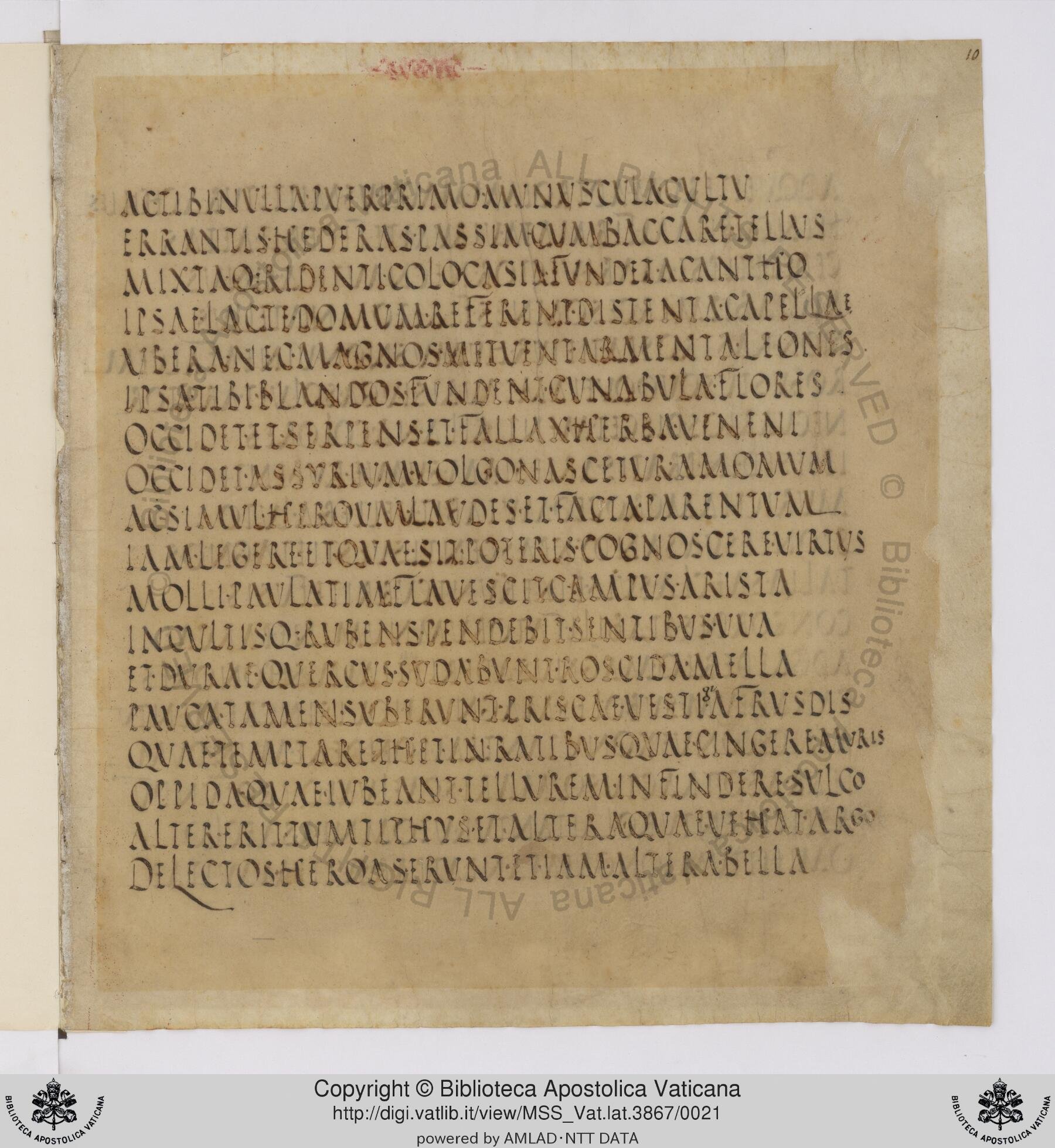
Where on the image
Lines 18-25 are on Vergilius Romanus (Vat. lat. 3867) fol. 10r. Checked on the images: Vat. lat. 3867 fol. 10r runs from 'At tibi prima, puer, nullo munuscula cultu' on its first line (18) to 'delectos heroas; erunt etiam altera bella' on its last (35). Viewer: https://digi.vatlib.it/view/MSS_Vat.lat.3867/0021 The Latin shown is Greenough's edited text; the manuscript's spelling differs from it in places.
18At tibi prima, puer, nullo munuscula cultu
19errantis hederas passim cum baccare tellus
20mixtaque ridenti colocasia fundet acantho.
21Ipsae lacte domum referent distenta capellae
22ubera, nec magnos metuent armenta leones;
23ipsa tibi blandos fundent cunabula flores,
24occidet et serpens, et fallax herba veneni
25occidet, Assyrium volgo nascetur amomum.
18reign o'er a world at peace. For thee, O boy,
first shall the earth, untilled, pour freely forth
her childish gifts, the gadding ivy-spray
with foxglove and Egyptian bean-flower mixed,
and laughing-eyed acanthus. Of themselves,
untended, will the she-goats then bring home
their udders swollen with milk, while flocks afield
shall of the monstrous lion have no fear.
Thy very cradle shall pour forth for thee
caressing flowers. The serpent too shall die,
die shall the treacherous poison-plant, and far
Where on the image
Lines 26-30 are on Vergilius Romanus (Vat. lat. 3867) fol. 10r. Checked on the images: Vat. lat. 3867 fol. 10r runs from 'At tibi prima, puer, nullo munuscula cultu' on its first line (18) to 'delectos heroas; erunt etiam altera bella' on its last (35). Viewer: https://digi.vatlib.it/view/MSS_Vat.lat.3867/0021 The Latin shown is Greenough's edited text; the manuscript's spelling differs from it in places.
26at simul heroum laudes et facta parentis
27iam legere et quae sit poteris cognoscere virtus,
28molli paulatim flavescet campus arista,
29incultisque rubens pendebit sentibus uva,
30et durae quercus sudabunt roscida mella
26and wide Assyrian spices spring. But soon
as thou hast skill to read of heroes' fame,
and of thy father's deeds, and inly learn
what virtue is, the plain by slow degrees
with waving corn-crops shall to golden grow,
from the wild briar shall hang the blushing grape,
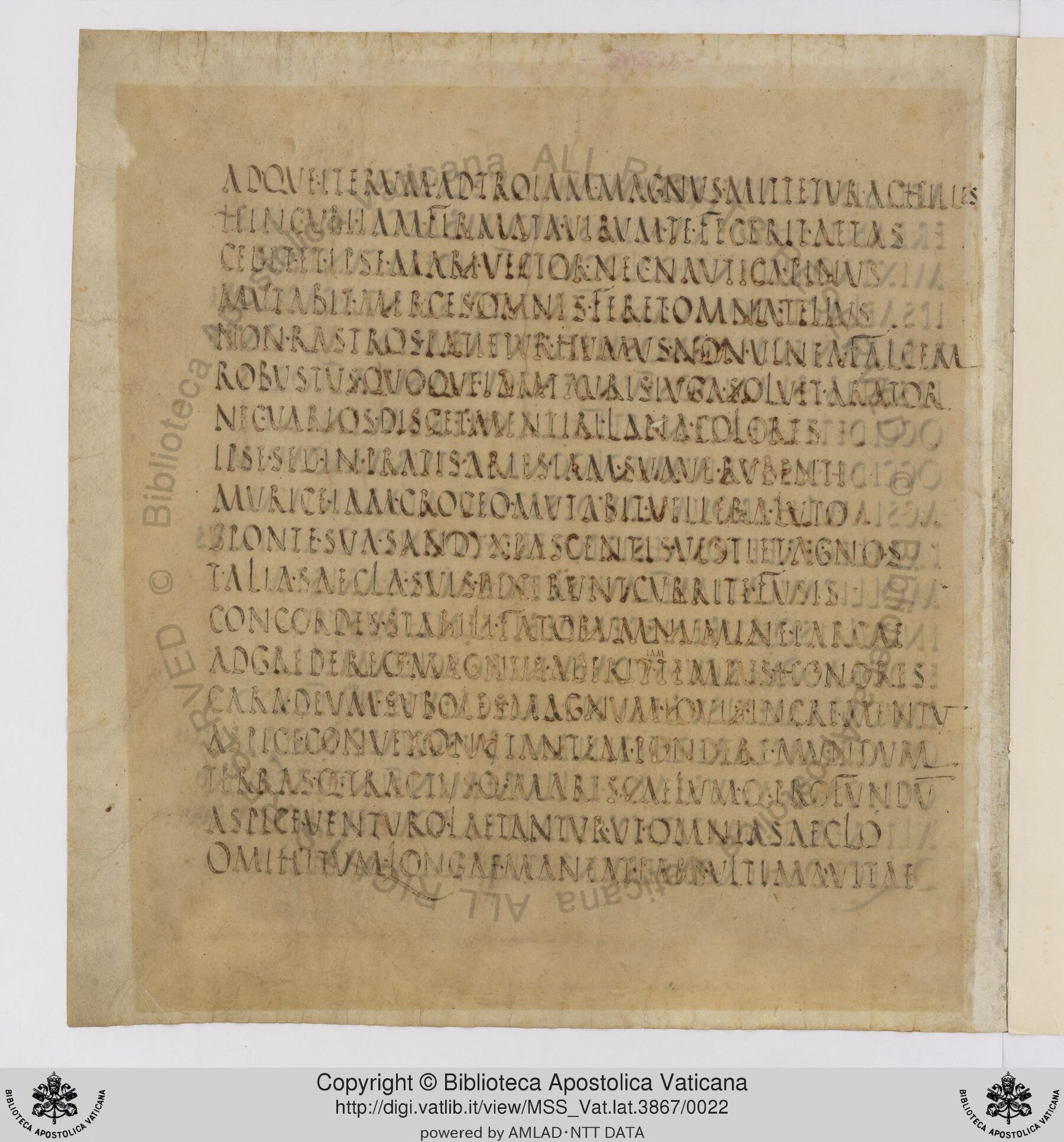
Where on the image
Lines 31-36 start on Vat. lat. 3867 fol. 10r and continue on fol. 10v (page break inside this section). Checked on the images: Vat. lat. 3867 fol. 10r runs from 'At tibi prima, puer, nullo munuscula cultu' on its first line (18) to 'delectos heroas; erunt etiam altera bella' on its last (35). Viewer: https://digi.vatlib.it/view/MSS_Vat.lat.3867/0021 Vat. lat. 3867 fol. 10v runs from 'atque iterum ad Troiam magnus mittetur Achilles' on its first line (36) to 'o mihi tum longae maneat pars ultima vitae' on its last (53). The last line reads TUM where Greenough prints 'tam' (4.53). Viewer: https://digi.vatlib.it/view/MSS_Vat.lat.3867/0022 The Latin shown is Greenough's edited text; the manuscript's spelling differs from it in places.
31Pauca tamen suberunt priscae vestigia fraudis,
32quae temptare Thetim ratibus, quae cingere muris
33oppida, quae iubeant telluri infindere sulcos:
34alter erit tum Tiphys, et altera quae vehat Argo
35delectos Heroas; erunt etiam altera bella,
36atque iterum ad Troiam magnus mittetur Achilles.
31and stubborn oaks sweat honey-dew. Nathless
yet shall there lurk within of ancient wrong
some traces, bidding tempt the deep with ships,
gird towns with walls, with furrows cleave the earth.
Therewith a second Tiphys shall there be,
her hero-freight a second Argo bear;
new wars too shall arise, and once again
some great Achilles to some Troy be sent.
Where on the image
Lines 37-45 are on Vergilius Romanus (Vat. lat. 3867) fol. 10v. Checked on the images: Vat. lat. 3867 fol. 10v runs from 'atque iterum ad Troiam magnus mittetur Achilles' on its first line (36) to 'o mihi tum longae maneat pars ultima vitae' on its last (53). The last line reads TUM where Greenough prints 'tam' (4.53). Viewer: https://digi.vatlib.it/view/MSS_Vat.lat.3867/0022 The Latin shown is Greenough's edited text; the manuscript's spelling differs from it in places.
37Hinc, ubi iam firmata virum te fecerit aetas,
38cedet et ipse mari vector, nec nautica pinus
39mutabit merces: omnis feret omnia tellus:
40non rastros patietur humus, non vinea falcem;
41robustus quoque iam tauris iuga solvet arator;
42nec varios discet mentiri lana colores:
43ipse sed in pratis aries iam suave rubenti
44murice, iam croceo mutabit vellera luto;
45sponte sua sandyx pascentis vestiet agnos.
37Then, when the mellowing years have made thee man,
no more shall mariner sail, nor pine-tree bark
ply traffic on the sea, but every land
shall all things bear alike: the glebe no more
shall feel the harrow's grip, nor vine the hook;
the sturdy ploughman shall loose yoke from steer,
nor wool with varying colours learn to lie;
but in the meadows shall the ram himself,
now with soft flush of purple, now with tint
of yellow saffron, teach his fleece to shine.
While clothed in natural scarlet graze the lambs.
Where on the image
Lines 46-47 are on Vergilius Romanus (Vat. lat. 3867) fol. 10v. Checked on the images: Vat. lat. 3867 fol. 10v runs from 'atque iterum ad Troiam magnus mittetur Achilles' on its first line (36) to 'o mihi tum longae maneat pars ultima vitae' on its last (53). The last line reads TUM where Greenough prints 'tam' (4.53). Viewer: https://digi.vatlib.it/view/MSS_Vat.lat.3867/0022 The Latin shown is Greenough's edited text; the manuscript's spelling differs from it in places.
46Talia saecla, suis dixerunt, currite, fusis
47concordes stabili fatorum numine Parcae.
46“Such still, such ages weave ye, as ye run,”
sang to their spindles the consenting Fates
by Destiny's unalterable decree.
Where on the image
Lines 48-52 are on Vergilius Romanus (Vat. lat. 3867) fol. 10v. Checked on the images: Vat. lat. 3867 fol. 10v runs from 'atque iterum ad Troiam magnus mittetur Achilles' on its first line (36) to 'o mihi tum longae maneat pars ultima vitae' on its last (53). The last line reads TUM where Greenough prints 'tam' (4.53). Viewer: https://digi.vatlib.it/view/MSS_Vat.lat.3867/0022 The Latin shown is Greenough's edited text; the manuscript's spelling differs from it in places.
48Adgredere o magnos—aderit iam tempus—honores,
49cara deum suboles, magnum Iovis incrementum!
50Aspice convexo nutantem pondere mundum,
51terrasque tractusque maris caelumque profundum!
52Aspice, venturo laetentur ut omnia saeclo!
48Assume thy greatness, for the time draws nigh,
dear child of gods, great progeny of Jove!
See how it totters—the world's orbed might,
earth, and wide ocean, and the vault profound,
all, see, enraptured of the coming time!
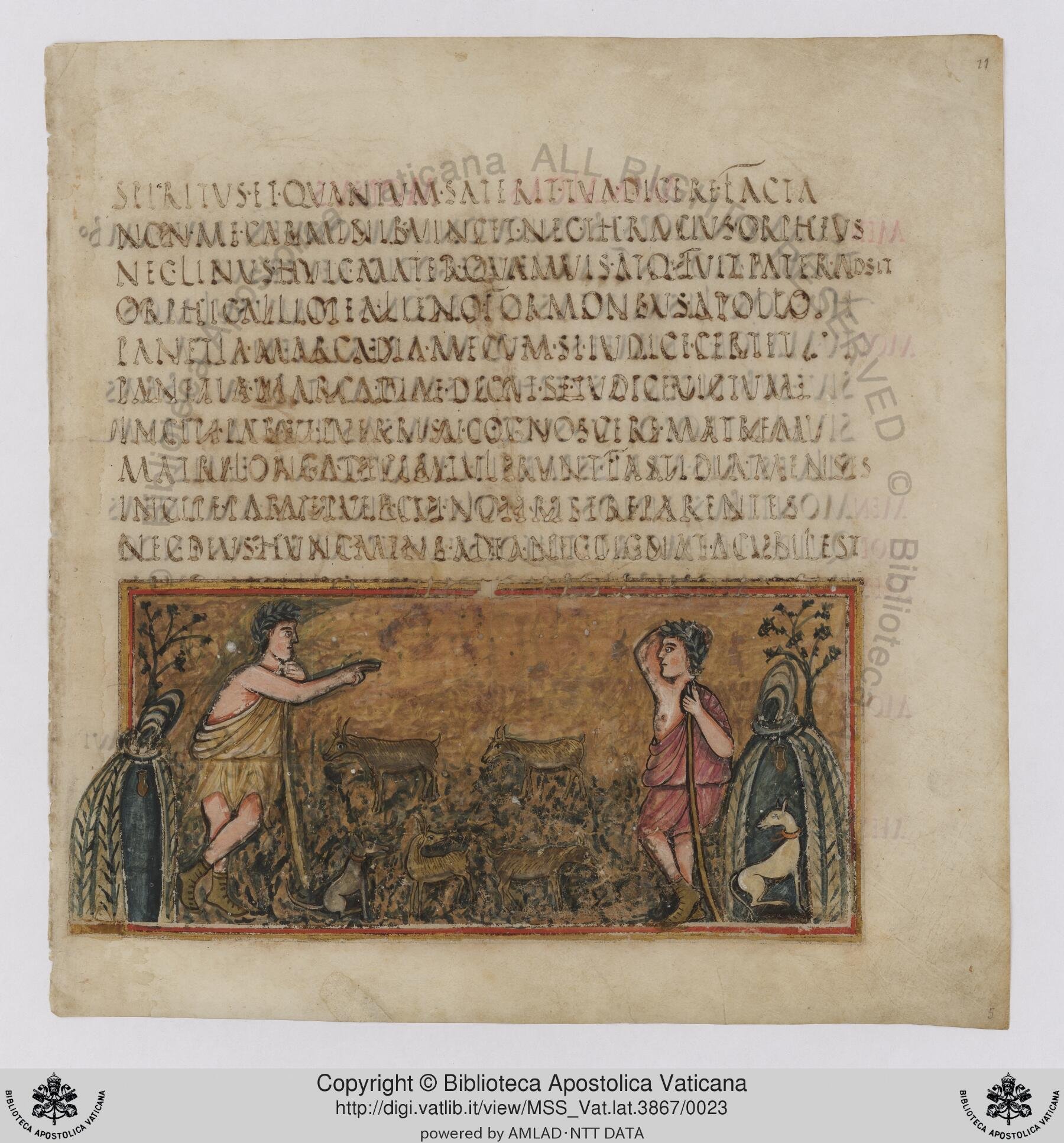
Where on the image
Lines 53-59 start on Vat. lat. 3867 fol. 10v and continue on fol. 11r (page break inside this section). Checked on the images: Vat. lat. 3867 fol. 10v runs from 'atque iterum ad Troiam magnus mittetur Achilles' on its first line (36) to 'o mihi tum longae maneat pars ultima vitae' on its last (53). The last line reads TUM where Greenough prints 'tam' (4.53). Viewer: https://digi.vatlib.it/view/MSS_Vat.lat.3867/0022 Vat. lat. 3867 fol. 11r runs from 'spiritus et quantum sat erit tua dicere facta' on its first line (54) to 'nec deus hunc mensa, dea nec dignata cubili est' on its last (63). The ten lines of text fill the upper part of the page; a framed miniature follows below them. Viewer: https://digi.vatlib.it/view/MSS_Vat.lat.3867/0023 The Latin shown is Greenough's edited text; the manuscript's spelling differs from it in places.
53O mihi tam longae maneat pars ultima vitae,
54spiritus et quantum sat erit tua dicere facta!
55Non me carminibus vincet nec Thracius Orpheus,
56nec Linus, huic mater quamvis atque huic pater adsit,
57Orphei Calliopea, Lino formosus Apollo,
58Pan etiam, Arcadia mecum si iudice certet,
59Pan etiam Arcadia dicat se iudice victum.
53Ah! might such length of days to me be given,
and breath suffice me to rehearse thy deeds,
nor Thracian Orpheus should out-sing me then,
nor Linus, though his mother this, and that
his sire should aid—Orpheus Calliope,
and Linus fair Apollo. Nay, though Pan,
with Arcady for judge, my claim contest,
with Arcady for judge great Pan himself
should own him foiled, and from the field retire.
Where on the image
Lines 60-63 are on Vergilius Romanus (Vat. lat. 3867) fol. 11r. Checked on the images: Vat. lat. 3867 fol. 11r runs from 'spiritus et quantum sat erit tua dicere facta' on its first line (54) to 'nec deus hunc mensa, dea nec dignata cubili est' on its last (63). The ten lines of text fill the upper part of the page; a framed miniature follows below them. Viewer: https://digi.vatlib.it/view/MSS_Vat.lat.3867/0023 The Latin shown is Greenough's edited text; the manuscript's spelling differs from it in places.
60Incipe, parve puer, risu cognoscere matrem,
61matri longa decem tulerunt fastidia menses.
62Incipe, parve puer, cui non risere parentes,
63nec deus hunc mensa, dea nec dignata cubili est.
60Begin to greet thy mother with a smile,
O baby-boy! ten months of weariness
for thee she bore: O baby-boy, begin!
For him, on whom his parents have not smiled,
gods deem not worthy of their board or bed.
Notes
- Latin: J. B. Greenough, The Bucolics, Aeneid, and Georgics of Virgil (Boston: Ginn), Perseus digital text.
- English: James Rhoades, The Poems of Vergil (London: Oxford University Press, 1921), Perseus canonical-latinLit phi0690.phi001.perseus-eng2. The translation is in verse with more lines than the Latin; each English section begins at the translator's line that starts the rendering of the section's first Latin line, so a few words can fall on the neighbouring side of a break.
- In Rhoades' Eclogue 4 the Perseus file lowercases three line-initial words; 'Muses' (line 1), 'Apollo' (13) and the vocative 'O' (76) are printed with capitals here.
Cite
Sources
- Source: Vat. lat. 3867 (Vergilius Romanus) fol. 9v-11r (DigiVatLib) + Greenough Latin (Perseus) + James Rhoades (1921) English (Perseus) (holding institution)
- Critical edition: Greenough, Virgil (Ginn), via Perseus
← previous · → next · v cycle view · l back to library