Mark, Chapter 10 (Codex Washingtonianus)
Introduction
Mark 10 from Codex Washingtonianus (the Freer Gospels, Gregory-Aland 032, Freer Gallery of Art F1906.274), a parchment codex of the four Gospels written in Egypt in the late 4th or early 5th century and bought by Charles Lang Freer from the dealer Ali Arabi at Giza in 1906. It is one of the oldest nearly complete Gospel books in existence. The Gospels stand in the so-called Western order, Matthew, John, Luke, Mark, and the text is famously block-mixed: the copyist drew on several exemplars of different textual character, so the text type changes in blocks within a single Gospel. After Mark 16:14 the codex carries the Freer Logion, a saying found in no other manuscript. Two passages are lost to damage: Mark 15:13-37 and John 14:26-16:6.
- Scan: each section is shown with the actual page of the codex that carries those verses, from the Freer Gallery's own photographs of F1906.274 served by the Smithsonian IIIF service (ids.si.edu). Which page holds which verse comes from the verse index of the Center for the Study of New Testament Manuscripts (CSNTM), whose photographs of the codex are the same shots; every CSNTM page was matched to its Smithsonian image by pixel comparison before use. Where a verse begins on one page and ends on the next, both pages are listed. For this chapter the page of each verse is taken from the transcription itself, which records where every page begins; CSNTM's index confirms which photograph shows that page.
- Greek: the manuscript's own text, from a diplomatic transcription (see Greek text below), with Tischendorf's 8th critical edition (1869) for comparison.
- English: the King James Version (1611, public domain), verbatim from bible-api.com. The KJV translates the later Byzantine text, so it will not always match the Greek shown or the reading of the codex.
Greek text: a diplomatic transcription of Codex Washingtonianus made by the Institut für Neutestamentliche Textforschung (INTF), Münster, for the New Testament Virtual Manuscript Room (NTVMR), published under a Creative Commons Attribution 4.0 licence. It gives the letters as the first scribe wrote them: no accents or breathings, the scribe's own spelling, and the sacred names in their contracted form (θς for θεος, ις for ιησους, κς for κυριος; the overline is not reproduced). Corrections by later hands are not shown. Letters in square brackets are not legible on the page and were restored by the transcribers, a dot under a letter marks an uncertain reading, and [...] marks text lost to damage. Beneath each section, for comparison, is Tischendorf's 8th critical edition (1869). Where the two differ, the transcription is what the manuscript says. Each section is shown with the page on which the transcription places its verses.
Manuscript note: Not written in Codex Washingtonianus: verse 48. The English is shown with a bracketed note in the Greek column.
How was this verified? (Provenance)
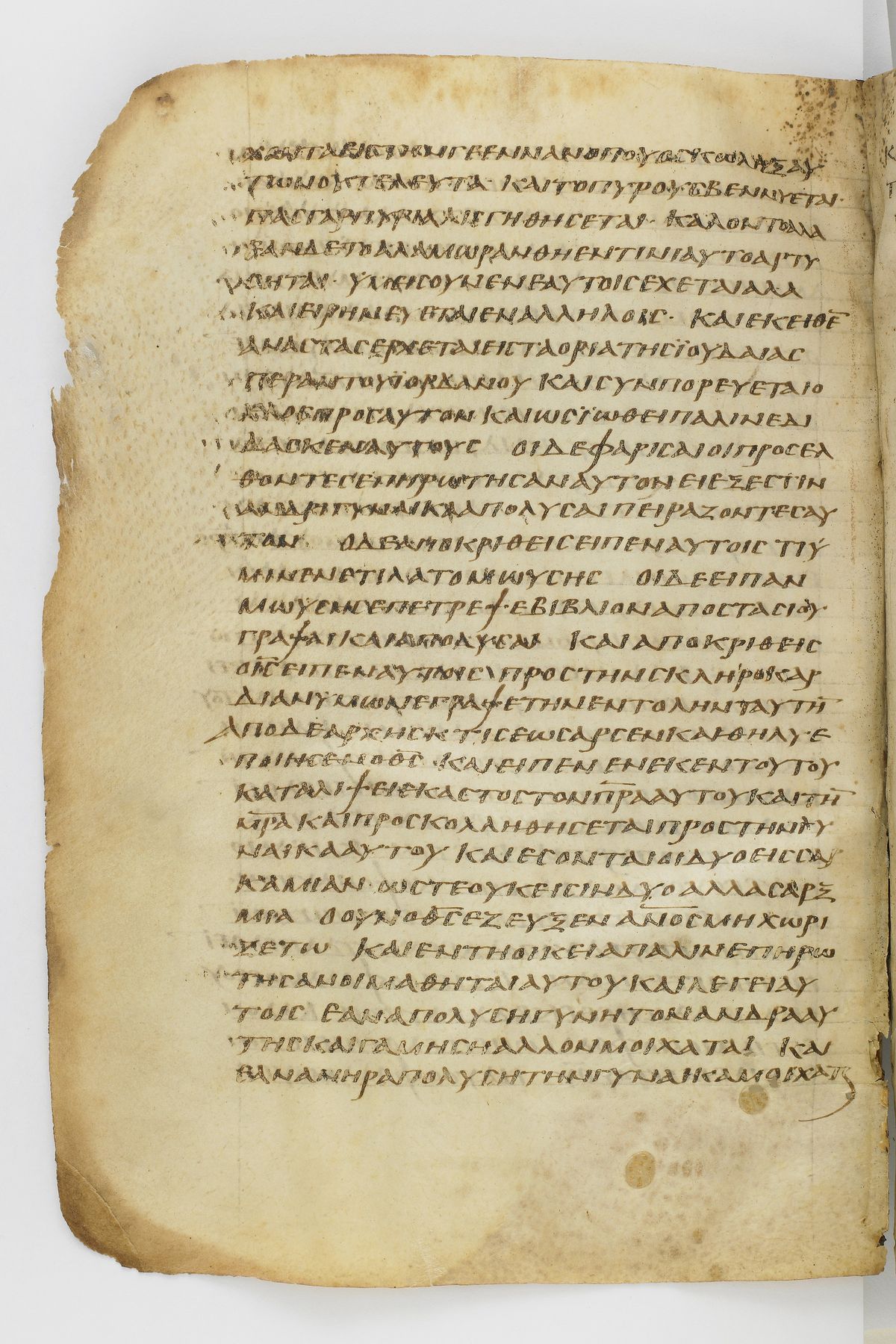
Where on the image
Page from the NTVMR transcription (docID 20032): verses 1-12 on CSNTM GA_032_0348.
1και εκειθεν αναστας ερχεται εις τα ορια της ιουδαιας περαν του ιορδανου και συνπορευεται οχλος προς αυτον και ως ιωθει παλιν εδιδασκεν αυτους 2οι δε φαρισαιοι προσελθοντες επηρωτησαν αυτον ει εξεστιν ανδρι γυναικα απολυσαι πειραζοντες αυτον · 3ο δε αποκριθεις ειπεν αυτοις τι υμιν ενετιλατο μωυσης 4οι δε ειπαν μωυσης επετρεψε βιβλιον αποστασιου γραψαι και απολυσαι 5και αποκριθεις ο ις ειπεν αυτοις προς την σκληροκαρδιαν υμων εγραψε την εντολην ταυτην 6απο δε αρχης κτισεως αρσεν και θηλυ εποιησεν ο θς 7και ειπεν ενεκεν τουτου καταλιψει εκαστος τον πρα αυτου και την μρα και προσκολληθησεται προς την γυναικα αυτου 8και εσονται οι δυο εις σαρκα μιαν · ωστε ουκ εισιν δυο αλλα σαρξ μια 9ο ουν ο θς εζευξεν ανος μη χωριζετω 10και εν τη οικεια παλιν επηρωτησαν οι μαθηται αυτου 11και λεγει αυτοις εαν απολυση γυνη τον ανδρα αυτης και γαμηση αλλον μοιχαται 12και εαν ανηρ απολυση την γυναικα μοιχαται
Compare: Tischendorf 8th edition (1869)
1Καὶ ἐκεῖθεν ἀναστὰς ἔρχεται εἰς τὰ ὅρια τῆς Ἰουδαίας καὶ πέραν τοῦ Ἰορδάνου, καὶ συμπορεύονται πάλιν ὄχλοι πρὸς αὐτόν, καὶ ὡς εἰώθει πάλιν ἐδίδασκεν αὐτούς. 2καὶ προσελθόντες οἱ Φαρισαῖοι ἐπηρώτων αὐτὸν εἰ ἔξεστιν ἀνδρὶ γυναῖκα ἀπολῦσαι, πειράζοντες αὐτόν. 3ὁ δὲ ἀποκριθεὶς εἶπεν αὐτοῖς· τί ὑμῖν ἐνετείλατο Μωϋσῆς; 4οἱ δὲ εἶπαν· ἐπέτρεψεν Μωϋσῆς βιβλίον ἀποστασίου γράψαι καὶ ἀπολῦσαι. 5ὁ δὲ Ἰησοῦς εἶπεν αὐτοῖς· πρὸς τὴν σκληροκαρδίαν ὑμῶν ἔγραψεν ὑμῖν τὴν ἐντολὴν ταύτην. 6ἀπὸ δὲ ἀρχῆς κτίσεως ἄρσεν καὶ θῆλυ ἐποίησεν αὐτούς· 7ἕνεκεν τούτου καταλείψει ἄνθρωπος τὸν πατέρα αὐτοῦ καὶ τὴν μητέρα αὐτοῦ, 8καὶ ἔσονται οἱ δύο εἰς σάρκα μίαν, ὥστε οὐκέτι εἰσὶν δύο ἀλλὰ μία σάρξ. 9ὃ οὖν ὁ θεὸς συνέζευξεν, ἄνθρωπος μὴ χωριζέτω. 10καὶ εἰς τὴν οἰκίαν πάλιν οἱ μαθηταὶ περὶ τούτου ἐπηρώτων αὐτόν. 11καὶ λέγει αὐτοῖς· ὃς ἂν ἀπολύσῃ τὴν γυναῖκα αὐτοῦ καὶ γαμήσῃ ἄλλην, μοιχᾶται ἐπ’ αὐτήν· 12καὶ ἐὰν αὐτὴ ἀπολύσασα τὸν ἄνδρα αὐτῆς γαμήσῃ ἄλλον, μοιχᾶται.
1And he arose from thence, and cometh into the coasts of Judaea by the farther side of Jordan: and the people resort unto him again; and, as he was wont, he taught them again. 2And the Pharisees came to him, and asked him, Is it lawful for a man to put away his wife? tempting him. 3And he answered and said unto them, What did Moses command you? 4And they said, Moses suffered to write a bill of divorcement, and to put her away. 5And Jesus answered and said unto them, For the hardness of your heart he wrote you this precept. 6But from the beginning of the creation God made them male and female. 7For this cause shall a man leave his father and mother, and cleave to his wife; 8And they twain shall be one flesh: so then they are no more twain, but one flesh. 9What therefore God hath joined together, let not man put asunder. 10And in the house his disciples asked him again of the same matter. 11And he saith unto them, Whosoever shall put away his wife, and marry another, committeth adultery against her. 12And if a woman shall put away her husband, and be married to another, she committeth adultery.
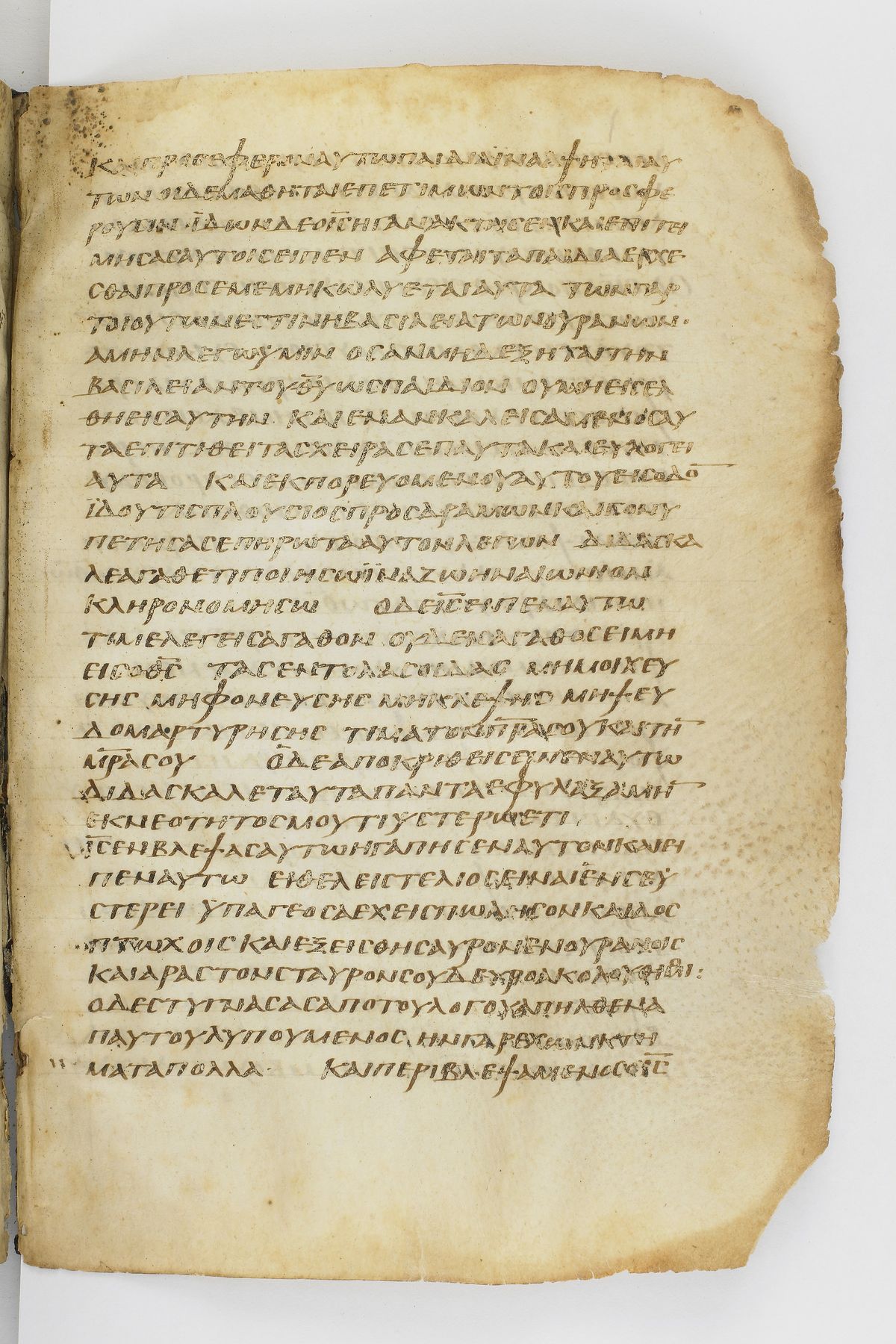
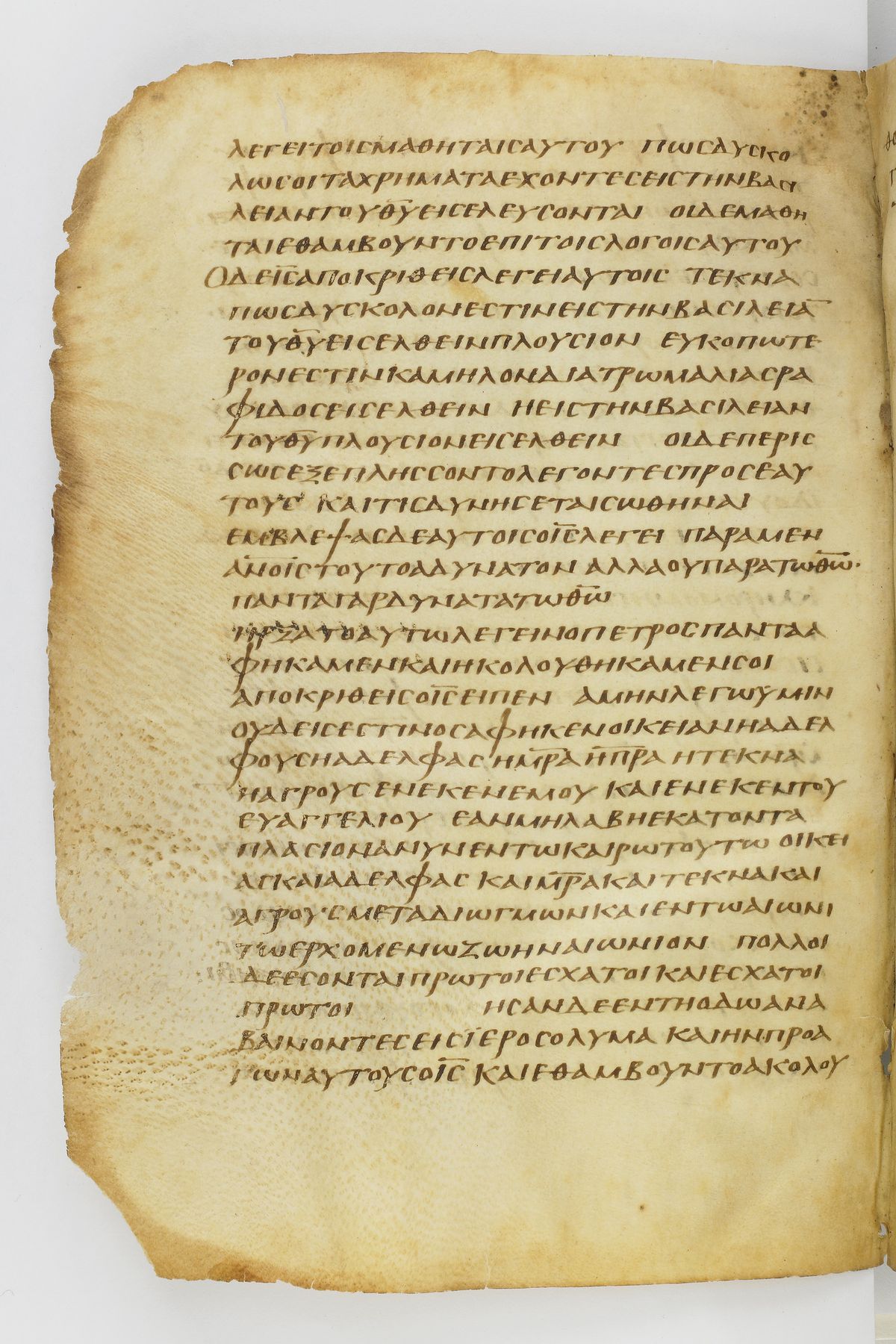
Where on the image
Page from the NTVMR transcription (docID 20032): verses 13-23 on CSNTM GA_032_0349; verse 23 continues on CSNTM GA_032_0350 (which begins 'λεγει τοις μαθηταις').
13και προσεφερο̣ν αυτω παιδια ινα αψηται αυτων οι δε μαθηται επετιμων τοις προσφερουσιν 14ιδων δε ο ις ηγανακτησεν και επιτειμησας αυτοις ειπεν αφεται τα παιδια ερχεσθαι προς εμε μη κωλυεται αυτα των γαρ τοιουτων εστιν η βασιλεια των ουρανων · 15αμην λεγω υμιν ος αν μη δεξηται την βασιλειαν του θυ ως παιδιον ου μη εισελθη εις αυτην 16και ενανκαλεισαμενος αυτα επιτιθει τας χειρας επ αυτα και ευλογει αυτα 17και εκπορευομενου αυτου εις οδον ιδου τις πλουσιος προσδραμων και γονυπετησας επηρωτα αυτον λεγων διδασκαλε αγαθε τι ποιησω ινα ζωην αιωνιον κληρονομησω 18ο δε ις ειπεν αυτω τι με λεγεις αγαθον ουδεις αγαθος ει μη εις ο θς 19τας εντολας οιδας μη μοιχευσης μη φονευσης μη κλεψης μη ψευδομαρτυρησης τιμα τον πρα σου και την μρα σου 20ο δε αποκριθεις ειπεν αυτω διδασκαλε ταυτα παντα εφυλαξαμην εκ νεοτητος μου τι υστερω ετι 21ις ενβλεψας αυτω ηγαπησεν αυτον και ειπεν αυτω ει θελεις τελιος ειναι εν σε υστερει υπαγε οσα εχεις πωλησον και δος πτωχοις και εξεις θησαυρον εν ουρανοις και αρας τον σταυρον σου δευρο ακολουθι μοι : 22ο δε στυγνασας απο του λογου απηλθεν απ αυτου λυπουμενος ην γαρ εχων κτηματα πολλα · 23και περιβλεψαμενος ο ις λεγει τοις μαθηταις αυτου πως δυσκολως οι τα χρηματα εχοντες εις την βασιλειαν του θυ εισελευσονται
Compare: Tischendorf 8th edition (1869)
13Καὶ προσέφερον αὐτῷ παιδία ἵνα ἅψηται αὐτῶν· οἱ δὲ μαθηταὶ ἐπετίμων τοῖς προσφέρουσιν 14ἰδὼν δὲ ὁ Ἰησοῦς ἠγανάκτησεν καὶ εἶπεν αὐτοῖς· ἄφετε τὰ παιδία ἔρχεσθαι πρός με, μὴ κωλύετε αὐτά· τῶν γὰρ τοιούτων ἐστὶν ἡ βασιλεία τοῦ θεοῦ. 15ἀμὴν λέγω ὑμῖν, ὃς ἂν μὴ δέξηται τὴν βασιλείαν τοῦ θεοῦ ὡς παιδίον, οὐ μὴ εἰσέλθῃ εἰς αὐτήν. 16καὶ ἐναγκαλισάμενος αὐτὰ κατευλόγει τιθεὶς τὰς χεῖρας ἐπ’ αὐτά. 17Καὶ ἐκπορευομένου αὐτοῦ εἰς ὁδὸν, προσδραμὼν εἷς καὶ γονυπετήσας αὐτὸν ἐπηρώτα αὐτόν· διδάσκαλε ἀγαθέ, τί ποιήσω ἵνα ζωὴν αἰώνιον κληρονομήσω; 18ὁ δὲ Ἰησοῦς εἶπεν αὐτῷ· τί με λέγεις ἀγαθόν; οὐδεὶς ἀγαθὸς εἰ μὴ εἷς ὁ θεός. 19τὰς ἐντολὰς οἶδας· μὴ μοιχεύσῃς, μὴ φονεύσῃς, μὴ κλέψῃς, μὴ ψευδομαρτυρήσῃς, μὴ ἀποστερήσῃς, τίμα τὸν πατέρα σου καὶ τὴν μητέρα σου. 20ὁ δὲ ἔφη αὐτῷ· διδάσκαλε, ταῦτα πάντα ἐφυλαξάμην ἐκ νεότητός μου. 21ὁ δὲ Ἰησοῦς ἐμβλέψας αὐτῷ ἠγάπησεν αὐτὸν καὶ εἶπεν αὐτῷ· ἕν σε ὑστερεῖ· ὕπαγε, ὅσα ἔχεις πώλησον καὶ δὸς τοῖς πτωχοῖς, καὶ ἕξεις θησαυρὸν ἐν οὐρανῷ, καὶ δεῦρο ἀκολούθει μοι. 22ὁ δὲ στυγνάσας ἐπὶ τῷ λόγῳ ἀπῆλθεν λυπούμενος· ἦν γὰρ ἔχων κτήματα πολλά. 23καὶ περιβλεψάμενος ὁ Ἰησοῦς λέγει τοῖς μαθηταῖς αὐτοῦ· πῶς δυσκόλως οἱ τὰ χρήματα ἔχοντες εἰς τὴν βασιλείαν τοῦ θεοῦ εἰσελεύσονται.
13And they brought young children to him, that he should touch them: and his disciples rebuked those that brought them. 14But when Jesus saw it, he was much displeased, and said unto them, Suffer the little children to come unto me, and forbid them not: for of such is the kingdom of God. 15Verily I say unto you, Whosoever shall not receive the kingdom of God as a little child, he shall not enter therein. 16And he took them up in his arms, put his hands upon them, and blessed them. 17And when he was gone forth into the way, there came one running, and kneeled to him, and asked him, Good Master, what shall I do that I may inherit eternal life? 18And Jesus said unto him, Why callest thou me good? there is none good but one, that is, God. 19Thou knowest the commandments, Do not commit adultery, Do not kill, Do not steal, Do not bear false witness, Defraud not, Honour thy father and mother. 20And he answered and said unto him, Master, all these have I observed from my youth. 21Then Jesus beholding him loved him, and said unto him, One thing thou lackest: go thy way, sell whatsoever thou hast, and give to the poor, and thou shalt have treasure in heaven: and come, take up the cross, and follow me. 22And he was sad at that saying, and went away grieved: for he had great possessions. 23And Jesus looked round about, and saith unto his disciples, How hardly shall they that have riches enter into the kingdom of God!
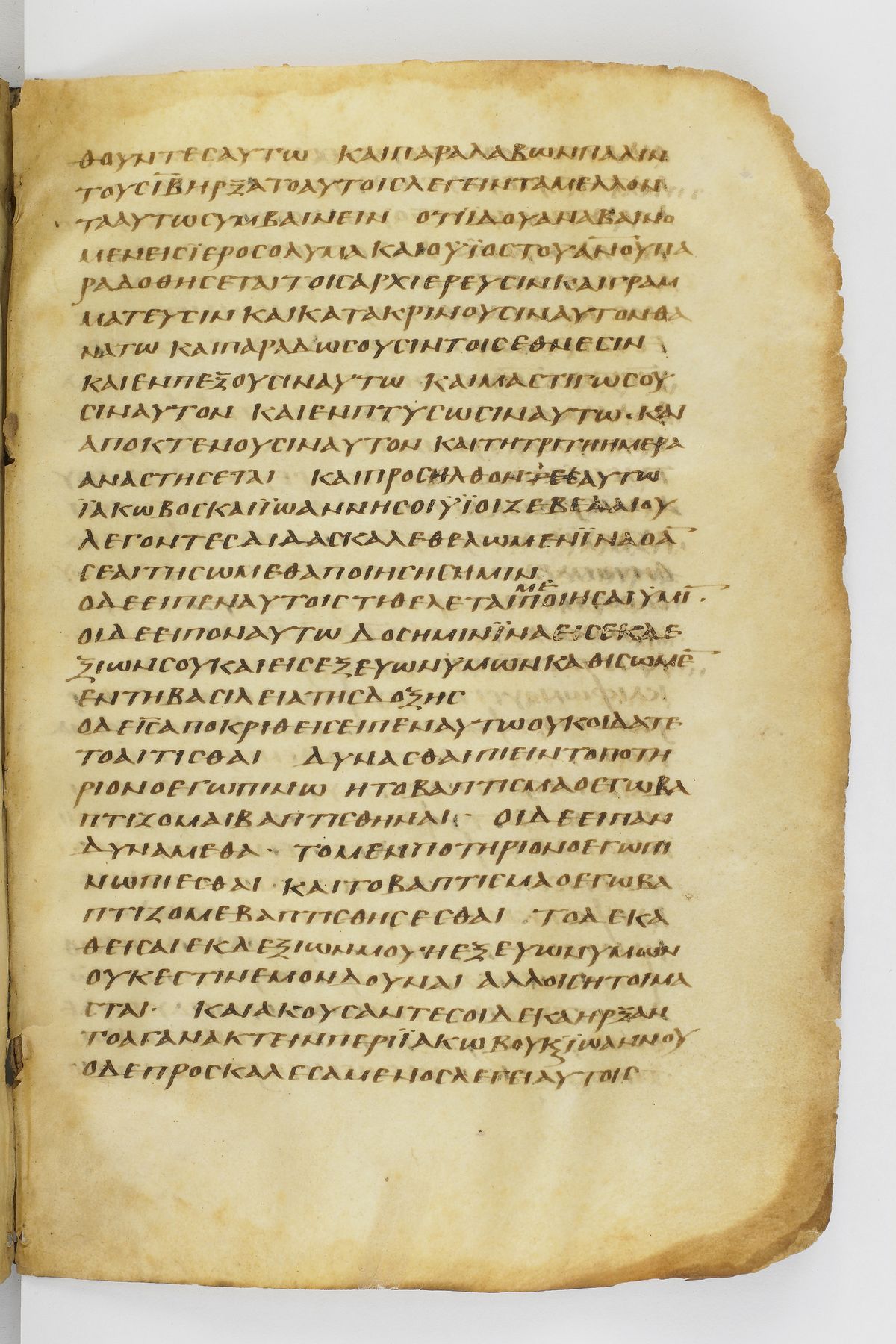
Where on the image
Page from the NTVMR transcription (docID 20032): verses 24-32 on CSNTM GA_032_0350; verse 32 continues on CSNTM GA_032_0351 (which begins 'θουντες αυτω και').
24οι δε μαθηται εθαμβουντο επι τοις λογοις αυτου ο δε ις αποκριθεις λεγει αυτοις τεκνα πως δυσκολον εστιν εις την βασιλειαν του θυ εισελθειν πλουσιον 25ευκοπωτερον εστιν καμηλον δια τρωμαλιας ραφιδος εισελθειν η εις την βασιλειαν του θυ πλουσιον εισελθειν 26οι δε περισσως εξεπλησσοντο λεγοντες προς εαυτους και τις δυνησεται σωθηναι 27εμβλεψας δε αυτοις ο ις λεγει παρα μεν ανοις τουτο αδυνατον αλλα ου παρα τω θω · παντα γαρ δυνατα τω θω 28ηρξατο αυτω λεγειν ο πετρος παντα αφηκαμεν και ηκολουθηκαμεν σοι 29αποκριθεις ο ις ειπεν αμην λεγω υμιν ουδεις εστιν ος αφηκεν οικειαν η αδελφους η αδελφας η μρα η πρα η τεκνα η αγρους ενεκεν εμου και ενεκεν του ευαγγελιου 30εαν μη λαβη εκατονταπλασιονα νυν εν τω καιρω τουτω οικειας και αδελφας και μρα και τεκνα και αγρους μετα διωγμων και εν τω αιωνι τω ερχομενω ζωην αιωνιον 31πολλοι δε εσονται πρωτοι εσχατοι και εσχατοι πρωτοι 32ησαν δε εν τη οδω αναβαινοντες εις ιεροσολυμα και ην προαγων αυτους ο ις και εθαμβουντο ακολουθουντες αυτω και παραλαβων παλιν τους ιβ ηρξατο αυτοις λεγειν τα μελλοντα αυτω συμβαινειν
Compare: Tischendorf 8th edition (1869)
24οἱ δὲ μαθηταὶ ἐθαμβοῦντο ἐπὶ τοῖς λόγοις αὐτοῦ. ὁ δὲ Ἰησοῦς πάλιν ἀποκριθεὶς λέγει αὐτοῖς· τέκνα, πῶς δύσκολόν ἐστιν εἰς τὴν βασιλείαν τοῦ θεοῦ εἰσελθεῖν· 25εὐκοπώτερόν ἐστιν κάμηλον διὰ τῆς τρυμαλιᾶς τῆς ῥαφίδος διελθεῖν ἢ πλούσιον εἰς τὴν βασιλείαν τοῦ θεοῦ εἰσελθεῖν. 26οἱ δὲ περισσῶς ἐξεπλήσσοντο λέγοντες πρὸς ἑαυτούς, καὶ τίς δύναται σωθῆναι; 27ἐμβλέψας αὐτοῖς ὁ Ἰησοῦς λέγει· παρὰ ἀνθρώποις ἀδύνατον, ἀλλ’ οὐ παρὰ θεῷ· πάντα γὰρ δυνατὰ παρὰ τῷ θεῷ. 28Ἤρξατο λέγειν ὁ Πέτρος αὐτῷ· ἰδοὺ ἡμεῖς ἀφήκαμεν πάντα καὶ ἠκολουθήκαμέν σοι. 29ἔφη ὁ Ἰησοῦς, ἀμὴν λέγω ὑμῖν, οὐδείς ἐστιν ὃς ἀφῆκεν οἰκίαν ἢ ἀδελφοὺς ἢ ἀδελφὰς ἢ μητέρα ἢ πατέρα ἢ τέκνα ἢ ἀγροὺς ἕνεκεν ἐμοῦ καὶ ἕνεκεν τοῦ εὐαγγελίου, 30ἐὰν μὴ λάβῃ ἑκατονταπλασίονα νῦν ἐν τῷ καιρῷ τούτῳ οἰκίας καὶ ἀδελφοὺς καὶ ἀδελφὰς καὶ μητέρας καὶ τέκνα καὶ ἀγροὺς μετὰ διωγμῶν, καὶ ἐν τῷ αἰῶνι τῷ ἐρχομένῳ ζωὴν αἰώνιον. 31πολλοὶ δὲ ἔσονται πρῶτοι ἔσχατοι καὶ οἱ ἔσχατοι πρῶτοι. 32Ἦσαν δὲ ἐν τῇ ὁδῷ ἀναβαίνοντες εἰς Ἱεροσόλυμα, καὶ ἦν προάγων αὐτοὺς ὁ Ἰησοῦς, καὶ ἐθαμβοῦντο, οἱ δὲ ἀκολουθοῦντες ἐφοβοῦντο. καὶ παραλαβὼν πάλιν τοὺς δώδεκα ἤρξατο αὐτοῖς λέγειν τὰ μέλλοντα αὐτῷ συμβαίνειν,
24And the disciples were astonished at his words. But Jesus answereth again, and saith unto them, Children, how hard is it for them that trust in riches to enter into the kingdom of God! 25It is easier for a camel to go through the eye of a needle, than for a rich man to enter into the kingdom of God. 26And they were astonished out of measure, saying among themselves, Who then can be saved? 27And Jesus looking upon them saith, With men it is impossible, but not with God: for with God all things are possible. 28Then Peter began to say unto him, Lo, we have left all, and have followed thee. 29And Jesus answered and said, Verily I say unto you, There is no man that hath left house, or brethren, or sisters, or father, or mother, or wife, or children, or lands, for my sake, and the gospel’s, 30But he shall receive an hundredfold now in this time, houses, and brethren, and sisters, and mothers, and children, and lands, with persecutions; and in the world to come eternal life. 31But many that are first shall be last; and the last first. 32And they were in the way going up to Jerusalem; and Jesus went before them: and they were amazed; and as they followed, they were afraid. And he took again the twelve, and began to tell them what things should happen unto him,
Where on the image
Page from the NTVMR transcription (docID 20032): verses 33-42 on CSNTM GA_032_0351; verse 42 continues on CSNTM GA_032_0352 (which begins 'οιδατε οτι οι').
33οτι ιδου αναβαινομεν εις ιεροσολυμα και ο υιος του ανου παραδοθησεται τοις αρχιερευσιν και γραμματευσιν και κατακρινουσιν αυτον θανατω και παραδωσουσιν τοις εθνεσιν 34και ενπεξουσιν αυτω και μαστιγωσουσιν αυτον και ενπτυσωσιν αυτω · και αποκτενουσιν αυτον και τη τριτη ημερα αναστησεται 35και προσελθοντες αυτω ιακωβος και ιωαννης οι υιοι ζεβεδαιου λεγοντες διδασκαλε θελωμεν ινα ο αν σε αιτησωμεθα ποιησης ημιν 36ο δε ειπεν αυτοις τι θελεται ποιησαι υμιν · 37οι δε ειπον αυτω δος ημιν ινα εις εκ δεξιων σου και εις εξ ευωνυμων καθισωμεν εν τη βασιλεια της δοξης 38ο δε ις αποκριθεις ειπεν αυτω ουκ οιδατε το αιτισθαι δυνασθαι πιειν το ποτηριον ο εγω πινω η το βαπτισμα ο εγω βαπτιζομαι βαπτισθηναι · 39οι δε ειπαν δυναμεθα · το μεν ποτηριον ο εγω πινω πιεσθαι · και το βαπτισμα ο εγω βαπτιζομε βαπτισθησεσθαι 40το δε καθεισαι εκ δεξιων μου η εξ ευωνυμων ουκ εστιν εμον δουναι αλλ οις ητοιμασται · 41και ακουσαντες οι δεκα ηρξαντο αγανακτειν περι ιακωβου και ιωαννου 42ο δε προσκαλεσαμενος λεγει αυτοις οιδατε οτι οι δοκουντες αρχειν των εθνων κατακυριευουσιν αυτων και ου μεγαλοι αυτων κατεξουσιαζουσιν
Compare: Tischendorf 8th edition (1869)
33ὅτι ἰδοὺ ἀναβαίνομεν εἰς Ἱεροσόλυμα, καὶ ὁ υἱὸς τοῦ ἀνθρώπου παραδοθήσεται τοῖς ἀρχιερεῦσιν καὶ τοῖς γραμματεῦσιν, καὶ κατακρινοῦσιν αὐτὸν θανάτῳ καὶ παραδώσουσιν αὐτὸν τοῖς ἔθνεσιν 34καὶ ἐμπαίξουσιν αὐτῷ καὶ ἐμπτύσουσιν αὐτῷ καὶ μαστιγώσουσιν αὐτὸν καὶ ἀποκτενοῦσιν, καὶ μετὰ τρεῖς ἡμέρας ἀναστήσεται. 35Καὶ προσπορεύονται αὐτῷ Ἰάκωβος καὶ Ἰωάννης οἱ υἱοὶ Ζεβεδαίου, λέγοντες αὐτῷ, διδάσκαλε, θέλομεν ἵνα ὃ ἐὰν αἰτήσωμέν σε ποιήσῃς ἡμῖν. 36ὁ δὲ εἶπεν αὐτοῖς· τί θέλετέ με ποιήσω ὑμῖν; 37οἱ δὲ εἶπαν αὐτῷ, δὸς ἡμῖν ἵνα εἷς σου ἐκ δεξιῶν καὶ εἷς σου ἐξ ἀριστερῶν καθίσωμεν ἐν τῇ δόξῃ σου. 38ὁ δὲ Ἰησοῦς εἶπεν αὐτοῖς· οὐκ οἴδατε τί αἰτεῖσθε. δύνασθε πιεῖν τὸ ποτήριον ὃ ἐγὼ πίνω, ἢ τὸ βάπτισμα ὃ ἐγὼ βαπτίζομαι βαπτισθῆναι; 39οἱ δὲ εἶπαν αὐτῷ· δυνάμεθα. ὁ δὲ Ἰησοῦς εἶπεν αὐτοῖς· τὸ ποτήριον ὃ ἐγὼ πίνω πίεσθε καὶ τὸ βάπτισμα ὃ ἐγὼ βαπτίζομαι βαπτισθήσεσθε· 40τὸ δὲ καθίσαι ἐκ δεξιῶν μου ἢ ἐξ εὐωνύμων οὐκ ἔστιν ἐμὸν δοῦναι, ἀλλ’ οἷς ἡτοίμασται. 41Καὶ ἀκούσαντες οἱ δέκα ἤρξαντο ἀγανακτεῖν περὶ Ἰακώβου καὶ Ἰωάννου. 42καὶ προσκαλεσάμενος αὐτοὺς ὁ Ἰησοῦς λέγει αὐτοῖς· οἴδατε ὅτι οἱ δοκοῦντες ἄρχειν τῶν ἐθνῶν κατακυριεύουσιν αὐτῶν καὶ οἱ μεγάλοι αὐτῶν κατεξουσιάζουσιν αὐτῶν.
33Saying,Behold, we go up to Jerusalem; and the Son of man shall be delivered unto the chief priests, and unto the scribes; and they shall condemn him to death, and shall deliver him to the Gentiles: 34And they shall mock him, and shall scourge him, and shall spit upon him, and shall kill him: and the third day he shall rise again. 35And James and John, the sons of Zebedee, come unto him, saying, Master, we would that thou shouldest do for us whatsoever we shall desire. 36And he said unto them, What would ye that I should do for you? 37They said unto him, Grant unto us that we may sit, one on thy right hand, and the other on thy left hand, in thy glory. 38But Jesus said unto them, Ye know not what ye ask: can ye drink of the cup that I drink of? and be baptized with the baptism that I am baptized with? 39And they said unto him, We can. And Jesus said unto them, Ye shall indeed drink of the cup that I drink of; and with the baptism that I am baptized withal shall ye be baptized: 40But to sit on my right hand and on my left hand is not mine to give; but it shall be given to them for whom it is prepared. 41And when the ten heard it, they began to be much displeased with James and John. 42But Jesus called them to him, and saith unto them, Ye know that they which are accounted to rule over the Gentiles exercise lordship over them; and their great ones exercise authority upon them.
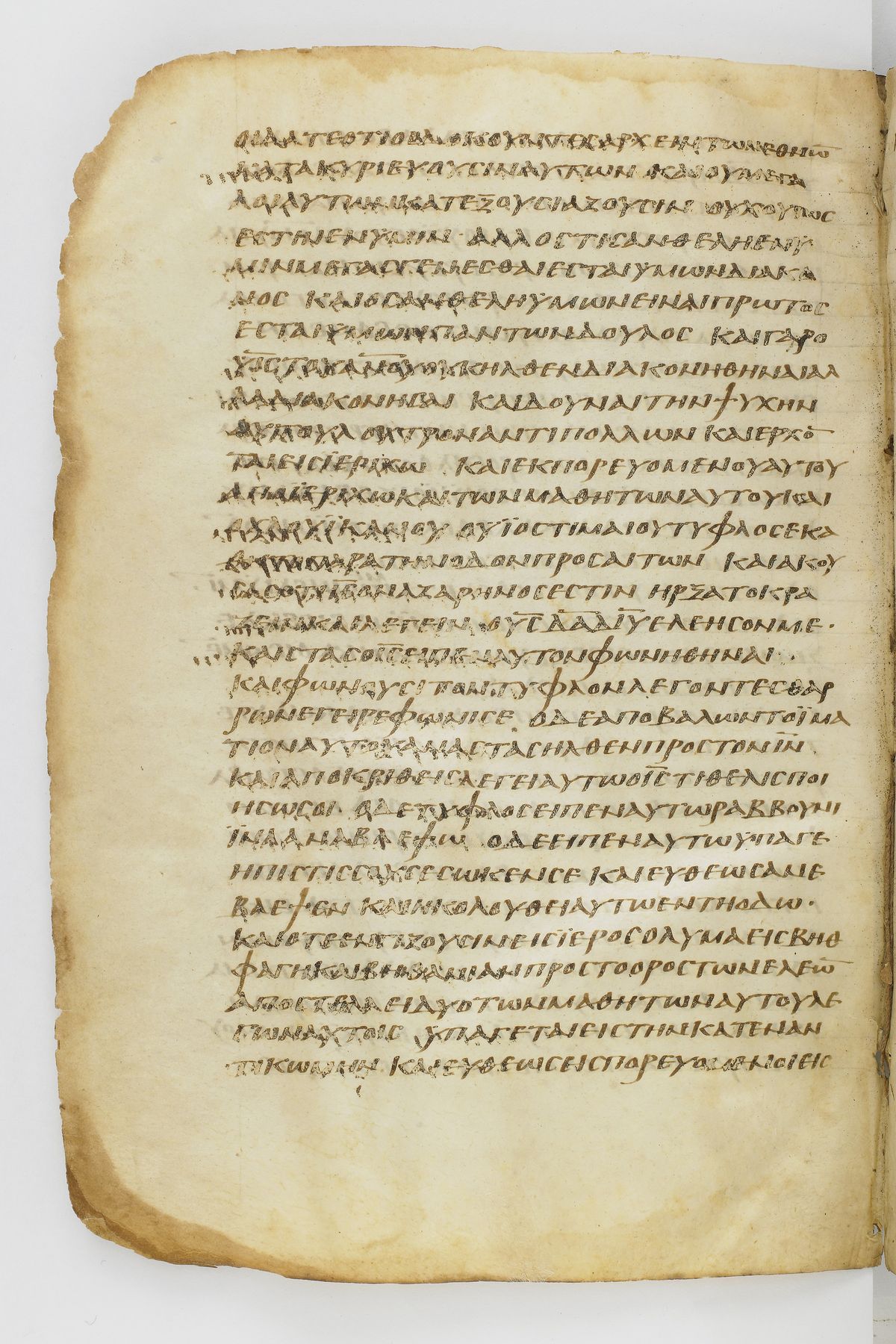
Where on the image
Page from the NTVMR transcription (docID 20032): verses 43-47, 49-52 on CSNTM GA_032_0352. Verse 48 is not in Codex Washingtonianus; the NTVMR transcription (docID 20032) shows the text passing over it on CSNTM GA_032_0352.
43ουχ ουτως εστιν εν υμιν · αλλ οστις αν θελη εν υμιν μεγας γενεσθαι εσται υμων διακονος 44και ος αν θελη υμων ειναι πρωτος εσται υμων παντων δουλος 45και γαρ ο υις του ανου ουκ ηλθεν διακονηθηναι αλλα διακονησαι και δουναι την ψυχην αυτου λουτρον αντι πολλων 46και ερχονται εις ιεριχω και εκπορευομενου αυτου απο ιεριχω και των μαθητων αυτου και οχλου ικανου ο υιος τιμαιου τυφλος εκαθητο παρα την οδον προσαιτων 47και ακουσας οτι ις ο ναζαρηνος εστιν ηρξατο κραζειν και λεγειν ο υς δαδ ιυ ελεησον με · 48[not in Codex Washingtonianus] 49και στας ο ις ειπεν αυτον φωνηθηναι · και φωνουσι τον τυφλον λεγοντες θαρρων εγειρε φωνι σε 50ο δε αποβαλων το ιματιον αυτου αναστας ηλθεν προς τον ιν 51και αποκριθεις λεγει αυτω ο ις τι θελις ποιησω σοι · ο δε τυφλος ειπεν αυτω ραββουνι ινα αναβλεψω 52ο δε ειπεν αυτω υπαγε η πιστις σου σεσωκεν σε και ευθεως ανεβλεψεν και ηκολουθει αυτω εν τη οδω ·
Compare: Tischendorf 8th edition (1869)
43οὐχ οὕτως δέ ἐστιν ἐν ὑμῖν· ἀλλ’ ὃς ἂν θέλῃ μέγας γενέσθαι ἐν ὑμῖν, ἔσται ὑμῶν διάκονος, 44καὶ ὃς ἂν θέλῃ ὑμῶν γενέσθαι πρῶτος, ἔσται πάντων δοῦλος· 45καὶ γὰρ ὁ υἱὸς τοῦ ἀνθρώπου οὐκ ἦλθεν διακονηθῆναι ἀλλὰ διακονῆσαι καὶ δοῦναι τὴν ψυχὴν αὐτοῦ λύτρον ἀντὶ πολλῶν. 46Καὶ ἔρχονται εἰς Ἰερειχώ. καὶ ἐκπορευομένου αὐτοῦ ἀπὸ Ἰερειχὼ καὶ τῶν μαθητῶν αὐτοῦ καὶ ὄχλου ἱκανοῦ ὁ υἱὸς Τιμαίου Βαρτιμαῖος, τυφλὸς προσαίτης, ἐκάθητο παρὰ τὴν ὁδόν. 47καὶ ἀκούσας ὅτι Ἰησοῦς ὁ Ναζαρηνός ἐστιν, ἤρξατο κράζειν καὶ λέγειν· υἱὲ Δαυεὶδ Ἰησοῦ, ἐλέησόν με. 48καὶ ἐπετίμων αὐτῷ πολλοὶ ἵνα σιωπήσῃ· ὁ δὲ πολλῷ μᾶλλον ἔκραζεν, υἱὲ Δαυείδ, ἐλέησόν με. 49καὶ στὰς ὁ Ἰησοῦς εἶπεν· φωνήσατε αὐτόν. καὶ φωνοῦσιν τὸν τυφλὸν λέγοντες αὐτῷ· θάρσει, ἔγειρε, φωνεῖ σε. 50ὁ δὲ ἀποβαλὼν τὸ ἱμάτιον αὐτοῦ ἀναπηδήσας ἦλθεν πρὸς τὸν Ἰησοῦν. 51καὶ ἀποκριθεὶς αὐτῷ ὁ Ἰησοῦς εἶπεν· τί σοι θέλεις ποιήσω; ὁ δὲ τυφλὸς εἶπεν αὐτῷ· ῥαββουνί, ἵνα ἀναβλέψω. 52ὁ δὲ Ἰησοῦς εἶπεν αὐτῷ, ὕπαγε, ἡ πίστις σου σέσωκέν σε. καὶ εὐθὺς ἀνέβλεψεν, καὶ ἠκολούθει αὐτῷ ἐν τῇ ὁδῷ.
43But so shall it not be among you: but whosoever will be great among you, shall be your minister: 44And whosoever of you will be the chiefest, shall be servant of all. 45For even the Son of man came not to be ministered unto, but to minister, and to give his life a ransom for many. 46And they came to Jericho: and as he went out of Jericho with his disciples and a great number of people, blind Bartimaeus, the son of Timaeus, sat by the highway side begging. 47And when he heard that it was Jesus of Nazareth, he began to cry out, and say, Jesus, thou Son of David, have mercy on me. 48And many charged him that he should hold his peace: but he cried the more a great deal, Thou Son of David, have mercy on me. 49And Jesus stood still, and commanded him to be called. And they call the blind man, saying unto him, Be of good comfort, rise; he calleth thee. 50And he, casting away his garment, rose, and came to Jesus. 51And Jesus answered and said unto him, What wilt thou that I should do unto thee? The blind man said unto him, Lord, that I might receive my sight. 52And Jesus said unto him, Go thy way; thy faith hath made thee whole. And immediately he received his sight, and followed Jesus in the way.
Cite
Sources
- Source: Codex Washingtonianus page images + NTVMR transcription (CC BY 4.0) + Tischendorf 8th edition + KJV (holding institution)
- Critical edition: Codex Washingtonianus transcription, NTVMR (INTF Münster, CC BY 4.0); Tischendorf 8th edition for comparison
← previous · → next · v cycle view · l back to library