Mark, Chapter 11 (Codex Washingtonianus)
Introduction
Mark 11 from Codex Washingtonianus (the Freer Gospels, Gregory-Aland 032, Freer Gallery of Art F1906.274), a parchment codex of the four Gospels written in Egypt in the late 4th or early 5th century and bought by Charles Lang Freer from the dealer Ali Arabi at Giza in 1906. It is one of the oldest nearly complete Gospel books in existence. The Gospels stand in the so-called Western order, Matthew, John, Luke, Mark, and the text is famously block-mixed: the copyist drew on several exemplars of different textual character, so the text type changes in blocks within a single Gospel. After Mark 16:14 the codex carries the Freer Logion, a saying found in no other manuscript. Two passages are lost to damage: Mark 15:13-37 and John 14:26-16:6.
- Scan: each section is shown with the actual page of the codex that carries those verses, from the Freer Gallery's own photographs of F1906.274 served by the Smithsonian IIIF service (ids.si.edu). Which page holds which verse comes from the verse index of the Center for the Study of New Testament Manuscripts (CSNTM), whose photographs of the codex are the same shots; every CSNTM page was matched to its Smithsonian image by pixel comparison before use. Where a verse begins on one page and ends on the next, both pages are listed. For this chapter the page of each verse is taken from the transcription itself, which records where every page begins; CSNTM's index confirms which photograph shows that page.
- Greek: the manuscript's own text, from a diplomatic transcription (see Greek text below), with Tischendorf's 8th critical edition (1869) for comparison.
- English: the King James Version (1611, public domain), verbatim from bible-api.com. The KJV translates the later Byzantine text, so it will not always match the Greek shown or the reading of the codex.
Greek text: a diplomatic transcription of Codex Washingtonianus made by the Institut für Neutestamentliche Textforschung (INTF), Münster, for the New Testament Virtual Manuscript Room (NTVMR), published under a Creative Commons Attribution 4.0 licence. It gives the letters as the first scribe wrote them: no accents or breathings, the scribe's own spelling, and the sacred names in their contracted form (θς for θεος, ις for ιησους, κς for κυριος; the overline is not reproduced). Corrections by later hands are not shown. Letters in square brackets are not legible on the page and were restored by the transcribers, a dot under a letter marks an uncertain reading, and [...] marks text lost to damage. Beneath each section, for comparison, is Tischendorf's 8th critical edition (1869). Where the two differ, the transcription is what the manuscript says. Each section is shown with the page on which the transcription places its verses.
Manuscript note: Not written in Codex Washingtonianus: verse 26. The English is shown with a bracketed note in the Greek column.
How was this verified? (Provenance)
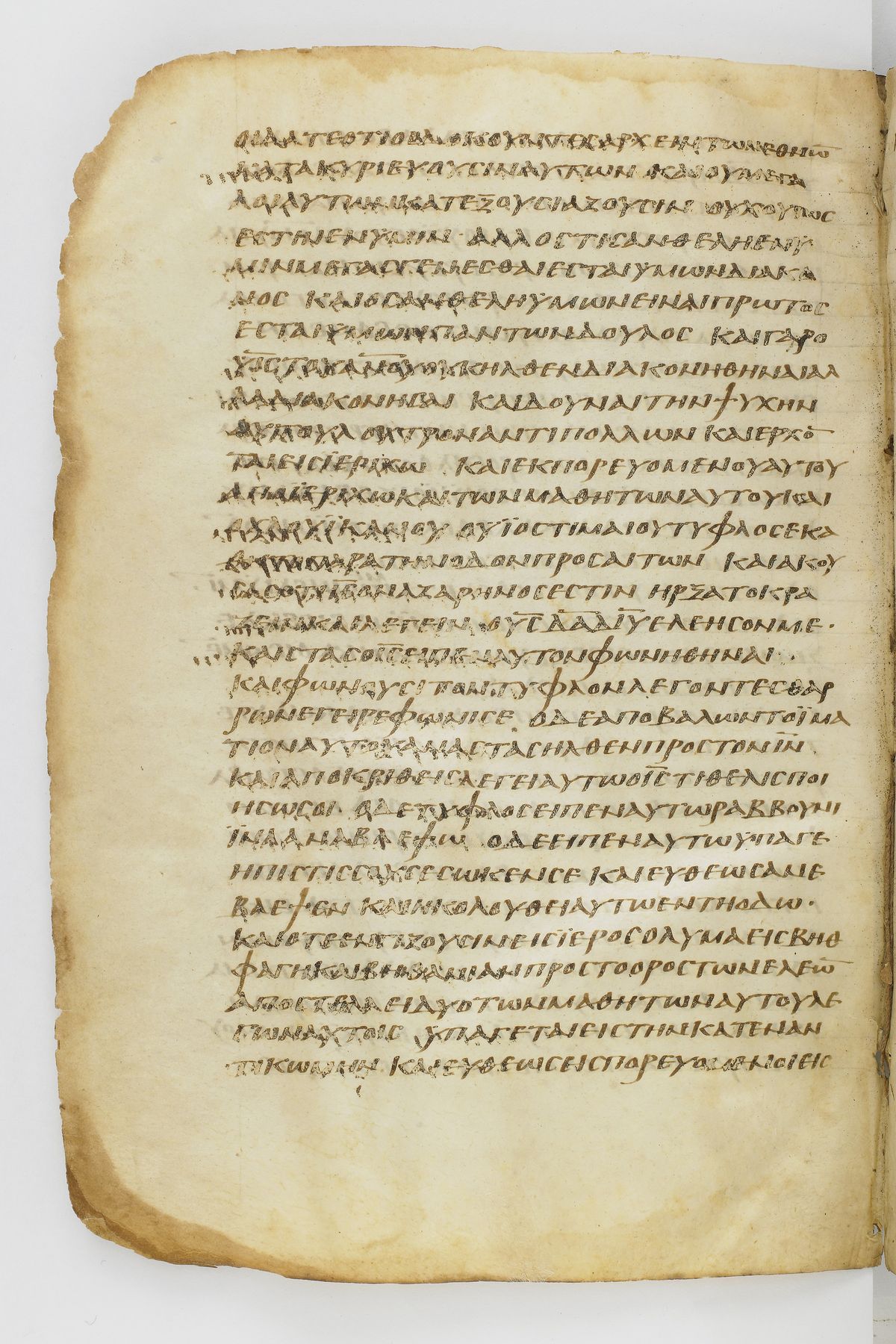
Where on the image
Page from the NTVMR transcription (docID 20032): verses 1-2 on CSNTM GA_032_0352; verse 2 continues on CSNTM GA_032_0353 (which begins 'αυτην ευρησεται πωλον̣').
1και οτε ενγιζουσιν εις ιεροσολυμα εις βηθφαγη και βηθανιαν προς το ορος των ελεων αποστελλει δυο των μαθητων αυτου 2λεγων αυτοις υπαγεται εις την κατεναντι κωμην . και ευθεως εισπορευομενοι εις αυτην ευρησεται πωλον̣ δεδεμενον ω ουπω ουδεις ανων επικεκαθεικεν λυσαντες αυτον αγαγετε
Compare: Tischendorf 8th edition (1869)
1Καὶ ὅτε ἐγγίζουσιν εἰς Ἱεροσόλυμα καὶ εἰς Βηθανίαν πρὸς τὸ ὄρος τῶν ἐλαιῶν, ἀποστέλλει δύο τῶν μαθητῶν αὐτοῦ 2καὶ λέγει αὐτοῖς· ὑπάγετε εἰς τὴν κώμην τὴν κατέναντι ὑμῶν, καὶ εὐθὺς εἰσπορευόμενοι εἰς αὐτὴν εὑρήσετε πῶλον δεδεμένον, ἐφ’ ὃν οὐδεὶς ἀνθρώπων οὔπω κεκάθικεν· λύσατε αὐτὸν καὶ φέρετε.
1And when they came nigh to Jerusalem, unto Bethphage and Bethany, at the mount of Olives, he sendeth forth two of his disciples, 2And saith unto them, Go your way into the village over against you: and as soon as ye be entered into it, ye shall find a colt tied, whereon never man sat; loose him, and bring him.
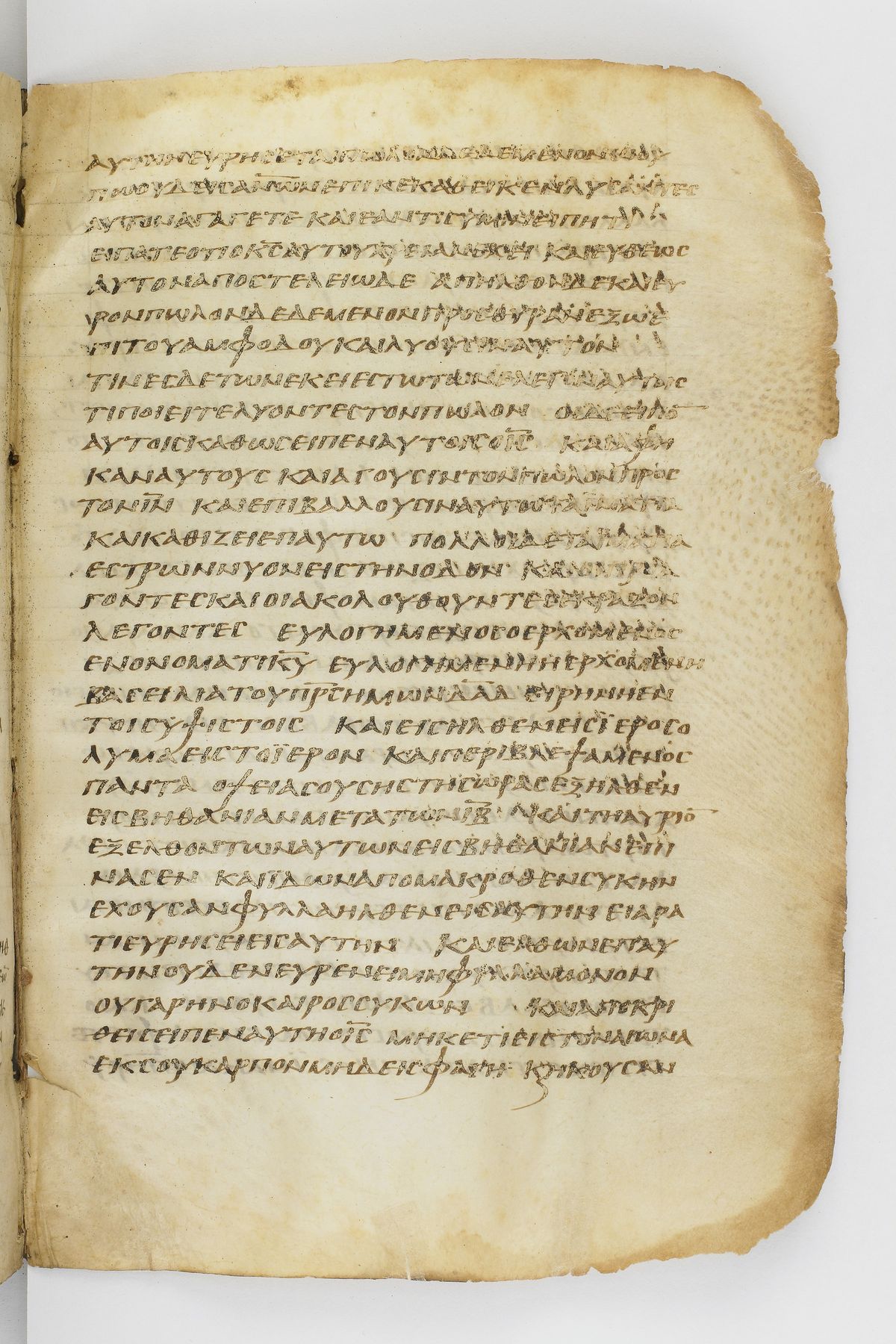
Where on the image
Page from the NTVMR transcription (docID 20032): verses 3-14 on CSNTM GA_032_0353; verse 14 continues on CSNTM GA_032_0354 (which begins 'οι μαθηται αυτου').
3και εαν τις υμιν ειπη τι ειπατε οτι ο κς αυτου χρειαν εχει και ευθεως αυτον αποστελει ωδε 4απηλθον δε και ευρον πωλον δεδεμενον προς θυραν εξω επι του αμφοδου και λυουσιν αυτον 5τινες δε των εκει εστωτων ελεγον αυτοις τι ποιειτε λυοντες τον πωλον 6οι δε ειπον αυτοις καθως ειπεν αυτοις ο ις και αφηκαν αυτους 7και αγουσιν τον πωλον προς τον ιν και επιβαλλουσιν αυτω τα ιματια και καθιζει επ αυτω 8πολλοι δε τα ιματια εστρωννυον εις την οδον · 9και οι προαγοντες και οι ακολουθουντες εκραζον λεγοντες ευλογημενος ο ερχομενος εν ονοματι κυ 10ευλογημενη η ερχομενη βασειλια του πρς ημων δαδ ειρηνη εν τοις υψιστοις 11και εισηλθεν εις ιεροσολυμα εις το ιερον και περιβλεψαμενος παντα οψειας ουσης της ωρας εξηλθεν εις βηθανιαν μετα των ιβ · 12και τη αυριον εξελθοντων αυτων εις βηθανιαν επινασεν 13και ιδων απο μακροθεν συκην εχουσαν φυλλα ηλθεν εις αυτην ει αρα τι ευρησει εις αυτην και ελθων επ αυτην ουδεν ευρεν ει μη φυλλα μονον ου γαρ ην ο καιρος συκων 14και αποκριθεις ειπεν αυτη ο ις μηκετι εις τον αιωνα εκ σου καρπον μηδεις φαγη και ηκουσαν οι μαθηται αυτου
Compare: Tischendorf 8th edition (1869)
3καὶ ἐάν τις ὑμῖν εἴπῃ· τί ποιεῖτε τοῦτο; εἴπατε· ὁ κύριος αὐτοῦ χρείαν ἔχει, καὶ εὐθὺς αὐτὸν ἀποστέλλει πάλιν ὧδε. 4καὶ ἀπῆλθον καὶ εὗρον τὸν πῶλον δεδεμένον πρὸς τὴν θύραν ἔξω ἐπὶ τοῦ ἀμφόδου, καὶ λύουσιν αὐτόν. 5καί τινες τῶν ἐκεῖ ἑστηκότων ἔλεγον αὐτοῖς· τί ποιεῖτε λύοντες τὸν πῶλον; 6οἱ δὲ εἶπαν αὐτοῖς καθὼς εἶπεν ὁ Ἰησοῦς· καὶ ἀφῆκαν αὐτούς. 7καὶ φέρουσιν τὸν πῶλον πρὸς τὸν Ἰησοῦν, καὶ ἐπιβάλλουσιν αὐτῷ τὰ ἱμάτια αὐτῶν, καὶ ἐκάθισεν ἐπ’ αὐτόν. 8καὶ πολλοὶ τὰ ἱμάτια αὐτῶν ἔστρωσαν εἰς τὴν ὁδόν, ἄλλοι δὲ στιβάδας, κόψαντες ἐκ τῶν ἀγρῶν. 9καὶ οἱ προάγοντες καὶ οἱ ἀκολουθοῦντες ἔκραζον· ὡσαννά, εὐλογημένος ὁ ἐρχόμενος ἐν ὀνόματι κυρίου· 10εὐλογημένη ἡ ἐρχομένη βασιλεία τοῦ πατρὸς ἡμῶν Δαυείδ, ὡσαννὰ ἐν τοῖς ὑψίστοις. 11Καὶ εἰσῆλθεν εἰς Ἱεροσόλυμα εἰς τὸ ἱερόν· καὶ περιβλεψάμενος πάντα, ὀψὲ ἤδη οὔσης τῆς ὥρας, ἐξῆλθεν εἰς Βηθανίαν μετὰ τῶν δώδεκα. 12Καὶ τῇ ἐπαύριον ἐξελθόντων αὐτῶν ἀπὸ Βηθανίας ἐπείνασεν. 13καὶ ἰδὼν συκῆν ἀπὸ μακρόθεν ἔχουσαν φύλλα, ἦλθεν εἰ ἄρα τι εὑρήσει ἐν αὐτῇ, καὶ ἐλθὼν ἐπ’ αὐτὴν οὐδὲν εὗρεν εἰ μὴ φύλλα· ὁ γὰρ καιρὸς οὐκ ἦν σύκων. 14καὶ ἀποκριθεὶς εἶπεν αὐτῇ· μηκέτι εἰς τὸν αἰῶνα ἐκ σοῦ μηδεὶς καρπὸν φάγοι. καὶ ἤκουον οἱ μαθηταὶ αὐτοῦ.
3And if any man say unto you, Why do ye this? say ye that the Lord hath need of him; and straightway he will send him hither. 4And they went their way, and found the colt tied by the door without in a place where two ways met; and they loose him. 5And certain of them that stood there said unto them, What do ye, loosing the colt? 6And they said unto them even as Jesus had commanded: and they let them go. 7And they brought the colt to Jesus, and cast their garments on him; and he sat upon him. 8And many spread their garments in the way: and others cut down branches off the trees, and strawed them in the way. 9And they that went before, and they that followed, cried, saying, Hosanna; Blessed is he that cometh in the name of the Lord: 10Blessed be the kingdom of our father David, that cometh in the name of the Lord: Hosanna in the highest. 11And Jesus entered into Jerusalem, and into the temple: and when he had looked round about upon all things, and now the eventide was come, he went out unto Bethany with the twelve. 12And on the morrow, when they were come from Bethany, he was hungry: 13And seeing a fig tree afar off having leaves, he came, if haply he might find any thing thereon: and when he came to it, he found nothing but leaves; for the time of figs was not yet. 14And Jesus answered and said unto it, No man eat fruit of thee hereafter for ever. And his disciples heard it.
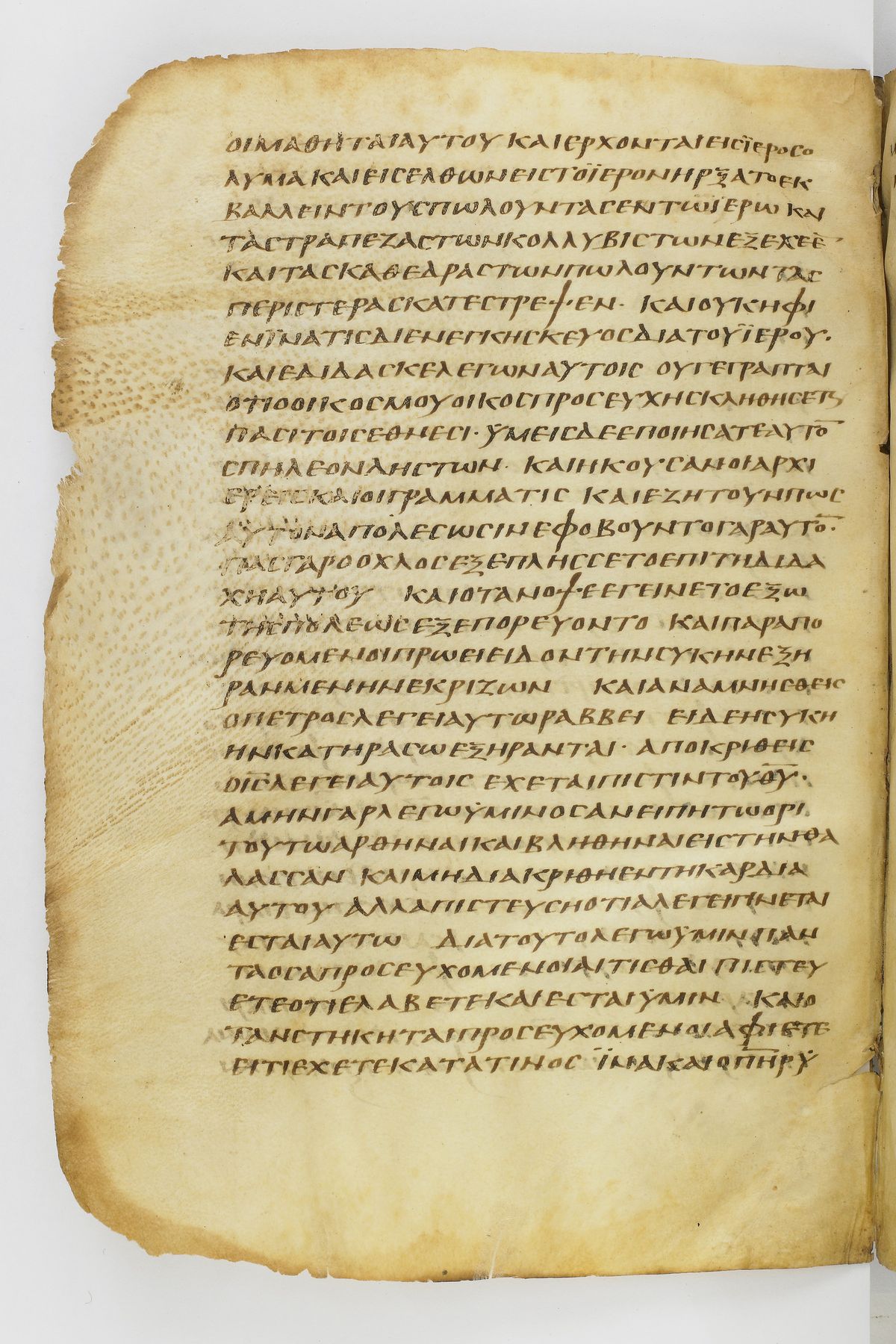
Where on the image
Page from the NTVMR transcription (docID 20032): verses 15-25 on CSNTM GA_032_0354; verse 25 continues on CSNTM GA_032_0355 (which begins 'μων ο εν').
15και ερχονται εις ιεροσολυμα και εισελθων εις το ιερον ηρξατο εκβαλλειν τους πωλουντας εν τω ιερω και τας τραπεζας των κολλυβιστων εξεχεεν και τας καθεδρας των πωλουντων τας περιστερας κατεστρεψεν · 16και ουκ ηφιεν ινα τις διενεγκη σκευος δια του ιερου · 17και εδιδασκε λεγων αυτοις ου γεγραπται οτι ο οικος μου οικος προσευχης κληθησεται πασι τοις εθνεσι · υμεις δε εποιησατε αυτον σπηλεον ληστων · 18και ηκουσαν οι αρχιερεις και οι γραμματις και εζητουν πως αυτον απολεσωσιν εφοβουντο γαρ αυτον · πας γαρ ο οχλος εξεπλησσετο επι τη διδαχη αυτου 19και οταν οψε εγεινετο εξω της πολεως εξεπορευοντο 20και παραπορευομενοι πρωει ειδον την συκην εξηρανμενην εκ ριζων 21και αναμνησθεις ο πετρος λεγει αυτω ραββει ειδε η συκη ην κατηρασω εξηρανται · 22αποκριθεις ο ις λεγει αυτοις εχεται πιστιν του θυ · 23αμην γαρ λεγω υμιν ος αν ειπη τω ορι . τουτω αρθηναι και βληθηναι εις την θαλασσαν και μη διακριθη εν τη καρδια αυτου αλλα πιστευση οτι α λεγει γινεται εσται αυτω 24δια τουτο λεγω υμιν παντα οσα προσευχομενοι αιτισθαι πιστευετε οτι ελαβετε και εσται υμιν 25και οταν στηκηται προσευχομενοι αφιετε ει τι εχετε κατα τινος ινα και ο πηρ υμων ο εν τοις ουρανοις ανη υμιν τα παραπτωματα υμων
Compare: Tischendorf 8th edition (1869)
15Καὶ ἔρχονται εἰς Ἱεροσόλυμα. καὶ εἰσελθὼν εἰς τὸ ἱερὸν ἤρξατο ἐκβάλλειν τοὺς πωλοῦντας καὶ τοὺς ἀγοράζοντας ἐν τῷ ἱερῷ, καὶ τὰς τραπέζας τῶν κολλυβιστῶν καὶ τὰς καθέδρας τῶν πωλούντων τὰς περιστερὰς κατέστρεψεν, 16καὶ οὐκ ἤφιεν ἵνα τις διενέγκῃ σκεῦος διὰ τοῦ ἱεροῦ, 17καὶ ἐδίδασκεν καὶ ἔλεγεν αὐτοῖς· οὐ γέγραπται ὅτι ὁ οἶκός μου οἶκος προσευχῆς κληθήσεται πᾶσιν τοῖς ἔθνεσιν; ὑμεῖς δὲ πεποιήκατε αὐτὸν σπήλαιον λῃστῶν. 18καὶ ἤκουσαν οἱ ἀρχιερεῖς καὶ οἱ γραμματεῖς, καὶ ἐζήτουν πῶς αὐτὸν ἀπολέσωσιν· ἐφοβοῦντο γὰρ αὐτόν, πᾶς γὰρ ὁ ὄχλος ἐξεπλήσσοντο ἐπὶ τῇ διδαχῇ αὐτοῦ. 19Καὶ ὅταν ὀψὲ ἐγένετο, ἐξεπορεύοντο ἔξω τῆς πόλεως. 20Καὶ παραπορευόμενοι πρωῒ εἶδον τὴν συκῆν ἐξηραμμένην ἐκ ῥιζῶν. 21καὶ ἀναμνησθεὶς ὁ Πέτρος λέγει αὐτῷ, ῥαββεί, ἴδε ἡ συκῆ ἣν κατηράσω ἐξήρανται. 22καὶ ἀποκριθεὶς ὁ Ἰησοῦς λέγει αὐτοῖς, ἔχετε πίστιν θεοῦ, 23ἀμὴν λέγω ὑμῖν ὅτι ὃς ἂν εἴπῃ τῷ ὄρει τούτῳ· ἄρθητι καὶ βλήθητι εἰς τὴν θάλασσαν, καὶ μὴ διακριθῇ ἐν τῇ καρδίᾳ αὐτοῦ, ἀλλὰ πιστεύῃ ὅτι ὃ λαλεῖ γίνεται, ἔσται αὐτῷ. 24διὰ τοῦτο λέγω ὑμῖν, πάντα ὅσα προσεύχεσθε καὶ αἰτεῖσθε, πιστεύετε ὅτι ἐλάβετε, καὶ ἔσται ὑμῖν. 25καὶ ὅταν στήκετε προσευχόμενοι, ἀφίετε εἴ τι ἔχετε κατά τινος, ἵνα καὶ ὁ πατὴρ ὑμῶν ὁ ἐν τοῖς οὐρανοῖς ἀφῇ ὑμῖν τὰ παραπτώματα ὑμῶν.
15And they come to Jerusalem: and Jesus went into the temple, and began to cast out them that sold and bought in the temple, and overthrew the tables of the moneychangers, and the seats of them that sold doves; 16And would not suffer that any man should carry any vessel through the temple. 17And he taught, saying unto them, Is it not written, My house shall be called of all nations the house of prayer? but ye have made it a den of thieves. 18And the scribes and chief priests heard it, and sought how they might destroy him: for they feared him, because all the people was astonished at his doctrine. 19And when even was come, he went out of the city. 20And in the morning, as they passed by, they saw the fig tree dried up from the roots. 21And Peter calling to remembrance saith unto him, Master, behold, the fig tree which thou cursedst is withered away. 22And Jesus answering saith unto them, Have faith in God. 23For verily I say unto you, That whosoever shall say unto this mountain, Be thou removed, and be thou cast into the sea; and shall not doubt in his heart, but shall believe that those things which he saith shall come to pass; he shall have whatsoever he saith. 24Therefore I say unto you, What things soever ye desire, when ye pray, believe that ye receive them, and ye shall havethem. 25And when ye stand praying, forgive, if ye have ought against any: that your Father also which is in heaven may forgive you your trespasses.
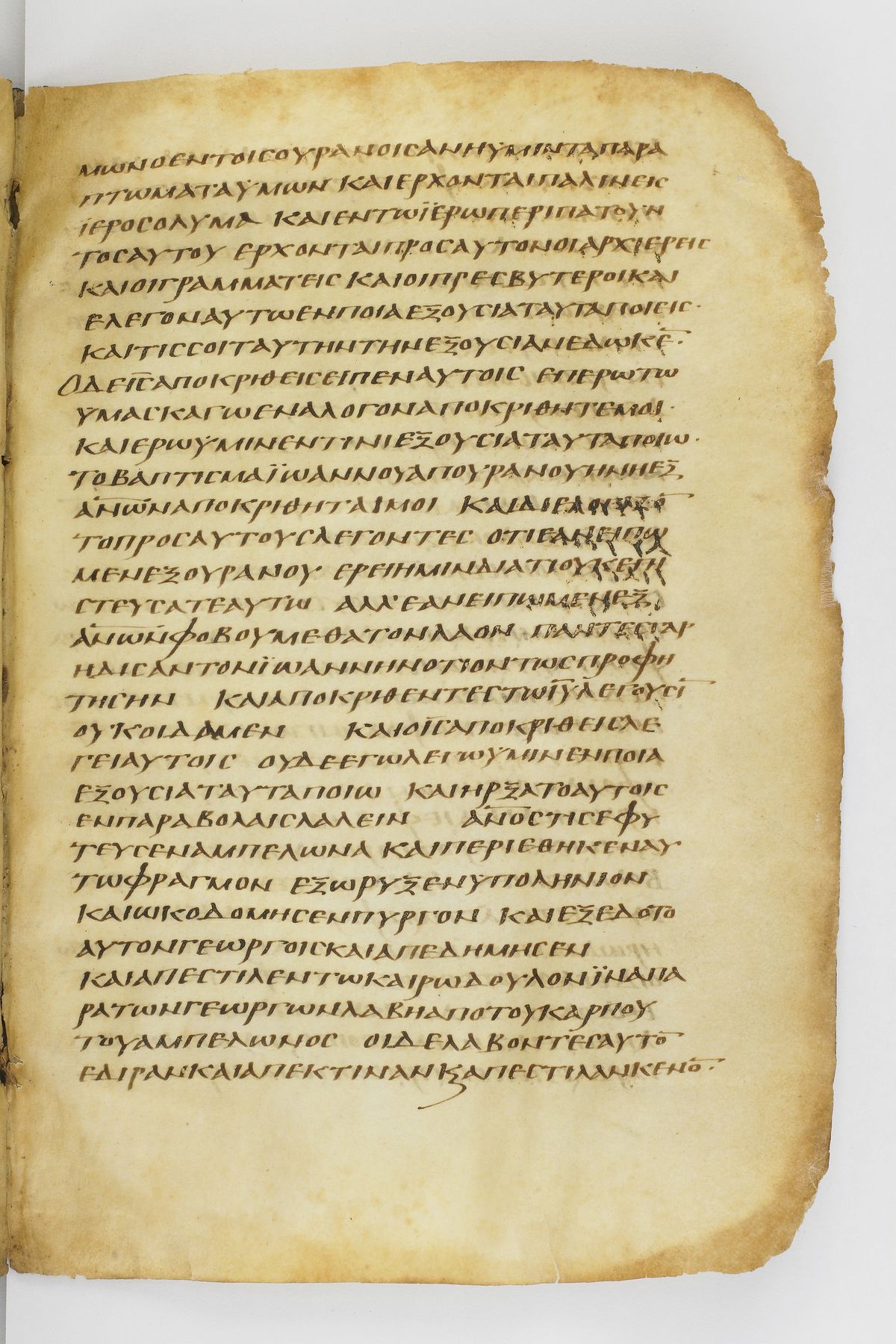
Where on the image
Page from the NTVMR transcription (docID 20032): verses 27-33 on CSNTM GA_032_0355. Verse 26 is not in Codex Washingtonianus; the NTVMR transcription (docID 20032) shows the text passing over it on CSNTM GA_032_0355.
26[not in Codex Washingtonianus] 27και ερχονται παλιν εις ιεροσολυμα και εν τω ιερω περιπατουντος αυτου ερχονται προς αυτον οι αρχιερεις και οι γραμματεις και οι πρεσβυτεροι 28και ελεγον αυτω εν ποια εξουσια ταυτα ποιεις · και τις σοι ταυτην την εξουσιαν εδωκεν · 29ο δε ις αποκριθεις ειπεν αυτοις επερωτω υμας καγω ενα λογον αποκριθητε μοι · και ερω υμιν εν τινι εξουσια ταυτα ποιω · 30το βαπτισμα ιωαννου απ ουρανου ην η εξ ανων αποκριθηται μοι 31και διελογιζοντο προς αυτους λεγοντες οτι εαν ειπωμεν εξ ουρανου ερει ημιν δια τι ουκ επιστευσατε αυτω 32αλλ εαν ειπωμεν εξ ανων φοβουμεθα τον λαον παντες γαρ ηδισαν τον ιωαννην οτι οντως προφητης ην 33και αποκριθεντες τω ιυ λεγουσιν ουκ οιδαμεν και ο ις αποκριθεις λεγει αυτοις ουδε εγω λεγω υμιν εν ποια εξουσια ταυτα ποιω
Compare: Tischendorf 8th edition (1869)
26 27Καὶ ἔρχονται πάλιν εἰς Ἱεροσόλυμα. καὶ ἐν τῷ ἱερῷ περιπατοῦντος αὐτοῦ ἔρχονται πρὸς αὐτὸν οἱ ἀρχιερεῖς καὶ οἱ γραμματεῖς καὶ οἱ πρεσβύτεροι 28καὶ ἔλεγον αὐτῷ· ἐν ποίᾳ ἐξουσίᾳ ταῦτα ποιεῖς; ἢ τίς σοι τὴν ἐξουσίαν ταύτην ἔδωκεν ἵνα ταῦτα ποιῇς; 29ὁ δὲ Ἰησοῦς εἶπεν αὐτοῖς· ἐπερωτήσω ὑμᾶς ἕνα λόγον, καὶ ἀποκρίθητέ μοι, καὶ ἐρῶ ὑμῖν ἐν ποίᾳ ἐξουσίᾳ ταῦτα ποιῶ· 30τὸ βάπτισμα τὸ Ἰωάννου ἐξ οὐρανοῦ ἦν ἢ ἐξ ἀνθρώπων; ἀποκρίθητέ μοι. 31καὶ διελογίζοντο πρὸς ἑαυτοὺς λέγοντες· ἐὰν εἴπωμεν· ἐξ οὐρανοῦ, ἐρεῖ· διατί οὖν οὐκ ἐπιστεύσατε αὐτῷ; 32ἀλλὰ εἴπωμεν· ἐξ ἀνθρώπων; ἐφοβοῦντο τὸν λαόν· ἅπαντες γὰρ εἶχον τὸν Ἰωάννην ὄντως ὅτι προφήτης ἦν. 33καὶ ἀποκριθέντες τῷ Ἰησοῦ λέγουσιν· οὐκ οἴδαμεν. καὶ ὁ Ἰησοῦς λέγει αὐτοῖς· οὐδὲ ἐγὼ λέγω ὑμῖν ἐν ποίᾳ ἐξουσίᾳ ταῦτα ποιῶ.
26But if ye do not forgive, neither will your Father which is in heaven forgive your trespasses. 27And they come again to Jerusalem: and as he was walking in the temple, there come to him the chief priests, and the scribes, and the elders, 28And say unto him, By what authority doest thou these things? and who gave thee this authority to do these things? 29And Jesus answered and said unto them, I will also ask of you one question, and answer me, and I will tell you by what authority I do these things. 30The baptism of John, was it from heaven, or of men? answer me. 31And they reasoned with themselves, saying, If we shall say, From heaven; he will say, Why then did ye not believe him? 32But if we shall say, Of men; they feared the people: for all men counted John, that he was a prophet indeed. 33And they answered and said unto Jesus, We cannot tell. And Jesus answering saith unto them, Neither do I tell you by what authority I do these things.
Cite
Sources
- Source: Codex Washingtonianus page images + NTVMR transcription (CC BY 4.0) + Tischendorf 8th edition + KJV (holding institution)
- Critical edition: Codex Washingtonianus transcription, NTVMR (INTF Münster, CC BY 4.0); Tischendorf 8th edition for comparison
← previous · → next · v cycle view · l back to library