Mark, Chapter 15 (Codex Washingtonianus)
Introduction
Mark 15 from Codex Washingtonianus (the Freer Gospels, Gregory-Aland 032, Freer Gallery of Art F1906.274), a parchment codex of the four Gospels written in Egypt in the late 4th or early 5th century and bought by Charles Lang Freer from the dealer Ali Arabi at Giza in 1906. It is one of the oldest nearly complete Gospel books in existence. The Gospels stand in the so-called Western order, Matthew, John, Luke, Mark, and the text is famously block-mixed: the copyist drew on several exemplars of different textual character, so the text type changes in blocks within a single Gospel. After Mark 16:14 the codex carries the Freer Logion, a saying found in no other manuscript. Two passages are lost to damage: Mark 15:13-37 and John 14:26-16:6.
- Scan: each section is shown with the actual page of the codex that carries those verses, from the Freer Gallery's own photographs of F1906.274 served by the Smithsonian IIIF service (ids.si.edu). Which page holds which verse comes from the verse index of the Center for the Study of New Testament Manuscripts (CSNTM), whose photographs of the codex are the same shots; every CSNTM page was matched to its Smithsonian image by pixel comparison before use. Where a verse begins on one page and ends on the next, both pages are listed. For this chapter the page of each verse is taken from the transcription itself, which records where every page begins; CSNTM's index confirms which photograph shows that page.
- Greek: the manuscript's own text, from a diplomatic transcription (see Greek text below), with Tischendorf's 8th critical edition (1869) for comparison.
- English: the King James Version (1611, public domain), verbatim from bible-api.com. The KJV translates the later Byzantine text, so it will not always match the Greek shown or the reading of the codex.
Not in the codex (lost to damage): Mark 15:13-37.
Greek text: a diplomatic transcription of Codex Washingtonianus made by the Institut für Neutestamentliche Textforschung (INTF), Münster, for the New Testament Virtual Manuscript Room (NTVMR), published under a Creative Commons Attribution 4.0 licence. It gives the letters as the first scribe wrote them: no accents or breathings, the scribe's own spelling, and the sacred names in their contracted form (θς for θεος, ις for ιησους, κς for κυριος; the overline is not reproduced). Corrections by later hands are not shown. Letters in square brackets are not legible on the page and were restored by the transcribers, a dot under a letter marks an uncertain reading, and [...] marks text lost to damage. Beneath each section, for comparison, is Tischendorf's 8th critical edition (1869). Where the two differ, the transcription is what the manuscript says. Each section is shown with the page on which the transcription places its verses.
How was this verified? (Provenance)
Where on the image
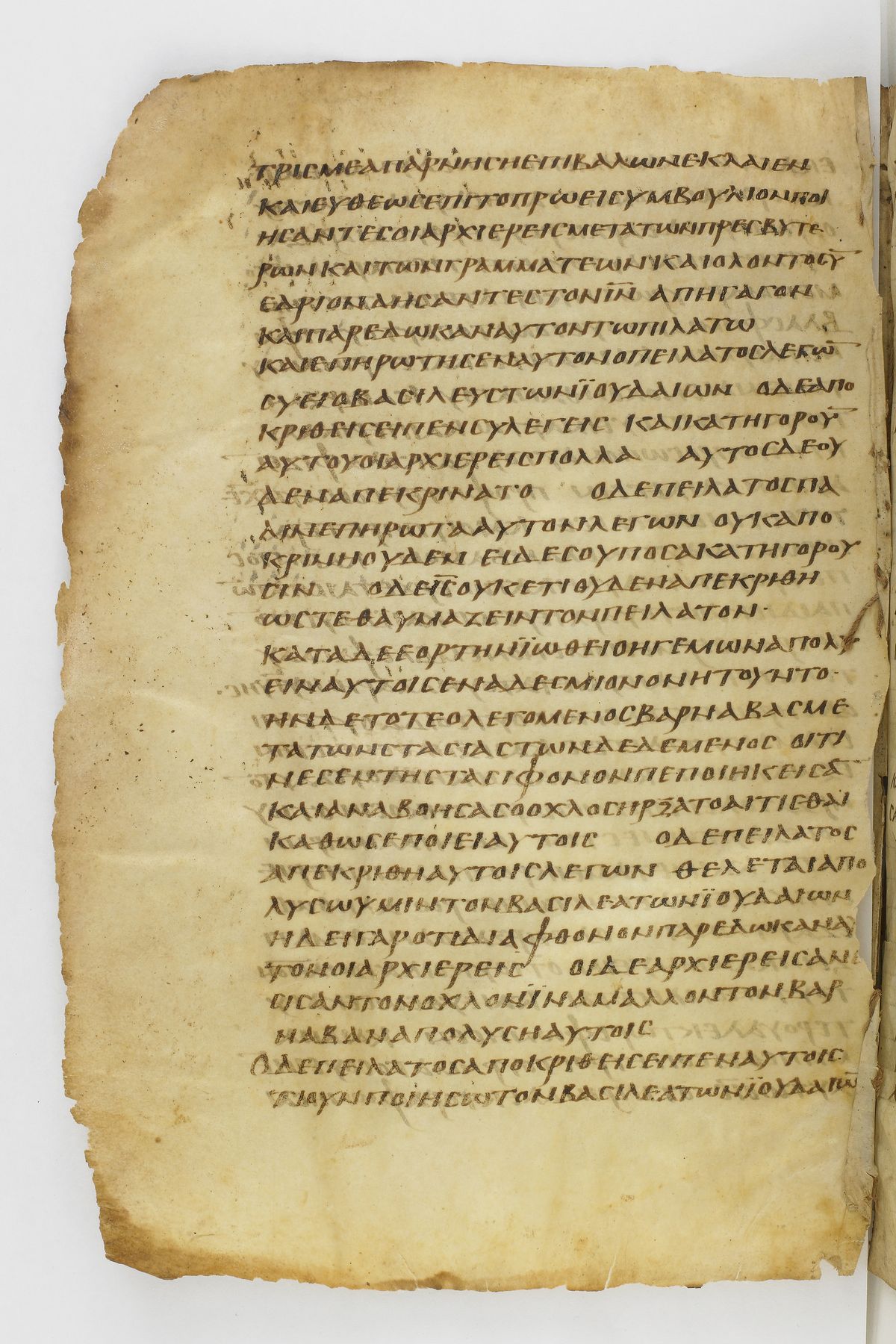
Page from the NTVMR transcription (docID 20032): verses 1-12 on CSNTM GA_032_0370.
1και ευθεως επι το πρωει συμβουλιον ποιησαντες οι αρχιερεις μετα των πρεσβυτερων και των γραμματεων και ολον το συνεδριον δησαντες τον ιν απηγαγον και παρεδωκαν αυτον τω πιλατω 2και επηρωτησεν αυτον ο πειλατος λεγων συ ει ο βασιλευς των ιουδαιων ο δε αποκριθεις ειπεν συ λεγεις 3και κατηγορουν αυτου οι αρχιερεις πολλα αυτος δε ουδεν απεκρινατο 4ο δε πειλατος παλιν επηρωτα αυτον λεγων ουκ αποκρινη ουδεν ειδε σου ποσα κατηγορουσιν 5ο δε ις ουκετι ουδεν απεκριθη ωστε θαυμαζειν τον πειλατον · 6κατα δε εορτην ιωθει ο ηγεμων απολυειν αυτοις ενα δεσμιον ον ητουντο · 7ην δε τοτε ο λεγομενος βαρναβας μετα των στασιαστων δεδεμενος οιτινες εν τη στασι φονον πεποιηκεισαν 8και αναβοησας ο οχλος ηρξατο αιτισθαι καθως εποιει αυτοις 9ο δε πειλατος απεκριθη αυτοις λεγων θελεται απολυσω υμιν τον βασιλεα των ιουδαιων 10ηδει γαρ οτι δια φθονον παρεδωκαν αυτον οι αρχιερεις 11οι δε αρχιερεις ανε̣σισαν τον οχλον ινα μαλλον τον βαρναβαν απολυση αυτοις 12ο δε πειλατος αποκριθεις ειπεν αυτοις τι ουν ποιησω τον βασιλεα των ιουδαιων
Compare: Tischendorf 8th edition (1869)
1Καὶ εὐθὺς πρωῒ συμβούλιον ἑτοιμάσαντες οἱ ἀρχιερεῖς μετὰ τῶν πρεσβυτέρων καὶ τῶν γραμματέων καὶ ὅλον τὸ συνέδριον, δήσαντες τὸν Ἰησοῦν ἀπήνεγκαν καὶ παρέδωκαν Πειλάτῳ. 2καὶ ἐπηρώτησεν αὐτὸν ὁ Πειλᾶτος· σὺ εἶ ὁ βασιλεὺς τῶν Ἰουδαίων; ὁ δὲ ἀποκριθεὶς αὐτῷ λέγει· σὺ λέγεις. 3καὶ κατηγόρουν αὐτοῦ οἱ ἀρχιερεῖς πολλά. 4ὁ δὲ Πειλᾶτος πάλιν ἐπηρώτα αὐτὸν· οὐκ ἀποκρίνῃ οὐδέν; ἴδε πόσα σου κατηγοροῦσιν. 5ὁ δὲ Ἰησοῦς οὐκέτι οὐδὲν ἀπεκρίθη, ὥστε θαυμάζειν τὸν Πειλᾶτον. 6Κατὰ δὲ ἑορτὴν ἀπέλυεν αὐτοῖς ἕνα δέσμιον ὃν παρῃτοῦντο. 7ἦν δὲ ὁ λεγόμενος Βαραββᾶς μετὰ τῶν στασιαστῶν δεδεμένος, οἵτινες ἐν τῇ στάσει φόνον πεποιήκεισαν. 8καὶ ἀναβὰς ὁ ὄχλος ἤρξατο αἰτεῖσθαι καθὼς ἐποίει αὐτοῖς. 9ὁ δὲ Πειλᾶτος ἀπεκρίθη αὐτοῖς λέγων· θέλετε ἀπολύσω ὑμῖν τὸν βασιλέα τῶν Ἰουδαίων; 10ἐγίνωσκεν γὰρ ὅτι διὰ φθόνον παραδεδώκεισαν αὐτὸν οἱ ἀρχιερεῖς. 11οἱ δὲ ἀρχιερεῖς ἀνέσεισαν τὸν ὄχλον ἵνα μᾶλλον τὸν Βαραββᾶν ἀπολύσῃ αὐτοῖς. 12ὁ δὲ Πειλᾶτος πάλιν ἀποκριθεὶς ἔλεγεν αὐτοῖς· τί οὖν θέλετε ποιήσω ὃν λέγετε τὸν βασιλέα τῶν Ἰουδαίων;
1And straightway in the morning the chief priests held a consultation with the elders and scribes and the whole council, and bound Jesus, and carried him away, and delivered him to Pilate. 2And Pilate asked him, Art thou the King of the Jews? And he answering said unto him, Thou sayest it. 3And the chief priests accused him of many things: but he answered nothing. 4And Pilate asked him again, saying, Answerest thou nothing? behold how many things they witness against thee. 5But Jesus yet answered nothing; so that Pilate marvelled. 6Now at that feast he released unto them one prisoner, whomsoever they desired. 7And there was one named Barabbas, which lay bound with them that had made insurrection with him, who had committed murder in the insurrection. 8And the multitude crying aloud began to desire him to do as he had ever done unto them. 9But Pilate answered them, saying, Will ye that I release unto you the King of the Jews? 10For he knew that the chief priests had delivered him for envy. 11But the chief priests moved the people, that he should rather release Barabbas unto them. 12And Pilate answered and said again unto them, What will ye then that I shall do unto him whom ye call the King of the Jews?
Where on the image
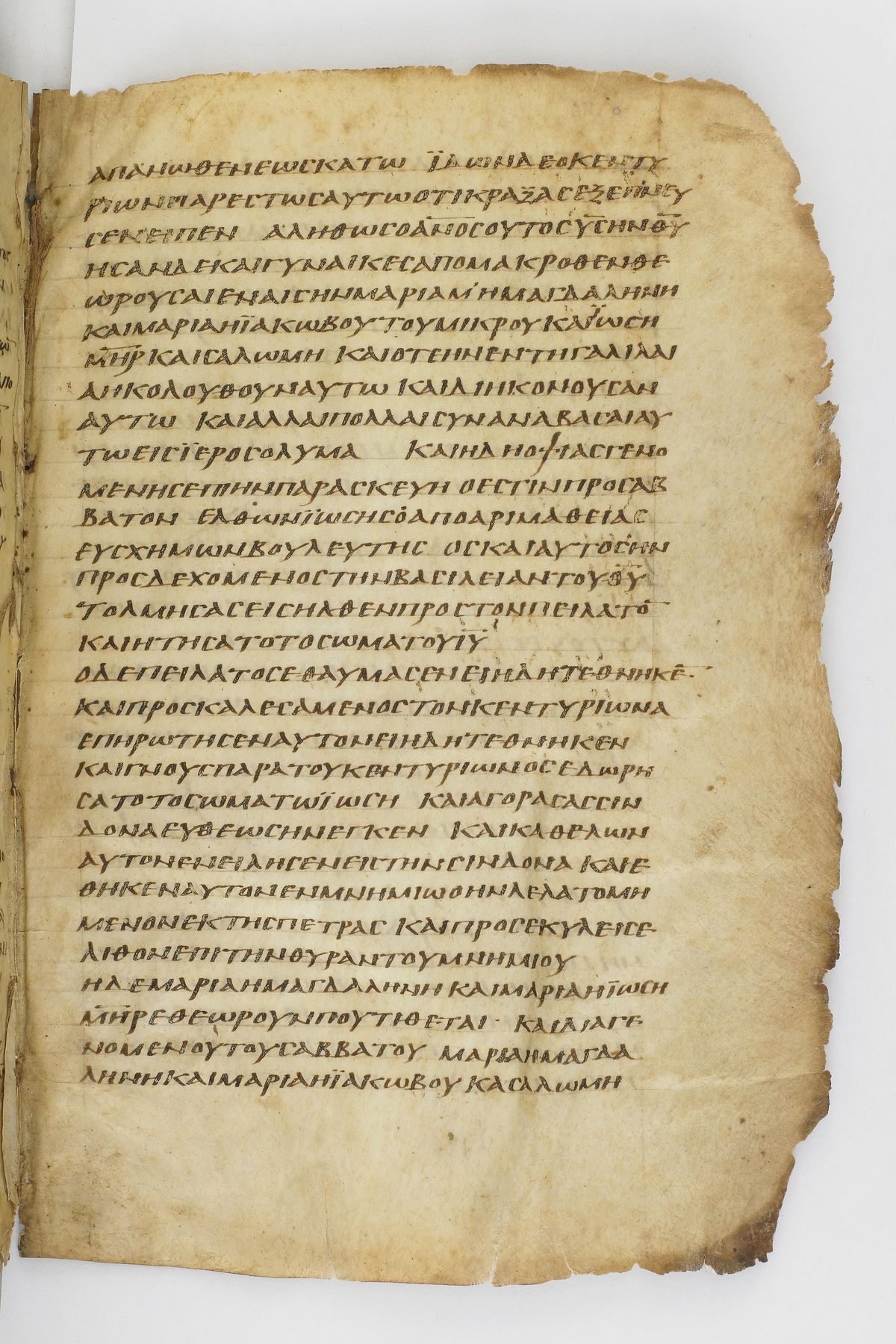
Page from the NTVMR transcription (docID 20032): verses 38-47 on CSNTM GA_032_0371.
38απ ανωθεν εως κατω 39ιδων δε ο κεντυριων παρεστως αυτω οτι κραξας εξεπνευσεν ειπεν αληθως ο ανος ουτος υς ην θυ 40ησαν δε και γυναικες απο μακροθεν θεωρουσαι εν αις ην μαριαμ η μαγδαληνη και μαρια η ιακωβου του μικρου και ωση μηρ και σαλωμη 41και οτε ην εν τη γαλιλαια ηκολουθουν αυτω και διηκονουσαν αυτω και αλλαι πολλαι συναναβασαι αυτω εις ιεροσολυμα 42και ηδη οψιας γενομενης επι ην παρασκευη ο εστιν προσαββατον 43ελθων ιωσης ο απο αριμαθειας ευσχημων βουλευτης ος και αυτος ην προσδεχομενος την βασιλειαν του θυ τολμησας εισηλθεν προς τον πειλατον και ητησατο το σωμα του ιυ 44ο δε πειλατος εθαυμασεν ει ηδη τεθνηκεν · και προσκαλεσαμενος τον κεντυριωνα επηρωτησεν αυτον ει ηδη τεθνηκεν 45και γνους παρα του κεντυριωνος εδωρησατο το σωμα τω ιωση 46και αγορασας σινδονα ευθεως ηνεγκεν και καθελων αυτον ενειλησεν εις την σινδονα και εθηκεν αυτον εν μνημιω ο ην λελατομημενον εκ της πετρας και προσεκυλεισε λιθον επι την θυραν του μνημιου 47η δε μαρια η μαγδαληνη και μαρια η ιωση μηρ εθεωρουν που τιθεται ·
Compare: Tischendorf 8th edition (1869)
38καὶ τὸ καταπέτασμα τοῦ ναοῦ ἐσχίσθη εἰς δύο ἀπὸ ἄνωθεν ἕως κάτω. 39ἰδὼν δὲ ὁ κεντυρίων ὁ παρεστηκὼς ἐξ ἐναντίας αὐτοῦ ὅτι οὕτως ἐξέπνευσεν εἶπεν· ἀληθῶς οὗτος ὁ ἄνθρωπος υἱὸς ἦν θεοῦ. 40Ἦσαν δὲ καὶ γυναῖκες ἀπὸ μακρόθεν θεωροῦσαι, ἐν αἷς καὶ Μαρία ἡ Μαγδαληνὴ καὶ Μαρία ἡ Ἰακώβου τοῦ μικροῦ καὶ Ἰωσῆτος μήτηρ καὶ Σαλώμη, 41αἳ ὅτε ἦν ἐν τῇ Γαλιλαίᾳ ἠκολούθουν αὐτῷ καὶ διηκόνουν αὐτῷ, καὶ ἄλλαι πολλαὶ αἱ συναναβᾶσαι αὐτῷ εἰς Ἱεροσόλυμα. 42Καὶ ἤδη ὀψίας γενομένης, ἐπεὶ ἦν παρασκευή, ὅ ἐστιν προσάββατον, 43ἐλθὼν Ἰωσὴφ ὁ ἀπὸ Ἀριμαθαίας εὐσχήμων βουλευτής, ὃς καὶ αὐτὸς ἦν προσδεχόμενος τὴν βασιλείαν τοῦ θεοῦ, τολμήσας εἰσῆλθεν πρὸς τὸν Πειλᾶτον καὶ ᾐτήσατο τὸ σῶμα τοῦ Ἰησοῦ. 44ὁ δὲ Πειλᾶτος ἐθαύμαζεν εἰ ἤδη τέθνηκεν, καὶ προσκαλεσάμενος τὸν κεντυρίωνα ἐπηρώτησεν αὐτὸν εἰ πάλαι ἀπέθανεν· 45καὶ γνοὺς ἀπὸ τοῦ κεντυρίωνος ἐδωρήσατο τὸ πτῶμα τῷ Ἰωσήφ. 46καὶ ἀγοράσας σινδόνα, καθελὼν αὐτὸν ἐνείλησεν τῇ σινδόνι καὶ κατέθηκεν αὐτὸν ἐν μνήματι ὃ ἦν λελατομημένον ἐκ πέτρας, καὶ προσεκύλισεν λίθον ἐπὶ τὴν θύραν τοῦ μνημείου. 47ἡ δὲ Μαρία ἡ Μαγδαληνὴ καὶ Μαρία ἡ Ἰωσῆτος ἐθεώρουν ποῦ τέθειται.
38And the veil of the temple was rent in twain from the top to the bottom. 39And when the centurion, which stood over against him, saw that he so cried out, and gave up the ghost, he said, Truly this man was the Son of God. 40There were also women looking on afar off: among whom was Mary Magdalene, and Mary the mother of James the less and of Joses, and Salome; 41(Who also, when he was in Galilee, followed him, and ministered unto him;) and many other women which came up with him unto Jerusalem. 42And now when the even was come, because it was the preparation, that is, the day before the sabbath, 43Joseph of Arimathaea, an honourable counsellor, which also waited for the kingdom of God, came, and went in boldly unto Pilate, and craved the body of Jesus. 44And Pilate marvelled if he were already dead: and calling unto him the centurion, he asked him whether he had been any while dead. 45And when he knew it of the centurion, he gave the body to Joseph. 46And he bought fine linen, and took him down, and wrapped him in the linen, and laid him in a sepulchre which was hewn out of a rock, and rolled a stone unto the door of the sepulchre. 47And Mary Magdalene and Mary the mother of Joses beheld where he was laid.
Cite
Sources
- Source: Codex Washingtonianus page images + NTVMR transcription (CC BY 4.0) + Tischendorf 8th edition + KJV (holding institution)
- Critical edition: Codex Washingtonianus transcription, NTVMR (INTF Münster, CC BY 4.0); Tischendorf 8th edition for comparison
← previous · → next · v cycle view · l back to library