Classic of Changes, Hexagram 46: Sheng 升 (Ming print of 1596)
Introduction
Sheng 升 is hexagram 46 in the received order of the Classic of Changes (周易 Zhouyi, also called 易經 Yijing). Its figure joins the trigram 巽 Xun (wind) below and 坤 Kun (earth) above. The text of each hexagram has two layers: a short statement on the hexagram as a whole (卦辭, which Legge calls the Thwan and ascribes to King Wen) and one statement for each of its six lines (爻辭, ascribed to the Duke of Zhou). The statements were used for divination and are generally dated to the Western Zhou period (roughly the 9th century BCE or earlier); the commentaries known as the Ten Wings were added later.
The photographs are of the first volume of a Five Classics printed in Nanjing with the main text only and punctuation circles, with a postface by Li Deng dated Wanli 24 (1596); the National Diet Library, Tokyo, holds the only known copy of these five volumes (call no. WA35-19). It follows the arrangement of Wang Bi's edition: after each hexagram figure come the statement, the commentaries on it (彖 Tuan and 大象 Great Image), and each line statement followed by its Small Image (小象). Those commentaries are not given here. In this copy the hexagram runs from canvas 78, left-hand page to canvas 79, left-hand page. Each section gathers the statements that begin on one page and links to that page and to any page the last statement runs onto; the page boundaries were found by reading the first characters of every column on the photographs.
The Chinese is the received text from Wikisource. The English is James Legge's translation in Sacred Books of the East, volume 16 (1882), The Text, hexagram 46 (Shăng), pages 159-160; his notes are not reproduced. Legge adds words in parentheses to make the sense plain; they are his.
How was this verified? (Provenance)
Where on the image
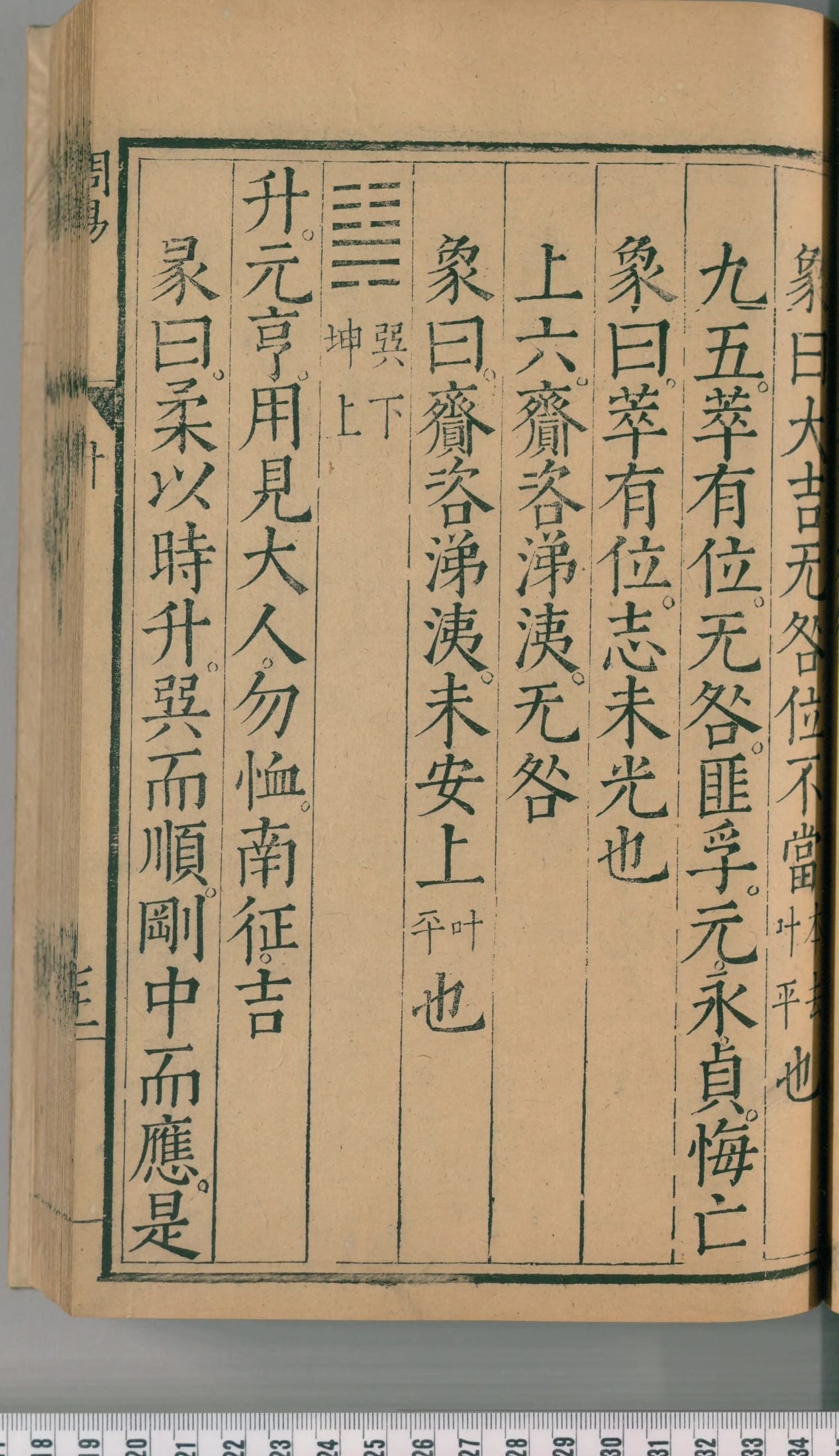
National Diet Library WA35-19 [五經白文], vol. 1 (周易), IIIF canvas 78, left-hand page: 8 columns, main text with punctuation circles and small sound glosses. Column 6 carries the hexagram figure with the trigram names 巽下坤上. Checked on the image: the hexagram statement opens column 7 ‹升元亨用›. Between the statements the print gives the commentaries of the Ten Wings (彖曰, 象曰), which are not part of this section. The Chinese shown is the received text from Wikisource, not a transcription of this print.
升:元亨,用見大人,勿恤,南征吉。
Shăng indicates that (under its conditions) there will be great progress and success. Seeking by (the qualities implied in it) to meet with the great man, its subject need have no anxiety. Advance to the south will be fortunate.
Where on the image
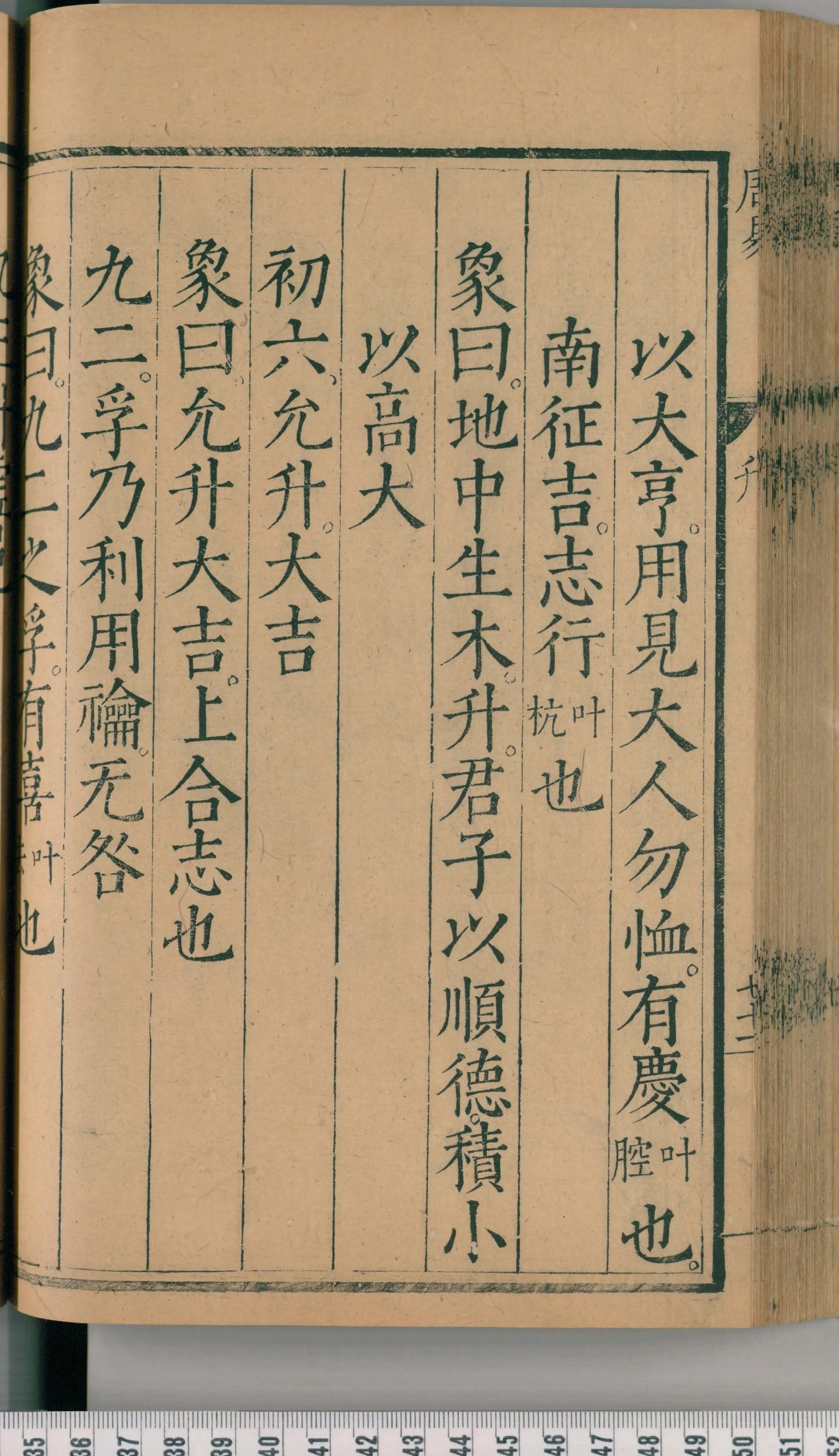
National Diet Library WA35-19 [五經白文], vol. 1 (周易), IIIF canvas 79, right-hand page: 8 columns, main text with punctuation circles and small sound glosses. Checked on the image: line statement 1 opens column 5 ‹初六允升›; line statement 2 opens column 7 ‹九二孚乃›. Between the statements the print gives the commentaries of the Ten Wings (彖曰, 象曰), which are not part of this section. The Chinese shown is the received text from Wikisource, not a transcription of this print.
1初六:允升,大吉。
2九二:孚乃利用禴,无咎。
1The first line, divided, shows its subject advancing upwards with the welcome (of those above him). There will be great good fortune.
2The second line, undivided, shows its subject with that sincerity which will make even the (small) offerings of the vernal sacrifice acceptable. There will be no error.
Where on the image
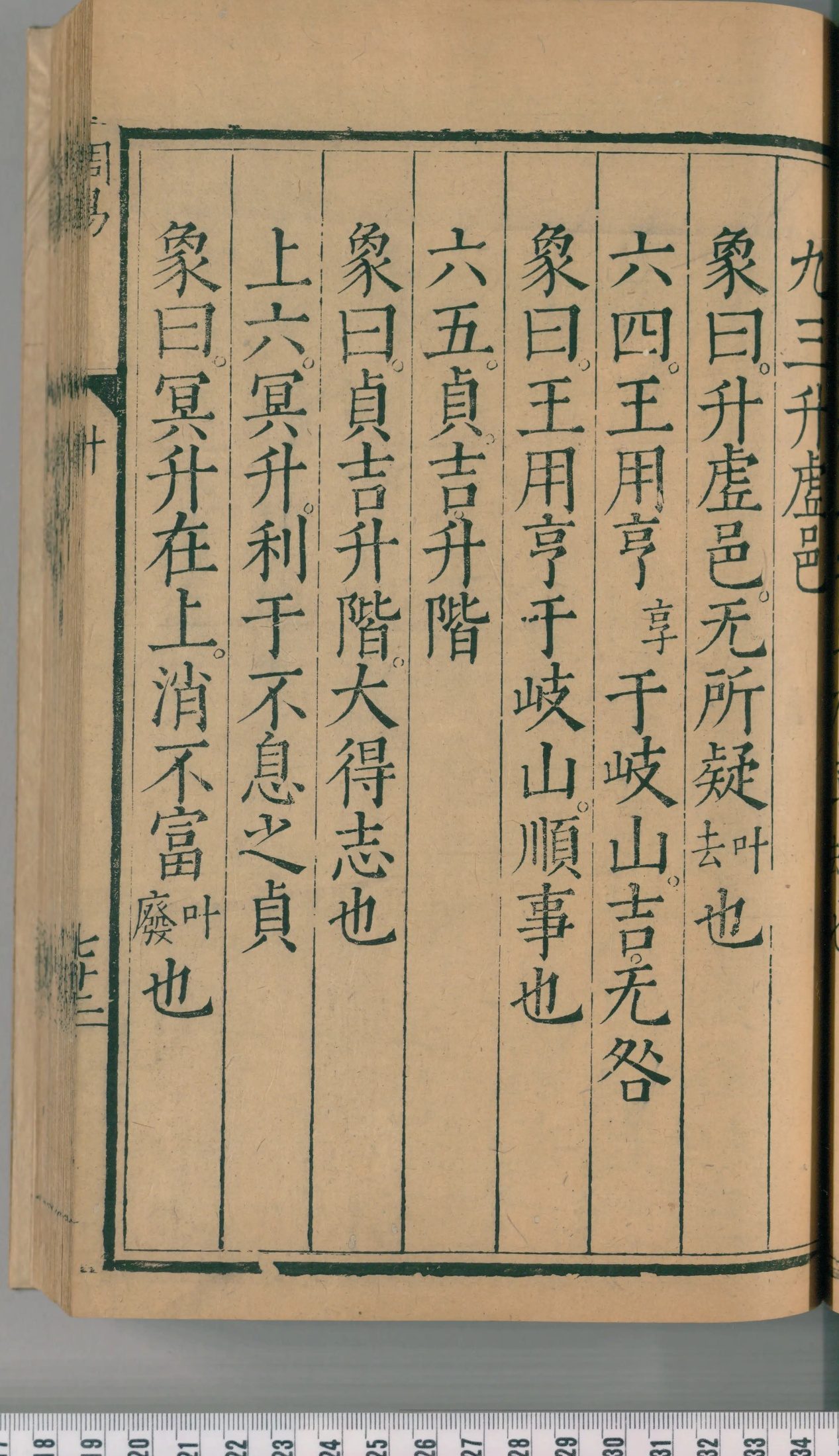
National Diet Library WA35-19 [五經白文], vol. 1 (周易), IIIF canvas 79, left-hand page: 8 columns, main text with punctuation circles and small sound glosses. Checked on the image: line statement 3 opens column 1 ‹九三升虛›; line statement 4 opens column 3 ‹六四王用›; line statement 5 opens column 5 ‹六五貞吉›; line statement 6 opens column 7 ‹上六冥升›. Between the statements the print gives the commentaries of the Ten Wings (彖曰, 象曰), which are not part of this section. The Chinese shown is the received text from Wikisource, not a transcription of this print.
3九三:升虛邑。
4六四:王用亨于岐山,吉无咎。
5六五:貞吉,升階。
6上六:冥升,利于不息之貞。
3The third line, undivided, shows its subject ascending upwards (as into) an empty city.
4The fourth line, divided, shows its subject employed by the king to present his offerings on mount Khî. There will be good fortune; there will be no mistake.
5The fifth line, divided, shows its subject firmly correct, and therefore enjoying good fortune. He ascends the stairs (with all due ceremony).
6The sixth line, divided, shows its subject advancing upwards blindly. Advantage will be found in a ceaseless maintenance of firm correctness.
Notes
- English: James Legge, The Yî King, Sacred Books of the East vol. 16 (1882), The Text, hexagram 46 (Shăng). The hexagram statement is unnumbered; the line statements are numbered from the bottom line up, as in Legge.
- Legge's footnotes and his notes under each hexagram are left out.
Cite
Sources
- Source: National Diet Library WA35-19 (Ming Five Classics print with postface of 1596, vol. 1, Zhouyi) + Wikisource received text + James Legge, Sacred Books of the East 16 (1882) (holding institution)
- Critical edition: Received text (Wikisource)
← previous · → next · v cycle view · l back to library