Classic of Changes, Hexagram 47: Kun 困 (Ming print of 1596)
Introduction
Kun 困 is hexagram 47 in the received order of the Classic of Changes (周易 Zhouyi, also called 易經 Yijing). Its figure joins the trigram 坎 Kan (water) below and 兌 Dui (lake) above. The text of each hexagram has two layers: a short statement on the hexagram as a whole (卦辭, which Legge calls the Thwan and ascribes to King Wen) and one statement for each of its six lines (爻辭, ascribed to the Duke of Zhou). The statements were used for divination and are generally dated to the Western Zhou period (roughly the 9th century BCE or earlier); the commentaries known as the Ten Wings were added later.
The photographs are of the first volume of a Five Classics printed in Nanjing with the main text only and punctuation circles, with a postface by Li Deng dated Wanli 24 (1596); the National Diet Library, Tokyo, holds the only known copy of these five volumes (call no. WA35-19). It follows the arrangement of Wang Bi's edition: after each hexagram figure come the statement, the commentaries on it (彖 Tuan and 大象 Great Image), and each line statement followed by its Small Image (小象). Those commentaries are not given here. In this copy the hexagram runs from canvas 80, right-hand page to canvas 81, left-hand page. Each section gathers the statements that begin on one page and links to that page and to any page the last statement runs onto; the page boundaries were found by reading the first characters of every column on the photographs.
The Chinese is the received text from Wikisource. The English is James Legge's translation in Sacred Books of the East, volume 16 (1882), The Text, hexagram 47 (Khwăn), pages 161-163; his notes are not reproduced. Legge adds words in parentheses to make the sense plain; they are his.
How was this verified? (Provenance)
Where on the image
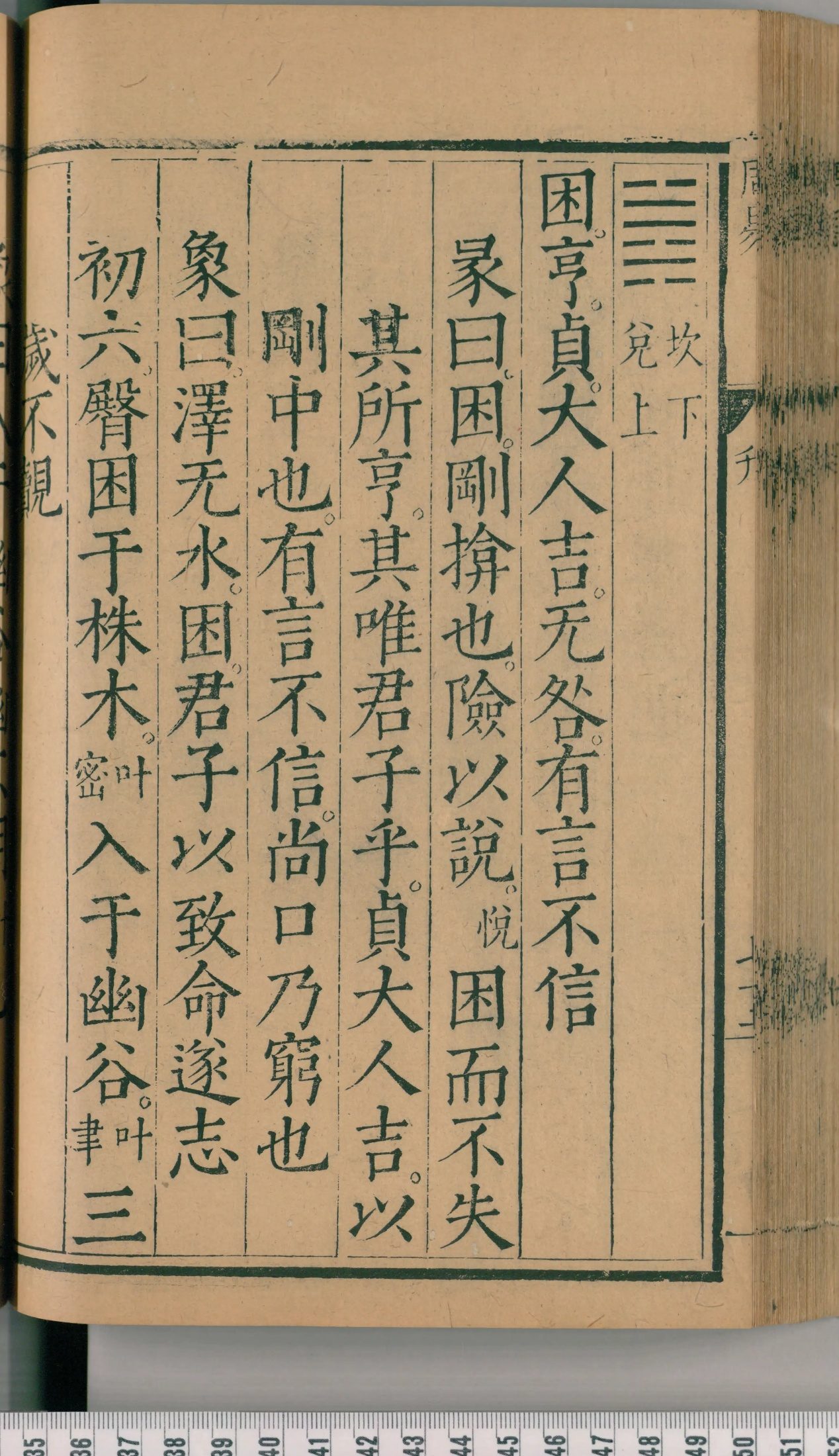
National Diet Library WA35-19 [五經白文], vol. 1 (周易), IIIF canvas 80, right-hand page: 8 columns, main text with punctuation circles and small sound glosses. Column 1 carries the hexagram figure with the trigram names 坎下兌上. Checked on the image: the hexagram statement opens column 2 ‹困亨貞大›; line statement 1 opens column 7 ‹初六臀困›. Between the statements the print gives the commentaries of the Ten Wings (彖曰, 象曰), which are not part of this section. The Chinese shown is the received text from Wikisource, not a transcription of this print.
困:亨,貞大人吉,无咎,有言不信。
1初六:臀困于株木,入于幽谷,三歲不覿。
In (the condition denoted by) Khwăn there may (yet be) progress and success. For the firm and correct, the (really) great man, there will be good fortune. He will fall into no error. If he make speeches, his words cannot be made good.
1The first line, divided, shows its subject with bare buttocks straitened under the stump of a tree. He enters a dark valley, and for three years has no prospect (of deliverance).
Where on the image
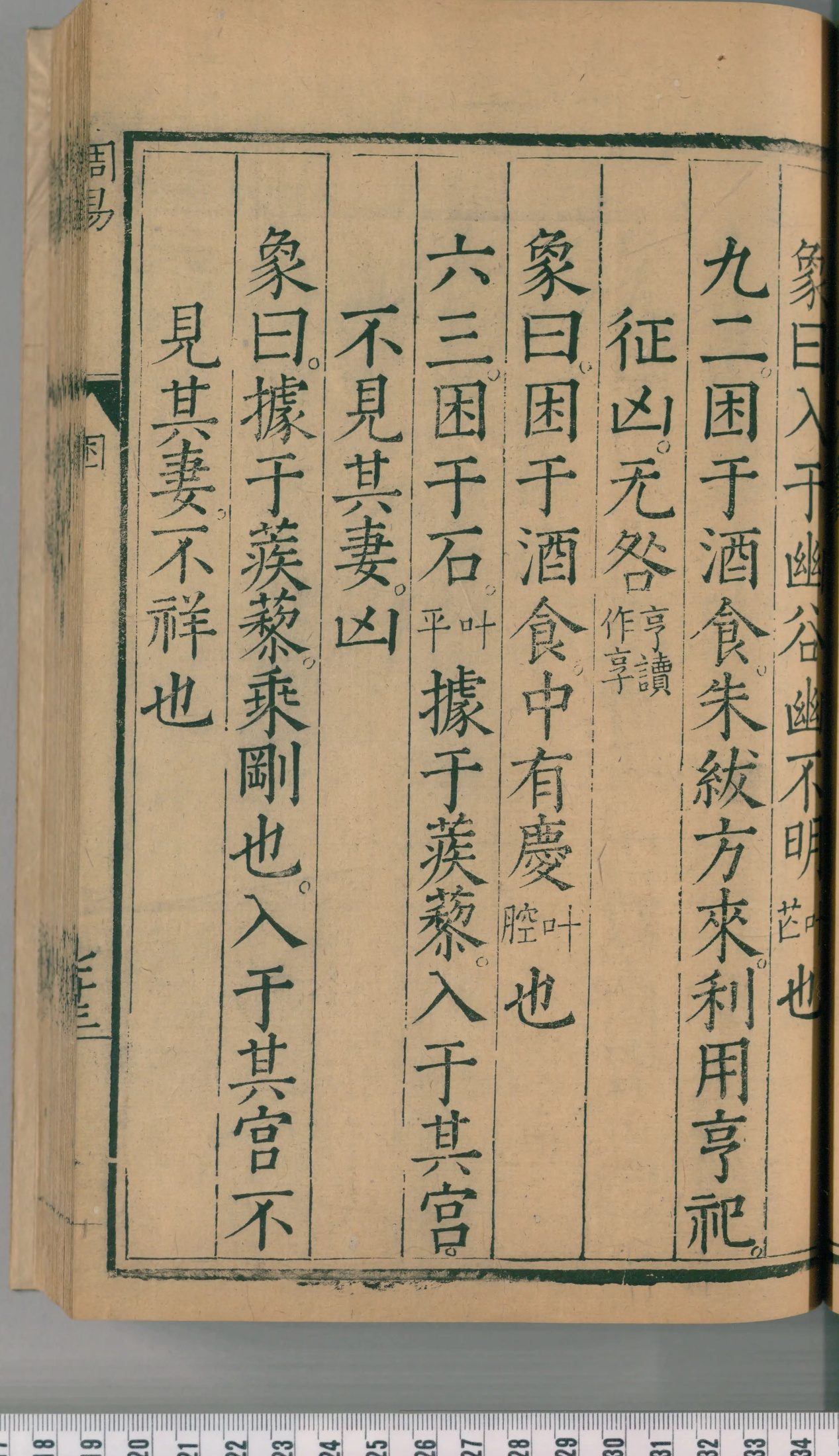
National Diet Library WA35-19 [五經白文], vol. 1 (周易), IIIF canvas 80, left-hand page: 8 columns, main text with punctuation circles and small sound glosses. Checked on the image: line statement 2 opens column 2 ‹九二困于›; line statement 3 opens column 5 ‹六三困于›. Between the statements the print gives the commentaries of the Ten Wings (彖曰, 象曰), which are not part of this section. The Chinese shown is the received text from Wikisource, not a transcription of this print.
2九二:困于酒食,朱紱方來,利用亨祀,征凶,无咎。
3六三:困于石,據于蒺藜,入于其宮,不見其妻,凶。
2The second line, undivided, shows its subject straitened amidst his wine and viands. There come to him anon the red knee-covers (of the ruler). It will be well for him (to maintain his sincerity as) in sacrificing. Active operations (on his part) will lead to evil, but he will be free from blame.
3The third line, divided, shows its subject straitened before a (frowning) rock. He lays hold of thorns. He enters his palace, and does not see his wife. There will be evil.
Where on the image
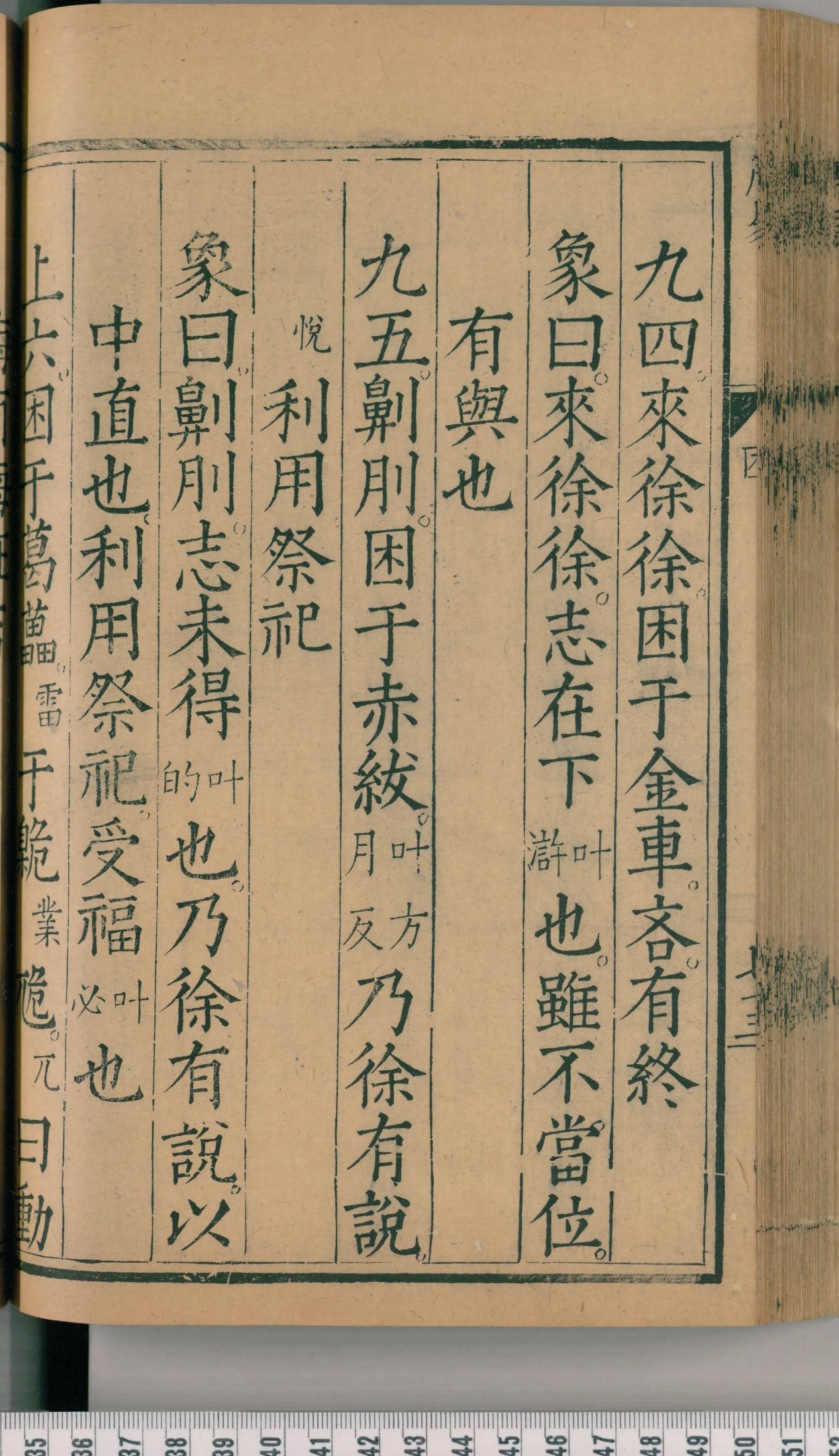
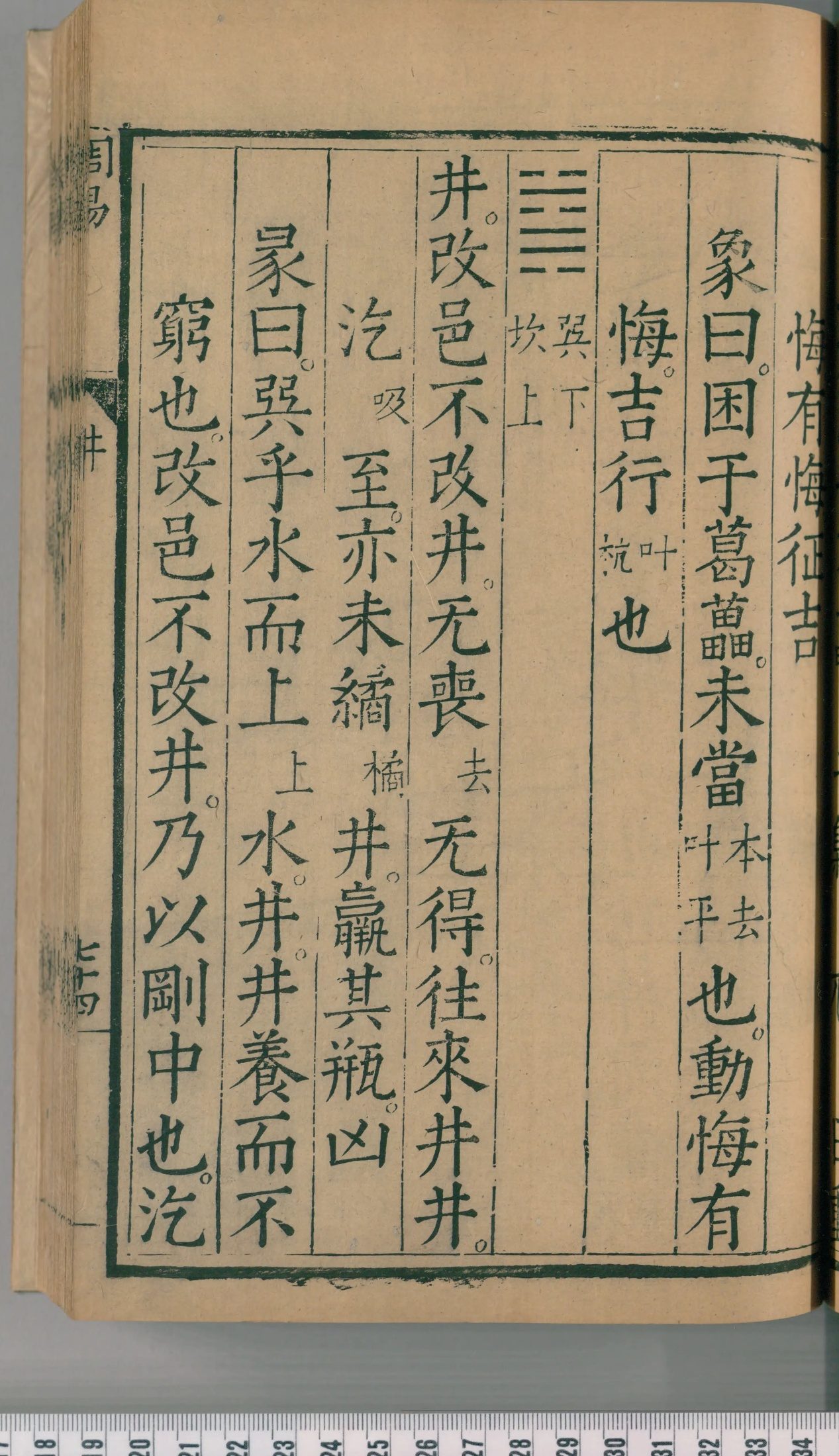
National Diet Library WA35-19 [五經白文], vol. 1 (周易), IIIF canvas 81, right-hand page: 8 columns, main text with punctuation circles and small sound glosses. Checked on the image: line statement 4 opens column 1 ‹九四來徐›; line statement 5 opens column 4 ‹九五劓刖›; line statement 6 opens column 8 ‹上六困于›. Between the statements the print gives the commentaries of the Ten Wings (彖曰, 象曰), which are not part of this section. Line statement 6 runs on to canvas 81, left-hand page (first column ‹悔有悔征›). The Chinese shown is the received text from Wikisource, not a transcription of this print.
4九四:來徐徐,困于金車,吝,有終。
5九五:劓刖,困于赤紱,乃徐有說,利用祭祀。
6上六:困于葛藟,于臲卼,曰動悔。有悔,征吉。
4The fourth line, undivided, shows its subject proceeding very slowly (to help the subject of the first line), who is straitened by the carriage adorned with metal in front of him. There will be occasion for regret, but the end will be good.
5The fifth line, undivided, shows its subject with his nose and feet cut off. He is straitened by (his ministers in their) scarlet aprons. He is leisurely in his movements, however, and is satisfied. It will be well for him to be (as sincere) as in sacrificing (to spiritual beings).
6The sixth line, divided, shows its subject straitened, as if bound with creepers; or in a high and dangerous position, and saying (to himself), 'If I move, I shall repent it.' If he do repent of former errors, there will be good fortune in his going forward.
Notes
- English: James Legge, The Yî King, Sacred Books of the East vol. 16 (1882), The Text, hexagram 47 (Khwăn). The hexagram statement is unnumbered; the line statements are numbered from the bottom line up, as in Legge.
- Legge's footnotes and his notes under each hexagram are left out.
Cite
Sources
- Source: National Diet Library WA35-19 (Ming Five Classics print with postface of 1596, vol. 1, Zhouyi) + Wikisource received text + James Legge, Sacred Books of the East 16 (1882) (holding institution)
- Critical edition: Received text (Wikisource)
← previous · → next · v cycle view · l back to library