Classic of Changes, Hexagram 48: Jing 井 (Ming print of 1596)
Introduction
Jing 井 is hexagram 48 in the received order of the Classic of Changes (周易 Zhouyi, also called 易經 Yijing). Its figure joins the trigram 巽 Xun (wind) below and 坎 Kan (water) above. The text of each hexagram has two layers: a short statement on the hexagram as a whole (卦辭, which Legge calls the Thwan and ascribes to King Wen) and one statement for each of its six lines (爻辭, ascribed to the Duke of Zhou). The statements were used for divination and are generally dated to the Western Zhou period (roughly the 9th century BCE or earlier); the commentaries known as the Ten Wings were added later.
The photographs are of the first volume of a Five Classics printed in Nanjing with the main text only and punctuation circles, with a postface by Li Deng dated Wanli 24 (1596); the National Diet Library, Tokyo, holds the only known copy of these five volumes (call no. WA35-19). It follows the arrangement of Wang Bi's edition: after each hexagram figure come the statement, the commentaries on it (彖 Tuan and 大象 Great Image), and each line statement followed by its Small Image (小象). Those commentaries are not given here. In this copy the hexagram runs from canvas 81, left-hand page to canvas 83, right-hand page. Each section gathers the statements that begin on one page and links to that page and to any page the last statement runs onto; the page boundaries were found by reading the first characters of every column on the photographs.
The Chinese is the received text from Wikisource. The English is James Legge's translation in Sacred Books of the East, volume 16 (1882), The Text, hexagram 48 (Ȝing), pages 164-166; his notes are not reproduced. Legge adds words in parentheses to make the sense plain; they are his.
How was this verified? (Provenance)
Where on the image
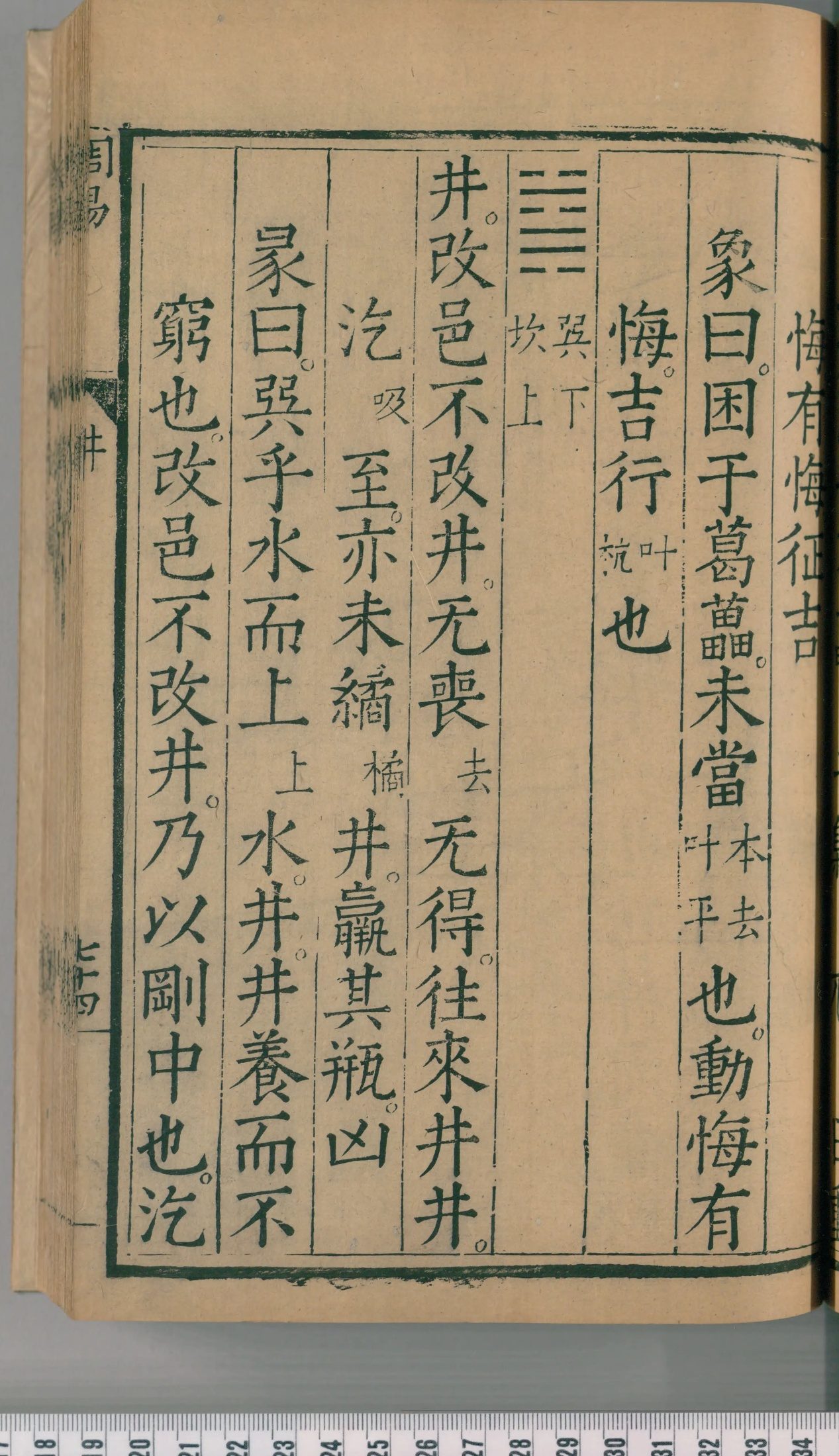
National Diet Library WA35-19 [五經白文], vol. 1 (周易), IIIF canvas 81, left-hand page: 8 columns, main text with punctuation circles and small sound glosses. Column 4 carries the hexagram figure with the trigram names 巽下坎上. Checked on the image: the hexagram statement opens column 5 ‹井改邑不›. Between the statements the print gives the commentaries of the Ten Wings (彖曰, 象曰), which are not part of this section. The Chinese shown is the received text from Wikisource, not a transcription of this print.
井:改邑不改井,无喪无得,往來井井。汔至亦未繘井。羸其瓶,凶。
(Looking at) Ȝing, (we think of) how (the site of) a town may be changed, while (the fashion of) its wells undergoes no change. (The water of a well) never disappears and never receives (any great) increase, and those who come and those who go can draw and enjoy the benefit. If (the drawing) have nearly been accomplished, but, before the rope has quite reached the water, the bucket is broken, this is evil.
Where on the image
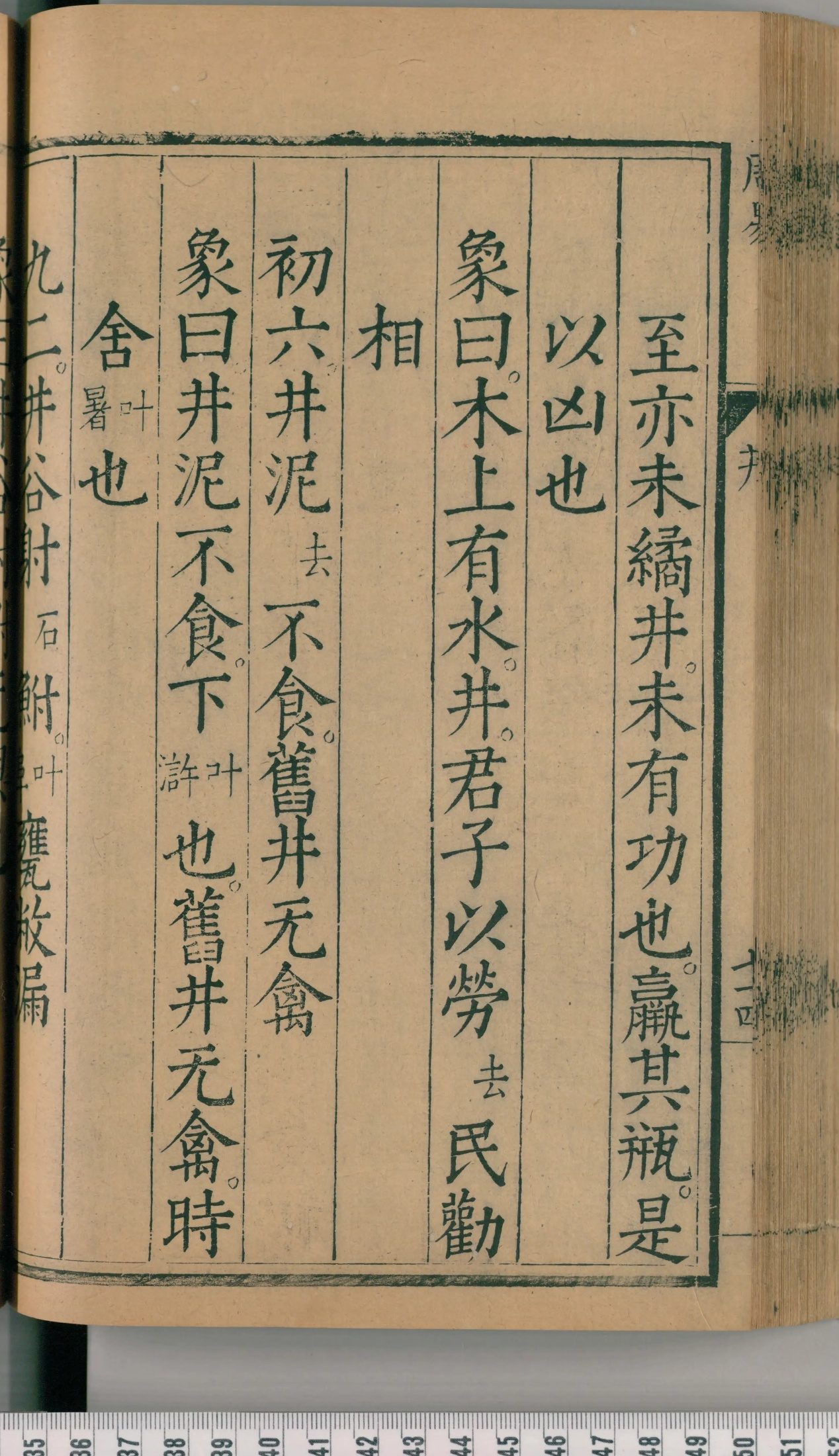
National Diet Library WA35-19 [五經白文], vol. 1 (周易), IIIF canvas 82, right-hand page: 8 columns, main text with punctuation circles and small sound glosses. Checked on the image: line statement 1 opens column 5 ‹初六井泥›; line statement 2 opens column 8 ‹九二井谷›. Between the statements the print gives the commentaries of the Ten Wings (彖曰, 象曰), which are not part of this section. The Chinese shown is the received text from Wikisource, not a transcription of this print.
1初六:井泥不食,舊井无禽。
2九二:井谷射鮒,瓮敝漏。
1The first line, divided, shows a well so muddy that men will not drink of it; or an old well to which neither birds (nor other creatures) resort.
2The second line, undivided, shows a well from which by a hole the water escapes and flows away to the shrimps (and such small creatures among the grass), or one the water of which leaks away from a broken basket.
Where on the image
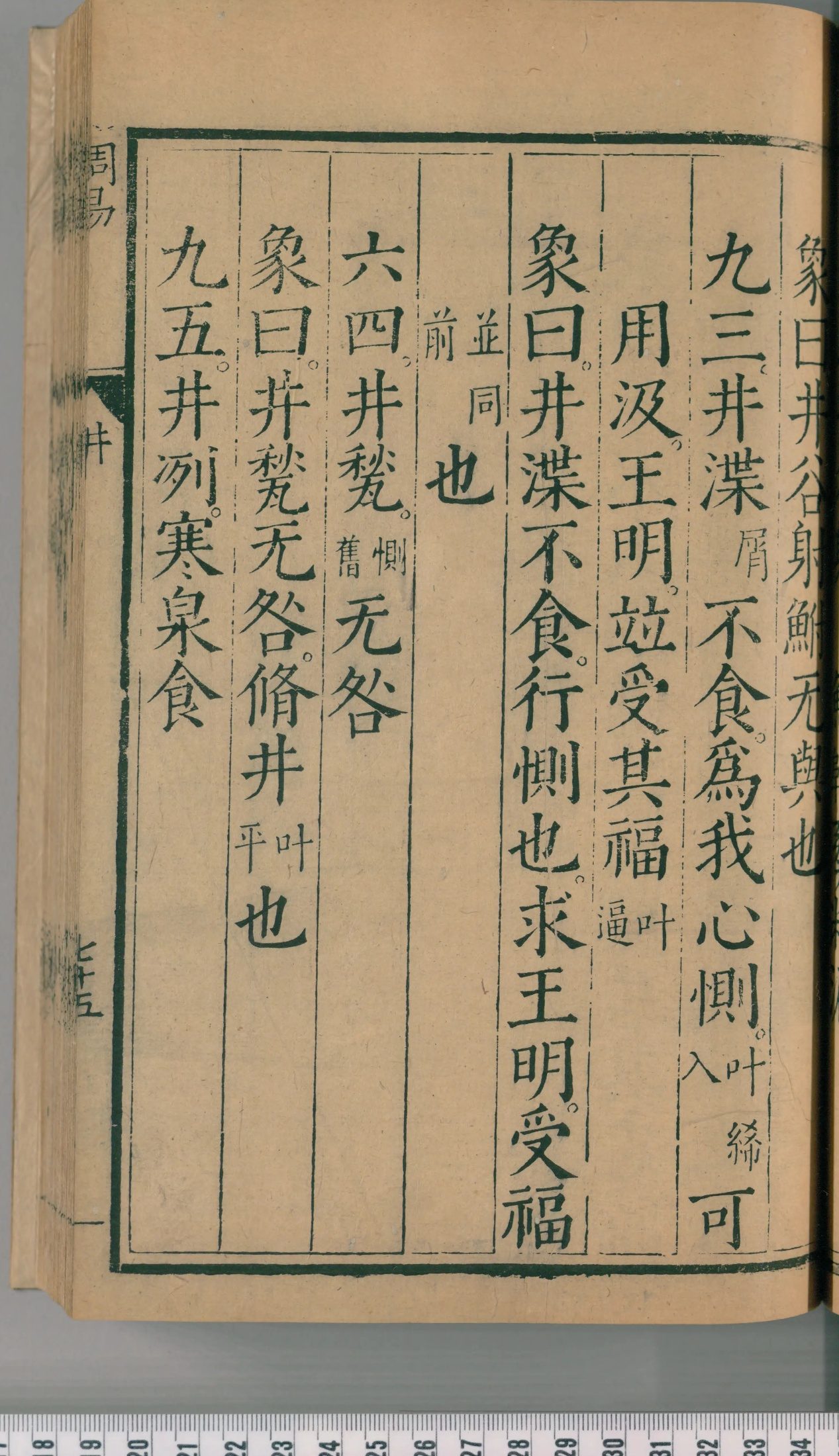
National Diet Library WA35-19 [五經白文], vol. 1 (周易), IIIF canvas 82, left-hand page: 8 columns, main text with punctuation circles and small sound glosses. Checked on the image: line statement 3 opens column 2 ‹九三井渫›; line statement 4 opens column 6 ‹六四井甃›; line statement 5 opens column 8 ‹九五井冽›. Between the statements the print gives the commentaries of the Ten Wings (彖曰, 象曰), which are not part of this section. The Chinese shown is the received text from Wikisource, not a transcription of this print.
3九三:井渫不食,為我心惻,可用汲,王明,並受其福。
4六四:井甃,无咎。
5九五:井冽,寒泉食。
3The third line, undivided, shows a well, which has been cleared out, but is not used. Our hearts are sorry for this, for the water might be drawn out and used. If the king were (only) intelligent, both he and we might receive the benefit of it.
4The fourth line, divided, shows a well, the lining of which is well laid. There will be no error.
5The fifth line, undivided, shows a clear, limpid well, (the waters from) whose cold spring are (freely) drunk.
Where on the image
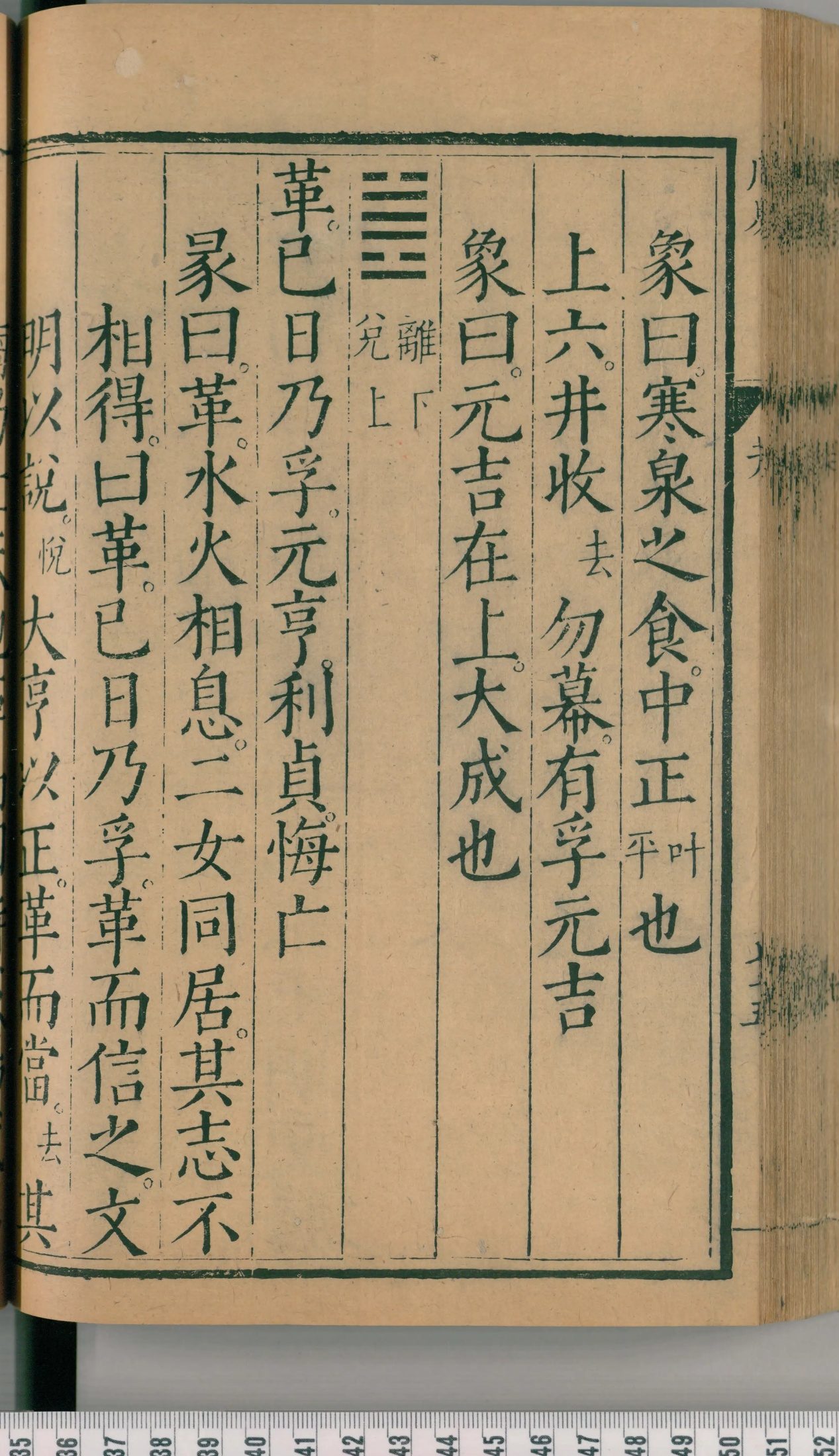
National Diet Library WA35-19 [五經白文], vol. 1 (周易), IIIF canvas 83, right-hand page: 8 columns, main text with punctuation circles and small sound glosses. Checked on the image: line statement 6 opens column 2 ‹上六井收›. Between the statements the print gives the commentaries of the Ten Wings (彖曰, 象曰), which are not part of this section. The Chinese shown is the received text from Wikisource, not a transcription of this print.
6上六:井收勿幕,有孚元吉。
6The topmost line, divided, shows (the water from) the well brought to the top, which is not allowed to be covered. This suggests the idea of sincerity. There will be great good fortune.
Notes
- English: James Legge, The Yî King, Sacred Books of the East vol. 16 (1882), The Text, hexagram 48 (Ȝing). The hexagram statement is unnumbered; the line statements are numbered from the bottom line up, as in Legge.
- Legge's footnotes and his notes under each hexagram are left out.
Cite
Sources
- Source: National Diet Library WA35-19 (Ming Five Classics print with postface of 1596, vol. 1, Zhouyi) + Wikisource received text + James Legge, Sacred Books of the East 16 (1882) (holding institution)
- Critical edition: Received text (Wikisource)
← previous · → next · v cycle view · l back to library