Classic of Changes, Great Treatise, Part 1, Chapter 1 (Ming print of 1596)
Introduction
The Great Treatise (繫辭傳 Xici zhuan, "Commentary on the Appended Statements"; Legge's "Great Appendix") is the longest of the Ten Wings, the commentaries attached to the Classic of Changes. It is an essay in two parts on how the hexagrams were made, how the yarrow stalks are counted, and how the book reflects the workings of heaven and earth. Tradition ascribed it to Confucius; it is now generally dated to the late Warring States period (4th to 3rd century BCE), and part of it is preserved on the Mawangdui silk manuscript of 168 BCE. This is chapter 1 of part 1 (上), in the chapter division of Zhu Xi (1130-1200), which Legge follows; Legge numbers his paragraphs straight through each part (here 1-8).
The photographs are of the first volume of a Five Classics printed in Nanjing with the main text only and punctuation circles, with a postface by Li Deng dated Wanli 24 (1596); the National Diet Library, Tokyo, holds the only known copy of these five volumes (call no. WA35-19). The Great Treatise follows the 64 hexagrams in this volume, from canvas 106 to canvas 128, and its passages stand in the order of Zhu Xi's edition. In this copy the chapter runs from canvas 106, left-hand page to canvas 107, right-hand page. Each section gathers the paragraphs that begin on one page and links to that page and to any page the last paragraph runs onto; the page boundaries were found by reading the first characters of every column on the photographs and aligning them to the text.
The Chinese is the received text from Wikisource. The English is James Legge's translation in Sacred Books of the East, volume 16 (1882), Appendix III, Section I, Chapter 1; his notes are not reproduced. Legge adds words in parentheses to make the sense plain; they are his.
How was this verified? (Provenance)
Where on the image
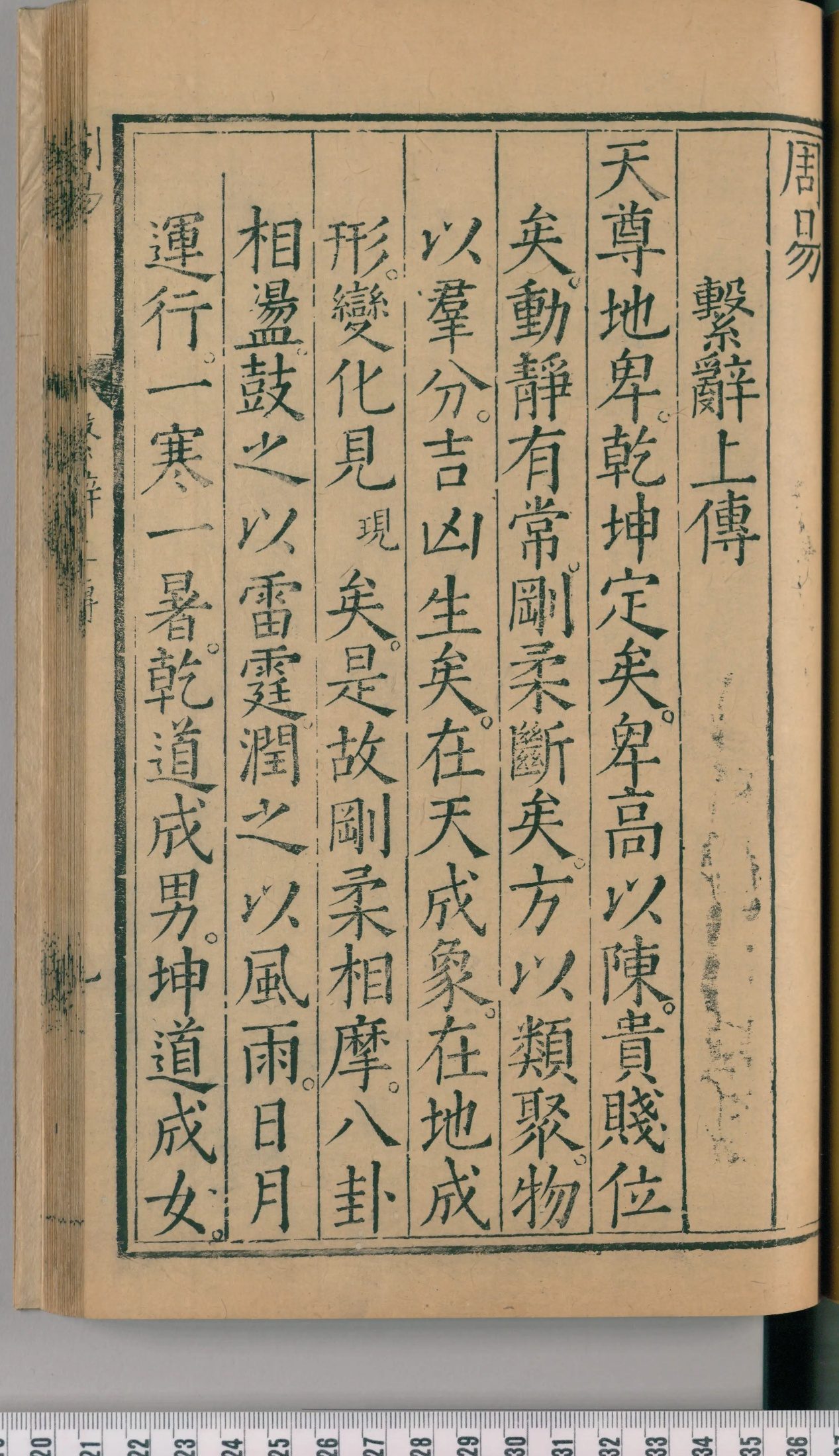
National Diet Library WA35-19 [五經白文], vol. 1 (周易), IIIF canvas 106, left-hand page: 8 columns, main text with punctuation circles and small sound glosses. On this page column 1 carries the heading 周易; column 2 carries the heading 繫辭上傳. Checked on the image (column openings aligned to the text): paragraph 1 opens column 3 ‹天尊地卑›; paragraph 2 begins within column 6, which opens ‹形變化見›; paragraph 3 begins within column 7, which opens ‹相盪鼓之›; paragraph 4 begins within column 8, which opens ‹運行一寒›. The Chinese shown is the received text from Wikisource, not a transcription of this print.
1天尊地卑,乾坤定矣。卑高以陳,貴賤位矣。動靜有常,剛柔斷矣。方以類聚,物以羣分,吉凶生矣。在天成象,在地成形,變化見矣。
2是故剛柔相摩,八卦相荡,
3鼓之以雷霆,潤之以風雨,日月運行,一寒一暑。
4乾道成男,坤道成女;
1Heaven is lofty and honourable; earth is low. (Their symbols), Khien and Khwăn, (with their respective meanings), were determined (in accordance with this).
Things low and high appear displayed in a similar relation. The (upper and lower trigrams, and the relative position of individual lines, as) noble and mean, had their places assigned accordingly.
Movement and rest are the regular qualities (of their respective subjects). Hence comes the definite distinction (of the several lines) as the strong and the weak.
(Affairs) are arranged together according to their tendencies, and things are divided according to their classes. Hence were produced (the interpretations in the Yî, concerning) what is good [or lucky] and evil [or unlucky].
In the heavens there are the (different) figures there completed, and on the earth there are the (different) bodies there formed. (Corresponding to them) were the changes and transformations exhibited (in the Yî).
2After this fashion a strong and a weak line were manipulated together (till there were the eight trigrams), and those eight trigrams were added, each to itself and to all the others, (till the sixty-four hexagrams were formed).
3We have the exciting forces of thunder and lightning; the fertilising influences of wind and rain; and the revolutions of the sun and moon, which give rise to cold and warmth.
4The attributes expressed by Khien constitute the male; those expressed by Khwăn constitute the female.
Where on the image
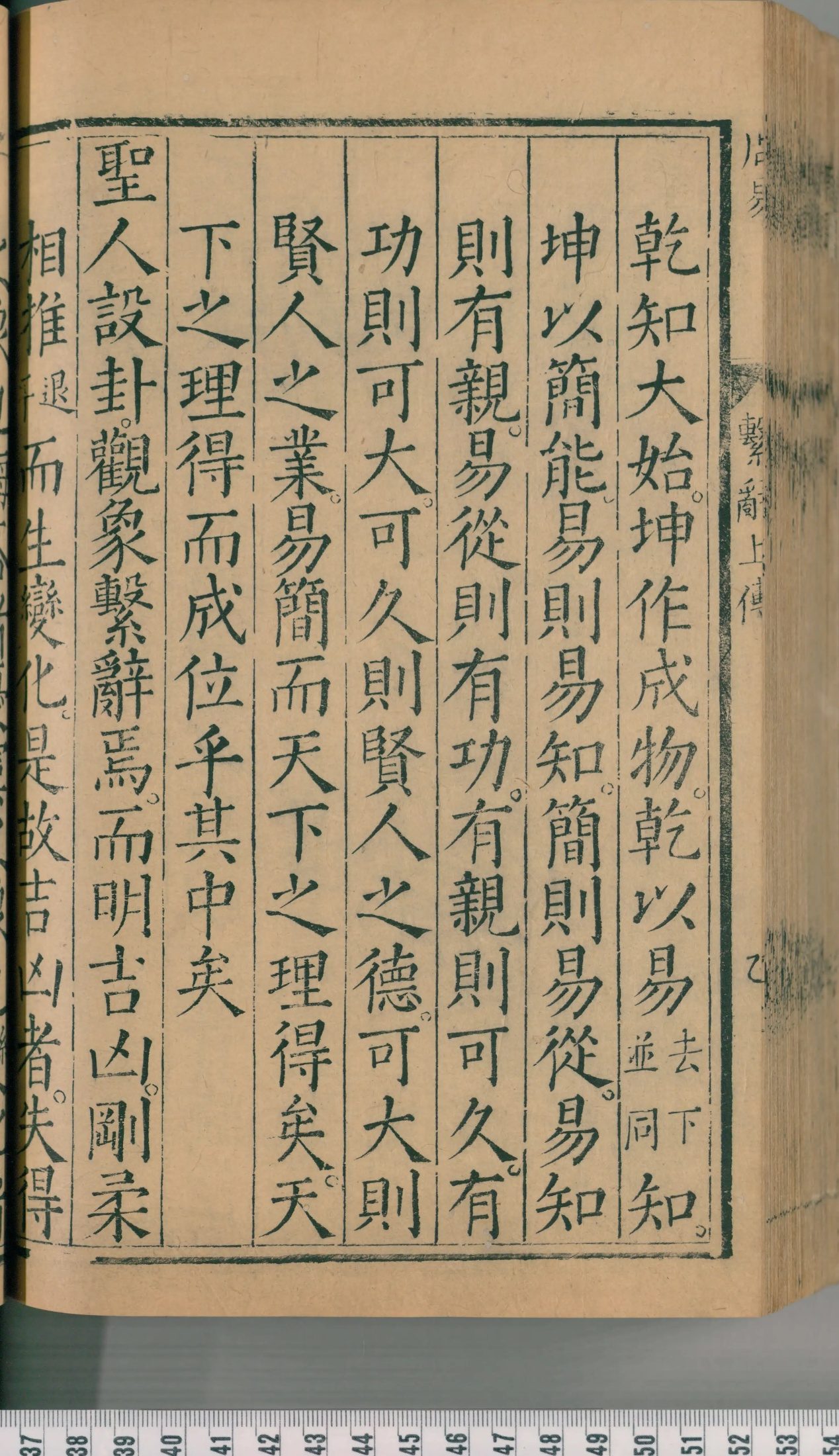
National Diet Library WA35-19 [五經白文], vol. 1 (周易), IIIF canvas 107, right-hand page: 8 columns, main text with punctuation circles and small sound glosses. Checked on the image (column openings aligned to the text): paragraph 5 opens column 1 ‹乾知大始›; paragraph 6 begins within column 1, which opens ‹乾知大始›; paragraph 7 begins within column 2, which opens ‹坤以簡能›; paragraph 8 begins within column 5, which opens ‹賢人之業›. The Chinese shown is the received text from Wikisource, not a transcription of this print.
5乾知大始,坤作成物;
6乾以易知,坤以簡能;
7易則易知,簡則易從;易知則有親,易從則有功;有親則可久,有功則可大;可久則賢人之德,可大則賢人之業。
8易簡,而天下之理得矣。天下之理得,而成位乎其中矣。
5Khien (symbolises Heaven, which) directs the great beginnings of things; Khwăn (symbolises Earth, which) gives to them their completion.
6It is by the ease with which it proceeds that Khien directs (as it does), and by its unhesitating response that Khwăn exhibits such ability.
7(He who attains to this) ease (of Heaven) will be easily understood, and (he who attains to this) freedom from laborious effort (of the Earth) will be easily followed. He who is easily understood will have adherents, and he who is easily followed will achieve success. He who has adherents can continue long, and he who achieves success can become great. To be able to continue long shows the virtue of the wise and able man; to be able to become great is the heritage he will acquire.
8With the attainment of such ease and such freedom from laborious effort, the mastery is got of all principles under the sky. With the attainment of that mastery, (the sage) makes good his position in the middle (between heaven and earth).
Notes
- English: James Legge, The Yî King, Sacred Books of the East vol. 16 (1882), Appendix III (The Great Appendix), Section I, Chapter 1, paragraphs 1-8.
- Legge's notes after each chapter are left out. Where one numbered paragraph is printed as several paragraphs, they are kept as printed.
Cite
Sources
- Source: National Diet Library WA35-19 (Ming Five Classics print with postface of 1596, vol. 1, Zhouyi) + Wikisource received text + James Legge, Sacred Books of the East 16 (1882), Appendix III (holding institution)
- Critical edition: Received text (Wikisource)
← previous · → next · v cycle view · l back to library