Classic of Changes, Great Treatise, Part 1, Chapter 2 (Ming print of 1596)
Introduction
The Great Treatise (繫辭傳 Xici zhuan, "Commentary on the Appended Statements"; Legge's "Great Appendix") is the longest of the Ten Wings, the commentaries attached to the Classic of Changes. It is an essay in two parts on how the hexagrams were made, how the yarrow stalks are counted, and how the book reflects the workings of heaven and earth. Tradition ascribed it to Confucius; it is now generally dated to the late Warring States period (4th to 3rd century BCE), and part of it is preserved on the Mawangdui silk manuscript of 168 BCE. This is chapter 2 of part 1 (上), in the chapter division of Zhu Xi (1130-1200), which Legge follows; Legge numbers his paragraphs straight through each part (here 9-14).
The photographs are of the first volume of a Five Classics printed in Nanjing with the main text only and punctuation circles, with a postface by Li Deng dated Wanli 24 (1596); the National Diet Library, Tokyo, holds the only known copy of these five volumes (call no. WA35-19). The Great Treatise follows the 64 hexagrams in this volume, from canvas 106 to canvas 128, and its passages stand in the order of Zhu Xi's edition. In this copy the chapter runs from canvas 107, right-hand page to canvas 107, left-hand page. Each section gathers the paragraphs that begin on one page and links to that page and to any page the last paragraph runs onto; the page boundaries were found by reading the first characters of every column on the photographs and aligning them to the text.
The Chinese is the received text from Wikisource. The English is James Legge's translation in Sacred Books of the East, volume 16 (1882), Appendix III, Section I, Chapter 2; his notes are not reproduced. Legge adds words in parentheses to make the sense plain; they are his.
How was this verified? (Provenance)
Where on the image
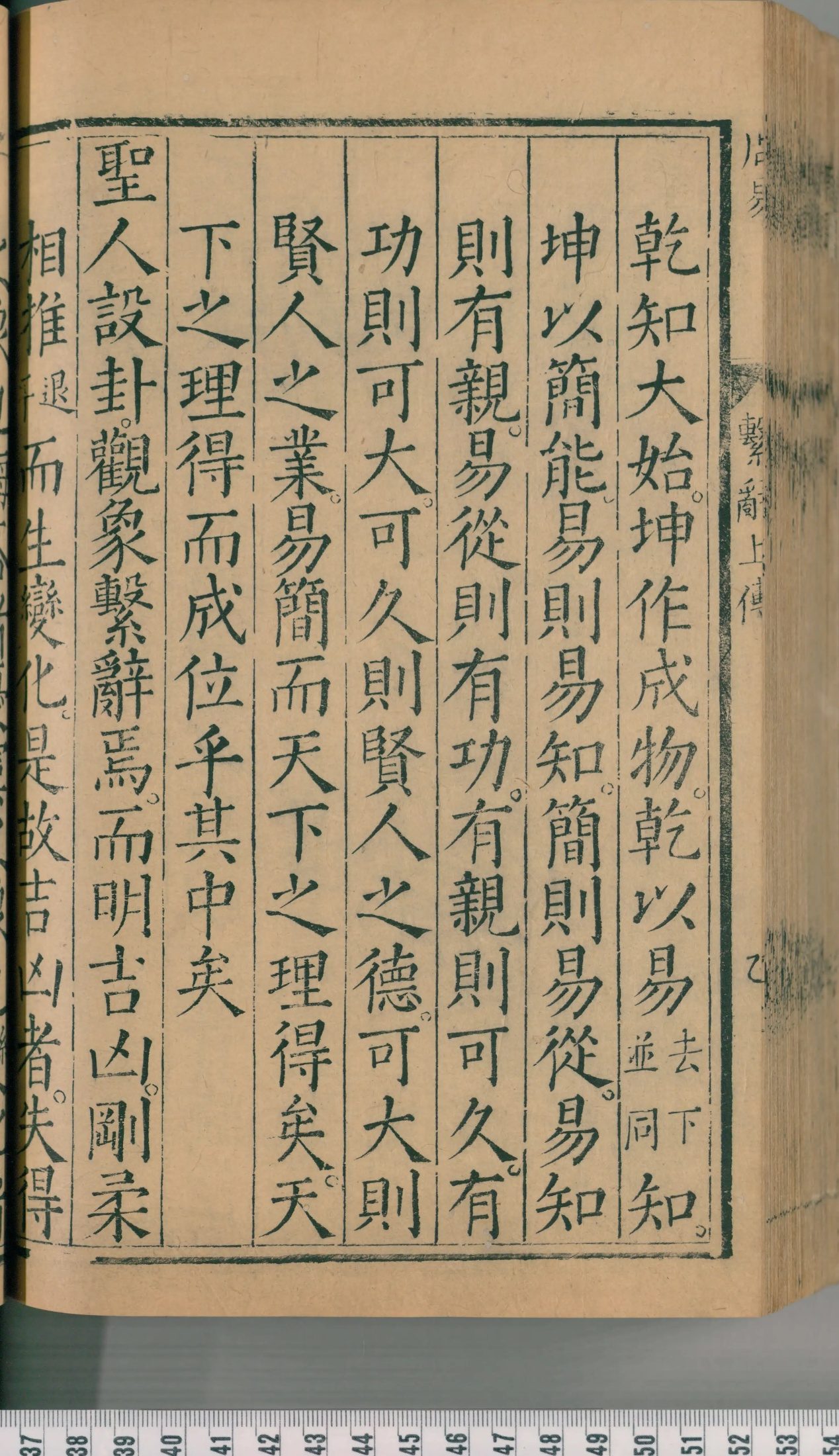
National Diet Library WA35-19 [五經白文], vol. 1 (周易), IIIF canvas 107, right-hand page: 8 columns, main text with punctuation circles and small sound glosses. Checked on the image (column openings aligned to the text): paragraph 9 opens column 7 ‹聖人設卦›; paragraph 10 begins within column 7, which opens ‹聖人設卦›; paragraph 11 begins within column 8, which opens ‹相推而生›. Paragraph 11 runs on to canvas 107, left-hand page (first column ‹之象也悔›). The Chinese shown is the received text from Wikisource, not a transcription of this print.
9聖人設卦觀象,繫辭焉而明吉凶;
10剛柔相推而生變化。
11是故吉凶者,失得之象也。悔吝者,憂虞之象也。
9The sages set forth the diagrams, inspected the emblems contained in them, and appended their explanations;—in this way the good fortune and bad (indicated by them) were made clear.
10The strong and the weak (lines) displace each other, and produce the changes and transformations (in the figures).
11Therefore the good fortune and evil (mentioned in the explanations) are the indications of the right and wrong (in men's conduct of affairs), and the repentance and regret (similarly mentioned) are the indications of their sorrow and anxiety.
Where on the image
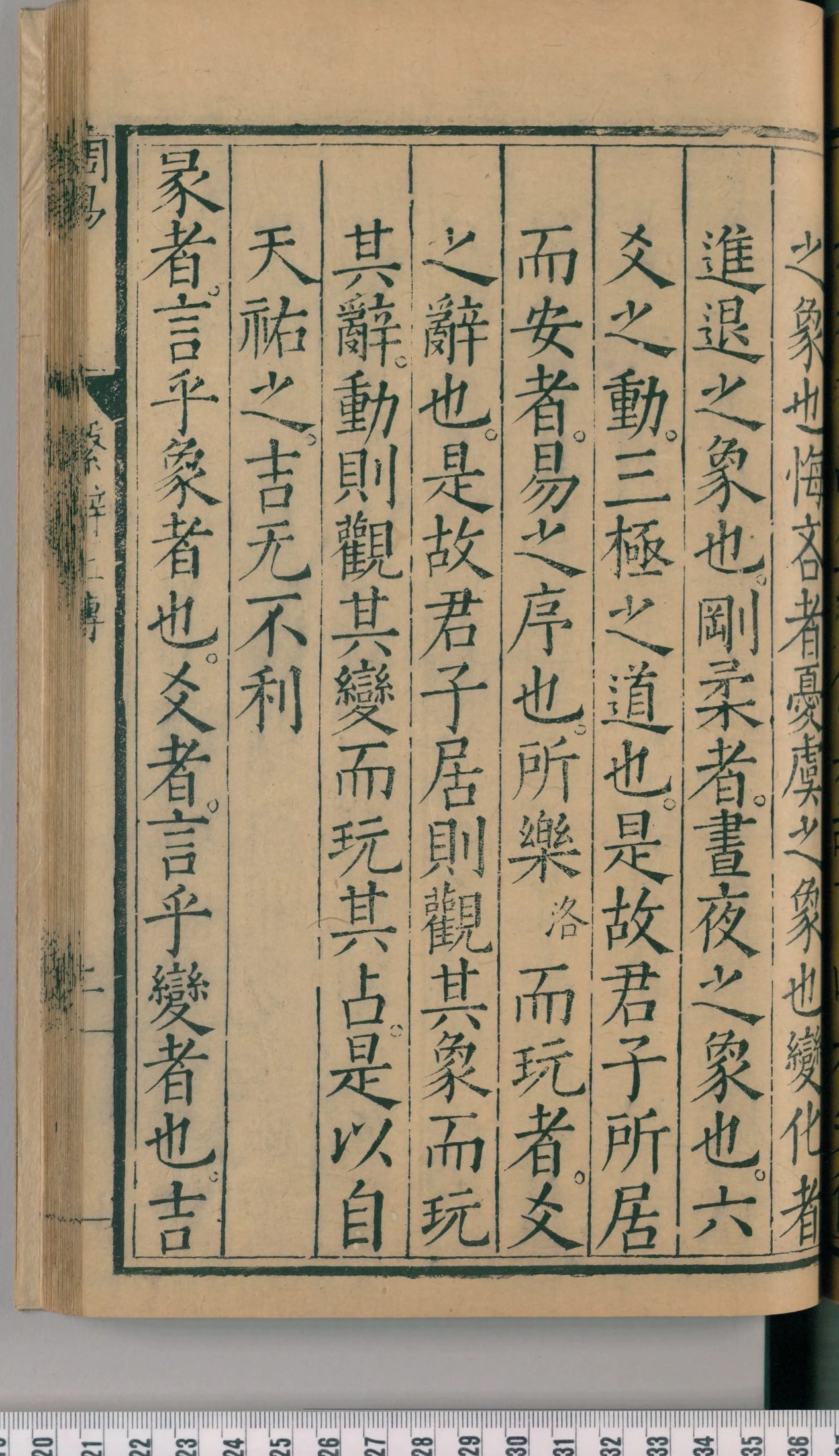
National Diet Library WA35-19 [五經白文], vol. 1 (周易), IIIF canvas 107, left-hand page: 8 columns, main text with punctuation circles and small sound glosses. Checked on the image (column openings aligned to the text): paragraph 12 begins within column 1, which opens ‹之象也悔›; paragraph 13 begins within column 3, which opens ‹爻之動三›; paragraph 14 begins within column 5, which opens ‹之辭也是›. The Chinese shown is the received text from Wikisource, not a transcription of this print.
12變化者,進退之象也。剛柔者,晝夜之象也。六爻之動,三極之道也。
13是故君子所居而安者,易之序也。所樂而玩者,爻之辭也。
14是故君子居則觀其象而玩其辭,動則觀其變而玩其占;是以自天祐之,吉无不利。
12The changes and transformations (of the lines) are the emblems of the advance and retrogression (of the vital force in nature). Thus what we call the strong and the weak (lines) become the emblems of day and night. The movements which take place in the six places (of the hexagram) show the course of the three extremes (i. e. of the three Powers in their perfect operation).
13Therefore what the superior man rests in, in whatever position he is placed, is the order shown in the Yî; and the study which gives him the greatest pleasure is that of the explanations of the several lines.
14Therefore the superior man, when living quietly, contemplates the emblems and studies the explanations of them; when initiating any movement, he contemplates the changes (that are made in divining), and studies the prognostications from them. Thus 'is help extended to him from Heaven; there will be good fortune, and advantage in every movement.'
Notes
- English: James Legge, The Yî King, Sacred Books of the East vol. 16 (1882), Appendix III (The Great Appendix), Section I, Chapter 2, paragraphs 9-14.
- Legge's notes after each chapter are left out. Where one numbered paragraph is printed as several paragraphs, they are kept as printed.
Cite
Sources
- Source: National Diet Library WA35-19 (Ming Five Classics print with postface of 1596, vol. 1, Zhouyi) + Wikisource received text + James Legge, Sacred Books of the East 16 (1882), Appendix III (holding institution)
- Critical edition: Received text (Wikisource)
← previous · → next · v cycle view · l back to library