Classic of Changes, Great Treatise, Part 1, Chapter 5 (Ming print of 1596)
Introduction
The Great Treatise (繫辭傳 Xici zhuan, "Commentary on the Appended Statements"; Legge's "Great Appendix") is the longest of the Ten Wings, the commentaries attached to the Classic of Changes. It is an essay in two parts on how the hexagrams were made, how the yarrow stalks are counted, and how the book reflects the workings of heaven and earth. Tradition ascribed it to Confucius; it is now generally dated to the late Warring States period (4th to 3rd century BCE), and part of it is preserved on the Mawangdui silk manuscript of 168 BCE. This is chapter 5 of part 1 (上), in the chapter division of Zhu Xi (1130-1200), which Legge follows; Legge numbers his paragraphs straight through each part (here 24-32).
The photographs are of the first volume of a Five Classics printed in Nanjing with the main text only and punctuation circles, with a postface by Li Deng dated Wanli 24 (1596); the National Diet Library, Tokyo, holds the only known copy of these five volumes (call no. WA35-19). The Great Treatise follows the 64 hexagrams in this volume, from canvas 106 to canvas 128, and its passages stand in the order of Zhu Xi's edition. In this copy the chapter runs from canvas 109, right-hand page to canvas 109, left-hand page. Each section gathers the paragraphs that begin on one page and links to that page and to any page the last paragraph runs onto; the page boundaries were found by reading the first characters of every column on the photographs and aligning them to the text.
The Chinese is the received text from Wikisource. The English is James Legge's translation in Sacred Books of the East, volume 16 (1882), Appendix III, Section I, Chapter 5; his notes are not reproduced. Legge adds words in parentheses to make the sense plain; they are his.
How was this verified? (Provenance)
Where on the image
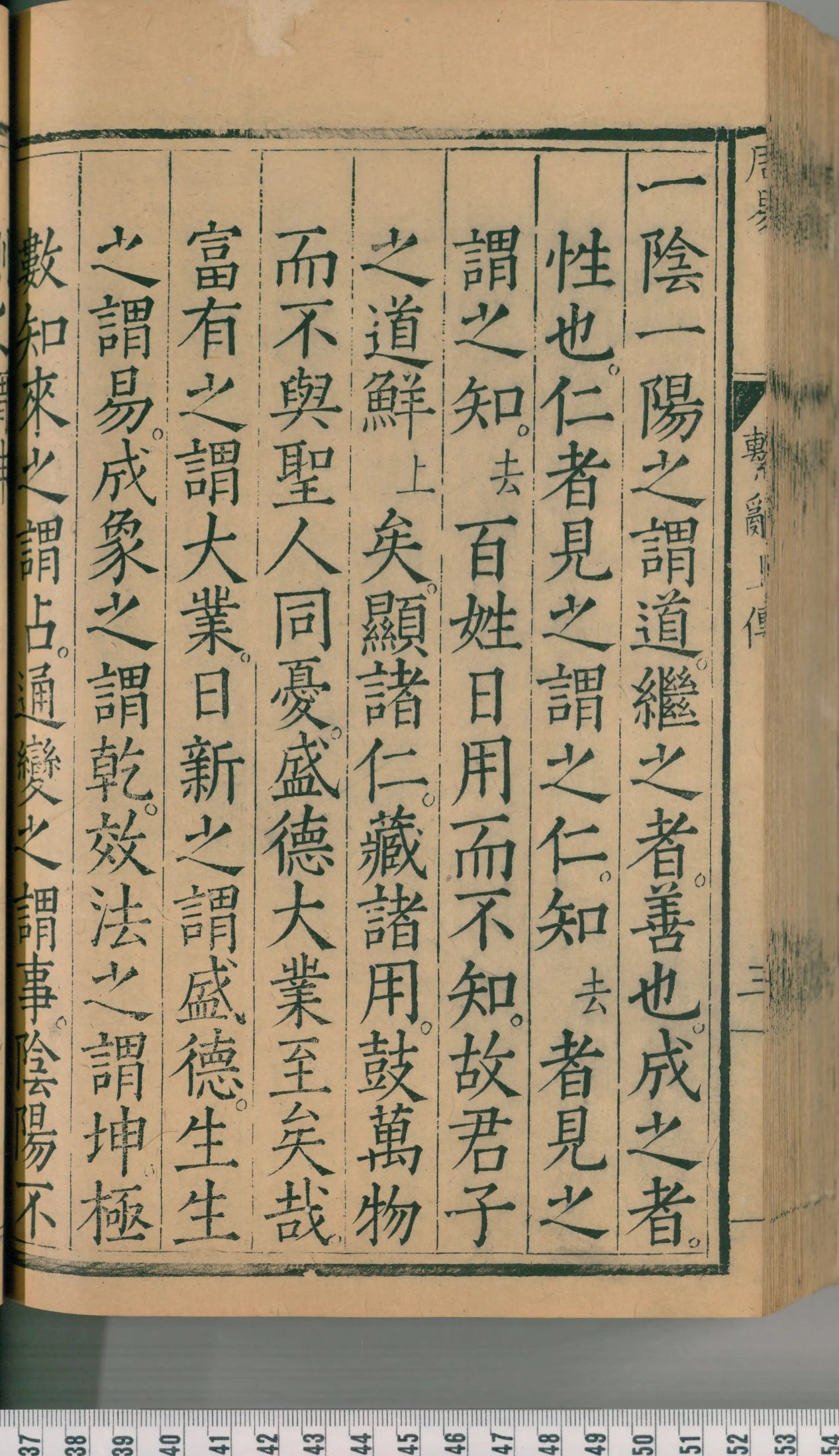
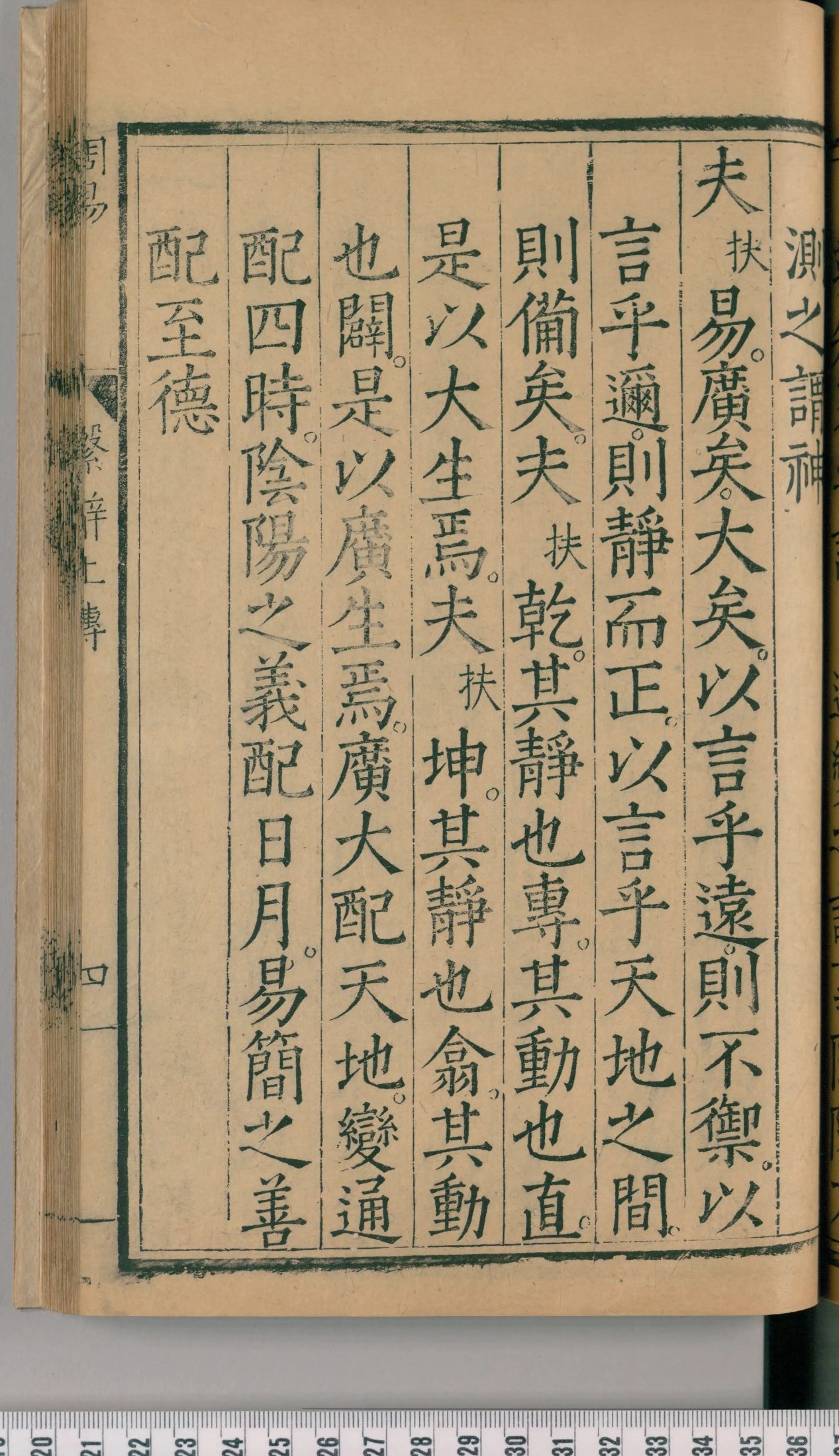
National Diet Library WA35-19 [五經白文], vol. 1 (周易), IIIF canvas 109, right-hand page: 8 columns, main text with punctuation circles and small sound glosses. Checked on the image (column openings aligned to the text): paragraph 24 opens column 1 ‹一陰一陽›; paragraph 25 begins within column 1, which opens ‹一陰一陽›; paragraph 26 begins within column 2, which opens ‹性也仁者›; paragraph 27 begins within column 4, which opens ‹之道鮮矣›; paragraph 28 opens column 6 ‹富有之謂›; paragraph 29 begins within column 6, which opens ‹富有之謂›; paragraph 30 begins within column 7, which opens ‹之謂易成›; paragraph 31 begins within column 7, which opens ‹之謂易成›; paragraph 32 begins within column 8, which opens ‹數知來之›. Paragraph 32 runs on to canvas 109, left-hand page (first column ‹測之謂神›). The Chinese shown is the received text from Wikisource, not a transcription of this print.
24一陰一陽之謂道:
25繼之者善也,成之者性也;
26仁者見之謂之仁,知者見之謂之知;百姓日用而不知,故君子之道鮮矣。
27顯諸仁,藏諸用,鼓萬物而不與聖人同憂,盛德大業至矣哉!
28富有之謂大業,日新之謂盛德,
29生生之謂易,
30成象之謂乾,效法之謂坤,
31極數知來之謂占,通變之謂事,
32陰陽不測之謂神。
24The successive movement of the inactive and active operations constitutes what is called the course (of things).
25That which ensues as the result (of their movement) is goodness; that which shows it in its completeness is the natures (of men and things).
26The benevolent see it and call it benevolence. The wise see it and call it wisdom. The common people, acting daily according to it, yet have no knowledge of it. Thus it is that the course (of things), as seen by the superior man, is seen by few.
27It is manifested in the benevolence (of its operations), and (then again) it conceals and stores up its resources. It gives their stimulus to all things, without having the same anxieties that possess the sage. Complete is its abundant virtue and the greatness of its stores!
28Its rich possessions is what is intended by 'the greatness of its stores;' the daily renovation which it produces is what is meant by 'the abundance of its virtue.'
29Production and reproduction is what is called (the process of) change.
30The formation of the semblances (shadowy forms of things) is what we attribute to Khien; the giving to them their specific forms is what we attribute to Khwăn.
31The exhaustive use of the numbers (that turn up in manipulating the stalks), and (thereby) knowing (the character of) coming events, is what we call prognosticating; the comprehension of the changes (indicated leads us to) what we call the business (to be done).
32That which is unfathomable in (the movement of) the inactive and active operations is (the presence of a) spiritual (power).
Notes
- English: James Legge, The Yî King, Sacred Books of the East vol. 16 (1882), Appendix III (The Great Appendix), Section I, Chapter 5, paragraphs 24-32.
- Legge's notes after each chapter are left out. Where one numbered paragraph is printed as several paragraphs, they are kept as printed.
Cite
Sources
- Source: National Diet Library WA35-19 (Ming Five Classics print with postface of 1596, vol. 1, Zhouyi) + Wikisource received text + James Legge, Sacred Books of the East 16 (1882), Appendix III (holding institution)
- Critical edition: Received text (Wikisource)
← previous · → next · v cycle view · l back to library