Classic of Changes, Great Treatise, Part 1, Chapter 4 (Ming print of 1596)
Introduction
The Great Treatise (繫辭傳 Xici zhuan, "Commentary on the Appended Statements"; Legge's "Great Appendix") is the longest of the Ten Wings, the commentaries attached to the Classic of Changes. It is an essay in two parts on how the hexagrams were made, how the yarrow stalks are counted, and how the book reflects the workings of heaven and earth. Tradition ascribed it to Confucius; it is now generally dated to the late Warring States period (4th to 3rd century BCE), and part of it is preserved on the Mawangdui silk manuscript of 168 BCE. This is chapter 4 of part 1 (上), in the chapter division of Zhu Xi (1130-1200), which Legge follows; Legge numbers his paragraphs straight through each part (here 20-23).
The photographs are of the first volume of a Five Classics printed in Nanjing with the main text only and punctuation circles, with a postface by Li Deng dated Wanli 24 (1596); the National Diet Library, Tokyo, holds the only known copy of these five volumes (call no. WA35-19). The Great Treatise follows the 64 hexagrams in this volume, from canvas 106 to canvas 128, and its passages stand in the order of Zhu Xi's edition. In this copy the chapter runs from canvas 108, right-hand page to canvas 108, left-hand page. Each section gathers the paragraphs that begin on one page and links to that page and to any page the last paragraph runs onto; the page boundaries were found by reading the first characters of every column on the photographs and aligning them to the text.
The Chinese is the received text from Wikisource. The English is James Legge's translation in Sacred Books of the East, volume 16 (1882), Appendix III, Section I, Chapter 4; his notes are not reproduced. Legge adds words in parentheses to make the sense plain; they are his.
How was this verified? (Provenance)
Where on the image
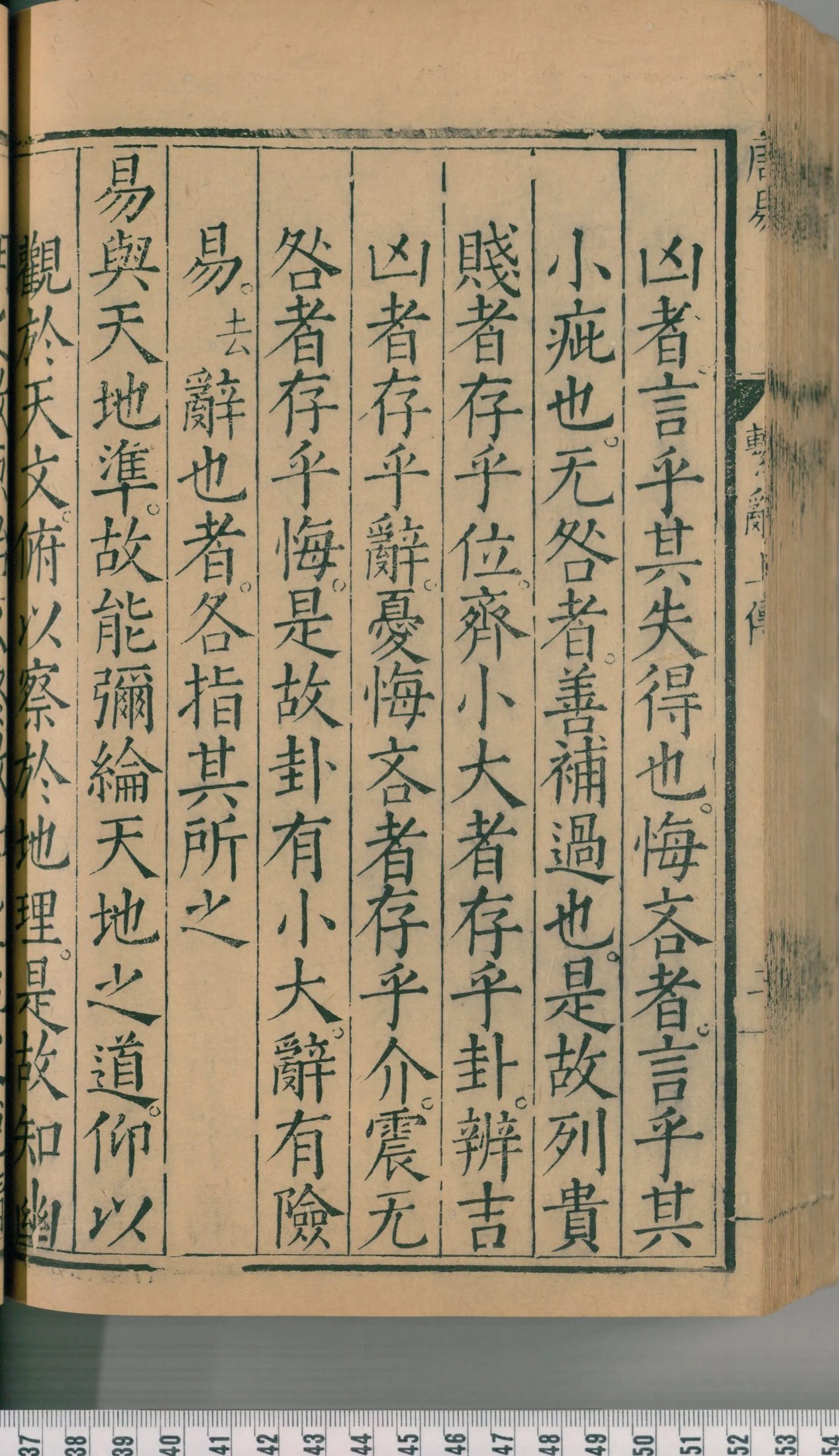
National Diet Library WA35-19 [五經白文], vol. 1 (周易), IIIF canvas 108, right-hand page: 8 columns, main text with punctuation circles and small sound glosses. Checked on the image (column openings aligned to the text): paragraph 20 opens column 7 ‹易與天地›; paragraph 21 begins within column 7, which opens ‹易與天地›. Paragraph 21 runs on to canvas 108, left-hand page (first column ‹明之故原›). The Chinese shown is the received text from Wikisource, not a transcription of this print.
20易與天地準,故能彌綸天地之道。
21仰以觀於天文,俯以察於地理,是故知幽明之故。原始反終,故知死生之說。精氣為物,遊魂為變,是故知鬼神之情狀。
20The Yî was made on a principle of accordance with heaven and earth, and shows us therefore, without rent or confusion, the course (of things) in heaven and earth.
21(The sage), in accordance with (the Yî), looking up, contemplates the brilliant phenomena of the heavens, and, looking down, examines the definite arrangements of the earth;—thus he knows the causes of darkness (or, what is obscure) and light (or, what is bright). He traces things to their beginning, and follows them to their end;—thus he knows what can be said about death and life. (He perceives how the union of) essence and breath form things, and the (disappearance or) wandering away of the soul produces the change (of their constitution);—thus he knows the characteristics of the anima and animus.
Where on the image
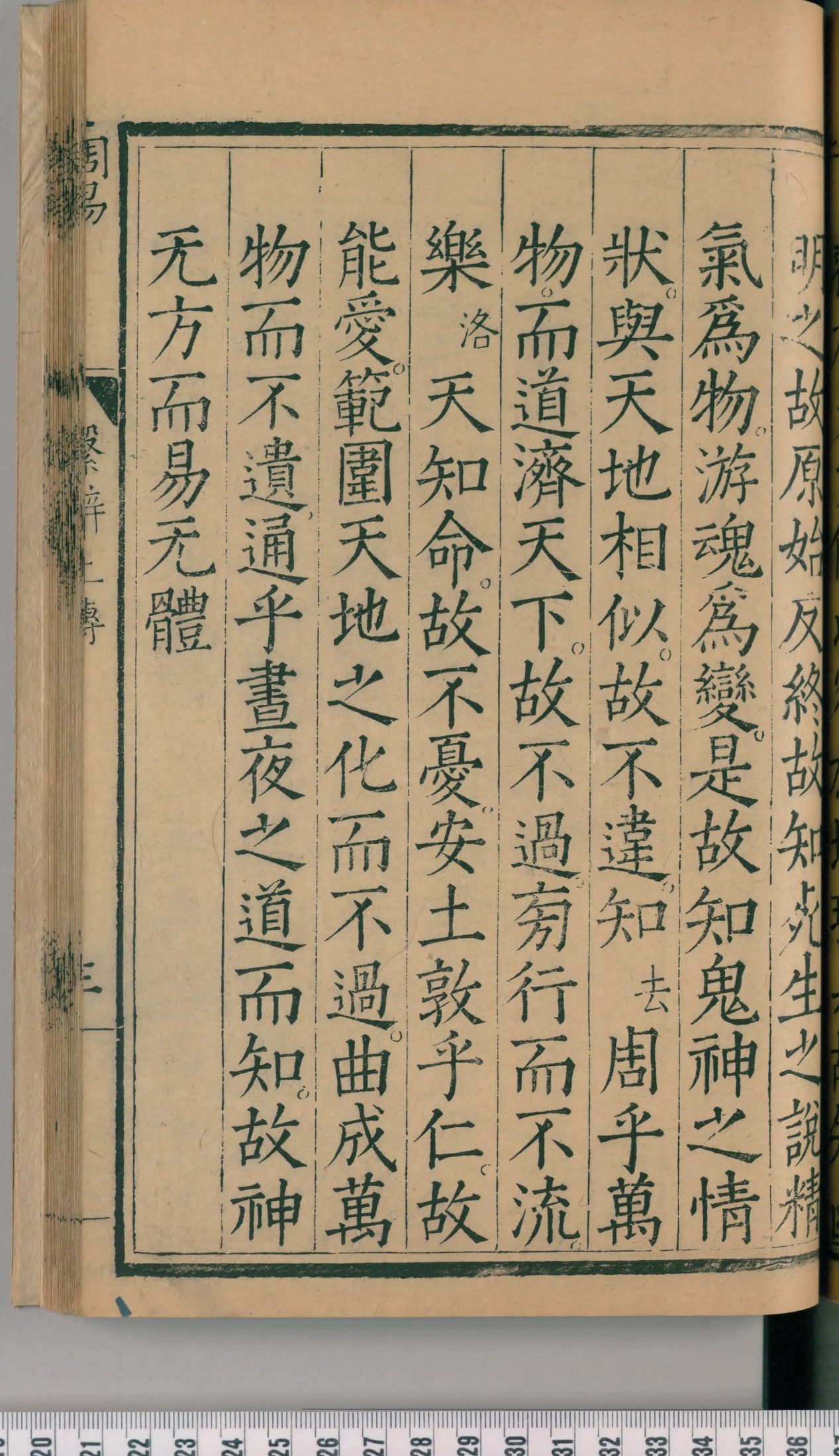
National Diet Library WA35-19 [五經白文], vol. 1 (周易), IIIF canvas 108, left-hand page: 8 columns, main text with punctuation circles and small sound glosses. Checked on the image (column openings aligned to the text): paragraph 22 begins within column 3, which opens ‹狀與天地›; paragraph 23 begins within column 6, which opens ‹能愛範圍›. The Chinese shown is the received text from Wikisource, not a transcription of this print.
22與天地相似,故不違;知周乎萬物,而道濟天下,故不過;旁行而不流,樂天知命,故不憂;安土敦乎仁,故能愛;
23範圍天地之化而不過,曲成萬物而不遺,通乎晝夜之道而知,故神无方而易无體。
22There is a similarity between him and heaven and earth, and hence there is no contrariety in him to them. His knowledge embraces all things, and his course is (intended to be) helpful to all under the sky;—and hence he falls into no error. He acts according to the exigency of circumstances without being carried away by their current; he rejoices in Heaven and knows its ordinations;—and hence he has no anxieties. He rests in his own (present) position, and cherishes (the spirit of) generous benevolence;—and hence he can love (without reserve).
23(Through the Yî), he comprehends as in a mould or enclosure the transformations of heaven and earth without any error; by an ever-varying adaptation he completes (the nature of) all things without exception; he penetrates to a knowledge of the course of day and night (and all other connected phenomena);—it is thus that his operation is spirit-like, unconditioned by place, while the changes which he produces are not restricted to any form.
Notes
- English: James Legge, The Yî King, Sacred Books of the East vol. 16 (1882), Appendix III (The Great Appendix), Section I, Chapter 4, paragraphs 20-23.
- Legge's notes after each chapter are left out. Where one numbered paragraph is printed as several paragraphs, they are kept as printed.
Cite
Sources
- Source: National Diet Library WA35-19 (Ming Five Classics print with postface of 1596, vol. 1, Zhouyi) + Wikisource received text + James Legge, Sacred Books of the East 16 (1882), Appendix III (holding institution)
- Critical edition: Received text (Wikisource)
← previous · → next · v cycle view · l back to library