Classic of Changes, Great Treatise, Part 1, Chapter 8 (Ming print of 1596)
Introduction
The Great Treatise (繫辭傳 Xici zhuan, "Commentary on the Appended Statements"; Legge's "Great Appendix") is the longest of the Ten Wings, the commentaries attached to the Classic of Changes. It is an essay in two parts on how the hexagrams were made, how the yarrow stalks are counted, and how the book reflects the workings of heaven and earth. Tradition ascribed it to Confucius; it is now generally dated to the late Warring States period (4th to 3rd century BCE), and part of it is preserved on the Mawangdui silk manuscript of 168 BCE. This is chapter 8 of part 1 (上), in the chapter division of Zhu Xi (1130-1200), which Legge follows; Legge numbers his paragraphs straight through each part (here 38-48).
The photographs are of the first volume of a Five Classics printed in Nanjing with the main text only and punctuation circles, with a postface by Li Deng dated Wanli 24 (1596); the National Diet Library, Tokyo, holds the only known copy of these five volumes (call no. WA35-19). The Great Treatise follows the 64 hexagrams in this volume, from canvas 106 to canvas 128, and its passages stand in the order of Zhu Xi's edition. In this copy the chapter runs from canvas 110, right-hand page to canvas 112, left-hand page. Each section gathers the paragraphs that begin on one page and links to that page and to any page the last paragraph runs onto; the page boundaries were found by reading the first characters of every column on the photographs and aligning them to the text.
The Chinese is the received text from Wikisource. The English is James Legge's translation in Sacred Books of the East, volume 16 (1882), Appendix III, Section I, Chapter 8; his notes are not reproduced. Legge adds words in parentheses to make the sense plain; they are his.
How was this verified? (Provenance)
Where on the image
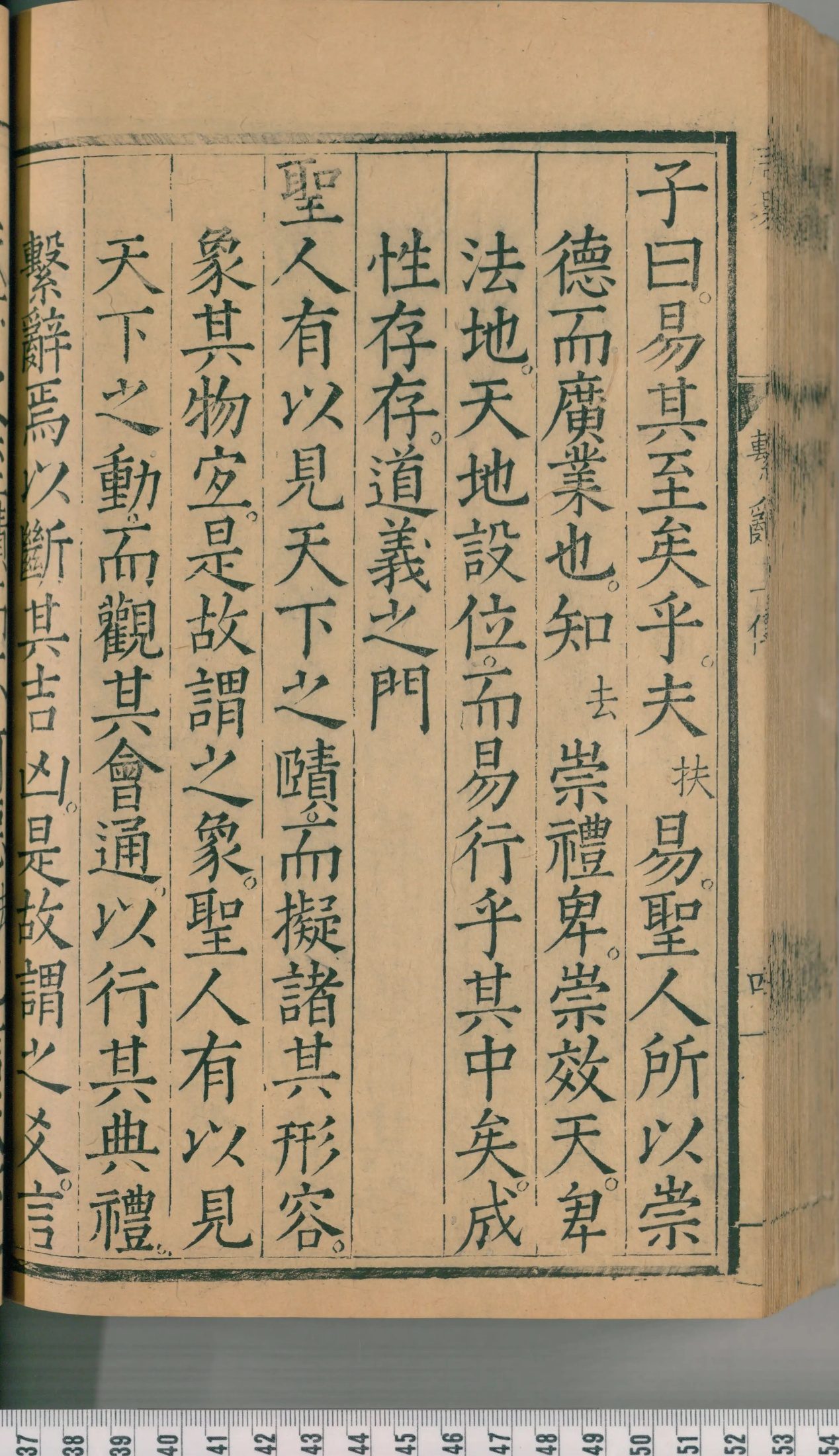
National Diet Library WA35-19 [五經白文], vol. 1 (周易), IIIF canvas 110, right-hand page: 8 columns, main text with punctuation circles and small sound glosses. Checked on the image (column openings aligned to the text): paragraph 38 opens column 5 ‹聖人有以›; paragraph 39 begins within column 6, which opens ‹象其物宜›; paragraph 40 begins within column 8, which opens ‹繫辭焉以›. Paragraph 40 runs on to canvas 110, left-hand page (first column ‹天下之至›). The Chinese shown is the received text from Wikisource, not a transcription of this print.
38聖人有以見天下之賾,而擬諸其形容,象其物宜,是故謂之象。
39聖人有以見天下之動,而觀其會通,以行其典禮,繫辭焉以斷其吉凶,是故謂之爻。
40言天下之至賾而不可惡也,言天下之至動而不可亂也。
38The sage was able to survey all the complex phenomena under the sky. He then considered in his mind how they could be figured, and (by means of the diagrams) represented their material forms and their character. Hence these (diagrams) are denominated Semblances (or emblematic figures, the Hsiang).
39A (later) sage was able to survey the motive influences working all under the sky. He contemplated them in their common action and special nature, in order to bring out the standard and proper tendency of each. He then appended his explanation (to each line of the diagrams), to determine the good or evil indicated by it. Hence those (lines with their explanations) are denominated Imitations (the Yâo).
40(The diagrams) speak of the most complex phenomena under the sky, and yet there is nothing in them that need awaken dislike; the explanations of the lines speak of the subtlest movements under the sky, and yet there is nothing in them to produce confusion.
Where on the image
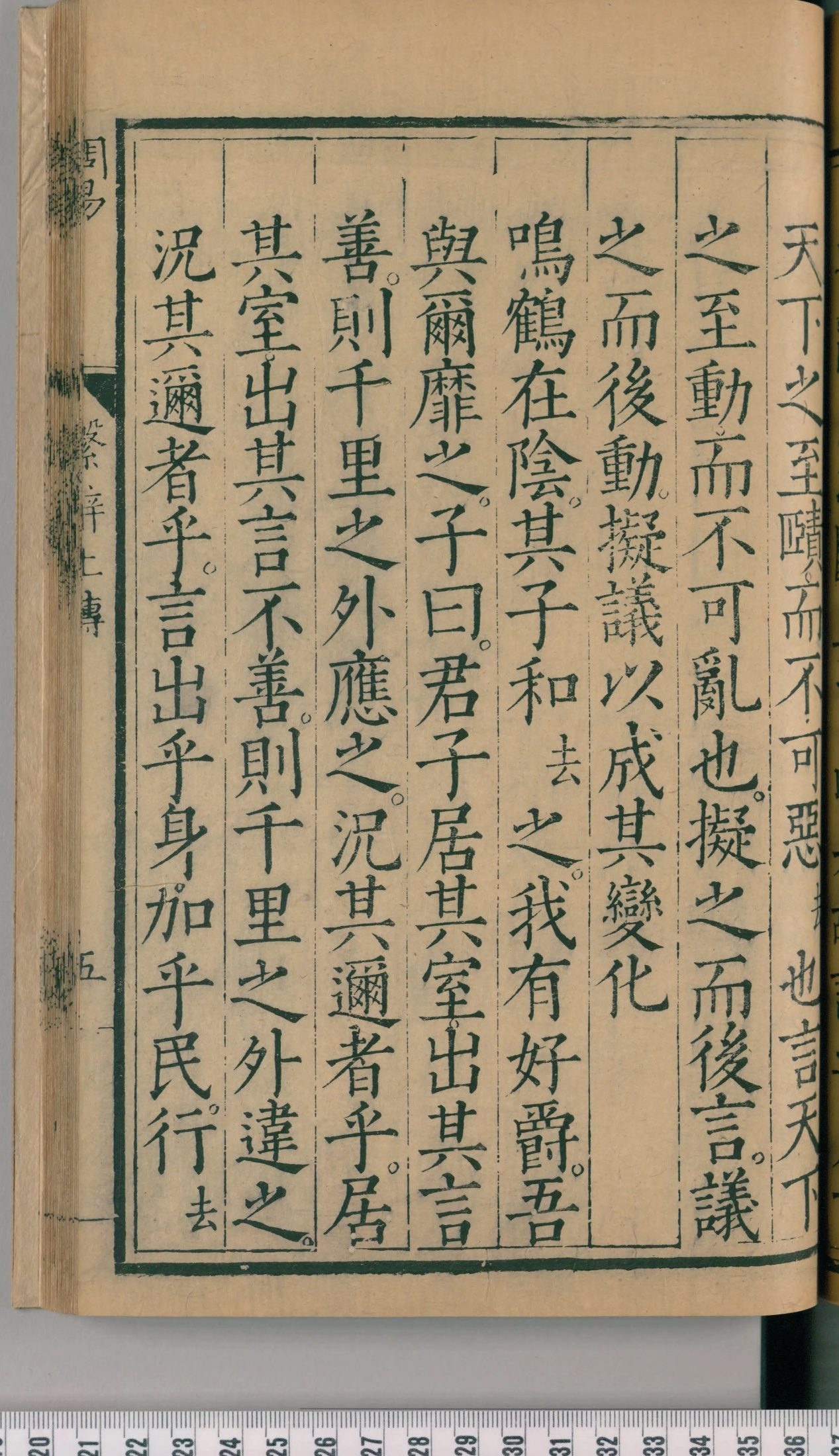
National Diet Library WA35-19 [五經白文], vol. 1 (周易), IIIF canvas 110, left-hand page: 8 columns, main text with punctuation circles and small sound glosses. Checked on the image (column openings aligned to the text): paragraph 41 begins within column 2, which opens ‹之至動而›; paragraph 42 opens column 4 ‹鳴鶴在陰›. Paragraph 42 runs on to canvas 111, right-hand page (first column ‹發乎邇見›). The Chinese shown is the received text from Wikisource, not a transcription of this print.
41擬之而後言,議之而後動,擬議以成其變化。
42「鳴鶴在陰,其子和之。我有好爵,吾與爾靡之。」子曰:「君子居其室,出其言善,則千里之外應之,況其邇者乎!居其室,出其言不善,則千里之外違之,況其邇者乎!言出乎身加乎民;行發乎邇見乎遠。言行,君子之樞機;樞機之發,榮辱之主也。言行,君子之所以動天地也,可不慎乎!」
41(A learner) will consider what is said (under the diagrams), and then speak; he will deliberate on what is said (in the explanations of the lines), and then move. By such consideration and deliberations he will be able to make all the changes which he undertakes successful.
42'Here hid, retired, cries out the crane;
Her young's responsive cry sounds there.
Of spirits good I drain this cup;
With thee a cup I'll freely share.'
The Master said:—'The superior man occupies his apartment and sends forth his words. If they be good, they will be responded to at a distance of more than a thousand lî;—how much more will they be so in the nearer circle! He occupies his apartment and sends forth his words. If they be evil, they will awaken opposition at a distance of more than a thousand lî;—how much more will they do so in the nearer circle! Words issue from one's person, and proceed to affect the people. Actions proceed from what is near, and their effects are seen at a distance. Words and actions are the hinge and spring of the superior man. The movement of that hinge and spring determines glory or disgrace. His words and actions move heaven and earth;—may he be careless in regard to them?'
Where on the image
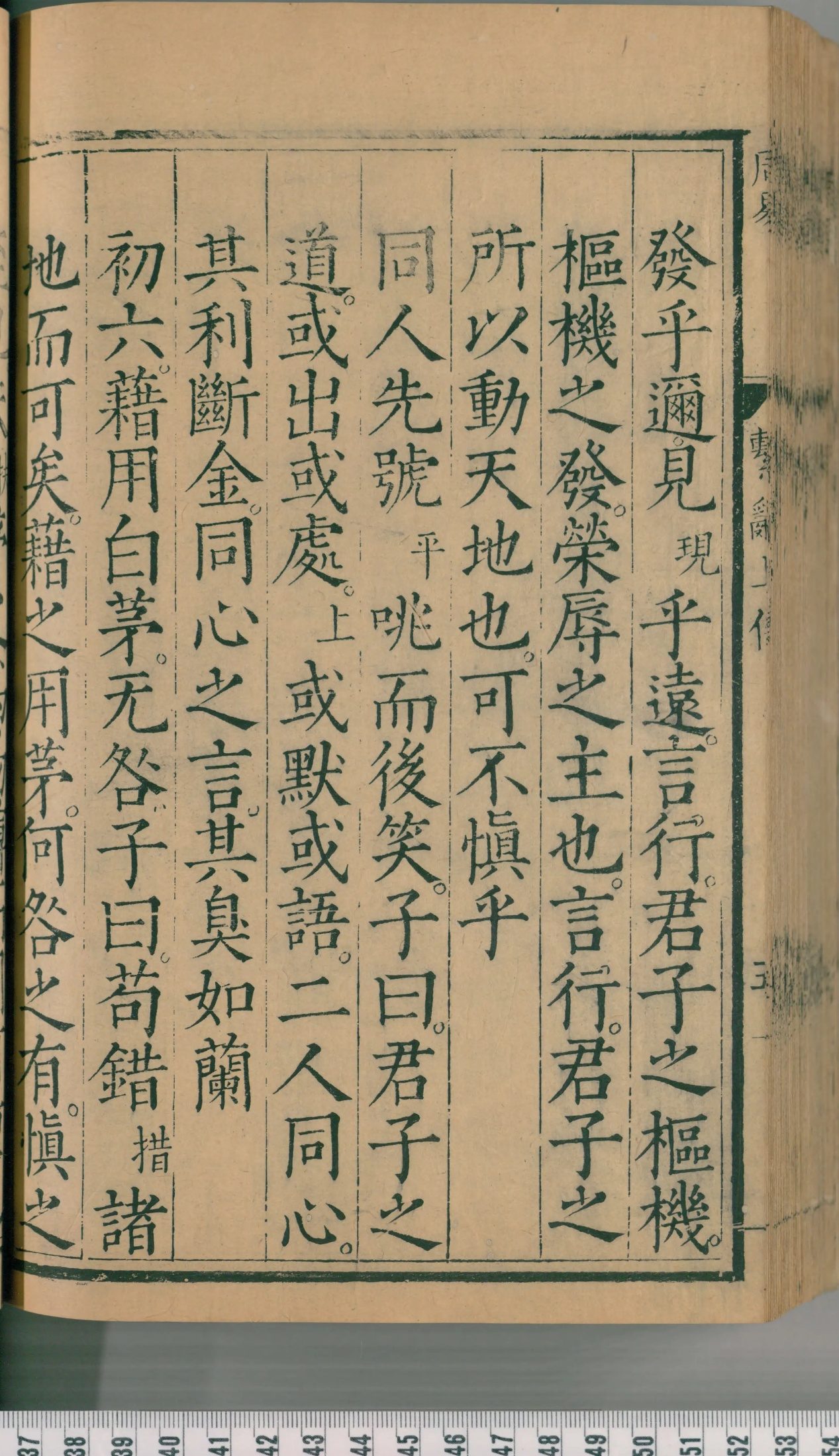
National Diet Library WA35-19 [五經白文], vol. 1 (周易), IIIF canvas 111, right-hand page: 8 columns, main text with punctuation circles and small sound glosses. Checked on the image (column openings aligned to the text): paragraph 43 opens column 4 ‹同人先號›; paragraph 44 opens column 7 ‹初六藉用›. Paragraph 44 runs on to canvas 111, left-hand page (first column ‹至也夫茅›). The Chinese shown is the received text from Wikisource, not a transcription of this print.
43「同人,先號咷而後笑。」子曰:「君子之道,或出或處,或默或語。二人同心,其利斷金。同心之言,其臭如蘭。」
44「初六,藉用白茅,无咎。」子曰:「苟錯諸地而可矣。藉之用茅,何咎之有!慎之至也。夫茅之為物薄而用可重也,慎斯術也以往,其无所失矣。」
43'(The representative of) the union of men first cries out and weeps, and afterwards laughs.' The Master said, on this:—
'The ways of good men (different seem).
This in a public office toils;
That in his home the time beguiles.
One man his lips with silence seals;
Another all his mind reveals.
But when two men are one in heart,
Not iron bolts keep them apart;
The words they in their union use,
Fragrance like orchid plants diffuse.'
44'The first line, undivided, shows its subject placing mats of the white grass beneath what he sets on the ground.' The Master said:—'To place the things on the ground might be considered sufficient; but when he places beneath them mats of the white grass, what occasion for blame can there be? Such a course shows the height of carefulness. The white grass is a trivial thing, but, through the use made of it, it may become important. He who goes forward using such careful art will not fall into any error.'
Where on the image
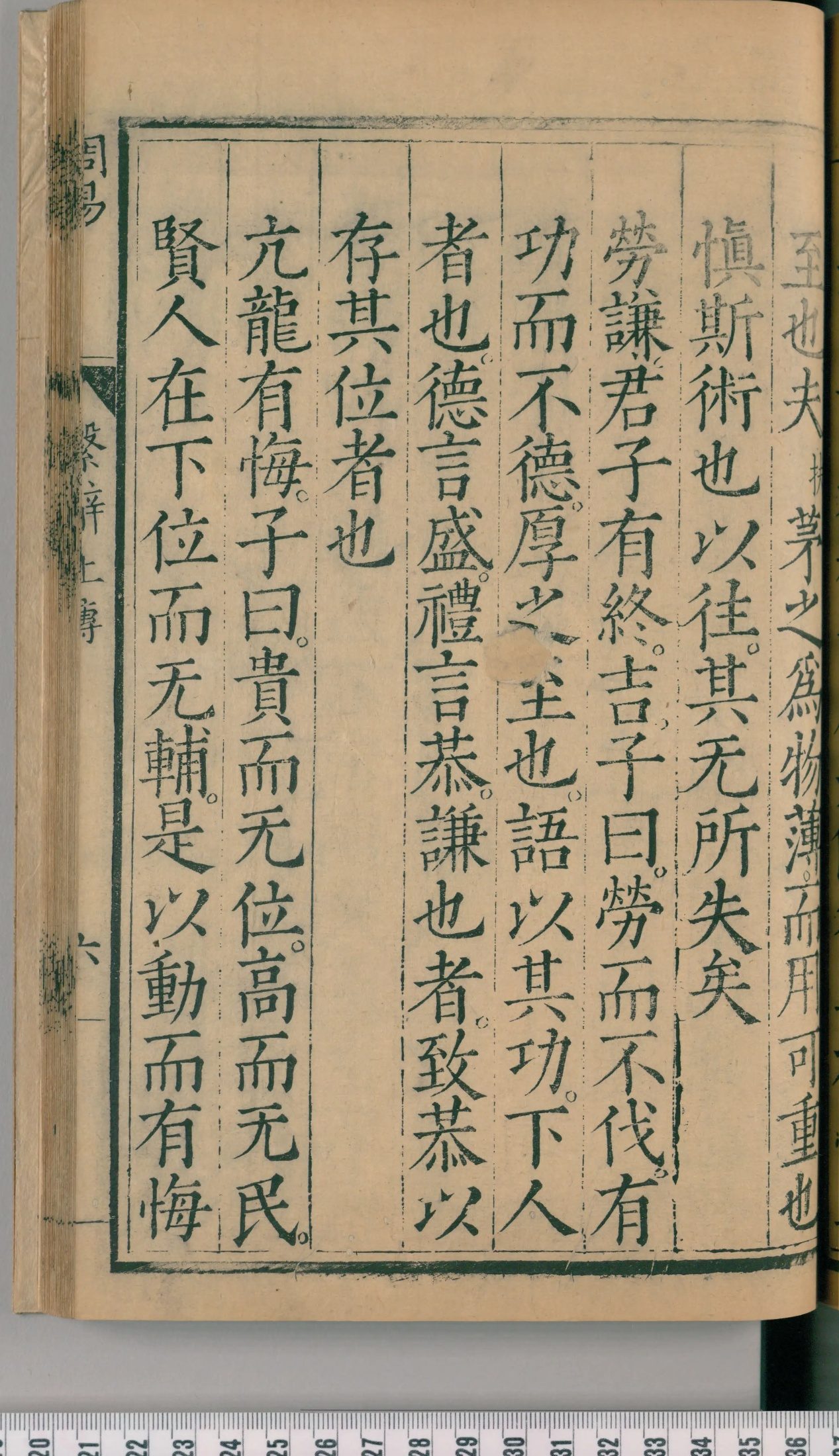
National Diet Library WA35-19 [五經白文], vol. 1 (周易), IIIF canvas 111, left-hand page: 8 columns, main text with punctuation circles and small sound glosses. Checked on the image (column openings aligned to the text): paragraph 45 opens column 3 ‹勞謙君子›; paragraph 46 opens column 7 ‹亢龍有悔›. Paragraph 46 runs on to canvas 112, right-hand page (first column ‹也›). The Chinese shown is the received text from Wikisource, not a transcription of this print.
45「勞謙,君子有終,吉。」子曰:「勞而不伐,有功而不德,厚之至也;語以其功下人者也。德言盛,禮言恭;謙也者,致恭以存其位者也。」
46「亢龍有悔。」子曰:「貴而无位,高而无民,賢人在下位而无輔,是以動而有悔也。」
45'A superior man toiling laboriously and yet humble! He will bring things to an end, and with good fortune.' The Master said on this:—'He toils with success, but does not boast of it; he achieves merit, but takes no virtue to himself from it;—this is the height of generous goodness, and speaks of the man who with (great) merit yet places himself below others. He wishes his virtue to be more and more complete, and in his intercourse with others to be more and more respectful;—he who is so humble, carrying his respectfulness to the utmost, will be able to preserve himself in his position.'
46'The dragon (is seen) beyond his proper haunts; there will be occasion for repentance.' The Master said on this:—'He is noble, but is not in his correct place; he is on high, but there are no people to acknowledge him; there is a man of virtue and ability below, but he will not assist him. Hence whatever movement he may make will give occasion for repentance.'
Where on the image
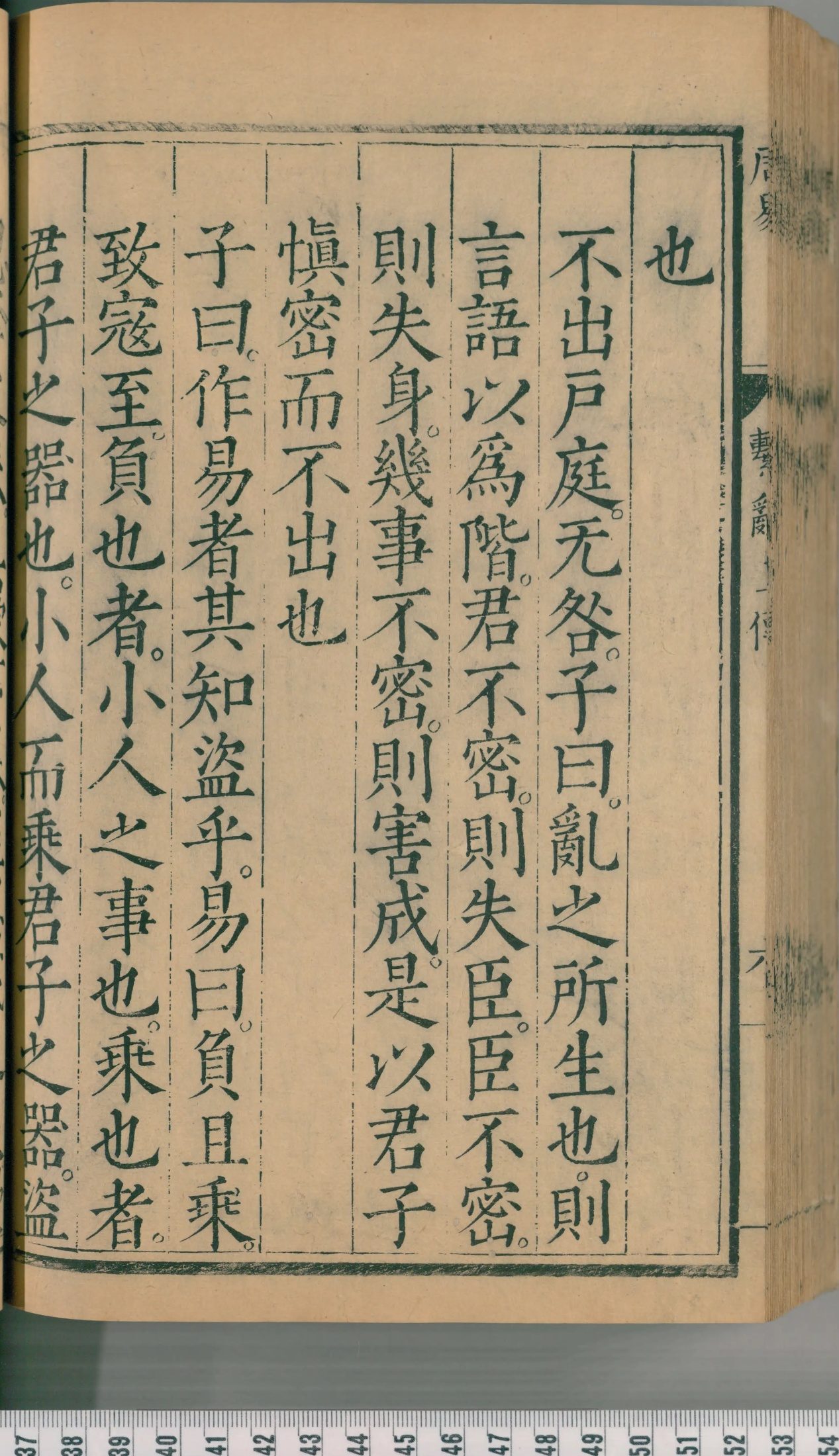
National Diet Library WA35-19 [五經白文], vol. 1 (周易), IIIF canvas 112, right-hand page: 8 columns, main text with punctuation circles and small sound glosses. Checked on the image (column openings aligned to the text): paragraph 47 opens column 2 ‹不出戶庭›; paragraph 48 opens column 6 ‹子曰作易›. Paragraph 48 runs on to canvas 112, left-hand page (first column ‹思奪之矣›). The Chinese shown is the received text from Wikisource, not a transcription of this print.
47「不出戶庭,无咎。」子曰:「亂之所生也,則言語以為階。君不密則失臣,臣不密則失身,幾事不密則害成;是以君子慎密而不出也。」
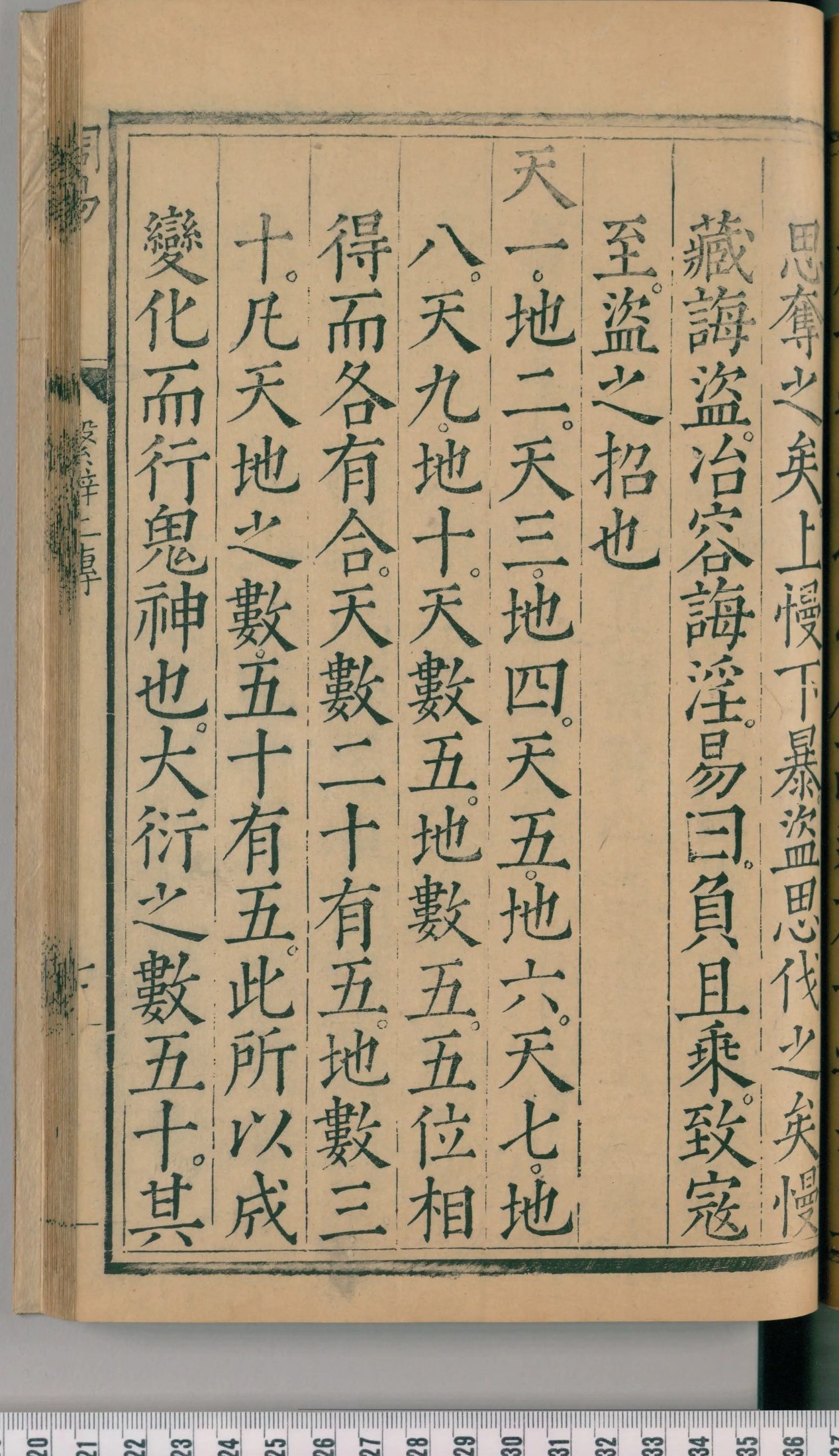
48子曰:「作易者,其知盜乎!易曰:『負且乘,致寇至。』負也者,小人之事也。乘也者,君子之器也。小人而乘君子之器,盜思奪之矣。上慢下暴,盜思伐之矣。慢藏誨盜,冶容誨淫。易曰:『負且乘,致寇至。』盜之招也。」
47'He does not quit the courtyard before his door;—there will be no occasion for blame.' The Master said on this:—'When disorder arises, it will be found that (ill-advised) speech was the stepping-stone to it. If a ruler do not keep secret (his deliberations with his minister), he will lose that minister. If a minister do not keep secret (his deliberations with his ruler), he will lose his life. If (important) matters in the germ be not kept secret, that will be injurious to their accomplishment. Therefore the superior man is careful to maintain secrecy, and does not allow himself to speak.'
48The Master said:—'The makers of the Yî may be said to have known (the philosophy of) robbery. The Yî says, "He is a burden-bearer, and yet rides in a carriage, thereby exciting robbers to attack him." Burden-bearing is the business of a small man. A carriage is the vehicle of a gentleman. When a small man rides in the vehicle of a gentleman, robbers will think of taking it from him. (When one is) insolent to those above him, and oppressive to those below, robbers will wish to attack him. Careless laying up of things excites to robbery, (as a woman's) adorning of herself excites to lust. What the Yî says about the burden-bearer's riding in a carriage, and exciting robbers to attack him, (shows how) robbery is called out.'
Notes
- English: James Legge, The Yî King, Sacred Books of the East vol. 16 (1882), Appendix III (The Great Appendix), Section I, Chapter 8, paragraphs 38-48.
- Legge's notes after each chapter are left out. Where one numbered paragraph is printed as several paragraphs, they are kept as printed.
Cite
Sources
- Source: National Diet Library WA35-19 (Ming Five Classics print with postface of 1596, vol. 1, Zhouyi) + Wikisource received text + James Legge, Sacred Books of the East 16 (1882), Appendix III (holding institution)
- Critical edition: Received text (Wikisource)
← previous · → next · v cycle view · l back to library