Classic of Changes, Great Treatise, Part 1, Chapter 9 (Ming print of 1596)
Introduction
The Great Treatise (繫辭傳 Xici zhuan, "Commentary on the Appended Statements"; Legge's "Great Appendix") is the longest of the Ten Wings, the commentaries attached to the Classic of Changes. It is an essay in two parts on how the hexagrams were made, how the yarrow stalks are counted, and how the book reflects the workings of heaven and earth. Tradition ascribed it to Confucius; it is now generally dated to the late Warring States period (4th to 3rd century BCE), and part of it is preserved on the Mawangdui silk manuscript of 168 BCE. This is chapter 9 of part 1 (上), in the chapter division of Zhu Xi (1130-1200), which Legge follows; Legge numbers his paragraphs straight through each part (here 49-58).
The photographs are of the first volume of a Five Classics printed in Nanjing with the main text only and punctuation circles, with a postface by Li Deng dated Wanli 24 (1596); the National Diet Library, Tokyo, holds the only known copy of these five volumes (call no. WA35-19). The Great Treatise follows the 64 hexagrams in this volume, from canvas 106 to canvas 128, and its passages stand in the order of Zhu Xi's edition. In this copy the chapter runs from canvas 112, left-hand page to canvas 113, left-hand page. Each section gathers the paragraphs that begin on one page and links to that page and to any page the last paragraph runs onto; the page boundaries were found by reading the first characters of every column on the photographs and aligning them to the text.
The Chinese is the received text from Wikisource. The English is James Legge's translation in Sacred Books of the East, volume 16 (1882), Appendix III, Section I, Chapter 9; his notes are not reproduced. Legge adds words in parentheses to make the sense plain; they are his.
How was this verified? (Provenance)
Where on the image
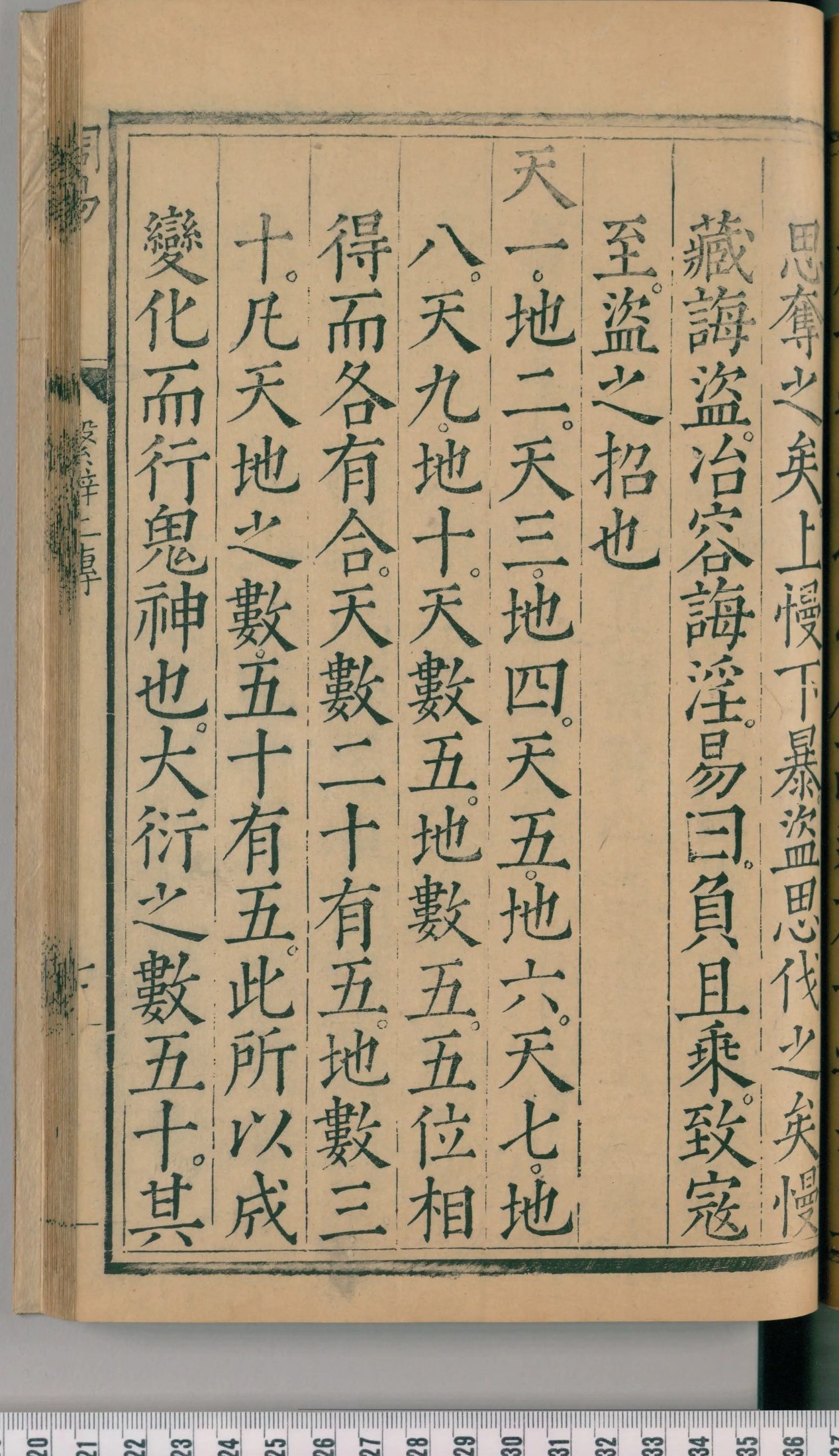
National Diet Library WA35-19 [五經白文], vol. 1 (周易), IIIF canvas 112, left-hand page: 8 columns, main text with punctuation circles and small sound glosses. Checked on the image (column openings aligned to the text): paragraph 49 opens column 4 ‹天一地二›; paragraph 50 begins within column 5, which opens ‹八天九地›; paragraph 51 begins within column 8, which opens ‹變化而行›. Paragraph 51 runs on to canvas 113, right-hand page (first column ‹用四十有›). The Chinese shown is the received text from Wikisource, not a transcription of this print.
49天一地二,天三地四,天五地六,天七地八,天九地十。
50天數五,地數五,五位相得而各有合。天數二十有五,地數三十,凡天地之數,五十有五,此所以成變化,而行鬼神也。
51大衍之數五十,其用四十有九,分而為二以象兩,掛一以象三,揲之以四以象四時,歸奇於扐以象閏,五歲再閏,故再扐而後掛。
49To heaven belongs (the number) 1; to earth, 2; to heaven, 3; to earth, 4; to heaven, 5; to earth, 6; to heaven, 7; to earth, 8; to heaven, 9; to earth, 10.
50The numbers belonging to heaven are five, and those belonging to earth are (also) five. The numbers of these two series correspond to each other (in their fixed positions), and each one has another that may be considered its mate. The heavenly numbers amount to 25, and the earthly to 30. The numbers of heaven and earth together amount to 55. It is by these that the changes and transformations are effected, and the spirit-like agencies kept in movement.
51The numbers of the Great Expansion, (multiplied together), make 50, of which (only) 49 are used (in divination). (The stalks representing these) are divided into two heaps to represent the two (emblematic lines, or heaven and earth). One is then taken (from the heap on the right), and placed (between the little finger of the left hand and the next), that there may thus be symbolised the three (powers of heaven, earth, and man). (The heaps on both sides) are manipulated by fours to represent the four seasons; and then the remainders are returned, and placed (between) the two middle fingers of the left hand, to represent the intercalary month. In five years there are two intercalations, and therefore there are two operations; and afterwards the whole process is repeated.
Where on the image
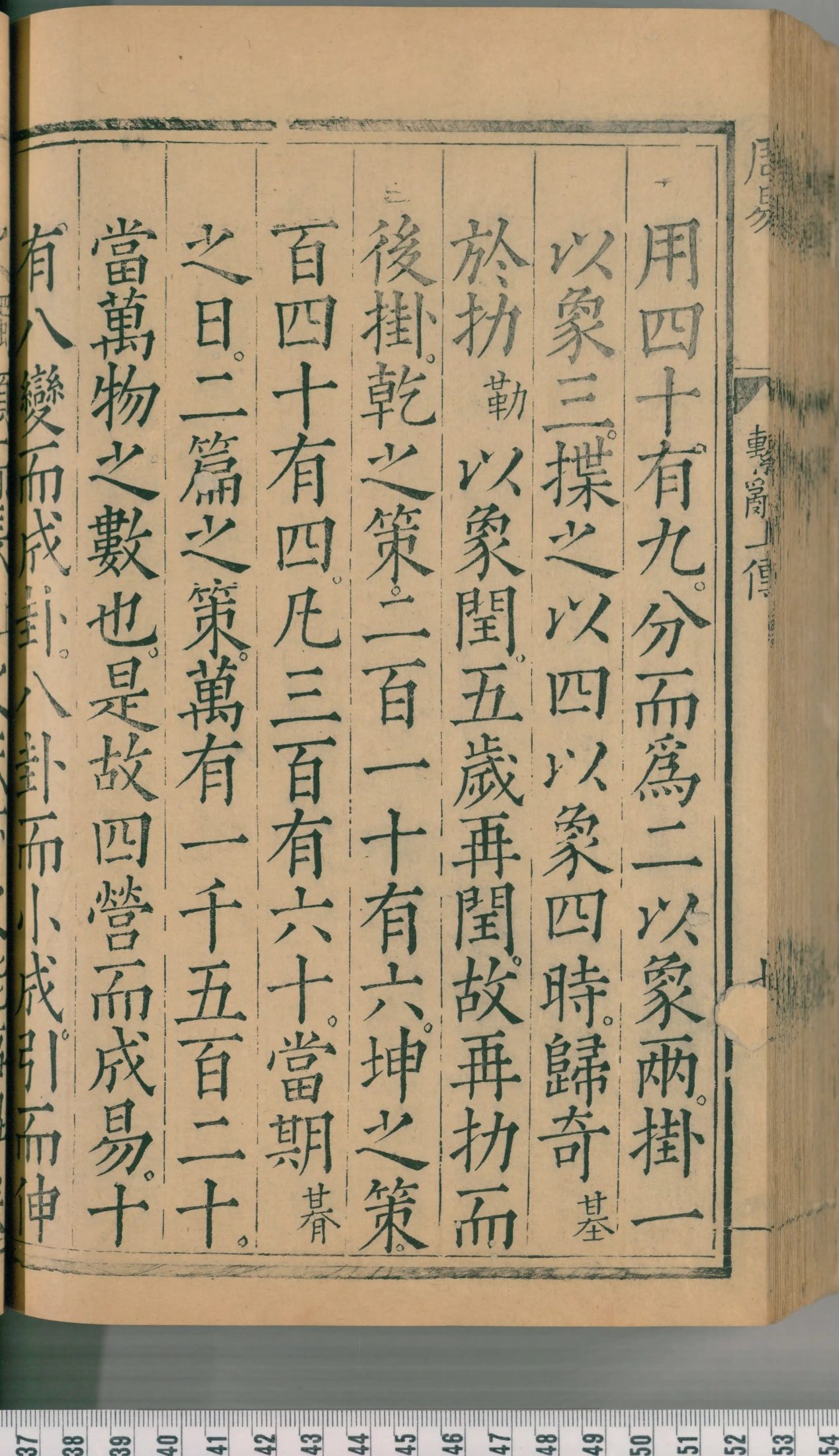
National Diet Library WA35-19 [五經白文], vol. 1 (周易), IIIF canvas 113, right-hand page: 8 columns, main text with punctuation circles and small sound glosses. Checked on the image (column openings aligned to the text): paragraph 52 begins within column 4, which opens ‹後掛乾之›; paragraph 53 begins within column 6, which opens ‹之日二篇›; paragraph 54 begins within column 7, which opens ‹當萬物之›; paragraph 55 begins within column 8, which opens ‹有八變而›; paragraph 56 begins within column 8, which opens ‹有八變而›. Paragraph 56 runs on to canvas 113, left-hand page (first column ‹之觸類而›). The Chinese shown is the received text from Wikisource, not a transcription of this print.
52乾之策,二百一十有六,坤之策,百四十有四,凡三百有六十,當期之日。
53二篇之策,萬有一千五百二十,當萬物之數也。
54是故四營而成易,十有八變而成卦,
55八卦而小成;
56引而伸之,觸類而長之,天下之能事畢矣。
52The numbers (required) for Khien (or the undivided line) amount to 216; those for Khwăn (or the divided line), to 144. Together they are 360, corresponding to the days of the year.
53The number produced by the lines in the two parts (of the Yî) amount to 11,520, corresponding to the number of all things.
54Therefore by means of the four operations is the Yî completed. It takes 18 changes to form a hexagram.
55(The formation of) the eight trigrams constitutes the small completion (of the Yî).
56If we led on the diagrams and expanded them, if we prolonged each by the addition of the proper lines, then all events possible under the sky might have their representation.
Where on the image
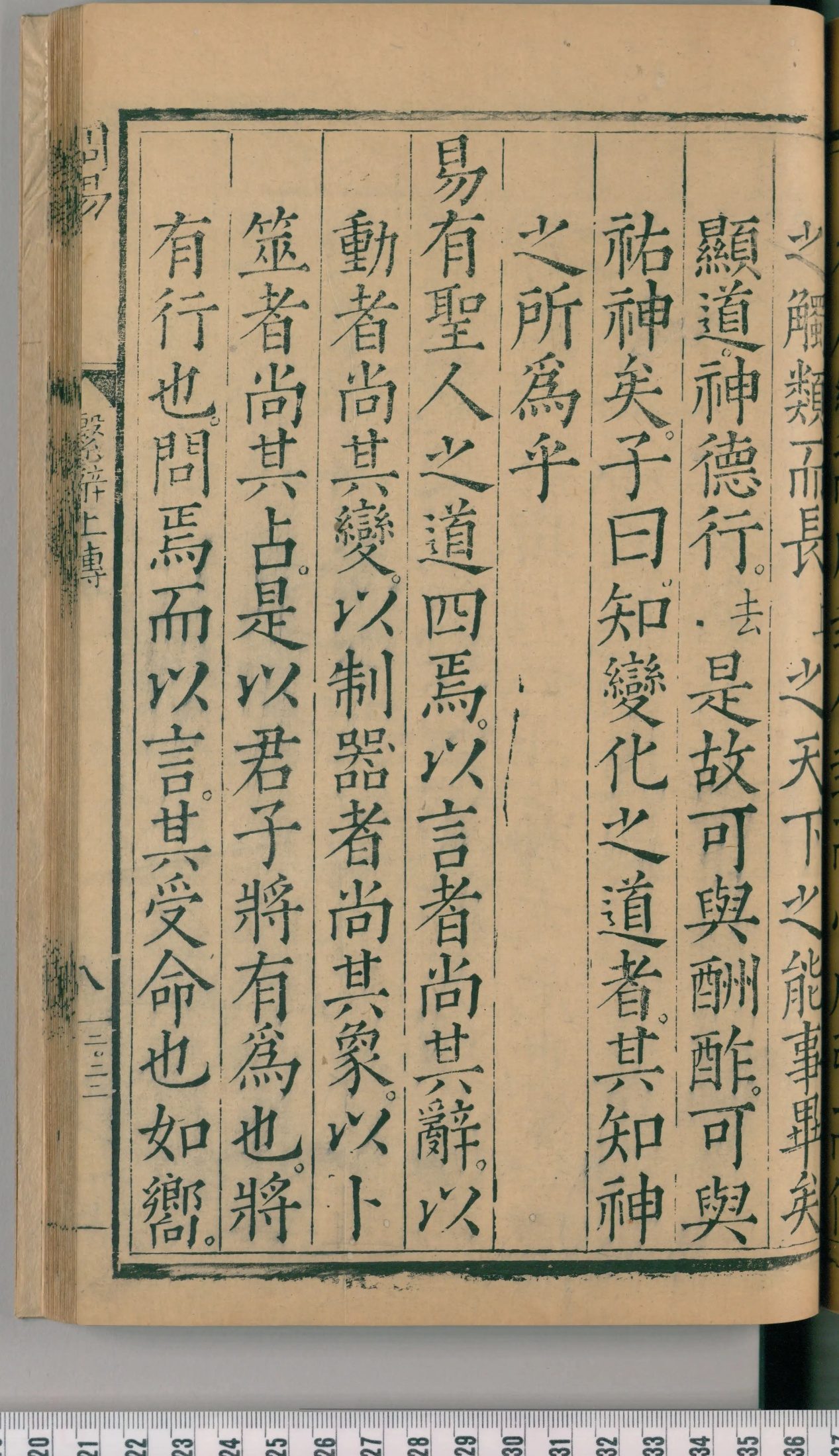
National Diet Library WA35-19 [五經白文], vol. 1 (周易), IIIF canvas 113, left-hand page: 8 columns, main text with punctuation circles and small sound glosses. Checked on the image (column openings aligned to the text): paragraph 57 opens column 2 ‹顯道神德›; paragraph 58 begins within column 3, which opens ‹祐神矣子›. The Chinese shown is the received text from Wikisource, not a transcription of this print.
57顯道神德行,是故可與酬酢,可與祐神矣。
58子曰:「知變化之道者,其知神之所為乎!」
57(The diagrams) make manifest (by their appended explanations), the ways (of good and ill fortune), and show virtuous actions in their spiritual relations. In this way, by consulting them, we may receive an answer (to our doubts), and we may also by means of them assist the spiritual (power in its agency in nature and providence).
58The Master said:—'He who knows the method of change and transformation may be said to know what is done by that spiritual (power).'
Notes
- English: James Legge, The Yî King, Sacred Books of the East vol. 16 (1882), Appendix III (The Great Appendix), Section I, Chapter 9, paragraphs 49-58.
- Legge's notes after each chapter are left out. Where one numbered paragraph is printed as several paragraphs, they are kept as printed.
Cite
Sources
- Source: National Diet Library WA35-19 (Ming Five Classics print with postface of 1596, vol. 1, Zhouyi) + Wikisource received text + James Legge, Sacred Books of the East 16 (1882), Appendix III (holding institution)
- Critical edition: Received text (Wikisource)
← previous · → next · v cycle view · l back to library