Classic of Changes, Great Treatise, Part 2, Chapter 2 (Ming print of 1596)
Introduction
The Great Treatise (繫辭傳 Xici zhuan, "Commentary on the Appended Statements"; Legge's "Great Appendix") is the longest of the Ten Wings, the commentaries attached to the Classic of Changes. It is an essay in two parts on how the hexagrams were made, how the yarrow stalks are counted, and how the book reflects the workings of heaven and earth. Tradition ascribed it to Confucius; it is now generally dated to the late Warring States period (4th to 3rd century BCE), and part of it is preserved on the Mawangdui silk manuscript of 168 BCE. This is chapter 2 of part 2 (下), in the chapter division of Zhu Xi (1130-1200), which Legge follows; Legge numbers his paragraphs straight through each part (here 11-23).
The photographs are of the first volume of a Five Classics printed in Nanjing with the main text only and punctuation circles, with a postface by Li Deng dated Wanli 24 (1596); the National Diet Library, Tokyo, holds the only known copy of these five volumes (call no. WA35-19). The Great Treatise follows the 64 hexagrams in this volume, from canvas 106 to canvas 128, and its passages stand in the order of Zhu Xi's edition. In this copy the chapter runs from canvas 118, left-hand page to canvas 120, left-hand page. Each section gathers the paragraphs that begin on one page and links to that page and to any page the last paragraph runs onto; the page boundaries were found by reading the first characters of every column on the photographs and aligning them to the text.
The Chinese is the received text from Wikisource. The English is James Legge's translation in Sacred Books of the East, volume 16 (1882), Appendix III, Section II, Chapter 2; his notes are not reproduced. Legge adds words in parentheses to make the sense plain; they are his.
How was this verified? (Provenance)
Where on the image
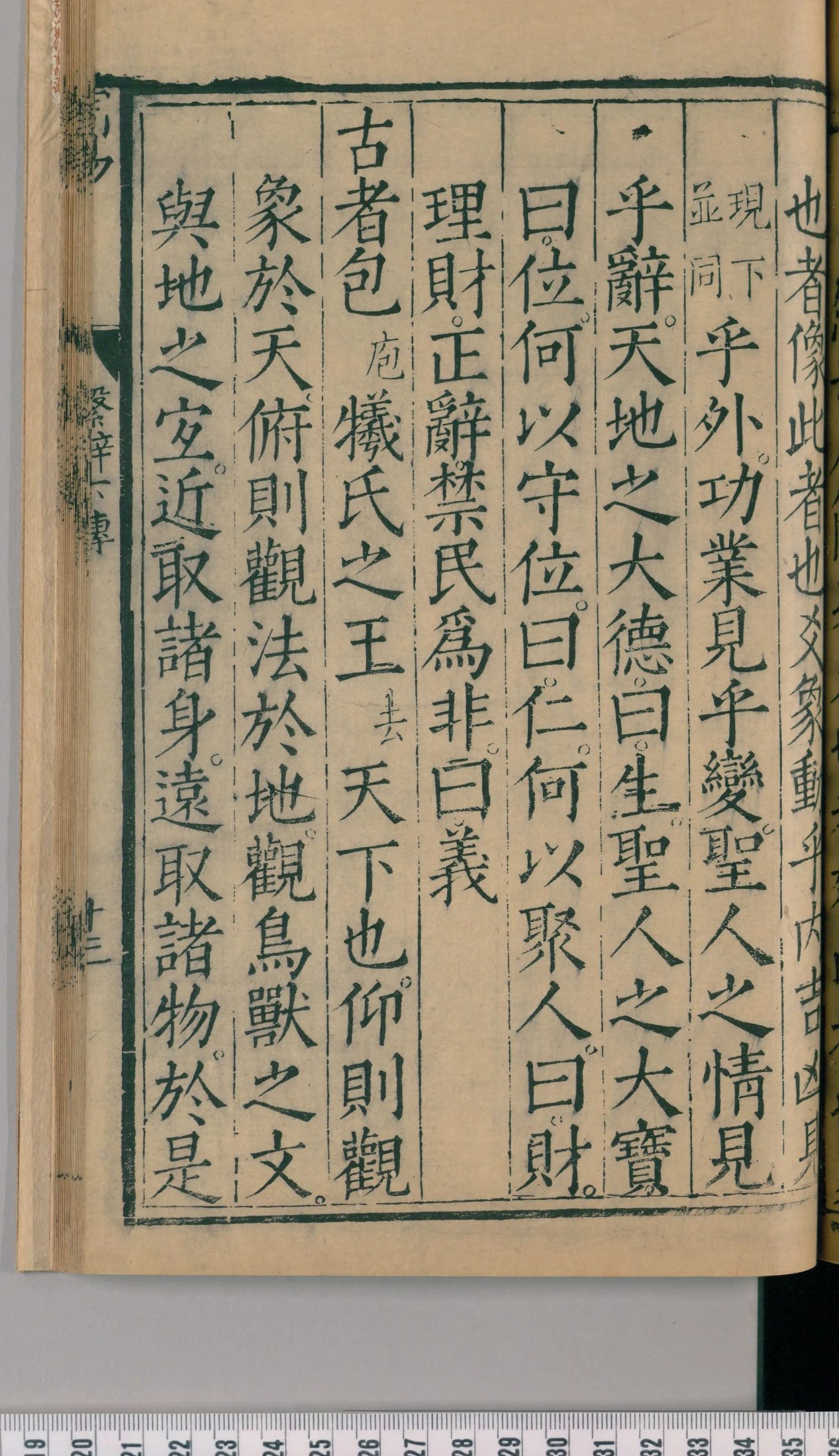
National Diet Library WA35-19 [五經白文], vol. 1 (周易), IIIF canvas 118, left-hand page: 8 columns, main text with punctuation circles and small sound glosses. Checked on the image (column openings aligned to the text): paragraph 11 opens column 6 ‹古者包犧›. Paragraph 11 runs on to canvas 119, right-hand page (first column ‹始作八卦›). The Chinese shown is the received text from Wikisource, not a transcription of this print.
11古者包犧氏之王天下也,仰則觀象於天,俯則觀法於地,觀鳥獸之文,與地之宜,近取諸身,遠取諸物;於是始作八卦,以通神明之德,以類萬物之情。
11Anciently, when Pâo-hsî had come to the rule of all under heaven, looking up, he contemplated the brilliant forms exhibited in the sky, and looking down he surveyed the patterns shown on the earth. He contemplated the ornamental appearances of birds and beasts and the (different) suitabilities of the soil. Near at hand, in his own person, he found things for consideration, and the same at a distance, in things in general. On this he devised the eight trigrams, to show fully the attributes of the spirit-like and intelligent (operations working secretly), and to classify the qualities of the myriads of things.
Where on the image
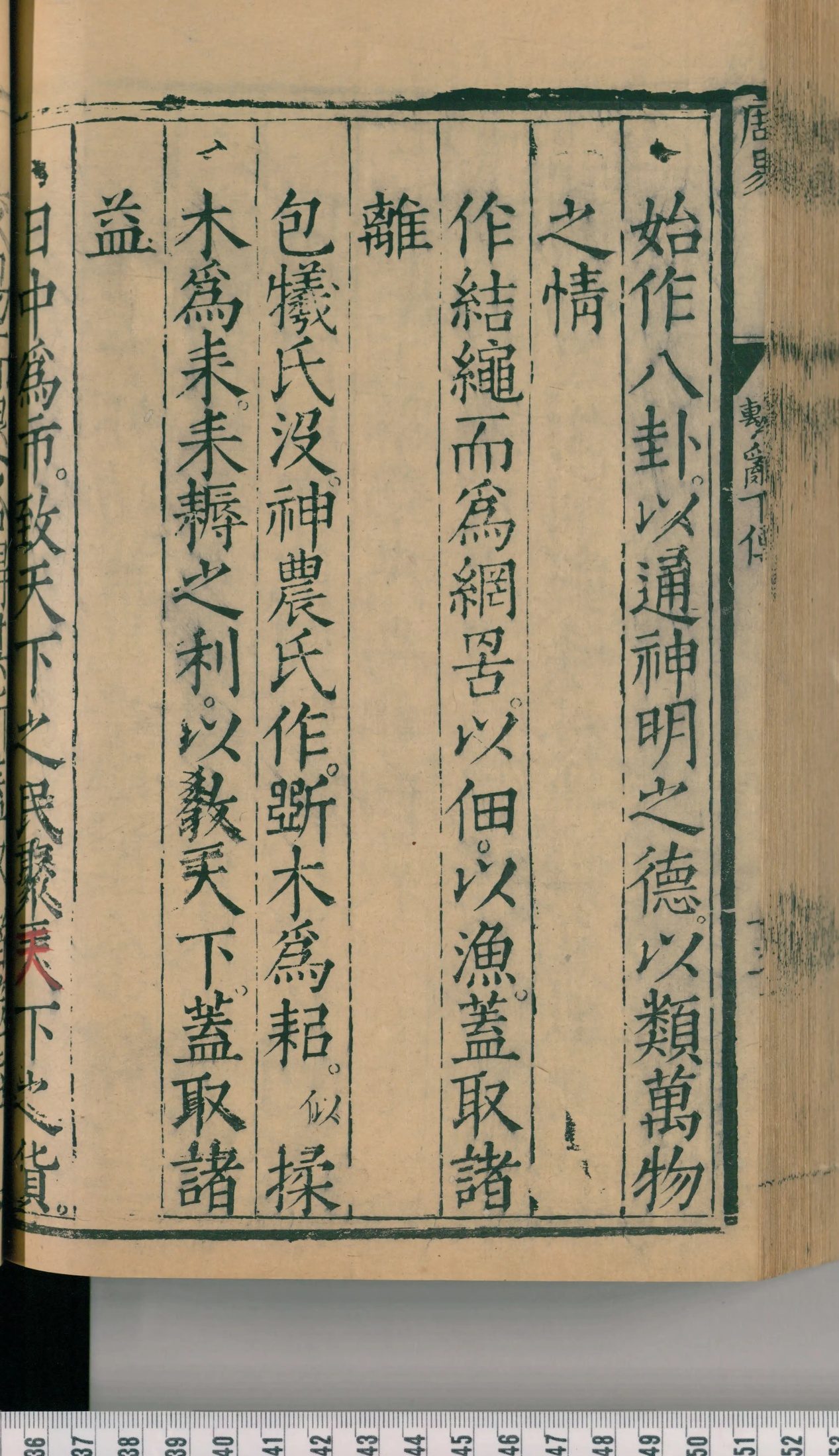
National Diet Library WA35-19 [五經白文], vol. 1 (周易), IIIF canvas 119, right-hand page: 8 columns, main text with punctuation circles and small sound glosses. Checked on the image (column openings aligned to the text): paragraph 12 opens column 3 ‹作結繩而›; paragraph 13 opens column 5 ‹包犧氏沒›; paragraph 14 opens column 8 ‹日中爲市›. Paragraph 14 runs on to canvas 119, left-hand page (first column ‹交易而退›). The Chinese shown is the received text from Wikisource, not a transcription of this print.
12作結繩而為罔罟,以佃以漁,蓋取諸離。
13包犧氏沒,神農氏作,斲木為耜,揉木為耒,耒耨之利,以教天下,蓋取諸益。
14日中為市,致天下之民,聚天下之貨,交易而退,各得其所,蓋取諸噬嗑。
12He invented the making of nets of various kinds by knitting strings, both for hunting and fishing. The idea of this was taken, probably, from Lî (the third trigram, and thirtieth hexagram).
13On the death of Pâo-hsî, there arose Shăn-năng (in his place). He fashioned wood to form the share, and bent wood to make the plough-handle. The advantages of ploughing and weeding were then taught to all under heaven. The idea of this was taken, probably, from Yî (the forty-second hexagram).
14He caused markets to be held at midday, thus bringing together all the people, and assembling in one place all their wares. They made their exchanges and retired, every one having got what he wanted. The idea of this was taken, probably, from Shih Ho (the twenty-first hexagram).
Where on the image
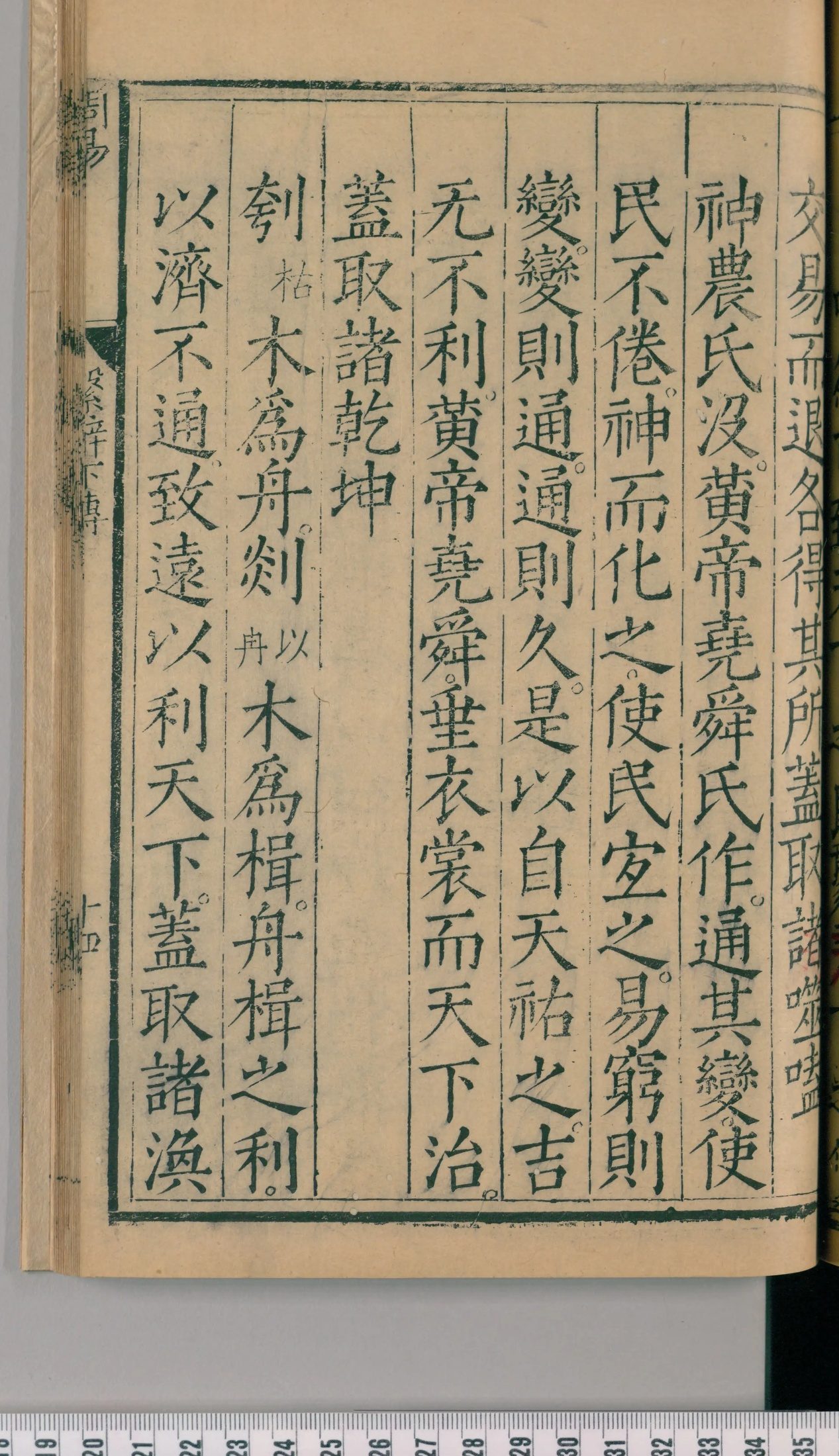
National Diet Library WA35-19 [五經白文], vol. 1 (周易), IIIF canvas 119, left-hand page: 8 columns, main text with punctuation circles and small sound glosses. Checked on the image (column openings aligned to the text): paragraph 15 opens column 2 ‹神農氏沒›; paragraph 16 opens column 7 ‹刳木爲舟›. The Chinese shown is the received text from Wikisource, not a transcription of this print.
15神農氏沒,黃帝、堯、舜氏作,通其變,使民不倦;神而化之,使民宜之;易窮則變,變則通,通則久;是以自天祐之,吉无不利。黃帝、堯、舜垂衣裳而天下治,蓋取諸乾坤。
16刳木為舟,剡木為楫,舟楫之利以濟不通,致遠以利天下,蓋取諸渙。
15After the death of Shăn-năng, there arose Hwang Tî, Yâo, and Shun. They carried through the (necessarily occurring) changes, so that the people did (what was required of them) without being wearied; yea, they exerted such a spirit-like transformation, that the people felt constrained to approve their (ordinances) as right. When a series of changes has run all its course, another change ensues. When it obtains free course, it will continue long. Hence it was that 'these (sovereigns) were helped by Heaven; they had good fortune, and their every movement was advantageous.' Hwang Tî, Yâo, and Shun (simply) wore their upper and lower garments (as patterns to the people), and good order was secured all under heaven. The idea of all this was taken, probably, from Khien and Khwăn (the first and eighth trigrams, or the first and second hexagrams).
16They hollowed out trees to form canoes; they cut others long and thin to make oars. Thus arose the benefit of canoes and oars for the help of those who had no means of intercourse with others. They could now reach the most distant parts, and all under heaven were benefited. The idea of this was taken, probably, from Hwân (the fifty-ninth hexagram).
Where on the image
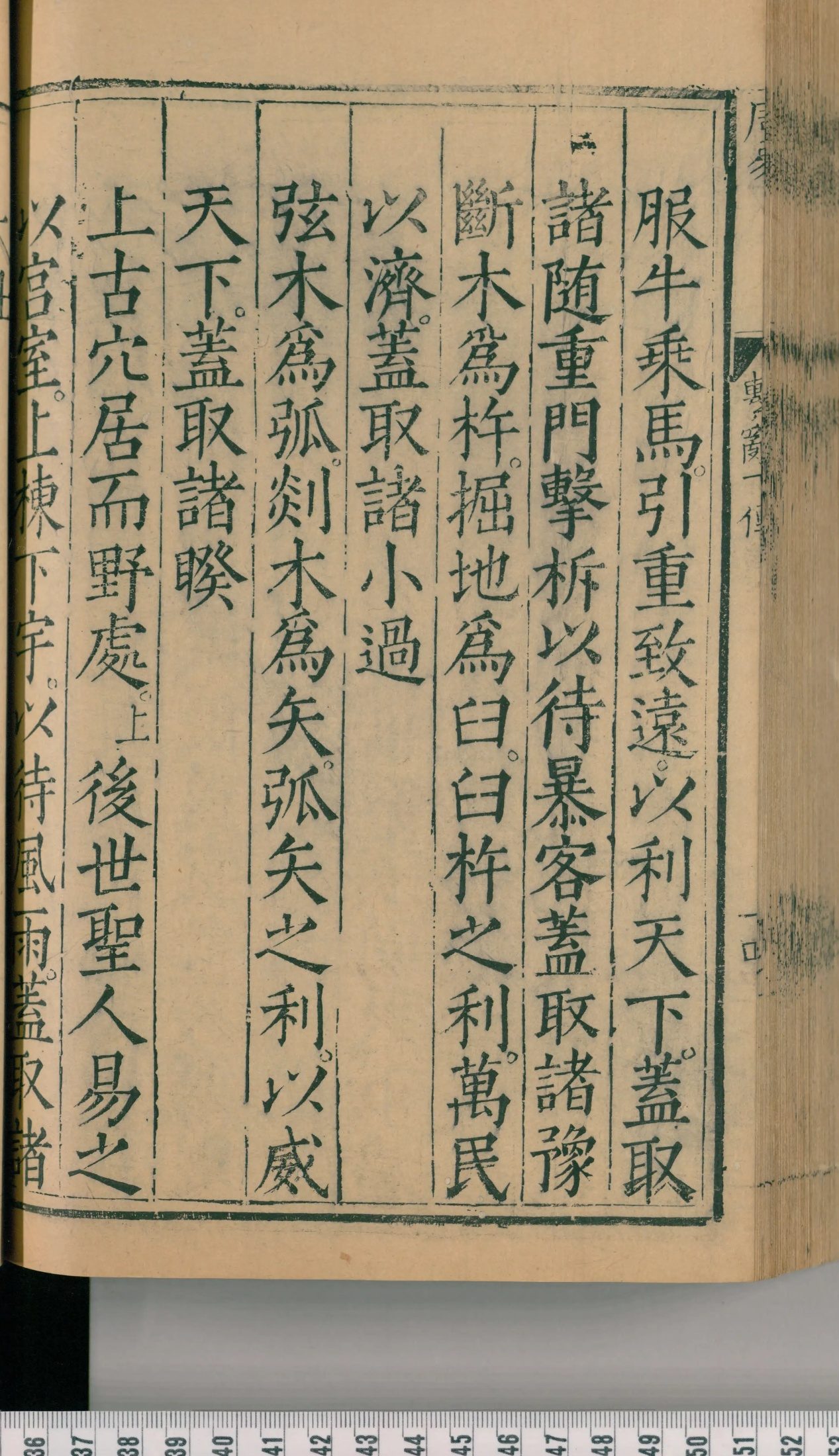
National Diet Library WA35-19 [五經白文], vol. 1 (周易), IIIF canvas 120, right-hand page: 8 columns, main text with punctuation circles and small sound glosses. Checked on the image (column openings aligned to the text): paragraph 17 opens column 1 ‹服牛乘馬›; paragraph 18 begins within column 2, which opens ‹諸隨重門›; paragraph 19 opens column 3 ‹斷木爲杵›; paragraph 20 opens column 5 ‹弦木爲弧›; paragraph 21 opens column 7 ‹上古穴居›. Paragraph 21 runs on to canvas 120, left-hand page (first column ‹大壯›). The Chinese shown is the received text from Wikisource, not a transcription of this print.
17服牛乘馬,引重致遠以利天下,蓋取諸隨。
18重門擊柝以待暴客,蓋取諸豫。
19斷木為杵,掘地為臼,臼杵之利,萬民以濟,蓋取諸小過。
20弦木為弧,剡木為矢,弧矢之利,以威天下,蓋取諸睽。
21上古穴居而野處,後世聖人易之以宮室,上棟下宇,以待風雨,蓋取諸大壯。
17They used oxen (in carts) and yoked horses (to chariots), thus providing for the carriage of what was heavy, and for distant journeys,—thereby benefiting all under the sky. The idea of this was taken, probably, from Sui (the seventeenth hexagram).
18They made the (defence of the) double gates, and (the warning of) the clapper, as a preparation against the approach of marauding visitors. The idea of this was taken, probably, from Yü (the sixteenth hexagram).
19They cut wood and fashioned it into pestles; they dug in the ground and formed mortars. Thus the myriads of the people received the benefit arising from the use of the pestle and mortar. The idea of this was taken, probably, from Hsiâo Kwo (the sixty-second hexagram).
20They bent wood by means of string so as to form bows, and sharpened wood so as to make arrows. This gave the benefit of bows and arrows, and served to produce everywhere a feeling of awe. The idea of this was taken, probably, from Khwei (the thirty-eighth hexagram).
21In the highest antiquity they made their homes (in winter) in caves, and (in summer) dwelt in the open country. In subsequent ages, for these the sages substituted houses, with the ridge-beam above and the projecting roof below, as a provision against wind and rain. The idea of this was taken, probably, from Tâ Kwang (the thirty-fourth hexagram).
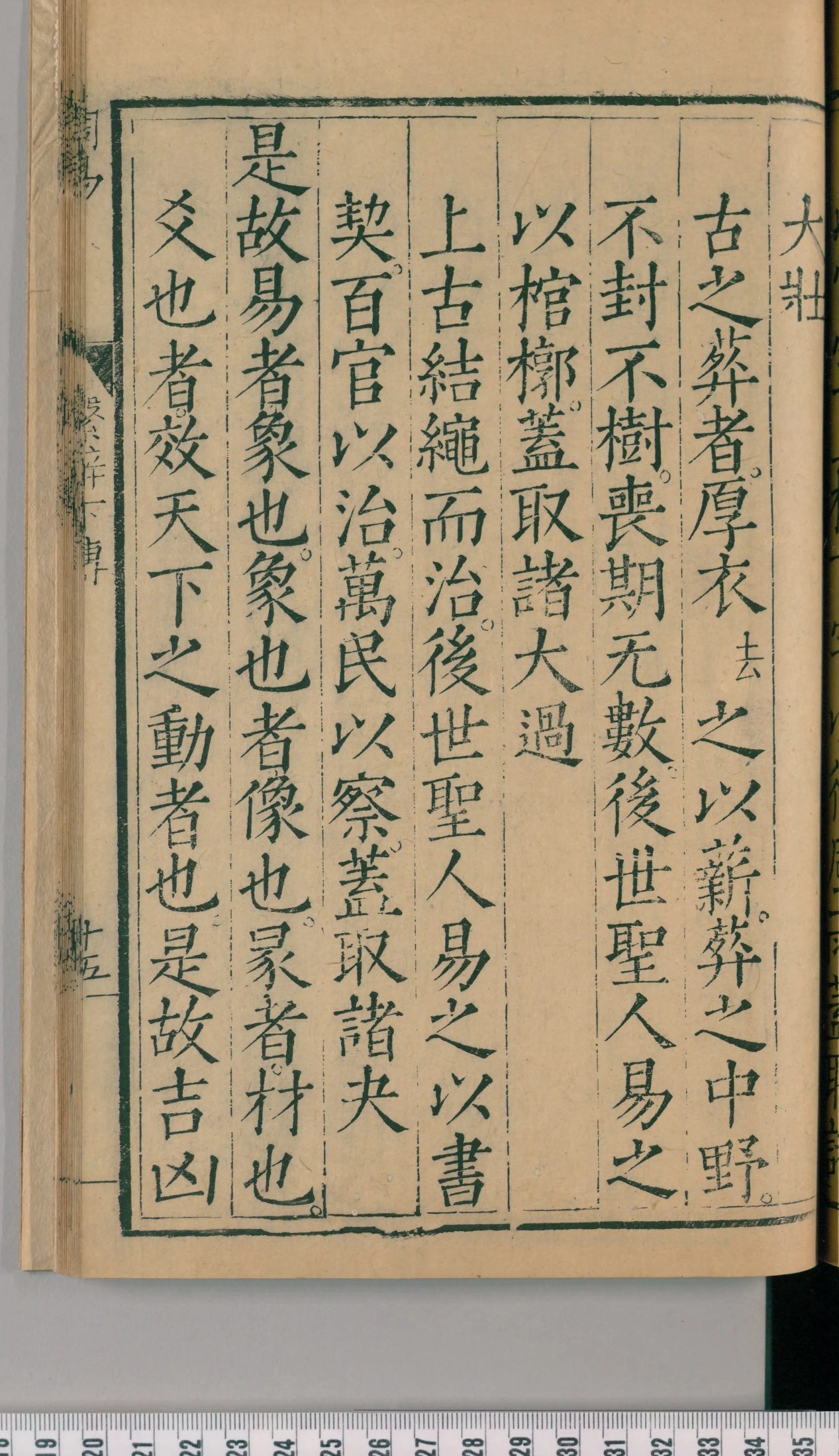
Where on the image
National Diet Library WA35-19 [五經白文], vol. 1 (周易), IIIF canvas 120, left-hand page: 8 columns, main text with punctuation circles and small sound glosses. Checked on the image (column openings aligned to the text): paragraph 22 opens column 2 ‹古之葬者›; paragraph 23 opens column 5 ‹上古結繩›. The Chinese shown is the received text from Wikisource, not a transcription of this print.
22古之葬者,厚衣之以薪,葬之中野,不封不樹,喪期无數,後世聖人易之以棺槨,蓋取諸大過。
23上古結繩而治,後世聖人易之以書契,百官以治,萬民以察,蓋取諸夬。
22When the ancients buried their dead, they covered the body thickly with pieces of wood, having laid it in the open country. They raised no mound over it, nor planted trees around; nor had they any fixed period for mourning. In subsequent ages the sages substituted for these practices the inner and outer coffins. The idea of this was taken, probably, from Tâ Kwo (the twenty-eighth hexagram).
23In the highest antiquity, government was carried on successfully by the use of knotted cords (to preserve the memory of things). In subsequent ages the sages substituted for these written characters and bonds. By means of these (the doings of) all the officers could be regulated, and (the affairs of) all the people accurately examined. The idea of this was taken, probably, from Kwâi (the forty-third hexagram).
Notes
- English: James Legge, The Yî King, Sacred Books of the East vol. 16 (1882), Appendix III (The Great Appendix), Section II, Chapter 2, paragraphs 11-23.
- Legge's notes after each chapter are left out. Where one numbered paragraph is printed as several paragraphs, they are kept as printed.
Cite
Sources
- Source: National Diet Library WA35-19 (Ming Five Classics print with postface of 1596, vol. 1, Zhouyi) + Wikisource received text + James Legge, Sacred Books of the East 16 (1882), Appendix III (holding institution)
- Critical edition: Received text (Wikisource)
← previous · → next · v cycle view · l back to library