Classic of Changes, Great Treatise, Part 2, Chapter 5 (Ming print of 1596)
Introduction
The Great Treatise (繫辭傳 Xici zhuan, "Commentary on the Appended Statements"; Legge's "Great Appendix") is the longest of the Ten Wings, the commentaries attached to the Classic of Changes. It is an essay in two parts on how the hexagrams were made, how the yarrow stalks are counted, and how the book reflects the workings of heaven and earth. Tradition ascribed it to Confucius; it is now generally dated to the late Warring States period (4th to 3rd century BCE), and part of it is preserved on the Mawangdui silk manuscript of 168 BCE. This is chapter 5 of part 2 (下), in the chapter division of Zhu Xi (1130-1200), which Legge follows; Legge numbers his paragraphs straight through each part (here 31-44).
The photographs are of the first volume of a Five Classics printed in Nanjing with the main text only and punctuation circles, with a postface by Li Deng dated Wanli 24 (1596); the National Diet Library, Tokyo, holds the only known copy of these five volumes (call no. WA35-19). The Great Treatise follows the 64 hexagrams in this volume, from canvas 106 to canvas 128, and its passages stand in the order of Zhu Xi's edition. In this copy the chapter runs from canvas 121, right-hand page to canvas 124, left-hand page. Each section gathers the paragraphs that begin on one page and links to that page and to any page the last paragraph runs onto; the page boundaries were found by reading the first characters of every column on the photographs and aligning them to the text.
The Chinese is the received text from Wikisource. The English is James Legge's translation in Sacred Books of the East, volume 16 (1882), Appendix III, Section II, Chapter 5; his notes are not reproduced. Legge adds words in parentheses to make the sense plain; they are his.
How was this verified? (Provenance)
Where on the image
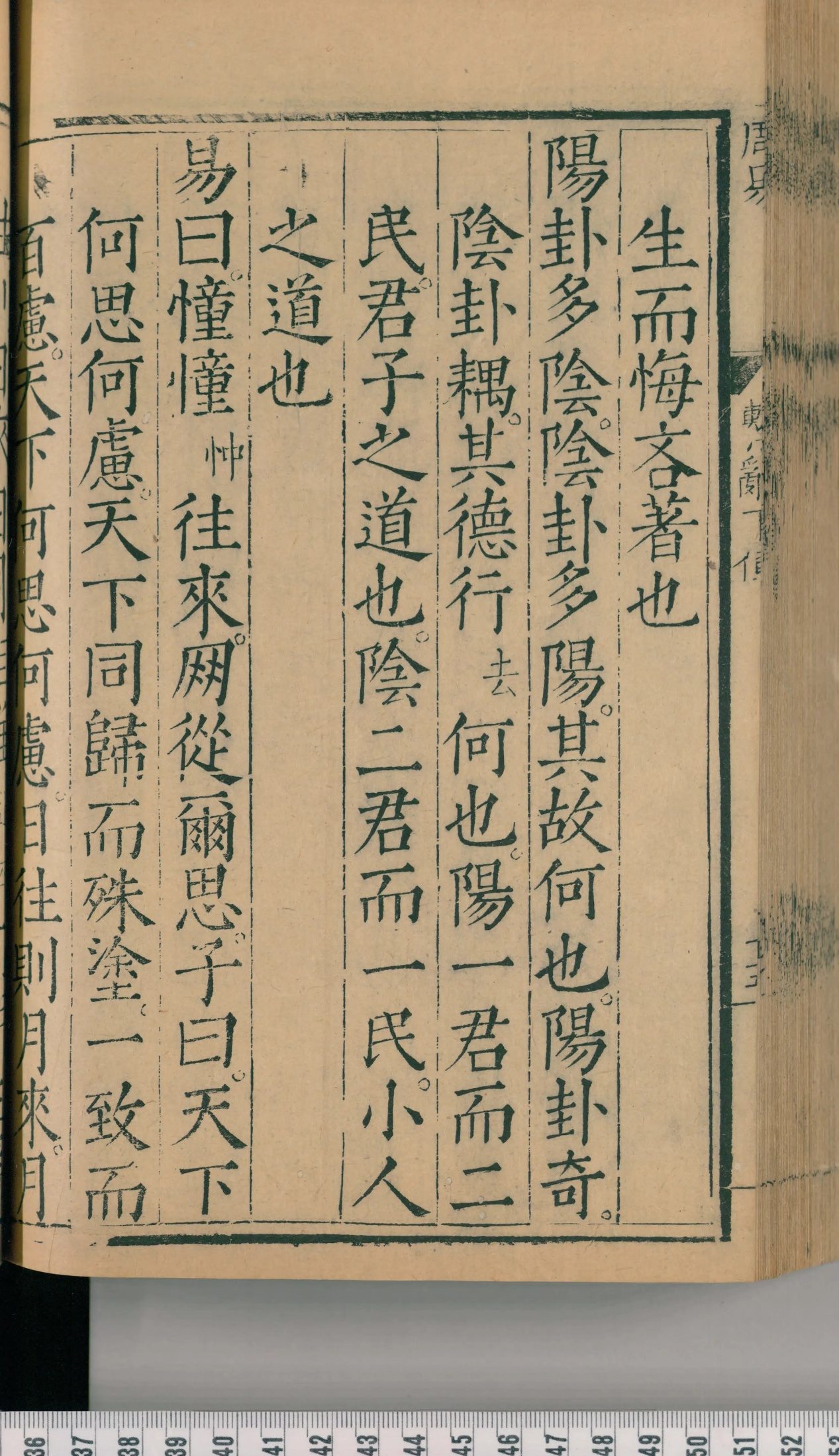
National Diet Library WA35-19 [五經白文], vol. 1 (周易), IIIF canvas 121, right-hand page: 8 columns, main text with punctuation circles and small sound glosses. Checked on the image (column openings aligned to the text): paragraph 31 opens column 6 ‹易曰憧憧›; paragraph 32 begins within column 8, which opens ‹百慮天下›. Paragraph 32 runs on to canvas 121, left-hand page (first column ‹往則日來›). The Chinese shown is the received text from Wikisource, not a transcription of this print.
31易曰:「憧憧往來,朋從爾思。」子曰:「天下何思何慮!天下同歸而殊途,一致而百慮,天下何思何慮!
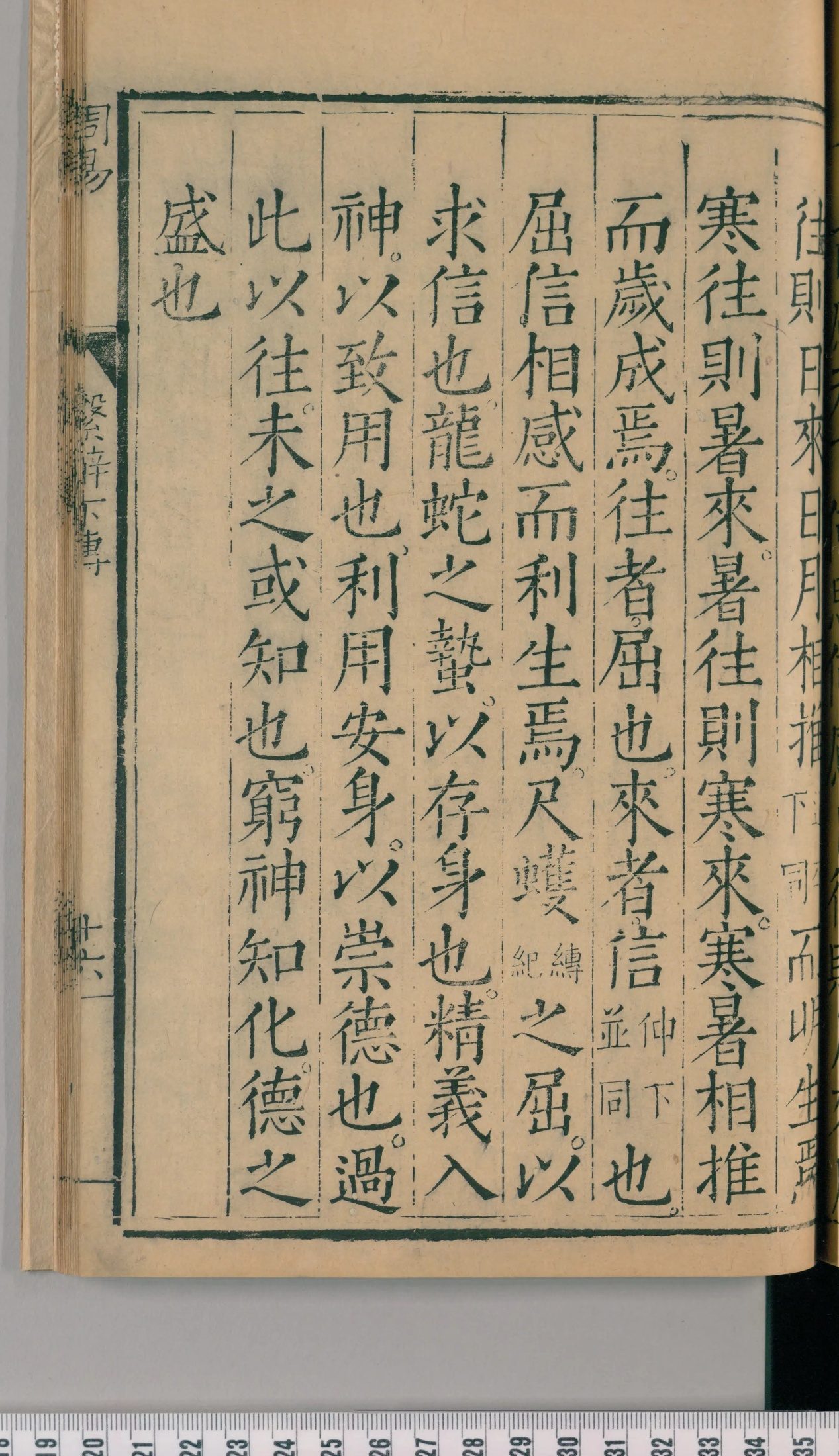
32日往則月來,月往則日來,日月相推而明生焉。寒往則暑來,暑往則寒來,寒暑相推而歲成焉。往者,屈也;來者,信也。屈信相感而利生焉。
31It is said in the Yî, 'Full of anxious thoughts you go and come; (only) friends will follow you and think with you.' The Master said:—'In all (the processes taking place) under heaven, what is there of thinking? what is there of anxious scheming? They all come to the same (successful) issue, though by different paths; there is one result, though there might be a hundred anxious schemes. What is there of thinking? what is there of anxious scheming?'
32The sun goes and the moon comes; the moon goes and the sun comes;—the sun and moon thus take the place each of the other, and their shining is the result. The cold goes and the heat comes; the heat goes and the cold comes;—it is by this mutual succession of the cold and heat that the year is completed. That which goes becomes less and less, and that which comes waxes more and more;—it is by the influence on each other of this contraction and expansion that the advantages (of the different conditions) are produced.
Where on the image
National Diet Library WA35-19 [五經白文], vol. 1 (周易), IIIF canvas 121, left-hand page: 8 columns, main text with punctuation circles and small sound glosses. Checked on the image (column openings aligned to the text): paragraph 33 begins within column 4, which opens ‹屈信相感›; paragraph 34 begins within column 6, which opens ‹神以致用›. The Chinese shown is the received text from Wikisource, not a transcription of this print.
33尺蠖之屈,以求信也。龍蛇之蟄,以存身也。精義入神,以致用也。利用安身,以崇德也。
34過此以往,未之或知也。窮神知化,德之盛也。」
33When the looper coils itself up, it thereby straightens itself again; when worms and snakes go into the state of hybernation, they thereby keep themselves alive. (So), when we minutely investigate the nature and reasons (of things), till we have entered into the inscrutable and spirit-like in them, we attain to the largest practical application of them; when that application becomes the quickest and readiest, and all personal restfulness is secured, our virtue is thereby exalted.
34Going on beyond this, we reach a point which it is hardly possible to know. We have thoroughly comprehended the inscrutable and spirit-like, and know the processes of transformation;—this is the fulness of virtue.
Where on the image
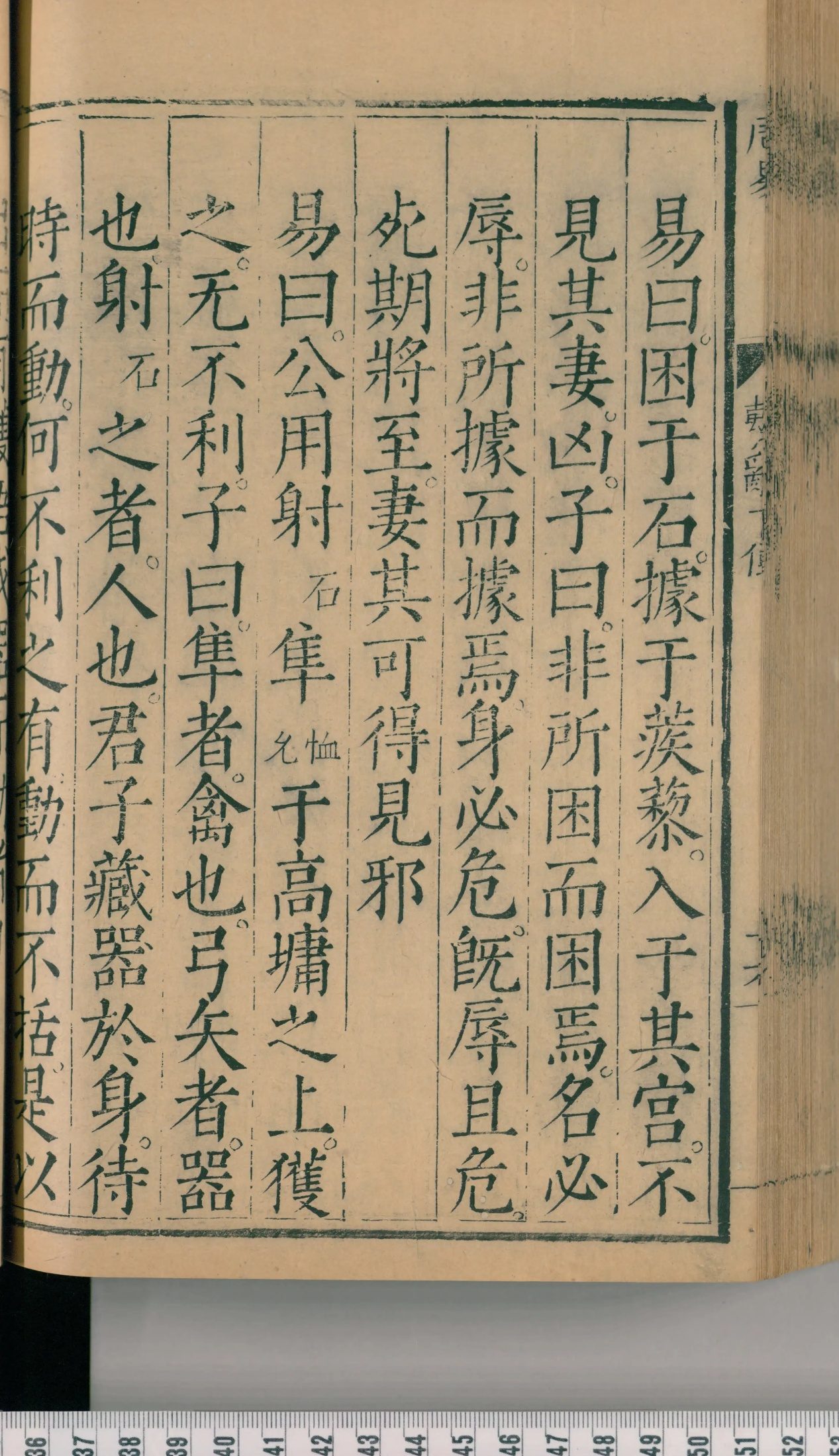
National Diet Library WA35-19 [五經白文], vol. 1 (周易), IIIF canvas 122, right-hand page: 8 columns, main text with punctuation circles and small sound glosses. Checked on the image (column openings aligned to the text): paragraph 35 opens column 1 ‹易曰困于›; paragraph 36 opens column 5 ‹易曰公用›. Paragraph 36 runs on to canvas 122, left-hand page (first column ‹出而有獲›). The Chinese shown is the received text from Wikisource, not a transcription of this print.
35易曰:「困于石,據于蒺蔾,入于其宮,不見其妻,凶。」子曰:「非所困而困焉,名必辱;非所據而據焉,身必危;既辱且危,死期將至,妻其可得見耶!」
36易曰:「公用射隼于高墉之上,獲之,无不利。」子曰:「隼者,禽也;弓矢者,器也。射之者,人也。君子藏器於身,待時而動,何不利之有。動而不括,是以出而有獲,語成器而動者也。」
35It is said in the Yî, '(The third line shows its subject) distressed before a rock, and trying to lay hold of thorns; entering into his palace and not seeing his wife:—there will be evil.' The Master said:—'If one be distressed by what need not distress him, his name is sure to be disgraced; if he lay hold on what he should not touch, his life is sure to be imperilled. In disgrace and danger, his death will (soon) come;—is it possible for him in such circumstances to see his wife?'
36It is said in the Yî, 'The duke with (his bow) shoots at the falcon on the top of the high wall; he hits it:—his every movement will be advantageous.' The Master said:—'The falcon is a bird (of prey); the bow and arrow is a weapon (of war); the shooter is a man. The superior man keeps his weapon concealed about his person, and waits for the proper time to move;—doing this, how should his movement be other than successful? There is nothing to fetter or embarrass his movement; and hence, when he comes forth, he succeeds in his object. The language speaks of movement when the instrument necessary to it is ready and perfect.'
Where on the image
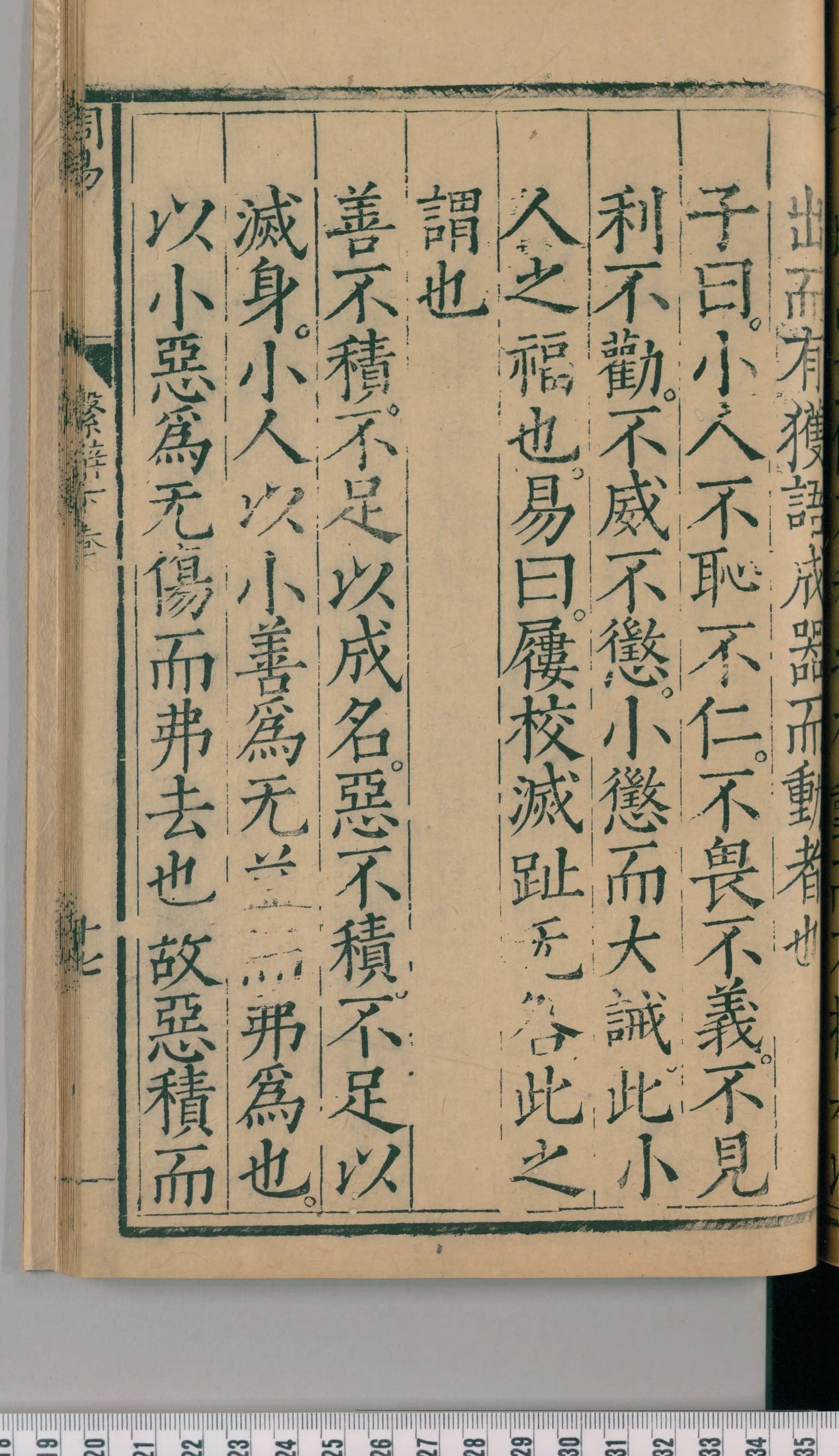
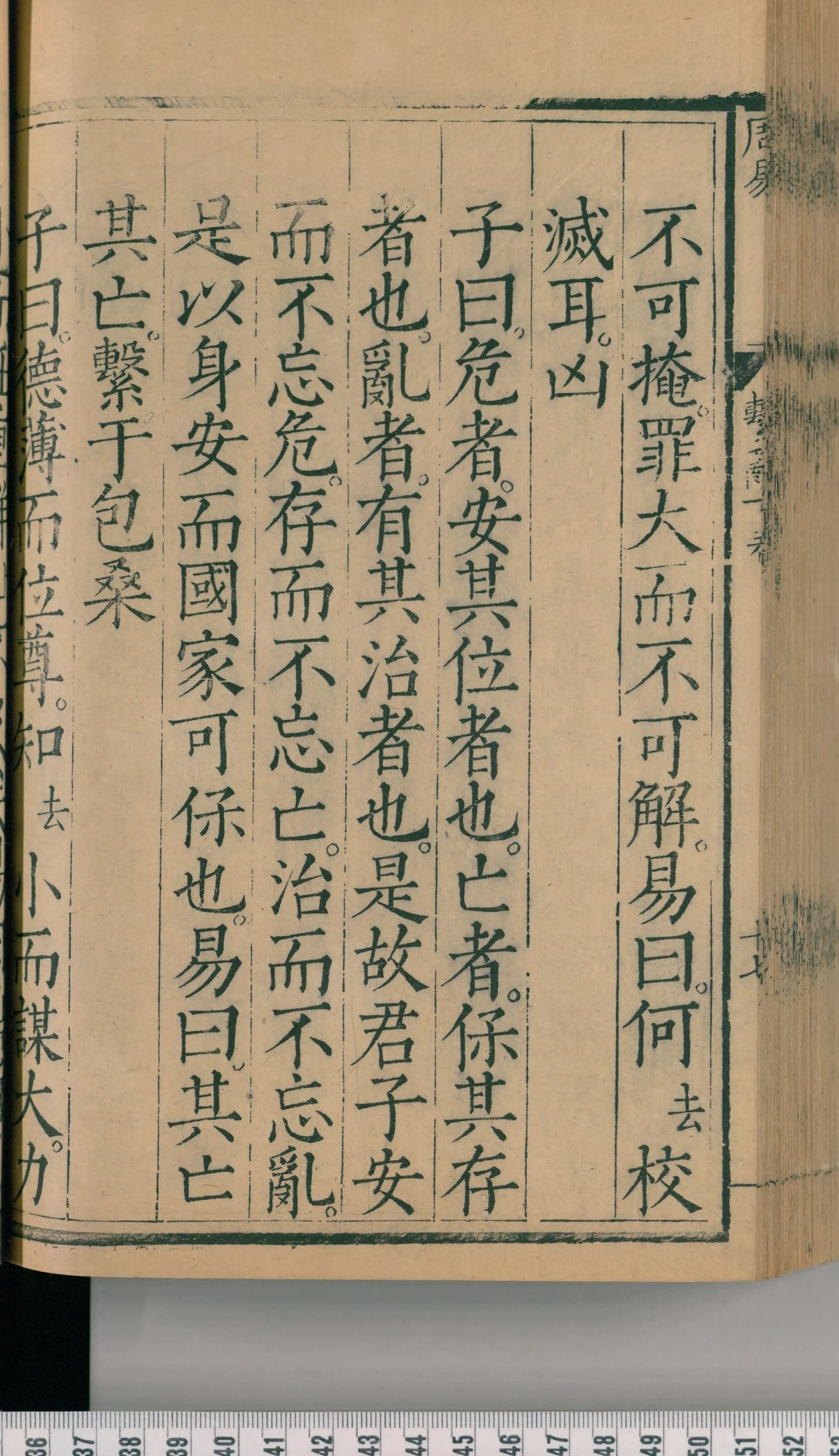
National Diet Library WA35-19 [五經白文], vol. 1 (周易), IIIF canvas 122, left-hand page: 8 columns, main text with punctuation circles and small sound glosses. Checked on the image (column openings aligned to the text): paragraph 37 opens column 2 ‹子曰小人›; paragraph 38 opens column 6 ‹善不積不›. Paragraph 38 runs on to canvas 123, right-hand page (first column ‹不可掩罪›). The Chinese shown is the received text from Wikisource, not a transcription of this print.
37子曰:「小人不恥不仁,不畏不義,不見利不勸,不威不懲,小懲而大誡,此小人之福也。易曰:『履校滅趾,无咎。』此之謂也。
38善不積不足以成名,惡不積不足以滅身,小人以小善為无益而弗為也,以小惡為无傷而弗去也;故惡積而不可揜,罪大而不可解。易曰:『何校滅耳,凶。』」
37The Master said:—'The small man is not ashamed of what is not benevolent, nor does he fear to do what is not righteous. Without the prospect of gain he does not stimulate himself to what is good, nor does he correct himself without being moved. Self-correction, however, in what is small will make him careful in what would be of greater consequence;—and this is the happiness of the small man. It is said in the Yî, "His feet are in the stocks, and he is disabled in his toes:—there will be no (further) occasion for blame."'
38If acts of goodness be not accumulated, they are not sufficient to give its finish to one's name; if acts of evil be not accumulated, they are not sufficient to destroy one's life. The small man thinks that small acts of goodness are of no benefit, and does not do them; and that small deeds of evil do no harm, and does not abstain from them. Hence his wickedness becomes great till it cannot be covered, and his guilt becomes great till it cannot be pardoned. This is what the Yî says, 'He wears the cangue and his ears are destroyed:—there will be evil.'
Where on the image
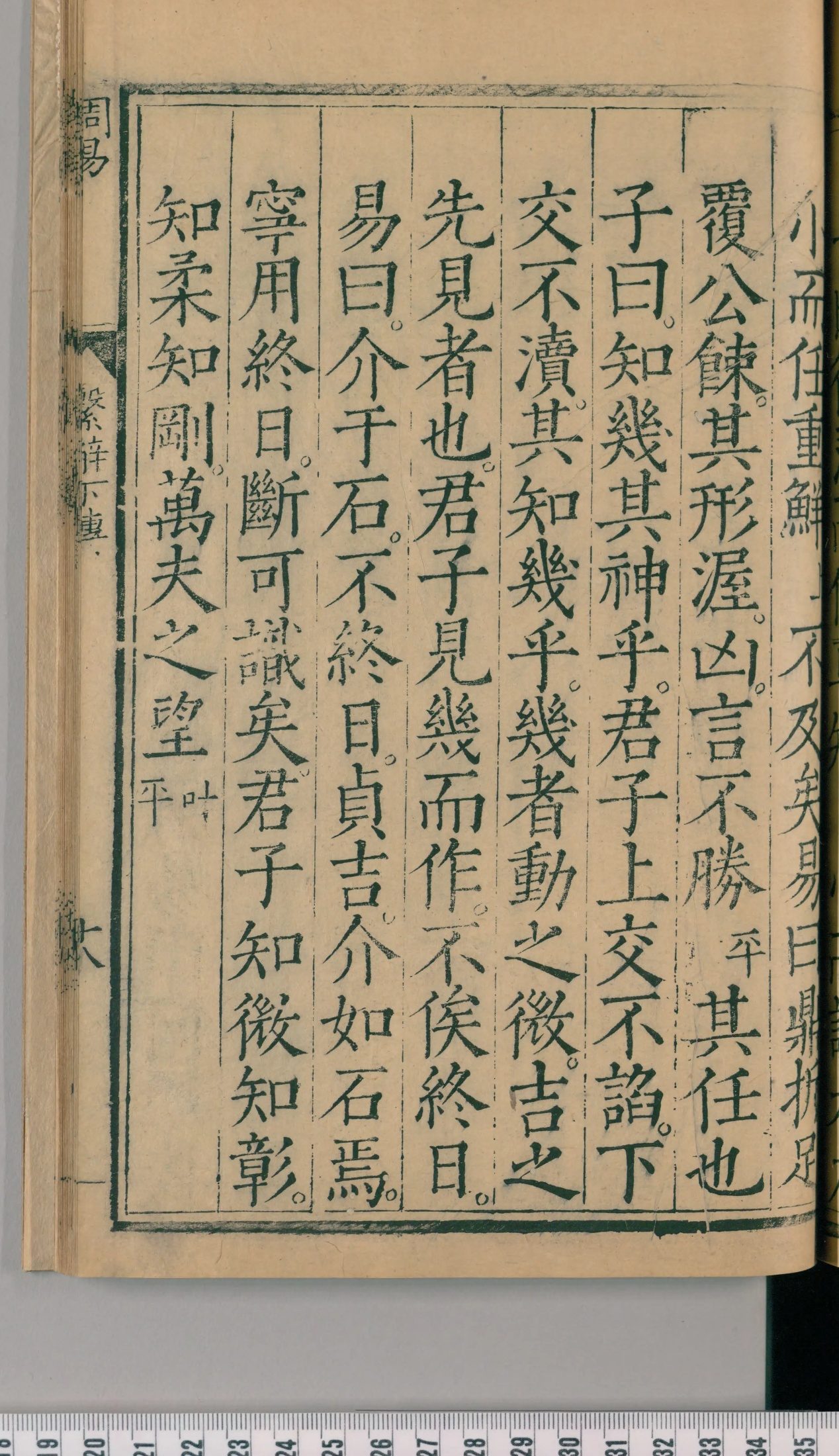
National Diet Library WA35-19 [五經白文], vol. 1 (周易), IIIF canvas 123, right-hand page: 8 columns, main text with punctuation circles and small sound glosses. Checked on the image (column openings aligned to the text): paragraph 39 opens column 3 ‹子曰危者›; paragraph 40 opens column 8 ‹子曰德薄›. Paragraph 40 runs on to canvas 123, left-hand page (first column ‹小而任重›). The Chinese shown is the received text from Wikisource, not a transcription of this print.
39子曰:「危者,安其位者也。亡者,保其存者也。亂者,有其治者也。是故君子安而不忘危,存而不忘亡,治而不忘亂,是以身安而國家可保也。易曰:『其亡其亡,繫于苞桑。』」
40子曰:「德薄而位尊,知小而謀大,力小而任重,鮮不及矣。易曰:『鼎折足,覆公餗,其形渥,凶。』言不勝其任也。」
39The Master said:—'He who keeps danger in mind is he who will rest safe in his seat; he who keeps ruin in mind is he who will preserve his interests secure; he who sets the danger of disorder before him is he who will maintain the state of order. Therefore the superior man, when resting in safety, does not forget that danger may come; when in a state of security, he does not forget the possibility of ruin; and when all is in a state of order, he does not forget that disorder may come. Thus his person is kept safe, and his states and all their clans can be preserved. This is according to what the Yî says, "(Let him say), 'Shall I perish? shall I perish?' (so shall this state be firm, as if) bound to a clump of bushy mulberry trees."'
40The Master said:—'Virtue small and office high; wisdom small and plans great; strength small and burden heavy:—where such conditions exist, it is seldom that they do not end (in evil). As is said in the Yî, "The tripod's feet are overthrown, and the ruler's food is overturned. The body of him (who is thus indicated) is wet (with shame):—there will be evil."'
Where on the image
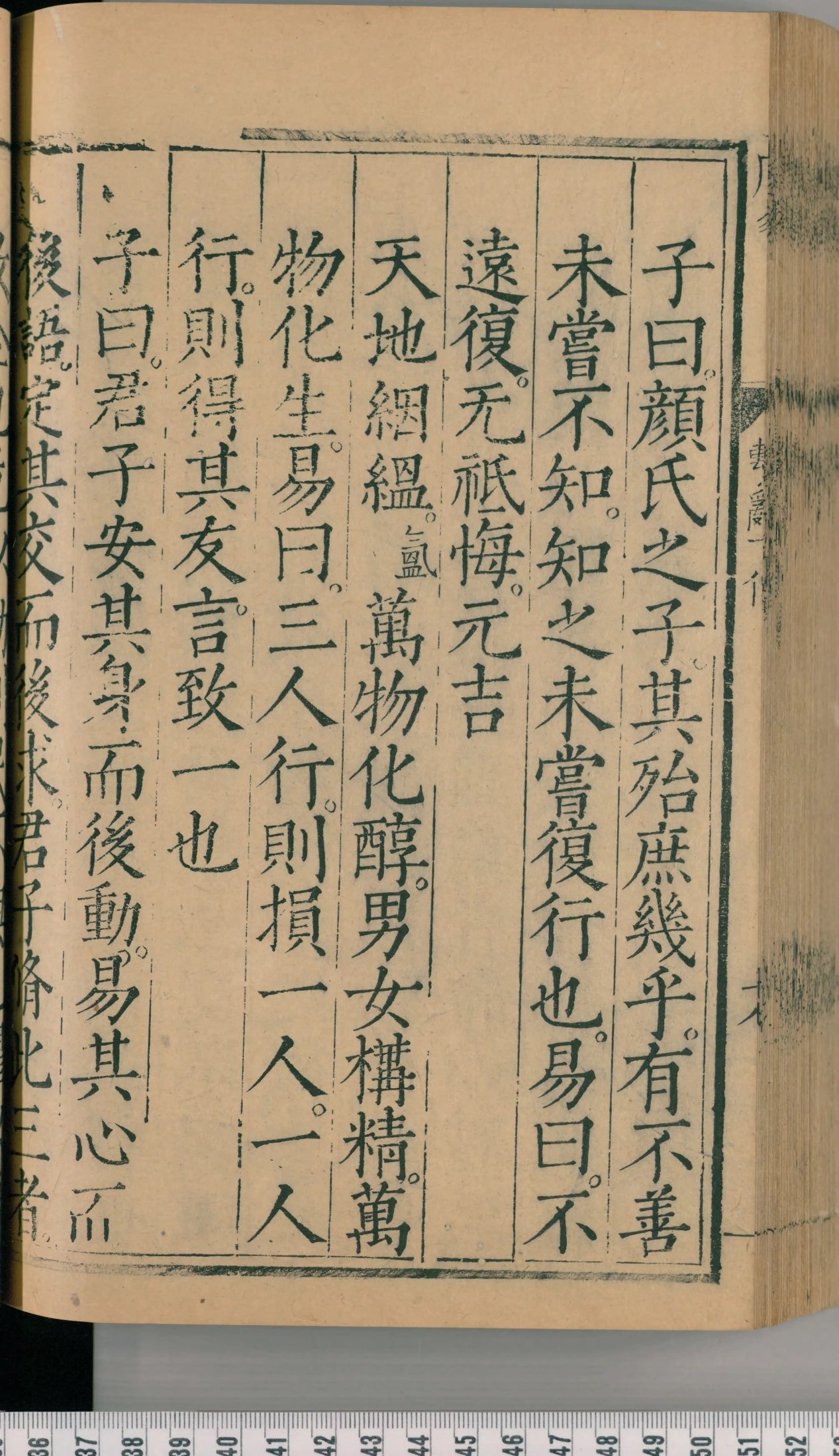
National Diet Library WA35-19 [五經白文], vol. 1 (周易), IIIF canvas 123, left-hand page: 8 columns, main text with punctuation circles and small sound glosses. Checked on the image (column openings aligned to the text): paragraph 41 opens column 3 ‹子曰知幾›. The Chinese shown is the received text from Wikisource, not a transcription of this print.
41子曰:「知幾其神乎!君子上交不諂,下交不瀆,其知幾乎!幾者,動之微,吉之先見者也。君子見幾而作,不俟終日。易曰:『介于石,不終日,貞吉。』介如石焉,寧用終日,斷可識矣。君子知微知彰,知柔知剛,萬夫之望。」
41The Master said:—'Does not he who knows the springs of things possess spirit-like wisdom? The superior man, in his intercourse with the high, uses no flattery, and, in his intercourse with the low, no coarse freedom:—does not this show that he knows the springs of things? Those springs are the slight beginnings of movement, and the earliest indications of good fortune (or ill). The superior man sees them, and acts accordingly without waiting for (the delay of) a single day. As is said in the Yî, "He is firm as a rock, (and acts) without the delay of a single day. With firm goodness there will be good fortune." Firm as a rock, how should he have to wait a single day to ensure his knowing (those springs and his course)? The superior man knows the minute and the manifested; he knows what is weak, and what is strong:—he is a model to ten thousand.'
Where on the image
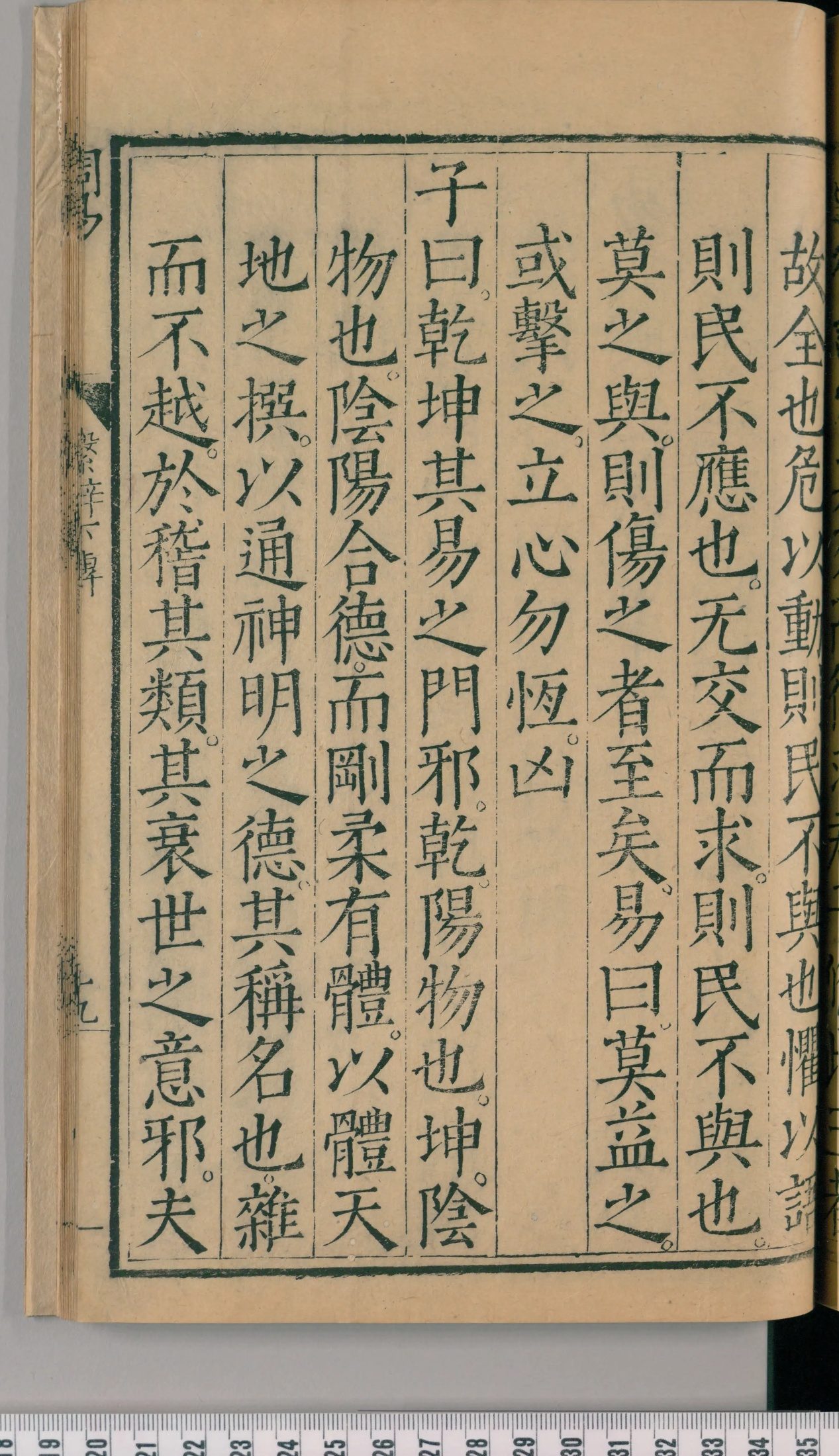
National Diet Library WA35-19 [五經白文], vol. 1 (周易), IIIF canvas 124, right-hand page: 8 columns, main text with punctuation circles and small sound glosses. Checked on the image (column openings aligned to the text): paragraph 42 opens column 1 ‹子曰顏氏›; paragraph 43 opens column 4 ‹天地絪縕›; paragraph 44 opens column 7 ‹子曰君子›. Paragraph 44 runs on to canvas 124, left-hand page (first column ‹故全也危›). The Chinese shown is the received text from Wikisource, not a transcription of this print.
42子曰:「顏氏之子,其殆庶幾乎!有不善,未嘗不知;知之,未嘗復行也。易曰:『不遠復,无祇悔,元吉。』
43天地絪縕,萬物化醇;男女構精,萬物化生。易曰:『三人行,則損一人;一人行,則得其友。』言致一也。」
44子曰:「君子安其身而後動,易其心而後語,定其交而後求。君子脩此三者,故全也。危以動,則民不與也。懼以語,則民不應也。无交而求,則民不與也。莫之與,則傷之者至矣。易曰:『莫益之,或擊之。立心勿恒,凶。』」
42The Master said:—'I may venture to say that the son of the Yen family had nearly attained (the standard of perfection). If anything that he did was not good, he was sure to become conscious of that; and when he knew it, he did not do the thing again. As is said in the Yî, "(The first line shows its subject) returning from an error that has not led him far away. There is no occasion for repentance. There will be great good."'
43There is an intermingling of the genial influences of heaven and earth, and transformation in its various forms abundantly proceeds. There is an intercommunication of seed between male and female, and transformation in its living types proceeds. What is said in the Yî, 'Three individuals are walking together and one is made to disappear; there is (but) one man walking, and he gets his mate,' tells us of the effort (in nature) at oneness (of operation).
44The Master said:—'The superior man (in a high place) composes himself before he (tries to) move others; makes his mind restful and easy before he speaks; settles (the principles of) his intercourse with others before he seeks anything from them. The superior man cultivates these three things, and so is complete. If he try to move others while he is himself in unrest, the people will not (act) with him; if he speak while he is himself in a state of apprehension, the people will not respond to him; if without (certain principles of) intercommunication, he issue his requests, the people will not grant them. When there are none to accord with him, those who (work to) injure him will make their appearance. As is said in the Yî, "(We see one) to whose advantage none will contribute, while some will seek to assail him. He observes no regular rule in the ordering of his heart:—there will be evil."'
Notes
- English: James Legge, The Yî King, Sacred Books of the East vol. 16 (1882), Appendix III (The Great Appendix), Section II, Chapter 5, paragraphs 31-44.
- Legge's notes after each chapter are left out. Where one numbered paragraph is printed as several paragraphs, they are kept as printed.
Cite
Sources
- Source: National Diet Library WA35-19 (Ming Five Classics print with postface of 1596, vol. 1, Zhouyi) + Wikisource received text + James Legge, Sacred Books of the East 16 (1882), Appendix III (holding institution)
- Critical edition: Received text (Wikisource)
← previous · → next · v cycle view · l back to library