Classic of Changes, Great Treatise, Part 2, Chapter 6 (Ming print of 1596)
Introduction
The Great Treatise (繫辭傳 Xici zhuan, "Commentary on the Appended Statements"; Legge's "Great Appendix") is the longest of the Ten Wings, the commentaries attached to the Classic of Changes. It is an essay in two parts on how the hexagrams were made, how the yarrow stalks are counted, and how the book reflects the workings of heaven and earth. Tradition ascribed it to Confucius; it is now generally dated to the late Warring States period (4th to 3rd century BCE), and part of it is preserved on the Mawangdui silk manuscript of 168 BCE. This is chapter 6 of part 2 (下), in the chapter division of Zhu Xi (1130-1200), which Legge follows; Legge numbers his paragraphs straight through each part (here 45-48).
The photographs are of the first volume of a Five Classics printed in Nanjing with the main text only and punctuation circles, with a postface by Li Deng dated Wanli 24 (1596); the National Diet Library, Tokyo, holds the only known copy of these five volumes (call no. WA35-19). The Great Treatise follows the 64 hexagrams in this volume, from canvas 106 to canvas 128, and its passages stand in the order of Zhu Xi's edition. In this copy the chapter runs from canvas 124, left-hand page to canvas 125, right-hand page. Each section gathers the paragraphs that begin on one page and links to that page and to any page the last paragraph runs onto; the page boundaries were found by reading the first characters of every column on the photographs and aligning them to the text.
The Chinese is the received text from Wikisource. The English is James Legge's translation in Sacred Books of the East, volume 16 (1882), Appendix III, Section II, Chapter 6; his notes are not reproduced. Legge adds words in parentheses to make the sense plain; they are his.
How was this verified? (Provenance)
Where on the image
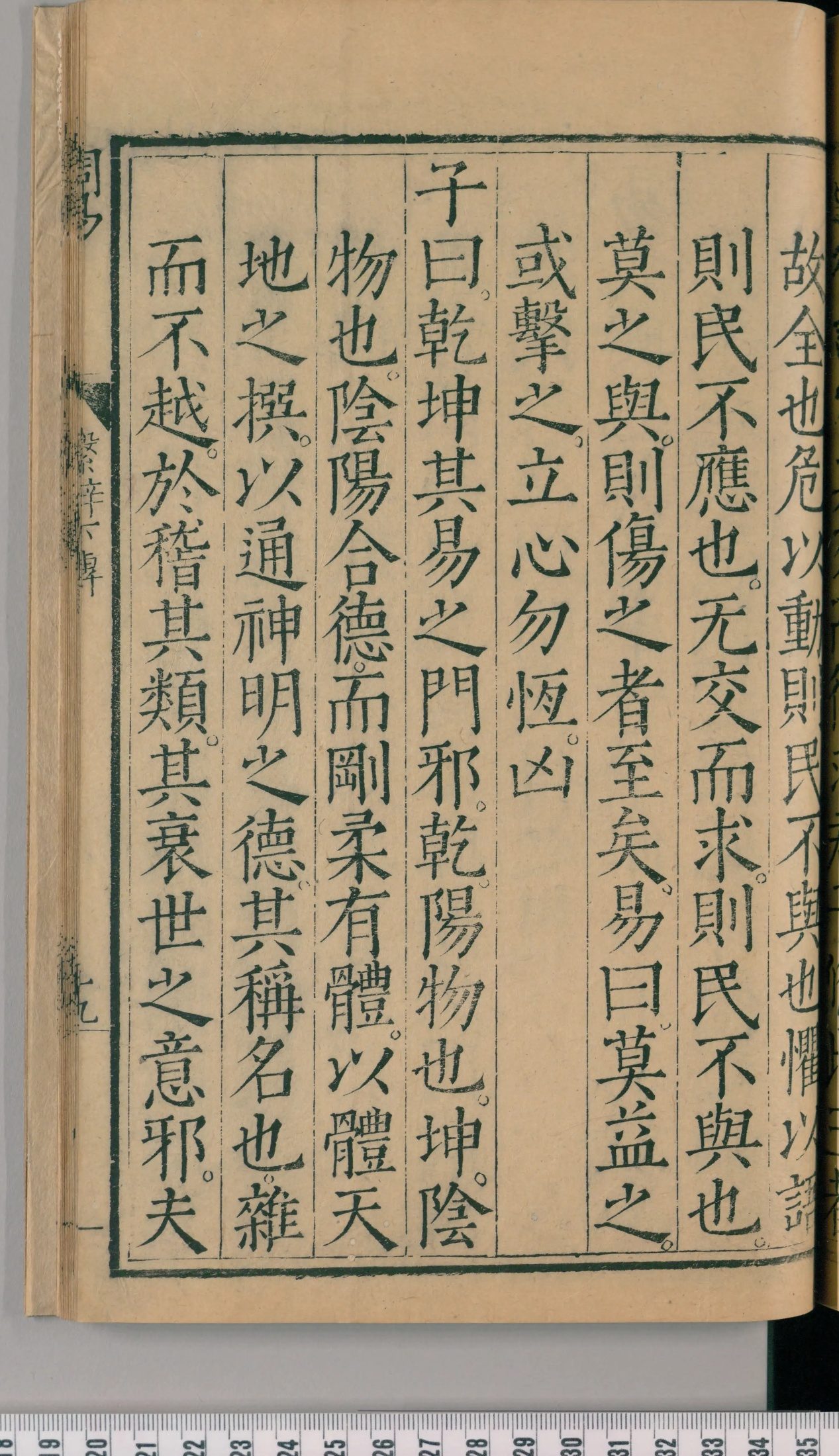
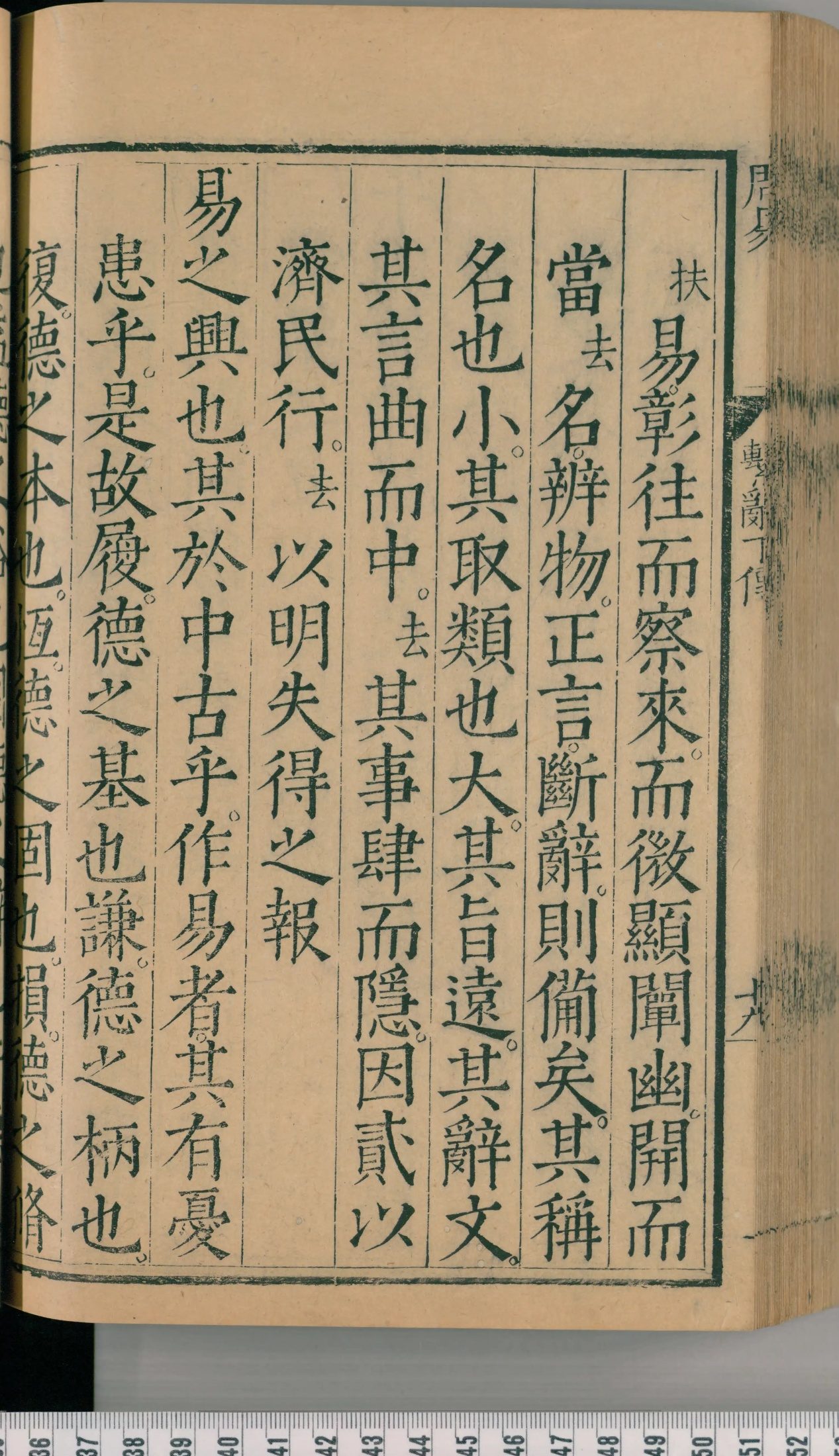
National Diet Library WA35-19 [五經白文], vol. 1 (周易), IIIF canvas 124, left-hand page: 8 columns, main text with punctuation circles and small sound glosses. Checked on the image (column openings aligned to the text): paragraph 45 opens column 5 ‹子曰乾坤›; paragraph 46 begins within column 7, which opens ‹地之撰以›; paragraph 47 begins within column 8, which opens ‹而不越於›. Paragraph 47 runs on to canvas 125, right-hand page (first column ‹易彰往而›). The Chinese shown is the received text from Wikisource, not a transcription of this print.
45子曰:「乾坤,其易之門邪!乾,陽物也;坤,陰物也。陰陽合德,而剛柔有體,以體天地之撰,以通神明之德。」
46其稱名也,雜而不越,於稽其類,其衰世之意邪!
47夫易,彰往而察來,而微顯闡幽,開而當名辨物,正言斷辭,則備矣。
45The Master said:—'(The trigrams) Khien and Khwăn may be regarded as the gate of the Yî.' Khien represents what is of the yang nature (bright and active); Khwăn what is of the yin nature (shaded and inactive). These two unite according to their qualities, and there comes the embodiment of the result by the strong and weak (lines). In this way we have the phenomena of heaven and earth visibly exhibited, and can comprehend the operation of the spiritual intelligence.
46The appellations and names (of the diagrams and lines) are various, but do not go beyond (what is to be ascribed to the operation of these two conditions). When we examine the nature and style (of the appended explanations), they seem to express the ideas of a decaying age.
47The Yî exhibits the past, and (teaches us to) discriminate (the issues of) the future; it makes manifest what is minute, and brings to light what is obscure. (Then king Wăn) opened (its symbols), and distinguished things in accordance with its names, so that all his words were correct and his explanations decisive;—(the book) was now complete.
Where on the image
National Diet Library WA35-19 [五經白文], vol. 1 (周易), IIIF canvas 125, right-hand page: 8 columns, main text with punctuation circles and small sound glosses. Checked on the image (column openings aligned to the text): paragraph 48 begins within column 2, which opens ‹當名辨物›. The Chinese shown is the received text from Wikisource, not a transcription of this print.
48其稱名也小,其取類也大,其旨遠,其辭文,其言曲而中,其事肆而隱,因貳以濟民行,以明失得之報。
48The appellations and names (of the diagrams and lines) are but small matters, but the classes of things comprehended under them are large. Their scope reaches far, and the explanations attached to them are elegant. The words are indirect, but to the point; the matters seem plainly set forth, but there is a secret principle in them. Their object is, in cases that are doubtful, to help the people in their conduct, and to make plain the recompenses of good and evil.
Notes
- English: James Legge, The Yî King, Sacred Books of the East vol. 16 (1882), Appendix III (The Great Appendix), Section II, Chapter 6, paragraphs 45-48.
- Legge's notes after each chapter are left out. Where one numbered paragraph is printed as several paragraphs, they are kept as printed.
Cite
Sources
- Source: National Diet Library WA35-19 (Ming Five Classics print with postface of 1596, vol. 1, Zhouyi) + Wikisource received text + James Legge, Sacred Books of the East 16 (1882), Appendix III (holding institution)
- Critical edition: Received text (Wikisource)
← previous · → next · v cycle view · l back to library