Classic of Changes, Great Treatise, Part 2, Chapter 9 (Ming print of 1596)
Introduction
The Great Treatise (繫辭傳 Xici zhuan, "Commentary on the Appended Statements"; Legge's "Great Appendix") is the longest of the Ten Wings, the commentaries attached to the Classic of Changes. It is an essay in two parts on how the hexagrams were made, how the yarrow stalks are counted, and how the book reflects the workings of heaven and earth. Tradition ascribed it to Confucius; it is now generally dated to the late Warring States period (4th to 3rd century BCE), and part of it is preserved on the Mawangdui silk manuscript of 168 BCE. This is chapter 9 of part 2 (下), in the chapter division of Zhu Xi (1130-1200), which Legge follows; Legge numbers his paragraphs straight through each part (here 57-62).
The photographs are of the first volume of a Five Classics printed in Nanjing with the main text only and punctuation circles, with a postface by Li Deng dated Wanli 24 (1596); the National Diet Library, Tokyo, holds the only known copy of these five volumes (call no. WA35-19). The Great Treatise follows the 64 hexagrams in this volume, from canvas 106 to canvas 128, and its passages stand in the order of Zhu Xi's edition. In this copy the chapter runs from canvas 126, right-hand page to canvas 127, right-hand page. Each section gathers the paragraphs that begin on one page and links to that page and to any page the last paragraph runs onto; the page boundaries were found by reading the first characters of every column on the photographs and aligning them to the text.
The Chinese is the received text from Wikisource. The English is James Legge's translation in Sacred Books of the East, volume 16 (1882), Appendix III, Section II, Chapter 9; his notes are not reproduced. Legge adds words in parentheses to make the sense plain; they are his.
How was this verified? (Provenance)
Where on the image
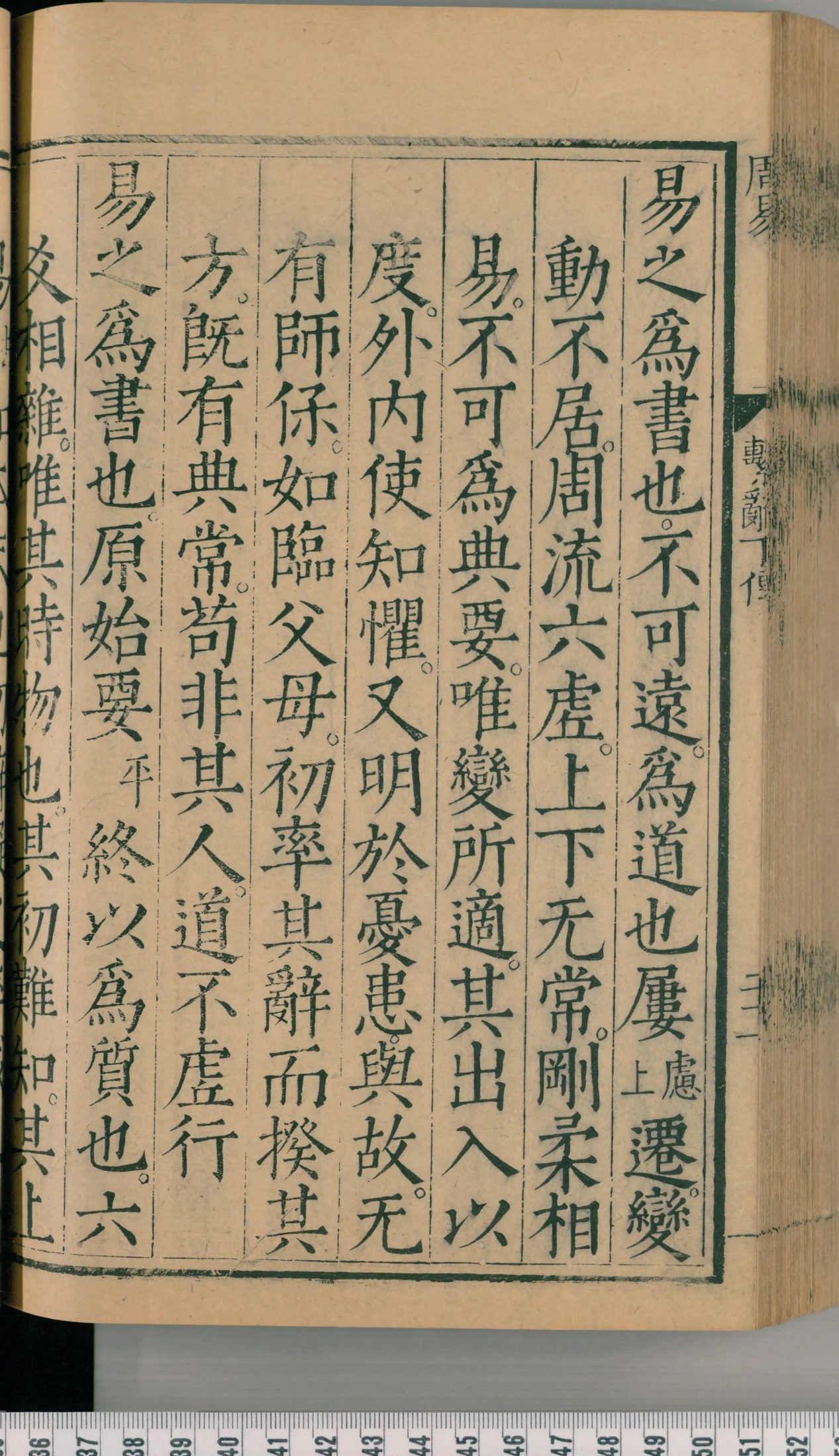
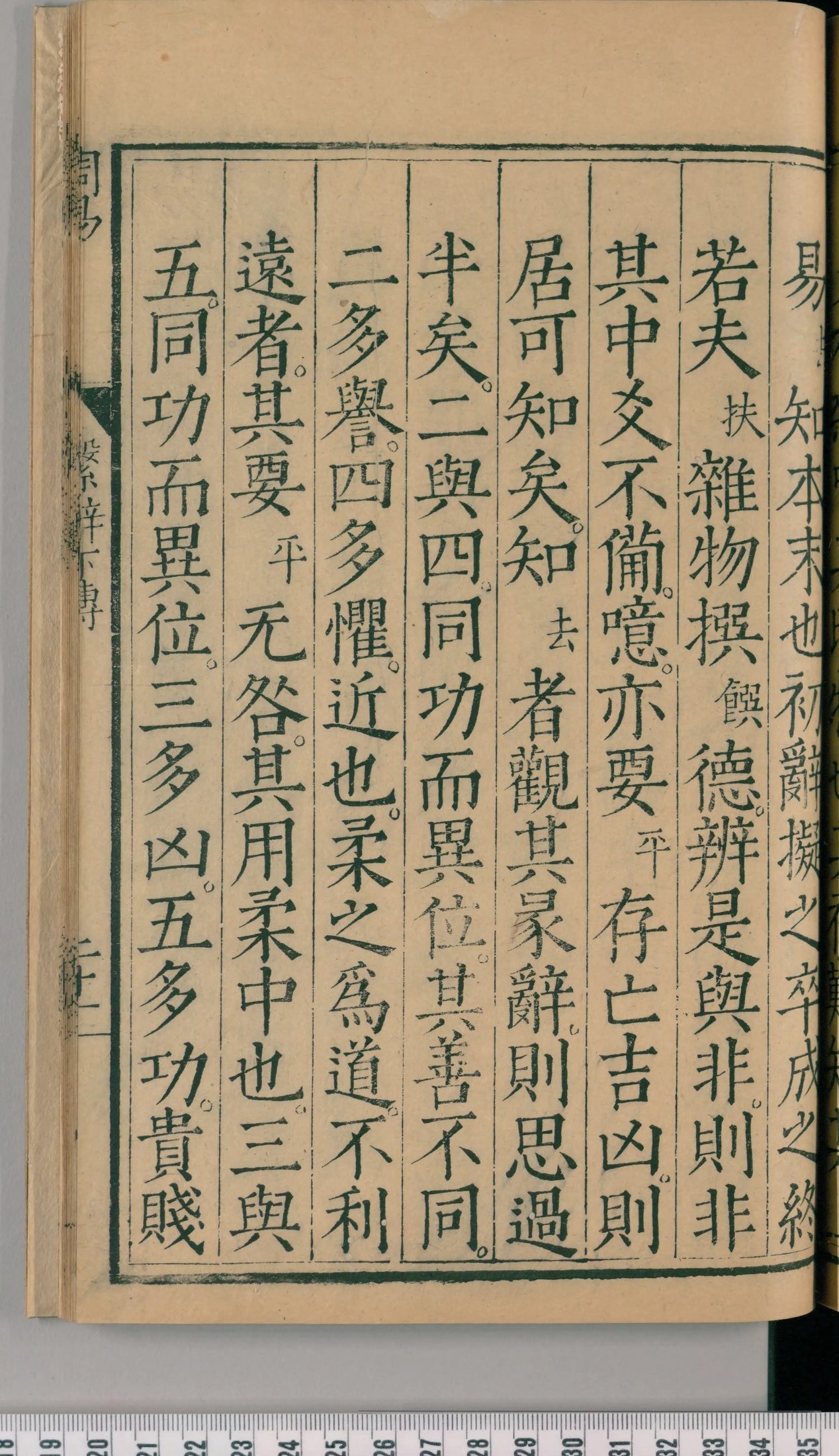
National Diet Library WA35-19 [五經白文], vol. 1 (周易), IIIF canvas 126, right-hand page: 8 columns, main text with punctuation circles and small sound glosses. Checked on the image (column openings aligned to the text): paragraph 57 opens column 7 ‹易之爲書›; paragraph 58 begins within column 8, which opens ‹爻相雜唯›. Paragraph 58 runs on to canvas 126, left-hand page (first column ‹易知本末›). The Chinese shown is the received text from Wikisource, not a transcription of this print.
57易之為書也,原始要終以為質也。六爻相雜,唯其時物也。
58其初難知,其上易知,本末也。初辭擬之,卒成之終。
57The Yî is a book in which the form (of each diagram) is determined by the lines from the first to the last, which must be carefully observed. The six lines are mixed together, according to the time (when they enter the figure) and their substance (as whole and divided).
58There is difficulty in knowing (the significance of) the first line, while to know that of the topmost line is easy;—they form the beginning and the end (of the diagram). The explanation of the first line tasks the calculating (of the makers), but in the end they had (but) to complete this.
Where on the image
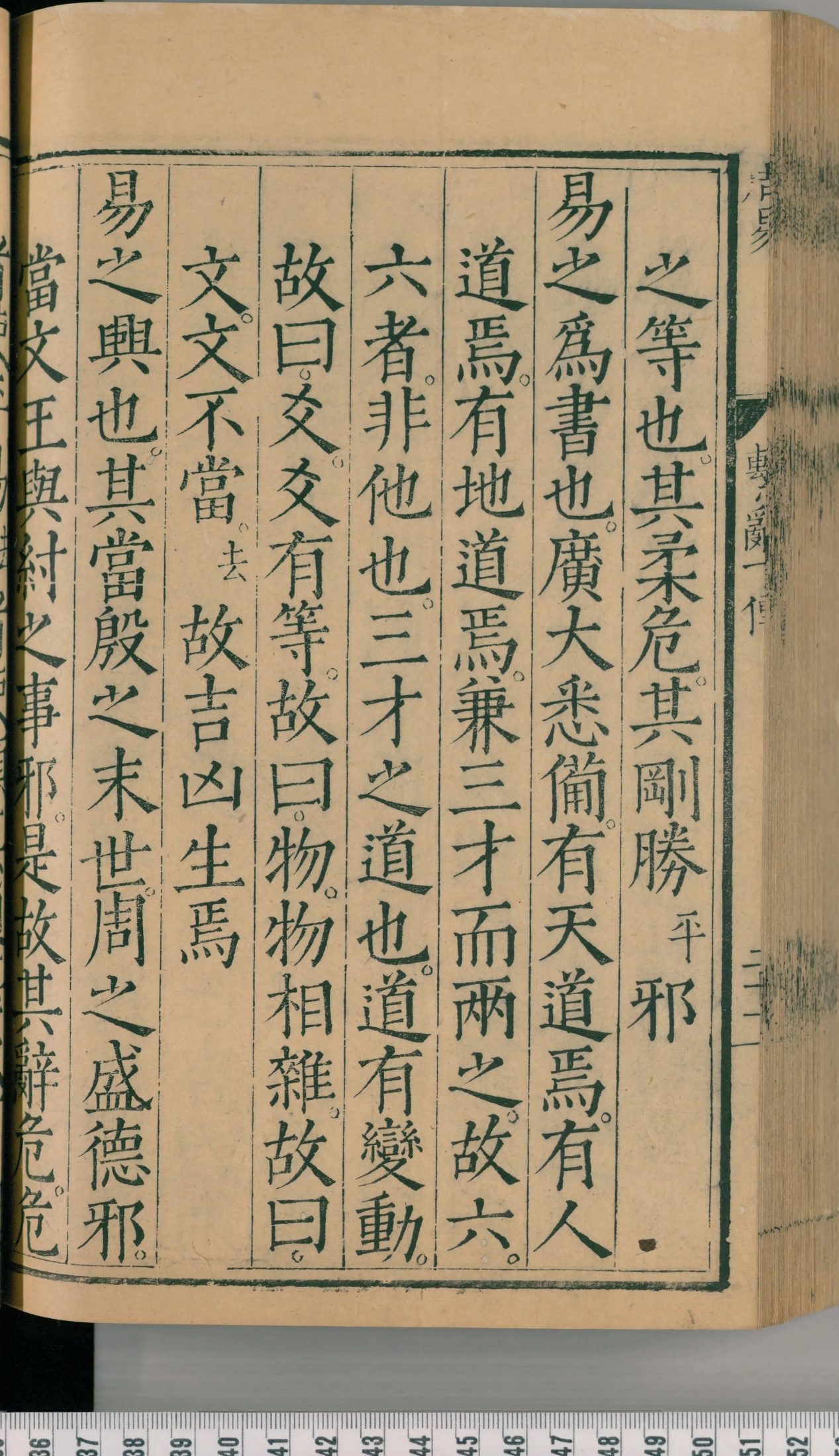
National Diet Library WA35-19 [五經白文], vol. 1 (周易), IIIF canvas 126, left-hand page: 8 columns, main text with punctuation circles and small sound glosses. Checked on the image (column openings aligned to the text): paragraph 59 opens column 2 ‹若夫雜物›; paragraph 60 begins within column 3, which opens ‹其中爻不›; paragraph 61 begins within column 5, which opens ‹半矣二與›; paragraph 62 begins within column 7, which opens ‹遠者其要›. Paragraph 62 runs on to canvas 127, right-hand page (first column ‹之等也其›). The Chinese shown is the received text from Wikisource, not a transcription of this print.
59若夫雜物撰德,辨是與非,則非其中爻不備。
60噫,亦要存亡吉凶,則居可知矣。知者觀其彖辭,則思過半矣。
61二與四同功而異位,其善不同:二多譽,四多懼,近也。柔之為道,不利遠者,其要無咎,其用柔中也。
62三與五同功而異位,三多凶,五多功,貴賤之等也。其柔危,其剛勝邪?《
59As to the variously-disposed intermediate lines with their diverse formations, for determining their qualities, and discriminating the right and wrong in them, we should be unprovided but for the explanations of them.
60Yea, moreover, if we wish to know what is likely to be preserved and what to perish, what will be lucky and what will be unlucky, this may easily be known (from the explanations of the different lines). But if the wise will look at the explanations of the entire diagrams, their thoughts will embrace more than half of this knowledge.
61The second and fourth lines are of the same quality (as being in even places), but their positions (with respect to the fifth line) are different, and their value is not the same; but the second is the object of much commendation, and the fourth the subject of many apprehensions,—from its nearness (to that line). But for a line in a place of weakness it is not good to be far (from the occupant of the place of strength), and what its subject should desire in such a case is (merely) to be without blame. The advantage (here) is in (the second line) being in the central place.
62The third and fifth lines are of the same quality, (as being in odd places), but their positions are different; and the (occupant of) the third meets with many misfortunes, while the occupant of the fifth achieves much merit:—this arises from one being in the noble position and the other in the mean. Are they occupied by the symbol of weakness? There will be peril. By that of strength? There will be victory.
Notes
- English: James Legge, The Yî King, Sacred Books of the East vol. 16 (1882), Appendix III (The Great Appendix), Section II, Chapter 9, paragraphs 57-62.
- Legge's notes after each chapter are left out. Where one numbered paragraph is printed as several paragraphs, they are kept as printed.
Cite
Sources
- Source: National Diet Library WA35-19 (Ming Five Classics print with postface of 1596, vol. 1, Zhouyi) + Wikisource received text + James Legge, Sacred Books of the East 16 (1882), Appendix III (holding institution)
- Critical edition: Received text (Wikisource)
← previous · → next · v cycle view · l back to library