Classic of Changes, Great Treatise, Part 2, Chapter 8 (Ming print of 1596)
Introduction
The Great Treatise (繫辭傳 Xici zhuan, "Commentary on the Appended Statements"; Legge's "Great Appendix") is the longest of the Ten Wings, the commentaries attached to the Classic of Changes. It is an essay in two parts on how the hexagrams were made, how the yarrow stalks are counted, and how the book reflects the workings of heaven and earth. Tradition ascribed it to Confucius; it is now generally dated to the late Warring States period (4th to 3rd century BCE), and part of it is preserved on the Mawangdui silk manuscript of 168 BCE. This is chapter 8 of part 2 (下), in the chapter division of Zhu Xi (1130-1200), which Legge follows; Legge numbers his paragraphs straight through each part (here 53-56).
The photographs are of the first volume of a Five Classics printed in Nanjing with the main text only and punctuation circles, with a postface by Li Deng dated Wanli 24 (1596); the National Diet Library, Tokyo, holds the only known copy of these five volumes (call no. WA35-19). The Great Treatise follows the 64 hexagrams in this volume, from canvas 106 to canvas 128, and its passages stand in the order of Zhu Xi's edition. In this copy the chapter runs from canvas 126, right-hand page to canvas 126, right-hand page. Each section gathers the paragraphs that begin on one page and links to that page and to any page the last paragraph runs onto; the page boundaries were found by reading the first characters of every column on the photographs and aligning them to the text.
The Chinese is the received text from Wikisource. The English is James Legge's translation in Sacred Books of the East, volume 16 (1882), Appendix III, Section II, Chapter 8; his notes are not reproduced. Legge adds words in parentheses to make the sense plain; they are his.
How was this verified? (Provenance)
Where on the image
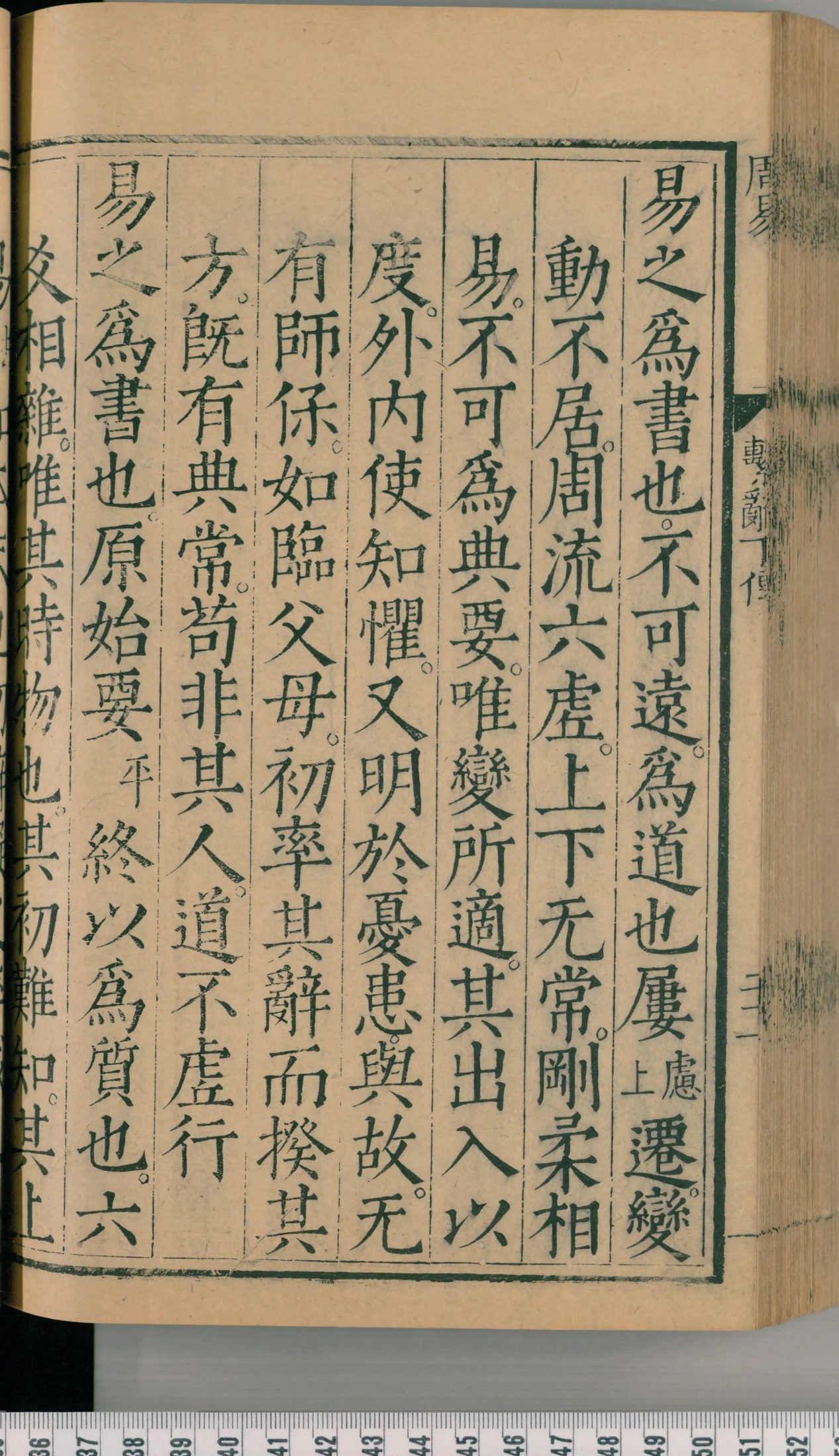
National Diet Library WA35-19 [五經白文], vol. 1 (周易), IIIF canvas 126, right-hand page: 8 columns, main text with punctuation circles and small sound glosses. Checked on the image (column openings aligned to the text): paragraph 53 opens column 1 ‹易之爲書›; paragraph 54 begins within column 3, which opens ‹易不可爲›; paragraph 55 begins within column 4, which opens ‹度外內使›; paragraph 56 begins within column 5, which opens ‹有師保如›. The Chinese shown is the received text from Wikisource, not a transcription of this print.
53易之為書也不可遠,為道也屢遷;變動不居,周流六虛,上下无常,剛柔相易,不可為典要,唯變所適。
54其出入以度,外內使知懼。
55又明於憂患與故,无有師保,如臨父母。
56初率其辭而揆其方,既有典常,苟非其人,道不虛行。
53The Yî is a book which should not be let slip from the mind. Its method (of teaching) is marked by the frequent changing (of its lines). They change and move without staying (in one place), flowing about into any one of the six places of the hexagram. They ascend and descend, ever inconstant. The strong and the weak lines change places, so that an invariable and compendious rule cannot be derived from them;—it must vary as their changes indicate.
54The goings forth and comings in (of the lines) are according to rule and measure. (People) learn from them in external and internal affairs to stand in awe.
55(The book), moreover, makes plain the nature of anxieties and calamities, and the causes of them. Though (its students) have neither master nor guardian, it is as if their parents drew near to them.
56Beginning with taking note of its explanations, we reason out the principles to which they point. We thus find out that it does supply a constant and standard rule. But if there be not the proper men (to carry this out), the course cannot be pursued without them.
Notes
- English: James Legge, The Yî King, Sacred Books of the East vol. 16 (1882), Appendix III (The Great Appendix), Section II, Chapter 8, paragraphs 53-56.
- Legge's notes after each chapter are left out. Where one numbered paragraph is printed as several paragraphs, they are kept as printed.
Cite
Sources
- Source: National Diet Library WA35-19 (Ming Five Classics print with postface of 1596, vol. 1, Zhouyi) + Wikisource received text + James Legge, Sacred Books of the East 16 (1882), Appendix III (holding institution)
- Critical edition: Received text (Wikisource)
← previous · → next · v cycle view · l back to library